airbag SAAB 9-5 2005 User Guide
[x] Cancel search | Manufacturer: SAAB, Model Year: 2005, Model line: 9-5, Model: SAAB 9-5 2005Pages: 276, PDF Size: 16.72 MB
Page 33 of 276
31 Safety
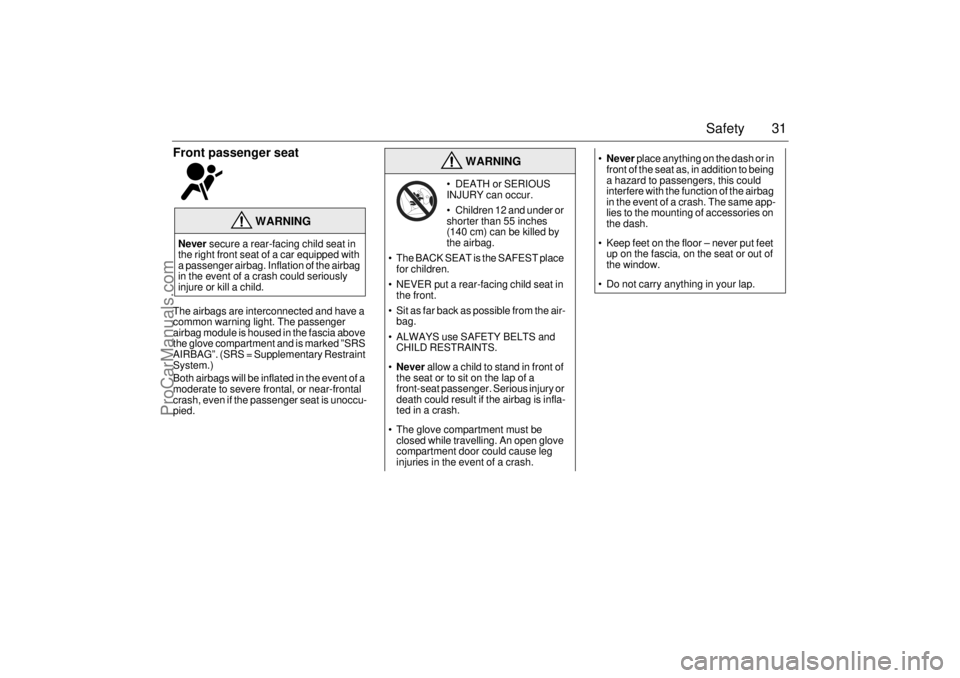
Front passenger seat The airbags are interconnected and have a
common warning light. The passenger
airbag module is housed in the fascia above
the glove compartment and is marked ”SRS
AIRBAG”. (SRS = Supplementary Restraint
System.)
Both airbags will be inflated in the event of a
moderate to severe frontal, or near-frontal
crash, even if the passenger seat is unoccu-
pied.
WARNING
Never secure a rear-facing child seat in
the right front seat of a car equipped with
a passenger airbag. Inflation of the airbag
in the event of a crash could seriously
injure or kill a child.
WARNING
DEATH or SERIOUS
INJURY can occur.
Children 12 and under or
shorter than 55 inches
(140 cm) can be killed by
the airbag.
The BACK SEAT is the SAFEST place
for children.
NEVER put a rear-facing child seat in
the front.
Sit as far back as possible from the air-
bag.
ALWAYS use SAFETY BELTS and
CHILD RESTRAINTS.
Never allow a child to stand in front of
the seat or to sit on the lap of a
front-seat passenger. Serious injury or
death could result if the airbag is infla-
ted in a crash.
The glove compartment must be
closed while travelling. An open glove
compartment door could cause leg
injuries in the event of a crash.
Never place anything on the dash or in
front of the seat as, in addition to being
a hazard to passengers, this could
interfere with the function of the airbag
in the event of a crash. The same app-
lies to the mounting of accessories on
the dash.
Keep feet on the floor – never put feet
up on the fascia, on the seat or out of
the window.
Do not carry anything in your lap.
ProCarManuals.com
Page 34 of 276

32 SafetySide airbags
The side airbags, which help protect the
upper body are integrated in the outside
edges of the front seat backrests.
In a side impact, only the airbag on that side
will be activated, and only then if certain pre-
determined conditions are met such as the
force and angle of the impact, the speed of
the car on impact, and at which point on the
car’s side the impact occurs.
The sensors, which are fitted in the front
doors, sense the rise in pressure caused by
the door panel being pressed in during an
impact condition. The side airbag trigger will
be commanded based on the characteris-
tics of this pressure rise.
WARNING
This car is equipped with side airbags
and no extra interior trim should be fit-
ted. Failure to observe this warning
could result in the side airbags not
inflating as intended and thus not pro-
viding the intended protection either.
Never place any object in the area that
would be occupied by the inflated air-
bag.
For optimum protection, sit upright in
the seat, with your safety belt correctly
fastened.
The sensors for the side airbags are
fitted in the front doors. We advise
against doing any work on the doors
that could affect the moisture barrier in
the door or the airbag sensors. It is
essential that the moisture barrier
(thick plastic film) in the front door is
not damaged in any way.
Improvement of the anticorrosion tre-
atment of the doors should only be
carried out by an authorized Saab
dealer. Otherwise there is a risk that
the side impact sensor and the mois-
ture barrier in the front door could be
damaged.
The side airbags will inflate only in the
event of a side impact; not in the event
of a front or rear-end crash or of the
car’s rolling over.
Damage or wear to the seat cover, or
the seat seam, in the area of the side
airbag must immediately be repaired
by an authorized Saab dealer.
Do not modify the speaker installation
in the front doors or install speakers
other than those specifically approved
by Saab.
ProCarManuals.com
Page 35 of 276

33 Safety
AIRBAG warning light
WARNING
If the airbag readiness light stays on
after you start your vehicle, it means
the airbag system may not be working
properly. See page 55. The airbags in
your vehicle may not inflate in a crash,
or they could even inflate without a
crash.
To help avoid injury to yourself or oth-
ers, have your vehicle serviced right
away if the airbag readiness light stays
on after you start your vehicle.
IB1182
Side airbag inflated
IB1707
Side airbag components 1 Side airbag
2 Sensor
3 Moisture barrier
4 Text on seat
ProCarManuals.com
Page 36 of 276
34 SafetyWhat Will You See After an
Airbag Inflates?After an airbag inflates, it quickly deflates,
so quickly that some people may not even
realize the airbag inflated. Some compo-
nents of the airbag module - the steering
wheel hub for the driver's frontal airbag, the
instrument panel for the right front passen-
ger's frontal airbag or the ceiling of your
vehicle near the side windows - will be hot
for a short time. The parts of the bag that
come into contact with you may be warm,
but not too hot to touch. There will be some
smoke and dust coming from the vents in
the deflated airbags. airbag inflation does
not prevent the driver from seeing or being
able to steer the vehicle, nor does it stop
people from leaving the vehicle.In many crashes severe enough to inflate an
airbag, windshields are broken by vehicle
deformation. Additional windshield break-
age may also occur from the right front pas-
senger airbag.
Airbags are designed to inflate only once.
After an airbag inflates, you will need
some new parts for your airbag system. If
you do not get them, the airbag system
will not be there to help protect you in
another crash. A new system will include
airbag modules and possibly other parts.
The service manual for your vehicle
covers the need to replace other par ts.
Your vehicle is equipped with a crash sen-
sing and diagnostic module which
records information after a crash. See
Vehicle Data Collection and Event Data
Recorders on page 249. Let only qualified technicians work on
your airbag system. Improper service can
mean that your airbag system will not
work properly. See your dealer for ser-
vice.
WARNING
When an airbag inflates, there is dust in
the air. This dust could cause breathing
problems for people with a history of
asthma or other breathing trouble. To
avoid this, everyone in the vehicle should
get out as soon as it is safe to do so. If you
have breathing problems but cannot get
out of the vehicle after an airbag inflates,
then get fresh air by opening a window or
a door. If you experience breathing prob-
lems following an airbag deployment, you
should seek medical attention.
WARNING
If you damage the covering for the driver's
or the right front passenger's airbag, or
the side impact airbag covering on the
ceiling near the side windows, the bag
may not work properly. You may have to
replace the airbag module in the steering
wheel, both the airbag module and the
instrument panel for the right front pas-
senger's airbag, or side impact airbag
module and ceiling covering for the
roof-mounted side impact airbag. Do not
open or break the airbag coverings.
ProCarManuals.com
Page 37 of 276

35 Safety
AIRBAG servicingThe airbag must be inspected as part of the
normal service program but otherwise may
be regarded as maintenance-free.Scrapping or working on airbags
and belt pretensioners Frequently asked questions on
function of airbags
Do you still need to wear a
safety b
elt if air-
bags are fitted?
Yes, always! The airbag merely supple-
ments the car’s normal safety system.
Moreover, the airbag will only be actuated in
a moderate to severe frontal, or near-frontal
crash, which means, of course, that it provi-
des no protection in minor frontal crashes,
major rear-end or side-on crashes or if the
car rolls over.
The safety belts help reduce the chance of
the car occupants from being thrown around
and injured or killed inside the car.
But they also ensure that, if a crash occurs
in which the airbags are inflated, the airbag
will make the optimum contact with the
occupant, i.e. square on from the front. If the
occupant meets the airbag in an offset posi-
tion, the protection afforded will be reduced.
In addition, airbags provide no protection
against a secondary impact occurring in the
same incident. So there is no doubt about
the benefit of wearing safety belts at all
times.
Do not sit too close to the airbag: it needs
room to inflate.
The airbag inflates very quickly and power-
fully in order to protect an adult person,
before they are thrown forward, in a serious
frontal crash.
WARNING
Under no circumstances should any
modifications be made that affect the
steering wheel or the airbag’s electri-
cal circuitry.
Before starting any welding work on
the car, always disconnect the nega-
tive (–) battery lead and cover the con-
ductor.
Airbags and belt pretensioners must
be deployed under controlled condi-
tions before the car is scrapped or any
of the system’s components are remo-
ved. Airbags or belt pretensioners that
have been deployed as a result of a
crash must be replaced by new ones.
Airbag-system components must
never be transferred for use in another
vehicle.
All work involving the scrapping or
replacement of airbags or belt preten-
sioners must only be carried out by
knowledgeable personnel.
The headlining and roof pillar trim
must not be modified in any way. Work
on these areas must only be carried
out at a Saab dealer.
ProCarManuals.com
Page 38 of 276

36 SafetyHow do I position the seat to leave room for
the airbag to inflate?Don’t have your seat too far forward.
Recline the seat back to increase the dis-
tance between you and the airbag. For short
drivers, special accessory pedal extensions
are available through your Saab dealer.
Airbags inflate extremely rapidly and with
great force – to be fast enough to protect an
adult in the seat. When do the front airbags inflate? The airbag will only be inflated under certain
predetermined conditions in a moderate to
severe frontal, or near-frontal crash, depen-
ding on such factors as the force and angle
of the impact, the speed of the car on
impact, and the resistance to deformation of
the impacting object.
The airbag can only be activated once in the
same incident.
Do not attempt to drive the car after an
airbag has been inflated, even if it is
possible.
What won’t trigger the front airbags? The airbag will not be activated in all
front-end crashes. For instance, if the car
has hit something relatively soft and yielding
(e.g. a snow drift or a hedge) or a solid
object at a low impact speed, the airbag will
not necessarily be triggered. How loud is the inflation? The noise of the inflation is certainly loud,
but it is very short-lived and will not damage
your hearing. For a short time afterwards
you could experience a buzzing noise in
your ears.
Most people who have experienced it
cannot remember the noise of the inflation
at all – all they remember is the noise of the
crash. Can you still use a child seat in the front if a
passenger airbag is installed? Definitely not!
Children 12 and under or shorter than
55 inches (140 cm) can be killed by the
airbag.
The BACK SEAT is the SAFEST place for
children.
NEVER put a child seat in the front.
Sit as far back as possible from the airbag.
Always use safety belts and child res-
traints.
Are the smoke and fumes given off when the
airbag operates at all harmful? Most people who have remained in a car
with little or no ventilation for several minu-
tes complained only of minor irritation of the
throat and eyes. Avoid as far as possible
getting dust on your skin as there is a risk of
skin irritation.
If you suffer from asthma, the incident may
bring on an attack, in which case you should
follow the normal procedure advised by
your doctor. It is advisable to consult a
doctor afterwards.What should I do if the AIRBAG warning
light comes on? If the warning light is on, it means that a fault
has been detected in the system. The
airbag cannot be relied on to operate as
intended and it might even be activated
erroneously. You should therefore take the
car to an authorized Saab dealer as soon as
possible.
ProCarManuals.com
Page 54 of 276
52 Instruments and controls
Indicator and warning
lights A number of indicator and warning lights will
come on when the ignition is switched on
prior to starting. Under normal conditions,
these should go out a few seconds after the
engine has started (see page 58).
This light will come on and a chime will
sound if a fault has been detected in any
system that is critical to safety. Any of the
following can activate the central warning
light and alarm:
Airbag system.
Low oil pressure in engine.
Parking brake is on (when car is moving).
Brake fluid level low.
Fault detected in ABS system.
Electronic brake force distribution (distri-
bution of brake pressure between front
and rear wheels).
Engine overheating.
Alternator not charging properly.
Central warning light
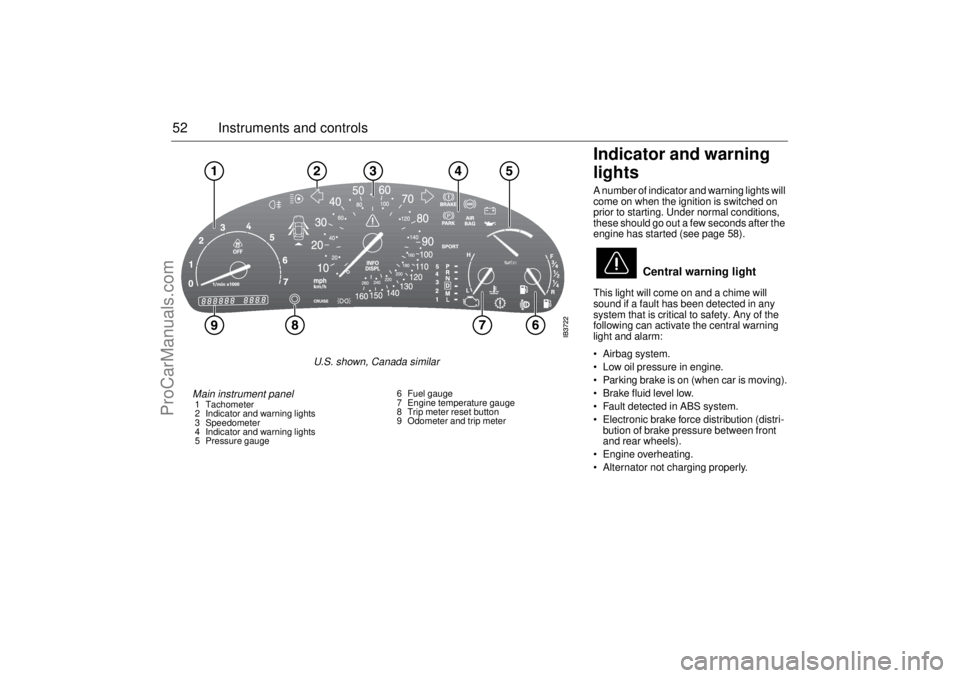
Main instrument panel 1 Tachometer
2 Indicator and warning lights
3 Speedometer
4 Indicator and warning lights
5 Pressure gauge6 Fuel gauge
7 Engine temperature gauge
8 Trip meter reset button
9 Odometer and trip meter
U.S. shown, Canada similar
ProCarManuals.com
Page 57 of 276

55 Instruments and controls
This light together with will come on if
a potentially serious fault has occurred in
the airbag system. The light will come on for about three
seconds when the ignition switch is turned
to the Start or Drive position. It should go out
after the engine has started.This light indicates a malfunction in the
fuel-injection or ignition system. The car
may still be driven with care and with
somewhat diminished performance (see
page 136).This light comes on when there is less than
about 2.5 gallons (10 liters) of fuel left in the
tank.
This light indicates that there is a message
in the Saab Information Display (SID). A
chime will also sound (see page 64).
Airbag warning light
WARNING
If the airbag readiness light stays on
after you start your vehicle, it means
the airbag system may not be working
properly. One or more of the following
conditions may occur:
– Non-deployment of the airbags in the
event of a crash.
– Deployment of the airbags without a
crash.
– Deployment of the airbags in crashes
less severe than intended.
To help avoid injury to yourself or
others, have your vehicle serviced
right away if the airbag readiness light
stays on after you start your vehicle.
Engine malfunction
(CHECK ENGINE)
WARNING
An illuminated ”Engine malfunction
(CHECK ENGINE)” indicator light indica-
tes an engine-related problem. While
your car may be able to be driven with the
”Engine malfunction (CHECK ENGINE)”
indicator light illuminated (Limp-home
mode), you are advised to have your car
serviced at an authorized Saab dealer as
soon as possible.
Continued driving without this problem
being corrected might cause serious
further damage to your car and create
unsafe driving conditions. The driver
should be prepared to take action if such
unsafe conditions arise (e.g.brake
smoothly, engage neutral, stop in a suita-
ble place, switch off the engine, etc.).
NOTICEThe car should be checked immediately
at an authorized Saab dealer to prevent
more serious faults from arising.
Indicator, fuel
NOTICE
If the car runs out of fuel, air can be drawn
in with the fuel, which, in turn, can cause
the catalytic converter to be damaged by
overheating.
CHECK message indicator
ProCarManuals.com
Page 105 of 276
103 Saab 9-5 Audio System
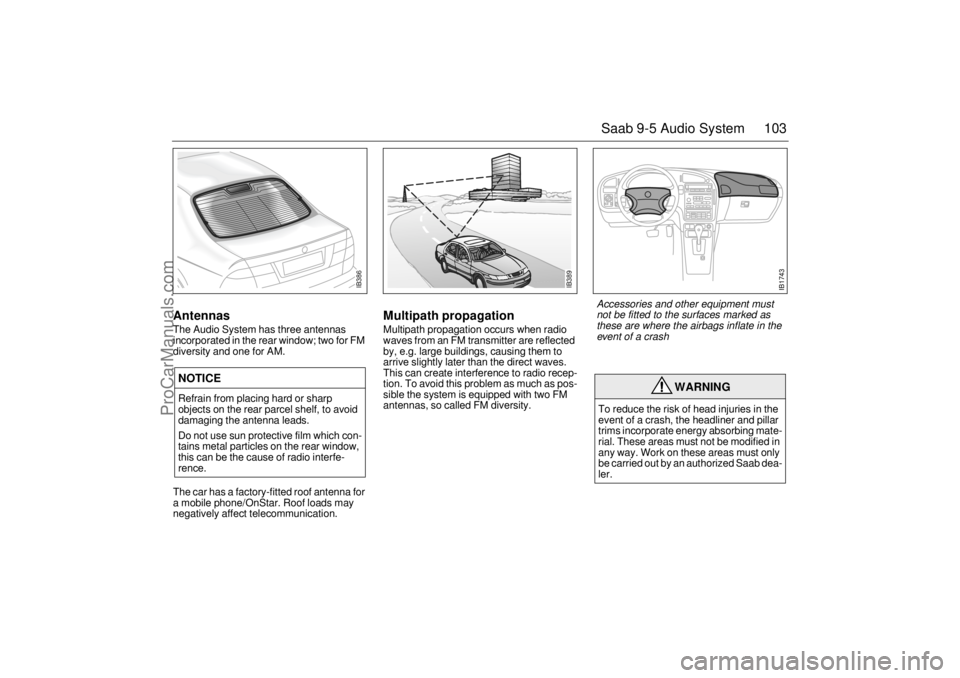
AntennasThe Audio System has three antennas
incorporated in the rear window; two for FM
diversity and one for AM. The car has a factory-fitted roof antenna for
a mobile phone/OnStar. Roof loads may
negatively affect telecommunication.
Multipath propagation Multipath propagation occurs when radio
waves from an FM transmitter are reflected
by, e.g. large buildings, causing them to
arrive slightly later than the direct waves.
This can create interference to radio recep-
tion. To avoid this problem as much as pos-
sible the system is equipped with two FM
antennas, so called FM diversity.
NOTICERefrain from placing hard or sharp
objects on the rear parcel shelf, to avoid
damaging the antenna leads.
Do not use sun protective film which con-
tains metal particles on the rear window,
this can be the cause of radio interfe-
rence.
WARNING
To reduce the risk of head injuries in the
event of a crash, the headliner and pillar
trims incorporate energy absorbing mate-
rial. These areas must not be modified in
any way. Work on these areas must only
be carried out by an authorized Saab dea-
ler.
IB386
IB389
IB1743
Accessories and other equipment must
not be fitted to the surfaces marked as
these are where the airbags inflate in the
event of a crash
ProCarManuals.com
Page 216 of 276
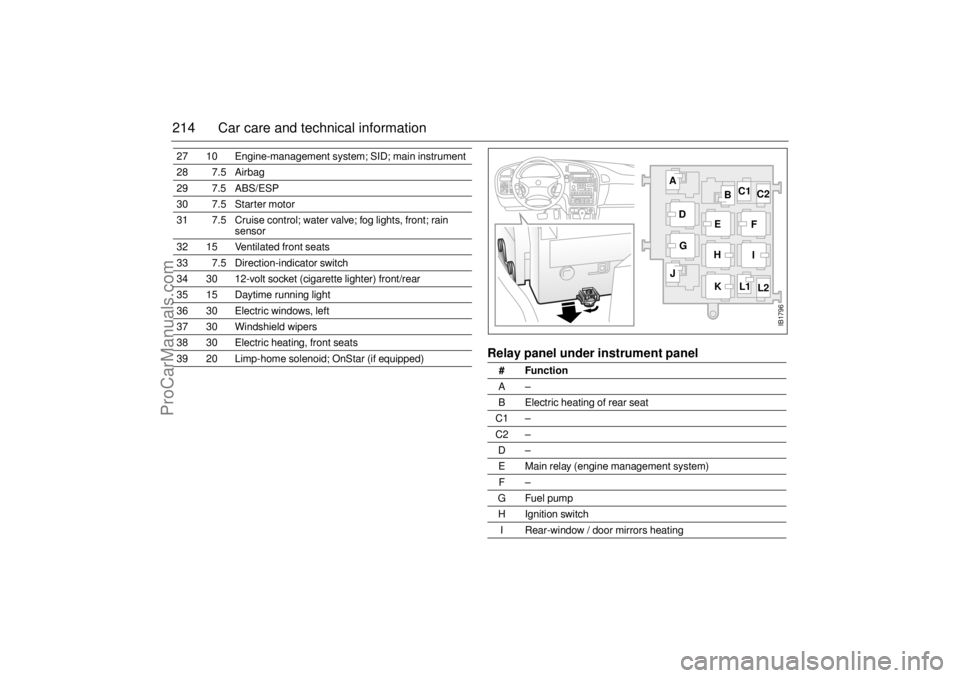
214 Car care and technical information
Relay panel under instrument panel
27 10 Engine-management system; SID; main instrument
28 7.5 Airbag
29 7.5 ABS/ESP
30 7.5 Starter motor
31 7.5 Cruise control; water valve; fog lights, front; rain
sensor
32 15 Ventilated front seats
33 7.5 Direction-indicator switch
34 30 12-volt socket (cigarette lighter) front/rear
35 15 Daytime running light
36 30 Electric windows, left
37 30 Windshield wipers
38 30 Electric heating, front seats
39 20 Limp-home solenoid; OnStar (if equipped)
# Function A –
B Electric heating of rear seat
C1 –
C2 –
D–
E Main relay (engine management system)
F–
G Fuel pump
H Ignition switch
I Rear-window / door mirrors heating
IB1796
A
BC1
C2
L2 L1 D
GE
F
H
I
K J
ProCarManuals.com