seats SAAB 9-5 2005 User Guide
[x] Cancel search | Manufacturer: SAAB, Model Year: 2005, Model line: 9-5, Model: SAAB 9-5 2005Pages: 276, PDF Size: 16.72 MB
Page 25 of 276
23 Safety
LATCH installationTo facilitate the proper fitting of new speci-
ally-designed child restraints, rigid lower
anchorages (ISOFIX) have been installed to
the vehicle that shall be used with the top
tether anchorages in the two outboard rear
seating positions. There is an additional top
tether anchorage for the center rear seating
position that is to be used together with the
safety belt.
LATCH is a U.S./Canadian government
standard for the uniform method of fitting
child restraints without using the standard
safety belts. Only certain child restraints are
equipped to utilize these rigid lower ancho-
rages behind where the seat cushion and
seat back come together. LATCH child
seats also utilize a top tether strap that is
found on some newer child seats that still
require installation with the standard safety
belts.
There are two bars attached to the car body
for each specially designed LATCH child
restraint. A small label is located on the seat
back just above the attachment bars to faci-
litate installing the child restraint. The label
contains a circle and a rearward facing child
restraint.
1 Place the child restraint on the seat
cushion.
2 Press the child restraint rearward into
the space between the backrest and
cushion, lining up the restraint attach-
ment arms with the labels.3 Follow the child restraint instructions to
confirm that both restraint arms are pro-
perly attached to the bars.
4 Attach the top tether strap to the in-car
anchorage and tighten according to the
restraint instructions, see page 24
and 25.
5 Pull the child restraint to make a second
check that restraint is securely attached
at both the lower anchorage bars and
the top tether strap.
For the top tether, only use the strap supp-
lied with the child restraint.
Always follow the installation instructions
supplied with the child restraint.
The availability of LATCH child restraints
may be limited.
When fitting child seats in cars you must
always read the instructions supplied by
the car seat manufacturer.
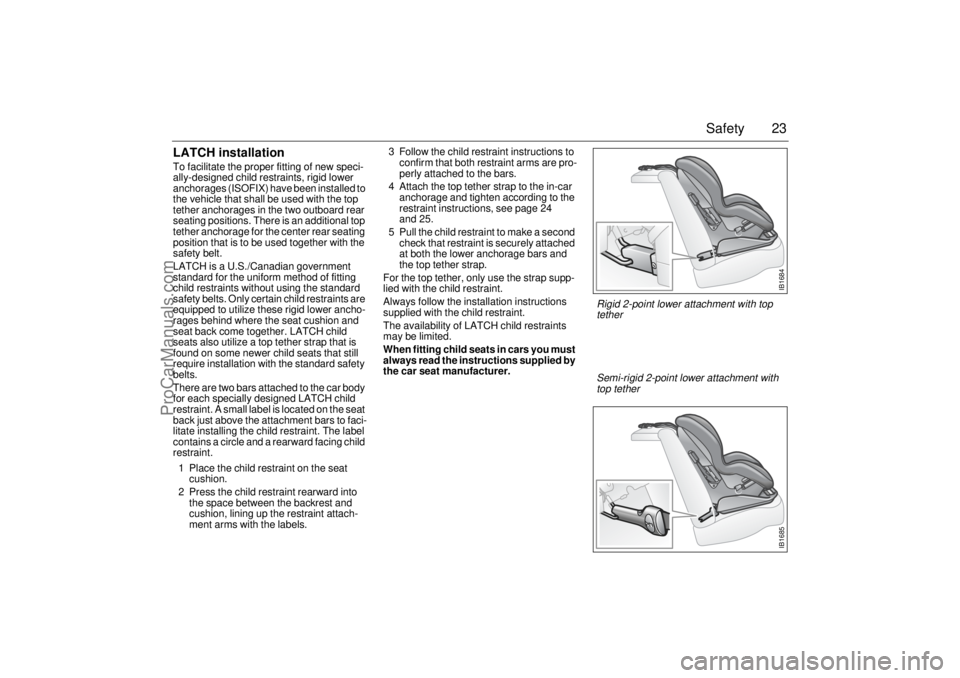
IB1684
Rigid 2-point lower attachment with top
tether
IB1685
Semi-rigid 2-point lower attachment with
top tether
ProCarManuals.com
Page 26 of 276

24 SafetyChild tether anchorages for
forward facing child car seatsChild restraints with a tether strap must be
anchored according to Canadian and USA
laws.
If you have any questions regarding child
tether anchorages please contact your
Saab dealer.9-5 Sedan:
1 Open the cover for the child tether
anchorage that is behind the seating
position in which the child restraint is to
be installed. Make sure it locks.
2 Place the child restraint in the rear seat.
3 Secure the lower part of the child res-
traint by means of the lower anchorages
(ISOFIX) or the safety belts as descri-
bed in the child restraint mounting ins-
truction.
4 Route the tether under the headrest.
5 Attach the tether to the anchorage.
6 Tighten the tether so that the back of the
child restraint is pressed hard against
the backrest.
7 Pull the child restraints to make a
second check that the restraints are
securely attached at both the lower
anchorages bars and the top tether
strap.
WARNING
Child tether anchorages are designed to
withstand only those loads imposed by
correctly fitted child restraints.
Under no circumstances are they to be
used for adult safety belts.
IB1698
Child tether anchorages in parcel shelf,
Saab 9-5 Sedan
ProCarManuals.com
Page 30 of 276

28 SafetyAirbag The AIRBAG system comprises an airbag in
the steering wheel, a front passenger airbag
and side airbags in the front seats.
The system supplements the protection
provided by the safety belts to further
enhance the safety of the occupants.
If a fault is detected in the AIRBAG, the
AIR BAG warning light on the main instru-
ment panel will come on (see pages 55
and 33). When the system is triggered by impact of a
frontal crash, the airbags in the steering
wheel and passenger side of the dash board
are inflated, after which they deflate through
vents in the back of the bags.
The driver and passenger airbags are refer-
red ta as ‘smart’ airbags. This means that
the system compensates for factors such as
the force of the collision.Note:
The sensor reacts differently depending on
whether or not the front seatbelts on the dri-
ver’s and passenger sides are used. Situa-
tions can therefore arise where only one of
the airbags inflates.
It is also possible for only the seatbelt pre-
tensioners to be activated and for the air-
bags to remain uninflated.
The entire process takes less than
0.1 second – literally, faster than the blin-
king of an eye.
These airbags are triggered only by mode-
rate to severe frontal or near-frontal cras-
hes. They will not be activated by minor
front-end impacts, rear-end or side impacts,
or by the car rolling over.
WARNING
To reduce risk of injury:
Always wear your safety belt.
Always adjust your seat so that you
are as far back as possible but still
able to operate the pedals and reach
the steering wheel and controls com-
fortably.
Children 12 and under or shorter than
55 inches (140 cm) should always
travel in the rear seat as the car is fitted
with a passenger airbag.
Never fit a child seat in front of the pas-
senger airbag.
IB419
Inflated airbag (driver side) Inflation and deflation together take less than
0.1 second.
ProCarManuals.com
Page 42 of 276
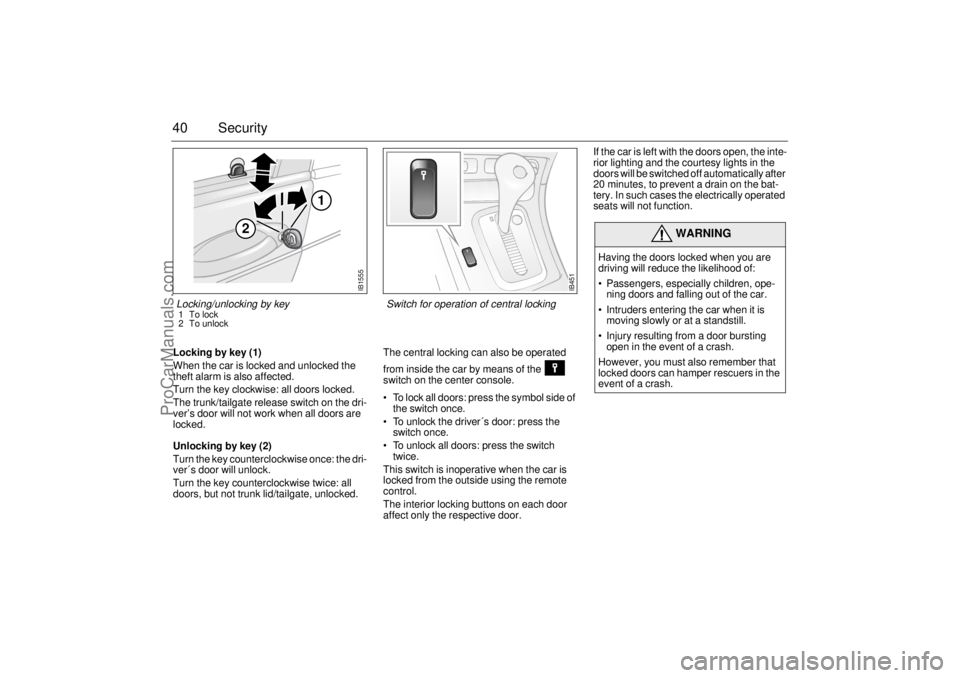
40 SecurityLocking by key (1)
When the car is locked and unlocked the
theft alarm is also affected.
Turn the key clockwise: all doors locked.
The trunk/tailgate release switch on the dri-
ver’s door will not work when all doors are
locked.
Unlocking by key (2)
Turn the key counterclockwise once: the dri-
ver´s door will unlock.
Turn the key counterclockwise twice: all
doors, but not trunk lid/tailgate, unlocked. The central locking can also be operated
from inside the car by means of the
switch on the center console.
To lock all doors: press the symbol side of
the switch once.
To unlock the driver´s door: press the
switch once.
To unlock all doors: press the switch
twice.
This switch is inoperative when the car is
locked from the outside using the remote
control.
The interior locking buttons on each door
affect only the respective door.If the car is left with the doors open, the inte-
rior lighting and the courtesy lights in the
doors will be switched off automatically after
20 minutes, to prevent a drain on the bat-
tery. In such cases the electrically operated
seats will not function.
WARNING
Having the doors locked when you are
driving will reduce the likelihood of:
Passengers, especially children, ope-
ning doors and falling out of the car.
Intruders entering the car when it is
moving slowly or at a standstill.
Injury resulting from a door bursting
open in the event of a crash.
However, you must also remember that
locked doors can hamper rescuers in the
event of a crash.
IB451
Switch for operation of central locking
IB1555
2
1
Locking/unlocking by key1To lock
2 To unlock
ProCarManuals.com
Page 43 of 276
41 Security
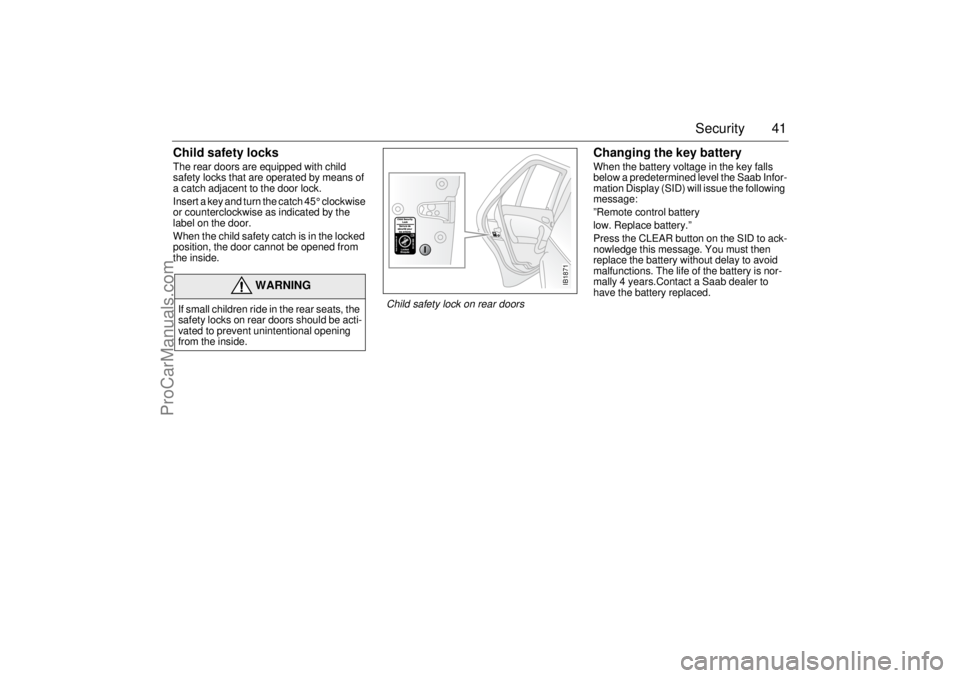
Child safety locksThe rear doors are equipped with child
safety locks that are operated by means of
a catch adjacent to the door lock.
Insert a key and turn the catch 45° clockwise
or counterclockwise as indicated by the
label on the door.
When the child safety catch is in the locked
position, the door cannot be opened from
the inside.
Changing the key batteryWhen the battery voltage in the key falls
below a predetermined level the Saab Infor-
mation Display (SID) will issue the following
message:
”Remote control battery
low. Replace battery.”
Press the CLEAR button on the SID to ack-
nowledge this message. You must then
replace the battery without delay to avoid
malfunctions. The life of the battery is nor-
mally 4 years.Contact a Saab dealer to
have the battery replaced.
WARNING
If small children ride in the rear seats, the
safety locks on rear doors should be acti-
vated to prevent unintentional opening
from the inside.
IB1871
Child safety lock on rear doors
ProCarManuals.com
Page 77 of 276
75 Instruments and controls
Temperature control The cabin is divided into two temperature
zones:
• The driver’s zone
The passenger zone (front and rear
seats)
The desired temperature can be set bet-
ween 58 and 82°F (15 and 27°C). In addi-
tion, there are also HI and LO settings (see
below). The HI and LO settings for the pas-
senger zone can only be selected if they are
also selected for the driver’s zone.
The displayed temperature is not the abso-
lute temperature but corresponds to the
comfort level normally experienced at that
temperature after allowance has been
made for the air flow, relative humidity, solar
radiation, etc., currently prevailing inside
the car.
The most usual temperature setting is
64–76°F (18–24°C), depending on perso-
nal preference and what clothing is worn.
To allow the system time to adjust, chan-
ges in the temperature setting can only be
made in steps of 2°F (1°C).
Once the desired climate has been achie-
ved, the rear center vents can be closed
to prevent warm air being distributed at
face height.
Settings when HI
selected:
Maximum heat
Air distribution to windshield and floor
Recirculation OFF (even if manually
selected before)
Fan: high speed
Settings shown on ACC display
Settings when LO
selected:
Maximum cooling (A/C compressor will
run even if ECON manually selected
before)
Air distribution through panel vents
Fan: maximum speed
Recirculation ON
Settings shown on ACC display
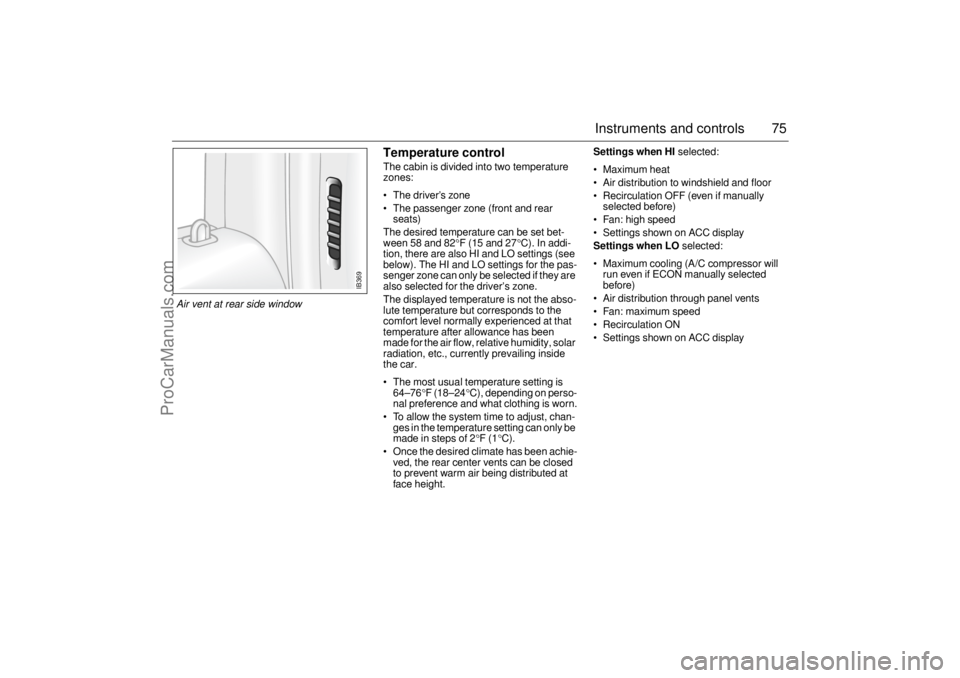
IB369
Air vent at rear side window
ProCarManuals.com
Page 121 of 276
119 Interior equipment and trunk
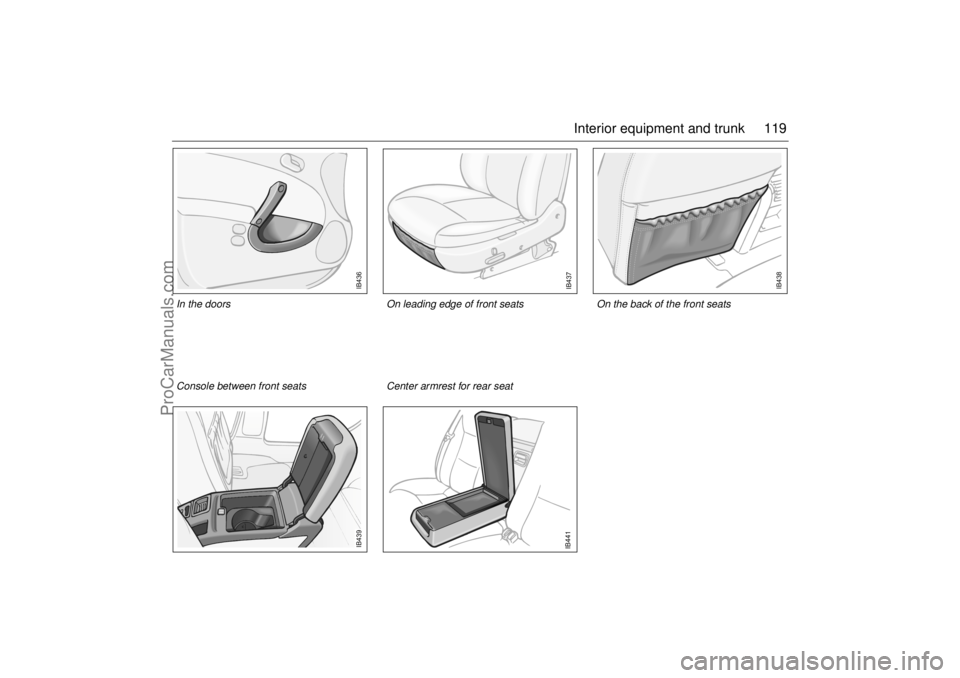
IB436
IB437
IB439
IB441
IB438
On the back of the front seats
Center armrest for rear seat On leading edge of front seats
Console between front seats In the doors
ProCarManuals.com
Page 122 of 276
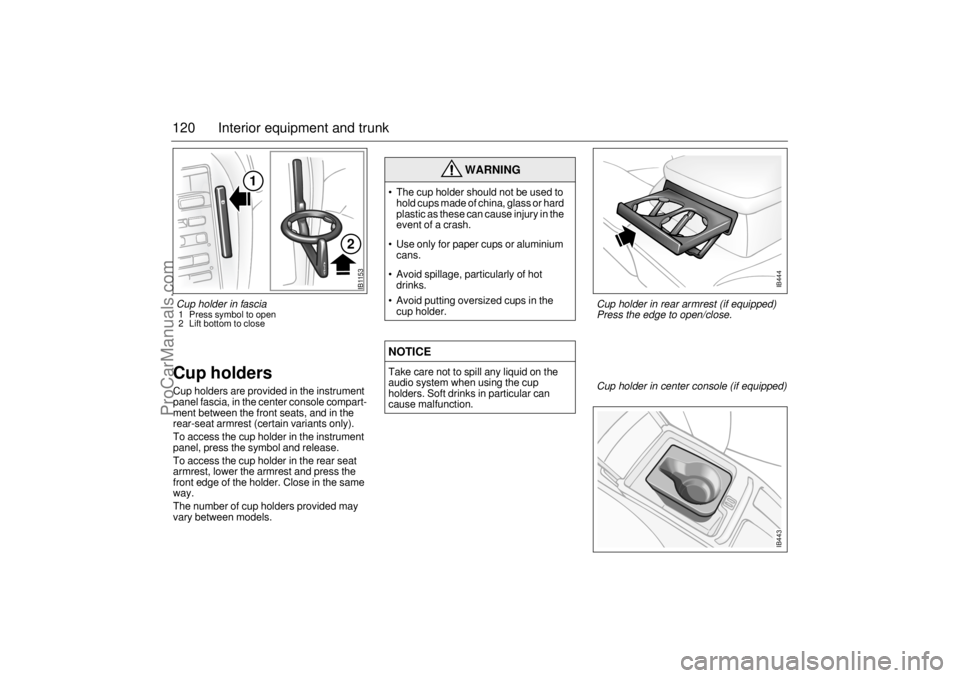
120 Interior equipment and trunkCup holders Cup holders are provided in the instrument
panel fascia, in the center console compart-
ment between the front seats, and in the
rear-seat armrest (certain variants only).
To access the cup holder in the instrument
panel, press the symbol and release.
To access the cup holder in the rear seat
armrest, lower the armrest and press the
front edge of the holder. Close in the same
way.
The number of cup holders provided may
vary between models.
WARNING
The cup holder should not be used to
hold cups made of china, glass or hard
plastic as these can cause injury in the
event of a crash.
Use only for paper cups or aluminium
cans.
Avoid spillage, particularly of hot
drinks.
Avoid putting oversized cups in the
cup holder.NOTICETake care not to spill any liquid on the
audio system when using the cup
holders. Soft drinks in particular can
cause malfunction.
IB1153
1
2
Cup holder in center console (if equipped)
IB443
Cup holder in rear armrest (if equipped)
Press the edge to open/close.
IB444
Cup holder in fascia 1 Press symbol to open
2 Lift bottom to close
ProCarManuals.com
Page 123 of 276
121 Interior equipment and trunk
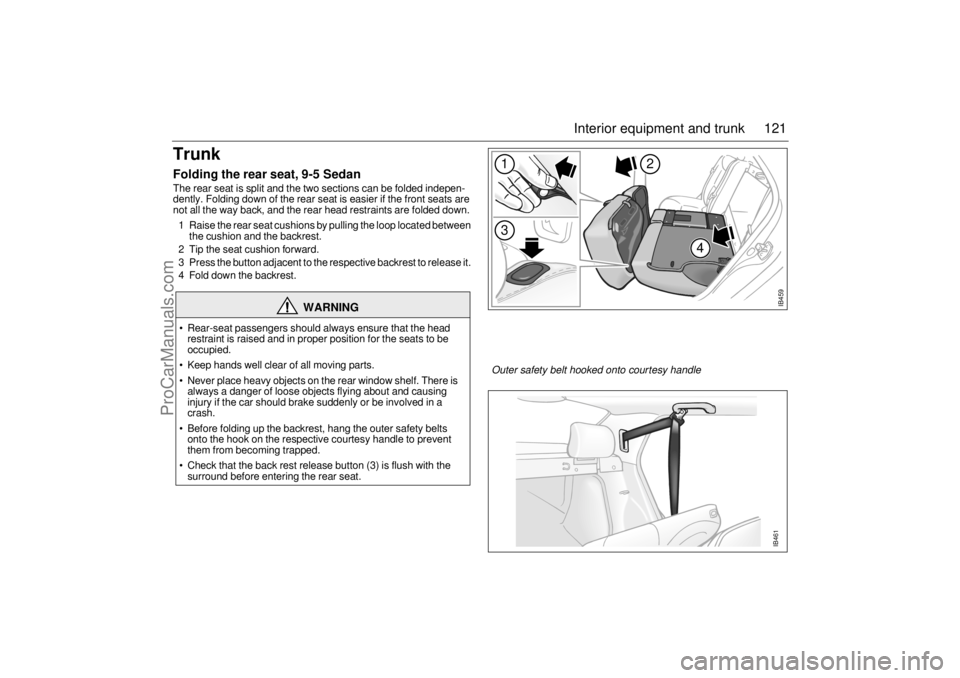
TrunkFolding the rear seat, 9-5 SedanThe rear seat is split and the two sections can be folded indepen-
dently. Folding down of the rear seat is easier if the front seats are
not all the way back, and the rear head restraints are folded down.
1 Raise the rear seat cushions by pulling the loop located between
the cushion and the backrest.
2 Tip the seat cushion forward.
3 Press the button adjacent to the respective backrest to release it.
4 Fold down the backrest.
WARNING
Rear-seat passengers should always ensure that the head
restraint is raised and in proper position for the seats to be
occupied.
Keep hands well clear of all moving parts.
Never place heavy objects on the rear window shelf. There is
always a danger of loose objects flying about and causing
injury if the car should brake suddenly or be involved in a
crash.
Before folding up the backrest, hang the outer safety belts
onto the hook on the respective courtesy handle to prevent
them from becoming trapped.
Check that the back rest release button (3) is flush with the
surround before entering the rear seat.
IB459
1
2
4
3
IB461
Outer safety belt hooked onto courtesy handle
ProCarManuals.com
Page 126 of 276
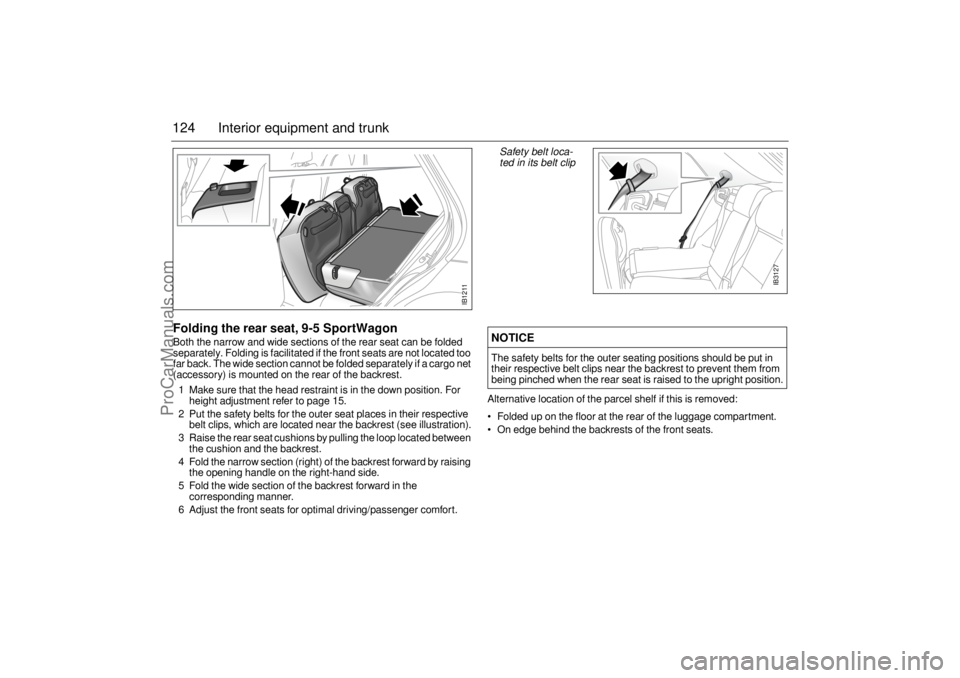
124 Interior equipment and trunkFolding the rear seat, 9-5 SportWagonBoth the narrow and wide sections of the rear seat can be folded
separately. Folding is facilitated if the front seats are not located too
far back. The wide section cannot be folded separately if a cargo net
(accessory) is mounted on the rear of the backrest.
1 Make sure that the head restraint is in the down position. For
height adjustment refer to page 15.
2 Put the safety belts for the outer seat places in their respective
belt clips, which are located near the backrest (see illustration).
3 Raise the rear seat cushions by pulling the loop located between
the cushion and the backrest.
4 Fold the narrow section (right) of the backrest forward by raising
the opening handle on the right-hand side.
5 Fold the wide section of the backrest forward in the
corresponding manner.
6 Adjust the front seats for optimal driving/passenger comfort.
Alternative location of the parcel shelf if this is removed:
Folded up on the floor at the rear of the luggage compartment.
On edge behind the backrests of the front seats.NOTICEThe safety belts for the outer seating positions should be put in
their respective belt clips near the backrest to prevent them from
being pinched when the rear seat is raised to the upright position.
IB1211
IB3127
Safety belt loca-
ted in its belt clip
ProCarManuals.com