brake light SAAB 9-5 2005 Owner's Manual
[x] Cancel search | Manufacturer: SAAB, Model Year: 2005, Model line: 9-5, Model: SAAB 9-5 2005Pages: 276, PDF Size: 16.72 MB
Page 205 of 276
203 Car care and technical information
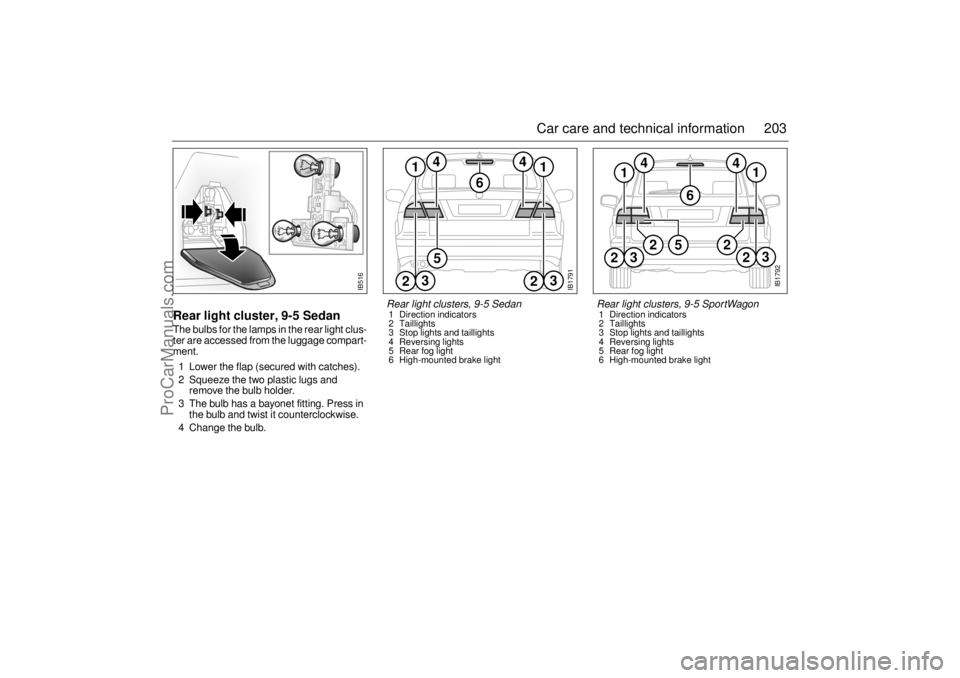
Rear light cluster, 9-5 SedanThe bulbs for the lamps in the rear light clus-
ter are accessed from the luggage compart-
ment.
1 Lower the flap (secured with catches).
2 Squeeze the two plastic lugs and
remove the bulb holder.
3 The bulb has a bayonet fitting. Press in
the bulb and twist it counterclockwise.
4 Change the bulb.
IB516
IB1791
12
3
2
3
5
6
4
1
4
IB1792
1
1
2
3
2
6
4
4
52
2
3
Rear light clusters, 9-5 SportWagon1 Direction indicators
2 Taillights
3 Stop lights and taillights
4 Reversing lights
5 Rear fog light
6 High-mounted brake light
Rear light clusters, 9-5 Sedan1 Direction indicators
2 Taillights
3 Stop lights and taillights
4 Reversing lights
5 Rear fog light
6 High-mounted brake light
ProCarManuals.com
Page 215 of 276
213 Car care and technical information
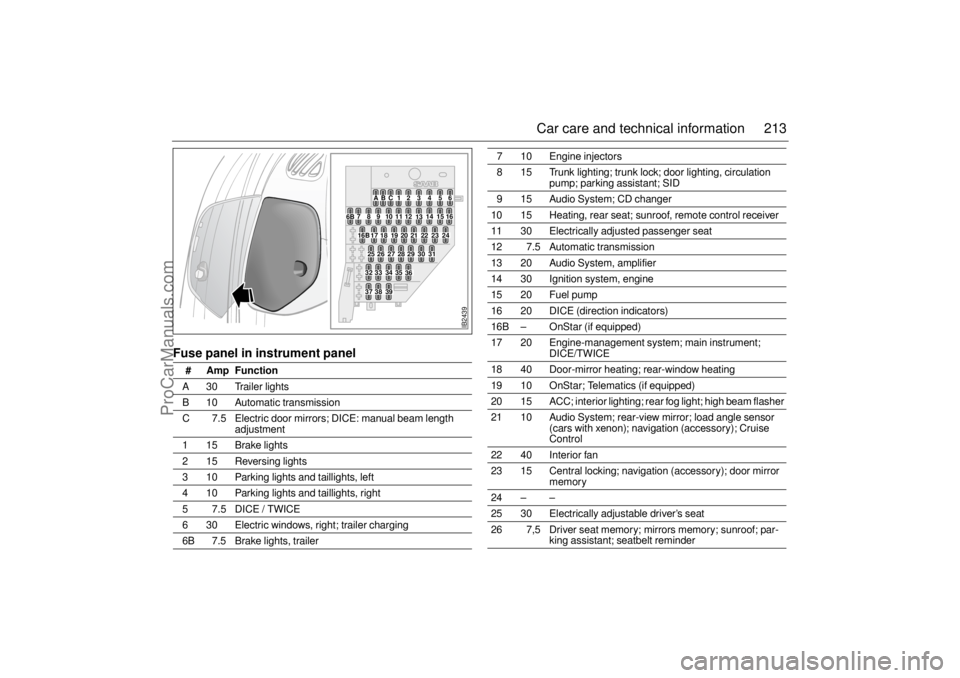
Fuse panel in instrument panel
# Amp Function A 30 Trailer lights
B 10 Automatic transmission
C 7.5 Electric door mirrors; DICE: manual beam length
adjustment
115Brake lights
2 15 Reversing lights
3 10 Parking lights and taillights, left
4 10 Parking lights and taillights, right
5 7.5 DICE / TWICE
6 30 Electric windows, right; trailer charging
6B 7.5 Brake lights, trailer
7 10 Engine injectors
8 15 Trunk lighting; trunk lock; door lighting, circulation
pump; parking assistant; SID
9 15 Audio System; CD changer
10 15 Heating, rear seat; sunroof, remote control receiver
11 30 Electrically adjusted passenger seat
12 7.5 Automatic transmission
13 20 Audio System, amplifier
14 30 Ignition system, engine
15 20 Fuel pump
16 20 DICE (direction indicators)
16B – OnStar (if equipped)
17 20 Engine-management system; main instrument;
DICE/TWICE
18 40 Door-mirror heating; rear-window heating
19 10 OnStar; Telematics (if equipped)
20 15 ACC; interior lighting; rear fog light; high beam flasher
21 10 Audio System; rear-view mirror; load angle sensor
(cars with xenon); navigation (accessory); Cruise
Control
22 40 Interior fan
23 15 Central locking; navigation (accessory); door mirror
memory
24 – –
25 30 Electrically adjustable driver’s seat
26 7,5 Driver seat memory; mirrors memory; sunroof; par-
king assistant; seatbelt reminder
IB2439
BC123456 A
14
121110987
13
6B
1516
2324
222120191817
16B25262728293031
3635343332
393837
ProCarManuals.com
Page 228 of 276
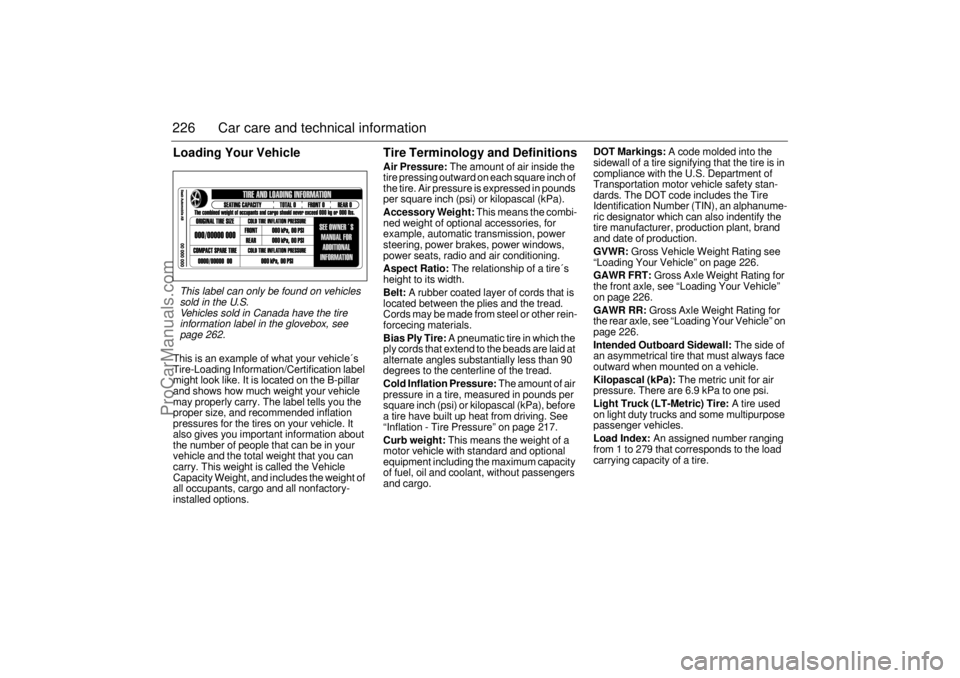
226 Car care and technical informationLoading Your VehicleThis is an example of what your vehicle´s
Tire-Loading Information/Certification label
might look like. It is located on the B-pillar
and shows how much weight your vehicle
may properly carry. The label tells you the
proper size, and recommended inflation
pressures for the tires on your vehicle. It
also gives you important information about
the number of people that can be in your
vehicle and the total weight that you can
carry. This weight is called the Vehicle
Capacity Weight, and includes the weight of
all occupants, cargo and all nonfactory-
installed options.
Tire Terminology and DefinitionsAir Pressure:
The amount of air inside the
tire pressing outward on each square inch of
the tire. Air pressure is expressed in pounds
per square inch (psi) or kilopascal (kPa).
Accessory Weight:
This means the combi-
ned weight of optional accessories, for
example, automatic transmission, power
steering, power brakes, power windows,
power seats, radio and air conditioning.
Aspect Ratio:
The relationship of a tire´s
height to its width.
Belt:
A rubber coated layer of cords that is
located between the plies and the tread.
Cords may be made from steel or other rein-
forcecing materials.
Bias Ply Tire:
A pneumatic tire in which the
ply cords that extend to the beads are laid at
alternate angles substantially less than 90
degrees to the centerline of the tread.
Cold Inflation Pressure:
The amount of air
pressure in a tire, measured in pounds per
square inch (psi) or kilopascal (kPa), before
a tire have built up heat from driving. See
“Inflation - Tire Pressure” on page 217.
Curb weight:
This means the weight of a
motor vehicle with standard and optional
equipment including the maximum capacity
of fuel, oil and coolant, without passengers
and cargo.
DOT Markings:
A code molded into the
sidewall of a tire signifying that the tire is in
compliance with the U.S. Department of
Transportation motor vehicle safety stan-
dards. The DOT code includes the Tire
Identification Number (TIN), an alphanume-
ric designator which can also indentify the
tire manufacturer, production plant, brand
and date of production.
GVWR:
Gross Vehicle Weight Rating see
“Loading Your Vehicle” on page 226.
GAWR FRT:
Gross Axle Weight Rating for
the front axle, see “Loading Your Vehicle”
on page 226.
GAWR RR:
Gross Axle Weight Rating for
the rear axle, see “Loading Your Vehicle” on
page 226.
Intended Outboard Sidewall:
The side of
an asymmetrical tire that must always face
outward when mounted on a vehicle.
Kilopascal (kPa):
The metric unit for air
pressure. There are 6.9 kPa to one psi.
Light Truck (LT-Metric) Tire:
A tire used
on light duty trucks and some multipurpose
passenger vehicles.
Load Index:
An assigned number ranging
from 1 to 279 that corresponds to the load
carrying capacity of a tire.
This label can only be found on vehicles
sold in the U.S.
Vehicles sold in Canada have the tire
information label in the glovebox, see
page 262.
ProCarManuals.com
Page 233 of 276

231 Car care and technical information
Changing a wheel
WARNING
Lifting a vehicle and getting under it to do
maintenance or repairs is dangerous
without the appropriate safety equipment
and training. The jack provided with your
vehicle is designed only for changing a
flat tire. If it is used for anything else, you
or others could be badly injured or killed if
the vehicle slips off the jack. Use the jack
provided with your vehicle only for chang-
ing a flat tire.
Changing a tire can be dangerous. The
vehicle can slip off the jack and roll over
or fall on you or other people. You and
they could be badly injured or even killed.
Find a level place to change your tire. To
help prevent the vehicle from moving:
1 Set the parking brake firmly.
2 If you have an automatic transmis-
sion, put the shift lever in PARK (P).
For a manual transmission, leave the
car in gear (1st or REVERSE (R)).
3 Turn off the engine and do not restart
while the vehicle is raised.
4 Do not allow passengers to remain in
the vehicle.
To be even more certain the vehicle won't
move, you should put blocks at the front
and rear of the tire farthest away from the
one being changed. That would be the
tire, on the other side, at the opposite end
of the vehicle.
The car jack is designed solely for use
in changing a wheel or fitting snow
chains.
It must not be used to
support the car during repair work
or servicing.
Never
crawl under a car that is
supported only by a jack.
Raising your vehicle too high or with
the jack improperly positioned can
damage the vehicle and even make
the vehicle fall. To help avoid personal
injury and vehicle damage, be sure to
fit the jack lift head into the proper
location before raising the vehicle, and
raise the vehicle only far enough off
the ground so there is enough room for
the spare tire to fit (no more than 25
mm or 1 inch clearance between the
ground and the bottom of the tire).
Switch on the hazard warning lights if
the car is on a road.
The jack should be stored correctly
under the carpeting in the trunk. If it
lies loose in the car, it could thrown
forward and cause personal injury in
the event of a crash or if the car rolls
over.
Grit, salt and rust can clog the inner
threads of the wheel bolts if the car has
been driven for several years exclu-
sively with alloy wheels.
If steel wheels are being installed, the
bolt hole threads in the brake hubs
should be cleaned before the thinner
steel wheels are fitted. It may other-
wise not be possible to achieve the
correct clamping force, despite tight-
ening the wheel bolts to the correct
torque.
ProCarManuals.com
Page 235 of 276
233 Car care and technical information
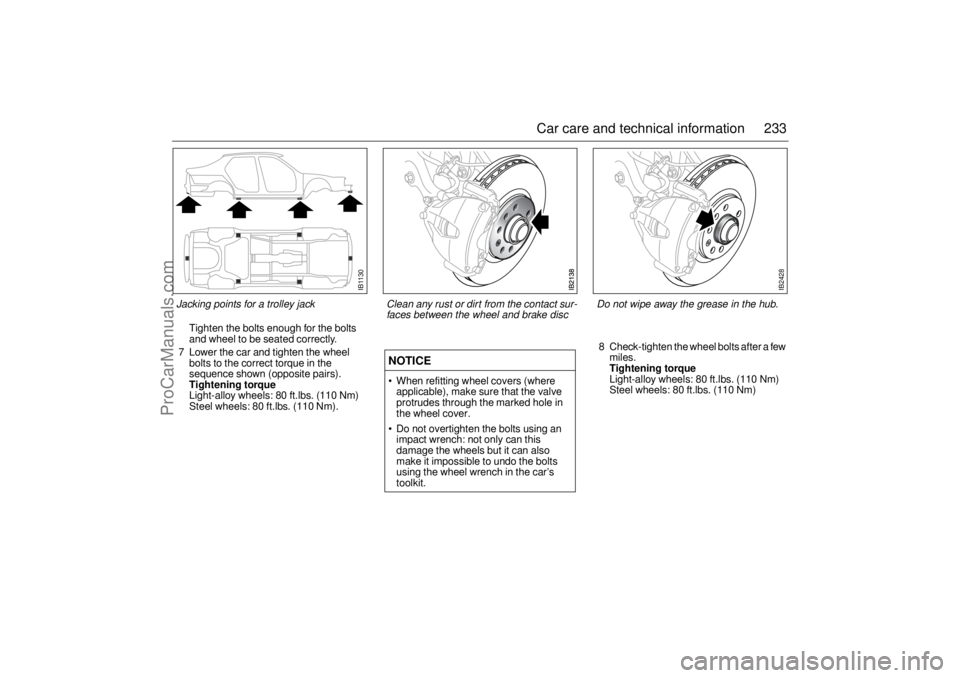
Tighten the bolts enough for the bolts
and wheel to be seated correctly.
7 Lower the car and tighten the wheel
bolts to the correct torque in the
sequence shown (opposite pairs).Tightening torqueLight-alloy wheels: 80 ft.lbs. (110 Nm)
Steel wheels: 80 ft.lbs. (110 Nm).
8 Check-tighten the wheel bolts after a few
miles.Tightening torqueLight-alloy wheels: 80 ft.lbs. (110 Nm)
Steel wheels: 80 ft.lbs. (110 Nm)
NOTICE When refitting wheel covers (where
applicable), make sure that the valve
protrudes through the marked hole in
the wheel cover.
Do not overtighten the bolts using an
impact wrench: not only can this
damage the wheels but it can also
make it impossible to undo the bolts
using the wheel wrench in the car’s
toolkit. Clean any rust or dirt from the contact sur-
faces between the wheel and brake disc
IB2428
Do not wipe away the grease in the hub.
IB1130
Jacking points for a trolley jack
ProCarManuals.com
Page 239 of 276

237 Car care and technical information
Washing the carWash your car frequently. To facilitate clea-
ning, a suitable detergent can be added to
the water, which should be lukewarm. Saab
offers a full line of car care products, inclu-
ding car wash, for the care of your vehicle.
See your dealer for available products or
visit www.saabcatalog.com (U.S. residents
only).
Do not use a pressure washer at close
range on stone chip damage, scratches or
other damage to the paintwork. The paint
can otherwise start to flake.
Remove any bird droppings without delay,
as these can discolor the paintwork and
prove difficult to polish out.
Use a soft cloth moistened with methyl alco-
hol to remove splashes of tar or asphalt. Do
not use strong cleaners, as these can dry
out the paintwork.
The underside of the car also needs wash-
ing regularly, and this should be done extra
thoroughly at the end of winter. Clean the
underside of the car by hand if the car is usu-
ally washed in an automatic car wash wit-
hout special facilities for underbody clea-
ning.
Never wash or leave the car to dry in the
sun, but wipe it dry with a chamois leather
immediately after washing to avoid smears
and streaks.
Clean the window glass inside and out using
a high quality window cleaner. This is parti-
cularly important when the car is new, as
upholstery and trim have a tendency to
sweat a little at first.
Keep the glass well cleaned, as this helps to
prevent misting.
NOTICEAvoid using any alcohol-based cleaners
on the front and rear light clusters, as
these can cause cracking of the lenses.
NOTICE The door mirrors must be fully
retracted before the car enters an
automatic car wash.
Remove fixed antennas, e.g. for
mobile phone, before putting car
through an automatic car wash.
Try your brakes on leaving a car wash.
Wet brake discs may reduce the
performance of the brakes.
Cars with Saab Parking Assistance:
Do not spray the sensors or closer
than 20 cm to the sensors with a pres-
sure washer, as this can damage
them.
ProCarManuals.com
Page 267 of 276

265 Index
IndexAA/C system, fault diagnosis
_______ 235
A/C system, maintenance
_________ 234
ABS brakes
____________________ 152
ACC
__________________________ 73
ACC functions
___________________ 76
ACC, automatic climate control
_____ 73
ACC, calibration
_________________ 81
ACC, condensation _______________ 82
ACC, programming _______________ 79
ACC, useful tips
_________________ 81
Adjusting the steering wheel
_______ 106
Adjustment, seats
________________ 12
Air conditioning (A/C), fault diagnosis
and maintenance ______________ 234
Air distribution, ACC ______________ 78
Airbag
_________________________ 28
Alarm _________________________ 44
Alarm functions
__________________ 47
Alarm signals
________________ 44
, 47
Alternator
_____________________ 194
Alternator drive belt
__________ 194
, 257
Alternator rating
________________ 257
Anticorrosion treatment
___________ 240
Antidazzle rear-view mirror
________ 111
Ashtrays
______________________ 117
Audio System
___________________ 83Audio System, quick guide
_________ 85
Autochecking of lights on starting
____ 58
Auto-dimming rear-view mirror with
garage door opener
____________ 108
Automatic climate control (ACC)
_____ 73
Automatic transmission, technical
data
_________________________ 258
Aviod theft, tip
__________________ 179
BBattery
________________________ 192
Battery charging/replacing
________ 193
Battery, boost starting
____________ 174
Before a long journey ____________ 241
Before towing a camper or trailer
___ 164
Belt guide
______________________ 16
Boost starting using jump leads
____ 174
Brake and clutch fluid
____________ 189
Brake-fluid reservoir
_____________ 189
Brakes, technical data ____________ 259
Bulbs, changing
________________ 197
Bulbs, table of
__________________ 210
Buying new tires ________________ 219
CCD changer
_____________________ 95
CD player
______________________ 93CHECK messages
_______________ 64
CHECKING
_____________________ 64
Calibration, ACC
_________________ 81
Cancelling the programmed settings
__ 79
Car alarm
_______________________ 44
Car care _______________________ 181
Cargo net, 9-5 SportWagon
_______ 128
Carpeting, care of
_______________ 236
Cassette player
__________________ 90
Catalytic converter, important
considerations _________________ 137
Central locking ___________________ 38
Change language in SID
___________ 66
Change of address notification
_____ 248
Changing a wheel
_______________ 231
Changing bulbs
_________________ 197
Changing wiper blades
___________ 195
Charger/Jump starting ____________ 176
Charging the battery/Jump starting
__ 176
Chassis number
________________ 262
Chassis number, key to
___________ 263
Checks before towing a camper or
trailer
________________________ 164
Child safety
_____________________ 21
Child safety locks, rear doors
_______ 41
Cleaning, engine bay
_____________ 238
Clock
_______________________ 65
, 66
Color code, body
________________ 262
Color code, trim _________________ 262
Compact spare wheel
____________ 230
Compass
______________________ 112
Condensation, ACC
_______________ 82
ProCarManuals.com
Page 268 of 276

266 IndexCoolant
_______________________ 188
Courtesy Headlight Feature
________ 68
Crash memory, see EDR
_________ 249
Cruise control
__________________ 151
Cup holder
____________________ 120
DDICE/TWICE
___________________ 212
Dampers
______________________ 259
Date code, tires
_________________ 229
Definitions and terminology, tire
____ 226
Determining correct load, tires
_____ 228
Dim-dipped beam
________________ 67
Direction indicators _______________ 69
Door handles
___________________ 38
Door mirrors
___________________ 107
Doors, locks & luggage compartment
_37
Drive belt
______________________ 257
Drive belt, alternator
_____________ 194
Drive belts, length
_______________ 257
Driver’s seat, programmable
________ 14
Driving at night
_________________ 168
Driving in hot weather
____________ 160
Driving with a load
______________ 168
EEDR (Event Data Recorders)
______ 249
ESP
__________________________ 155
Electric heating seat
______________ 15
Electric heating, front seats
_________ 15
Electric windows
________________ 113
Electrical system, technical data
____ 257
Electronic Stability Program, ESP ___ 155
Electronic starting interlock
_________ 43
Emergency operation of sunroof
____ 115
Emission control systems
_________ 184
Engine bay
____________________ 183
Engine bay, cleaning
_____________ 238
Engine number
_________________ 262
Engine oil, grade ________________ 255
Engine, description ______________ 186
Engine, technical data ____________ 254
Engine, temperature gauge
________ 59
Engine-oil level, checking
_________ 186
Event Data Recorders (EDR) ______ 249
Expansion tank, coolant
__________ 188
FFault codes, Audio System
________ 104
Flat spots, tires
_________________ 218
Fluid level, automatic transmission
__ 188
Folding the rear seat, 9-5 Sedan
___ 121
Folding the rear seat,
9-5 SportWagon
_______________ 124Frequently asked questions on airbag
35
Front fog lights
___________________ 70
Frost warning ____________________ 62
Fuel
__________________________ 138
Fuel consumption
________________ 61
Fuel gauge
_____________________ 59
Fuel grade _____________________ 254
Fuse box under hood
____________ 215
Fuse panel
_____________________ 211
Fuses
_________________________ 211
GGarage door opener
_____________ 108
Gearbox number
________________ 262
Gearbox oil, checking
____________ 188
Gearbox, technical data, __________ 258
Glove compartment
______________ 118
HHandbrake
_____________________ 179
Hazard warning lights
_____________ 70
Head restraint
___________________ 15
Headlight flasher _________________ 67
Headlights
______________________ 67
Hood
_________________________ 182
Horn __________________________ 106
ProCarManuals.com