wheel SAAB 9-5 2005 Workshop Manual
[x] Cancel search | Manufacturer: SAAB, Model Year: 2005, Model line: 9-5, Model: SAAB 9-5 2005Pages: 276, PDF Size: 16.72 MB
Page 232 of 276
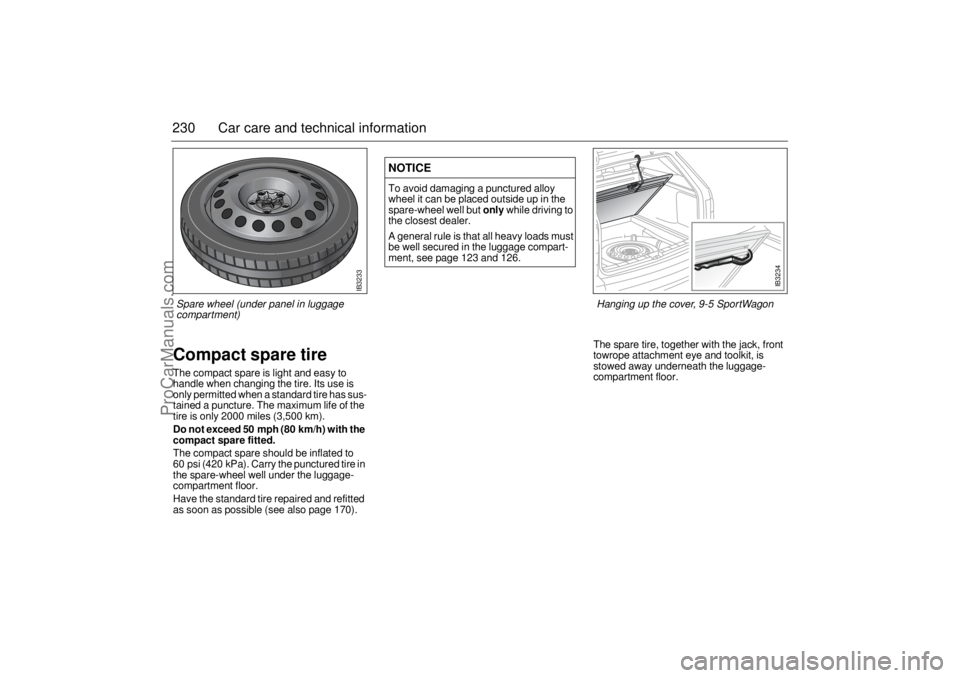
230 Car care and technical informationCompact spare tireThe compact spare is light and easy to
handle when changing the tire. Its use is
only permitted when a standard tire has sus-
tained a puncture. The maximum life of the
tire is only 2000 miles (3,500 km).Do not exceed 50 mph (80 km/h) with the
compact spare fitted.The compact spare should be inflated to
60 psi (420 kPa). Carry the punctured tire in
the spare-wheel well under the luggage-
compartment floor.
Have the standard tire repaired and refitted
as soon as possible (see also page 170).The spare tire, together with the jack, front
towrope attachment eye and toolkit, is
stowed away underneath the luggage-
compartment floor.
NOTICETo avoid damaging a punctured alloy
wheel it can be placed outside up in the
spare-wheel well but
only
while driving to
the closest dealer.
A general rule is that all heavy loads must
be well secured in the luggage compart-
ment, see page 123 and 126.
IB3234
Hanging up the cover, 9-5 SportWagon
IB3233
Spare wheel (under panel in luggage
compartment)
ProCarManuals.com
Page 233 of 276

231 Car care and technical information
Changing a wheel
WARNING
Lifting a vehicle and getting under it to do
maintenance or repairs is dangerous
without the appropriate safety equipment
and training. The jack provided with your
vehicle is designed only for changing a
flat tire. If it is used for anything else, you
or others could be badly injured or killed if
the vehicle slips off the jack. Use the jack
provided with your vehicle only for chang-
ing a flat tire.
Changing a tire can be dangerous. The
vehicle can slip off the jack and roll over
or fall on you or other people. You and
they could be badly injured or even killed.
Find a level place to change your tire. To
help prevent the vehicle from moving:
1 Set the parking brake firmly.
2 If you have an automatic transmis-
sion, put the shift lever in PARK (P).
For a manual transmission, leave the
car in gear (1st or REVERSE (R)).
3 Turn off the engine and do not restart
while the vehicle is raised.
4 Do not allow passengers to remain in
the vehicle.
To be even more certain the vehicle won't
move, you should put blocks at the front
and rear of the tire farthest away from the
one being changed. That would be the
tire, on the other side, at the opposite end
of the vehicle.
The car jack is designed solely for use
in changing a wheel or fitting snow
chains.
It must not be used to
support the car during repair work
or servicing.
Never
crawl under a car that is
supported only by a jack.
Raising your vehicle too high or with
the jack improperly positioned can
damage the vehicle and even make
the vehicle fall. To help avoid personal
injury and vehicle damage, be sure to
fit the jack lift head into the proper
location before raising the vehicle, and
raise the vehicle only far enough off
the ground so there is enough room for
the spare tire to fit (no more than 25
mm or 1 inch clearance between the
ground and the bottom of the tire).
Switch on the hazard warning lights if
the car is on a road.
The jack should be stored correctly
under the carpeting in the trunk. If it
lies loose in the car, it could thrown
forward and cause personal injury in
the event of a crash or if the car rolls
over.
Grit, salt and rust can clog the inner
threads of the wheel bolts if the car has
been driven for several years exclu-
sively with alloy wheels.
If steel wheels are being installed, the
bolt hole threads in the brake hubs
should be cleaned before the thinner
steel wheels are fitted. It may other-
wise not be possible to achieve the
correct clamping force, despite tight-
ening the wheel bolts to the correct
torque.
ProCarManuals.com
Page 234 of 276
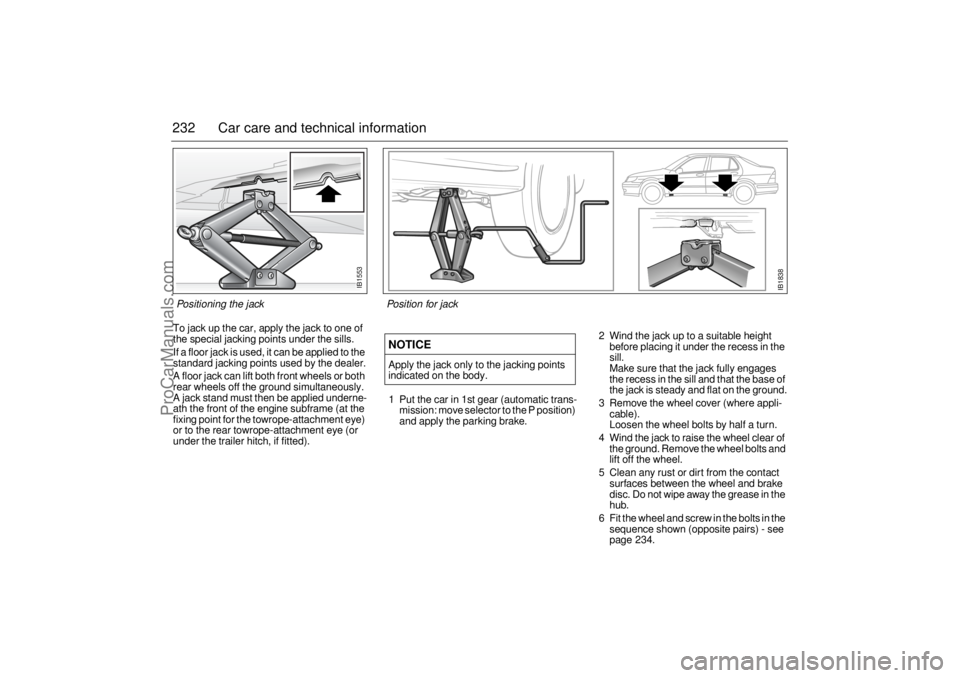
232 Car care and technical informationTo jack up the car, apply the jack to one of
the special jacking points under the sills.
If a floor jack is used, it can be applied to the
standard jacking points used by the dealer.
A floor jack can lift both front wheels or both
rear wheels off the ground simultaneously.
A jack stand must then be applied underne-
ath the front of the engine subframe (at the
fixing point for the towrope-attachment eye)
or to the rear towrope-attachment eye (or
under the trailer hitch, if fitted).1 Put the car in 1st gear (automatic trans-
mission: move selector to the P position)
and apply the parking brake.2 Wind the jack up to a suitable height
before placing it under the recess in the
sill.
Make sure that the jack fully engages
the recess in the sill and that the base of
the jack is steady and flat on the ground.
3 Remove the wheel cover (where appli-
cable).
Loosen the wheel bolts by half a turn.
4 Wind the jack to raise the wheel clear of
the ground. Remove the wheel bolts and
lift off the wheel.
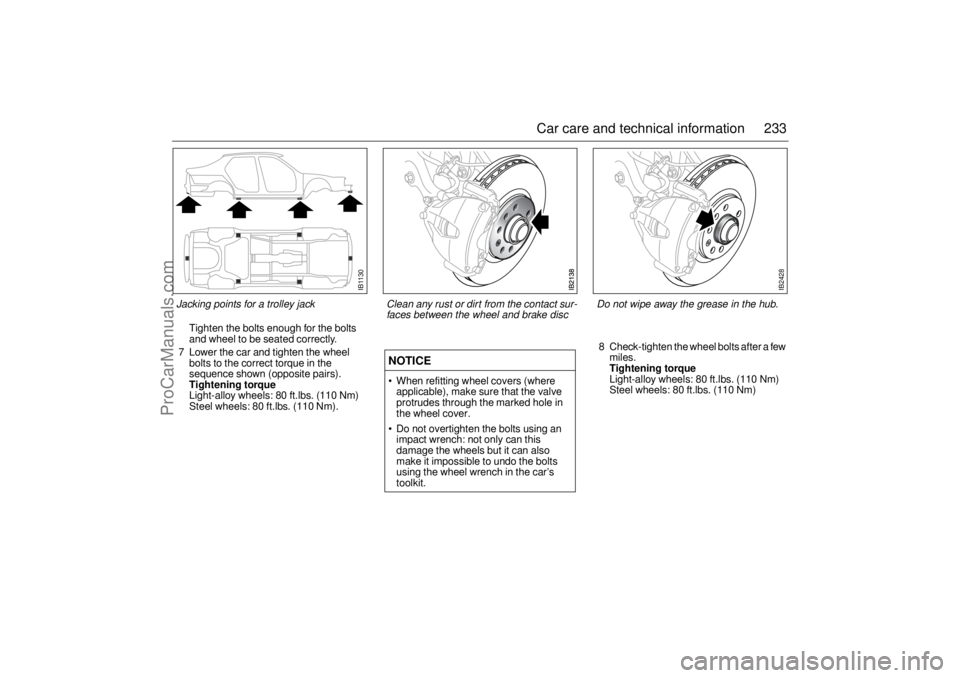
5 Clean any rust or dirt from the contact
surfaces between the wheel and brake
disc. Do not wipe away the grease in the
hub.
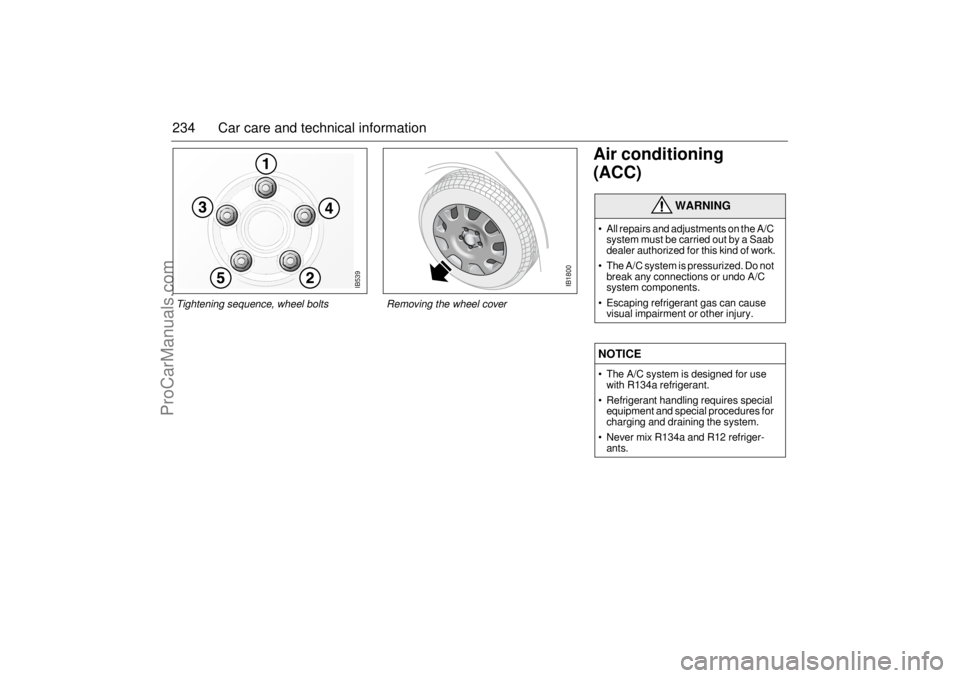
6 Fit the wheel and screw in the bolts in the
sequence shown (opposite pairs) - see
page 234.
NOTICEApply the jack only to the jacking points
indicated on the body.Position for jack
IB1838
IB1553
Positioning the jack
ProCarManuals.com
Page 235 of 276
233 Car care and technical information
Tighten the bolts enough for the bolts
and wheel to be seated correctly.
7 Lower the car and tighten the wheel
bolts to the correct torque in the
sequence shown (opposite pairs).Tightening torqueLight-alloy wheels: 80 ft.lbs. (110 Nm)
Steel wheels: 80 ft.lbs. (110 Nm).
8 Check-tighten the wheel bolts after a few
miles.Tightening torqueLight-alloy wheels: 80 ft.lbs. (110 Nm)
Steel wheels: 80 ft.lbs. (110 Nm)
NOTICE When refitting wheel covers (where
applicable), make sure that the valve
protrudes through the marked hole in
the wheel cover.
Do not overtighten the bolts using an
impact wrench: not only can this
damage the wheels but it can also
make it impossible to undo the bolts
using the wheel wrench in the car’s
toolkit. Clean any rust or dirt from the contact sur-
faces between the wheel and brake disc
IB2428
Do not wipe away the grease in the hub.
IB1130
Jacking points for a trolley jack
ProCarManuals.com
Page 236 of 276
234 Car care and technical information
Air conditioning
(ACC)
WARNING
All repairs and adjustments on the A/C
system must be carried out by a Saab
dealer authorized for this kind of work.
The A/C system is pressurized. Do not
break any connections or undo A/C
system components.
Escaping refrigerant gas can cause
visual impairment or other injury.NOTICE The A/C system is designed for use
with R134a refrigerant.
Refrigerant handling requires special
equipment and special procedures for
charging and draining the system.
Never mix R134a and R12 refriger-
ants.
IB1800IB1800
Removing the wheel cover
IB539
Tightening sequence, wheel bolts
ProCarManuals.com
Page 242 of 276

240 Car care and technical informationAnti-corrosion
treatmentThe entire car is corrosion-protected at the
factory in different stages by an electrolytic
immersion coating and a PVC-based pro-
tective coating to protect against corrosion
caused by stones flung up by the wheels. A
thin penetrating anti-rust oil is also applied
in cavities and body members.
In addition to conventional anti-corrosion
treatment like painting, underbody treat-
ment and cavity treatment, most of the body
panel surfaces are galvanized. These
include the hood, the doors and the under-
body.
The anti-corrosion treatment on the under-
side of the car and inside the wheel arches
is particularly exposed to constant wear and
possible damage, the degree of which will
obviously depend on driving conditions.
What causes rust?Steel body panels of automobiles are sub-
ject to rusting whenever air and moisture
manage to penetrate the protective finish,
and body panels may rust through if the pro-
cess is unchecked. Rusting can occur
wherever water is trapped or where the
car’s panels are continuously damp.
Damage to paint and undercoating by sto-
nes, gravel and minor crashes immediately
exposes metal to air and moisture. Road
salts used for de-icing will collect on the
bottom of the car and promote rusting.
Areas of the country with high humidity have
great potential for rust problems, especially
where salt is used on roads or there is moist
sea air. Industrial pollution (fallout) may also
damage paint and promote rusting.
Preventive maintenanceThe following procedures are necessary to
help protect against rusting. Refer also to
the terms and conditions of the Sheet Metal
Coverage described in the warranty
booklet.
1
Wash the car frequently, and wax at
least twice a year.
Under adverse con-
ditions, where there is a rapid buildup of
dirt, sand or road salt, wash your car at
least once a week. After extreme expo-
sure to salted snow or slush, evidenced
by a white film on the car, wash the car
immediately. Frequent washing will pre-
vent paint damage from acid rain and
other airborne contaminants such as
tree sap and bird droppings. If any of
these contaminants are noticed on the
car the finish should be washed immedi-
ately.
Begin washing by rinsing the entire car
with water to loosen and flush off heavy
concentrations of dirt (include the
underbody).
Sponge the car with a solution of either
a good quality car soap or mild general
purpose (dish washing) detergent and
water.
Rinse car thoroughly with clean water.
After washing, check and clear all
drains in doors and body panels.
Wipe the car dry, preferably using a
chamois.
ProCarManuals.com
Page 243 of 276

241 Car care and technical information
2Clean the underside of the car during
the winter.
Use high pressure water to
clean the car’s underside (floor panels,
wheel wells) at least at mid- winter and
in the spring.
3
Inspect the car frequently for leaks or
damage, and arrange for needed
repairs promptly.
After washing or after
heavy rain, check for leaks. When wash-
ing the car inspect body surfaces for
paint damage. While checking for leaks,
lift the floor mats and check beneath
them. Water can collect in these areas
and remain for prolonged periods. Dry
any wet areas including the floor mats.
Have leaks repaired as soon as pos-
sible.
Use touch-up paint to repair small scrat-
ches or minor finish damage. Areas
where metal is exposed will rust quickly
and MUST be repaired immediately by
touch-up or professional repainting.
Rust must be removed, the bare metal
primed and painted. Major body
damage should be repaired immediately
and new panels or exposed areas
should be undercoated with anti- corro-
sion material.
Repairs of this type are the owner’s
responsibility and are not covered under
warranty.4
Inspect the undercoating and touch
up if necessary.
Pay particular atten-
tion to the fenders and wheel housings,
which are exposed to abrasion by flying
gravel, etc. If the composition has worn
or flaked off, the steel must be tho-
roughly cleaned and dried before a fresh
coat is applied. The cleaning is best
done with a scraper and a steel wire
brush, followed by washing with solvent.
Apply the new coating thinly, as other-
wise it may run off or fall off when dry.
For long tripsBefore setting off on a long journey, it is
advisable to have your car checked over by
your Saab dealer.
Obtain a few important items to take along
on your journey such as spare bulbs, wiper
blades, fuses, a Poly-V-belt and the like.
You can check some points yourself befor-
ehand:
Make sure that the engine is in good con-
dition.
Check that no oil or gasoline leaks out of
the engine or gearbox/transmission.
Check the coolant and power steering
fluid levels. Check also for leaks.
Inspect the Poly-V-belt and replace it if it
shows any signs of hard wear.
Check the battery charge.
Check the tires for tread pattern and air
pressure, including the compact spare
wheel.
Check the brakes.
Check all bulbs.
Check for the presence of the tool kit and
the jack in the car.
ProCarManuals.com
Page 244 of 276

242 Car care and technical informationRecovery and/or
recycling of automotive
materialsA typical car consists of metals (65–75 %),
plastics (10–15 %), rubber (5 %) and small
quantities of glass, wood, paper and texti-
les. The recycling of metals has been com-
monplace for a long time now.
To facilitate sorting of other materials for
recycling, plastic parts, for instance, have
been marked to identify the precise nature
of the plastic.
The quantity of materials in the car that can
be recycled or recovered depends on the
scrapping facilities in different countries. EU
legislation that comes into force in 2006 will
require a minimum of 85 % of the total
weight of materials to be recycled. Howe-
ver, every major car salvage yard in each
market will receive details from Saab of how
the highest percentage of materials can be
reclaimed.
Headlight aimingThe vehicle has a visual optical headlight
aiming system equipped with vertical
aiming device. The aim has been preset at
the factory and should normally not need
further adjustments.
If your headlights are damaged in a crash,
the headlight aim may be affected. If you
believe your headlights need to be re-
aimed, we recommend that you take it to
your Saab dealer for service, however, it is
possible for you to re-aim your headlights as
described in the following procedure.To check the aim, the vehicle should be pro-
perly prepared as follows:
The vehicle shall be placed so that the
headlights are 25 ft (7.6 m) from a light
colored wall or other flat surface. The
aiming area should be darkened, this will
improve your ability to see the beam of the
low beam headlight being aimed.
The vehicle must have all four wheels on
a perfectly level surface which is level all
the way to the wall or other flat surface.
The vehicle should be placed so it is per-
pendicular to the wall or other flat surface.
The vehicle should be unloaded and fuel
tank full, and one person or 160 lbs.
(75 kg) on the drivers seat.
WARNING
Before checking/adjusting the headlight
aiming, switch off the engine to avoid
danger of fingers and hands being injured
by moving parts.
The radiator fan can start up even when
the engine is switched off.NOTICETo make sure that your headlights are
aimed properly read all instructions
before beginning. Failure to follow these
instructions could cause damage to
headlight parts or a not correctly aimed
headlight.
ProCarManuals.com
Page 251 of 276

249 Customer Assistance and Information
Vehicle Data Collection and
Event Data RecordersYour vehicle, like other modern motor vehi-
cles, has a number of sophisticated com-
puter systems that monitor and control sev-
eral aspects of the vehicle’s performance.
Your vehicle uses on-board vehicle comput-
ers to monitor emission control components
to optimize fuel economy, to monitor condi-
tions for air bag deployment and, if so
equipped, to provide anti-lock braking and
to help the driver control the vehicle in diffi-
cult driving situations. Some information
may be stored during regular operations to
facilitate repair of detected malfunctions;
other information is stored only in a crash
event by computer systems commonly
called event data recorders (EDR).
In a crash event, computer systems, such
as the Air Bag Sensing and Diagnostic
Module (SDM) in your vehicle may record
information about the condition of the vehi-
cle and how it was operated, such as data
related to engine speed, brake application,
throttle position, vehicle speed, steering
wheel angle, lateral acceleration, safety belt
usage, air bag readiness, air bag perfor-
mance, and the severity of a collision. This
information has been used to improve vehi-
cle crash performance and may be used to
improve crash performance of future vehi-
cles and driving safety. Unlike the data
recorders on many airplanes, these on-
board systems do not record sounds, such
as conversation of vehicle occupants.To read this information, special equipment
is needed and access to the vehicle or the
SDM is required.
Saab will not access information about a
crash event or share it with others other than
with the consent of the vehicle owner or, if
the vehicle is leased, with the consent of
the lessee,
in response to an official request of police
or similar government office,
as part of Saab’s defense of litigation
through the discovery process, or
as required by law.
In addition, once Saab collects or receives
data, Saab may
use the data for Saab research needs,
make it available for research where
appropriate confidentiality is to be main-
tained and need is shown, or
share summary data which is not tied to a
specific vehicle with non-Saab organiza-
tions for research purposes.
Others, such as law enforcement, may have
access to the special equipment that can
read the information if they have access to
the vehicle or SDM.
If your vehicle is equipped with OnStar®,
please check lthe OnStar® subscription
service agreement or manual for informa-
tion on its operations and data collection.
ProCarManuals.com
Page 253 of 276
251 Specifications
General_______________ 252
Engine _______________ 254
Fuel__________________ 254
Engine oil _____________ 255
Engine variants ________ 256
Electrical system_______ 257
Drive belts ____________ 257
Manual gearbox________ 258
Automatic transmission _ 258
Suspension ___________ 259
Steering ______________ 259
Brake system__________ 259
Wheels and tires _______ 260
Plates and labels _______ 262
IB603
Specifications
ProCarManuals.com