battery SAAB 9-5 2005 Owners Manual
[x] Cancel search | Manufacturer: SAAB, Model Year: 2005, Model line: 9-5, Model: SAAB 9-5 2005Pages: 276, PDF Size: 16.72 MB
Page 8 of 276
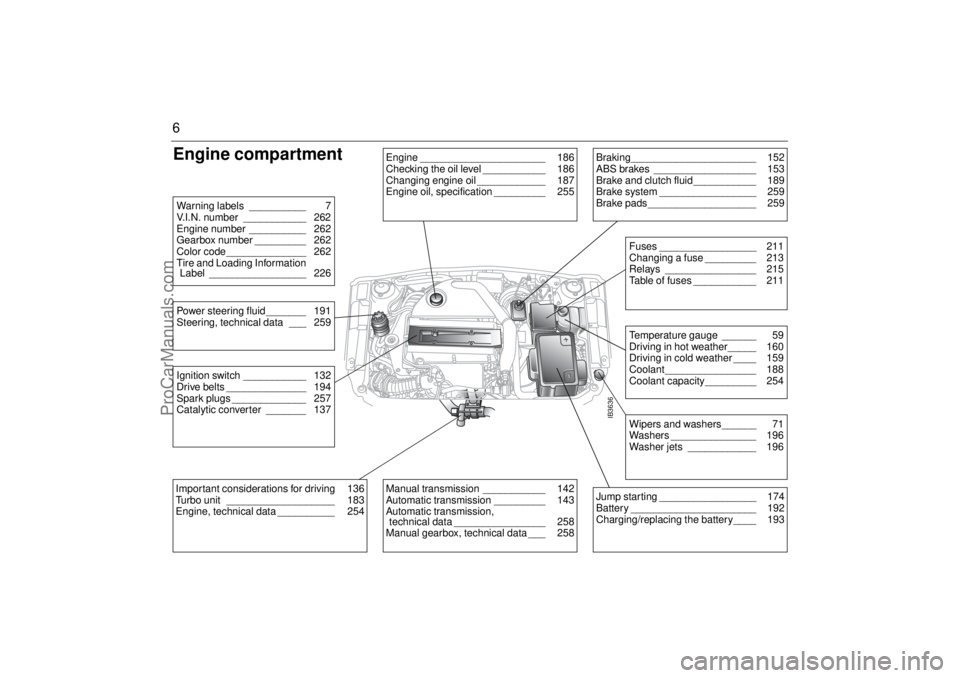
6Engine compartment
IB3636
Engine ______________________ 186
Checking the oil level ___________ 186
Changing engine oil ____________ 187
Engine oil, specification _________ 255
Braking______________________ 152
ABS brakes __________________ 153
Brake and clutch fluid ___________ 189
Brake system _________________ 259
Brake pads ___________________ 259
Fuses _________________ 211
Changing a fuse _________ 213
Relays ________________ 215
Table of fuses ___________ 211Temperature gauge ______ 59
Driving in hot weather_____ 160
Driving in cold weather ____ 159
Coolant________________ 188
Coolant capacity_________ 254
Power steering fluid _______ 191
Steering, technical data ___ 259
Wipers and washers ______ 71
Washers _______________ 196
Washer jets ____________ 196
Jump starting _________________ 174
Battery ______________________ 192
Charging/replacing the battery____ 193
Manual transmission ___________ 142
Automatic transmission _________ 143
Automatic transmission,
technical data ________________ 258
Manual gearbox, technical data ___ 258
Important considerations for driving 136
Turbo unit ___________________ 183
Engine, technical data __________ 254Ignition switch ___________ 132
Drive belts ______________ 194
Spark plugs _____________ 257
Catalytic converter _______ 137Warning labels __________ 7
V.I.N. number ___________ 262
Engine number __________ 262
Gearbox number _________ 262
Color code______________ 262
Tire and Loading Information
Label _________________ 226
ProCarManuals.com
Page 9 of 276
7
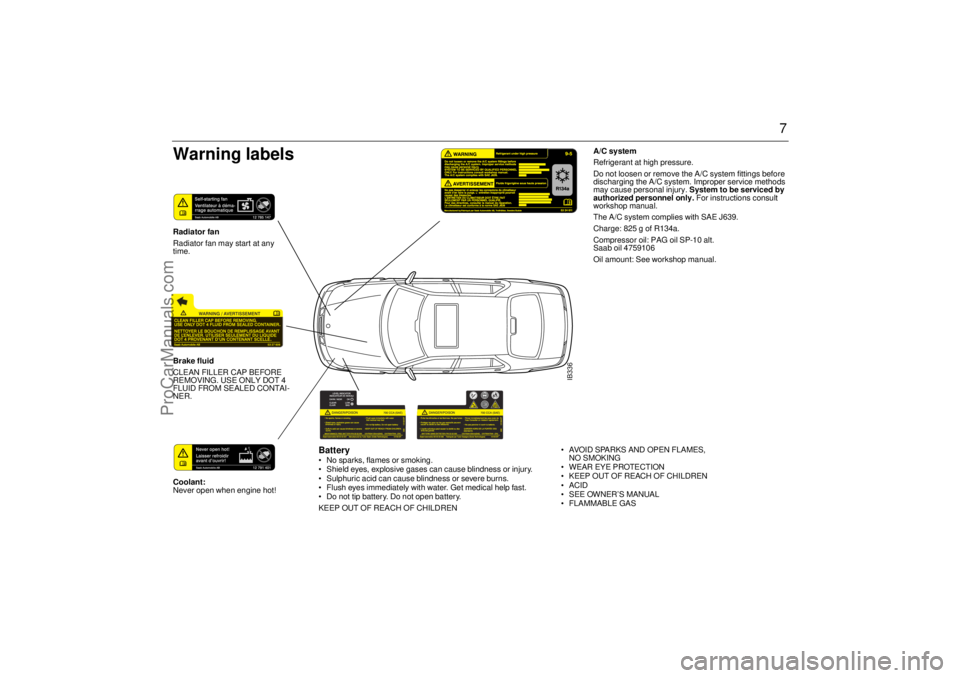
Battery No sparks, flames or smoking.
Shield eyes, explosive gases can cause blindness or injury.
Sulphuric acid can cause blindness or severe burns.
Flush eyes immediately with water. Get medical help fast.
Do not tip battery. Do not open battery.
KEEP OUT OF REACH OF CHILDREN Brake fluid
CLEAN FILLER CAP BEFORE
REMOVING. USE ONLY DOT 4
FLUID FROM SEALED CONTAI-
NER. Radiator fan
Radiator fan may start at any
time.
IB336
A/C system
Refrigerant at high pressure.
Do not loosen or remove the A/C system fittings before
discharging the A/C system. Improper service methods
may cause personal injury. System to be serviced by
authorized personnel only. For instructions consult
workshop manual.
The A/C system complies with SAE J639.
Charge: 825 g of R134a.
Compressor oil: PAG oil SP-10 alt.
Saab oil 4759106
Oil amount: See workshop manual.
Warning labels
AVOID SPARKS AND OPEN FLAMES,
NO SMOKING
WEAR EYE PROTECTION
KEEP OUT OF REACH OF CHILDREN
ACID
SEE OWNER’S MANUAL
FLAMMABLE GAS
Coolant:
Never open when engine hot!
ProCarManuals.com
Page 11 of 276
9
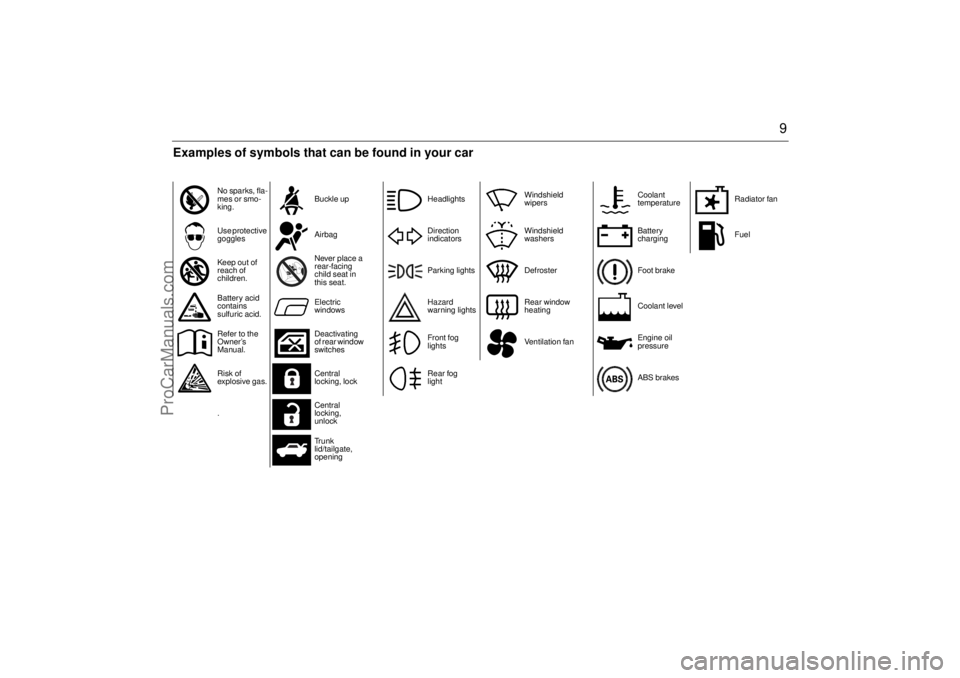
No sparks, fla-
mes or smo-
king.Buckle up
Use protective
gogglesAirbag
Keep out of
reach of
children.Never place a
rear-facing
child seat in
this seat.
Battery acid
contains
sulfuric acid.Electric
windows
Refer to the
Owner’s
Manual.Deactivating
of rear window
switches
Risk of
explosive gas.Central
locking, lock
.Central
locking,
unlock
Tr u n k
lid/tailgate,
opening
HeadlightsWindshield
wipers
Direction
indicatorsWindshield
washers
Parking lights Defroster
Hazard
warning lightsRear window
heating
Front fog
lightsVentilation fan
Rear fog
light
Coolant
temperatureRadiator fan
Battery
chargingFuel
Foot brake
Coolant level
Engine oil
pressure
ABS brakes
Examples of symbols that can be found in your car
ProCarManuals.com
Page 22 of 276
20 Safety
WARNING
Safety belts are designed to bear upon
the bony structure of the body, and
should be worn low across the front of
the pelvis or the pelvis, chest and
shoulders, as applicable; wearing the
lap section of the belt across the abdo-
minal area must be avoided.
Safety belts should be adjusted as
firmly as possible, consistent with
comfort, to provide the protection for
which they have been designed. A
loose belt will greatly reduce the pro-
tection afforded to the wearer.
Care should be taken to avoid conta-
mination of the webbing with polishes,
oils and chemicals, and particularly
battery acid. Cleaning may safely be
carried out using mild soap and water.
The belt should be replaced if webbing
becomes frayed, contaminated or
damaged.
It is essential to replace the entire
assembly after it has been worn in a
severe impact even if damage to the
assembly is not obvious.
Belts should not be worn with straps
twisted.
Each belt assembly must only be used
by one occupant; it is dangerous to put
a belt around a child being carried on
the occupant´s lap.
No modifications or additions should
be made by the user which will either
prevent the safety belt adjusting
device from operating to remove
slack, or prevent the safety belt
assembly from being adjusted to
remove slack.
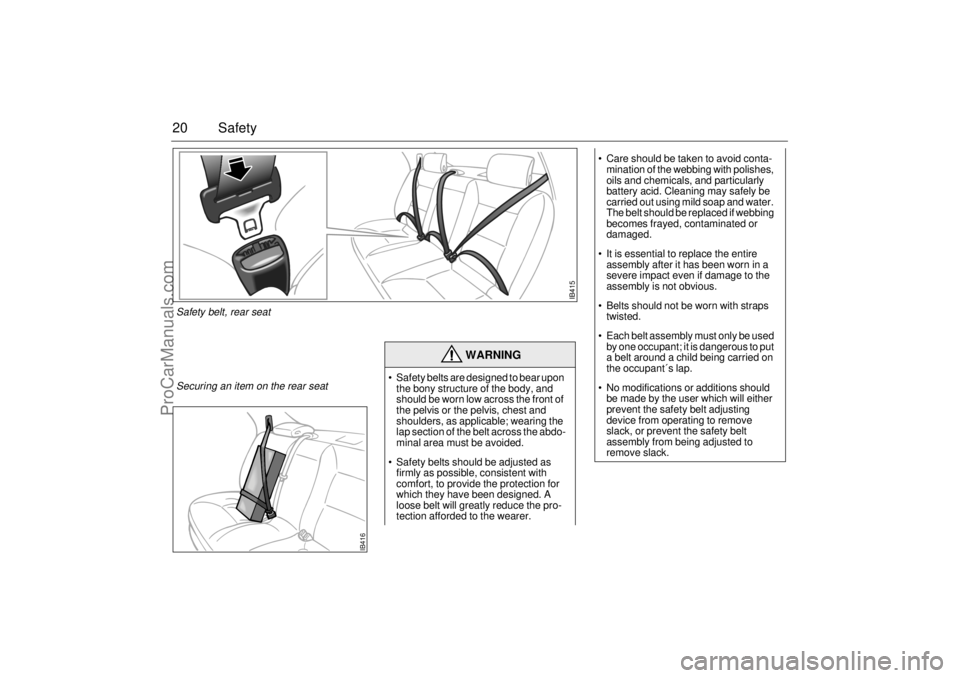
IB416
Securing an item on the rear seat
IB???IB415
Safety belt, rear seat
ProCarManuals.com
Page 37 of 276

35 Safety
AIRBAG servicingThe airbag must be inspected as part of the
normal service program but otherwise may
be regarded as maintenance-free.Scrapping or working on airbags
and belt pretensioners Frequently asked questions on
function of airbags
Do you still need to wear a
safety b
elt if air-
bags are fitted?
Yes, always! The airbag merely supple-
ments the car’s normal safety system.
Moreover, the airbag will only be actuated in
a moderate to severe frontal, or near-frontal
crash, which means, of course, that it provi-
des no protection in minor frontal crashes,
major rear-end or side-on crashes or if the
car rolls over.
The safety belts help reduce the chance of
the car occupants from being thrown around
and injured or killed inside the car.
But they also ensure that, if a crash occurs
in which the airbags are inflated, the airbag
will make the optimum contact with the
occupant, i.e. square on from the front. If the
occupant meets the airbag in an offset posi-
tion, the protection afforded will be reduced.
In addition, airbags provide no protection
against a secondary impact occurring in the
same incident. So there is no doubt about
the benefit of wearing safety belts at all
times.
Do not sit too close to the airbag: it needs
room to inflate.
The airbag inflates very quickly and power-
fully in order to protect an adult person,
before they are thrown forward, in a serious
frontal crash.
WARNING
Under no circumstances should any
modifications be made that affect the
steering wheel or the airbag’s electri-
cal circuitry.
Before starting any welding work on
the car, always disconnect the nega-
tive (–) battery lead and cover the con-
ductor.
Airbags and belt pretensioners must
be deployed under controlled condi-
tions before the car is scrapped or any
of the system’s components are remo-
ved. Airbags or belt pretensioners that
have been deployed as a result of a
crash must be replaced by new ones.
Airbag-system components must
never be transferred for use in another
vehicle.
All work involving the scrapping or
replacement of airbags or belt preten-
sioners must only be carried out by
knowledgeable personnel.
The headlining and roof pillar trim
must not be modified in any way. Work
on these areas must only be carried
out at a Saab dealer.
ProCarManuals.com
Page 41 of 276
39 Security
To check the number of keys that are pro-
grammed for the car; see page 48.
Locking/unlocking the carWhen the car is locked and unlocked the
theft alarm is also affected.
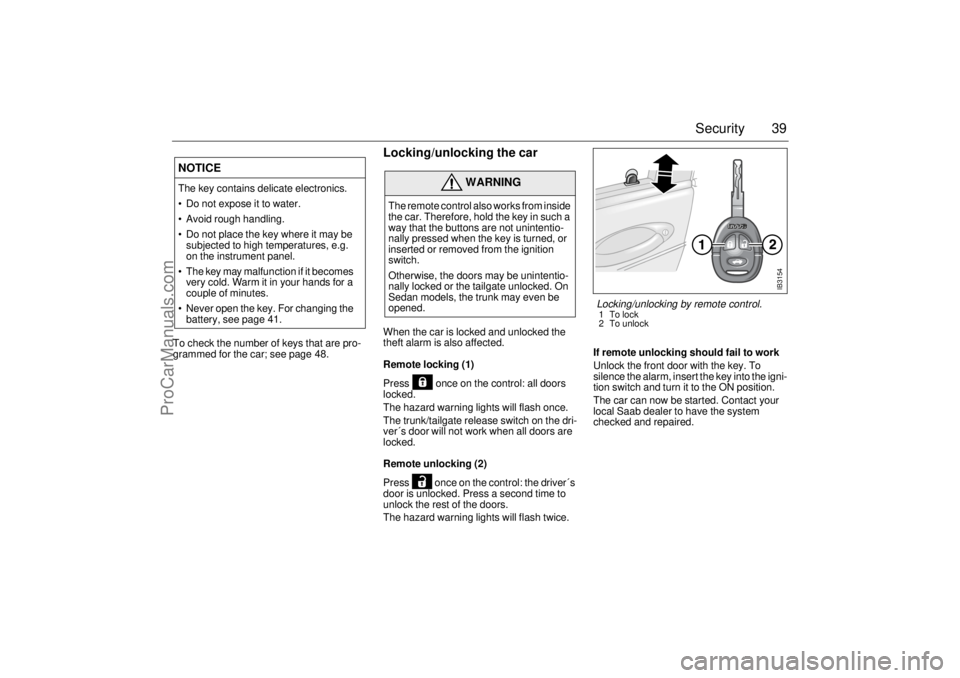
Remote locking (1)
Press once on the control: all doors
locked.
The hazard warning lights will flash once.
The trunk/tailgate release switch on the dri-
ver´s door will not work when all doors are
locked.
Remote unlocking (2)
Press once on the control: the driver´s
door is unlocked. Press a second time to
unlock the rest of the doors.
The hazard warning lights will flash twice.If remote unlocking should fail to work
Unlock the front door with the key. To
silence the alarm, insert the key into the igni-
tion switch and turn it to the ON position.
The car can now be started. Contact your
local Saab dealer to have the system
checked and repaired.
NOTICEThe key contains delicate electronics.
Do not expose it to water.
Avoid rough handling.
Do not place the key where it may be
subjected to high temperatures, e.g.
on the instrument panel.
The key may malfunction if it becomes
very cold. Warm it in your hands for a
couple of minutes.
Never open the key. For changing the
battery, see page 41.
WARNING
The remote control also works from inside
the car. Therefore, hold the key in such a
way that the buttons are not unintentio-
nally pressed when the key is turned, or
inserted or removed from the ignition
switch.
Otherwise, the doors may be unintentio-
nally locked or the tailgate unlocked. On
Sedan models, the trunk may even be
opened.
IB3154
Locking/unlocking by remote control.1To lock
2 To unlock
ProCarManuals.com
Page 43 of 276
41 Security
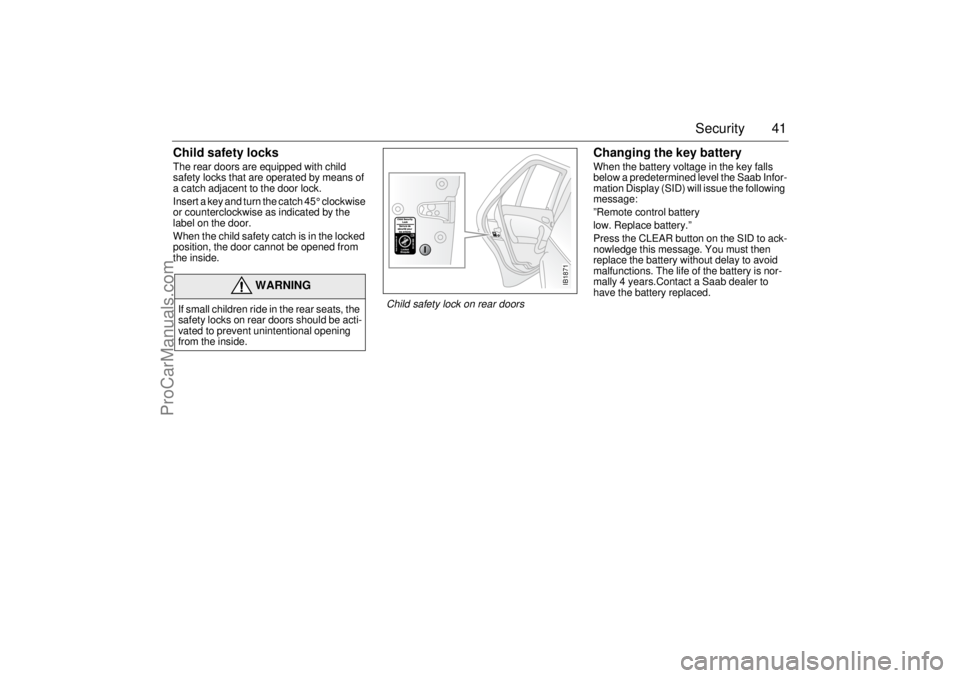
Child safety locksThe rear doors are equipped with child
safety locks that are operated by means of
a catch adjacent to the door lock.
Insert a key and turn the catch 45° clockwise
or counterclockwise as indicated by the
label on the door.
When the child safety catch is in the locked
position, the door cannot be opened from
the inside.
Changing the key batteryWhen the battery voltage in the key falls
below a predetermined level the Saab Infor-
mation Display (SID) will issue the following
message:
”Remote control battery
low. Replace battery.”
Press the CLEAR button on the SID to ack-
nowledge this message. You must then
replace the battery without delay to avoid
malfunctions. The life of the battery is nor-
mally 4 years.Contact a Saab dealer to
have the battery replaced.
WARNING
If small children ride in the rear seats, the
safety locks on rear doors should be acti-
vated to prevent unintentional opening
from the inside.
IB1871
Child safety lock on rear doors
ProCarManuals.com
Page 48 of 276

46 SecurityAlarm signals When the car alarm is armed, it will be trig-
gered if any door, or the trunk lid or hood, is
opened.
The alarm will also be triggered if an attempt
is made to bypass or short-circuit the igni-
tion switch, or to disconnect the battery.
If the alarm is triggered, the following alarm
signals will be set off:
Flashing of hazard warning lights for five
minutes.
Horn wailing for 30 seconds.
The alarm signals will stop if the alarm is
deactivated (car unlocked) during the alarm
period.
Panic-functionIn the car alarm system there is a feature
called "Panic-function".
To activate panic function:
Push and hold one of the buttons on the
key for 2 seconds. Or, if you are sitting
inside the car, push the LOCK-switch on
the center console for 2 seconds.
These actions will trigger the alarm (hazard
warning lights and horn).
To deactivate panic function:
Push one of the buttons on the key, push
the LOCK-switch in the center console,
turn the key in the driver´s door or turn the
ignition to ON.
When the panic-function is activated the car
will be locked/unlocked depending upon
which button was pushed.
When the ignition is ON the panic-function
cannot be activated.
ProCarManuals.com
Page 49 of 276

47 Security
Overview of functions
Alarm signals may differ between model variants for different
countries.
Some of the car-alarm functions can be reprogrammed – con-
sult your Saab dealer for further details (see page 264). Locking/
activation Hazard warning lights flash once.
The LED will come on for 10 seconds.
Unlocking/
deactivation Hazard warning lights flash twice.
The LED will come on for two seconds.
Unlocking/
deactivation of
trunk lid/tailgate
alarm Hazard warning lights flash three times.
The LED will flash three times per second for
10 seconds.
Alarm triggered Hazard warning lights flash for 5 min.
Horn wails for 30 seconds.
To switch off the alarm, deactivate the system in
the normal way (unlocking).
Key The range of the key is normally 5–10 yds. (5–
10 metres), although it can be substantially more
than this in ideal conditions (range can vary gre-
atly depending on the position of the car and its
surroundings).
If the key is not working, it may be because the
code signal has not been synchronized with that
in the control module for the car alarm. To rectify
this, press the unlock button on the key at least
four times in quick succession. When it is recog-
nized, the door locks will cycle.
If a key is lost, the new one will have to be pro-
grammed (all keys must be present) to match the
car’s unique security code. Contact an author-
ized Saab dealer.Battery for key The battery for the key will normally have a life of
4 years. When the battery needs changing,
”Remote control battery
low. Replace battery.”
will appear on the Saab Information Display
(SID).
Contact an authorized Saab dealer.
Car-battery
voltage If the battery is disconnected while the alarm is
active (car is locked), for example during an
attempt to steal the car, the alarm will be
triggered.
ProCarManuals.com
Page 50 of 276

48 SecurityOverview of LED signals and SID messagesSome signals may differ between model variants for different
countries. Status LED signal
Activation (during 10-second delay). Comes on for 10 seconds.
Alarm activated (after delay). Flashes once every other
second.
Deactivation. Comes on for 2 seconds.
Alarm not activated. Off.
Door, trunk lid/tailgate or hood open
or opened during delay period.Flashes three times per
second for 10 seconds.
Unlocking the trunk lid/tailgate. Flashes three times per
second for 10 seconds.
Closing of door, trunk lid/tailgate or
hood after delay period.Comes on for 10 seconds.
Car immobilized but not locked.
Car alarm not activated.Flashes twice at three
seconds intervals.
Fault in a switch serving doors, hood
or trunk lid.Flashing (instead of being
on continuously) during
delay period.
SID message Reason/action
Theft protection failure.
Contact service.Probably a fault in one of the sensors
or the horn.
Have the car checked by an authori-
zed Saab dealer.
Key not accepted.
Contact service.Fault in key transmitter or in igni-
tion-switch receiver.
Turn ignition switch to ON and press
the unlock button on the key. Start
the engine.
Have the car checked by an authori-
zed Saab dealer.
Remote control battery
low. Replace battery.Fit a new battery in the key, see
page 41.
REMOTE KEY
TRANSPONDRTurn the ignition key to position ON
and then press the button for ope-
ning the trunk lid. Saab Information
Display (SID) displays the number of
keys and transmitters (transponders)
coded to the car.
ProCarManuals.com