hood open SAAB 9-5 2005 Owners Manual
[x] Cancel search | Manufacturer: SAAB, Model Year: 2005, Model line: 9-5, Model: SAAB 9-5 2005Pages: 276, PDF Size: 16.72 MB
Page 42 of 276
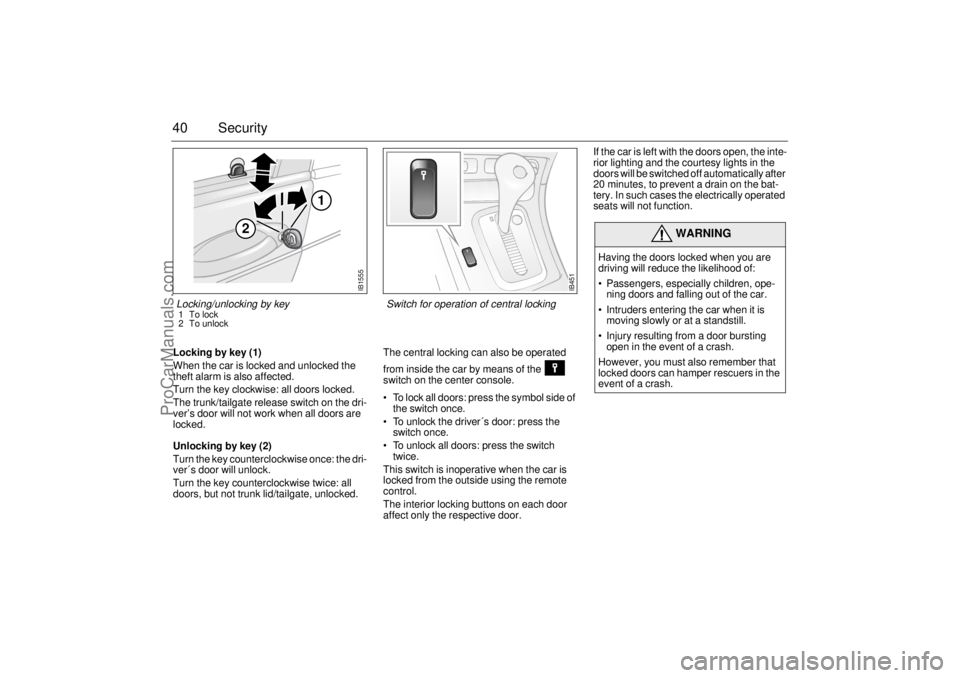
40 SecurityLocking by key (1)
When the car is locked and unlocked the
theft alarm is also affected.
Turn the key clockwise: all doors locked.
The trunk/tailgate release switch on the dri-
ver’s door will not work when all doors are
locked.
Unlocking by key (2)
Turn the key counterclockwise once: the dri-
ver´s door will unlock.
Turn the key counterclockwise twice: all
doors, but not trunk lid/tailgate, unlocked. The central locking can also be operated
from inside the car by means of the
switch on the center console.
To lock all doors: press the symbol side of
the switch once.
To unlock the driver´s door: press the
switch once.
To unlock all doors: press the switch
twice.
This switch is inoperative when the car is
locked from the outside using the remote
control.
The interior locking buttons on each door
affect only the respective door.If the car is left with the doors open, the inte-
rior lighting and the courtesy lights in the
doors will be switched off automatically after
20 minutes, to prevent a drain on the bat-
tery. In such cases the electrically operated
seats will not function.
WARNING
Having the doors locked when you are
driving will reduce the likelihood of:
Passengers, especially children, ope-
ning doors and falling out of the car.
Intruders entering the car when it is
moving slowly or at a standstill.
Injury resulting from a door bursting
open in the event of a crash.
However, you must also remember that
locked doors can hamper rescuers in the
event of a crash.
IB451
Switch for operation of central locking
IB1555
2
1
Locking/unlocking by key1To lock
2 To unlock
ProCarManuals.com
Page 46 of 276
44 SecurityCar alarm The car alarm (anti-theft system) is acti-
vated/deactivated when the car is
locked/unlocked by the remote control or by
the key, see page 39.
The antenna for the alarm system is located
in the center console.
All the doors plus trunk lid/tailgate and hood
are monitored by microswitches.
Your Saab 9-5 is equipped with an Electro-
nic starting interlock (immobilizer), see
page 45 for details.
The car alarm is armed 10 seconds after the
car has been locked by the remote control.
During this ten-second delay period, the
doors, trunk lid/tailgate and hood may still
be opened without the alarm being trigge-
red.
The LED indicator on the instrument panel
fascia will be on continuously during this
period, at the end of which it will start to flash
(once every other second). If a door or the trunk lid/tailgate or hood has
been left open when the car is locked, the
LED on the fascia will flash (three times per
second) for ten seconds to indicate this.
WARNING
Leaving children or pets unattended in a
locked car is dangerous. It is also
dangerous to leave children in a vehicle
with the ignition key. A child or others
could be badly injured or even killed.
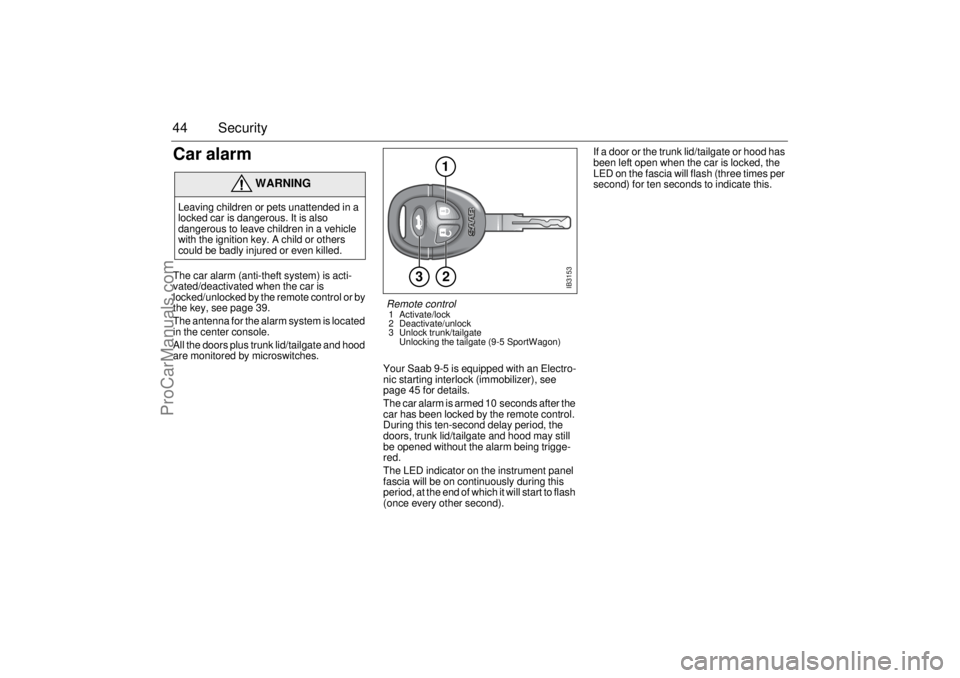
IB3153
3
2 1
Remote control 1 Activate/lock
2 Deactivate/unlock
3 Unlock trunk/tailgate
Unlocking the tailgate (9-5 SportWagon)
ProCarManuals.com
Page 47 of 276

45 Security
Check to ensure that all the doors, plus
trunk lid/tailgate and hood, are closed pro-
perly.
If the fault persists (LED flashing when
another attempt is made to activate the car
alarm by remote control), lock the car using
the key instead. The car alarm will not have
been activated and you should contact an
authorized Saab dealer.
To avoid inconvenience caused by the
alarm being triggered inadvertently, make
sure that anyone else using the car is fami-
liar with how both the car alarm and the lock-
ing system work.
If the alarm is tripped (the direction indica-
tors are flashing and the horn is on) it can be
turned off by unlocking the car using the
button.
Activating the car alarm The car alarm cannot be activated if the dri-
ver’s door is open or if the ignition switch is
in ON position.
If one of the other doors or the trunk or hood
is open or opened and not closed again
during the 10-second delay period, it will be
excluded from the alarm function.
If it is then closed, a new delay period of ten
seconds will start, and the door (or trunk or
hood) will once again be secured by the
alarm system.
As usual, the LED will be on continuously
during the new delay period and will start to
flash once every other second after the
10-second period has elapsed.
Electronic starting interlock
(immobilizer) When the key is inserted in the ignition, a
signal is sent to the receiver. If the signal is
verified, the engine can be started.
Each time the key is removed from the igni-
tion, the electronic immobilizer is activated.
This means that the car cannot be started
without the correct key inserted in the igni-
tion and the immobilizer thus deactivated.
If a fault is detected (e.g. in the transmitter)
”Key not accepted.
Contact service.”
will appear on the Saab Information Display
(SID).
In this case, you can still start the car if you
turn the ignition key to ON and press one of
the buttons on the key (providing that the
receiver gets the right signal from the key).
Take the car to an authorized Saab dealer
to have the system checked.
The LED double-flashes when the car is
immobilized.
ProCarManuals.com
Page 48 of 276

46 SecurityAlarm signals When the car alarm is armed, it will be trig-
gered if any door, or the trunk lid or hood, is
opened.
The alarm will also be triggered if an attempt
is made to bypass or short-circuit the igni-
tion switch, or to disconnect the battery.
If the alarm is triggered, the following alarm
signals will be set off:
Flashing of hazard warning lights for five
minutes.
Horn wailing for 30 seconds.
The alarm signals will stop if the alarm is
deactivated (car unlocked) during the alarm
period.
Panic-functionIn the car alarm system there is a feature
called "Panic-function".
To activate panic function:
Push and hold one of the buttons on the
key for 2 seconds. Or, if you are sitting
inside the car, push the LOCK-switch on
the center console for 2 seconds.
These actions will trigger the alarm (hazard
warning lights and horn).
To deactivate panic function:
Push one of the buttons on the key, push
the LOCK-switch in the center console,
turn the key in the driver´s door or turn the
ignition to ON.
When the panic-function is activated the car
will be locked/unlocked depending upon
which button was pushed.
When the ignition is ON the panic-function
cannot be activated.
ProCarManuals.com
Page 50 of 276

48 SecurityOverview of LED signals and SID messagesSome signals may differ between model variants for different
countries. Status LED signal
Activation (during 10-second delay). Comes on for 10 seconds.
Alarm activated (after delay). Flashes once every other
second.
Deactivation. Comes on for 2 seconds.
Alarm not activated. Off.
Door, trunk lid/tailgate or hood open
or opened during delay period.Flashes three times per
second for 10 seconds.
Unlocking the trunk lid/tailgate. Flashes three times per
second for 10 seconds.
Closing of door, trunk lid/tailgate or
hood after delay period.Comes on for 10 seconds.
Car immobilized but not locked.
Car alarm not activated.Flashes twice at three
seconds intervals.
Fault in a switch serving doors, hood
or trunk lid.Flashing (instead of being
on continuously) during
delay period.
SID message Reason/action
Theft protection failure.
Contact service.Probably a fault in one of the sensors
or the horn.
Have the car checked by an authori-
zed Saab dealer.
Key not accepted.
Contact service.Fault in key transmitter or in igni-
tion-switch receiver.
Turn ignition switch to ON and press
the unlock button on the key. Start
the engine.
Have the car checked by an authori-
zed Saab dealer.
Remote control battery
low. Replace battery.Fit a new battery in the key, see
page 41.
REMOTE KEY
TRANSPONDRTurn the ignition key to position ON
and then press the button for ope-
ning the trunk lid. Saab Information
Display (SID) displays the number of
keys and transmitters (transponders)
coded to the car.
ProCarManuals.com
Page 62 of 276
60 Instruments and controls Check fuse 1 (radiator fan) in the fuse panel
under the hood, see page 215.
If the needle repeatedly enters the red zone,
stop the car as soon as it is safe to do so and
check the coolant level by looking at the
level visible through the plastic tank – do not
remove the cap.
If the coolant level falls below the MIN mark,
the Saab Information Display (SID) will dis-
play the message
”Coolant level low.
Refill.”.
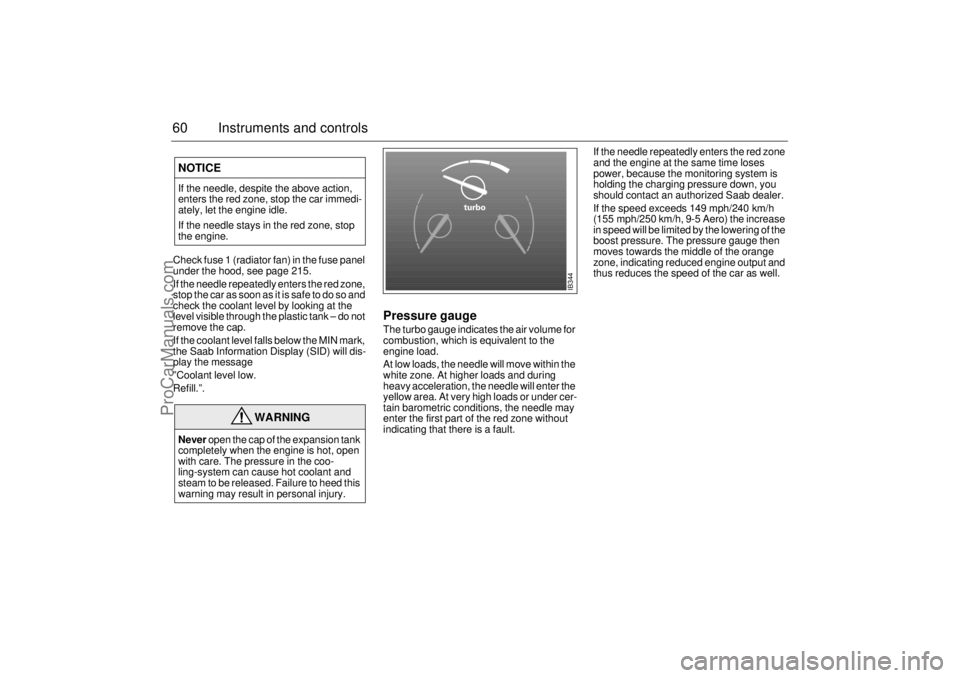
Pressure gaugeThe turbo gauge indicates the air volume for
combustion, which is equivalent to the
engine load.
At low loads, the needle will move within the
white zone. At higher loads and during
heavy acceleration, the needle will enter the
yellow area. At very high loads or under cer-
tain barometric conditions, the needle may
enter the first part of the red zone without
indicating that there is a fault.If the needle repeatedly enters the red zone
and the engine at the same time loses
power, because the monitoring system is
holding the charging pressure down, you
should contact an authorized Saab dealer.
If the speed exceeds 149 mph/240 km/h
(155 mph/250 km/h, 9-5 Aero) the increase
in speed will be limited by the lowering of the
boost pressure. The pressure gauge then
moves towards the middle of the orange
zone, indicating reduced engine output and
thus reduces the speed of the car as well.
NOTICEIf the needle, despite the above action,
enters the red zone, stop the car immedi-
ately, let the engine idle.
If the needle stays in the red zone, stop
the engine.
WARNING
Never open the cap of the expansion tank
completely when the engine is hot, open
with care. The pressure in the coo-
ling-system can cause hot coolant and
steam to be released. Failure to heed this
warning may result in personal injury.
IB344
ProCarManuals.com
Page 75 of 276
73 Instruments and controls
Automatic climate
control (ACC) The ACC system automatically works to
maintain the desired temperature inside the
car.
The system will achieve the desired tempe-
rature in the quickest possible way. Note
that selecting a higher or lower temperature
than that desired will not speed up the pro-
cess.
For the ACC system to be most effective, all
windows (and sunroof, if fitted) should be
closed.
Fresh air for the cabin is drawn in through an
inlet grille adjacent to the bottom edge of the
windshield. The air flows through a filter
upstream of the ACC system before deli-
very to the cabin. Cabin air is evacuated via
openings in the rear parcel shelf and then
through outlets on either side of the car
behind the rear bumper.
The incoming air is treated in three stages:
first it passes through a filter; it is then dehu-
midified and cooled and, finally, if required,
heated.
The filter is a combined particle and char-
coal filter. It is so efficient that levels of nox-
ious substances such as benzene and tolu-
ene are also reduced.To reduce the likelihood of misting on the
insides of the windows, the glass should be
cleaned with a quality window cleaner. How
often this will need to be done depends on
how clean the air is – if there are smokers in
the car, cleaning will need to be done more
frequently.
AUTO
ECON OFF
AUTO
ECON OFF
IB367
9
1
5
4
23
68
7
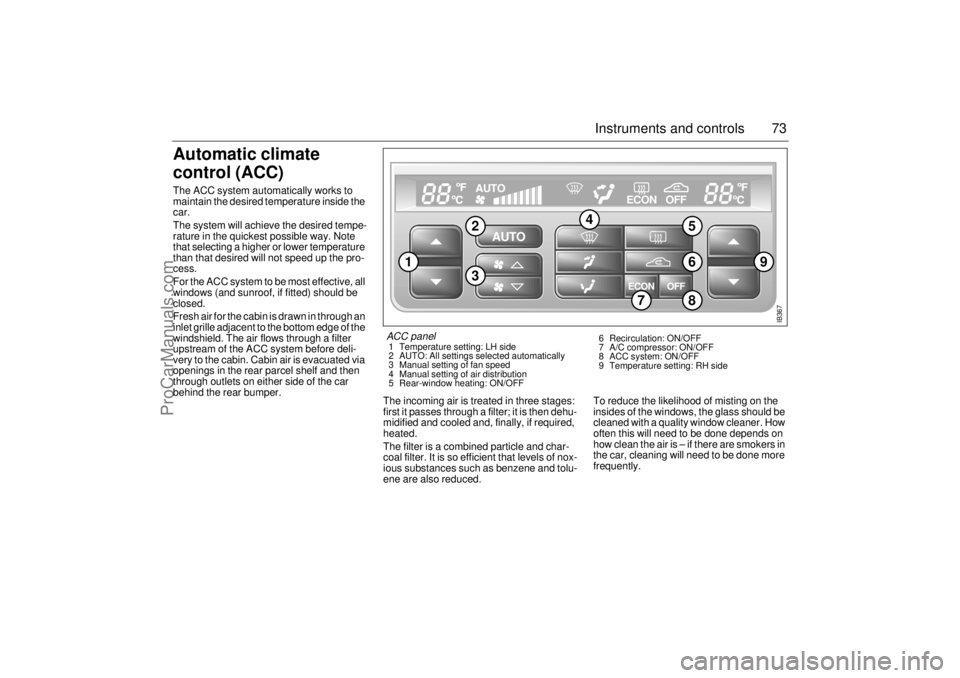
ACC panel 1 Temperature setting: LH side
2 AUTO: All settings selected automatically
3 Manual setting of fan speed
4 Manual setting of air distribution
5 Rear-window heating: ON/OFF 6 Recirculation: ON/OFF
7 A/C compressor: ON/OFF
8 ACC system: ON/OFF
9 Temperature setting: RH side
ProCarManuals.com
Page 142 of 276
140 Starting and drivingFilling a portable fuel container Fuel (Gasoline Engine)
FuelUse of the recommended fuel is an impor-
tant part of the proper maintenance of your
vehicle.
For optimum performance Saab recom-
mends:
2.3t 185 hp (Linear) – AON 90.2.3T 220 hp (Arc) and
2.3 Turbo 250 hp (Aero) – AON 93.
Gasoline OctaneFor the 2.3T and 2.3 Turbo, use premium
unleaded gasoline with a posted octane of
93 or higher for best performance. For the
2.3t, use a mid-grade with a posted octane
of 90 for best performance. You may also
use regular unleaded gasoline rated at
87 octane or higher, but your vehicle's
acceleration may be slightly reduced. If the
octane is less than 87, you may get a heavy
knocking noise when you drive. If this
occurs, use a gasoline rated at 87 octane or
higher as soon as possible. Otherwise, you
might damage your engine. A little pinging
noise when you accelerate or drive uphill is
considered normal. This does not indicate a
problem exists or that a higher-octane fuel
is necessary. If you are using 87 octane or
higher-octane fuel and hear heavy knock-
ing, your engine needs service.
Gasoline SpecificationsIt is recommended that gasoline meet spec-
ifications which were developed by automo-
bile manufacturers around the world and
contained in the World-Wide Fuel Charter
which is available from the Alliance of Auto-
mobile Manufacturers at www.autoalli-
ance.org/fuel_charter.htm. Gasoline meet-
ing these specifications could provide
improved driveability and emission control
system performance compared to other
gasoline.California FuelIf your vehicle is certified to meet California
Emission Standards (see the underhood
emission control label), it is designed to
operate on fuels that meet California speci-
fications. If this fuel is not available in states
adopting California emissions standards,
your vehicle will operate satisfactorily on
fuels meeting federal specifications, but
emission control system performance may
be affected. The malfunction indicator lamp
may turn on and your vehicle may fail a
smog-check test. See Engine malfunction
(CHECK ENGINE) on page 55. If this
occurs, return to your authorized Saab
dealer for diagnosis. If it is determined that
the condition is caused by the type of fuel
used, repairs may not be covered by your
warranty.
WARNING
Never fill a portable fuel container while it
is in your vehicle. Static electricity
discharge from the container can ignite
the gasoline vapor. You can be badly
burned and your vehicle damaged if this
occurs. To help avoid injury to you and
others:
Dispense gasoline only into approved
containers.
Do not fill a container while it is inside
a vehicle, in a vehicle’s trunk, pickup
bed or on any surface other than the
ground.
Bring the fill nozzle in contact with the
inside of the fill opening before opera-
ting the nozzle. Contact should be
maintained until the filling is complete.
Do not smoke while pumping gaso-
line.
ProCarManuals.com
Page 148 of 276

146 Starting and drivingIf ”Automatic transmission, fault indicator”
light appears on the main instrument panel,
the system has detected a fault in the auto-
matic transmission or its control module
(see page 57).
This also means that the Limp-home mode
has been selected, to guard against further
damage being done to the transmission. In
this mode, the automatic transmission
starts in 5th gear, and gear changes (if nec-
essary) will have to be made manually.
Stop the car in a safe place. Switch off then
restart the engine. If the fault is intermittent,
the transmission will operate as normal
despite the fault indicator being on. Have
the car checked at an authorized Saab
dealer.
It is not possible to select the SPORT or
Sentronic mode when the Limp-home mode
is active.
Gear changes must be made manually.
The following gears will be engaged in the
respective selector positions when the auto-
matic transmission is in Limp-home mode:
Overheated transmission fluid If the automatic-transmission fluid should
overheat, the following message will appear
on the SID:
”Gearbox too hot.
Make a safe stop.”
In this event, stop the car in a suitable place,
switch off the engine and open the hood.
Wait for several minutes then turn on the
ignition to check that the message has gone
out. When driving subsequent to the trans-
mission fluid overheating, select a gear in
which the engine speed is about 3,000 rpm.
Overheating of the automatic-transmission
fluid can occur when the car is towing a
heavy load, such as a camping trailer in hilly
country. High ambient temperatures can
also increase the temperature of the trans-
mission fluid or the oil cooler may be faulty.
Contact an authorized Saab dealer (see
also page 161).
Automatic transmission,
fault indicator
Position R D M L
Gear Reverse 5th 5th 2nd
NOTICEIf the control module has actuated the
Limp-home function for the automatic
transmission, the car will remain in 5th
gear when D is selected, making it very
sluggish.
Select position L to prevent unnecessary
wear on the transmission. The transmis-
sion then starts in 2nd gear. Once the car
is moving you can select position D.
When the indicator light is on, the car
must not be driven with a caravan or trai-
ler attached.
ProCarManuals.com
Page 161 of 276

159 Starting and driving
Engine block heater(standard equipment in Canada, acces-
sory in U.S.)The following are just some of the benefits
to the car and the environment of using an
engine block heater:
Lower fuel consumption.
Exhaust emissions substantially reduced
over short runs.
Reduced wear on the engine.
Inside of car warms up faster.
The engine heater is effective at outside
temperatures up to +15–20°C. The warmer
it is outside, the shorter the time the engine
heater needs to be connected. Longer than
1.5 hours is unnecessary.
If the car is equipped with a removable,
electrical cabin heater that is not in use, this
should be stored in the luggage compart-
ment.
Driving in cold weatherBefore starting a journey in cold weather
you should check the following:
That the wiper blades have not become
frozen to the windshield/glass.
Brush any snow away from the air intake
for the heater system (opening between
hood and windshield).
It may be advisable to lubricate the door-
lock cylinder (use molybdenum
disulphide, MoS
2) to prevent its freezing.
If the lock has frozen, take care not to
break the key (or use the remote control)
– heat it first or spray it with de-icer.
Periodically during the winter, add gaso-
line anti-freeze to the fuel to dispel any
condensation in the fuel tank which could
freeze and cause problems in the system.
Keep the tank well filled to reduce the risk
of condensation forming.
If the car is parked outside in freezing
weather, fuel additives (gasoline anti-
freeze) will not do any good as it cannot
remove water that has already frozen.
Park the car in a warm place so that any
ice that may have built up melts, then add
gasoline anti-freeze when filling up the
tank. Condensation is caused by changes
in the outdoor temperature or by the car
being parked alternately in a garage and
outside.
It is particularly important when the roads
are slippery that the brakes and tires be in
good condition. Check the anti-freeze in the engine coo-
lant, see page 188.
The car´s trip computer will warn you when
there is a risk of slippery conditions. For fur-
ther information on this function, see
page 62.
The car is equipped with tires designed to
provide optimum grip on both wet and dry
roads, although this has been achieved at
the expense of somewhat reduced grip on
snow and ice. For regular driving on snow
and ice, we therefore recommend that
winter (snow) tires be fitted.
Winter (snow) tires, particularly studded
tires (where use is legally permitted), gener-
ally make driving safer on snow and ice.
Acquaint yourself with the legal provi-
sions governing the use of different
types of winter tires and snow chains.
Studded tires are not allowed in some
countries
.
ProCarManuals.com