warning SAAB 9-5 2007 Owners Manual
[x] Cancel search | Manufacturer: SAAB, Model Year: 2007, Model line: 9-5, Model: SAAB 9-5 2007Pages: 288, PDF Size: 18.14 MB
Page 198 of 288
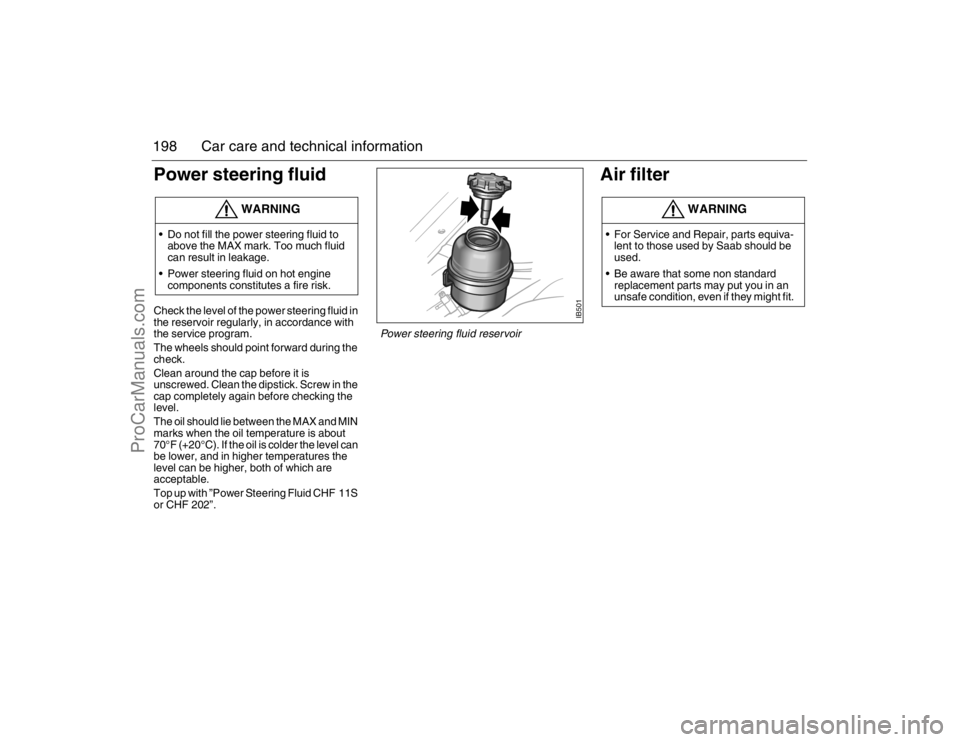
198 Car care and technical informationPower steering fluidCheck the level of the power steering fluid in
the reservoir regularly, in accordance with
the service program.
The wheels should point forward during the
check.
Clean around the cap before it is
unscrewed. Clean the dipstick. Screw in the
cap completely again before checking the
level.
The oil should lie between the MAX and MIN
marks when the oil temperature is about
70°F (+20°C). If the oil is colder the level can
be lower, and in higher temperatures the
level can be higher, both of which are
acceptable.
Top up with ”Power Steering Fluid CHF 11S
or CHF 202”.
Air filter
WARNING
Do not fill the power steering fluid to
above the MAX mark. Too much fluid
can result in leakage.
Power steering fluid on hot engine
components constitutes a fire risk.
WARNING
For Service and Repair, parts equiva-
lent to those used by Saab should be
used.
Be aware that some non standard
replacement parts may put you in an
unsafe condition, even if they might fit.
IB501
Power steering fluid reservoir
95_U S _M 07.book Page 198 Friday, June 9, 2006 8:58 AM
ProCarManuals.com
Page 199 of 288
199 Car care and technical information
Battery
The battery is provided with a cover to pro-
tect it from radiated heat. If the battery is
exposed to high temperatures, its life will be
shortened. To remove the cover, release
the two clips along its long sides.
The cover fits the standard battery installed
in the car. If a new battery is to be fitted,
make sure that its dimensions are the same
as the standard one.
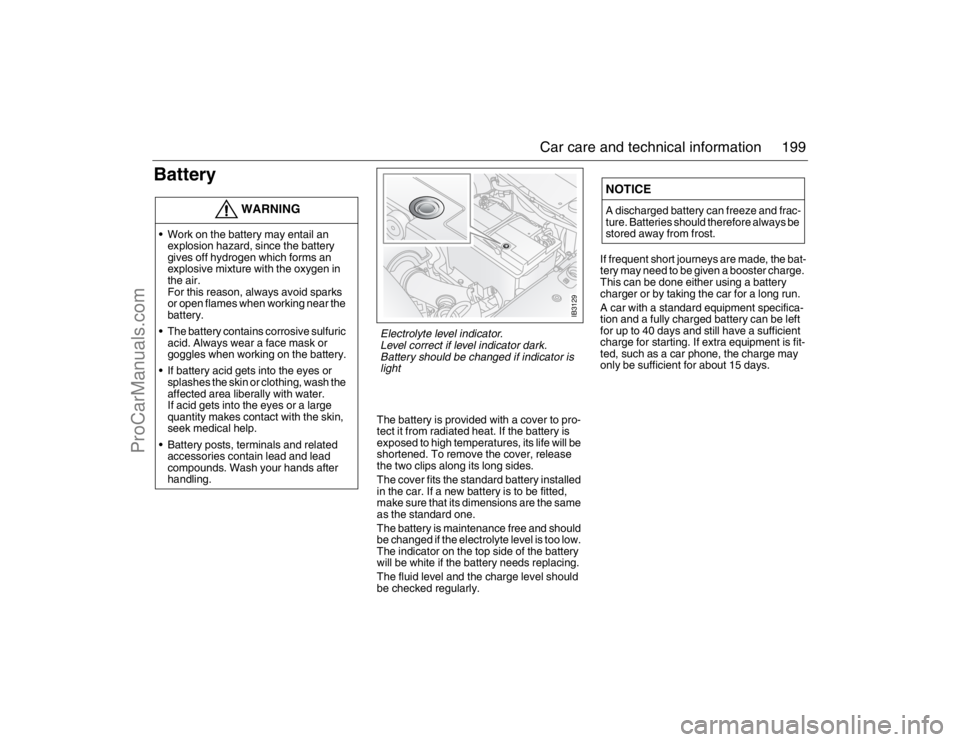
The battery is maintenance free and should
be changed if the electrolyte level is too low.
The indicator on the top side of the battery
will be white if the battery needs replacing.
The fluid level and the charge level should
be checked regularly.
If frequent short journeys are made, the bat-
tery may need to be given a booster charge.
This can be done either using a battery
charger or by taking the car for a long run.
A car with a standard equipment specifica-
tion and a fully charged battery can be left
for up to 40 days and still have a sufficient
charge for starting. If extra equipment is fit-
ted, such as a car phone, the charge may
only be sufficient for about 15 days.
WARNING
Work on the battery may entail an
explosion hazard, since the battery
gives off hydrogen which forms an
explosive mixture with the oxygen in
the air.
For this reason, always avoid sparks
or open flames when working near the
battery.
The battery contains corrosive sulfuric
acid. Always wear a face mask or
goggles when working on the battery.
If battery acid gets into the eyes or
splashes the skin or clothing, wash the
affected area liberally with water.
If acid gets into the eyes or a large
quantity makes contact with the skin,
seek medical help.
Battery posts, terminals and related
accessories contain lead and lead
compounds. Wash your hands after
handling.
NOTICEA discharged battery can freeze and frac-
ture. Batteries should therefore always be
stored away from frost.
IB3129
Electrolyte level indicator.
Level correct if level indicator dark.
Battery should be changed if indicator is
light
95_U S _M 07.book Page 199 Friday, June 9, 2006 8:58 AM
ProCarManuals.com
Page 201 of 288
201 Car care and technical information
Drive belts
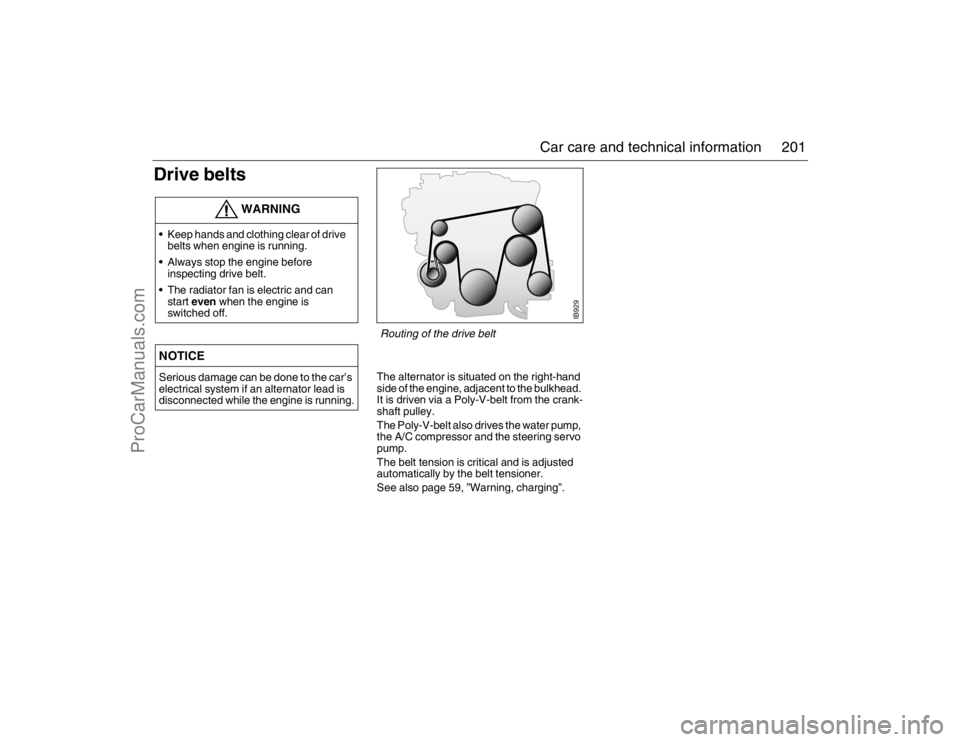
The alternator is situated on the right-hand
side of the engine, adjacent to the bulkhead.
It is driven via a Poly-V-belt from the crank-
shaft pulley.
The Poly-V-belt also drives the water pump,
the A/C compressor and the steering servo
pump.
The belt tension is critical and is adjusted
automatically by the belt tensioner.
See also page 59, ”Warning, charging”.
WARNING
Keep hands and clothing clear of drive
belts when engine is running.
Always stop the engine before
inspecting drive belt.
The radiator fan is electric and can
start even when the engine is
switched off.NOTICESerious damage can be done to the car’s
electrical system if an alternator lead is
disconnected while the engine is running.
IB929
Routing of the drive belt
95_U S _M 07.book Page 201 Friday, June 9, 2006 8:58 AM
ProCarManuals.com
Page 203 of 288
203 Car care and technical information
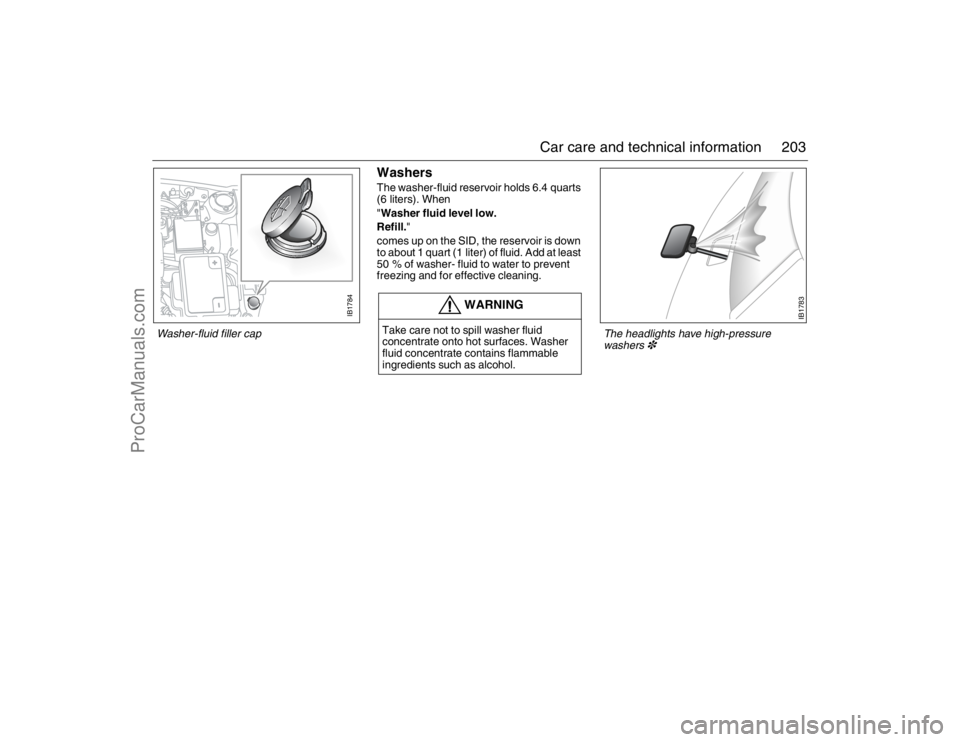
WashersThe washer-fluid reservoir holds 6.4 quarts
(6 liters). When
"Washer fluid level low.
Refill."
comes up on the SID, the reservoir is down
to about 1 quart (1 liter) of fluid. Add at least
50 % of washer- fluid to water to prevent
freezing and for effective cleaning.
WARNING
Take care not to spill washer fluid
concentrate onto hot surfaces. Washer
fluid concentrate contains flammable
ingredients such as alcohol.
IB1784
Washer-fluid filler cap
IB1783
The headlights have high-pressure
washers
3
95_U S _M 07.book Page 203 Friday, June 9, 2006 8:58 AM
ProCarManuals.com
Page 204 of 288

204 Car care and technical informationChanging bulbs
Check that the new bulb is working when fin-
ished.
Use only "Long Life" bulbs.
Headlight aiming, see page 247.
Xenon headlight3Xenon headlights produce roughly twice as
much light as halogen bulbs and have a sig-
nificantly longer service life.
The lamp units consist of a gas discharge
lamp containing xenon. When the lights are
switched on a very high voltage activates
the xenon gas. The lamps soon reach full
intensity.
Cars with xenon headlights have automatic
levelling. The levelling system comprises
two sensors on the front axle, one on the
rear axle and a control unit under the head-
light housing. Headlight alignment is regu-
lated automatically to prevent dazzling
oncoming traffic. Alignment is also adjusted
during braking.
WARNING
Before changing a bulb in the engine bay,
switch off the engine to avoid danger of
fingers and hands being injured by
moving parts.
The radiator fan can start up even when
the engine is switched off.
Xenon headlights3 are high voltage
and must therefore be changed at a
workshop. We recommend that you
contact an authorized Saab work-
shop. Work involving high-voltage
components is potentially lethal.NOTICE Since the headlight lenses are made
of plastic, rinse dried-on dirt with
water and allow it time to soften up
before cleaning the lenses. Avoid
rubbing the lenses when dry and
never use solvents.
Use de-icer spray instead of scraping
the ice off.
NOTICE Do not fit bulbs with a higher rating
than 55 W, since the headlight reflec-
tor and the wiring of the car are not
designed for a higher wattage.
Switch off the ignition before chang-
ing a bulb, to avoid possible short-cir-
cuiting.
Do not touch the glass of the bulbs
with your fingers. The oil on your skin
can shorten the life of the bulb.
95_U S _M 07.book Page 204 Friday, June 9, 2006 8:58 AM
ProCarManuals.com
Page 207 of 288
207 Car care and technical information
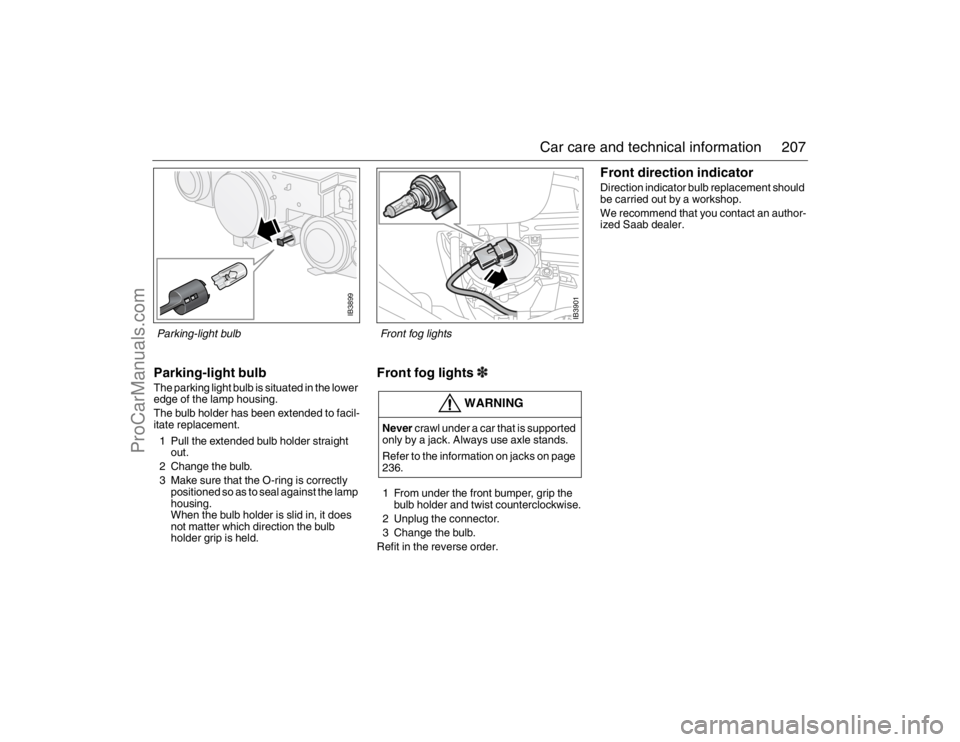
Parking-light bulbThe parking light bulb is situated in the lower
edge of the lamp housing.
The bulb holder has been extended to facil-
itate replacement.
1 Pull the extended bulb holder straight
out.
2 Change the bulb.
3 Make sure that the O-ring is correctly
positioned so as to seal against the lamp
housing.
When the bulb holder is slid in, it does
not matter which direction the bulb
holder grip is held.
Front fog lights31 From under the front bumper, grip the
bulb holder and twist counterclockwise.
2 Unplug the connector.
3 Change the bulb.
Refit in the reverse order.
Front direction indicatorDirection indicator bulb replacement should
be carried out by a workshop.
We recommend that you contact an author-
ized Saab dealer.
WARNING
Never crawl under a car that is supported
only by a jack. Always use axle stands.
Refer to the information on jacks on page
236.
IB3899
Parking-light bulb
IB3901
Front fog lights
95_U S _M 07.book Page 207 Friday, June 9, 2006 8:58 AM
ProCarManuals.com
Page 216 of 288
216 Car care and technical informationFuses
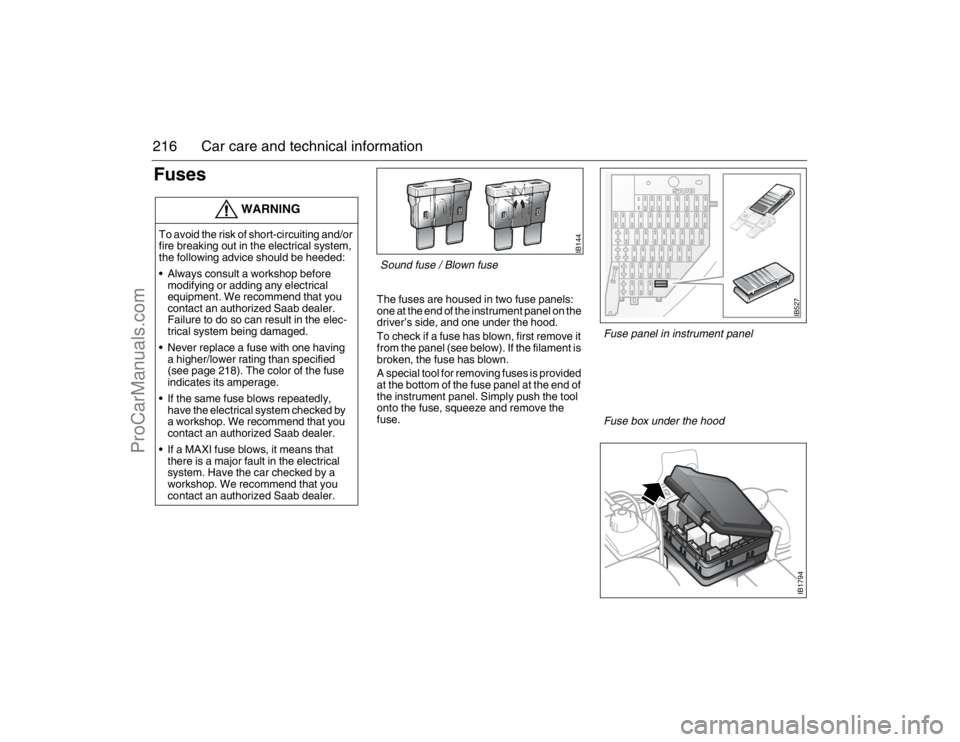
The fuses are housed in two fuse panels:
one at the end of the instrument panel on the
driver’s side, and one under the hood.
To check if a fuse has blown, first remove it
from the panel (see below). If the filament is
broken, the fuse has blown.
A special tool for removing fuses is provided
at the bottom of the fuse panel at the end of
the instrument panel. Simply push the tool
onto the fuse, squeeze and remove the
fuse.
WARNING
To avoid the risk of short-circuiting and/or
fire breaking out in the electrical system,
the following advice should be heeded:
Always consult a workshop before
modifying or adding any electrical
equipment. We recommend that you
contact an authorized Saab dealer.
Failure to do so can result in the elec-
trical system being damaged.
Never replace a fuse with one having
a higher/lower rating than specified
(see page 218). The color of the fuse
indicates its amperage.
If the same fuse blows repeatedly,
have the electrical system checked by
a workshop. We recommend that you
contact an authorized Saab dealer.
If a MAXI fuse blows, it means that
there is a major fault in the electrical
system. Have the car checked by a
workshop. We recommend that you
contact an authorized Saab dealer.
IB527
Fuse panel in instrument panel
IB1794
Fuse box under the hood
IB144
Sound fuse / Blown fuse
95_U S _M 07.book Page 216 Friday, June 9, 2006 8:58 AM
ProCarManuals.com
Page 217 of 288
217 Car care and technical information
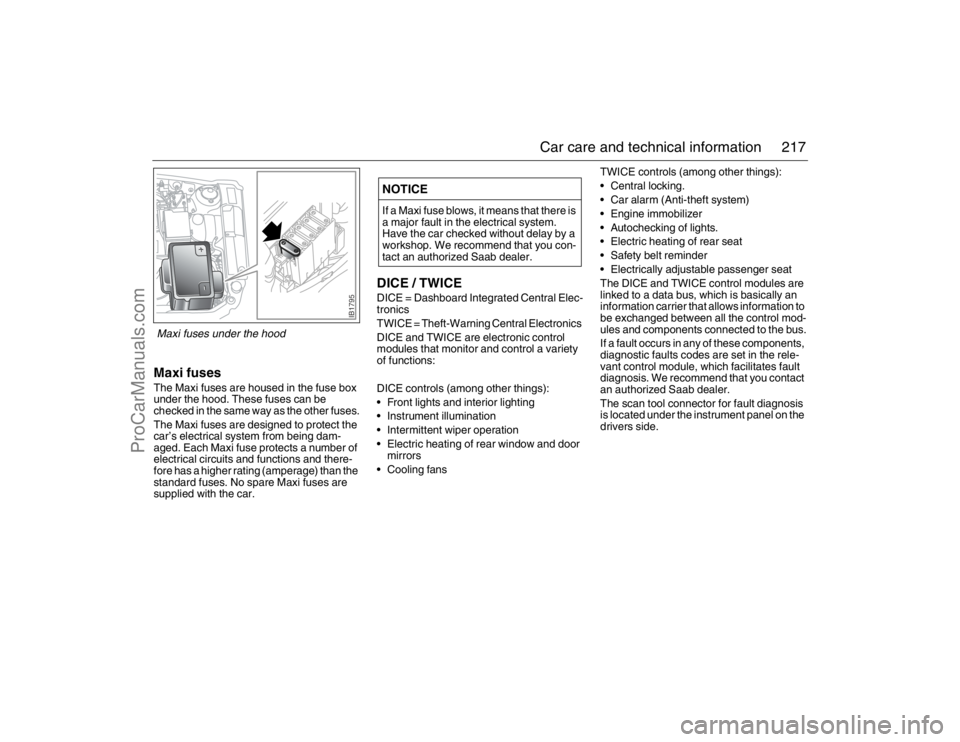
Maxi fusesThe Maxi fuses are housed in the fuse box
under the hood. These fuses can be
checked in the same way as the other fuses.
The Maxi fuses are designed to protect the
car’s electrical system from being dam-
aged. Each Maxi fuse protects a number of
electrical circuits and functions and there-
fore has a higher rating (amperage) than the
standard fuses. No spare Maxi fuses are
supplied with the car.
DICE / TWICEDICE = Dashboard Integrated Central Elec-
tronics
TWICE = Theft-Warning Central Electronics
DICE and TWICE are electronic control
modules that monitor and control a variety
of functions:
DICE controls (among other things):
Front lights and interior lighting
Instrument illumination
Intermittent wiper operation
Electric heating of rear window and door
mirrors
Cooling fansTWICE controls (among other things):
Central locking.
Car alarm (Anti-theft system)
Engine immobilizer
Autochecking of lights.
Electric heating of rear seat
Safety belt reminder
Electrically adjustable passenger seat
The DICE and TWICE control modules are
linked to a data bus, which is basically an
information carrier that allows information to
be exchanged between all the control mod-
ules and components connected to the bus.
If a fault occurs in any of these components,
diagnostic faults codes are set in the rele-
vant control module, which facilitates fault
diagnosis. We recommend that you contact
an authorized Saab dealer.
The scan tool connector for fault diagnosis
is located under the instrument panel on the
drivers side.NOTICEIf a Maxi fuse blows, it means that there is
a major fault in the electrical system.
Have the car checked without delay by a
workshop. We recommend that you con-
tact an authorized Saab dealer.
IB1795
Maxi fuses under the hood 95_U S _M 07.book Page 217 Friday, June 9, 2006 8:58 AM
ProCarManuals.com
Page 222 of 288

222 Car care and technical informationTires Your new vehicle comes with high-quality
tires made by a leading tire manufacturer. If
you ever have questions about your tire
warranty and where to obtain service, see
your Saab Warranty and Service Record
Booklet for details.
Inflation - Tire PressureThe Tire-Loading Information label shows
the correct inflation pressures for your tires
when they’re cold. “Cold” means your vehi-
cle has been sitting for at least three hours
or driven no more than 1 mile (1.6 km).Notice:
Don’t let anyone tell you that
underinflation or overinflation is all
right. It’s not. If your tires don’t have
enough air (underinflation), you can get
the following:
Too much flexing
Too much heat
Tire overloading
Bad wear
Bad handling
Bad fuel economy
If your tires have too much air (overinfla-
tion), you can get the following:
Unusual wear
Bad handling
Rough ride
Needless damage from road hazardsAdjust the tire pressure to match the current
load and speed of the car (see page 267).
The stated tire pressures apply to cold tires,
i.e. tires that are the same temperature as
the outside air temperature. Tire pressure
increases as the tires become warm (e.g.
during highway driving) by approximately
0.3 bar (4 psi). When the temperature of the
tires changes by 50°F (10°C), the tire pres-
sure will change 0.1 bar (2 psi).
Never reduce the pressure of a hot tire. If the
tires are hot when you check them, only
increase the pressure, if necessary.
WARNING
Poorly maintained and improperly used
tires are dangerous.
Overloading your tires can cause
overheating as a result of too much
friction. You could have an blow-out
and a serious accident. See “Loading
Your Vehicle” on page 231.
Underinflated tires pose the same
danger as overloaded tires. The
resulting accident could cause serious
injury. Check all tires frequently to
maintain the recommended pressure.
Tire pressure should be checked
when your tires are cold.
Overinflated tires are more likely to be
cut, punctured or broken by a sudden
impact – such as when you hit a pot-
hole. Keep tires at the recommended
pressure.
Worn, old tires can cause accidents. If
your tread is badly worn, or if your tires
have been damaged, replace them.95_U S _M 07.book Page 222 Friday, June 9, 2006 8:58 AM
ProCarManuals.com
Page 223 of 288

223 Car care and technical information
High speed operation When to check
Check your tires once a month or more.
Don’t forget your compact spare tire. It
should be at 60 psi (420 kPa).How to CheckUse a good quality pocket-type gauge to
check tire pressure. You can’t tell if your
tires are properly inflated simply by looking
at them. Radial tires may look properly
inflated even when they’re underinflated.
Be sure to put the valve caps back on the
valve stems. They help prevent leaks by
keeping out dirt and moisture.Tire Inspection and RotationTires should be rotated every 10,000 miles
(16 000 km).
Any time you notice unusual wear, rotate
your tires as soon as possible and check
wheel alignment. Also check for damaged
tires or wheels. See “When It Is Time for
New Tires” on page 224 and “Wheel
Replacement” on page 227 for more infor-
mation.
The purpose of regular rotation is to achieve
more uniform wear for all tires on the vehi-
cle. The first rotation is the most important.
When rotating your tires, always use the
correct rotation pattern. Left front tire to left
rear. Left rear tire to right front. Right front to
right rear. Right rear to left front.
Don’t include the compact spare tire in your
tire rotation.After the tires have been rotated, adjust the
front and rear inflation pressures as shown
on the Tire-Loading Information label. Make
certain that all wheel nuts are properly tight-
ened. See page 238.
WARNING
Driving at high speeds, 100 mph
(160 km/h) or higher, puts an additional
strain on tires.
Sustained high-speed driving causes
excessive heat build up and can cause
sudden tire failure. You could have a
crash and you or others could be killed.
Some high-speed rated tires require infla-
tion pressure adjustment for high speed
operation. When speed limits and road
conditions are such that a vehicle can be
driven at high speeds, make sure the tires
are rated for high speed operation, in
excellent condition, and set to the correct
cold tire inflation pressure for the vehicle
load.
WARNING
Rust or dirt on a wheel, or on the parts to
which it is fastened, can make wheel nuts
become loose after a time. The wheel
could come off and cause an accident.
When you change a wheel, remove any
rust or dirt from places where the wheel
attaches to the vehicle. In an emergency,
you can use a cloth or a paper towel to do
this; but be sure to use a scraper or wire
brush later, if you need to, to get all the
rust or dirt off. See “Changing a wheel” on
page 236.
95_U S _M 07.book Page 223 Friday, June 9, 2006 8:58 AM
ProCarManuals.com