warning SAAB 9-5 2007 Manual PDF
[x] Cancel search | Manufacturer: SAAB, Model Year: 2007, Model line: 9-5, Model: SAAB 9-5 2007Pages: 288, PDF Size: 18.14 MB
Page 144 of 288

144 Starting and drivingImportant
considerations for
drivingThe engine-management system in the
Saab 9-5 is called Saab Trionic T7. The
system manages the ignition, fuel injection
and turbo boost pressure.
The Trionic T7 system developed by Saab
is an intelligent engine-management
system designed to achieve optimum driv-
ability under differing driving conditions.
The system makes adjustments automati-
cally, for instance, if the car is being driven
at altitude (oxygen-deficient air), for differ-
ent grades of fuel (AON 87–93) and for dif-
ferent load conditions.
1 Starting and driving
Refrain from using full throttle before
the engine has warmed up (before
needle in mid-range on temperature
gauge).
A safety function prevents the engine
from revving faster than 6,000 rpm by
limiting the induction air.
2 Stopping the engine
Do not rev the engine immediately
before switching it off – stop the engine
when it is idling.
3 Regulating the boost pressure
One of the advantages of boost pres-
sure regulation is that the engine can
also be run safely on gasoline with a
lower octane rating, although not lower than AON 87. However, engine perfor-
mance will fall slightly and heavy load-
ing and laboring should be avoided. For
optimum performance, use the recom-
mended grade of fuel.
The maximum boost pressure is
adjusted automatically to the knocking
or pinging tendency of the engine.
Occasional, short-lived knocking when
the engine is under a heavy load is per-
fectly normal; the extent will depend on
the grade of fuel in the tank.
Isolated instances of knocking are
more likely to occur with low-octane
fuel. This controlled form of knocking,
followed by a reduction in the boost
pressure, is a sign that the wastegate is
functioning and is perfectly safe for the
engine.
NOTICE If the engine sounds strange there is a
fault in the system. Have the car
checked without delay by a workshop.
We recommend that you contact an
authorized Saab dealer.
The use of fuel with too low an octane
rating can cause serious engine
damage.
WARNING
If the engine is being run with the car on a
rolling road or dynamometer, longer than
for a standard state emission inspection,
to ensure adequate cooling, air must be
blown into the engine compartment and
under the car at a rate equivalent to the
ram-air effect that would be obtained at
the corresponding road speed.
95_U S _M 07.book Page 144 Friday, June 9, 2006 8:58 AM
ProCarManuals.com
Page 146 of 288

146 Starting and drivingRefueling
WARNING
If you spill fuel and then something ignites
it, you could be badly burned. Fuel can
spray out on you if you open the fuel cap
too quickly. This spray can happen if your
tank is nearly full, and is more likely in hot
weather. Open the fuel cap slowly and
wait for any “hiss” noise to stop. Then
unscrew the cap all the way.
Gasoline fumes are highly explosive.
Therefore:
never smoke while refueling
never use gasoline for any purpose
other than as engine fuel
gasoline is extremely flammable and
can cause severe burns. No open or
exposed flames near gasoline
do not use a mobile phone at the
same time as refueling.
NOTICE Do not overfill. Fuel should not come
right up the filler pipe as room for
expansion is needed for when the
temperature rises.
The use of fuel with too low an octane
rating can cause serious engine
damage.
Clean fuel from painted surfaces as
soon as possible.
NOTICEThe engine control module (ECM) mon-
itoring the engine parameters also
stores fault codes.
Under certain circumstances, this may
cause constant illumination of the
”Engine malfunction (CHECK
ENGINE)” lamp , thus indicating a
fault that must be checked by your Saab
dealer, see page 58.
NOTE: always observe the following two
measures:
Make sure that the fuel filler cap is
screwed on correctly before the
engine is started. Screw on the fuel
filler cap until you hear 3 distinct
clicks.
Avoid driving with the fuel low level
indicator illuminated. The symbol
illuminates when less than approxi-
mately 2 gallons (8 litres) of fuel
remains in the tank.
95_U S _M 07.book Page 146 Friday, June 9, 2006 8:58 AM
ProCarManuals.com
Page 147 of 288
147 Starting and driving
Refueling
1 Switch off the engine.
2 Open the filler cap, located in the
right-hand rear fender.
3 Insert the fuel pump nozzle beyond the
flange on the filler pipe and let the first
mark (a ring, a pimple or the first
spring-coil) rest on the flange. Do not
withdraw the nozzle while filling is in
progress.
4 Cease refueling the first time the pump
stops, and wait a few seconds after
you´ve finished pumping before you
remove the nozzle.Filler cap
When you put the filler cap back on, turn it
to the right (clockwise) until you hear three
clicks. Make sure you fully install the cap.
The most effective way to prevent conden-
sation forming in the tank (and thus avoid
possible running problems) is to keep the
tank well filled.
Before the onset of freezing temperatures in
winter, it may be advisable to add gasoline
anti-freeze to the fuel a few times to dispel
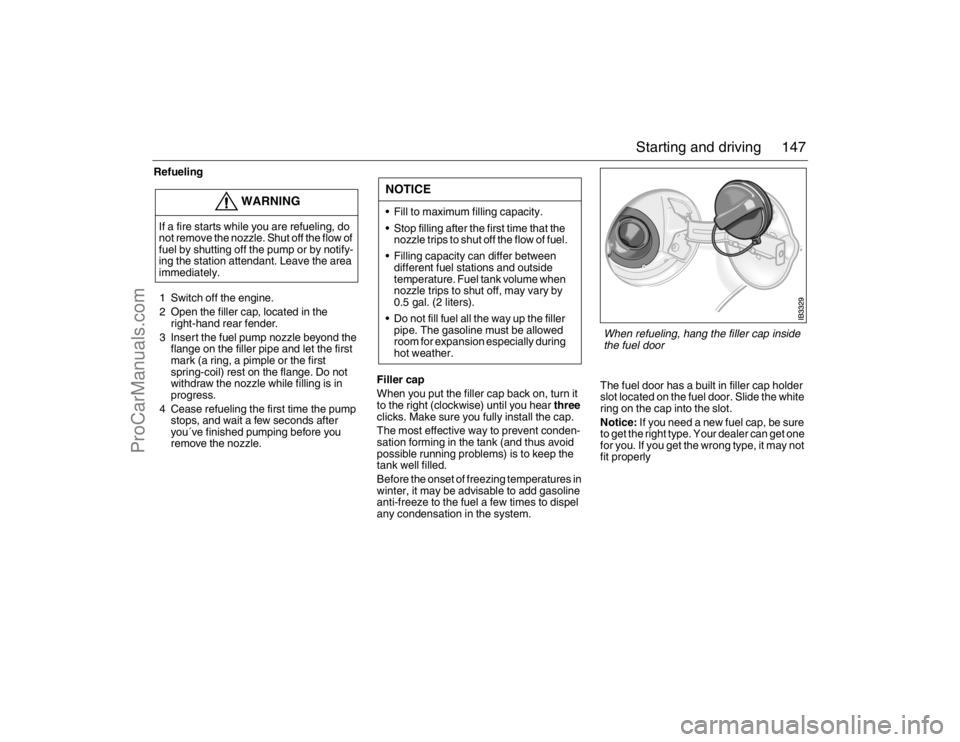
any condensation in the system.The fuel door has a built in filler cap holder
slot located on the fuel door. Slide the white
ring on the cap into the slot.
Notice: If you need a new fuel cap, be sure
to get the right type. Your dealer can get one
for you. If you get the wrong type, it may not
fit properly
WARNING
If a fire starts while you are refueling, do
not remove the nozzle. Shut off the flow of
fuel by shutting off the pump or by notify-
ing the station attendant. Leave the area
immediately.
NOTICE Fill to maximum filling capacity.
Stop filling after the first time that the
nozzle trips to shut off the flow of fuel.
Filling capacity can differ between
different fuel stations and outside
temperature. Fuel tank volume when
nozzle trips to shut off, may vary by
0.5 gal. (2 liters).
Do not fill fuel all the way up the filler
pipe. The gasoline must be allowed
room for expansion especially during
hot weather.
When refueling, hang the filler cap inside
the fuel door
95_U S _M 07.book Page 147 Friday, June 9, 2006 8:58 AM
ProCarManuals.com
Page 148 of 288

148 Starting and drivingFilling a portable fuel container Fuel (Gasoline Engine)
Fuel
Use of the recommended fuel is an impor-
tant part of the proper maintenance of your
vehicle.
For optimum performance Saab recom-
mends:
Gasoline Octane
Use premium unleaded gasoline with a
posted octane of 93 or higher for best per-
formance. You may also use regular
unleaded gasoline rated at 87 octane or
higher, but your vehicle's acceleration may
be slightly reduced.
If the octane is less than 87, you may get a
heavy knocking noise when you drive. If this
occurs, use a gasoline rated at 87 octane or
higher as soon as possible. Otherwise, you
might damage your engine. A little pinging
noise when you accelerate or drive uphill is
considered normal. This does not indicate a
problem exists or that a higher-octane fuel
is necessary. If you are using 87 octane or
higher-octane fuel and hear heavy knock-
ing, your engine needs service.
Gasoline Specifications
It is recommended that gasoline meet spec-
ifications which were developed by automo-
bile manufacturers around the world and
contained in the World-Wide Fuel Charter
which is available from the Alliance of Auto-mobile Manufacturers at www.autoalli-
ance.org/fuel_charter.htm. Gasoline meet-
ing these specifications could provide
improved driveability and emission control
system performance compared to other
gasoline.
California Fuel
If your vehicle is certified to meet California
Emission Standards (see the underhood
emission control label), it is designed to
operate on fuels that meet California speci-
fications. If this fuel is not available in states
adopting California emissions standards,
your vehicle will operate satisfactorily on
fuels meeting federal specifications, but
emission control system performance may
be affected. The malfunction indicator lamp
may turn on and your vehicle may fail a
smog-check test. See Engine malfunction
(CHECK ENGINE) on page 58. If this
occurs, return to your authorized Saab
dealer for diagnosis. If it is determined that
WARNING
Never fill a portable fuel container while it
is in your vehicle. Static electricity dis-
charge from the container can ignite the
gasoline vapor. You can be badly burned
and your vehicle damaged if this occurs.
To help avoid injury to you and others:
Dispense gasoline only into approved
containers.
Do not fill a container while it is inside
a vehicle, in a vehicle’s trunk, pickup
bed or on any surface other than the
ground.
Bring the fill nozzle in contact with the
inside of the fill opening before operat-
ing the nozzle. Contact should be
maintained until the filling is complete.
Do not smoke while pumping gaso-
line.
NOTICEGasolines containing oxygenates, such
as ethers and ethanol, and reformulated
gasolines may be available in your area.
We recommend that you use these gaso-
lines, if they comply with the specifica-
tions described earlier. However, E85
(85% ethanol) and other fuels containing
more than 10% ethanol must not be used
in vehicles that were not designed for
those fuels.
95_U S _M 07.book Page 148 Friday, June 9, 2006 8:58 AM
ProCarManuals.com
Page 151 of 288
151 Starting and driving
Towing Towing of cars with manual transmission,
see page 183.
Automatic transmission3
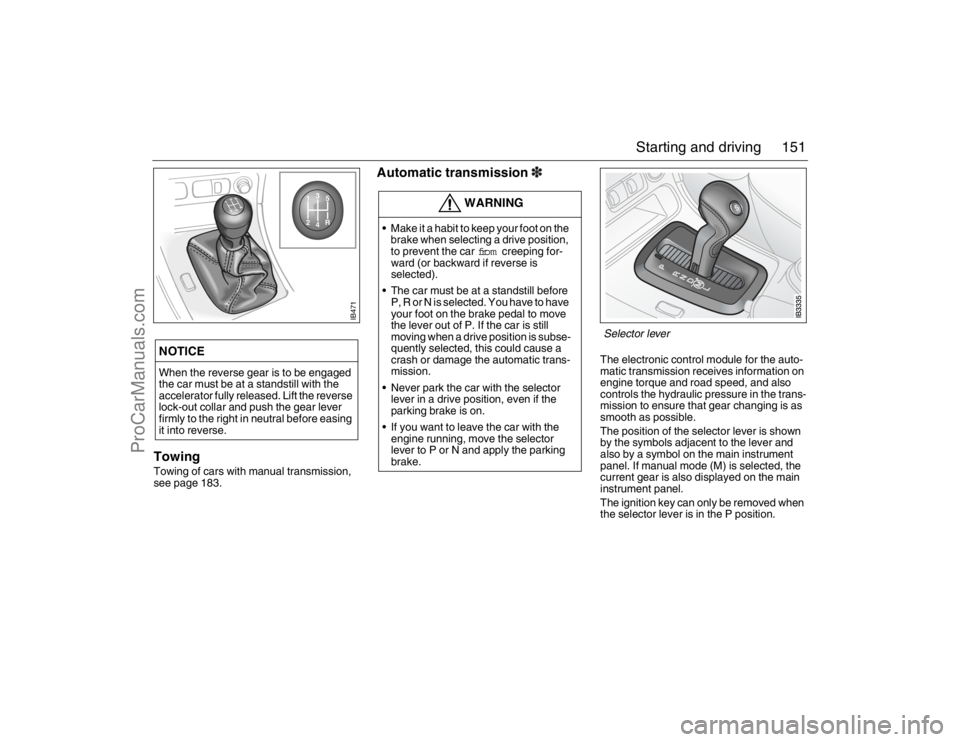
The electronic control module for the auto-
matic transmission receives information on
engine torque and road speed, and also
controls the hydraulic pressure in the trans-
mission to ensure that gear changing is as
smooth as possible.
The position of the selector lever is shown
by the symbols adjacent to the lever and
also by a symbol on the main instrument
panel. If manual mode (M) is selected, the
current gear is also displayed on the main
instrument panel.
The ignition key can only be removed when
the selector lever is in the P position.
NOTICEWhen the reverse gear is to be engaged
the car must be at a standstill with the
accelerator fully released. Lift the reverse
lock-out collar and push the gear lever
firmly to the right in neutral before easing
it into reverse.
WARNING
Make it a habit to keep your foot on the
brake when selecting a drive position,
to prevent the car from creeping for-
ward (or backward if reverse is
selected).
The car must be at a standstill before
P, R or N is selected. You have to have
your foot on the brake pedal to move
the lever out of P. If the car is still
moving when a drive position is subse-
quently selected, this could cause a
crash or damage the automatic trans-
mission.
Never park the car with the selector
lever in a drive position, even if the
parking brake is on.
If you want to leave the car with the
engine running, move the selector
lever to P or N and apply the parking
brake.
Selector lever
IB471
13
25
R
4
95_U S _M 07.book Page 151 Friday, June 9, 2006 8:58 AM
ProCarManuals.com
Page 155 of 288

155 Starting and driving
Driving on hilly roads with a
heavy loadThe transmission fluid can overheat when
the gearbox is strained, for example, when
driving with a trailer on hilly roads. To avoid
the transmission fluid overheating, always
drive in Normal mode. The adaptive gear
change patterns are then active.
High air temperatures or a faulty oil cooler
can also cause the transmission fluid to
overheat. Overheating reduces the service
life of the fluid. Contact an authorized Saab
dealer (see also page 174).
Towing Towing of cars with automatic transmission,
see page 183.
Descending hillsIf the speed of the car increases while
descending a steep hill, despite the acceler-
ator being released, the control module will
change down a gear when you brake. If you
desire more powerful engine braking, man-
ually select a lower gear.
WARNING
Remember to use engine-braking (selec-
tor position D or L) to spare the brakes
when you are driving on a long or steep
downhill slope.
Brake failure can result from overheated
brakes!
95_U S _M 07.book Page 155 Friday, June 9, 2006 8:58 AM
ProCarManuals.com
Page 159 of 288
159 Starting and driving
Cruise controlFor safety reasons (brake system func-
tion) the brakes must be applied once,
when the engine has started, before the
cruise control system can be activated.
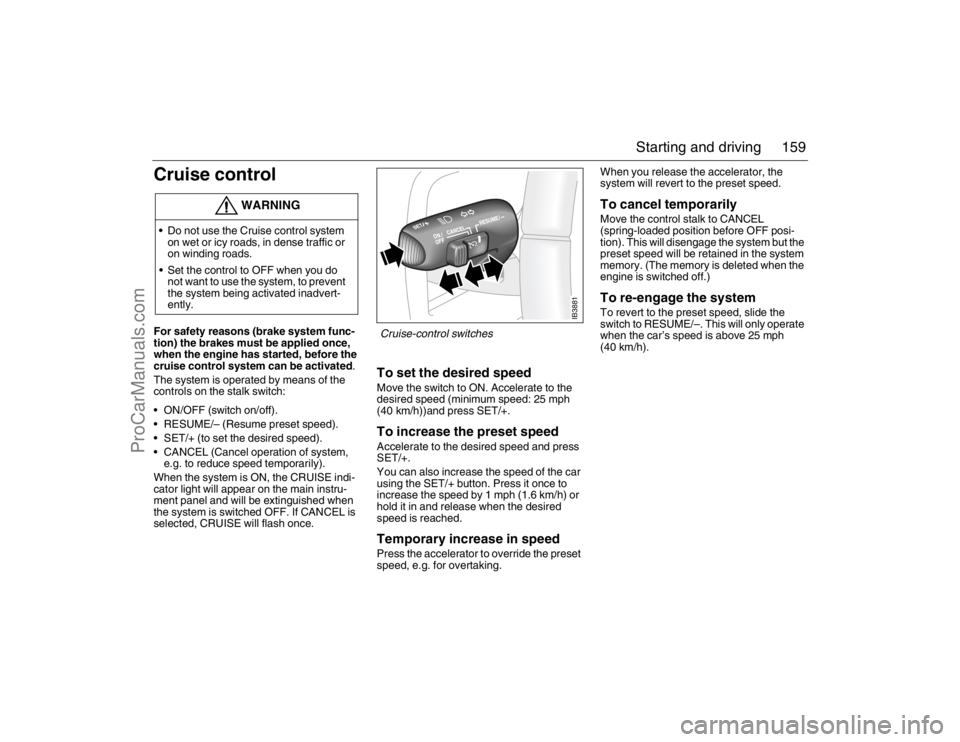
The system is operated by means of the
controls on the stalk switch:
ON/OFF (switch on/off).
RESUME/– (Resume preset speed).
SET/+ (to set the desired speed).
CANCEL (Cancel operation of system,
e.g. to reduce speed temporarily).
When the system is ON, the CRUISE indi-
cator light will appear on the main instru-
ment panel and will be extinguished when
the system is switched OFF. If CANCEL is
selected, CRUISE will flash once.
To set the desired speed Move the switch to ON. Accelerate to the
desired speed (minimum speed: 25 mph
(40 km/h))and press SET/+. To increase the preset speed Accelerate to the desired speed and press
SET/+.
You can also increase the speed of the car
using the SET/+ button. Press it once to
increase the speed by 1 mph (1.6 km/h) or
hold it in and release when the desired
speed is reached. Temporary increase in speed Press the accelerator to override the preset
speed, e.g. for overtaking. When you release the accelerator, the
system will revert to the preset speed.
To cancel temporarily Move the control stalk to CANCEL
(spring-loaded position before OFF posi-
tion). This will disengage the system but the
preset speed will be retained in the system
memory. (The memory is deleted when the
engine is switched off.) To re-engage the system To revert to the preset speed, slide the
switch to RESUME/–. This will only operate
when the car’s speed is above 25 mph
(40 km/h).
WARNING
Do not use the Cruise control system
on wet or icy roads, in dense traffic or
on winding roads.
Set the control to OFF when you do
not want to use the system, to prevent
the system being activated inadvert-
ently.
IB3881
Cruise-control switches
95_U S _M 07.book Page 159 Friday, June 9, 2006 8:58 AM
ProCarManuals.com
Page 161 of 288
161 Starting and driving
ABS brakes
ABS (antilock braking system) modulates
the brake pressure to the respective
wheels. Wheel sensors detect if a wheel is
about to lock, and the control module
reduces the pressure to that wheel and then
increases it once more until the tendency is
detected again.
The brake system is equipped with an Elec-
tronic Brake-force Distribution device
(EBD), which distributes the brake pressure
between the front and rear wheels, in such
a way as to achieve optimum braking perfor-
mance irrespective of the car’s speed and
load.
WARNING
It is prudent to try your brakes from
time to time, especially when driving in
heavy rain, through water collected on
the road, in snow, on a wet road sur-
face or in salty slush. In such condi-
tions, the brakes may take longer than
normal to take effect. To rectify this,
touch the brake pedal periodically to
dry the brakes out.
The same applies after the car has
been washed or when the weather is
very humid.
Avoid parking the car with wet brakes.
Before parking, and if the traffic condi-
tions allow, brake quite heavily so that
the brake discs and pads warm up and
dry.
The brakes are power assisted and it
should be kept in mind that the servo
unit only provides the power assis-
tance when the engine is running.
The brake pressure required when the
engine is off,(e.g. when the car is
being towed) is roughly four times the
normal pedal force required. The
pedal also feels hard and unre-
sponsive.
WARNING
The additional safety afforded by the
ABS system is not designed to allow
drivers to drive faster but to make
normal driving safer.
To stop as quickly as possible, without
loss of directional stability, whether
the road surface is dry, wet or slippery,
press the brake pedal down hard-
without letting up (do not pump the
pedal), declutching simulta-
neously, and steer the car to safety.
95_U S _M 07.book Page 161 Friday, June 9, 2006 8:58 AM
ProCarManuals.com
Page 162 of 288
162 Starting and drivingThe ABS system has a built-in diagnostic
function which will switch on the Anti-lock
brake warning light if a fault is detected in
the system (see page 60).
The ABS system will not reduce the braking
distance on loose gravel or on snow or ice
but, because the wheels cannot lock up,
some steering control is retained.
When the ABS system is working, i.e. mod-
ulation of the brake pressure is in progress,
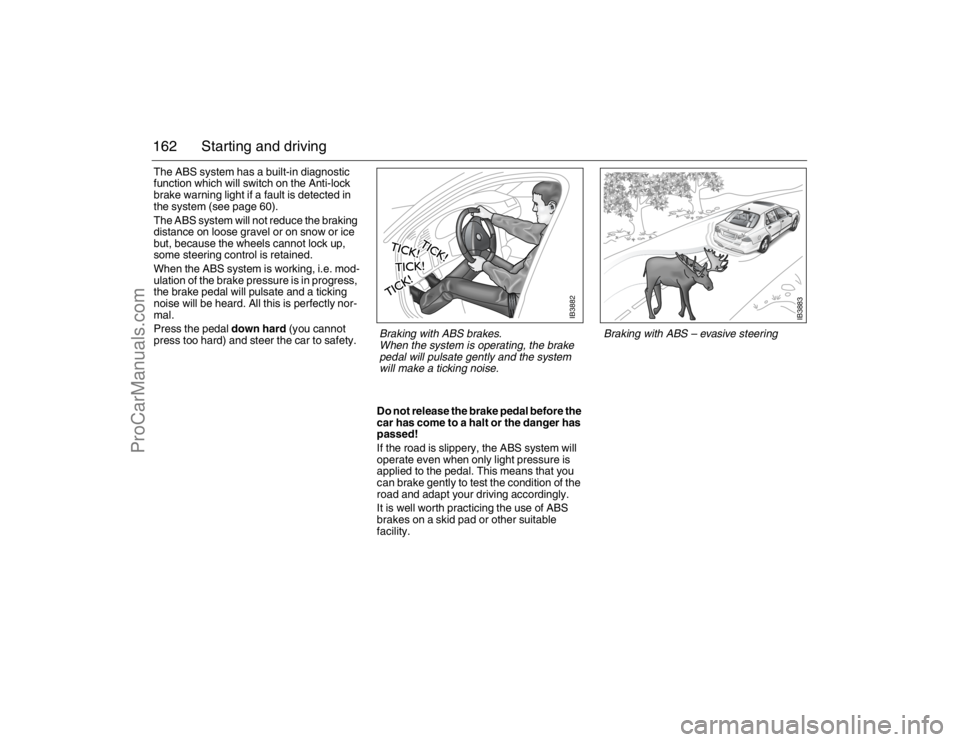
the brake pedal will pulsate and a ticking
noise will be heard. All this is perfectly nor-
mal.
Press the pedal down hard (you cannot
press too hard) and steer the car to safety.
Do not release the brake pedal before the
car has come to a halt or the danger has
passed!
If the road is slippery, the ABS system will
operate even when only light pressure is
applied to the pedal. This means that you
can brake gently to test the condition of the
road and adapt your driving accordingly.
It is well worth practicing the use of ABS
brakes on a skid pad or other suitable
facility.
IB3882
Braking with ABS brakes.
When the system is operating, the brake
pedal will pulsate gently and the system
will make a ticking noise.
IB3883
Braking with ABS – evasive steering
95_U S _M 07.book Page 162 Friday, June 9, 2006 8:58 AM
ProCarManuals.com
Page 163 of 288
163 Starting and driving
Electronic Stability
Program (ESP
®)
The system employs both the antilock brak-
ing system (ABS) and the traction control
system (TCS). It is a system that helps the
driver to stabilize the car in unusual circum-
stances that would otherwise be more diffi-
cult to handle.
How the ESP
® system works
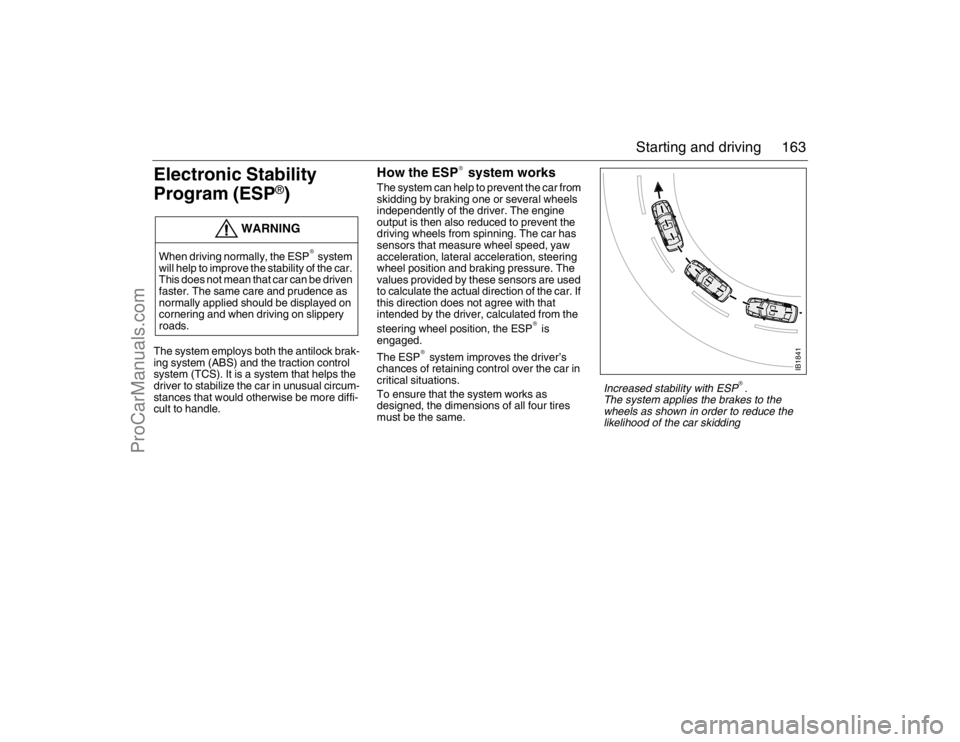
The system can help to prevent the car from
skidding by braking one or several wheels
independently of the driver. The engine
output is then also reduced to prevent the
driving wheels from spinning. The car has
sensors that measure wheel speed, yaw
acceleration, lateral acceleration, steering
wheel position and braking pressure. The
values provided by these sensors are used
to calculate the actual direction of the car. If
this direction does not agree with that
intended by the driver, calculated from the
steering wheel position, the ESP
® is
engaged.
The ESP
® system improves the driver’s
chances of retaining control over the car in
critical situations.
To ensure that the system works as
designed, the dimensions of all four tires
must be the same.
WARNING
When driving normally, the ESP
® system
will help to improve the stability of the car.
This does not mean that car can be driven
faster. The same care and prudence as
normally applied should be displayed on
cornering and when driving on slippery
roads.
IB1841
Increased stability with ESP
®.
The system applies the brakes to the
wheels as shown in order to reduce the
likelihood of the car skidding
95_U S _M 07.book Page 163 Friday, June 9, 2006 8:58 AM
ProCarManuals.com