heating SAAB 9-5 2007 User Guide
[x] Cancel search | Manufacturer: SAAB, Model Year: 2007, Model line: 9-5, Model: SAAB 9-5 2007Pages: 288, PDF Size: 18.14 MB
Page 154 of 288

154 Starting and drivingIf ”Automatic transmission3, fault indicator”
light appears on the main instrument panel,
the system has detected a fault in the auto-
matic transmission or its control module
(see page 62).
This also means that the Limp-home mode
has been selected, to guard against further
damage being done to the transmission. In
this mode, the automatic transmission
starts in 5th gear, and gear changes (if nec-
essary) will have to be made manually.
Stop the car in a safe place. Switch off then
restart the engine. If the fault is intermittent,
the transmission will operate as normal
despite the fault indicator being on. Have
the car checked at a workshop. We recom-
mend that you contact an authorized Saab
dealer.
It is not possible to select the SPORT or
Sentronic mode when the Limp-home mode
is active.
Gear changes must be made manually.
The following gears will be engaged in the
respective selector positions when the auto-
matic transmission is in Limp-home mode:
Overheated transmission fluid If the automatic-transmission fluid should
overheat, the following message will appear
on the SID:
”Gearbox too hot.
Make a safe stop.”
In this event, stop the car in a suitable place,
switch off the engine and open the hood.
Wait for several minutes then turn on the
ignition to check that the message has gone
out. When driving subsequent to the trans-
mission fluid overheating, select a gear in
which the engine speed is about 3,000 rpm.
Overheating of the automatic-transmission
fluid can occur when the car is towing a
heavy load, such as a camping trailer in hilly
country. High ambient temperatures can
also increase the temperature of the trans-
mission fluid or the oil cooler may be faulty.
Contact a workshop. We recommend that
you contact an authorized Saab dealer (see
also page 174).
Automatic transmission3,
fault indicator
Position R D M L
Gear Reverse 5th 5th 2nd
NOTICEIf the control module has actuated the
Limp-home function for the automatic
transmission, the car will remain in 5th
gear when D is selected, making it very
sluggish.
Select position L to prevent unnecessary
wear on the transmission. The transmis-
sion then starts in 2nd gear. Once the car
is moving you can select position D.
When the indicator light is on, the car
must not be driven with a caravan or
trailer attached.
95_U S _M 07.book Page 154 Friday, June 9, 2006 8:58 AM
ProCarManuals.com
Page 155 of 288
155 Starting and driving
Driving on hilly roads with a
heavy loadThe transmission fluid can overheat when
the gearbox is strained, for example, when
driving with a trailer on hilly roads. To avoid
the transmission fluid overheating, always
drive in Normal mode. The adaptive gear
change patterns are then active.
High air temperatures or a faulty oil cooler
can also cause the transmission fluid to
overheat. Overheating reduces the service
life of the fluid. Contact an authorized Saab
dealer (see also page 174).
Towing Towing of cars with automatic transmission,
see page 183.
Descending hillsIf the speed of the car increases while
descending a steep hill, despite the acceler-
ator being released, the control module will
change down a gear when you brake. If you
desire more powerful engine braking, man-
ually select a lower gear.
WARNING
Remember to use engine-braking (selec-
tor position D or L) to spare the brakes
when you are driving on a long or steep
downhill slope.
Brake failure can result from overheated
brakes!
95_U S _M 07.book Page 155 Friday, June 9, 2006 8:58 AM
ProCarManuals.com
Page 158 of 288
158 Starting and drivingIf you move the selector lever from D to L, down shifts will follow a
set pattern to avoid damaging the engine or transmission.
Manual gear-changing is not recommended on slippery roads.
If one of the drive wheels spins excessively, the engine torque will
be reduced to avoid damaging the transmission.Adaptive gear-change patternsAdaptive gear-change patterns are selected automatically depend-
ing on the engine load and the present temperature of the transmis-
sion. The function is available in Normal and Sport modes.
The changes occur at a higher engine speed and the car remains in
the same gear for longer, if the transmission control module senses
that the load has not decreased. These gear-change patterns pre-
vent unnecessary changing up and down, when for example driving
up or down long slopes with a trailer or caravan, and to prevent over-
heating the transmission oil. The adaptive gear-change function is
also selected automatically when the transmission oil becomes too
hot, to protect the transmission itself from damage and to lower the
oil temperature.
The adaptive gear-change pattern function is deselected when:
The engine is switched off.
The load is reduced so much that the function is no longer
required.
”Automatic transmission3, fault indicator” appears on main
instrument panel, see page 154.
SPORT modes
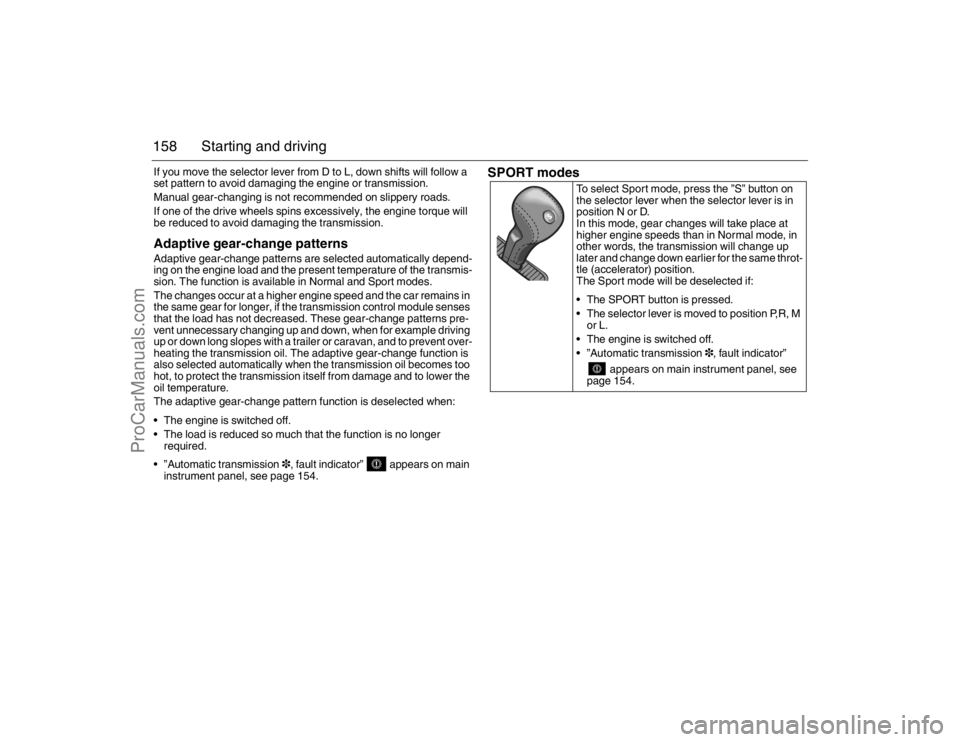
To select Sport mode, press the ”S” button on
the selector lever when the selector lever is in
position N or D.
In this mode, gear changes will take place at
higher engine speeds than in Normal mode, in
other words, the transmission will change up
later and change down earlier for the same throt-
tle (accelerator) position.
The Sport mode will be deselected if:
The SPORT button is pressed.
The selector lever is moved to position P,R, M
or L.
The engine is switched off.
”Automatic transmission3, fault indicator”
appears on main instrument panel, see
page 154.
95_U S _M 07.book Page 158 Friday, June 9, 2006 8:58 AM
ProCarManuals.com
Page 176 of 288
176 Starting and drivingWhen negotiating long hills, bear the follow-
ing important considerations in mind:
Use Normal mode when driving with a
caravan or trailer on hilly roads. The
adaptive gear change pattern function will
prevent the transmission overheating.
Rises in coolant temperature are indi-
cated by the temperature gauge in the
main instrument panel.Recommendations for cars with
automatic transmission
Rises in coolant temperature are indicated
by the temperature gauge in the main instru-
ment panel.
The following steps are taken in order as the
temperature of the engine increases:
Gear change pattern is altered.
A/C compressor is switched off.
Engine torque is reduced.
The following message will be displayed on
the SID if the transmission fluid becomes
too hot:
“Gearbox too hot.
Make a safe stop.
If this message appears, stop the car as
soon as it is safe to do so and allow the
engine to idle until the message has gone
out. The selector lever should be in
position P.When continuing your journey, select
manual mode and a gear in which the
engine speed is about 3,000 rpm until the
incline eases (see page 157).
WARNING
Remember to use the braking effect of the
engine (position D or L) when you are
descending long or steep hills to spare
the brakes.
Brake failure can result from overheated
brakes!
95_U S _M 07.book Page 176 Friday, June 9, 2006 8:58 AM
ProCarManuals.com
Page 217 of 288
217 Car care and technical information
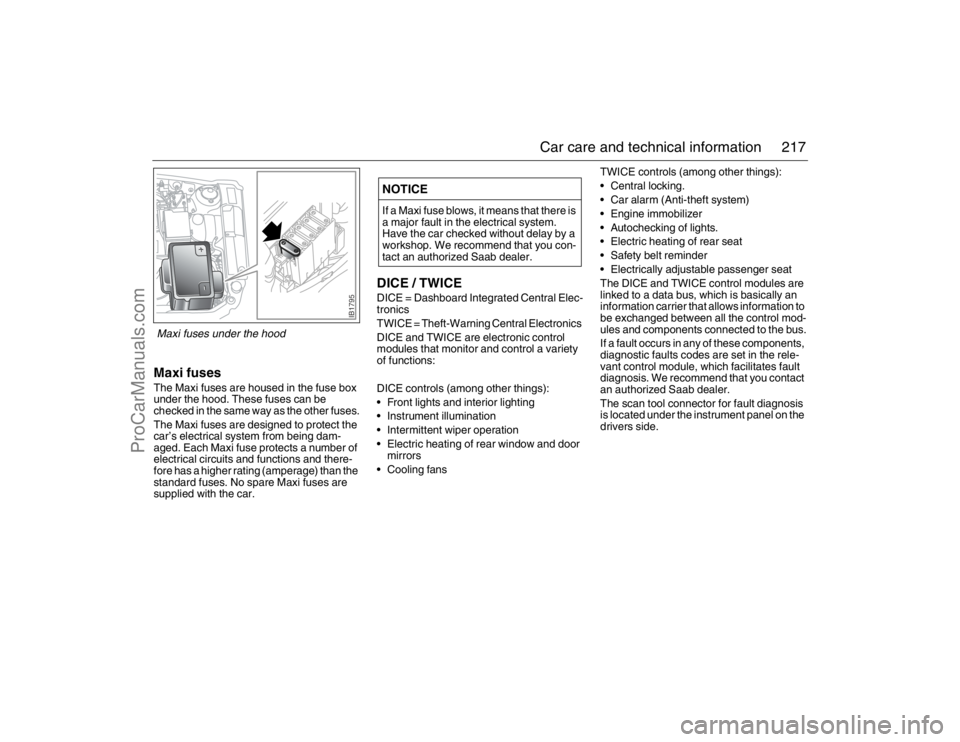
Maxi fusesThe Maxi fuses are housed in the fuse box
under the hood. These fuses can be
checked in the same way as the other fuses.
The Maxi fuses are designed to protect the
car’s electrical system from being dam-
aged. Each Maxi fuse protects a number of
electrical circuits and functions and there-
fore has a higher rating (amperage) than the
standard fuses. No spare Maxi fuses are
supplied with the car.
DICE / TWICEDICE = Dashboard Integrated Central Elec-
tronics
TWICE = Theft-Warning Central Electronics
DICE and TWICE are electronic control
modules that monitor and control a variety
of functions:
DICE controls (among other things):
Front lights and interior lighting
Instrument illumination
Intermittent wiper operation
Electric heating of rear window and door
mirrors
Cooling fansTWICE controls (among other things):
Central locking.
Car alarm (Anti-theft system)
Engine immobilizer
Autochecking of lights.
Electric heating of rear seat
Safety belt reminder
Electrically adjustable passenger seat
The DICE and TWICE control modules are
linked to a data bus, which is basically an
information carrier that allows information to
be exchanged between all the control mod-
ules and components connected to the bus.
If a fault occurs in any of these components,
diagnostic faults codes are set in the rele-
vant control module, which facilitates fault
diagnosis. We recommend that you contact
an authorized Saab dealer.
The scan tool connector for fault diagnosis
is located under the instrument panel on the
drivers side.NOTICEIf a Maxi fuse blows, it means that there is
a major fault in the electrical system.
Have the car checked without delay by a
workshop. We recommend that you con-
tact an authorized Saab dealer.
IB1795
Maxi fuses under the hood 95_U S _M 07.book Page 217 Friday, June 9, 2006 8:58 AM
ProCarManuals.com
Page 218 of 288
218 Car care and technical information
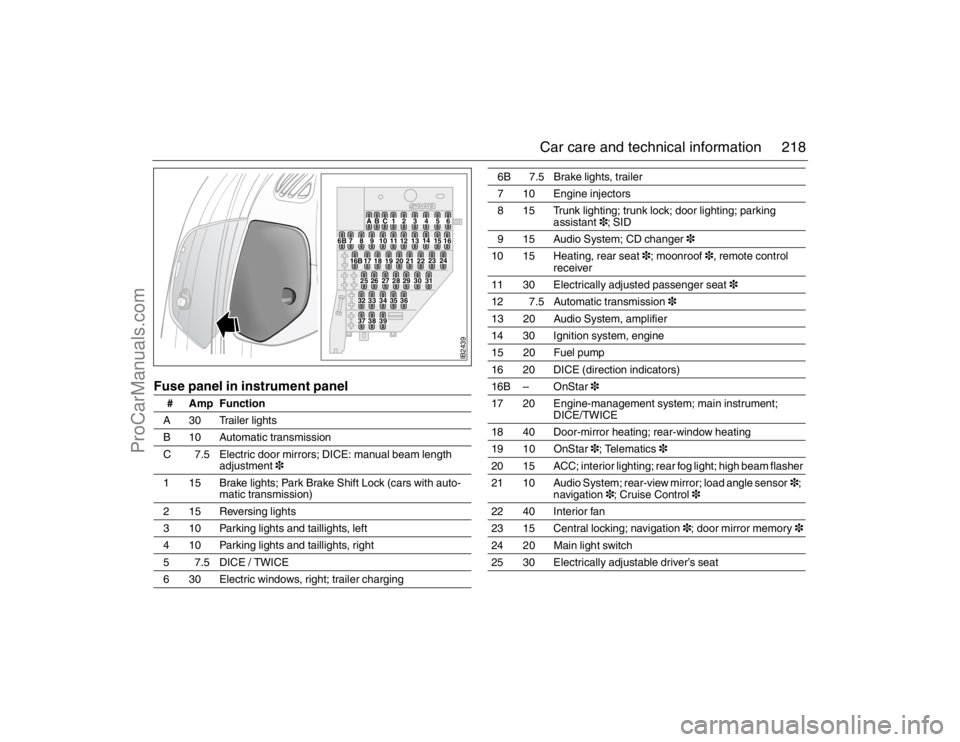
Fuse panel in instrument panel
# Amp Function
A 30 Trailer lights
B 10 Automatic transmission
C 7.5 Electric door mirrors; DICE: manual beam length
adjustment3
1 15 Brake lights; Park Brake Shift Lock (cars with auto-
matic transmission)
2 15 Reversing lights
3 10 Parking lights and taillights, left
4 10 Parking lights and taillights, right
5 7.5 DICE / TWICE
6 30 Electric windows, right; trailer charging
6B 7.5 Brake lights, trailer
7 10 Engine injectors
8 15 Trunk lighting; trunk lock; door lighting; parking
assistant3; SID
9 15 Audio System; CD changer3
10 15 Heating, rear seat3; moonroof3, remote control
receiver
11 30 Electrically adjusted passenger seat3
12 7.5 Automatic transmission3
13 20 Audio System, amplifier
14 30 Ignition system, engine
15 20 Fuel pump
16 20 DICE (direction indicators)
16B – OnStar3
17 20 Engine-management system; main instrument;
DICE/TWICE
18 40 Door-mirror heating; rear-window heating
19 10 OnStar3; Telematics3
20 15 ACC; interior lighting; rear fog light; high beam flasher
21 10 Audio System; rear-view mirror; load angle sensor3;
navigation3; Cruise Control3
22 40 Interior fan
23 15 Central locking; navigation3; door mirror memory3
24 20 Main light switch
25 30 Electrically adjustable driver’s seat
IB2439
BC123456 A
14
121110987
13
6B
1516
2324
222120191817
16B25262728293031
3635343332
393837
95_U S _M 07.book Page 218 Friday, June 9, 2006 8:58 AM
ProCarManuals.com
Page 219 of 288
219 Car care and technical information
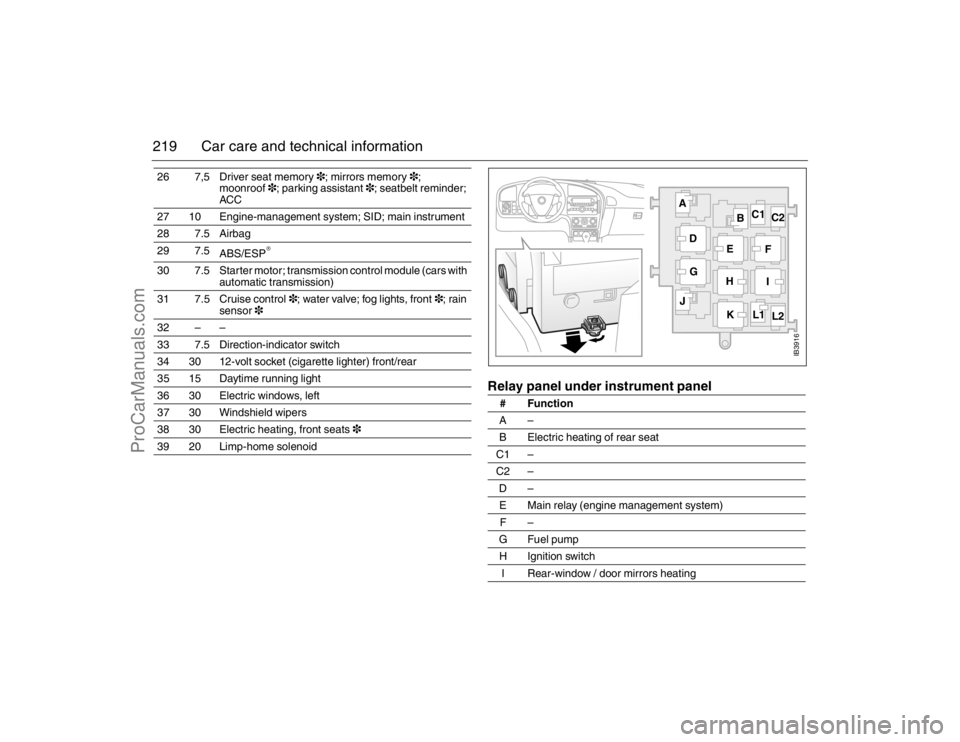
Relay panel under instrument panel
26 7,5 Driver seat memory3; mirrors memory3;
moonroof3; parking assistant3; seatbelt reminder;
ACC
27 10 Engine-management system; SID; main instrument
28 7.5 Airbag
29 7.5
ABS/ESP
®
30 7.5 Starter motor; transmission control module (cars with
automatic transmission)
31 7.5 Cruise control3; water valve; fog lights, front3; rain
sensor3
32 – –
33 7.5 Direction-indicator switch
34 30 12-volt socket (cigarette lighter) front/rear
35 15 Daytime running light
36 30 Electric windows, left
37 30 Windshield wipers
38 30 Electric heating, front seats3
39 20 Limp-home solenoid
# Function
A –
B Electric heating of rear seat
C1 –
C2 –
D–
E Main relay (engine management system)
F–
G Fuel pump
H Ignition switch
I Rear-window / door mirrors heating
IB3916
A
BC1
C2
L2 L1 D
GE
F
H
I
K J
95_U S _M 07.book Page 219 Friday, June 9, 2006 8:58 AM
ProCarManuals.com
Page 222 of 288
222 Car care and technical informationTires Your new vehicle comes with high-quality
tires made by a leading tire manufacturer. If
you ever have questions about your tire
warranty and where to obtain service, see
your Saab Warranty and Service Record
Booklet for details.
Inflation - Tire PressureThe Tire-Loading Information label shows
the correct inflation pressures for your tires
when they’re cold. “Cold” means your vehi-
cle has been sitting for at least three hours
or driven no more than 1 mile (1.6 km).Notice:
Don’t let anyone tell you that
underinflation or overinflation is all
right. It’s not. If your tires don’t have
enough air (underinflation), you can get
the following:
Too much flexing
Too much heat
Tire overloading
Bad wear
Bad handling
Bad fuel economy
If your tires have too much air (overinfla-
tion), you can get the following:
Unusual wear
Bad handling
Rough ride
Needless damage from road hazardsAdjust the tire pressure to match the current
load and speed of the car (see page 267).
The stated tire pressures apply to cold tires,
i.e. tires that are the same temperature as
the outside air temperature. Tire pressure
increases as the tires become warm (e.g.
during highway driving) by approximately
0.3 bar (4 psi). When the temperature of the
tires changes by 50°F (10°C), the tire pres-
sure will change 0.1 bar (2 psi).
Never reduce the pressure of a hot tire. If the
tires are hot when you check them, only
increase the pressure, if necessary.
WARNING
Poorly maintained and improperly used
tires are dangerous.
Overloading your tires can cause
overheating as a result of too much
friction. You could have an blow-out
and a serious accident. See “Loading
Your Vehicle” on page 231.
Underinflated tires pose the same
danger as overloaded tires. The
resulting accident could cause serious
injury. Check all tires frequently to
maintain the recommended pressure.
Tire pressure should be checked
when your tires are cold.
Overinflated tires are more likely to be
cut, punctured or broken by a sudden
impact – such as when you hit a pot-
hole. Keep tires at the recommended
pressure.
Worn, old tires can cause accidents. If
your tread is badly worn, or if your tires
have been damaged, replace them.95_U S _M 07.book Page 222 Friday, June 9, 2006 8:58 AM
ProCarManuals.com
Page 270 of 288

270 SpecificationsSeveral of the systems in your
Saab car can be adjusted to
better fit your individual needsSome functions are governed by legal
requirements and cannot therefore be
reprogrammed.
We recommend that you contact an autho-
rized Saab dealer for further information.
Car alarm/central locking system:
The number of blinks when locking/
unlocking.
Automatic locking of the trunk when the
car (SportCombi) is driven, 1 to 8 mph
(2–14 km/h), YES or NO.
Preclude the unlocking of the trunk while
the car (SportCombi) is driven, YES or
NO.
Automatic locking of the trunk (Sport-
Combi) after 1 second–4 minutes if it has
not been opened, YES or NO.
Automatic locking of the trunk (Sport-
Combi) when it is closed, YES or NO.
Automatic locking of all doors when the
car is driven above 7.5 mph (12 km/h),
YES or NO.Saab Information Display:
Outdoor temperature display can be
adjusted.
Miscellaneous:
Select the on-time for heated rear seat3.
Additional sweep of the wipers after wind-
shield washer function (ON or OFF).
Courtesy Headlight Feature on-time can
vary from 20 to 50 seconds.
Night panel illumination deactivation
speed for the speedometer can be
adjusted.
Following adjustments can be
done by the driver:Automatic Climate Control (ACC):
You can choose whether front seat and rear
window heating is to be activated manually
or automatically; see "Adaptation of ACC"
on page 85.
Saab 9-5 Audio System (see page 106):
Speed dependent volume.
Daytime Running Lights:
To disable, turn off the ignition and pull out
fuse 35, see page 219.
95_U S _M 07.book Page 270 Friday, June 9, 2006 8:58 AM
ProCarManuals.com
Page 272 of 288

272 IndexDDICE/TWICE
___________________ 217
Dampers
______________________ 265
Date
_________________________ 105
Date code, tires
_________________ 234
Date display
___________________ 105
Definitions and terminology, tire
____ 231
Determining correct load, tires
_____ 233
Dim-dipped beam
________________ 73
Direction indicators _______________ 75
Diversity antenna
_______________ 109
Door handles
___________________ 44
Door mirrors
___________________ 116
Doors, locks & luggage compartment
_43
Drive belt
______________________ 263
Drive belt, alternator
_____________ 201
Drive belts, length
_______________ 263
Driver’s seat, programmable
________ 20
Driving at night
_________________ 181
Driving in hot weather
____________ 173
Driving with a load
______________ 181
EEDR (Event Data Recorders)
______ 255
ESP
® _________________________ 163
Electric heating of rear seat
________ 87
Electric windows
________________ 115
Electrical system, technical data
____ 263
Electronic Stability Program
_______ 163
Electronic starting interlock _________ 49Emergency operation of moonroof
__ 124
Emission control systems
_________ 192
Engine bay
____________________ 191
Engine bay, cleaning
_____________ 242
Engine number
_________________ 268
Engine oil, grade ________________ 261
Engine, description ______________ 194
Engine, technical data ____________ 260
Engine, temperature gauge
________ 65
Engine-oil level, checking
_________ 194
Error codes, Audio System ________ 112
Event Data Recorders (EDR) ______ 255
Expansion tank, coolant
__________ 195
FFilling a portable fuel container
_____ 148
Flat spots, tires
_________________ 224
Fluid level, automatic transmission
__ 195
Folding the parcel shelf,
9-5 SportCombi
________________ 133
Folding the rear seat, 9-5 Sedan
___ 129
Folding the rear seat, 9-5 SportCombi
132
Frequency band
_________________ 93
Frequently asked questions on airbag
40
Front fog lights
__________________ 76
Frost warning
___________________ 68
Fuel
__________________________ 146
Fuel consumption
________________ 68
Fuel container
__________________ 148
Fuel gauge
_____________________ 65
Fuel grade _____________________ 260Fuel information
_________________ 148
Fuse box under hood
____________ 220
Fuse panel
_____________________ 216
Fuses
_________________________ 216
GGarage door opener
_____________ 118
Gearbox number
________________ 268
Gearbox oil, checking
____________ 195
Gearbox, technical data, __________ 264
General functions
_______________ 105
Glove compartment ______________ 126
HHandbrake
_____________________ 165
Hazard warning lights
_____________ 76
Head restraint
___________________ 21
Headlight flasher _________________ 73
Headlights
______________________ 73
Heated front seats
________________ 87
Hood
_________________________ 190
Horn __________________________ 114
IIf a tire goes flat
_________________ 228
Ignition switch
__________________ 140
Immobilizer
_____________________ 49
Indicator and warning lights
_________ 58
95_U S _M 07.book Page 272 Friday, June 9, 2006 8:58 AM
ProCarManuals.com