light SAAB 9-5 2007 Owner's Guide
[x] Cancel search | Manufacturer: SAAB, Model Year: 2007, Model line: 9-5, Model: SAAB 9-5 2007Pages: 288, PDF Size: 18.14 MB
Page 73 of 288
73 Instruments and controls
Switches The parking lights and daytime running
lights come on automatically when the igni-
tion switch is ON.
Note to owners in the U.S.: If you do not
want Daytime Running Lights, this feature
can be disconnected: switch off the engine
and remove fuse No. 35 (see page 218).
Note to owners in Canada: Daytime Run-
ning Lights must not be disconnected as
they are a Canadian Federal legal require-
ment.
The parking lights can be switched on
regardless of the position of the ignition
switch. Do not use parking lights when driv-
ing.
If the parking lights are on and the driver´s
door is opened, a reminder to turn them off
will sound.
Note: The lighting switch must be in parking
light or headlight position (low beam posi-
tion only) to operate the fog lights (see
page 76).The headlights come on automatically when
the ignition is ON and go off when the igni-
tion switch is turned to the LOCK position.
The parking lights, however, can be on
when the ignition switch is in the LOCK posi-
tion.
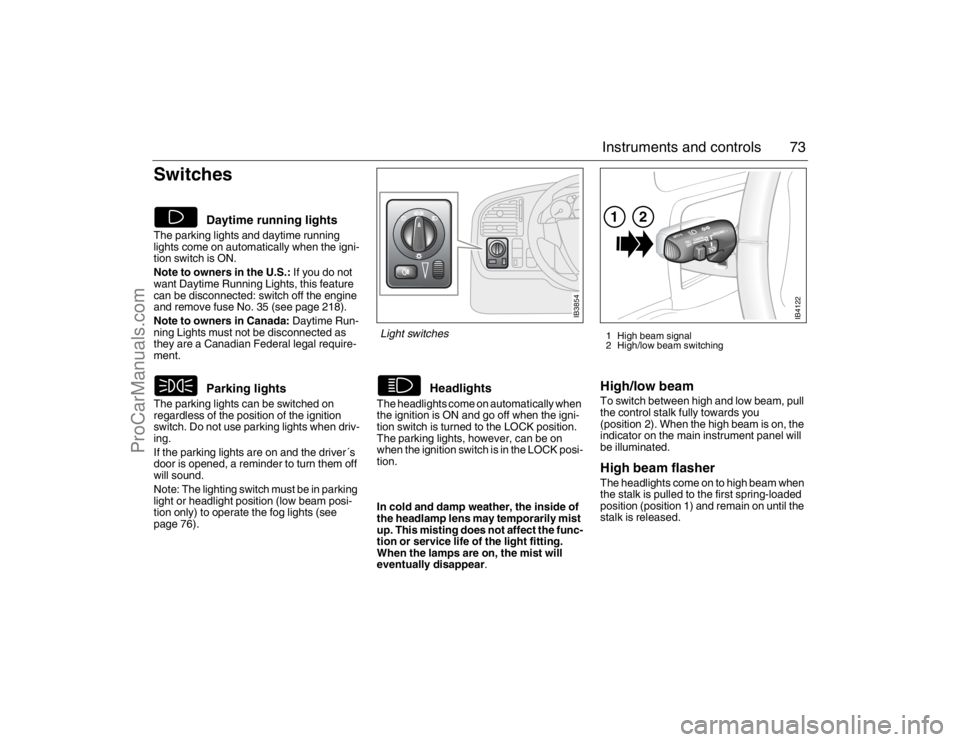
High/low beamTo switch between high and low beam, pull
the control stalk fully towards you
(position 2). When the high beam is on, the
indicator on the main instrument panel will
be illuminated.High beam flasher The headlights come on to high beam when
the stalk is pulled to the first spring-loaded
position (position 1) and remain on until the
stalk is released.
Daytime running lights
Parking lights
Headlights
IB4122
121 High beam signal
2 High/low beam switching
IB3854
Light switches In cold and damp weather, the inside of
the headlamp lens may temporarily mist
up. This misting does not affect the func-
tion or service life of the light fitting.
When the lamps are on, the mist will
eventually disappear.
95_U S _M 07.book Page 73 Friday, June 9, 2006 8:58 AM
ProCarManuals.com
Page 74 of 288
74 Instruments and controlsCourtesy Headlight FeatureA delay function allows the headlights to
remain on low beam for about 30 seconds
after the driver’s door has been closed.
To activate this function,
Switch off the ignition and remove the key
Open the driver’s door
Pull the high/low beam control stalk
towards the steering wheel like you are
flashing the high beam, see page 73. The
low beam headlights will now come on
immediately after the driver’s door has
been closed (within 30 seconds) and will
remain on for about 30 seconds.
The length of time for this function can be
adjusted by your authorized Saab dealer.
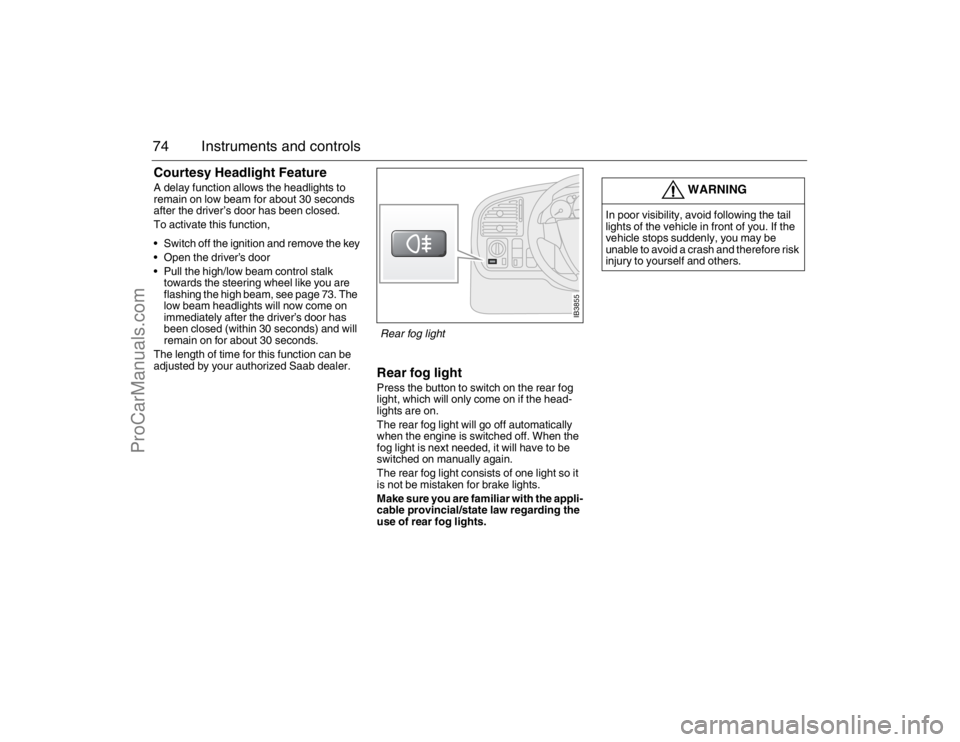
Rear fog lightPress the button to switch on the rear fog
light, which will only come on if the head-
lights are on.
The rear fog light will go off automatically
when the engine is switched off. When the
fog light is next needed, it will have to be
switched on manually again.
The rear fog light consists of one light so it
is not be mistaken for brake lights.
Make sure you are familiar with the appli-
cable provincial/state law regarding the
use of rear fog lights.
WARNING
In poor visibility, avoid following the tail
lights of the vehicle in front of you. If the
vehicle stops suddenly, you may be
unable to avoid a crash and therefore risk
injury to yourself and others.
IB3855
Rear fog light
95_U S _M 07.book Page 74 Friday, June 9, 2006 8:58 AM
ProCarManuals.com
Page 75 of 288
75 Instruments and controls
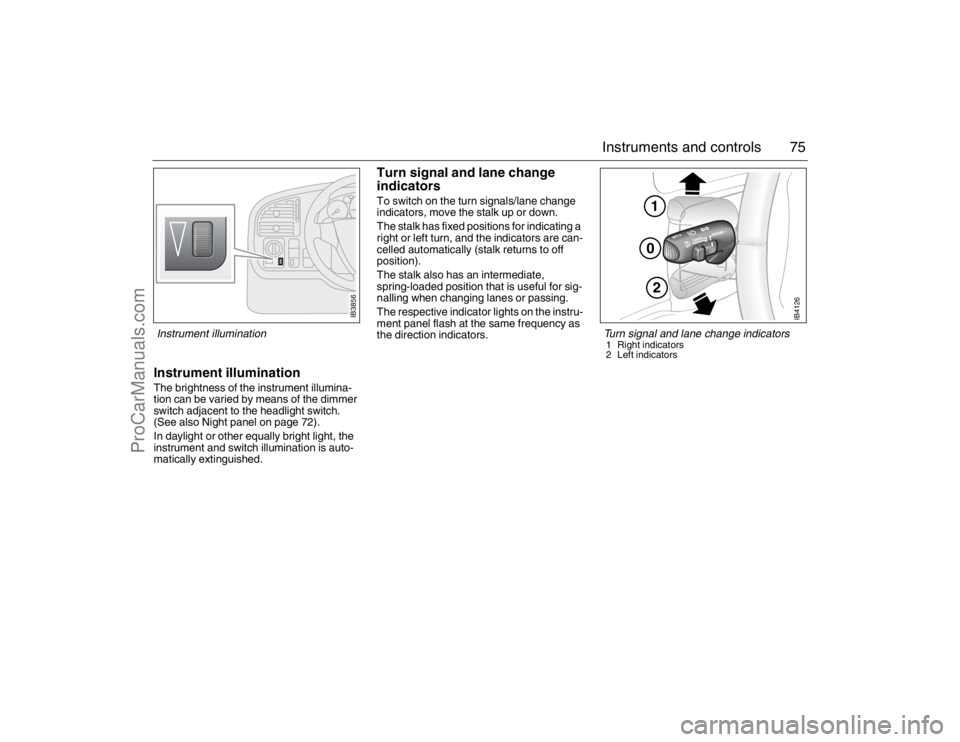
Instrument illuminationThe brightness of the instrument illumina-
tion can be varied by means of the dimmer
switch adjacent to the headlight switch.
(See also Night panel on page 72).
In daylight or other equally bright light, the
instrument and switch illumination is auto-
matically extinguished.
Turn signal and lane change
indicatorsTo switch on the turn signals/lane change
indicators, move the stalk up or down.
The stalk has fixed positions for indicating a
right or left turn, and the indicators are can-
celled automatically (stalk returns to off
position).
The stalk also has an intermediate,
spring-loaded position that is useful for sig-
nalling when changing lanes or passing.
The respective indicator lights on the instru-
ment panel flash at the same frequency as
the direction indicators.
IB3856
102
IB4126
Turn signal and lane change indicators 1 Right indicators
2 Left indicators
Instrument illumination95_U S _M 07.book Page 75 Friday, June 9, 2006 8:58 AM
ProCarManuals.com
Page 76 of 288
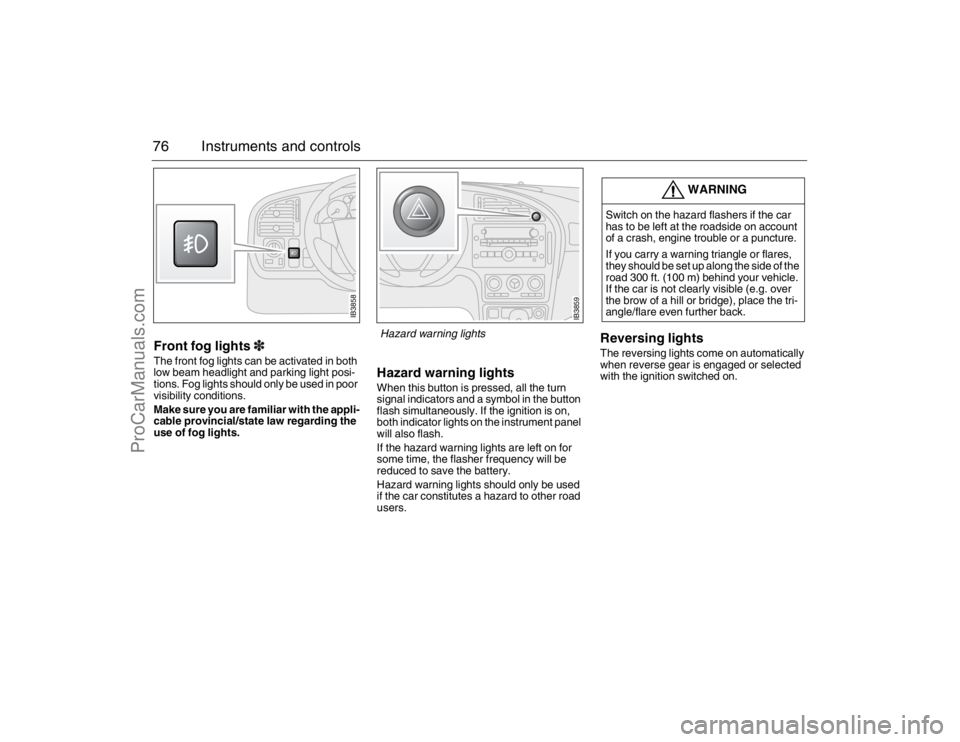
76 Instruments and controlsFront fog lights3The front fog lights can be activated in both
low beam headlight and parking light posi-
tions. Fog lights should only be used in poor
visibility conditions.
Make sure you are familiar with the appli-
cable provincial/state law regarding the
use of fog lights.
Hazard warning lightsWhen this button is pressed, all the turn
signal indicators and a symbol in the button
flash simultaneously. If the ignition is on,
both indicator lights on the instrument panel
will also flash.
If the hazard warning lights are left on for
some time, the flasher frequency will be
reduced to save the battery.
Hazard warning lights should only be used
if the car constitutes a hazard to other road
users.
Reversing lightsThe reversing lights come on automatically
when reverse gear is engaged or selected
with the ignition switched on.
WARNING
Switch on the hazard flashers if the car
has to be left at the roadside on account
of a crash, engine trouble or a puncture.
If you carry a warning triangle or flares,
they should be set up along the side of the
road 300 ft. (100 m) behind your vehicle.
If the car is not clearly visible (e.g. over
the brow of a hill or bridge), place the tri-
angle/flare even further back.
IB3858
IB3859
Hazard warning lights
95_U S _M 07.book Page 76 Friday, June 9, 2006 8:58 AM
ProCarManuals.com
Page 77 of 288
77 Instruments and controls
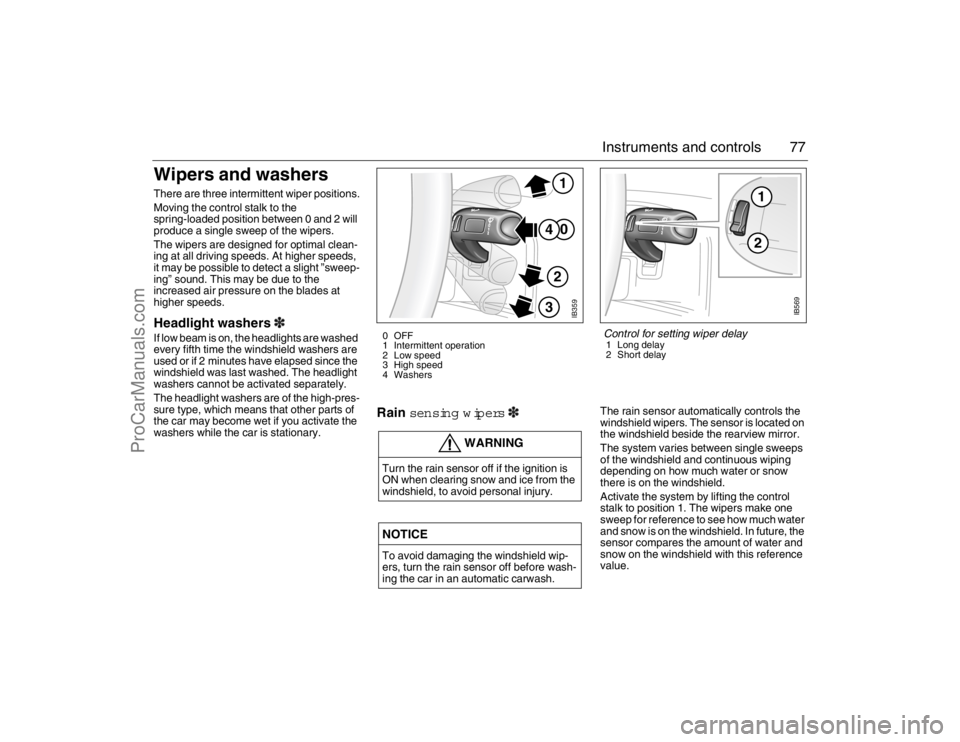
Wipers and washers There are three intermittent wiper positions.
Moving the control stalk to the
spring-loaded position between 0 and 2 will
produce a single sweep of the wipers.
The wipers are designed for optimal clean-
ing at all driving speeds. At higher speeds,
it may be possible to detect a slight ”sweep-
ing” sound. This may be due to the
increased air pressure on the blades at
higher speeds.Headlight washers3If low beam is on, the headlights are washed
every fifth time the windshield washers are
used or if 2 minutes have elapsed since the
windshield was last washed. The headlight
washers cannot be activated separately.
The headlight washers are of the high-pres-
sure type, which means that other parts of
the car may become wet if you activate the
washers while the car is stationary.
Rain sen sing wipers3
The rain sensor automatically controls the
windshield wipers. The sensor is located on
the windshield beside the rearview mirror.
The system varies between single sweeps
of the windshield and continuous wiping
depending on how much water or snow
there is on the windshield.
Activate the system by lifting the control
stalk to position 1. The wipers make one
sweep for reference to see how much water
and snow is on the windshield. In future, the
sensor compares the amount of water and
snow on the windshield with this reference
value.
WARNING
Turn the rain sensor off if the ignition is
ON when clearing snow and ice from the
windshield, to avoid personal injury.NOTICETo avoid damaging the windshield wip-
ers, turn the rain sensor off before wash-
ing the car in an automatic carwash.
IB359
0
41
2
3
0 OFF
1 Intermittent operation
2 Low speed
3 High speed
4 Washers
12
IB569
Control for setting wiper delay1 Long delay
2 Short delay
95_U S _M 07.book Page 77 Friday, June 9, 2006 8:58 AM
ProCarManuals.com
Page 78 of 288
78 Instruments and controlsWhen the engine has been switched off,
the control stalk must be moved to posi-
tion 0 and back to position 1 to reactivate
the sensor.
Set the sensitivity using the control on the
wiper stalk (the same control as used for
wiper delay on cars not fitted with a rain sen-
sor). The sensor has three sensitivity set-
tings. It is most sensitive when in the upper-
most position (1). When a higher degree of
sensitivity is selected, the wipers make one
sweep of the windshield for reference.
The rain sensor has a daylight and a night
time mode. The sensor measures the
amount of available light and automatically
selects the appropriate mode. The sensor is
more sensitive at night. The function of the
rain sensor is impaired by dry snow.
Rear-window wiper
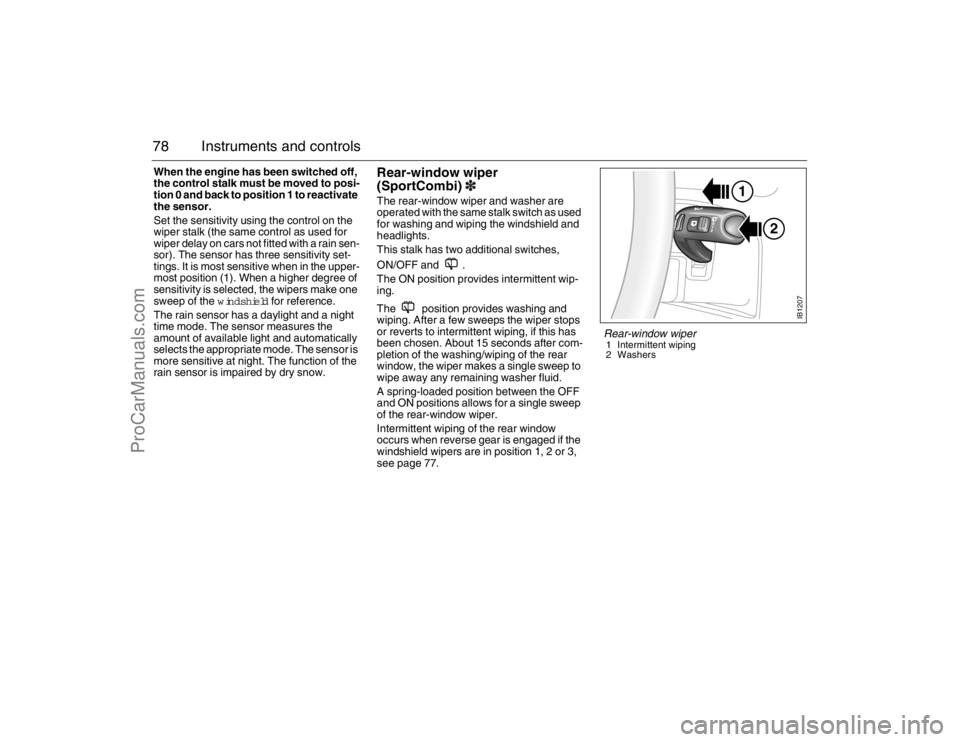
(SportCombi)3The rear-window wiper and washer are
operated with the same stalk switch as used
for washing and wiping the windshield and
headlights.
This stalk has two additional switches,
ON/OFF and .
The ON position provides intermittent wip-
ing.
The position provides washing and
wiping. After a few sweeps the wiper stops
or reverts to intermittent wiping, if this has
been chosen. About 15 seconds after com-
pletion of the washing/wiping of the rear
window, the wiper makes a single sweep to
wipe away any remaining washer fluid.
A spring-loaded position between the OFF
and ON positions allows for a single sweep
of the rear-window wiper.
Intermittent wiping of the rear window
occurs when reverse gear is engaged if the
windshield wipers are in position 1, 2 or 3,
see page 77.
2 1
IB1207
Rear-window wiper1 Intermittent wiping
2 Washers
95_U S _M 07.book Page 78 Friday, June 9, 2006 8:58 AM
ProCarManuals.com
Page 82 of 288
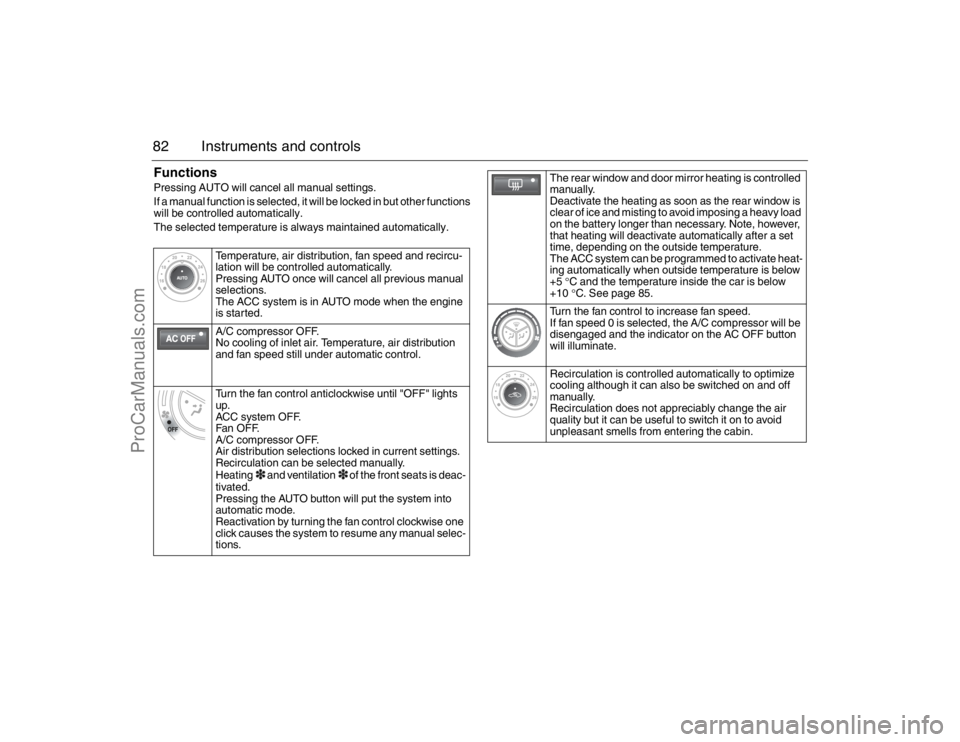
82 Instruments and controlsFunctionsPressing AUTO will cancel all manual settings.
If a manual function is selected, it will be locked in but other functions
will be controlled automatically.
The selected temperature is always maintained automatically.
Temperature, air distribution, fan speed and recircu-
lation will be controlled automatically.
Pressing AUTO once will cancel all previous manual
selections.
The ACC system is in AUTO mode when the engine
is started.
A/C compressor OFF.
No cooling of inlet air. Temperature, air distribution
and fan speed still under automatic control.
Turn the fan control anticlockwise until "OFF" lights
up.
ACC system OFF.
Fan OF F.
A/C compressor OFF.
Air distribution selections locked in current settings.
Recirculation can be selected manually.
Heating
3 and ventilation
3 of the front seats is deac-
tivated.
Pressing the AUTO button will put the system into
automatic mode.
Reactivation by turning the fan control clockwise one
click causes the system to resume any manual selec-
tions.
The rear window and door mirror heating is controlled
manually.
Deactivate the heating as soon as the rear window is
clear of ice and misting to avoid imposing a heavy load
on the battery longer than necessary. Note, however,
that heating will deactivate automatically after a set
time, depending on the outside temperature.
The ACC system can be programmed to activate heat-
ing automatically when outside temperature is below
+5 °C and the temperature inside the car is below
+10°C. See page 85.
Turn the fan control to increase fan speed.
If fan speed 0 is selected, the A/C compressor will be
disengaged and the indicator on the AC OFF button
will illuminate.
Recirculation is controlled automatically to optimize
cooling although it can also be switched on and off
manually.
Recirculation does not appreciably change the air
quality but it can be useful to switch it on to avoid
unpleasant smells from entering the cabin.
95_U S _M 07.book Page 82 Friday, June 9, 2006 8:58 AM
ProCarManuals.com
Page 85 of 288
85 Instruments and controls
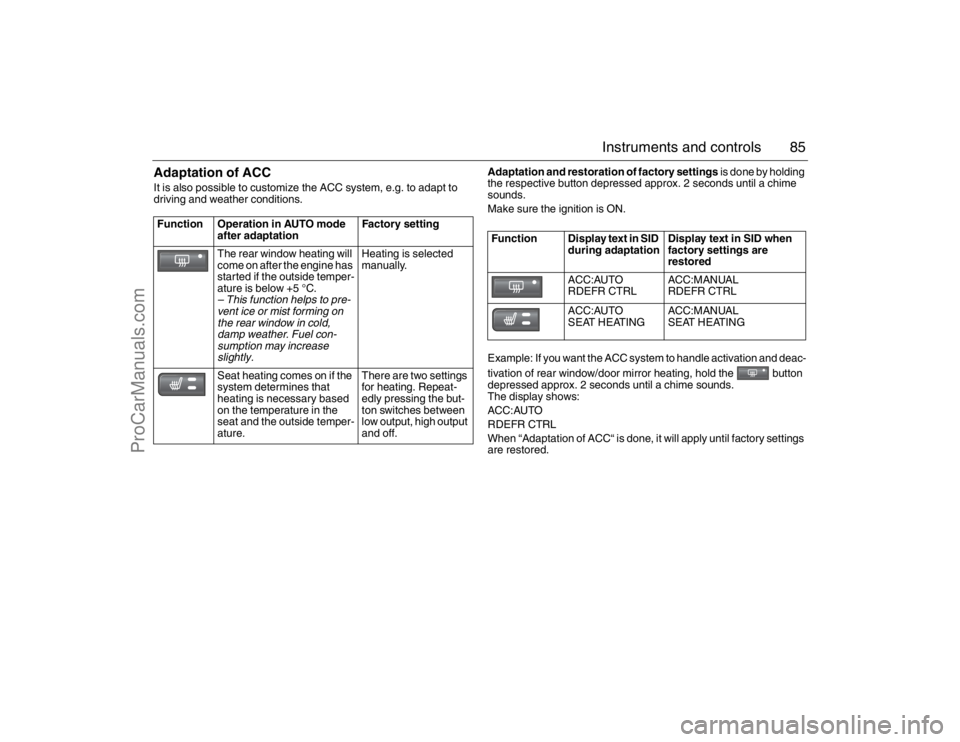
Adaptation of ACCIt is also possible to customize the ACC system, e.g. to adapt to
driving and weather conditions.
Adaptation and restoration of factory settings is done by holding
the respective button depressed approx. 2 seconds until a chime
sounds.
Make sure the ignition is ON.
Example: If you want the ACC system to handle activation and deac-
tivation of rear window/door mirror heating, hold the button
depressed approx. 2 seconds until a chime sounds.
The display shows:
ACC:AUTO
RDEFR CTRL
When “Adaptation of ACC“ is done, it will apply until factory settings
are restored. Function Operation in AUTO mode
after adaptationFactory setting
The rear window heating will
come on after the engine has
started if the outside temper-
ature is below +5 °C.
– This function helps to pre-
vent ice or mist forming on
the rear window in cold,
damp weather. Fuel con-
sumption may increase
slightly.
Heating is selected
manually.
Seat heating comes on if the
system determines that
heating is necessary based
on the temperature in the
seat and the outside temper-
ature
.
There are two settings
for heating. Repeat-
edly pressing the but-
ton switches between
low output, high output
and off.
Function Display text in SID
during adaptationDisplay text in SID when
factory settings are
restored
ACC:AUTO
RDEFR CTRLACC:MANUAL
RDEFR CTRL
ACC:AUTO
SEAT HEATINGACC:MANUAL
SEAT HEATING
95_U S _M 07.book Page 85 Friday, June 9, 2006 8:58 AM
ProCarManuals.com
Page 109 of 288

109 Saab 9-5 Audio System
AntennasThe audio system has two antennas incor-
porated in the rear window: one for FM and
one for AM.
The XM
TM
Satellite Radio antenna3 is
located on the roof of the vehicle. Keep this
antenna clear of snow and ice build up for
clear radio reception.
Roof loads can negatively affect telecom-
munication, GPS reception and the per-
formance of the XM
TM
system3.
If sun film is fitted to the rear window, it
must be a pure-plastic variety to maintain
good radio reception. Ensure that the film
does not contain any metal.
Multipath propagationMultipath propagation occurs when radio
waves from an FM transmitter are reflected
by a large building, or the like, causing them
to arrive slightly later than the direct waves.
This can create interference to radio recep-
tion. See also "Diversity antenna".
Diversity antenna3To improve radio reception when the topog-
raphy is a problem, a second FM antenna,
known as a diversity antenna, can be fitted
in the rear window. Consult a Saab dealer
for further information.
NOTICERefrain from placing hard or sharp
objects on the rear parcel shelf, to avoid
damaging the antenna leads.
IB4470
IB4471
95_U S _M 07.book Page 109 Friday, June 9, 2006 8:58 AM
ProCarManuals.com
Page 111 of 288
111 Saab 9-5 Audio System
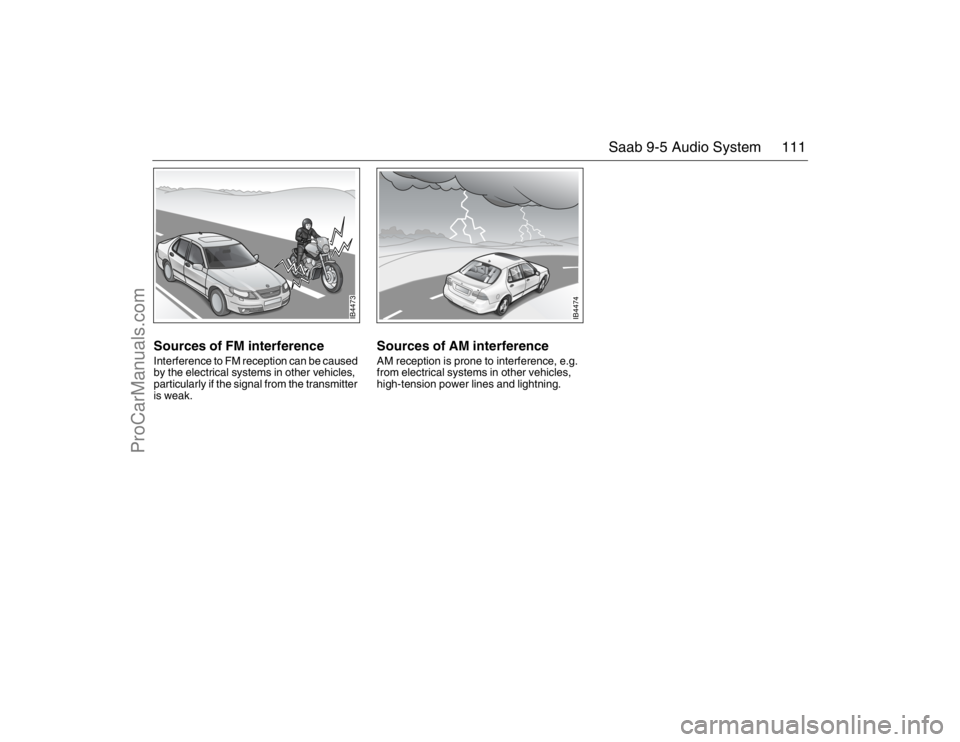
Sources of FM interferenceInterference to FM reception can be caused
by the electrical systems in other vehicles,
particularly if the signal from the transmitter
is weak.
Sources of AM interferenceAM reception is prone to interference, e.g.
from electrical systems in other vehicles,
high-tension power lines and lightning.
IB4473
IB4474
95_U S _M 07.book Page 111 Friday, June 9, 2006 8:58 AM
ProCarManuals.com