light SAAB 9-5 2007 Manual PDF
[x] Cancel search | Manufacturer: SAAB, Model Year: 2007, Model line: 9-5, Model: SAAB 9-5 2007Pages: 288, PDF Size: 18.14 MB
Page 185 of 288
185 Starting and driving
Towing the car Gear lever in neutral (in cars with automatic
transmission: selector lever at N (neutral))
Turn on the parking lights.
Drive carefully and do not exceed the
speed limit for vehicles being towed.
Always try to keep the towrope taut by
gently applying the brake, as necessary.
This will avoid the towrope being jerked
violently.
The local regulations on towing speeds
must be followed.
The highest permissible towing speed is
30 mph (50 km/h), unless the legal limit is
lower. The longest permissible towing dis-
tance is 30 miles (50 km). If the car has to
be transported farther than that, summon a
tow truck. A flat bed tow truck is the pre-
ferred method to tow.
Failure to follow these guidelines can result
in damage.Cars with automatic transmission
The car cannot be push started. In an emer-
gency, it is possible to start the engine using
jump leads (see the section, ”Jump starting”
on page 186).
Transporting the car
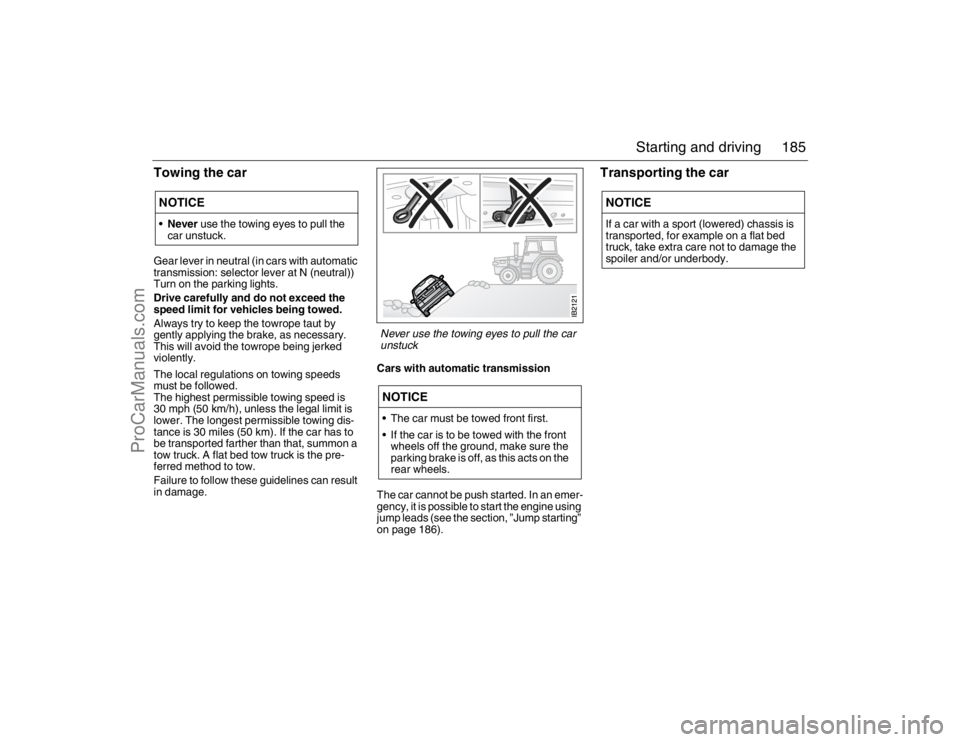
NOTICENever use the towing eyes to pull the
car unstuck.
NOTICE The car must be towed front first.
If the car is to be towed with the front
wheels off the ground, make sure the
parking brake is off, as this acts on the
rear wheels.
NOTICEIf a car with a sport (lowered) chassis is
transported, for example on a flat bed
truck, take extra care not to damage the
spoiler and/or underbody.
Never use the towing eyes to pull the car
unstuck
95_U S _M 07.book Page 185 Friday, June 9, 2006 8:58 AM
ProCarManuals.com
Page 186 of 288
186 Starting and drivingJump startingIf your battery has run down, you may want
to use another vehicle and some jumper
cables to start your Saab. Follow the steps
below to do it safely.To jump start your vehicle:
1 Check the other vehicle. It must have a
12-volt battery with a negative ground
system.
2 Get the vehicles close enough so the
jumper cables can reach, but be sure the
vehicles are not touching each other. If a
poor connection on the negative jumper
cable should exist, it is possible for
damage to be caused to electrical sys-
tems/components of either vehicle
should inadvertent contact be made.
You would not be able to start your car
and bad grounding could damage elec-
trical systems.
3 Turn off the ignition on both vehicles.
Turn off all lights that are not needed,
and radios. This will avoid sparks and
help save both batteries and it could
save your radio.
WARNING
When working on the battery, highly
explosive gas can build up. A spark
could ignite this gas that collects
around the battery.
Therefore, always avoid sparks and
open flames in the vicinity of the bat-
tery.
The battery contains corrosive sulfuric
acid. Always wear a face mask or gog-
gles when working on the battery.
If battery acid gets into the eyes or
splashes onto skin or clothing, wash
the affected area liberally with water.
If acid gets into the eyes or a large
quantity makes contact with the skin,
seek medical help.
Battery posts, terminals and related
accessories contain lead and lead
compounds. Wash your hands after
handling.
NOTICEIgnoring these steps could result in costly
damage to your vehicle that would not be
covered by your warranty.
Trying to start your car by pushing or pull-
ing it could damage your vehicle, even if
you have a manual transmission. If you
have an automatic transmission, your
vehicle cannot be started by pushing or
pulling it.
NOTICEIf the other system is not a 12-volt system
with a negative ground, both vehicles can
be damaged.
WARNING
You could be injured if the vehicles roll.
Set the parking brake firmly on each vehi-
cle. Put an automatic transmission in P
(Park) or a manual transmission in
Neutral.
IB3931
95_U S _M 07.book Page 186 Friday, June 9, 2006 8:58 AM
ProCarManuals.com
Page 187 of 288

187 Starting and driving
4 Open the hood and locate the battery.
Find the positive (+) and negative (–) termi-
nals on the battery.5 Check that the jumper cables do not
have loose or missing insulation. If they
do, you could get a shock and also the
vehicles could be damaged.
Before you connect the cables, here are
some basic things you should know.
Positive (+) will go to positive (+) and
negative (–) will go to a major metal
engine part with a good ground. Do not
connect (+) to (–) or you will get a short
that could injure you or would damage
the battery and maybe other parts as
well.
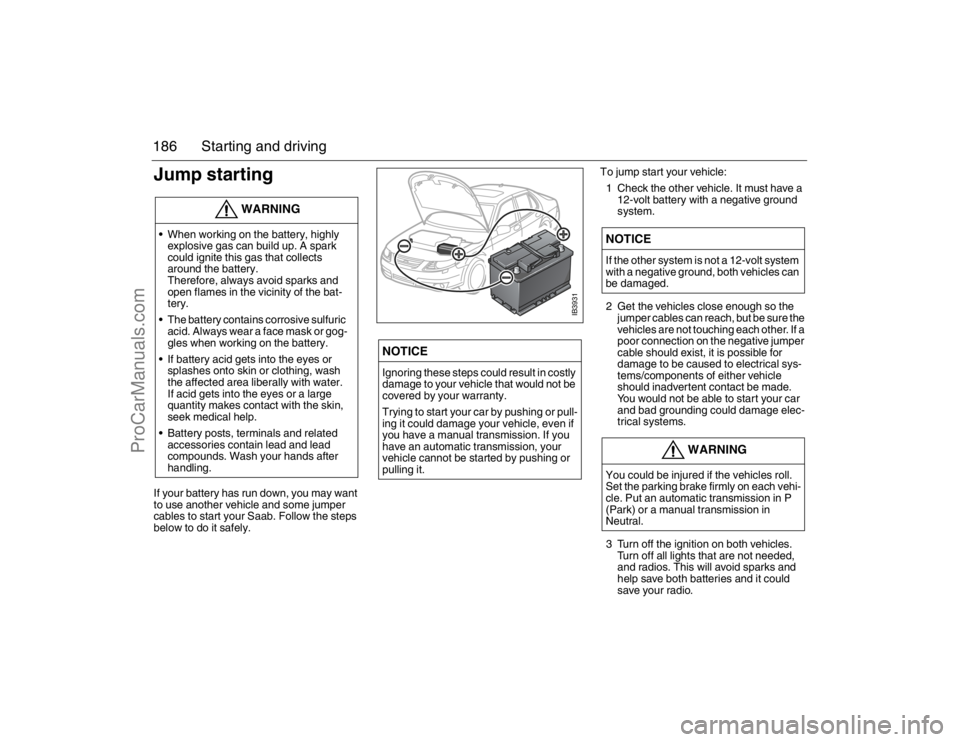
6 Connect the red positive (+) cable to the
positive (+) terminal of the vehicle with
the discharged battery.
7 Do not let the other end touch metal.
Connect it to the positive (+) terminal of
the good battery. Use a remote positive
(+) terminal if the vehicle has one.
8 Now connect the black negative (–)
cable to the good battery’s negative
terminal.NOTICEIf you leave your radio on, it could be
badly damaged. The repairs would not be
covered by your warranty.
WARNING
An electric fan can start up even when the
engine is not running and can injure you.
Keep hands, clothing and tools away from
any underhood electric fan.
WARNING
Using a match or flame of any kind near a
battery can cause battery gas to explode.
You can suffer burns or be blinded. Use a
flashlight if you need more light.
Be sure the battery has enough water.
The battery installed in your new Saab
has filler caps. Be sure the right amount
of water is there. Add distilled or boiled
water if the level is too low. If you don’t,
explosive gas could be present.
Be sure the electrolyte in the battery is not
frozen. Discharged batteries will freeze.
When connecting jumper cables to a
frozen battery, gas from the chemical
reaction inside the battery can build up
under the ice and cause an explosion.
Battery fluid contains acid that can burn
you. Do not get it on you. If you acciden-
tally get it in your eyes or on your skin,
flush the area with water and get medical
help immediately.
95_U S _M 07.book Page 187 Friday, June 9, 2006 8:58 AM
ProCarManuals.com
Page 189 of 288
189 Car care and technical information
IB3888
Hood ________________ 190
Engine compartment __ 191
Emission control
systems ____________ 192
Engine ______________ 194
Engine oil ____________ 194
Transmission fluid ____ 195
Coolant ______________ 195
Brake and clutch fluid__ 196
Power steering fluid ___ 198
Air filter _____________ 198
Battery ______________ 199
Drive belts ___________ 201
Wipers and washers ___ 202
Changing bulbs _______ 204
Fuses _______________ 216 Tires ________________ 222
Compact spare tire ____ 234
Safety belts __________ 239
Upholstery and trim ___ 240
Textile carpeting ______ 240
Washing the car ______ 241
Waxing and polishing __ 242
Engine compartment __ 242
Touching up the paint _ 242
Air conditioning (ACC) _ 243
Anti-corrosion treatment 245
For long trips _________ 246
Recovery and/or
recycling of automotive
materials ___________ 247
Headlight aiming ______ 247
Car care and technical information
3 Asterisk means: equipment not fitted in all cars
(can depend on model variant, engine variant,
market specification, options or accessories).95_U S _M 07.book Page 189 Friday, June 9, 2006 8:58 AM
ProCarManuals.com
Page 193 of 288

193 Car care and technical information
Saab Trionic engine
management systemThe Saab Trionic engine management
system is a unique Saab development that
combines sequential multiport fuel injection,
electronic distributorless ignition and turbo-
charger boost pressure control into one sys-
tem.
The Trionic engine control module (ECM)
monitors many different engine parameters
such as:
Intake manifold pressure
Intake air temperature
Crankshaft position
Engine coolant temperature
Throttle position and
The oxygen content of the exhaust gases.
The ECM receives information regarding
engine knocking from a sophisticated feed-
back function in the ignition discharge unit.
By processing all of this information, the Tri-
onic system can control fuel injector open-
ing duration, ignition timing and turbo-
charger boost pressure to provide excellent
engine performance while maintaining low
emissions and fuel consumption.
ORVR (Onboard Refueling Vapor
Recovery)Hydrocarbon vapors formed when refueling
will be recovered by the car and not
released into the atmosphere. The hydro-
carbons are absorbed in a evaporative
emission canister. When the engine is sub-
sequently started, the evaporative emission
canister is gradually purged as air is sucked
into it through a shut-off valve. The hydro-
carbon/air mixture passes through the evap
canister purge valve and into the engine
where it is burned.
When refueling, make sure you screw the
filler cap on and keep turning until it has
clicked at least 3 times. Otherwise, it is pos-
sible for the CHECK ENGINE light to illumi-
nate.
Refueling, see page 146.
NOTICEThe Trionic engine management system
continuously monitors the operation of
these systems and has on-board diag-
nostic capabilities (OBD II).
If the ”Engine malfunction (CHECK
ENGINE)” lamp in the main instru-
ment illuminates, this indicates that the
Trionic ECM has detected a problem. The
car will continue to operate, but perfor-
mance may be diminished. You should
have your car checked by a Saab dealer
as soon as possible.
95_U S _M 07.book Page 193 Friday, June 9, 2006 8:58 AM
ProCarManuals.com
Page 199 of 288
199 Car care and technical information
Battery
The battery is provided with a cover to pro-
tect it from radiated heat. If the battery is
exposed to high temperatures, its life will be
shortened. To remove the cover, release
the two clips along its long sides.
The cover fits the standard battery installed
in the car. If a new battery is to be fitted,
make sure that its dimensions are the same
as the standard one.
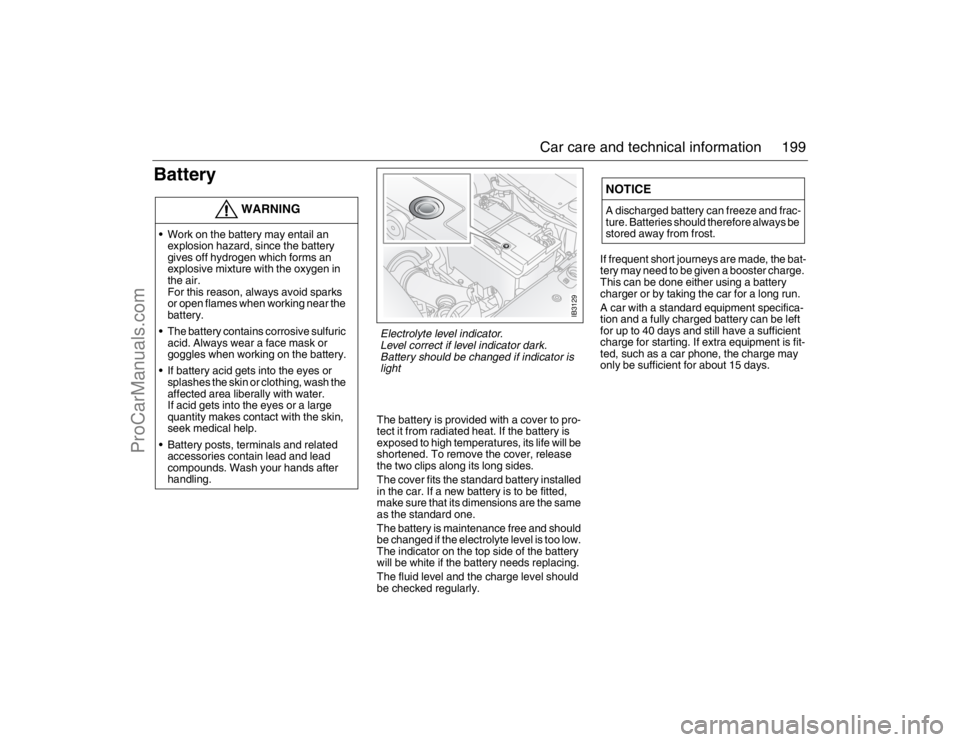
The battery is maintenance free and should
be changed if the electrolyte level is too low.
The indicator on the top side of the battery
will be white if the battery needs replacing.
The fluid level and the charge level should
be checked regularly.
If frequent short journeys are made, the bat-
tery may need to be given a booster charge.
This can be done either using a battery
charger or by taking the car for a long run.
A car with a standard equipment specifica-
tion and a fully charged battery can be left
for up to 40 days and still have a sufficient
charge for starting. If extra equipment is fit-
ted, such as a car phone, the charge may
only be sufficient for about 15 days.
WARNING
Work on the battery may entail an
explosion hazard, since the battery
gives off hydrogen which forms an
explosive mixture with the oxygen in
the air.
For this reason, always avoid sparks
or open flames when working near the
battery.
The battery contains corrosive sulfuric
acid. Always wear a face mask or
goggles when working on the battery.
If battery acid gets into the eyes or
splashes the skin or clothing, wash the
affected area liberally with water.
If acid gets into the eyes or a large
quantity makes contact with the skin,
seek medical help.
Battery posts, terminals and related
accessories contain lead and lead
compounds. Wash your hands after
handling.
NOTICEA discharged battery can freeze and frac-
ture. Batteries should therefore always be
stored away from frost.
IB3129
Electrolyte level indicator.
Level correct if level indicator dark.
Battery should be changed if indicator is
light
95_U S _M 07.book Page 199 Friday, June 9, 2006 8:58 AM
ProCarManuals.com
Page 203 of 288
203 Car care and technical information
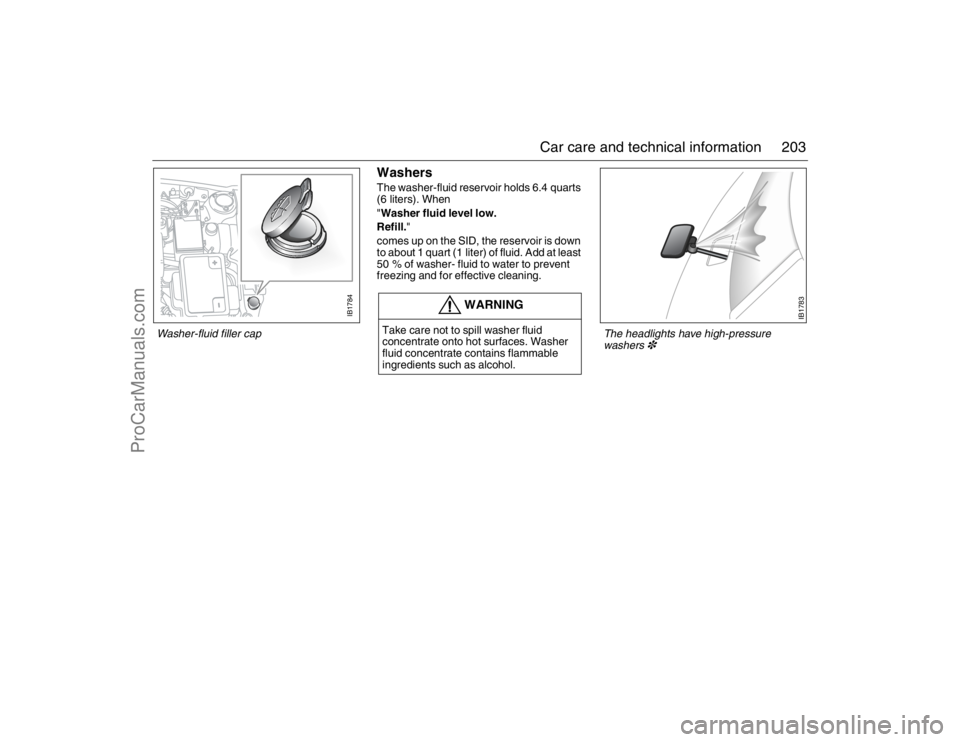
WashersThe washer-fluid reservoir holds 6.4 quarts
(6 liters). When
"Washer fluid level low.
Refill."
comes up on the SID, the reservoir is down
to about 1 quart (1 liter) of fluid. Add at least
50 % of washer- fluid to water to prevent
freezing and for effective cleaning.
WARNING
Take care not to spill washer fluid
concentrate onto hot surfaces. Washer
fluid concentrate contains flammable
ingredients such as alcohol.
IB1784
Washer-fluid filler cap
IB1783
The headlights have high-pressure
washers
3
95_U S _M 07.book Page 203 Friday, June 9, 2006 8:58 AM
ProCarManuals.com
Page 204 of 288
204 Car care and technical informationChanging bulbs
Check that the new bulb is working when fin-
ished.
Use only "Long Life" bulbs.
Headlight aiming, see page 247.
Xenon headlight3Xenon headlights produce roughly twice as
much light as halogen bulbs and have a sig-
nificantly longer service life.
The lamp units consist of a gas discharge
lamp containing xenon. When the lights are
switched on a very high voltage activates
the xenon gas. The lamps soon reach full
intensity.
Cars with xenon headlights have automatic
levelling. The levelling system comprises
two sensors on the front axle, one on the
rear axle and a control unit under the head-
light housing. Headlight alignment is regu-
lated automatically to prevent dazzling
oncoming traffic. Alignment is also adjusted
during braking.
WARNING
Before changing a bulb in the engine bay,
switch off the engine to avoid danger of
fingers and hands being injured by
moving parts.
The radiator fan can start up even when
the engine is switched off.
Xenon headlights3 are high voltage
and must therefore be changed at a
workshop. We recommend that you
contact an authorized Saab work-
shop. Work involving high-voltage
components is potentially lethal.NOTICE Since the headlight lenses are made
of plastic, rinse dried-on dirt with
water and allow it time to soften up
before cleaning the lenses. Avoid
rubbing the lenses when dry and
never use solvents.
Use de-icer spray instead of scraping
the ice off.
NOTICE Do not fit bulbs with a higher rating
than 55 W, since the headlight reflec-
tor and the wiring of the car are not
designed for a higher wattage.
Switch off the ignition before chang-
ing a bulb, to avoid possible short-cir-
cuiting.
Do not touch the glass of the bulbs
with your fingers. The oil on your skin
can shorten the life of the bulb.
95_U S _M 07.book Page 204 Friday, June 9, 2006 8:58 AM
ProCarManuals.com
Page 205 of 288
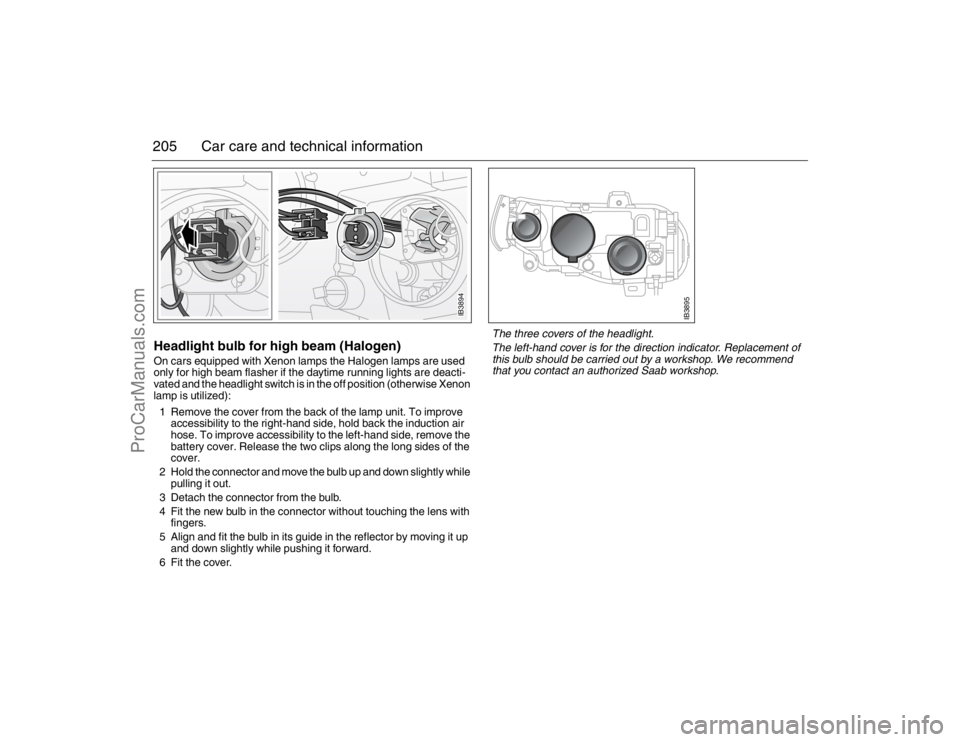
205 Car care and technical informationHeadlight bulb for high beam (Halogen)On cars equipped with Xenon lamps the Halogen lamps are used
only for high beam flasher if the daytime running lights are deacti-
vated and the headlight switch is in the off position (otherwise Xenon
lamp is utilized):
1 Remove the cover from the back of the lamp unit. To improve
accessibility to the right-hand side, hold back the induction air
hose. To improve accessibility to the left-hand side, remove the
battery cover. Release the two clips along the long sides of the
cover.
2 Hold the connector and move the bulb up and down slightly while
pulling it out.
3 Detach the connector from the bulb.
4 Fit the new bulb in the connector without touching the lens with
fingers.
5 Align and fit the bulb in its guide in the reflector by moving it up
and down slightly while pushing it forward.
6Fit the cover.
IB3894
IB3895
The three covers of the headlight.
The left-hand cover is for the direction indicator. Replacement of
this bulb should be carried out by a workshop. We recommend
that you contact an authorized Saab workshop.
95_U S _M 07.book Page 205 Friday, June 9, 2006 8:58 AM
ProCarManuals.com
Page 206 of 288
206 Car care and technical information
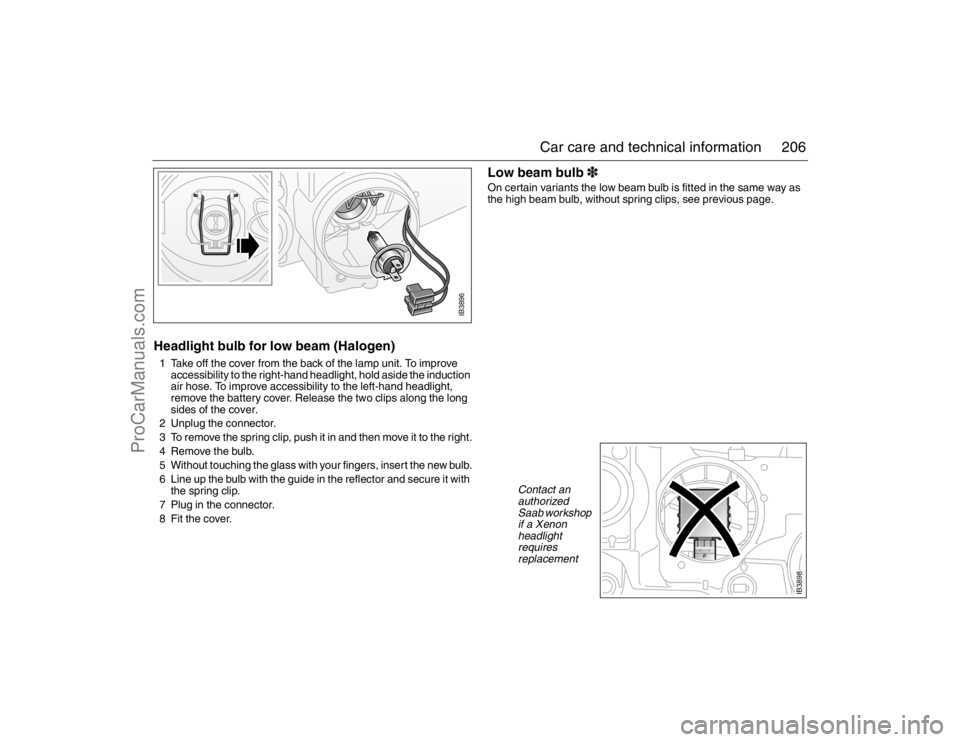
Headlight bulb for low beam (Halogen)1 Take off the cover from the back of the lamp unit. To improve
accessibility to the right-hand headlight, hold aside the induction
air hose. To improve accessibility to the left-hand headlight,
remove the battery cover. Release the two clips along the long
sides of the cover.
2 Unplug the connector.
3 To remove the spring clip, push it in and then move it to the right.
4 Remove the bulb.
5 Without touching the glass with your fingers, insert the new bulb.
6 Line up the bulb with the guide in the reflector and secure it with
the spring clip.
7 Plug in the connector.
8Fit the cover.
Low beam bulb3On certain variants the low beam bulb is fitted in the same way as
the high beam bulb, without spring clips, see previous page.
IB3896
IB3898
Contact an
authorized
Saab workshop
if a Xenon
headlight
requires
replacement
95_U S _M 07.book Page 206 Friday, June 9, 2006 8:58 AM
ProCarManuals.com