ignition SAAB 9-7X 2007 Manual PDF
[x] Cancel search | Manufacturer: SAAB, Model Year: 2007, Model line: 9-7X, Model: SAAB 9-7X 2007Pages: 498, PDF Size: 3.13 MB
Page 303 of 498
Your vehicle was not designed to be towed with
any of its wheels on the ground. If your vehicle
must be towed, see “Towing Your Vehicle” earlier
in this section.
Notice:Towing an all-wheel-drive vehicle with
all four wheels on the ground, or even with
only two of its wheels on the ground, will
damage drivetrain components. Do not tow an
all-wheel-drive vehicle if any of its wheels
will be on the ground.
Electronically Controlled Air
Suspension System
Your vehicle is equipped with an electronically
controlled air suspension system that automatically
keeps your vehicle level as you load and unload.
The system includes a compressor, two height
sensors, and two air springs supporting the
rear axle.
The system also has an internal clock to prevent
overheating if the inator is used for prolonged
periods. If the system overheats, all levelingfunction stops until the system cools down.
During this time, the indicator light on the air
inator switch will be ashing.
The ignition has to be on for the system to inate,
in order to raise the vehicle to the standard ride
height after loading. The system can lower
the vehicle to the standard ride height after
unloading with the ignition on and also for up to
30 minutes after the ignition has been turned off.
You may hear the compressor operating when you
load your vehicle, and periodically as the system
adjusts the vehicle to the standard ride height.
Load leveling will not function normally with the
inator hose attached to the inator outlet. Remove
the inator hose from the outlet during loading
and unloading.
If the vehicle is parked for an extended period of
time, some bleed down of the suspension is
normal. Upon starting the vehicle, proper height
will be achieved.
303
ProCarManuals.com
Page 304 of 498
Overload Protection
The air suspension system is equipped with
overload protection. Overload protection is
designed to protect the air suspension system,
and it is an indicator to the driver that the
vehicle is overloaded. When the overload
protection mode is on, it will not allow damage to
the air compressor. However, do not overload
the vehicle. SeeLoading Your Vehicle on
page 296.
If the suspension remains at a low height,
the rear axle load has exceeded GAWR
(Gross Axle Weight Rating). When the overload
protection mode is activated, the compressor
operates for about 30 seconds to one minute
without raising the vehicle depending on the
amount of overload. This will continue each time
the ignition is turned on until the rear axle load
is reduced below GAWR.
Indicator Light
The indicator light on the inator switch in the
rear passenger compartment also serves as an
indicator for internal system error. If the indicator
light is ashing without the load leveling function
or the inator being active, turn off the ignition.
The next day turn on the ignition and check
the indicator light. The vehicle can be driven with
the light ashing, but if it is you should have
the vehicle serviced as soon as possible.
304
ProCarManuals.com
Page 363 of 498
Trying to start your vehicle by pushing or
pulling it will not work, and it could damage
your vehicle.
1. Check the other vehicle. It must have a
12-volt battery with a negative ground system.
Notice:If the other vehicle’s system is not a
12-volt system with a negative ground,
both vehicles can be damaged. Only use
vehicles with 12-volt systems with negative
grounds to jump start your vehicle.
2. Get the vehicles close enough so the jumper
cables can reach, but be sure the vehicles are
not touching each other. If they are, it could
cause a ground connection you do not
want. You would not be able to start your
vehicle, and the bad grounding could damage
the electrical systems.
To avoid the possibility of the vehicles rolling,
set the parking brake rmly on both vehicles
involved in the jump start procedure. Put
an automatic transmission in PARK (P) or a
manual transmission in NEUTRAL before
setting the parking brake. If you have a
four-wheel-drive vehicle, be sure the transfer
case is not in NEUTRAL.Notice:If you leave your radio or other
accessories on during the jump starting
procedure, they could be damaged. The repairs
would not be covered by your warranty.
Always turn off your radio and other
accessories when jump starting your vehicle.
3. Turn off the ignition on both vehicles.
Unplug unnecessary accessories plugged into
the cigarette lighter or the accessory power
outlets, if equipped. Turn off the radio and all
lamps that are not needed. This will avoid
sparks and help to save both batteries. And it
could save the radio!
363
ProCarManuals.com
Page 391 of 498
Tire Pressure Monitor System
The Tire Pressure Monitor System (TPMS) uses
radio and sensor technology to check tire pressure
levels. TPMS sensors are mounted on each tire
and wheel assembly, except the spare tire.
The TPMS sensors monitor the air pressure in
your vehicle’s tires and transmit tire pressure
readings to a receiver located in the vehicle.
The TPMS is designed to alert the driver if a low
tire pressure condition exists. Tire pressure
levels may also be checked by using the Driver
Information Center (DIC) Trip Information
button, located on the instrument panel. See “Tire
Pressures” underDIC Operation and Displays
on page 195for additional information.
When a low tire pressure condition is detected,
the TPMS will illuminate the low tire pressure
warning symbol located on the instrument panel
cluster, and at the same time a message will also
appear on the DIC display. The low tire pressure
warning symbol on the instrument panel cluster
and the CHECK TIRE PRESSURE warning
message on the DIC will appear at each ignitioncycle until the tires are inated to the correct
ination pressure. For additional information and
details about the DIC operation and displays
seeDIC Operation and Displays on page 195and
DIC Warnings and Messages on page 199.
You may notice, during cooler weather conditions,
that the tire pressure monitor light, located on
the instrument panel cluster, and the CHECK TIRE
PRESSURE message will appear when the
vehicle is rst started, and then turn off as you
start to drive the vehicle. This could be an
early indicator that the tire pressures are getting
low and need to be inated to the proper pressure.
Each tire, including the spare (if provided),
should be checked monthly when cold and inated
to the ination pressure recommended by the
vehicle manufacturer on the vehicle placard or tire
ination pressure label. (If your vehicle has tires
of a different size than the size indicated on
the vehicle placard or tire ination pressure label,
you should determine the proper tire ination
pressure for those tires.)
391
ProCarManuals.com
Page 394 of 498

You will have two minutes to match the rst
tire/wheel position, and ve minutes overall to
match all four tire/wheel positions. If it takes longer
than two minutes, to match the rst tire and
wheel, or more than ve minutes to match all
four tire and wheel positions the matching process
stops and you will need to start over.
The TPMS sensor matching process is outlined
below:
1. Set the parking brake.
2. Turn the ignition switch to RUN with the
engine off.
3. Turn the headlamp control from off to parking
lamps four times within three seconds.
A double horn chirp will sound and the TPMS
low tire warning light will begin to ash.
The double horn chirp and ashing TPMS
warning light indicate that the TPMS matching
process has started. The TPMS warning
light should continue ashing throughout the
matching procedure.4. Start with the driver’s side front tire.
5. Remove the valve cap from the valve cap
stem. Activate the TPMS sensor by
increasing or decreasing the tire’s air pressure
for 10 seconds, then stop and listen for a
single horn chirp. The single horn chirp should
sound within 15 seconds, conrming that
the sensor identication code has been
matched to this tire and wheel position.
If you do not hear the conrming single horn
chirp, you will need to start over with step
number one. To let air-pressure out of a tire
you can use the pointed end of the valve cap,
a pencil-style air pressure gage, or a key.
6. Proceed to the passenger’s side front tire, and
repeat the procedure in Step 5.
7. Proceed to the passenger’s side rear tire, and
repeat the procedure in Step 5.
8. Proceed to the driver’s side rear tire, and
repeat the procedure in Step 5.
394
ProCarManuals.com
Page 395 of 498
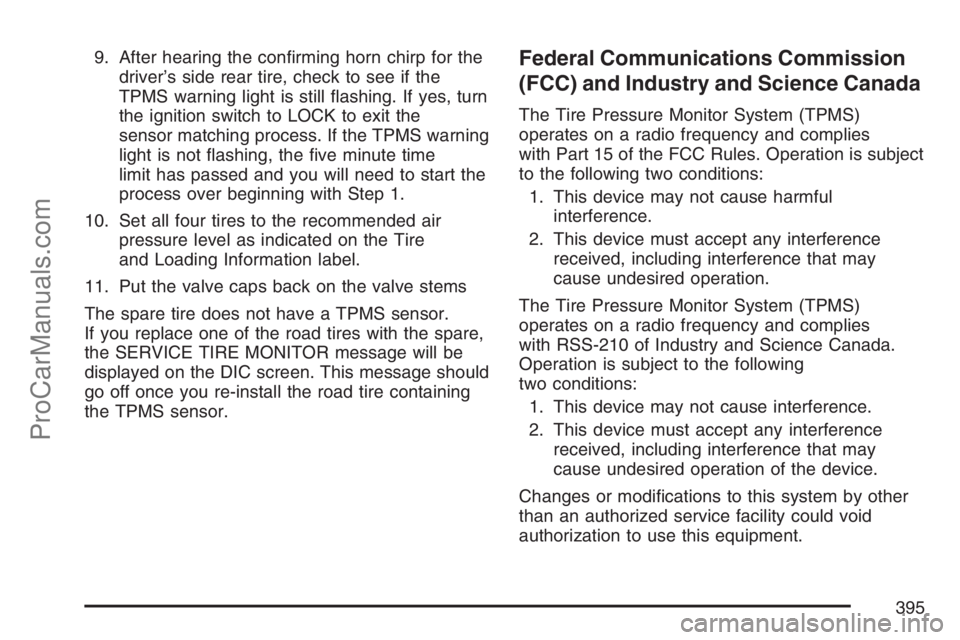
9. After hearing the conrming horn chirp for the
driver’s side rear tire, check to see if the
TPMS warning light is still ashing. If yes, turn
the ignition switch to LOCK to exit the
sensor matching process. If the TPMS warning
light is not ashing, the ve minute time
limit has passed and you will need to start the
process over beginning with Step 1.
10. Set all four tires to the recommended air
pressure level as indicated on the Tire
and Loading Information label.
11. Put the valve caps back on the valve stems
The spare tire does not have a TPMS sensor.
If you replace one of the road tires with the spare,
the SERVICE TIRE MONITOR message will be
displayed on the DIC screen. This message should
go off once you re-install the road tire containing
the TPMS sensor.Federal Communications Commission
(FCC) and Industry and Science Canada
The Tire Pressure Monitor System (TPMS)
operates on a radio frequency and complies
with Part 15 of the FCC Rules. Operation is subject
to the following two conditions:
1. This device may not cause harmful
interference.
2. This device must accept any interference
received, including interference that may
cause undesired operation.
The Tire Pressure Monitor System (TPMS)
operates on a radio frequency and complies
with RSS-210 of Industry and Science Canada.
Operation is subject to the following
two conditions:
1. This device may not cause interference.
2. This device must accept any interference
received, including interference that may
cause undesired operation of the device.
Changes or modications to this system by other
than an authorized service facility could void
authorization to use this equipment.
395
ProCarManuals.com
Page 437 of 498

Fuses Usage
5 Driver’s Side Headlamp High-Beam
6 Driver’s Side Headlamp Low-Beam
7 Windshield Wiper
8 Automatic Transfer Case
9 Windshield Washer
10 Powertrain Control Module B
11 Fog Lamps
12 Stoplamp
13 Cigarette Lighter
15 Electric Adjustable Pedals
16 Ignition B
18 Airbag System
19 Electric Brake
20 Cooling Fan
21 Horn
22 Ignition E
23 Electronic Throttle ControlFuses Usage
24Instrument Panel Cluster/Driver
Information Center (DIC)
25 Brake Transmission Shift Interlock
26Transmission Control Module (TCM)
Canister
27 Backup
28 Powertrain Control Module 1
29 Oxygen Sensor
30 Air Conditioning
31 Truck Body Controller 1
50 Passenger’s Side Trailer Turn
51 Driver’s Side Trailer Turn
52 Hazard Flashers
53 Headlamp Driver Module
54 Air Injection Reactor Solenoid
57 Ignition A1
59 Regulated Voltage Control
437
ProCarManuals.com
Page 438 of 498
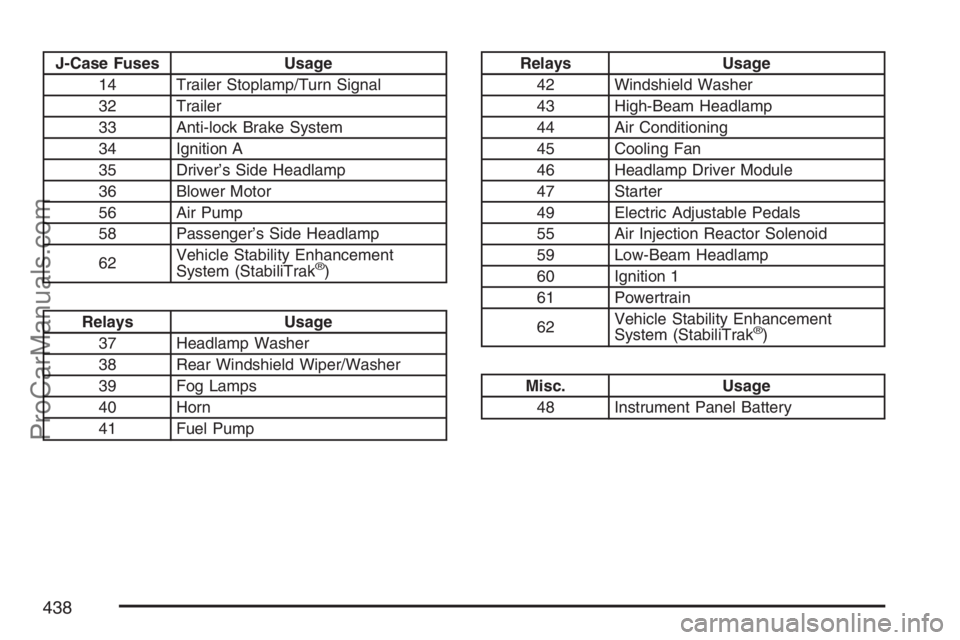
J-Case Fuses Usage
14 Trailer Stoplamp/Turn Signal
32 Trailer
33 Anti-lock Brake System
34 Ignition A
35 Driver’s Side Headlamp
36 Blower Motor
56 Air Pump
58 Passenger’s Side Headlamp
62Vehicle Stability Enhancement
System (StabiliTrak
®)
Relays Usage
37 Headlamp Washer
38 Rear Windshield Wiper/Washer
39 Fog Lamps
40 Horn
41 Fuel Pump
Relays Usage
42 Windshield Washer
43 High-Beam Headlamp
44 Air Conditioning
45 Cooling Fan
46 Headlamp Driver Module
47 Starter
49 Electric Adjustable Pedals
55 Air Injection Reactor Solenoid
59 Low-Beam Headlamp
60 Ignition 1
61 Powertrain
62Vehicle Stability Enhancement
System (StabiliTrak
®)
Misc. Usage
48 Instrument Panel Battery
438
ProCarManuals.com
Page 440 of 498

Fuses Usage
5 Driver’s Side Headlamp High-Beam
6 Driver’s Side Headlamp Low-Beam
7 Windshield Wiper
8 Automatic Transfer Case
9 Windshield Washer
10 Powertrain Control Module B
11 Fog Lamps
12 Stoplamp
13 Cigarette Lighter
14 Ignition Coils
15Transmission Control
Module/Canister
16 Ignition B
18 Airbag System
19 Electric Brake
20 Cooling Fan
21 Horn
22 Ignition E
23 Electronic Throttle Control
24Instrument Panel Cluster/Driver
Information CenterFuses Usage
25 Brake Transmission Shift Interlock
26 Engine 1
27 Backup
28 Engine Control Module 1
29 Engine Control Module
30 Air Conditioning
31 Injector Bank A
50 Passenger’s Side Trailer Turn
51 Driver’s Side Trailer Turn
52 Hazard Flashers
53 Transmission
54 Oxygen Sensor B
55 Oxygen Sensor A
56 Injector Bank B
57 Headlamp Driver Module
58 Truck Body Controller 1
59 Electric Adjustable Pedals
61 Ignition A1
66 Regulated Voltage Control
440
ProCarManuals.com
Page 441 of 498
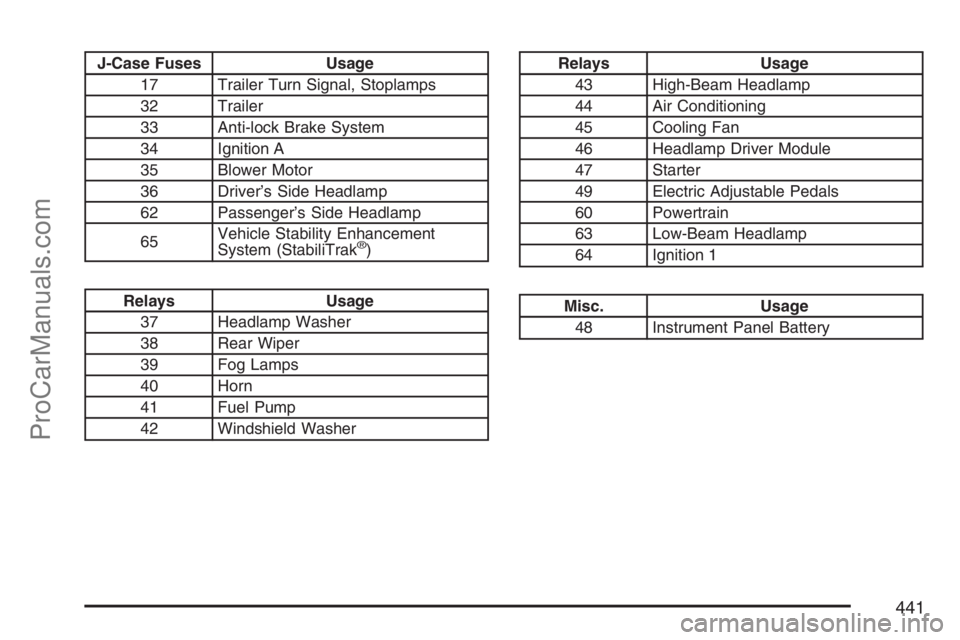
J-Case Fuses Usage
17 Trailer Turn Signal, Stoplamps
32 Trailer
33 Anti-lock Brake System
34 Ignition A
35 Blower Motor
36 Driver’s Side Headlamp
62 Passenger’s Side Headlamp
65Vehicle Stability Enhancement
System (StabiliTrak
®)
Relays Usage
37 Headlamp Washer
38 Rear Wiper
39 Fog Lamps
40 Horn
41 Fuel Pump
42 Windshield Washer
Relays Usage
43 High-Beam Headlamp
44 Air Conditioning
45 Cooling Fan
46 Headlamp Driver Module
47 Starter
49 Electric Adjustable Pedals
60 Powertrain
63 Low-Beam Headlamp
64 Ignition 1
Misc. Usage
48 Instrument Panel Battery
441
ProCarManuals.com