Transmission SATURN ASTRA 2008 User Guide
[x] Cancel search | Manufacturer: SATURN, Model Year: 2008, Model line: ASTRA, Model: SATURN ASTRA 2008Pages: 304, PDF Size: 1.92 MB
Page 158 of 304

PARK (P):This position locks the
front wheels. It is the best position
to use when the engine is started
because your vehicle cannot
move easily.
{CAUTION
It is dangerous to get out of
your vehicle if the shift lever is
not fully in PARK (P) with the
parking brake rmly set. Your
vehicle can roll.
Do not leave your vehicle when
the engine is running unless
you have to. If you have left the
engine running, the vehicle can
move suddenly. You or others
could be injured. To be sure
your vehicle will not move, even
when you are on fairly level
ground, always set your parking
brake and move the shift lever to
PARK (P). SeeShifting Into Park
on page 8-11.Make sure the shift lever is fully in
PARK (P) before starting the engine.
Your vehicle has an automatic
transmission shift lock control
system. The regular brakes must be
applied before you can shift from
PARK (P) when the ignition key is in
ON/RUN. If you cannot shift out of
PARK (P) while holding the brake
pedal down, seeShifting Out of
Park on page 8-13.
REVERSE (R):Use this gear to
back up.
Notice:Shifting to R (Reverse)
while the vehicle is moving
forward could damage the
transmission. The repairs would
not be covered by the vehicle
warranty. Shift to R (Reverse)
only after the vehicle is stopped.
To rock your vehicle back and
forth to get out of snow, ice, or sand
without damaging the transmission,
seeRocking Your Vehicle to Get
It Out on page 8-30.NEUTRAL (N):In this position,
the engine does not connect with the
wheels. To restart while you are
already moving, use NEUTRAL (N)
only. Also, use NEUTRAL (N)
when your vehicle is being towed.{CAUTION
Shifting into a drive gear while
the engine is running at high
speed is dangerous. Unless
your foot is rmly on the brake
pedal, the vehicle could move
very rapidly. You could lose
control and hit people or
objects. Do not shift into a
drive gear while the engine is
running at high speed.
8-6 Driving and Operating
ProCarManuals.com
Page 159 of 304

Notice:Shifting out of P (Park)
or N (Neutral) with the engine
running at high speed may
damage the transmission. The
repairs would not be covered by
the vehicle warranty. Be sure the
engine is not running at high
speed when shifting the vehicle.
DRIVE (D):This position is for
normal driving.
Notice:If your vehicle seems to
start up rather slowly or not shift
gears when you go faster, and you
continue to drive your vehicle that
way, you could damage the
transmission. Have your vehicle
serviced right away.THIRD (3):This position is also
used for normal driving, however, it
offers more power and lower fuel
economy than DRIVE (D). Here are
some times you might choose
THIRD (3) instead of DRIVE (D):
When driving on hilly, winding
roads.
When going down a steep hill.
SECOND (2):This position gives
you more power but lower fuel
economy. Use SECOND (2) on hills.
It can help control the vehicles speed
as you go down steep mountain
roads, but then you would also want
to use your brakes off and on.
Notice:Driving in FIRST (1) for
more than 25 miles (40 km) or at
speeds over 55 mph (90 km/h)
may damage the transmission.
Also, shifting into FIRST (1) at
speeds above 65 mph (105 km/h)
can cause damage. Drive in
THIRD (3) or DRIVE (D) instead
of FIRST (1).FIRST (1):This position gives you
even more power but lower fuel
economy than SECOND (2). Use it
on very steep hills, or in deep snow
or mud. If the shift lever is put in
FIRST (1), the transmission does not
shift into rst gear until the vehicle is
going slowly enough.
Notice:Spinning the tires
or holding the vehicle in one
place on a hill using only
the accelerator pedal may
damage the transmission. The
repair will not be covered by your
warranty. If you are stuck, do
not spin the tires. When stopping
on a hill, use the brakes to
hold the vehicle in place.
Driving and Operating 8-7
ProCarManuals.com
Page 160 of 304
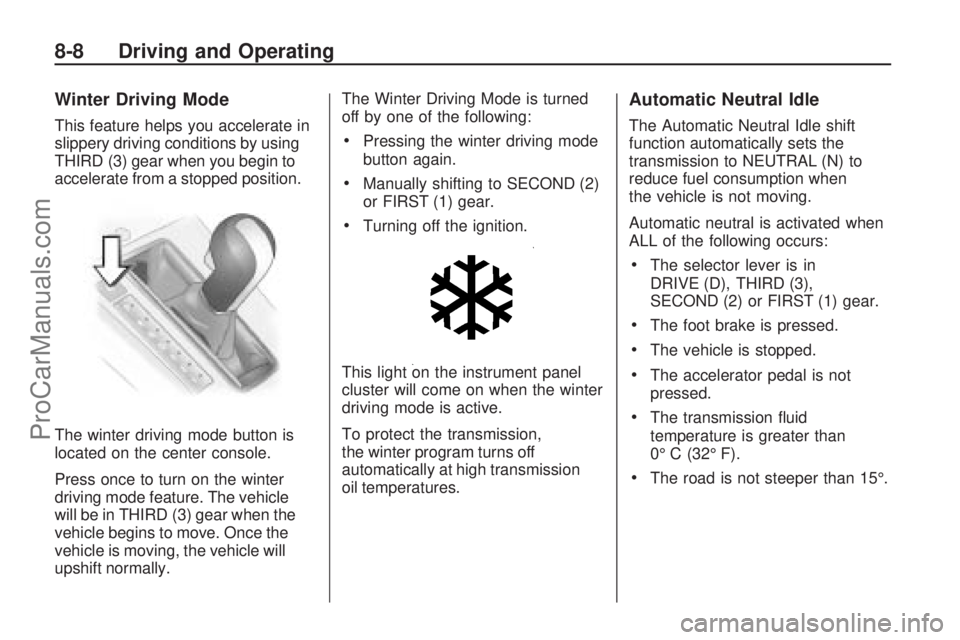
Winter Driving Mode
This feature helps you accelerate in
slippery driving conditions by using
THIRD (3) gear when you begin to
accelerate from a stopped position.
The winter driving mode button is
located on the center console.
Press once to turn on the winter
driving mode feature. The vehicle
will be in THIRD (3) gear when the
vehicle begins to move. Once the
vehicle is moving, the vehicle will
upshift normally.The Winter Driving Mode is turned
off by one of the following:Pressing the winter driving mode
button again.
Manually shifting to SECOND (2)
or FIRST (1) gear.
Turning off the ignition.
This light on the instrument panel
cluster will come on when the winter
driving mode is active.
To protect the transmission,
the winter program turns off
automatically at high transmission
oil temperatures.
Automatic Neutral Idle
The Automatic Neutral Idle shift
function automatically sets the
transmission to NEUTRAL (N) to
reduce fuel consumption when
the vehicle is not moving.
Automatic neutral is activated when
ALL of the following occurs:
The selector lever is in
DRIVE (D), THIRD (3),
SECOND (2) or FIRST (1) gear.
The foot brake is pressed.
The vehicle is stopped.
The accelerator pedal is not
pressed.
The transmission uid
temperature is greater than
0° C (32° F).
The road is not steeper than 15°.
8-8 Driving and Operating
ProCarManuals.com
Page 161 of 304
When you release the brake with the
transmission in gear, you may feel
the transmission shift from Neutral to
Drive automatically. You may also
feel the transmission shift from Drive
to Neutral when the brake is applied.
This is normal operation of the
automatic transmission.
Downhill Grade Assist
When traveling down steep grades
your transmission may automatically
downshift into a lower gear when the
brake is applied. You may feel this
downshift. This performance feature
of your automatic transmission
assists with engine braking to reduce
wear on your brake system. This is
normal operation of the automatic
transmission.
Performance On Demand
This feature allows the driver to
automatically force a downshift,
when traveling at speeds less than
approximately 70 mph (112 km/h),
by fully pressing the accelerator
pedal.
Manual Transmission
Operation
Five-Speed
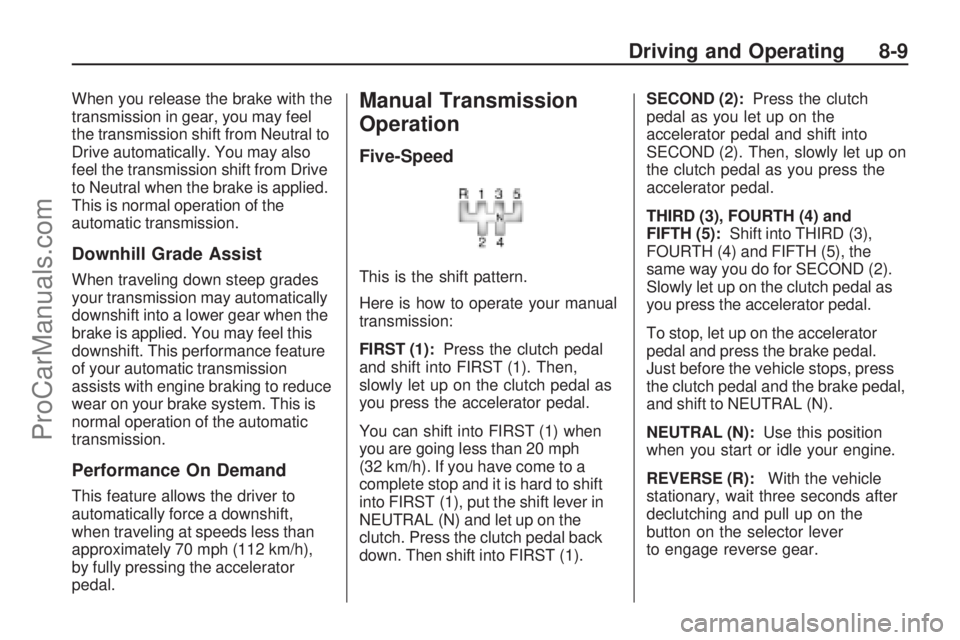
This is the shift pattern.
Here is how to operate your manual
transmission:
FIRST (1):Press the clutch pedal
and shift into FIRST (1). Then,
slowly let up on the clutch pedal as
you press the accelerator pedal.
You can shift into FIRST (1) when
you are going less than 20 mph
(32 km/h). If you have come to a
complete stop and it is hard to shift
into FIRST (1), put the shift lever in
NEUTRAL (N) and let up on the
clutch. Press the clutch pedal back
down. Then shift into FIRST (1).SECOND (2):Press the clutch
pedal as you let up on the
accelerator pedal and shift into
SECOND (2). Then, slowly let up on
the clutch pedal as you press the
accelerator pedal.
THIRD (3), FOURTH (4) and
FIFTH (5):Shift into THIRD (3),
FOURTH (4) and FIFTH (5), the
same way you do for SECOND (2).
Slowly let up on the clutch pedal as
you press the accelerator pedal.
To stop, let up on the accelerator
pedal and press the brake pedal.
Just before the vehicle stops, press
the clutch pedal and the brake pedal,
and shift to NEUTRAL (N).
NEUTRAL (N):Use this position
when you start or idle your engine.
REVERSE (R):With the vehicle
stationary, wait three seconds after
declutching and pull up on the
button on the selector lever
to engage reverse gear.
Driving and Operating 8-9
ProCarManuals.com
Page 162 of 304
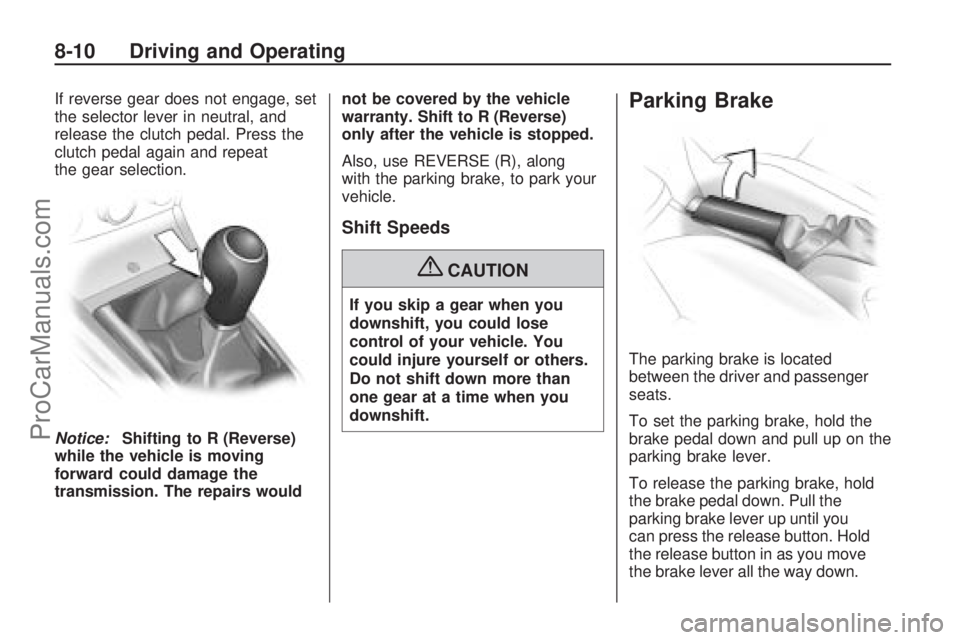
If reverse gear does not engage, set
the selector lever in neutral, and
release the clutch pedal. Press the
clutch pedal again and repeat
the gear selection.
Notice:Shifting to R (Reverse)
while the vehicle is moving
forward could damage the
transmission. The repairs wouldnot be covered by the vehicle
warranty. Shift to R (Reverse)
only after the vehicle is stopped.
Also, use REVERSE (R), along
with the parking brake, to park your
vehicle.
Shift Speeds
{CAUTION
If you skip a gear when you
downshift, you could lose
control of your vehicle. You
could injure yourself or others.
Do not shift down more than
one gear at a time when you
downshift.
Parking Brake
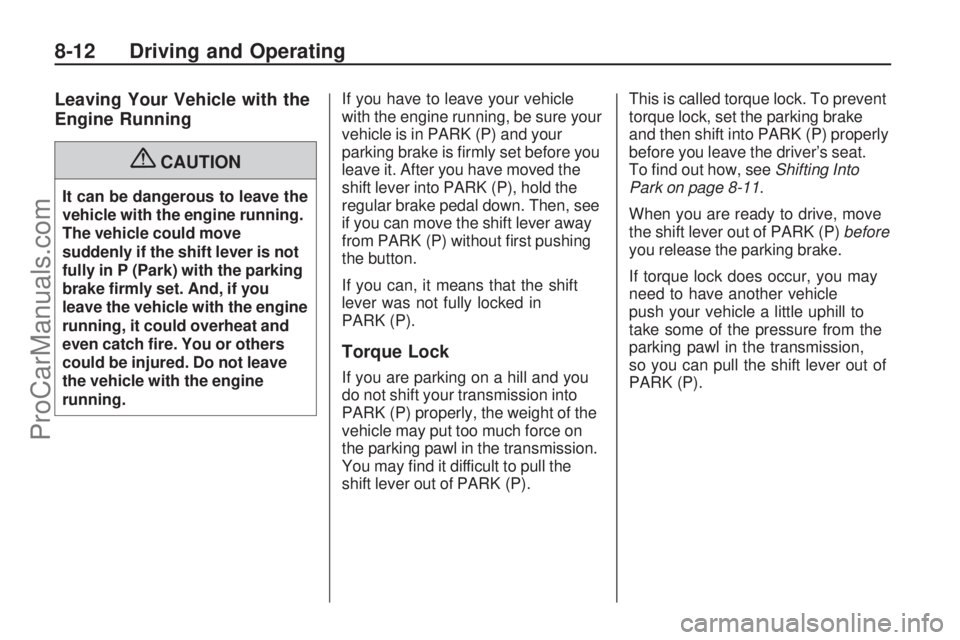
The parking brake is located
between the driver and passenger
seats.
To set the parking brake, hold the
brake pedal down and pull up on the
parking brake lever.
To release the parking brake, hold
the brake pedal down. Pull the
parking brake lever up until you
can press the release button. Hold
the release button in as you move
the brake lever all the way down.
8-10 Driving and Operating
ProCarManuals.com
Page 164 of 304
Leaving Your Vehicle with the
Engine Running
{CAUTION
It can be dangerous to leave the
vehicle with the engine running.
The vehicle could move
suddenly if the shift lever is not
fully in P (Park) with the parking
brake rmly set. And, if you
leave the vehicle with the engine
running, it could overheat and
even catch re. You or others
could be injured. Do not leave
the vehicle with the engine
running.If you have to leave your vehicle
with the engine running, be sure your
vehicle is in PARK (P) and your
parking brake is rmly set before you
leave it. After you have moved the
shift lever into PARK (P), hold the
regular brake pedal down. Then, see
if you can move the shift lever away
from PARK (P) without rst pushing
the button.
If you can, it means that the shift
lever was not fully locked in
PARK (P).
Torque Lock
If you are parking on a hill and you
do not shift your transmission into
PARK (P) properly, the weight of the
vehicle may put too much force on
the parking pawl in the transmission.
You may nd it difficult to pull the
shift lever out of PARK (P).This is called torque lock. To prevent
torque lock, set the parking brake
and then shift into PARK (P) properly
before you leave the driver’s seat.
To nd out how, seeShifting Into
Park on page 8-11.
When you are ready to drive, move
the shift lever out of PARK (P)before
you release the parking brake.
If torque lock does occur, you may
need to have another vehicle
push your vehicle a little uphill to
take some of the pressure from the
parking pawl in the transmission,
so you can pull the shift lever out of
PARK (P).
8-12 Driving and Operating
ProCarManuals.com
Page 178 of 304
Before Leaving on a
Long Trip
To prepare your vehicle for a long
trip, consider having it serviced by
your dealer/retailer before departing.
Things to check on your own
include:
Windshield Washer Fluid:
Reservoir full? Windows
clean — inside and outside?
Wiper Blades:In good shape?
Fuel, Engine Oil, Other Fluids:All
levels checked?
Lamps:Do they all work and are
lenses clean?
Tires:Are treads good? Are tires
inated to recommended
pressure?
Weather and Maps:Safe to
travel? Have up-to-date maps?
Highway Hypnosis
Always be alert and pay attention
to your surroundings while driving.
If you become tired or sleepy, nd
a safe place to park your vehicle
and rest.
Other driving tips include:
Keep the vehicle well ventilated.
Keep interior temperature cool.
Keep your eyes moving — scan
the road ahead and to the sides.
Check the rearview mirror and
vehicle instruments often.
Hill and Mountain Roads
Driving on steep hills or through
mountains is different than driving
on at or rolling terrain. Tips for
driving in these conditions include:
Keep the vehicle serviced
and in good shape.
Check all uid levels and brakes,
tires, cooling system, and
transmission.
Going down steep or long hills,
shift to a lower gear.
{CAUTION
If you do not shift down, the
brakes could get so hot that
they would not work well. You
would then have poor braking
or even none going down a hill.
You could crash. Shift down to
let the engine assist the brakes
on a steep downhill slope.
8-26 Driving and Operating
ProCarManuals.com
Page 182 of 304

Rocking Your Vehicle to
Get It Out
First, turn the steering wheel left and
right to clear the area around the
front wheels. Turn off any stability
system. SeeStabiliTrak
®System on
page 8-19. Then shift back and forth
between REVERSE (R) and a
forward gear, or with a manual
transmission, between FIRST (1) or
SECOND (2) and REVERSE (R),
spinning the wheels as little as
possible. To prevent transmission
wear, wait until the wheels stop
spinning before shifting gears.Release the accelerator pedal
while you shift, and press lightly
on the accelerator pedal when
the transmission is in gear. By slowly
spinning the wheels in the forward
and reverse directions, you will
cause a rocking motion that could
free your vehicle. If that does not get
your vehicle out after a few tries, it
might need to be towed out. If your
vehicle does need to be towed out,
seeTowing Your Vehicle on
page 9-72.
Loading the Vehicle
It is very important to know how
much weight your vehicle can
carry. This weight is called the
vehicle capacity weight and
includes the weight of all
occupants, cargo and all
nonfactory-installed options.
Two labels on your vehicle
show how much weight it may
properly carry, the Tire and
Loading Information label and
the Certication label.
8-30 Driving and Operating
ProCarManuals.com
Page 191 of 304
Vehicle Service
and Care
Service
Service...............................9-2
Accessories and
Modications.....................9-3
California Proposition 65
Warning............................9-3
California Perchlorate
Materials Requirements.....9-3
Doing Your Own
Service Work....................9-4
Adding Equipment to the
Outside of the Vehicle......9-4
Owner Checks
Owner Checks....................9-5
Hood Release.....................9-5
Engine Compartment
Overview...........................9-6
Engine Oil..........................9-7
Engine Oil Life System.......9-9
Engine Air Cleaner/Filter. . . .9-11
Automatic Transmission
Fluid................................9-12
Manual Transmission
Fluid................................9-12
Hydraulic Clutch................9-12
Engine Coolant.................9-12
Pressure Cap....................9-15
Engine Overheating...........9-15
Cooling System.................9-16
Power Steering Fluid.........9-20
Windshield Washer Fluid. . . .9-20
Windshield Wiper Blade
Replacement...................9-21
Brakes..............................9-22
Battery..............................9-25
Headlamp Aiming
Headlamp Aiming..............9-26
Bulb Replacement
Bulb Replacement.............9-28
Halogen Bulbs..................9-28
Front Turn Signal Lamps. . .9-28
Taillamps
(Five-Door Hatchback).....9-29
Taillamps
(Three-Door Hatchback). . .9-30
License Plate Lamp..........9-32
Replacement Bulbs...........9-33
Electrical System
Add-On Electrical
Equipment.......................9-33
Headlamp Wiring..............9-33
Windshield Wiper Fuses. . . .9-34
Power Windows and
Other Power Options.......9-34
Fuses...............................9-34
Engine Compartment
Fuse Block......................9-34
Rear Compartment
Fuse Block......................9-36
Tires
Tires.................................9-38
Winter Tires......................9-39
Tire Sidewall Labeling.......9-40
Tire Terminology and
Denitions.......................9-43
Ination - Tire Pressure. . . .9-46
High-Speed Operation.......9-47
Tire Pressure Monitor
System............................9-48
Tire Pressure Monitor
Operation........................9-50
Tire Inspection and
Rotation..........................9-51
When It Is Time for
New Tires.......................9-53
Vehicle Service and Care 9-1
ProCarManuals.com
Page 202 of 304
Automatic Transmission
Fluid
It is not necessary to check
the transmission uid level.
A transmission uid leak is the only
reason for uid loss. If a leak
occurs, take your vehicle to the
dealer/retailer service department
and have it repaired as soon
as possible.
Change the uid and lter at the
intervals listed in the Maintenance
Schedule. See “Additional
Required Services” in Service
and Maintenance. Be sure to use
the transmission uid listed in
“Recommended Fluids and
Lubricants” in Service and
Maintenance.
Notice:Use of the incorrect
automatic transmission uid
may damage your vehicle,
and the damages may not becovered by your warranty.
See “Recommended Fluids
and Lubricants” in the Limited
Warranty, Maintenance and Owner
Assistance Information manual.
Manual Transmission
Fluid
It is not necessary to check the
manual transmission uid level.
A transmission uid leak is the only
reason for uid loss. If a leak
occurs, take the vehicle to the
dealer/retailer service department
and have it repaired as soon
as possible. You may also have
your uid level checked by
your dealer/retailer when you have
your oil changed. See “Part D:
Recommended Fluids and
Lubricants” in Service and
Maintenance for the proper uid
to use.
Hydraulic Clutch
The hydraulic clutch linkage in
your vehicle is self-adjusting.
This system does not have its own
reservoir. It receives uid from
the brake master cylinder reservoir.
SeeBrakes on page 9-22for more
information.
Engine Coolant
The cooling system in your vehicle
is lled with DEX-COOL®engine
coolant. This coolant is designed to
remain in your vehicle for ve years
or 150,000 miles (240 000 km),
whichever occurs rst, if you add
only DEX-COOL
®extended life
coolant.
The following explains your cooling
system and how to add coolant
when it is low. If you have a problem
with engine overheating, see
Engine Overheating on page 9-15.
9-12 Vehicle Service and Care
ProCarManuals.com