steering SATURN AURA 2008 Owner's Guide
[x] Cancel search | Manufacturer: SATURN, Model Year: 2008, Model line: AURA, Model: SATURN AURA 2008Pages: 362, PDF Size: 2.29 MB
Page 233 of 362
Hood Release
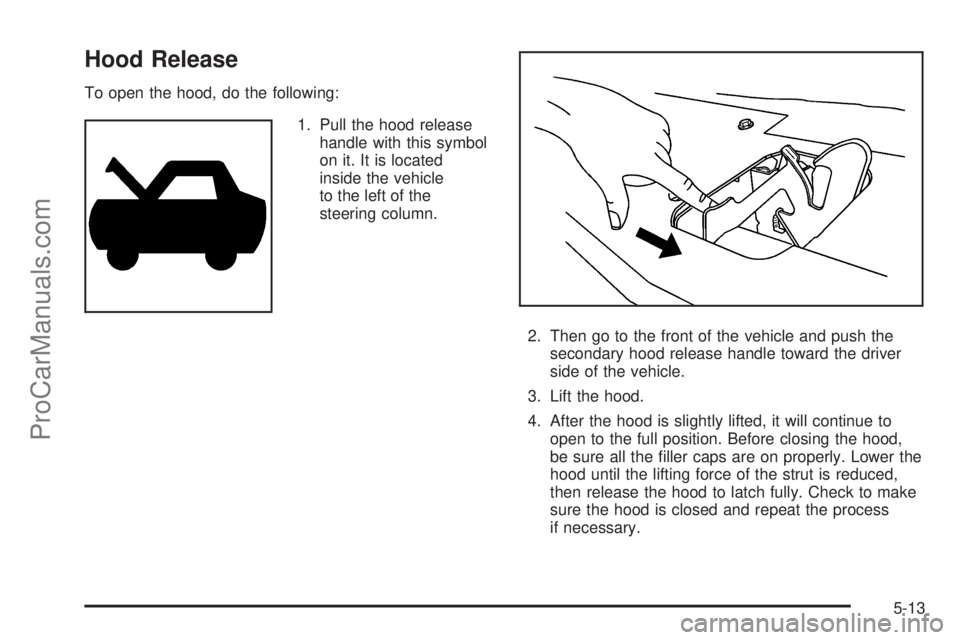
To open the hood, do the following:
1. Pull the hood release
handle with this symbol
on it. It is located
inside the vehicle
to the left of the
steering column.
2. Then go to the front of the vehicle and push the
secondary hood release handle toward the driver
side of the vehicle.
3. Lift the hood.
4. After the hood is slightly lifted, it will continue to
open to the full position. Before closing the hood,
be sure all the ller caps are on properly. Lower the
hood until the lifting force of the strut is reduced,
then release the hood to latch fully. Check to make
sure the hood is closed and repeat the process
if necessary.
5-13
ProCarManuals.com
Page 269 of 362
(D) Construction Code:A letter code is used
to indicate the type of ply construction in the tire.
The letter R means radial ply construction; the
letter D means diagonal or bias ply construction;
and the letter B means belted-bias ply construction.
(E) Rim Diameter
:Diameter of the wheel in
inches.
(F) Service Description
:The service description
indicates the load range and speed rating of a
tire. The load index can range from 1 to 279.
Speed ratings range from A to Z.
Tire Terminology and Denitions
Air Pressure:The amount of air inside the
tire pressing outward on each square inch of
the tire. Air pressure is expressed in pounds
per square inch (psi) or kilopascal (kPa).
Accessory Weight
:This means the combined
weight of optional accessories. Some examples of
optional accessories are, automatic transmission,
power steering, power brakes, power windows,
power seats, and air conditioning.
Aspect Ratio
:The relationship of a tire’s height
to its width.Belt
:A rubber coated layer of cords that is
located between the plies and the tread.
Cords may be made from steel or other
reinforcing materials.
Bead
:The tire bead contains steel wires wrapped
by steel cords that hold the tire onto the rim.
Bias Ply Tire
:A pneumatic tire in which the plies
are laid at alternate angles less than 90 degrees
to the centerline of the tread.
Cold Tire Pressure
:The amount of air pressure
in a tire, measured in pounds per square inch
(psi) or kilopascals (kPa) before a tire has built up
heat from driving. SeeInflation - Tire Pressure
on page 5-52.
Curb Weight
:The weight of a motor vehicle
with standard and optional equipment including
the maximum capacity of fuel, oil, and coolant,
but without passengers and cargo.
DOT Markings
:A code molded into the sidewall
of a tire signifying that the tire is in compliance
with the U.S. Department of Transportation (DOT)
motor vehicle safety standards. The DOT code
includes the Tire Identication Number (TIN),
an alphanumeric designator which can also identify
the tire manufacturer, production plant, brand,
and date of production.
5-49
ProCarManuals.com
Page 287 of 362
If a Tire Goes Flat
Your vehicle has a tire sealant and compressor kit.
SeeTire Sealant and Compressor Kit on page 5-68.
There is no spare tire, no tire changing equipment,
and no place to store a tire.
It is unusual for a tire to blow out while you are driving,
especially if you maintain your tires properly. See
Tires on page 5-46. If air goes out of a tire, it is much
more likely to leak out slowly. But, if you should
ever have a blow out, here are a few tips about what
to expect and what to do:
If a front tire fails, the at tire will create a drag that
pulls the vehicle toward that side. Take your foot off the
accelerator pedal and grip the steering wheel rmly.
Steer to maintain lane position, and then gently brake
to a stop well out of the traffic lane.
A rear blow out, particularly on a curve, acts much like
a skid and may require the same correction you would
use in a skid. In any rear blow out, remove your foot
from the accelerator pedal. Get the vehicle under control
by steering the way you want the vehicle to go. It may
be very bumpy and noisy, but you can still steer.
Gently brake to a stop, well off the road if possible.If a tire goes at, avoid further tire and wheel damage by
driving slowly to a level place and stopping. Then do this:
1. Turn on the hazard warning ashers. SeeHazard
Warning Flashers on page 3-6.
2. Park your vehicle. Set the parking brake rmly and
put the shift lever in PARK (P). SeeShifting Into
PARK (P) on page 2-29.
3. Turn off the engine.
4. Inspect the at tire.
If the tire has been separated from the wheel, has
damaged sidewalls, or has a puncture larger than a
14inch (6 mm), the tire is too severely damaged for
the tire sealant and compressor kit to be effective.
SeeRoadside Assistance Program on page 7-7.
If the tire has a puncture less than a
14inch (6 mm)
in the tread area of the tire, seeTire Sealant and
Compressor Kit on page 5-68.
5-67
ProCarManuals.com
Page 309 of 362
Fuses Usage
CLUSTER/
THEFTInstrument Panel Cluster,
Theft Deterrent System
ONSTAR OnStar
®
NOT
INSTALLEDNot Used
AIRBAG (IGN) Airbag (Ignition)
HVAC
CTRL (BATT)Heating Ventilation Air Conditioning
Control Diagnostic Link Connector
(Battery)
PEDAL Adjustable Pedals
WIPER SW Windshield Wiper/Washer Switch
IGN SENSOR Ignition Switch
STRG WHL
ILLUMSteering Wheel Illumination
NOT
INSTALLEDNot Used
RADIO Audio System
INTERIOR
LIGHTSInterior Lamps
REAR WIPER Not Used
POWER
WINDOWSPower Windows
HVAC
CTRL (IGN)Heating Ventilation Air Conditioning
Control (Ignition)
HVAC
BLOWERHeating Ventilation Air Conditioning
Blower Switch
Fuses Usage
DOOR LOCK Door Locks
ROOF/
HEAT SEATSunroof, Power Windows
NOT
INSTALLEDNot Used
NOT
INSTALLEDNot Used
AIRBAG (BATT) Airbag (Battery)
SPARE FUSE
HOLDERSpare Fuse Holder
SPARE FUSE
HOLDERSpare Fuse Holder
SPARE FUSE
HOLDERSpare Fuse Holder
SPARE FUSE
HOLDERSpare Fuse Holder
FUSE PULLER Fuse Puller
Engine Compartment Fuse Block
The engine compartment fuse block is located on the
driver side of the engine compartment, near the battery.
Your vehicle might not have all the fuses and
features listed.
Notice:Spilling liquid on any electrical components
on your vehicle may damage it. Always keep the
covers on any electrical component.
5-89
ProCarManuals.com
Page 311 of 362
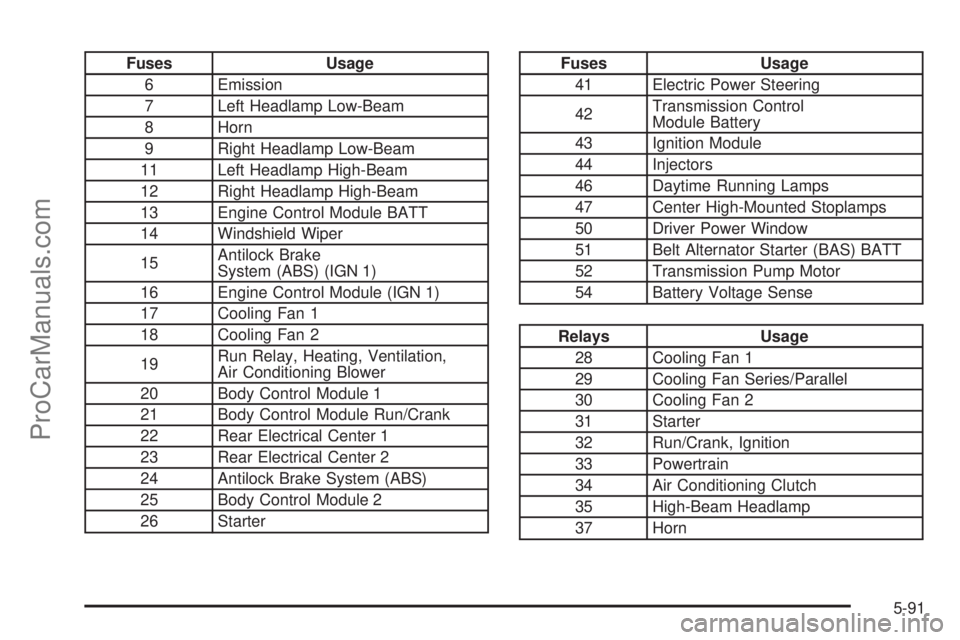
Fuses Usage
6 Emission
7 Left Headlamp Low-Beam
8 Horn
9 Right Headlamp Low-Beam
11 Left Headlamp High-Beam
12 Right Headlamp High-Beam
13 Engine Control Module BATT
14 Windshield Wiper
15Antilock Brake
System (ABS) (IGN 1)
16 Engine Control Module (IGN 1)
17 Cooling Fan 1
18 Cooling Fan 2
19Run Relay, Heating, Ventilation,
Air Conditioning Blower
20 Body Control Module 1
21 Body Control Module Run/Crank
22 Rear Electrical Center 1
23 Rear Electrical Center 2
24 Antilock Brake System (ABS)
25 Body Control Module 2
26 StarterFuses Usage
41 Electric Power Steering
42Transmission Control
Module Battery
43 Ignition Module
44 Injectors
46 Daytime Running Lamps
47 Center High-Mounted Stoplamps
50 Driver Power Window
51 Belt Alternator Starter (BAS) BATT
52 Transmission Pump Motor
54 Battery Voltage Sense
Relays Usage
28 Cooling Fan 1
29 Cooling Fan Series/Parallel
30 Cooling Fan 2
31 Starter
32 Run/Crank, Ignition
33 Powertrain
34 Air Conditioning Clutch
35 High-Beam Headlamp
37 Horn
5-91
ProCarManuals.com
Page 321 of 362
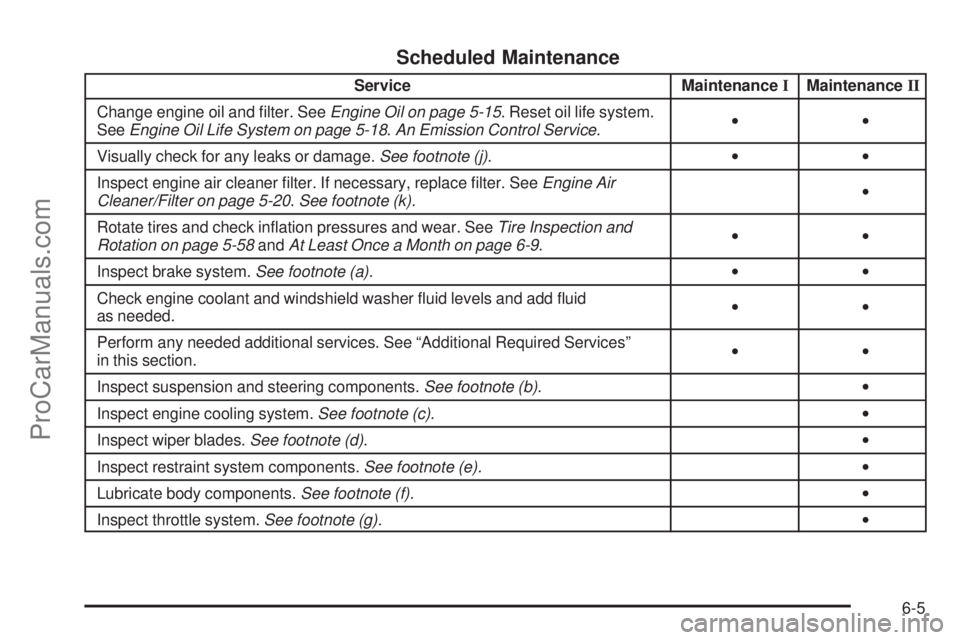
Scheduled Maintenance
Service MaintenanceIMaintenanceII
Change engine oil and lter. SeeEngine Oil on page 5-15. Reset oil life system.
SeeEngine Oil Life System on page 5-18.An Emission Control Service.••
Visually check for any leaks or damage.See footnote (j).••
Inspect engine air cleaner lter. If necessary, replace lter. SeeEngine Air
Cleaner/Filter on page 5-20.See footnote (k).•
Rotate tires and check ination pressures and wear. SeeTire Inspection and
Rotation on page 5-58andAt Least Once a Month on page 6-9.••
Inspect brake system.See footnote (a).••
Check engine coolant and windshield washer uid levels and add uid
as needed.••
Perform any needed additional services. See “Additional Required Services”
in this section.••
Inspect suspension and steering components.See footnote (b).•
Inspect engine cooling system.See footnote (c).•
Inspect wiper blades.See footnote (d).•
Inspect restraint system components.See footnote (e).•
Lubricate body components.See footnote (f).•
Inspect throttle system.See footnote (g).•
6-5
ProCarManuals.com
Page 323 of 362
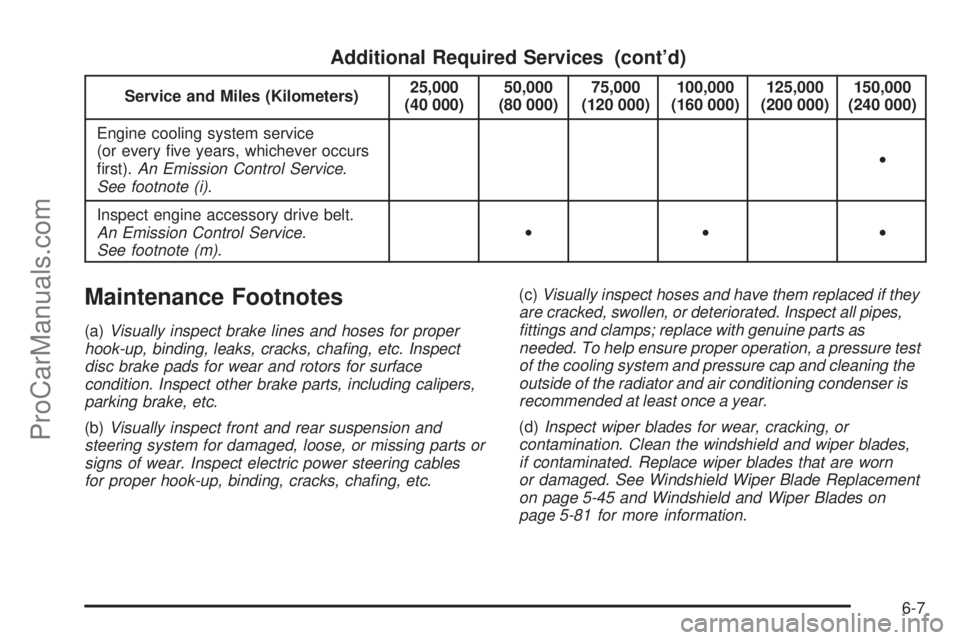
Additional Required Services (cont’d)
Service and Miles (Kilometers)25,000
(40 000)50,000
(80 000)75,000
(120 000)100,000
(160 000)125,000
(200 000)150,000
(240 000)
Engine cooling system service
(or every ve years, whichever occurs
rst).An Emission Control Service.
See footnote (i).•
Inspect engine accessory drive belt.
An Emission Control Service.
See footnote (m).•••
Maintenance Footnotes
(a)Visually inspect brake lines and hoses for proper
hook-up, binding, leaks, cracks, chafing, etc. Inspect
disc brake pads for wear and rotors for surface
condition. Inspect other brake parts, including calipers,
parking brake, etc.
(b)Visually inspect front and rear suspension and
steering system for damaged, loose, or missing parts or
signs of wear. Inspect electric power steering cables
for proper hook-up, binding, cracks, chafing, etc.(c)Visually inspect hoses and have them replaced if they
are cracked, swollen, or deteriorated. Inspect all pipes,
fittings and clamps; replace with genuine parts as
needed. To help ensure proper operation, a pressure test
of the cooling system and pressure cap and cleaning the
outside of the radiator and air conditioning condenser is
recommended at least once a year.
(d)Inspect wiper blades for wear, cracking, or
contamination. Clean the windshield and wiper blades,
if contaminated. Replace wiper blades that are worn
or damaged. See Windshield Wiper Blade Replacement
on page 5-45 and Windshield and Wiper Blades on
page 5-81 for more information.
6-7
ProCarManuals.com
Page 351 of 362
A
Accessories and Modications............................ 5-3
Adding Equipment to Your Airbag-Equipped
Vehicle.......................................................1-68
Additives, Fuel................................................. 5-7
Add-On Electrical Equipment............................5-86
Air Cleaner/Filter, Engine.................................5-20
Air Conditioning..............................................3-19
Airbag
Passenger Status Indicator...........................3-30
Readiness Light..........................................3-29
Airbag System................................................1-54
What Will You See After an Airbag Inates?....1-62
When Should an Airbag Inate?....................1-59
Where Are the Airbags?...............................1-56
Airbag Systems
Adding Equipment to Your Airbag-Equipped
Vehicle...................................................1-68
How Does an Airbag Restrain?......................1-61
Passenger Sensing System...........................1-63
Servicing Your Airbag-Equipped Vehicle..........1-68
What Makes an Airbag Inate?......................1-61
Antenna, Backglass.........................................3-74
Antenna, XM™ Satellite Radio Antenna System.....3-74
Antilock Brake System (ABS)............................. 4-4
Antilock Brake, System Warning Light................3-33Appearance Care
Aluminum Wheels........................................5-82
Care of Safety Belts....................................5-79
Chemical Paint Spotting...............................5-83
Cleaning Exterior Lamps/Lenses....................5-80
Fabric/Carpet..............................................5-78
Finish Care.................................................5-81
Finish Damage............................................5-83
Instrument Panel, Vinyl, and Other
Plastic Surfaces.......................................5-79
Interior Cleaning..........................................5-77
Sheet Metal Damage...................................5-83
Tires..........................................................5-83
Underbody Maintenance...............................5-83
Vehicle Care/Appearance Materials................5-84
Washing Your Vehicle...................................5-80
Weatherstrips..............................................5-80
Windshield and Wiper Blades........................5-81
Appointments, Scheduling Service....................... 7-9
Audio System.................................................3-56
Audio Steering Wheel Controls......................3-72
Backglass Antenna......................................3-74
Radio Reception..........................................3-73
Setting the Clock.........................................3-57
Theft-Deterrent Feature................................3-72
XM™ Satellite Radio Antenna System............3-74
Audio System(s).............................................3-58
1
ProCarManuals.com
Page 360 of 362
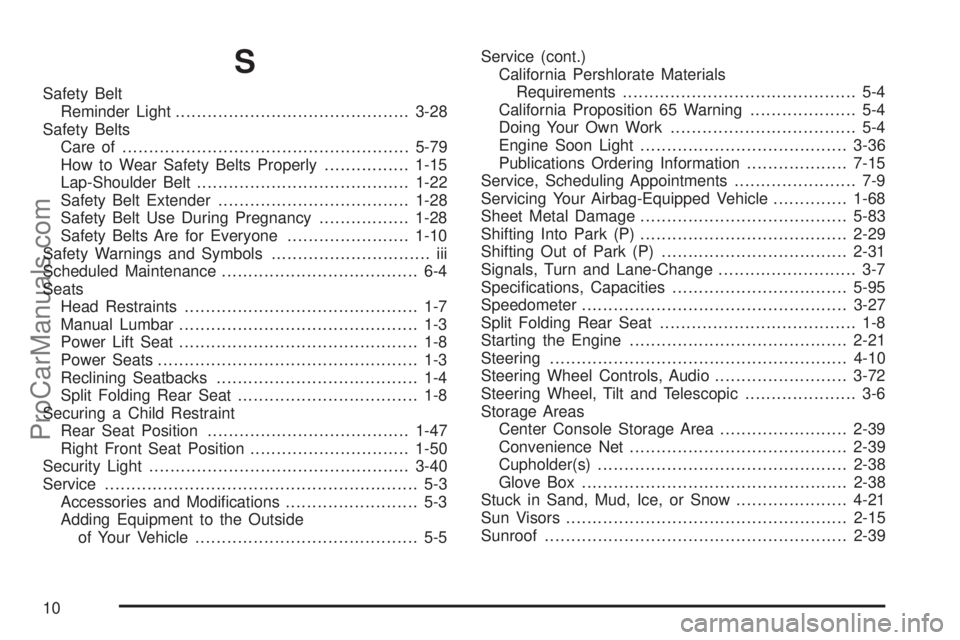
S
Safety Belt
Reminder Light............................................3-28
Safety Belts
Care of......................................................5-79
How to Wear Safety Belts Properly................1-15
Lap-Shoulder Belt........................................1-22
Safety Belt Extender....................................1-28
Safety Belt Use During Pregnancy.................1-28
Safety Belts Are for Everyone.......................1-10
Safety Warnings and Symbols.............................. iii
Scheduled Maintenance..................................... 6-4
Seats
Head Restraints............................................ 1-7
Manual Lumbar............................................. 1-3
Power Lift Seat............................................. 1-8
Power Seats................................................. 1-3
Reclining Seatbacks...................................... 1-4
Split Folding Rear Seat.................................. 1-8
Securing a Child Restraint
Rear Seat Position......................................1-47
Right Front Seat Position..............................1-50
Security Light.................................................3-40
Service........................................................... 5-3
Accessories and Modications......................... 5-3
Adding Equipment to the Outside
of Your Vehicle.......................................... 5-5Service (cont.)
California Pershlorate Materials
Requirements............................................ 5-4
California Proposition 65 Warning.................... 5-4
Doing Your Own Work................................... 5-4
Engine Soon Light.......................................3-36
Publications Ordering Information...................7-15
Service, Scheduling Appointments....................... 7-9
Servicing Your Airbag-Equipped Vehicle..............1-68
Sheet Metal Damage.......................................5-83
Shifting Into Park (P).......................................2-29
Shifting Out of Park (P)...................................2-31
Signals, Turn and Lane-Change.......................... 3-7
Specications, Capacities.................................5-95
Speedometer..................................................3-27
Split Folding Rear Seat..................................... 1-8
Starting the Engine.........................................2-21
Steering........................................................4-10
Steering Wheel Controls, Audio.........................3-72
Steering Wheel, Tilt and Telescopic..................... 3-6
Storage Areas
Center Console Storage Area........................2-39
Convenience Net.........................................2-39
Cupholder(s)...............................................2-38
Glove Box..................................................2-38
Stuck in Sand, Mud, Ice, or Snow.....................4-21
Sun Visors.....................................................2-15
Sunroof.........................................................2-39
10
ProCarManuals.com