instrument cluster SATURN AURA 2010 Owner's Manual
[x] Cancel search | Manufacturer: SATURN, Model Year: 2010, Model line: AURA, Model: SATURN AURA 2010Pages: 428, PDF Size: 2.78 MB
Page 298 of 428

3. Fill the coolant surge tank with the proper mixture,
to the FULL COLD mark. Wait about five minutes,
then check to see if the level is below the mark.
If the level is below the FULL COLD mark,
add additional coolant to bring the level up to the
mark. Repeat this procedure until the level remains
constant at the FULL COLD mark for at least
five minutes.
4. With the coolant surge tank pressure cap off,
start the engine and let it run until you can feel
the upper radiator hose getting hot. Watch out for
the engine cooling fans.
By this time, the coolant level inside the coolant
surge tank might be lower. If the level is lower than
the FULL COLD mark, add more of the proper
mixture to the coolant surge tank until the level
reaches the FULL COLD mark.
5. Then replace the pressure cap. Be sure the
pressure cap is hand-tight and fully seated.
Notice:If the pressure cap is not tightly installed,
coolant loss and possible engine damage may
occur. Be sure the cap is properly and tightly
secured.Engine Overheating
The vehicle has several indicators to warn of engine
overheating.
You will find an engine coolant temperature gage as
well as an engine coolant temperature warning light on
your vehicle’s instrument panel cluster. SeeEngine
Coolant Temperature Gage on page 4-33andEngine
Coolant Temperature Warning Light on page 4-33.
You may decide not to lift the hood when this warning
appears, but instead get service help right away.
SeeRoadside Assistance Program on page 8-6.
If you do decide to lift the hood, make sure the vehicle
is parked on a level surface.
Then check to see if the engine cooling fans are
running. If the engine is overheating, both fans should
be running. If they are not, do not continue to run
the engine and have the vehicle serviced.
Notice:Engine damage from running the engine
without coolant is not covered by the warranty.
Notice:If the engine catches re while driving with
no coolant, the vehicle can be badly damaged.
The costly repairs would not be covered by
the vehicle warranty. SeeOverheated Engine
Protection Operating Mode on page 6-30for
information on driving to a safe place in an
emergency.
6-28
ProCarManuals.com
Page 324 of 428
When the malfunction indicator is illuminated, the
system may not be able to detect or signal low tire
pressure as intended. TPMS malfunctions may occur for
a variety of reasons, including the installation of
replacement or alternate tires or wheels on the vehicle
that prevent the TPMS from functioning properly.
Always check the TPMS malfunction telltale after
replacing one or more tires or wheels on your vehicle to
ensure that the replacement or alternate tires and
wheels allow the TPMS to continue to function properly.
SeeTire Pressure Monitor Operation on page 6-54
for additional information.
Federal Communications Commission
(FCC) and Industry and Science
Canada
SeeRadio Frequency Statement on page 8-17for
information regarding Part 15 of the Federal
Communications Commission (FCC) Rules and
RSS-210/211 of Industry and Science Canada.
Tire Pressure Monitor Operation
This vehicle may have a Tire Pressure Monitor System
(TPMS). The TPMS is designed to warn the driver
when a low tire pressure condition exists. TPMS sensors
are mounted onto each tire and wheel assembly,
excluding the spare tire and wheel assembly. The TPMS
sensors monitor the air pressure in the vehicle’s tires
and transmits the tire pressure readings to a receiver
located in the vehicle.
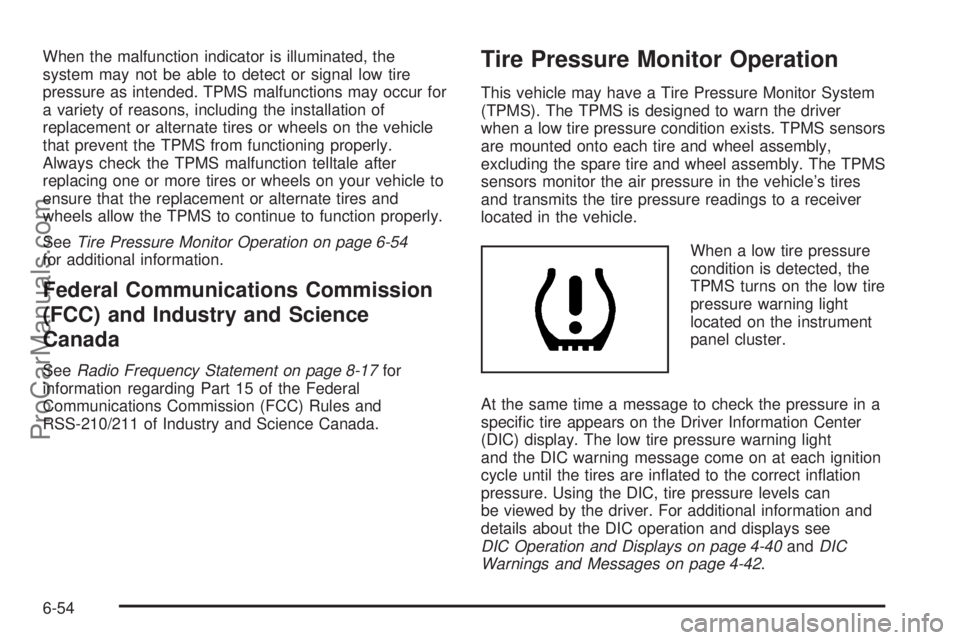
When a low tire pressure
condition is detected, the
TPMS turns on the low tire
pressure warning light
located on the instrument
panel cluster.
At the same time a message to check the pressure in a
specific tire appears on the Driver Information Center
(DIC) display. The low tire pressure warning light
and the DIC warning message come on at each ignition
cycle until the tires are inflated to the correct inflation
pressure. Using the DIC, tire pressure levels can
be viewed by the driver. For additional information and
details about the DIC operation and displays see
DIC Operation and Displays on page 4-40andDIC
Warnings and Messages on page 4-42.
6-54
ProCarManuals.com
Page 369 of 428

Fuses Usage
POWER
MIRRORSPower Mirrors
EPS Electronic Power Steering
RUN/CRANKCruise Control Switch, Passenger
Airbag Status Indicator
HVAC
BLOWER HIGHHeating Ventilation Air Conditioning
Blower - High Speed Relay
CLUSTER/
THEFTInstrument Panel Cluster, Theft
Deterrent System
ONSTAR OnStar
®
NOT
INSTALLEDNot Used
AIRBAG (IGN) Airbag (Ignition)
HVAC CTRL
(BATT)Heating Ventilation Air Conditioning
Control Diagnostic Link Connector
(Battery)
PEDAL Not Used
WIPER SW Windshield Wiper/Washer Switch
IGN SENSOR Ignition Switch
STRG WHL
ILLUMSteering Wheel Illumination
NOT
INSTALLEDNot Used
RADIO Audio System
INTERIOR
LIGHTSInterior Lamps
Fuses Usage
NOT
INSTALLEDNot Used
POWER
WINDOWSPower Windows
HVAC
CTRL (IGN)Heating Ventilation Air Conditioning
Control (Ignition)
HVAC
BLOWERHeating Ventilation Air Conditioning
Blower Switch
DOOR LOCK Door Locks
ROOF/HEAT
SEATSunroof, Heated Seat
NOT
INSTALLEDNot Used
NOT
INSTALLEDNot Used
AIRBAG
(BATT)Airbag (Battery)
SPARE FUSE
HOLDERSpare Fuse Holder
SPARE FUSE
HOLDERSpare Fuse Holder
SPARE FUSE
HOLDERSpare Fuse Holder
SPARE FUSE
HOLDERSpare Fuse Holder
FUSE PULLER Fuse Puller
6-99
ProCarManuals.com
Page 418 of 428

Headlamps Off in Park....................................4-10
Headphones...................................................4-80
Heated Seats................................................... 2-6
Heated Seats (If Equipped)................................ 1-8
Heater...........................................................4-16
Engine Coolant...........................................3-22
Highbeam On Light.........................................4-38
High-Speed Operation, Tires.............................6-52
Highway Hypnosis...........................................5-14
Hill and Mountain Roads..................................5-15
Hitches..........................................................5-30
Hood
Checking Things Under................................6-12
Release.....................................................6-13
Horn ............................................................... 4-3
How OnStar Service Works..............................1-24
How the System Alarm is Activated...................3-16
How to Add Coolant to the Radiator..................6-27
How to Add Coolant to the Recovery Tank.........6-26
How to Check................................................6-52
How to Check Power Steering Fluid..................6-31
How to Detect a Tamper Condition....................3-17
How to Inspect the Engine Air Cleaner/Filter.......6-22
How to Reset the Engine Oil Life System...........6-21
How to Turn Off the System Alarm....................3-17
How to Wear Safety Belts Properly...................2-17
Hydraulic Power Steering................................... 5-9
Hydroplaning..................................................5-14I
If a Crash Occurs...........................................8-12
If No Steam Is Coming From The Engine
Compartment..............................................6-29
If Steam Is Coming From The Engine
Compartment..............................................6-29
If the Off Indicator is Lit for an Adult-Size
Occupant...................................................2-72
If the On Indicator is Lit for a Child Restraint......2-71
Ignition Positions.............................................3-19
Ignition Transmission Lock Check....................... 7-9
Infants and Young Children, Restraints...............2-35
Inflation - Tire Pressure...................................6-51
Information Modes..........................................4-40
Instrument Panel
Brightness..................................................4-13
Cluster.......................................................4-25
Insuring Your Vehicle.......................................8-11
Interior Mirror.................................................1-10
Introduction...................................................... 7-2
J
Jump Starting.................................................6-36
8
ProCarManuals.com