instrument panel SATURN AURA 2010 Service Manual
[x] Cancel search | Manufacturer: SATURN, Model Year: 2010, Model line: AURA, Model: SATURN AURA 2010Pages: 428, PDF Size: 2.78 MB
Page 241 of 428
Using ABS
Do not pump the brakes. Just hold the brake pedal
down firmly and let antilock work. The antilock pump or
motor might be heard operating and the brake pedal
might be felt to pulsate, but this is normal.
Braking in Emergencies
ABS allows the driver to steer and brake at the same
time. In many emergencies, steering can help more than
even the very best braking.
Brake Assist
This vehicle has a Brake Assist feature designed to
assist the driver in stopping or decreasing vehicle speed
in emergency driving conditions. This feature uses the
stability system hydraulic brake control module to
supplement the power brake system under conditions
where the driver has quickly and forcefully applied
the brake pedal in an attempt to quickly stop or slow
down the vehicle. The stability system hydraulic
brake control module increases brake pressure at each
corner of the vehicle until the ABS activates. Minor
brake pedal pulsations or pedal movement during this
time is normal and the driver should continue to
apply the brake pedal as the driving situation dictates
The Brake Assist feature will automatically disengage
when the brake pedal is released or brake pedal
pressure is quickly decreased.
Electronic Stability Control (ESC)
The vehicle has an Electronic Stability Control (ESC)
system which combines antilock brake, traction
and stability control systems and helps the driver
maintain directional control of the vehicle in most driving
conditions.
When you first start the vehicle and begin to drive away,
the system performs several diagnostic checks to
ensure there are no problems. The system may be
heard or felt while it is working. This is normal and does
not mean there is a problem with the vehicle. The
system should initialize before the vehicle reaches
32 km/h (20 mph).
If the system fails to turn on or activate, the ESC/TCS
light will be on solid, and the ESC OFF or SERVICE
ESC message will be displayed.
For more information, seeDriver Information Center
(DIC) on page 4-39.
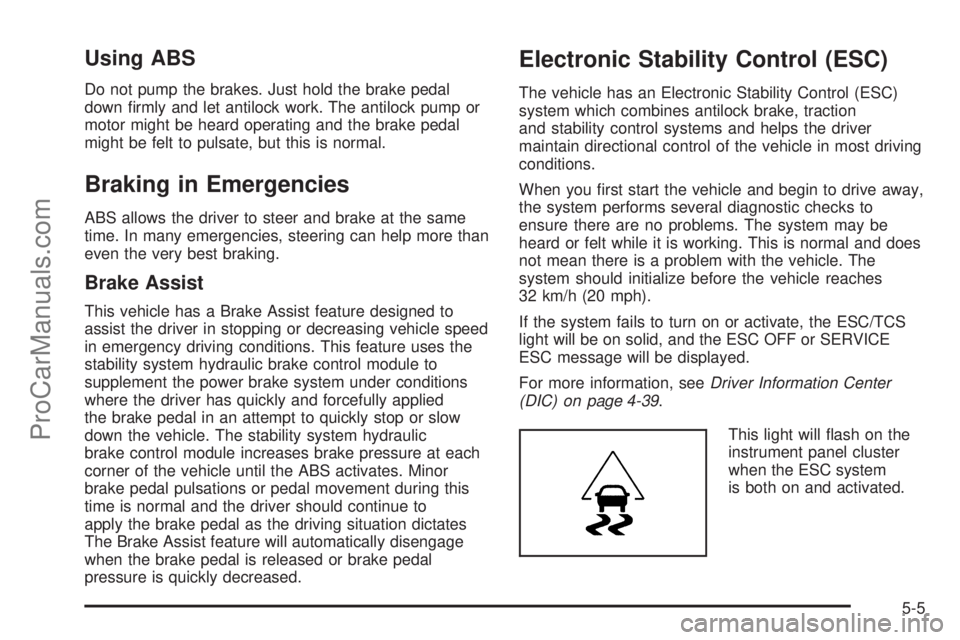
This light will flash on the
instrument panel cluster
when the ESC system
is both on and activated.
5-5
ProCarManuals.com
Page 242 of 428

The system may be heard or felt while it is working; this
is normal.
When the light is on solid and either the SERVICE ESC
or ESC OFF message is displayed, the system will
not assist the driver in maintaining directional control of
the vehicle. Adjust your driving accordingly. SeeDIC
Warnings and Messages on page 4-42.
The Electronic Stability Control (ESC) system is
automatically enabled whenever the vehicle is started.
To assist the driver with vehicle directional control,
especially in slippery road conditions, the system should
always be left on. But, ESC can be turned off if
needed.
If the vehicle is in cruise control when the system
begins to assist the driver maintain directional control of
the vehicle, the ESC/TCS light will flash and the
cruise control will automatically disengage. The cruise
control system may be re-engaged when road conditions
allow. SeeCruise Control on page 4-7.
The ESC/TCS button is
located on the instrument
panel.The traction control system can be turned off or back on
by pressing the ESC/TCS button. To disable both
traction control and ESC, press and hold the button
briefly.
When the ESC system is turned off, the TRACTION
OFF and ESC OFF messages will appear, and
the ESC/TCS light will be on solid to warn the driver
that both traction control and ESC are disabled.
It is recommended to leave the system on for normal
driving conditions, but it may be necessary to turn
the system off if the vehicle is stuck in sand, mud, ice or
snow, and you want to “rock” the vehicle to attempt to
free it. It may also be necessary to turn off the
system when driving in extreme off-road conditions
where high wheel spin is required. SeeIf Your Vehicle
is Stuck in Sand, Mud, Ice, or Snow on page 5-18.
ESC may also turn off automatically if it determines that
a problem exists with the system. The ESC OFF and
SERVICE ESC messages and the ESC/TCS light will be
on solid to warn the driver that ESC is disabled and
requires service. If the problem does not clear after
restarting the vehicle, see your dealer/retailer for service.
SeeDIC Warnings and Messages on page 4-42for
more information.
Adding non-dealer/non-retailer accessories can affect
the vehicle’s performance. SeeAccessories and
Modications on page 6-3for more information.
5-6
ProCarManuals.com
Page 253 of 428

WARNING: (Continued)
If the vehicle is stuck in the snow:
•Clear away snow from around the base of
your vehicle, especially any that is blocking
the exhaust pipe.
•Check again from time to time to be sure
snow does not collect there.
•Open a window about 5 cm (two inches) on
the side of the vehicle that is away from the
wind to bring in fresh air.
•Fully open the air outlets on or under the
instrument panel.
•Adjust the Climate Control system to a setting
that circulates the air inside the vehicle and
set the fan speed to the highest setting. See
Climate Control System in the Index.
For more information about carbon monoxide, see
Engine Exhaust on page 3-30.
Snow can trap exhaust gases under your vehicle.
This can cause deadly CO (carbon monoxide) gas
to get inside. CO could overcome you and kill you.
You cannot see it or smell it, so you might not
know it is in your vehicle. Clear away snow from
around the base of your vehicle, especially any
that is blocking the exhaust.Run the engine for short periods only as needed to
keep warm, but be careful.
To save fuel, run the engine for only short periods as
needed to warm the vehicle and then shut the engine off
and close the window most of the way to save heat.
Repeat this until help arrives but only when you
feel really uncomfortable from the cold. Moving about to
keep warm also helps.
If it takes some time for help to arrive, now and then
when you run the engine, push the accelerator
pedal slightly so the engine runs faster than the idle
speed. This keeps the battery charged to restart
the vehicle and to signal for help with the headlamps.
Do this as little as possible to save fuel.
5-17
ProCarManuals.com
Page 261 of 428

Dinghy Towing
When dinghy towing, the vehicle should be run at the
beginning of each day and at each RV fuel stop
for about five minutes. This will ensure proper lubrication
of transmission components.
To dinghy tow the vehicle from the front with all four
wheels on the ground:
1. Position the vehicle to tow and then secure it to the
towing vehicle.
2. Shift the transmission to P (Park) and turn the
ignition to LOCK/OFF.3. Set the parking brake.
4. To prevent the battery from draining while
the vehicle is being towed, remove the
following fuse from the instrument panel fuse
block: (IGN SENSOR). SeeInstrument Panel
Fuse Block on page 6-97for more information.
5. Turn the ignition to ACC/ACCESSORY.
6. Shift the transmission to N (Neutral).
7. Release the parking brake.
Remember to reinstall the IGN SENSOR fuse once the
destination has been reached.
Notice:If 105 km/h (65 mph) is exceeded while
towing the vehicle, it could be damaged. Never
exceed 105 km/h (65 mph) while towing the vehicle.
5-25
ProCarManuals.com
Page 268 of 428

Turn Signals When Towing a Trailer
The arrows on the instrument panel flash whenever
signaling a turn or lane change. Properly hooked up, the
trailer lamps also flash, telling other drivers the vehicle
is turning, changing lanes or stopping.
When towing a trailer, the arrows on the instrument
panel flash for turns even if the bulbs on the trailer are
burned out. For this reason you may think other
drivers are seeing the signal when they are not. It is
important to check occasionally to be sure the
trailer bulbs are still working.
Driving on Grades
Notice:Do not tow on steep continuous grades
exceeding 6 miles (9.6 km). Extended, higher
than normal engine and transmission temperatures
may result and damage the vehicle. Frequent
stops are very important to allow the engine and
transmission to cool.
Reduce speed and shift to a lower gearbeforestarting
down a long or steep downgrade. If the transmission is
not shifted down, the brakes might have to be used so
much that they would get hot and no longer work well.On a long uphill grade, shift down and reduce the
vehicle’s speed to around 45 mph (70 km/h) to reduce
the possibility of the engine and the transmission
overheating. If the engine does overheat, seeEngine
Overheating on page 6-28.
Parking on Hills
{WARNING:
Parking the vehicle on a hill with the trailer
attached can be dangerous. If something goes
wrong, the rig could start to move. People can be
injured, and both the vehicle and the trailer can be
damaged. When possible, always park the rig on a
flat surface.
If parking the rig on a hill:
1. Press the brake pedal, but do not shift into P (Park)
yet. Turn the wheels into the curb if facing downhill
or into traffic if facing uphill.
2. Have someone place chocks under the trailer
wheels.
3. When the wheel chocks are in place, release the
brake pedal until the chocks absorb the load.
5-32
ProCarManuals.com
Page 272 of 428

Uniform Tire Quality Grading..........................6-62
Wheel Alignment and Tire Balance..................6-63
Wheel Replacement......................................6-64
Tire Chains..................................................6-65
If a Tire Goes Flat........................................6-66
Tire Sealant and Compressor Kit....................6-67
Tire Sealant and Compressor Kit Storage.........6-74
Changing a Flat Tire.....................................6-74
Removing the Spare Tire and Tools................6-76
Removing the Flat Tire and Installing the
Spare Tire................................................6-78
Storing a Flat or Spare Tire and Tools............6-84
Compact Spare Tire......................................6-88
Appearance Care............................................6-89
Interior Cleaning...........................................6-89
Fabric/Carpet...............................................6-90
Leather.......................................................6-91
Instrument Panel, Vinyl, and Other Plastic
Surfaces..................................................6-91
Care of Safety Belts......................................6-91
Weatherstrips...............................................6-92
Washing Your Vehicle...................................6-92Cleaning Exterior Lamps/Lenses.....................6-92
Finish Care..................................................6-92
Windshield and Wiper Blades.........................6-93
Aluminum Wheels.........................................6-94
Tires...........................................................6-94
Sheet Metal Damage.....................................6-94
Finish Damage.............................................6-95
Underbody Maintenance................................6-95
Chemical Paint Spotting.................................6-95
Vehicle Identication......................................6-95
Vehicle Identification Number (VIN).................6-95
Service Parts Identification Label.....................6-96
Electrical System............................................6-96
Add-On Electrical Equipment..........................6-96
Windshield Wiper Fuses................................6-96
Power Windows and Other Power Options.......6-97
Fuses.........................................................6-97
Instrument Panel Fuse Block..........................6-97
Engine Compartment Fuse Block...................6-100
Rear Compartment Fuse Block.....................6-102
Capacities and Specications........................6-105
Section 6 Service and Appearance Care
6-2
ProCarManuals.com
Page 275 of 428
Keep a record with all parts receipts and list the mileage
and the date of any service work performed. See
Maintenance Record on page 7-13.
Adding Equipment to the Outside of
the Vehicle
Things added to the outside of the vehicle can affect the
airflow around it. This can cause wind noise and can
affect fuel economy and windshield washer performance.
Check with your dealer/retailer before adding equipment
to the outside of the vehicle.
Fuel
Use of the recommended fuel is an important part of the
proper maintenance of this vehicle. To help keep the
engine clean and maintain optimum vehicle
performance, we recommend the use of gasoline
advertised as TOP TIER Detergent Gasoline.
Look for the TOP TIER label on the fuel pump to ensure
gasoline meets enhanced detergency standards
developed by auto companies. A list of marketers
providing TOP TIER Detergent Gasoline can be found
at www.toptiergas.com.The 8th digit of the Vehicle Identification Number (VIN)
shows the code letter or number that identifies the
vehicle’s engine. The VIN is at the top left of the
instrument panel. SeeVehicle Identication Number
(VIN) on page 6-95.
If the vehicle has the 2.4L L4 engine (VIN Code 0), you
can use either unleaded gasoline or ethanol fuel
containing up to 85% ethanol (E85). SeeFuel E85
(85% Ethanol) on page 6-8. In all other engines, use
only the unleaded gasoline described underGasoline
Octane on page 6-6.
6-5
ProCarManuals.com
Page 278 of 428
Fuel E85 (85% Ethanol)
The 8th digit of the Vehicle Identification Number (VIN)
shows the code letter or number that identifies the
vehicle’s engine. The VIN is at the top left of the
instrument panel. SeeVehicle Identication Number
(VIN) on page 6-95.
If the vehicle has the 2.4L L4 engine (VIN Code 0), you
can use either unleaded gasoline or ethanol fuel
containing up to 85% ethanol (E85). SeeFuel on
page 6-5. In all other engines, use only the unleaded
gasoline described underGasoline Octane on page 6-6.
Only vehicles that have the 2.4L L4 engine (VIN
Code 0) can use 85% ethanol fuel (E85). We encourage
the use of E85 in vehicles that are designed to use it.
The ethanol in E85 is a “renewable” fuel, meaning
it is made from renewable sources such as corn and
other crops.
Many service stations will not have an 85% ethanol
fuel (E85) pump available. The U.S. Department
of Energy has an alternative fuels website
(www.eere.energy.gov/afdc/infrastructure/locator.html)
that can help you find E85 fuel. Those stations that
do have E85 should have a label indicating ethanol
content. Do not use the fuel if the ethanol content
is greater than 85%.At a minimum, E85 should meet ASTM
Specification D 5798. By definition, this means that fuel
labeled E85 will have an ethanol content between
70% and 85%. Filling the fuel tank with fuel mixtures
that do not meet ASTM specifications can affect
driveability and could cause the malfunction indicator
lamp to come on.
To ensure quick starts in the wintertime, the E85 fuel
must be formulated properly for your climate according
to ASTM specification D 5798. If you have trouble
starting on E85, it could be because the E85 fuel is not
properly formulated for your climate. If this happens,
switching to gasoline or adding gasoline to the fuel tank
can improve starting. For good starting and heater
efficiency below 32°F (0°C), the fuel mix in the fuel tank
should contain no more than 70% ethanol. It is best
not to alternate repeatedly between gasoline and E85. If
you do switch fuels, it is recommended that you add
as much fuel as possible — do not add less than
three gallons (11 L) when refueling. You should drive
the vehicle immediately after refueling for at least
seven miles (11 km) to allow the vehicle to adapt to the
change in ethanol concentration.
6-8
ProCarManuals.com
Page 298 of 428

3. Fill the coolant surge tank with the proper mixture,
to the FULL COLD mark. Wait about five minutes,
then check to see if the level is below the mark.
If the level is below the FULL COLD mark,
add additional coolant to bring the level up to the
mark. Repeat this procedure until the level remains
constant at the FULL COLD mark for at least
five minutes.
4. With the coolant surge tank pressure cap off,
start the engine and let it run until you can feel
the upper radiator hose getting hot. Watch out for
the engine cooling fans.
By this time, the coolant level inside the coolant
surge tank might be lower. If the level is lower than
the FULL COLD mark, add more of the proper
mixture to the coolant surge tank until the level
reaches the FULL COLD mark.
5. Then replace the pressure cap. Be sure the
pressure cap is hand-tight and fully seated.
Notice:If the pressure cap is not tightly installed,
coolant loss and possible engine damage may
occur. Be sure the cap is properly and tightly
secured.Engine Overheating
The vehicle has several indicators to warn of engine
overheating.
You will find an engine coolant temperature gage as
well as an engine coolant temperature warning light on
your vehicle’s instrument panel cluster. SeeEngine
Coolant Temperature Gage on page 4-33andEngine
Coolant Temperature Warning Light on page 4-33.
You may decide not to lift the hood when this warning
appears, but instead get service help right away.
SeeRoadside Assistance Program on page 8-6.
If you do decide to lift the hood, make sure the vehicle
is parked on a level surface.
Then check to see if the engine cooling fans are
running. If the engine is overheating, both fans should
be running. If they are not, do not continue to run
the engine and have the vehicle serviced.
Notice:Engine damage from running the engine
without coolant is not covered by the warranty.
Notice:If the engine catches re while driving with
no coolant, the vehicle can be badly damaged.
The costly repairs would not be covered by
the vehicle warranty. SeeOverheated Engine
Protection Operating Mode on page 6-30for
information on driving to a safe place in an
emergency.
6-28
ProCarManuals.com
Page 324 of 428
When the malfunction indicator is illuminated, the
system may not be able to detect or signal low tire
pressure as intended. TPMS malfunctions may occur for
a variety of reasons, including the installation of
replacement or alternate tires or wheels on the vehicle
that prevent the TPMS from functioning properly.
Always check the TPMS malfunction telltale after
replacing one or more tires or wheels on your vehicle to
ensure that the replacement or alternate tires and
wheels allow the TPMS to continue to function properly.
SeeTire Pressure Monitor Operation on page 6-54
for additional information.
Federal Communications Commission
(FCC) and Industry and Science
Canada
SeeRadio Frequency Statement on page 8-17for
information regarding Part 15 of the Federal
Communications Commission (FCC) Rules and
RSS-210/211 of Industry and Science Canada.
Tire Pressure Monitor Operation
This vehicle may have a Tire Pressure Monitor System
(TPMS). The TPMS is designed to warn the driver
when a low tire pressure condition exists. TPMS sensors
are mounted onto each tire and wheel assembly,
excluding the spare tire and wheel assembly. The TPMS
sensors monitor the air pressure in the vehicle’s tires
and transmits the tire pressure readings to a receiver
located in the vehicle.
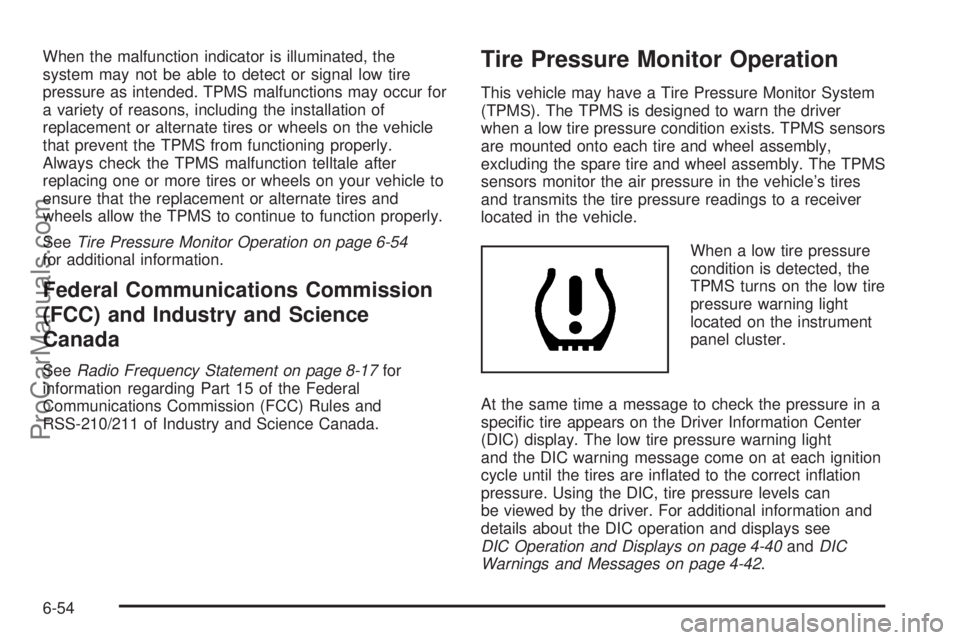
When a low tire pressure
condition is detected, the
TPMS turns on the low tire
pressure warning light
located on the instrument
panel cluster.
At the same time a message to check the pressure in a
specific tire appears on the Driver Information Center
(DIC) display. The low tire pressure warning light
and the DIC warning message come on at each ignition
cycle until the tires are inflated to the correct inflation
pressure. Using the DIC, tire pressure levels can
be viewed by the driver. For additional information and
details about the DIC operation and displays see
DIC Operation and Displays on page 4-40andDIC
Warnings and Messages on page 4-42.
6-54
ProCarManuals.com