radio SATURN OUTLOOK 2009 Workshop Manual
[x] Cancel search | Manufacturer: SATURN, Model Year: 2009, Model line: OUTLOOK, Model: SATURN OUTLOOK 2009Pages: 432, PDF Size: 2.48 MB
Page 332 of 432

When to Check
Check your tires once a month
or more. Do not forget to check
the compact spare tire, if the
vehicle has one. It should be at
60 psi (420 kPa). For additional
information regarding the
compact spare tire, seeCompact
Spare Tire on page 5-83.
How to Check
Use a good quality pocket-type
gage to check tire pressure.
You cannot tell if your tires are
properly inated simply by
looking at them. Radial tires may
look properly inated even when
they are under-inated. Check
the tire’s ination pressure when
the tires are cold. Cold means
your vehicle has been sitting for
at least three hours or driven no
more than 1 mile (1.6 km).Remove the valve cap from
the tire valve stem. Press the
tire gage rmly onto the valve
to get a pressure measurement.
If the cold tire ination pressure
matches the recommended
pressure on the Tire and Loading
Information label, no further
adjustment is necessary. If the
ination pressure is low, add air
until you reach the recommended
amount.
If you overll the tire, release
air by pushing on the metal stem
in the center of the tire valve.
Re-check the tire pressure with
the tire gage.
Be sure to put the valve caps
back on the valve stems.
They help prevent leaks by
keeping out dirt and moisture.Tire Pressure Monitor
System
The Tire Pressure Monitor System
(TPMS) uses radio and sensor
technology to check tire pressure
levels. The TPMS sensors monitor
the air pressure in your vehicle’s tires
and transmit tire pressure readings
to a receiver located in the vehicle.
Each tire, including the spare
(if provided), should be checked
monthly when cold and inated to the
ination pressure recommended by
the vehicle manufacturer on the
vehicle placard or tire ination
pressure label. (If your vehicle has
tires of a different size than the size
indicated on the vehicle placard or
tire ination pressure label, you
should determine the proper tire
ination pressure for those tires.)
5-46 Service and Appearance Care
ProCarManuals.com
Page 334 of 432

Federal Communications
Commission (FCC) and
Industry and Science Canada
The Tire Pressure Monitor System
(TPMS) operates on a radio
frequency and complies with Part 15
of the FCC Rules. Operation is
subject to the following two
conditions:
1. This device may not cause
harmful interference.
2. This device must accept any
interference received, including
interference that may cause
undesired operation.Vehicles with TPMS operate on a
radio frequency and comply with
RSS-210 of Industry and Science
Canada. Operation is subject to the
following two conditions:
1. This device may not cause
interference.
2. This device must accept any
interference received, including
interference that may cause
undesired operation of the device.
Changes or modications to
this system by other than an
authorized service facility could
void authorization to use this
equipment.
Tire Pressure Monitor
Operation
This vehicle may have a Tire
Pressure Monitor System (TPMS).
The TPMS is designed to warn the
driver when a low tire pressure
condition exists. TPMS sensors are
mounted onto each tire and wheel
assembly, excluding the spare tire
and wheel assembly, if the vehicle
has one. The TPMS sensors monitor
the air pressure in the vehicle’s tires
and transmits the tire pressure
readings to a receiver located in the
vehicle.
5-48 Service and Appearance Care
ProCarManuals.com
Page 336 of 432

TPMS Malfunction Light and
Message
The TPMS will not function properly
if one or more of the TPMS sensors
are missing or inoperable. When the
system detects a malfunction, the
low tire warning light ashes for
about one minute and then stays on
for the remainder of the ignition
cycle. A DIC warning message is
also displayed. The low tire warning
light and DIC warning message
come on at each ignition cycle until
the problem is corrected. Some of
the conditions that can cause the
malfunction light and DIC message
to come on are:
One of the road tires has been
replaced with the spare tire, if
your vehicle has one. The spare
tire does not have a TPMS
sensor. The TPMS malfunction
light and DIC message should go
off once you re-install the road tire
containing the TPMS sensor.
The TPMS sensor matching
process was started but not
completed or not completed
successfully after rotating the
vehicle’s tires. The DIC message
and TPMS malfunction light
should go off once the TPMS
sensor matching process is
performed successfully. See
“TPMS Sensor Matching Process”
later in this section.
One or more TPMS sensors
are missing or damaged. The
DIC message and the TPMS
malfunction light should go off
when the TPMS sensors are
installed and the sensor
matching process is performed
successfully. See your dealer/
retailer for service.
Replacement tires or wheels do
not match your vehicle’s original
equipment tires or wheels. Tires
and wheels other than those
recommended for your vehicle
could prevent the TPMS from
functioning properly. SeeBuying
New Tires on page 5-54.
Operating electronic devices or
being near facilities using radio
wave frequencies similar to the
TPMS could cause the TPMS
sensors to malfunction.
If the TPMS is not functioning it
cannot detect or signal a low tire
condition. See your dealer/retailer for
service if the TPMS malfunction light
and DIC message comes on and
stays on.
5-50 Service and Appearance Care
ProCarManuals.com
Page 379 of 432
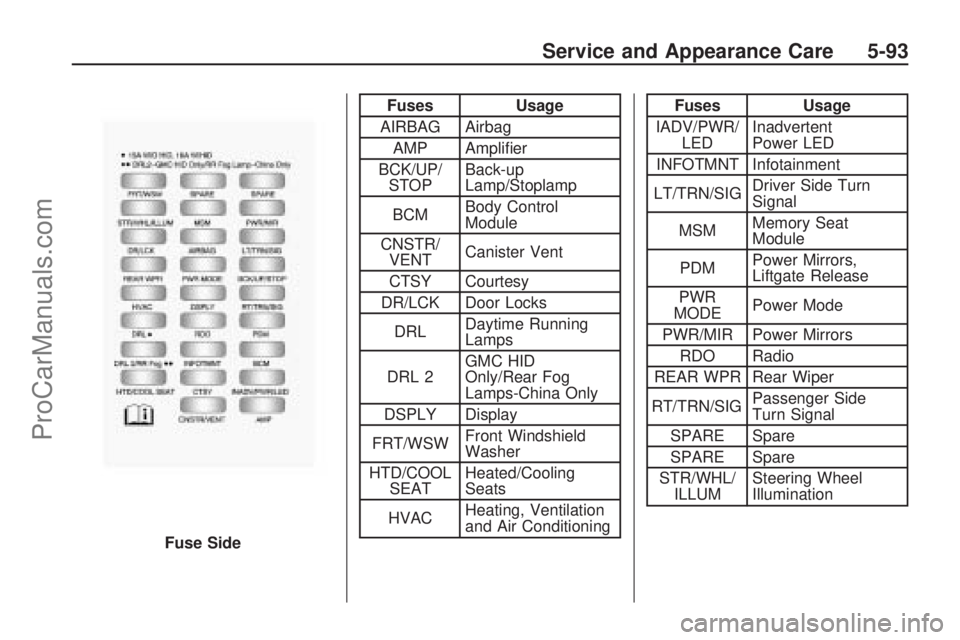
Fuses Usage
AIRBAG Airbag
AMP Amplier
BCK/UP/
STOPBack-up
Lamp/Stoplamp
BCMBody Control
Module
CNSTR/
VENTCanister Vent
CTSY Courtesy
DR/LCK Door Locks
DRLDaytime Running
Lamps
DRL 2GMC HID
Only/Rear Fog
Lamps-China Only
DSPLY Display
FRT/WSWFront Windshield
Washer
HTD/COOL
SEATHeated/Cooling
Seats
HVACHeating, Ventilation
and Air ConditioningFuses Usage
IADV/PWR/
LEDInadvertent
Power LED
INFOTMNT Infotainment
LT/TRN/SIGDriver Side Turn
Signal
MSMMemory Seat
Module
PDMPower Mirrors,
Liftgate Release
PWR
MODEPower Mode
PWR/MIR Power Mirrors
RDO Radio
REAR WPR Rear Wiper
RT/TRN/SIGPassenger Side
Turn Signal
SPARE Spare
SPARE Spare
STR/WHL/
ILLUMSteering Wheel
Illumination
Fuse Side
Service and Appearance Care 5-93
ProCarManuals.com
Page 403 of 432

Customer
Assistance
Information
Customer Assistance and
Information
Customer Satisfaction
Procedure...........................7-1
Online Owner Center.............7-4
Customer Assistance for
Text Telephone (TTY)
Users.................................7-5
Customer Assistance Offices. . . .7-5
GM Mobility Reimbursement
Program.............................7-6
Roadside Assistance
Program.............................7-6
Scheduling Service
Appointments......................7-9
Courtesy Transportation.........7-9
Collision Damage Repair......7-11
Reporting Safety DefectsReporting Safety Defects to
the United States
Government......................7-14
Reporting Safety Defects to
the Canadian Government. . . .7-15
Reporting Safety Defects to
Saturn..............................7-15
Service Publications
Ordering Information...........7-15
Vehicle Data Recording
and Privacy
Vehicle Data Recording
and Privacy.......................7-16
Event Data Recorders..........7-17
OnStar
®.............................7-18
Navigation System...............7-18
Radio Frequency
Identication (RFID)............7-18
Customer Assistance
and Information
Customer Satisfaction
Procedure
Your satisfaction and goodwill are
important to your retailer and to
Saturn. Together we are committed
to providing our customers with
unparalleled service, before,
during, and after the purchase
of a Saturn vehicle, for total
customer satisfaction. We call this
the Saturn Difference. Normally,
any concerns with the sales
transaction or the operation of the
vehicle are resolved by the retailer’s
sales or service departments.
Customer Assistance Information 7-1
ProCarManuals.com
Page 418 of 432

Owner Publications
Information on how to obtain product
bulletins and as described below is
applicable only in the fty U.S. states
and the District of Columbia, and
only for cars and light trucks with
a Gross Vehicle Weight Rating
(GVWR) less than 10,000 pounds
(4 536 kg). Copies of individual
bulletins are also at your participating
Saturn retailer. You can ask to
see them.
In Canada, information relating to
product service bulletins can
be obtained by contacting your
Saturn retailer.
Service Bulletins
Saturn regularly sends its retailers
useful service bulletins about Saturn
products. Saturn monitors product
performance in the eld. We then
prepare bulletins for servicing
our products better. You can get
these bulletins, too.Bulletins cover various subjects.
Some pertain to the proper use and
care of your vehicle. Some describe
costly repairs. Others describe
inexpensive repairs which, if done on
time with the latest parts, may avoid
future costly repairs.
Some bulletins tell a technician how
to repair a new or unexpected
condition. Others describe a quicker
way to x your vehicle. They can
help a technician service your
vehicle better.
Most bulletins apply to conditions
affecting a small number of vehicles.
Your Saturn retailer or a qualied
technician may have to determine
if a specic bulletin applies to your
vehicle. To order Saturn bulletins,
call Saturn Publications at
1-800-2-SATURN or visit
saturn-publications.com to order
online.
Vehicle Data
Recording and
Privacy
Your Saturn vehicle has a number of
sophisticated computers that record
information about the vehicle’s
performance and how it is driven.
For example, your vehicle uses
computer modules to monitor and
control engine and transmission
performance, to monitor the
conditions for airbag deployment and
deploy airbags in a crash and, if so
equipped, to provide antilock braking
to help the driver control the vehicle.
These modules may store data to
help your dealer/retailer technician
service your vehicle. Some modules
may also store data about how you
operate the vehicle, such as rate of
fuel consumption or average speed.
These modules may also retain the
owner’s personal preferences, such
as radio pre-sets, seat positions, and
temperature settings.
7-16 Customer Assistance Information
ProCarManuals.com
Page 420 of 432

OnStar®
If your vehicle has OnStar and you
subscribe to the OnStar services,
please refer to the OnStar Terms and
Conditions for information on data
collection and use. See alsoOnStar
®
System on page 2-42in this manual
for more information.
Navigation System
If your vehicle has a navigation
system, use of the system may
result in the storage of destinations,
addresses, telephone numbers, and
other trip information. Refer to the
navigation system operating manual
for information on stored data and for
deletion instructions.
Radio Frequency
Identication (RFID)
RFID technology is used in some
vehicles for functions such as
tire pressure monitoring and ignition
system security, as well as in
connection with conveniences such
as key fobs for remote door
locking/unlocking and starting, and
in-vehicle transmitters for garage
door openers. RFID technology in
Saturn vehicles does not use
or record personal information or
link with any other Saturn system
containing personal information.
7-18 Customer Assistance Information
ProCarManuals.com
Page 421 of 432

A
Accessories and
Modications...................... 5-3
Accessory Power.................2-21
Accessory Power Outlets......3-17
Adding Equipment to Your
Airbag-Equipped Vehicle....1-60
Additional Required Services,
Scheduled Maintenance....... 6-6
Additives, Fuel...................... 5-6
Add-On Electrical
Equipment.......................5-92
Air Cleaner/Filter, Engine.......5-17
Air Conditioning...................3-19
Airbag
Readiness Light................3-33
Airbag System.....................1-47
Adding Equipment to
Your Airbag-Equipped
Vehicle........................1-60
How Does an Airbag
Restrain?.....................1-53
Passenger Sensing
System........................1-55
Servicing Your
Airbag-Equipped
Vehicle........................1-60Airbag System (cont.)
What Makes an Airbag
Inate?........................1-52
What Will You See After
an Airbag Inates?........1-53
When Should an Airbag
Inate?........................1-51
Where Are the Airbags?.....1-49
Airbags
Passenger Status
Indicator.......................3-34
All-Wheel Drive....................5-35
All-Wheel-Drive (AWD)
System............................. 4-8
Antilock Brake System (ABS).... 4-4
Warning Light...................3-37
Appearance Care
Aluminum or
Chrome-Plated Wheels . . . 5-89
Care of Safety Belts..........5-86
Chemical Paint Spotting.....5-90
Cleaning Exterior
Lamps/Lenses...............5-87
Fabric/Carpet...................5-85
Finish Care......................
5-87
Finish Damage.................5-90
Instrument Panel, Vinyl, and
Other Plastic Surfaces....5-86Appearance Care (cont.)
Interior Cleaning...............5-84
Leather...........................5-86
Sheet Metal Damage........5-90
Tires...............................5-90
Underbody Maintenance....5-90
Washing Your Vehicle........5-87
Weatherstrips...................5-87
Windshield, Backglass,
and Wiper Blades..........5-88
Assistance Program,
Roadside.......................... 7-6
Audio System......................3-74
Audio Steering Wheel
Controls.....................3-125
Navigation/Radio System,
see Navigation
Manual.......................3-103
Setting the Clock..............3-74
Audio System(s)..................3-75
Audio Systems
Radio Reception.............3-126
Rear Seat (RSA).............3-123
Theft-Deterrent Feature....3-125
Automatic Transmission
Fluid...............................5-18
Operation........................2-24
INDEX i-1
ProCarManuals.com
Page 427 of 432

Locks (cont.)
Power Door ....................... 2-8
Programmable Automatic
Door Locks.................... 2-9
Rear Door Security Locks..... 2-9
Loss of Control....................4-10
Lower Anchors and
Tethers for Children...........1-37
Luggage Carrier...................2-52
Lumbar
Manual Controls................. 1-4
Power Controls.................. 1-5
M
Maintenance
Footnotes.......................... 6-7
Maintenance Schedule
Additional Required
Services........................ 6-6
At Each Fuel Fill................ 6-9
At Least Once a Month.....6-10
At Least Once a Year.......6-10
Maintenance Record.........6-16
Maintenance
Replacement Parts.........6-14
Maintenance Requirements . . . 6-1Maintenance Schedule (cont.)
Owner Checks and
Services........................ 6-9
Recommended Fluids and
Lubricants....................6-12
Scheduled Maintenance....... 6-3
Using............................... 6-2
Your Vehicle and the
Environment................... 6-1
Malfunction Indicator Lamp....3-39
Manual Lumbar Controls......... 1-4
Manual Seats........................ 1-3
Memory Seat and Mirrors....... 1-6
Message
DIC Warnings and
Messages....................3-56
Mirrors
Automatic Dimming
Rearview......................2-31
Manual Rearview Mirror.....2-31
Outside Convex Mirror.......2-34
Outside Heated Mirrors......2-34
Outside Power Foldaway
Mirrors.........................2-33
Outside Power Mirrors.......2-32
Park Tilt..........................2-34
MP3 ...........................3-92, 3-97
N
Navigation System, Privacy....7-18
Navigation/Radio System,
see Navigation Manual.....3-103
Net
Convenience....................2-52
New Vehicle Break-In...........2-20
O
Odometer...........................3-32
Off-Road
Recovery.......................... 4-9
Oil
Engine............................5-13
Engine Oil Life System......5-15
Pressure Light..................3-42
Older Children, Restraints......1-28
Online Owner Center.............. 7-4
OnStar, Privacy....................7-18
OnStar
®System, see
OnStar®Manual...............2-42
Operation, Universal Home
Remote System................2-46
Outlet Adjustment.................3-27
Outlets
Accessory Power..............3-17
INDEX i-7
ProCarManuals.com
Page 428 of 432

Outside
Convex Mirror..................2-34
Heated Mirrors.................2-34
Power Foldaway Mirrors.....2-33
Power Mirrors..................2-32
Overheated Engine Protection
Operating Mode................5-25
Owner Checks and Services..... 6-9
Owners, Canadian.................... ii
P
Paint, Damage.....................5-90
Parade Dimming..................3-15
Park
Shifting Into.....................2-28
Shifting Out of..................2-29
Park Aid.............................2-34
Park Tilt Mirrors...................2-34
Parking
Assist.............................2-34
Over Things That Burn......2-29
Parking Brake......................2-27
Passenger Airbag Status
Indicator..........................3-34
Passenger Sensing System....1-55
Passing..............................4-10PASS-Key
®III+ Electronic
Immobilizer......................2-18
PASS-Key
®III+ Electronic
Immobilizer Operation........2-18
Perchlorate Materials
Requirements, California...... 5-4
Phone
Bluetooth
®.....................3-103
Power
Door Locks........................ 2-8
Electrical System..............5-92
Liftgate............................2-11
Lumbar Controls................. 1-5
Outlet 115 Volt Alternating
Current........................3-18
Retained
Accessory (RAP)...........2-21
Seat................................. 1-4
Steering Fluid...................5-25
Windows.........................2-14
Pregnancy, Using
Safety Belts.....................1-28
Privacy...............................7-16
Navigation System............7-18
OnStar............................7-18
Radio Frequency
Identication (RFID).......7-18Programmable Automatic
Door Locks........................ 2-9
Proposition 65 Warning,
California.......................... 5-3
R
Radio Frequency Identication
(RFID), Privacy.................7-18
Radio(s).............................3-75
Radios
Navigation/Radio System,
see Navigation
Manual.......................3-103
Reception......................3-126
Setting the Clock..............3-74
Theft-Deterrent...............3-125
Reading Lamps...................3-15
Rear Air Conditioning and
Heating System................3-28
Rear Air Conditioning and
Heating System and
Electronic Climate
Controls..........................3-29
Rear Door Security Locks....... 2-9
Rear Seat Armrest...............2-52
i-8 INDEX
ProCarManuals.com