brake SATURN RELAY 2007 Owner's Manual
[x] Cancel search | Manufacturer: SATURN, Model Year: 2007, Model line: RELAY, Model: SATURN RELAY 2007Pages: 570, PDF Size: 3.41 MB
Page 251 of 570

PARKING BRAKE ON
This message displays to alert the driver when the
vehicle’s parking brake is on, the ignition is in
RUN, and the vehicle speed is greater than 5 mph
(8 km/h). Release the parking brake before
driving. SeeParking Brake on page 147for more
information.
The brake system warning light also appears on
the instrument panel cluster when this message
appears on the DIC. SeeBrake System Warning
Light on page 226.
A chime sounds continuously while this message
is displayed if driving above 5 mph (8 km/h).
Press any of the DIC buttons to acknowledge this
message and to clear it from the screen.
This message continues to display for two seconds
if it has not been acknowledged when the engine is
turned off. It also re-displays for two seconds if the
message has been acknowledged, but the
condition still exists when the engine is turned off.
If the condition still exists, the message re-appears
when the engine is turned on.
PARK LAMPS ON
This message displays to alert the driver when the
headlamps or parking lamps are on while the
ignition is off and the driver’s door is opened. See
Exterior Lamps on page 192for more information.
A chime sounds continuously while this message
is displayed.
This message cannot be acknowledged.
PASSENGER’S DOOR AJAR
This message displays when the front passenger’s
door is not closed properly. When this message
appears, make sure that the front passenger’s
door is closed completely.
This message displays while the ignition is in
RUN. A chime sounds when the ignition is shifted
out of PARK (P). Press any of the DIC buttons
to acknowledge this message and to clear it from
the screen.
This message continues to display for two seconds
if it has not been acknowledged when the engine is
turned off. It also re-displays for two seconds if the
message has been acknowledged, but the
condition still exists when the engine is turned off.
If the condition still exists, the message re-appears
when the engine is turned on.
251
ProCarManuals.com
Page 255 of 570

RIGHT REAR TURN LAMP OUT
This message displays when the right rear turn
signal bulb needs to be replaced. SeeTaillamps,
Turn Signal, Stoplamps and Back-up Lamps
on page 458.
This message displays while the ignition is in RUN.
Press any of the DIC buttons to acknowledge this
message and to clear it from the screen.
This message continues to display for two seconds
if it has not been acknowledged when the engine is
turned off. It also re-displays for two seconds if the
message has been acknowledged, but the
condition still exists when the engine is turned off.
If the condition still exists, the message re-appears
when the engine is turned on.
SERVICE ABS SYSTEM
This message displays when the vehicle’s
Anti-lock Brake System (ABS) is not functioning
properly. Have the ABS serviced by your
retailer as soon as possible.
The ABS warning light also appears on the
instrument panel cluster when this message
appears on the DIC. SeeAnti-Lock Brake System
Warning Light on page 227.
This message only displays while the ignition is in
RUN. Press any of the DIC buttons to acknowledge
this message and to clear it from the screen.
This message continues to display for two seconds
if it has not been acknowledged when the engine
is turned off. It also re-displays for two seconds
if the message has been acknowledged, but
the condition still exists when the engine is
turned off.
If the condition still exists, the message re-appears
when the engine is turned on.
255
ProCarManuals.com
Page 256 of 570

SERVICE AIR BAG
This message displays along with the airbag
readiness light if there is a problem with the airbag
system. Have your retailer inspect the system
for problems. SeeAirbag Readiness Light
on page 223andAirbag System on page 83for
more information.
This message only displays while the ignition is in
RUN. Press any of the DIC buttons to acknowledge
this message and to clear it from the screen.
This message continues to display for two seconds
if it has not been acknowledged when the engine is
turned off. It also re-displays for two seconds if the
message has been acknowledged, but the
condition still exists when the engine is turned off.
If the condition still exists, the message re-appears
when the engine is turned on.
SERVICE BRAKE SYSTEM
This message displays when a problem with the
brake system has been detected. Have your
vehicle serviced by your retailer as soon as
possible.
The brake system warning light also appears on
the instrument panel cluster when this message
appears on the DIC. SeeBrake System Warning
Light on page 226.
This message only displays while the ignition is in
RUN. Press any of the DIC buttons to acknowledge
this message and to clear it from the screen.
This message continues to display for two seconds
if it has not been acknowledged when the engine
is turned off. It also re-displays for two seconds
if the message has been acknowledged, but
the condition still exists when the engine is
turned off.
If the condition still exists, the message re-appears
when the engine is turned on.
256
ProCarManuals.com
Page 271 of 570
Here are some ways in which you can help avoid
distraction while driving.
While your vehicle is parked:
Familiarize yourself with all of its controls.
Familiarize yourself with its operation.
Set up your audio system by presetting your
favorite radio stations, setting the tone, and
adjusting the speakers. Then, when driving
conditions permit, you can tune to your favorite
radio stations using the presets and steering
wheel controls if the vehicle has them.
Notice:Before adding any sound equipment
to your vehicle, such as an audio system,
CD player, CB radio, mobile telephone,
or two-way radio, make sure that it can be
added by checking with your retailer. Also,
check federal rules covering mobile radio and
telephone units. If sound equipment can be
added, it is very important to do it properly.
Added sound equipment may interfere with the
operation of your vehicle’s engine, radio, or
other systems, and even damage them.
Your vehicle’s systems may interfere with the
operation of sound equipment that has
been added.Notice:The chime signals related to safety
belts, parking brake, and other functions
of your vehicle operate through the radio/
entertainment system. If that equipment
is replaced or additional equipment is added to
your vehicle, the chimes may not work. Make
sure that replacement or additional equipment
is compatible with your vehicle before
installing it. SeeAccessories and Modifications
on page 412.
Your vehicle has a feature called Retained
Accessory Power (RAP). With RAP, the audio
system can be played even after the ignition
is turned off. SeeRetained Accessory Power
(RAP) on page 139for more information.
271
ProCarManuals.com
Page 357 of 570

Your Driving, the Road, and
Your Vehicle............................................ 358
Defensive Driving...................................... 358
Drunken Driving........................................ 359
Control of a Vehicle.................................. 362
Braking...................................................... 362
Anti-Lock Brake System (ABS).................. 363
Braking in Emergencies............................. 365
Traction Control System (TCS).................. 365
StabiliTrak
®System................................... 367
Steering.................................................... 369
Off-Road Recovery.................................... 372
Passing..................................................... 372
Loss of Control.......................................... 374
Driving at Night......................................... 375
Driving in Rain and on Wet Roads............ 376City Driving............................................... 380
Freeway Driving........................................ 381
Before Leaving on a Long Trip.................. 382
Highway Hypnosis..................................... 383
Hill and Mountain Roads........................... 384
Winter Driving........................................... 386
If Your Vehicle is Stuck in Sand,
Mud, Ice, or Snow ................................. 390
Rocking Your Vehicle to Get It Out........... 391
Loading Your Vehicle................................ 391
Towing........................................................ 396
Towing Your Vehicle ................................. 396
Recreational Vehicle Towing...................... 396
Level Control............................................. 398
Towing a Trailer........................................ 398
Section 4 Driving Your Vehicle
357
ProCarManuals.com
Page 362 of 570
Control of a Vehicle
You have three systems that make your
vehicle go where you want it to go. They are
the brakes, the steering, and the accelerator.
All three systems have to do their work at
the places where the tires meet the road.
Sometimes, as when you are driving on snow or
ice, it is easy to ask more of those control systems
than the tires and road can provide. That means
you can lose control of your vehicle. SeeTraction
Control System (TCS) on page 365and
StabiliTrak
®System on page 367.
Adding non-Saturn accessories can affect your
vehicle’s performance. SeeAccessories and
Modications on page 412.
Braking
SeeBrake System Warning Light on page 226.
Braking action involves perception time and
reaction time.
First, you have to decide to push on the brake
pedal. That is perception time. Then you have to
bring up your foot and do it. That is reaction time.
Average reaction time is about three-fourths of a
second. But that is only an average. It might be less
with one driver and as long as two or three seconds
or more with another. Age, physical condition,
alertness, coordination, and eyesight all play a part.
So do alcohol, drugs, and frustration. But even in
three-fourths of a second, a vehicle moving at
60 mph (100 km/h) travels 66 feet (20 m). That
could be a lot of distance in an emergency, so
keeping enough space between your vehicle and
others is important.
And, of course, actual stopping distances vary
greatly with the surface of the road, whether it is
pavement or gravel; the condition of the road,
whether it is wet, dry, or icy; tire tread; the
condition of the brakes; the weight of the vehicle;
and the amount of brake force applied.
362
ProCarManuals.com
Page 363 of 570

Avoid needless heavy braking. Some people drive
in spurts — heavy acceleration followed by
heavy braking — rather than keeping pace with
traffic. This is a mistake. The brakes may not have
time to cool between hard stops. The brakes
will wear out much faster if you do a lot of heavy
braking. If you keep pace with the traffic and
allow realistic following distances, you will
eliminate a lot of unnecessary braking. That means
better braking and longer brake life.
If your vehicle’s engine ever stops while you are
driving, brake normally but do not pump the
brakes. If you do, the pedal may get harder to
push down. If the engine stops, you will still have
some power brake assist. But you will use it
when you brake. Once the power assist is used
up, it may take longer to stop and the brake pedal
will be harder to push.
Adding non-Saturn accessories can affect your
vehicle’s performance. SeeAccessories and
Modications on page 412.Anti-Lock Brake System (ABS)
Your vehicle has the Anti-Lock Brake System
(ABS), an advanced electronic braking system
that will help prevent a braking skid.
When you start your engine and begin to drive
away, ABS will check itself. You may hear a
momentary motor or clicking noise while this test is
going on, and you may even notice that your brake
pedal moves or pulses a little. This is normal.
If there is a problem
with ABS, this warning
light will stay on.
SeeAnti-Lock Brake
System Warning
Light on page 227.
363
ProCarManuals.com
Page 364 of 570
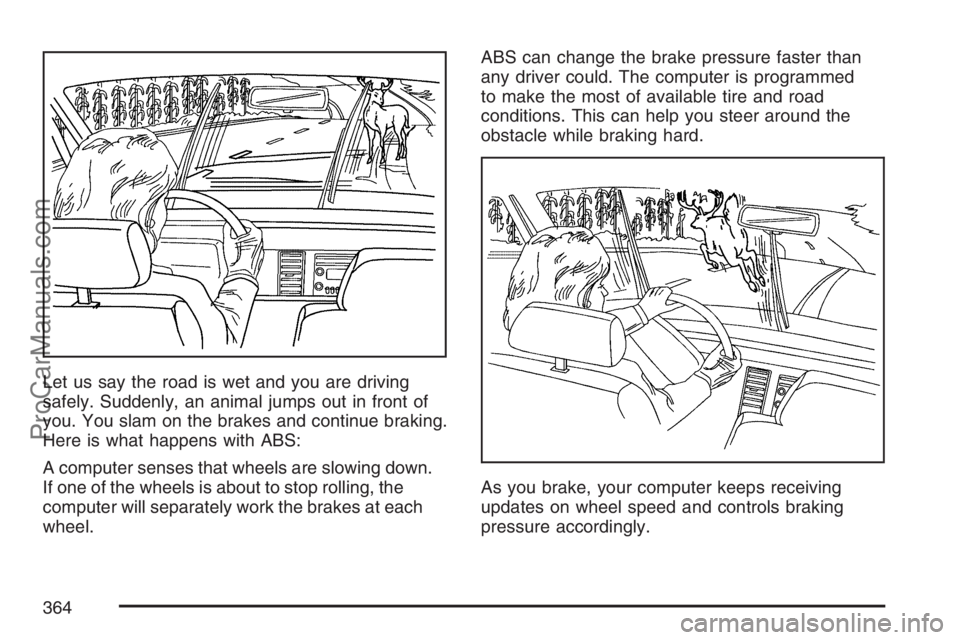
Let us say the road is wet and you are driving
safely. Suddenly, an animal jumps out in front of
you. You slam on the brakes and continue braking.
Here is what happens with ABS:
A computer senses that wheels are slowing down.
If one of the wheels is about to stop rolling, the
computer will separately work the brakes at each
wheel.ABS can change the brake pressure faster than
any driver could. The computer is programmed
to make the most of available tire and road
conditions. This can help you steer around the
obstacle while braking hard.
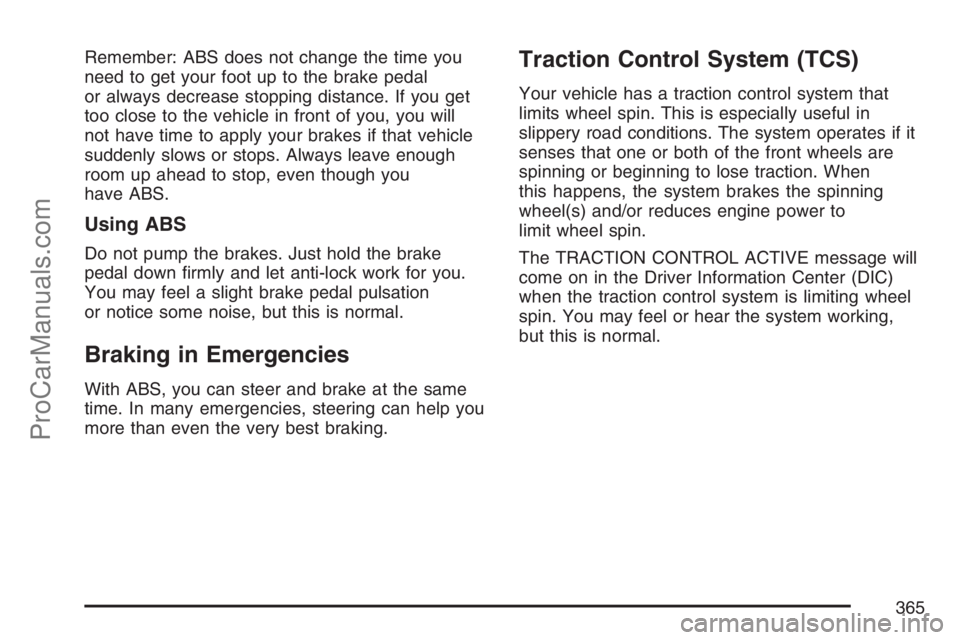
As you brake, your computer keeps receiving
updates on wheel speed and controls braking
pressure accordingly.
364
ProCarManuals.com
Page 365 of 570
Remember: ABS does not change the time you
need to get your foot up to the brake pedal
or always decrease stopping distance. If you get
too close to the vehicle in front of you, you will
not have time to apply your brakes if that vehicle
suddenly slows or stops. Always leave enough
room up ahead to stop, even though you
have ABS.
Using ABS
Do not pump the brakes. Just hold the brake
pedal down rmly and let anti-lock work for you.
You may feel a slight brake pedal pulsation
or notice some noise, but this is normal.
Braking in Emergencies
With ABS, you can steer and brake at the same
time. In many emergencies, steering can help you
more than even the very best braking.
Traction Control System (TCS)
Your vehicle has a traction control system that
limits wheel spin. This is especially useful in
slippery road conditions. The system operates if it
senses that one or both of the front wheels are
spinning or beginning to lose traction. When
this happens, the system brakes the spinning
wheel(s) and/or reduces engine power to
limit wheel spin.
The TRACTION CONTROL ACTIVE message will
come on in the Driver Information Center (DIC)
when the traction control system is limiting wheel
spin. You may feel or hear the system working,
but this is normal.
365
ProCarManuals.com
Page 367 of 570

You can turn the system back on at any time by
pressing the button again. The traction control
system warning message should go off.
Adding non-Saturn accessories can affect your
vehicle’s performance. SeeAccessories and
Modications on page 412for more information.
StabiliTrak®System
Your vehicle is equipped with StabiliTrak®which
combines anti-lock brake, traction and stability
control systems and helps the driver maintain
directional control of the vehicle in most driving
conditions.
When you rst start your vehicle and begin to
drive away, the system performs several diagnostic
checks to insure there are no problems. You
may hear or feel the system working. This
is normal and does not mean there is a problem
with your vehicle.
If the system fails to turn on or activate, the
SERVICE STABILITY SYSTEM message will be
displayed on the Driver Information Center (DIC).If the vehicle has gone through heavy acceleration
or braking or multiple turns during the rst two miles
of driving after starting your vehicle, the STABILITY
CONTROL OFF message may appear on the DIC.
If this is the case, your vehicle does not need
servicing. You will need to turn the vehicle off and
then restart it to initialize StabiliTrak
®. If either
message appears on the DIC, and your vehicle has
not gone through hard acceleration, braking or
multiple turns in the rst two miles of driving, your
vehicle should be taken in for service.
The STABILITY CONTROL ACTIVE message will
appear on the DIC only when the system is
both on and activated. It means that an advanced
computer-controlled system has come on to
help your vehicle continue to go in the direction in
which you are steering. StabiliTrak
®activates
when the computer senses that your vehicle is just
starting to spin, as it might if you hit a patch of
ice or other slippery spot on the road. When
the system activates, you may hear a noise or feel
a vibration in the brake pedal. This is normal.
367
ProCarManuals.com