ESP Seat Alhambra 2006 Owner's Guide
[x] Cancel search | Manufacturer: SEAT, Model Year: 2006, Model line: Alhambra, Model: Seat Alhambra 2006Pages: 299, PDF Size: 6.33 MB
Page 138 of 299
Seats and stowage 136
Coat hooks are located in the roof. They are integrated in the grab handles in
the passenger compartment.
Location of CD changer
31)
The CD changer, which can be factory fitted, is located either in the dash
panel or in the right-hand stowage compartment in the luggage compart-
ment.
WARNING
•Ensure that no objects can fall from the dash panel or other stowage
areas into the driver foot well while the vehicle is moving. In the event of a
sudden braking manoeuvre, you will not be able to use the brake, clutch or
accelerator. Risk of accident.
•Clothing hung on the coat hooks must not restrict the driver's view.
Risk of accident. The coat hooks are intended only for use with light arti-
cles of clothing. Do not leave any hard, sharp or heavy objects in hanging
articles of clothing. During sudden braking manoeuvres or accidents, espe-
cially those involving airbag deployment, these objects could injure the
vehicle occupants.
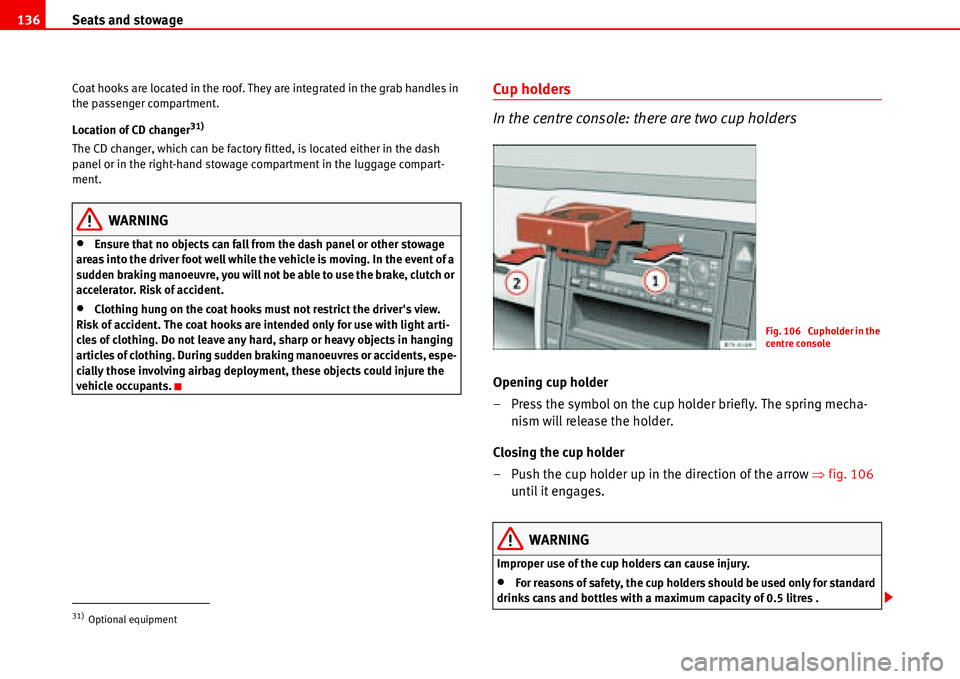
Cup holders
In the centre console: there are two cup holders
Opening cup holder
– Press the symbol on the cup holder briefly. The spring mecha-
nism will release the holder.
Closing the cup holder
– Push the cup holder up in the direction of the arrow Ÿfig. 106
until it engages.
WARNING
Improper use of the cup holders can cause injury.
•For reasons of safety, the cup holders should be used only for standard
drinks cans and bottles with a maximum capacity of 0.5 litres .
31)Optional equipment
Fig. 106 Cupholder in the
centre console
Page 145 of 299
Seats and stowage143
Safety FirstOperating instructionsTips and MaintenanceTe c h n i c a l D a t a
WARNING
Loose luggage and other objects in the luggage compartment can cause
serious injuries.
•Always stow objects in the luggage compartment and secure them on
the fastening rings.
•Use suitable specialist straps to secure heavy objects.
•During sudden manoeuvres or accidents, loose objects can be thrown
forward, injuring vehicle occupants. This increased risk of injury will be
further increased if a loose object is struck by an inflating airbag. If this
happens, objects can be transformed into “missiles”. Risk of fatal injury.
•Remember that transporting heavy objects modifies the driving condi-
tions as the centre of gravity has been altered. There is a risk of accident.
Therefore, it is essential to adjust your speed and driving style accordingly,
to avoid accidents.
•Never exceed the allowed axle loads or allowed maximum weight. If the
allowed axle load or the allowed total weight is exceeded, the driving char-
acteristics of the vehicle may change, leading to accidents, injuries and
damage to the vehicle.
•Never leave the vehicle unattended, especially when the tailgate is
open. Children could climb into the luggage compartment closing the door
behind them; they will remain trapped without help and there is a mortal
risk.
•Never allow children to play in or around the vehicle. Close and lock
both the tailgate and all the doors when you leave the vehicle. Before you
lock the vehicle, make sure that there are no adults or children in the
vehicle.
•Never transport passengers in the luggage compartment. Every
passenger must be properly belted in .
Caution
•Avoid overloading small areas by placing heavy objects on the vehicle
floor.
•The wires of the heating element in the rear window and the window aerial
in the rear side windows could be damaged if objects on the luggage
compartment cover rub against them.
•If you have removed the seats from the passenger compartment, you
should place a large, robust covering over the floor anchors to prevent
damage.
Note
•Air circulation in the vehicle helps reduce fogging of the windows. Used
air escapes through ventilation slits in the side trim of the luggage compart-
ment. Ensure that the ventilation slits are never covered.
•Straps for securing the load to the fastening rings are commercially
available.
Fastening rings
There are fastening rings in the luggage compartment which
can be used to secure luggage and other objects.
– Always use suitable undamaged belts for fastening the luggage
or any other object tot he anchorage rings Ÿ in “Loading the
luggage compartment” on page 142.
The retainers for the detachable seat belts for the third row of seats and the
floor anchors for the seats can be used as fastening rings for items of
luggage.
Page 146 of 299
Seats and stowage 144
During a collision or an accident, even small and light objects can build up so
much energy that they can cause very severe injuries. The amount of “kinetic
energy” depends on the speed of the vehicle and the weight of the object.
The most significant factor, however, is the speed of the vehicle.
For example: an object weighing 4.5 kg is lying unsecured in the vehicle.
During a frontal collision at a speed of 50 km/h, this object generates a force
corresponding to 20 times its weight. That means that the effective weight of
the object increases to about 90 kg. You can imagine the severity of the inju-
ries which might be sustained if this “projectile” strikes an occupant as it flies
through the passenger compartment. This increased risk of injury will be
further increased if a loose object is struck by an inflating airbag.
WARNING
If pieces of baggage or other objects are secured to the fastening rings with
inappropriate or damaged retaining cords, injuries could result in the event
of braking manoeuvres or accidents.
•To prevent pieces of luggage or other objects from flying forward,
always use appropriate retaining cords which are secured to the fastening
rings.
•Never secure a child seat on the fastening rings.
Loading heavy objects
Special care is required when loading heavy objects and
when driving a vehicle which contains heavy objects.
Observe the following points to prevent damage and accidents:
– If necessary, remove the seats to increase the load area.–Before loading the vehicle place a sturdy mat or similar cover
flush on floor of the vehicle.
– Where necessary, do not cover protruding parts of the vehicle
floor.
– Protect the seat anchor points from damage.
– Avoid overloading small areas - spread the load.
– Use suitable straps to secure the objects to retaining rings.
– Drive particularly carefully and think ahead.
– If possible, avoid sudden braking and driving manoeuvres.
WARNING
For safety reasons, you should read and observe all information on loading
the vehicle Ÿpage 144.
Caution
•If you have removed the seats from the passenger compartment, you
should place a large, robust covering over the seat rails to prevent damage.
•Avoid overloading small areas - spread the load.
Safety notes on loading the vehicle
WARNING
Loose luggage and other objects in the luggage compartment can cause
serious injuries.
Page 147 of 299
Seats and stowage145
Safety FirstOperating instructionsTips and MaintenanceTe c h n i c a l D a t a
•Always stow objects safely in the vehicle and secure them on the
fastening rings if necessary.
•Use suitable specialist straps to secure heavy objects.
•Loose objects in the vehicle can move suddenly. As the centre of gravity
moves, safety is impaired and the vehicle becomes difficult to handle.
•During sudden manoeuvres or accidents, loose objects can be thrown
forward, injuring vehicle occupants. This increased risk of injury will be
further increased if a loose object is struck by an inflating airbag. If this
happens, objects can be transformed into “missiles”. Risk of fatal injury.
•Remember that transporting heavy objects modifies the driving condi-
tions as the centre of gravity has been altered. There is a risk of accident.
Therefore, it is essential to adjust your speed and driving style accordingly,
to avoid accidents.
•Never exceed the allowed axle loads or allowed maximum weight. If the
allowed axle load or the allowed total weight is exceeded, the driving char-
acteristics of the vehicle may change, leading to accidents, injuries and
damage to the vehicle.
•Never leave the vehicle unattended, especially when the tailgate is
open. Children could climb into the interior of the vehicle closing the door
behind them; they will remain trapped without help and there is a mortal
risk.
•Never allow children to play in or around the vehicle. Close and lock all
windows, the tailgate and all doors when you leave the vehicle.
•Never transport passengers in the luggage compartment. Every
passenger must be properly belted in.
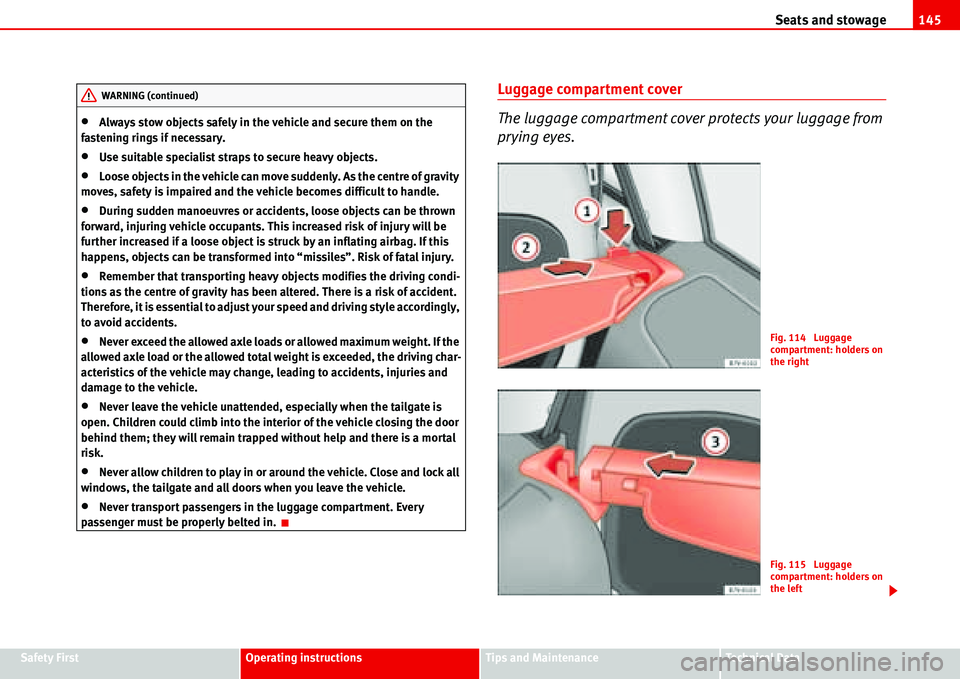
Luggage compartment cover
The luggage compartment cover protects your luggage from
prying eyes.WARNING (continued)
Fig. 114 Luggage
compartment: holders on
the right
Fig. 115 Luggage
compartment: holders on
the left
Page 150 of 299
Seats and stowage 148
•Damage to the vehicle caused by incorrect installation of mounts or roof
carrier systems not approved by the factory are excluded from the vehicle
warranty.
Securing the load
Loads transported on the roof carrier must be securely
attached. The car's handling is affected when transporting
loads.
The maximum permissible roof load for your vehicle is 75 kg. The load limit
applies to the combined weight of the carrier system and the load itself.
Distribute the load evenly. However, if you are using a roof carrier with a lower
weight rating, you will not be able to carry the maximum roof load. Do not
exceed the maximum weight limit for the roof carrier which is listed in the
fitting instructions.
WARNING
•If damaged, fine or inadequate securing straps are used to fasten
objects carried on the roof, they could break in the event of sharp braking.
This could cause an accident and serious injury.
•Always use appropriate securing straps to secure objects on the roof
carrier against sliding or flying off. This could cause an accident. The load
must be correctly secured.
•Always respect the maximum authorised weight for the roof, the
maximum authorised weight on the axles and the total maximum author-
ised weight of the vehicle. Otherwise there is danger of causing an acci-
dent.
•The risk of an accident is increased by transporting heavy or bulky
loads on the roof, which affects the car's handling by shifting the centre of
gravity and increasing susceptibility to cross winds. Both circumstances increase the risk of accident. Therefore you must adapt your driving style
and speed to the prevailing conditions - avoid sudden braking or driving
manoeuvres when there is a load on the roof carrier.
Caution
Please take extra care not to let the tailgate or rear window strike the roof load
when open – there is a risk of damage to the vehicle.
For the sake of the environment
The roof carrier is often left on the roof for convenience even if it is not being
used. However, increased air resistance means that the vehicle uses more
fuel. For this reason you should always take off the roof carrier when it is not
in use.
Cooling and heating box*
Notes on usage
The cooling and heating box may only be installed in the posi-
tion of rear left seat in the third row.
Power can be supplied by any of the 12 Volt sockets in the vehicle. It
consumes approximately 33 watts and has a capacity of approximately
32 litres.
The battery will discharge if the cooling and heating box is used for a long
period while the engine is switched off.
WARNING (continued)
Page 151 of 299
Seats and stowage149
Safety FirstOperating instructionsTips and MaintenanceTe c h n i c a l D a t a Before using the cooling and heating box for the first time, you should clean
it using a household detergent.
Disconnect the power supply and clean the box if you do not plan to use the
cooling and heating box for a long period. Place a folded towel between the
box and its lid. This prevents mould and damp stains forming in the cooling
and heating box.
Whenever possible, food and drinks should be stored in air-tight containers
in the box.
Do not overfill the box - this would prevent air circulation within the box.
Place crumpled paper (or similar) between bottles and other containers in the
box to prevent clanking noises.
Do not fill the interior of the box with liquid or ice.
Caution
•Do not place objects, blankets, or clothes on top of the cooling/heating
box, as the air intake and output may be obstructed and the box will discon-
nect itself.
•Do not place any containers, food items or other objects into the box if
they are warmer than +50°C. This could damage the cooling and heating box.
•The cold/hot box is not suitable for transporting corrosive material or
material containing solvents.
•Never leave the cold/hot box in the rain or damp.
Note
•The cooling and heating box is not designed to heat or cool the interior of
the vehicle. The cooling and heating box should be used only for cooling and
warming food and drinks and for transporting heat-sensitive items on short
journeys.
•A corresponding manual for the installation and use of the cooling and
heating box is included by the manufacturer and should be kept with the
vehicle wallet.
Cooling or heating
The contents of the cooling and heating box can be cooled or
kept warm.
Switching on the cooling function
– Insert the cable plug in the cooling and heating box so that the
blue marking on the plug is pointing to the notch.
– Insert the connector cable plug into one of the vehicle's 12 volt
sockets.
– Keep the lid of the cooling and heating box closed.
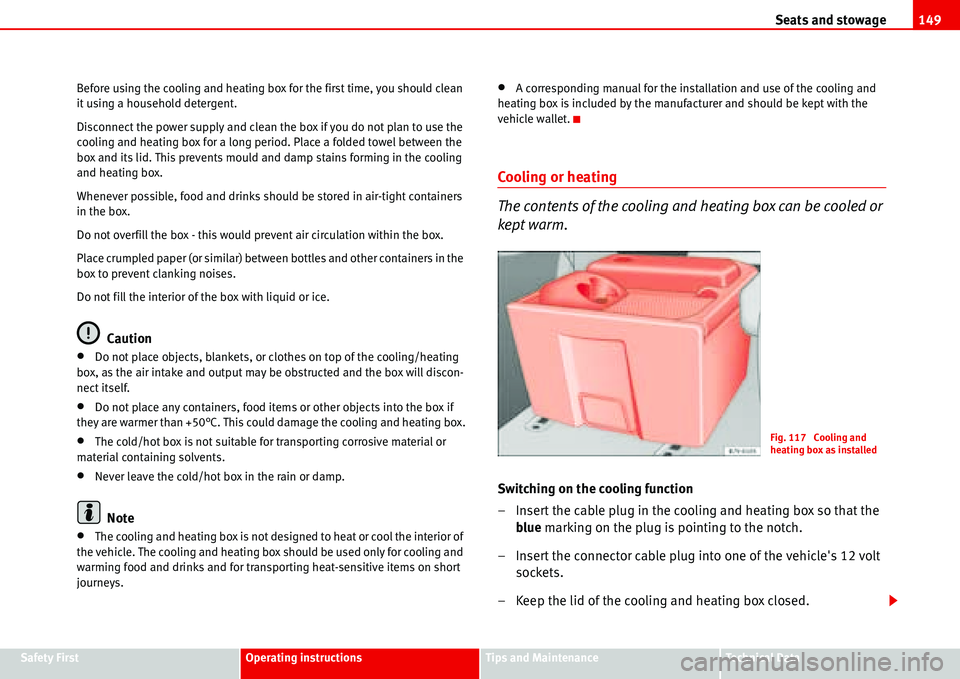
Fig. 117 Cooling and
heating box as installed
Page 162 of 299
Driving 160
•Adjust the driver seat or steering wheel so that there is a distance of at
least 25 cm between the steering wheel and your breast bone Ÿpage 159,
fig. 124. If you fail to observe the minimum distance, the airbag will not
protect you. Risk of fatal injury.
•If your physical constitution prevents you from maintaining the
minimum distance of 25 cm, contact an Authorised Service Centre. The
Authorised Service Centre will help you decide if special specific modifica-
tions are necessary.
•If you adjust the steering wheel so that it points towards your face, the
driver airbag will not protect you properly in the event of an accident. Make
sure that the steering wheel points towards your chest.
•When driving, always hold the steering wheel with both hands on the
outside of the ring at the 9 o'clock and 3 o'clock positions. Never hold the
steering wheel at the 12 o'clock position, or in any other manner (e.g. in
the centre of the steering wheel, or on the inside of the rim). In such cases,
you could receive severe injuries to the arms, hands and head.
Safety
Electronic stabilisation programme (ESP)
ESP helps make driving safer in certain situations.
The Electronic Stabilisation Programme (ESP) contains the electronic differ-
ential lock (EDL) and the traction control system (TCS). The ESP works
together with the anti-locking brake system (ABS). Both warning lamps will
light up if the ESP or ABS systems are faulty.
The ESP is started automatically when the engine is started.
In specific circumstances where you require less traction, you can switch off
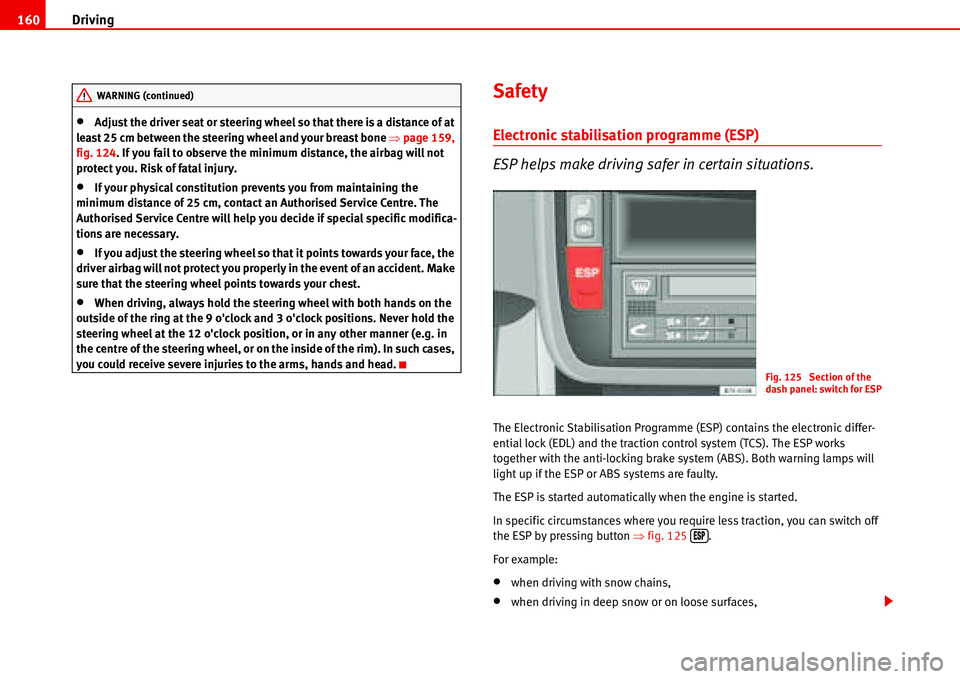
the ESP by pressing button Ÿfig. 125 .
For example:
•when driving with snow chains,
•when driving in deep snow or on loose surfaces,
WARNING (continued)
Fig. 125 Section of the
dash panel: switch for ESP
%30
Page 163 of 299
Driving161
Safety FirstOperating instructionsTips and MaintenanceTe c h n i c a l D a t a
•when rocking the vehicle backwards and forwards to free it from mud, for
example.
You should press the button to switch the ESP back on when you no longer
need wheel spin.
The TCS and EDL are also switched off if the ESP is switched off. This means
that this technology is not available for as long as the ESP remains switched
off.
When does the inscription OFF light up on the button?
•It will light up continuously if there is a malfunction in the ESP.
•It will light up continuously if the ESP is switched off.
WARNING
•The electronic stabilisation program (ESP) cannot defy the laws of
physics. This should be kept in mind, particularly on slippery and wet
roads and when towing a trailer.
•Always adapt your driving style to suit the condition of the roads and
the traffic situation. Do not let the extra safety afforded by ESP tempt you
into taking any risks when driving, this can cause accidents.
•Please refer to the corresponding warning notes on ESP.
Ignition lock
Position of the ignition key
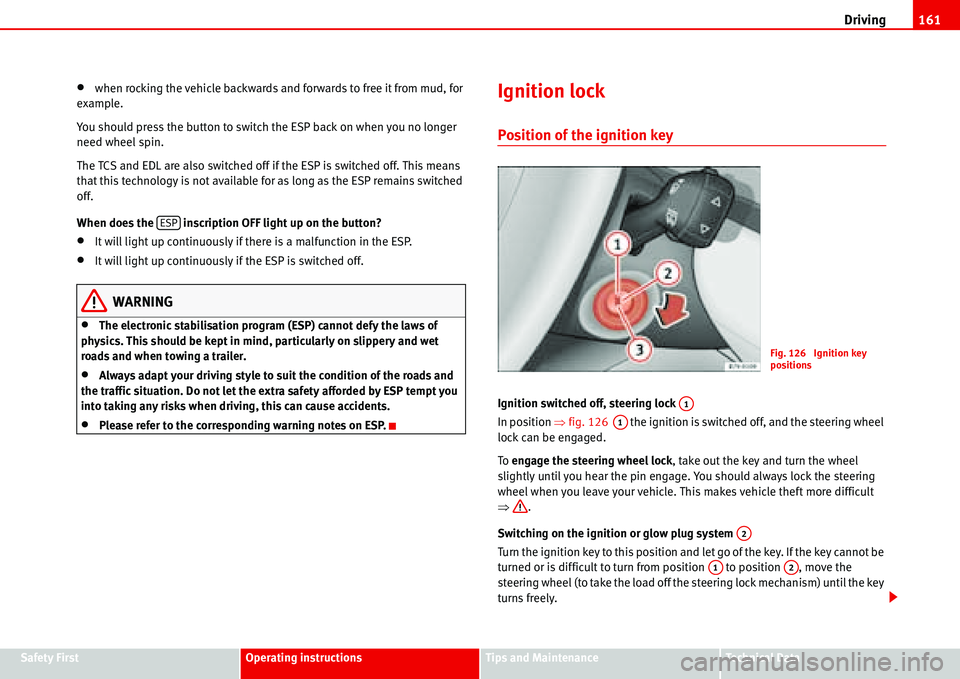
Ignition switched off, steering lock
In position Ÿfig. 126 the ignition is switched off, and the steering wheel
lock can be engaged.
To engage the steering wheel lock, take out the key and turn the wheel
slightly until you hear the pin engage. You should always lock the steering
wheel when you leave your vehicle. This makes vehicle theft more difficult
Ÿ.
Switching on the ignition or glow plug system
Tu rn the ignition key to this position and let go of the key. If the key canno t b e
turned or is difficult to turn from position to position , move the
steering wheel (to take the load off the steering lock mechanism) until the key
turns freely.
ESP
Fig. 126 Ignition key
positions
A1
A1
A2
A1A2
Page 164 of 299
Driving 162
Starting
The engine is started when the key is in this position. Electrical components
with a high power consumption are switched off temporarily.
Each time that the vehicle must be started, the ignition key must be turned to
the position . The repetitive start prevention lock of the ignition prevents
possible damage to the starter motor if the engine is already running.
WARNING
•Wait for the vehicle to come to a standstill before removing the ignition
key from the lock. The steering lock could be activated immediately - Risk
of accident!
•Always remove the key from the ignition lock when leaving the vehicle,
even if you only intend to be gone for a short period. This is especially
important if you must leave children or disabled people in the vehicle, they
could accidentally start the engine or work electrical equipment such as
the windows possibly resulting in an accident.
•Unsupervised use of the keys could result in the engine being started
or electrical systems, such as the electric windows, being used. This can
result in serious injury.
Caution
The starter must not be used unless the vehicle is at a standstill (key position
). If the starter is used as soon as the engine is switched off, the starter or
the engine could be damaged.
Safety interlock for ignition key
The ignition key can only be taken out of the ignition lock if the
selector lever is in position P.
After switching off the ignition, you can remove the ignition key only if the
automatic gearbox gear selector lever Ÿpage 167 is in position P. The
selector lever is blocked after the ignition key has been removed.
Electronic immobiliser
The immobiliser prevents unauthorised persons from driving
the vehicle.
Inside the key there is a chip that deactivates the electronic immobiliser auto-
matically when the key is inserted into the ignition.
The electronic immobiliser is automatically activated when you take the key
out of the ignition lock.
The engine can only be started using a genuine SEAT key with the correct
code.
Note
The vehicle cannot be operated properly if you do not have a genuine SEAT
key.
A3
A1
A3
Page 176 of 299
Driving 174
Switching the parking distance warning system on and off
Switching on the parking distance warning system
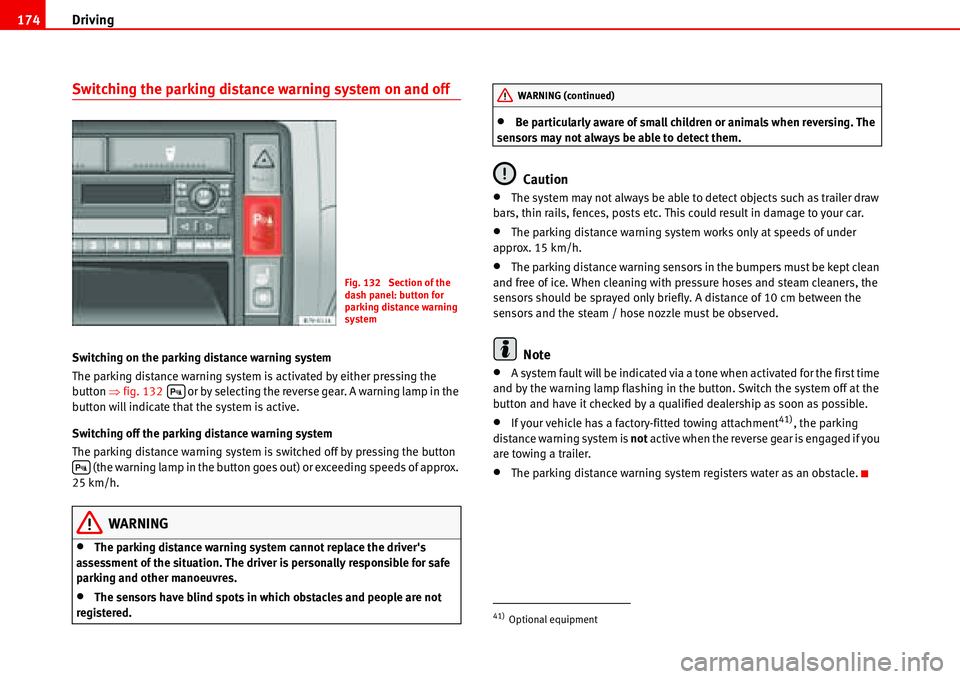
The parking distance warning system is activated by either pressing the
button Ÿfig. 132 or by selecting the reverse gear. A warning lamp in the
button will indicate that the system is active.
Switching off the parking distance warning system
The parking distance warning system is switched off by pressing the button
(the warning lamp in the button goes out) or exceeding speeds of approx.
25 km/h.
WARNING
•The parking distance warning system cannot replace the driver's
assessment of the situation. The driver is personally responsible for safe
parking and other manoeuvres.
•The sensors have blind spots in which obstacles and people are not
registered.
•Be particularly aware of small children or animals when reversing. The
sensors may not always be able to detect them.
Caution
•The system may not always be able to detect objects such as trailer draw
bars, thin rails, fences, posts etc. This could result in damage to your car.
•The parking distance warning system works only at speeds of under
approx. 15 km/h.
•The parking distance warning sensors in the bumpers must be kept clean
and free of ice. When cleaning with pressure hoses and steam cleaners, the
sensors should be sprayed only briefly. A distance of 10 cm between the
sensors and the steam / hose nozzle must be observed.
Note
•A system fault will be indicated via a tone when activated for the first time
and by the warning lamp flashing in the button. Switch the system off at the
button and have it checked by a qualified dealership as soon as possible.
•If your vehicle has a factory-fitted towing attachment41), the parking
distance warning system is not active when the reverse gear is engaged if you
are towing a trailer.
•The parking distance warning system registers water as an obstacle.
Fig. 132 Section of the
dash panel: button for
parking distance warning
system
'
'
41)Optional equipment
WARNING (continued)