maintenance Seat Alhambra 2007 Owner's Manual
[x] Cancel search | Manufacturer: SEAT, Model Year: 2007, Model line: Alhambra, Model: Seat Alhambra 2007Pages: 291, PDF Size: 9.13 MB
Page 201 of 291
Cleaning and caring for your vehicle199
Safety First
Operating instructions
Tips and Maintenance
Te c h n i c a l D a t a
Cleaning the engine compartment
Take special care when cleaning the engine compartment.Anti-corrosion treatment
The engine compartment and the surface of the power unit are given anti-
corrosion treatment at the factory.
Good corrosion protection is particularly important in winter when the car is
frequently driven on salted roads. To prevent the salt corroding the vehicle,
the entire engine compartment should be thoroughly cleaned before and
after the salting period.
Your Authorised Service Centre is able to provide the correct cleaning and
preserving products and has the necessary equipment. For this reason, we
recommend having this work performed by them.
The anti-corrosion protection is usua lly removed if the engine compartment
is cleaned with grease removing solution s, or if you have the engine cleaned.
If this job is carried out, you should ensure that all surfaces, seams, joints and
components in the engine compartmen t are given anti-corrosion treatment
afterwards.
WARNING
•
When working in the engine compartment, always observe the safety
warnings ⇒ page 209
•
Switch off the engine, apply the parking brake firmly and always
remove the key from the ignition before you open the bonnet.
•
Allow the engine to cool before you clean the engine compartment.
•
Do not clean the underside of vehicle, wheel arches without protecting
your hands and arms. You may cut your self on sharp-edged metal parts.
Failure to comply could result in injury.
•
Moisture, ice and salt on the brakes may affect braking efficiency. Risk
of accident. If possible, avoid sudden braking immediately after washing
the vehicle.
•
Never touch the radiator fan. It is temperature-controlled and could
start automatically, even when the key is removed from the ignition!For the sake of the environment
Fuel, grease and oil deposits could be removed when the engine is washed.
The polluted water must be cleaned in an oil separator. For this reason,
engine washing should be carried out only by a qualified workshop or a suit-
able filling station.Care of the vehicle interiorCleaning plastic parts and the dash panel– Use a clean, damp cloth to clean plastic parts and the dash panel.
– If this does not provide satisfactory results, use a special solvent-free plastic cleaning product.
WARNING
Never clean the dash panel and surface of the airbag module with cleansers
containing solvents. Solvents cause the surface to become porous. If the
airbag inflates, disintegrating plastic parts can cause substantial injuries.
WARNING (continued)
alhambra ingles.book Seite 199 Donnerstag, 19. April 2007 4:04 16
Page 203 of 291
Cleaning and caring for your vehicle201
Safety First
Operating instructions
Tips and Maintenance
Te c h n i c a l D a t a
•
To avoid damage, stubborn stains should be removed by a qualified
workshop.
Cleaning seat belts
A dirty belt may stop the seat belt working properly.Keep the seat belts clean and check all seat belts regularly.
Cleaning seat belts
– Carefully pull the dirty seat belt right out and leave it out.
– Clean the dirty seat belts with a gentle soap solution.
– Allow the seat belt fabric to dry.
– Do not roll up the seat belt until it is dry.If large stains form on the belts the belt will not retract correctly into the auto-
matic belt retractor.
WARNING
•
Do not use chemical cleaning agents on the seat belts, as this can
impair the strength of the webbing. Ensure that the belts do not come into
contact with corrosive fluids.
•
Check the condition of all seat belts at regular intervals. If you notice
that the belt webbing, fittings, retractor mechanism or buckle of any of the
belts is damaged, the belt must be replaced by a specialist workshop.
•
Do not attempt to repair a damaged seat belt yourself. The seat belts
must not be removed or modified in any way.
Caution
After cleaning, allow seat belts to dr y completely before rolling them up.
Otherwise the belt retracto rs could become damaged.Cleaning the cool/thermos box –Before using the insulated box for the first time, you should clean
it, using a household detergent.
– Always clean the inside of the insulated box when it is soiled.If you do not plan to use the insulated box for a long period, disconnect the
power supply and clean the inside and outside of the box. Place a folded
towel between the box and its lid. This prevents mould and damp stains
forming in the cooling and heating box.
alhambra ingles.book Seite 201 Donnerstag, 19. April 2007 4:04 16
Page 205 of 291
Accessories, parts replacement and modifications203
Safety First
Operating instructions
Tips and Maintenance
Te c h n i c a l D a t a
WARNING
Incorrectly performed modifications or other work on your vehicle can lead
to malfunctions and cause accidents.Roof aerial*The vehicle may be fitted with a collapsible roof aerial* with antitheft
system*, which can be folded backwards, when, for example, going through
an automatic carwash.
To f o l d
Unscrew the aerial rod, tilting it backwards into a horizontal position and then
screw in again.
To return to working position
Proceed in reverse order.Mobile telephones and two-way radiosYou will require an external aerial for mobile phones and two-
way radios. SEAT has approved your vehicle for use with mobile telephones and two-way
radios providing the following conditions are observed:•
The correct installation of an external aerial,
•
transmitting power of maximum 10 watts.
An external aerial is needed to give the equipment its optimal range. First consult your Authorised Service Centre if you wish to use a mobile tele-
phone or a two-way radio with a transmitting power in excess of 10 watts.
Here you will receive information concerning the technical possibilities for
retrofitting this equipment.
Mobile telephones and two-way radios
should be fitted only by a qualified
workshop, for example an Authorised Service Centre.
WARNING
•
Always concentrate primarily on driving. If you are distracted while
driving you could have an accident.
•
Never attach the telephone mountings to the surfaces covering the
airbag units or within the range of the airbags, danger of injury if the airbag
is triggered.
•
If you use mobile telephones or two-way radios in the vehicle without
an external aerial, electromagnetic ra diation in the vehicle could exceed
authorised limits. This also applies to external aerials that have not been
correctly installed.Caution
Failure to observe the above conditions could cause the electronics to
malfunction. The most common causes of faults are:•
no external aerial,
•
external aerial incorrectly installed,
•
transmitting power in excess of 10 watts.Note
Please observe the operating instructions of your mobile telephone / two-way
radio.
alhambra ingles.book Seite 203 Donnerstag, 19. April 2007 4:04 16
Page 207 of 291
Accessories, parts replacement and modifications205
Safety First
Operating instructions
Tips and Maintenance
Te c h n i c a l D a t a
If a towing bracket is to be retro-fitted to
the car, it must be done according to
the instructions of the towing bracket manufacturer.
The attachment points for the towing bracket ⇒page 204, fig. 137 are
underneath the vehicle.
Always observe the minimum distance from the middle of the ball coupling to
the ground (350 to 420 mm). This also appl ies when the vehicle is fully laden,
including maximum drawbar load.
Fitting a towing bracket
•
Driving with a trailer implies additional work for the vehicle. Therefore,
before fitting a towing bracket, please contact an Authorised Service Centre
to check whether your cooling system needs modification.
•
Observe the legal requirements in your country (e. g. the fitting of a sepa-
rate pilot lamp).
•
Certain vehicle componen ts, e.g. the rear bumper must be removed and
reinstalled. The towing bracket securing bolts have to be tightened using a
torque wrench, and a socket connected to the vehicle's electrical system. This
requires specialist knowledge and tools.
•
The figures in the illustration show the dimensions and attachment points
which must be observed if you are retrofitting a towing bracket.
WARNING
If a towing bracket is retrofitted, it should be done by a qualified dealer.•
If the towing bracket is incorrectly fi tted, this could cause a safety risk.
•
For your own safety, please observe the instructions provided by the
manufacturer of the towing bracket.Caution
If the connector socket is not fitted correctly, this could cause damage to the
vehicle's electrical system.
AA
alhambra ingles.book Seite 205 Donnerstag, 19. April 2007 4:04 16
Page 209 of 291
Checking and refilling levels207
Safety First
Operating instructions
Tips and Maintenance
Te c h n i c a l D a t a
PetrolPetrol types
The correct petrol types are listed on a sticker inside the fuel
tank flap.Only unleaded petrol, corresponding to the standard DIN EN 228 , may be
used for vehicles with catalytic converters (EN = “European Norm”).
Petrol types are categorised according to their octane number, e. g. 91, 95,
98 or 99 octanes You may use petrol with a higher octane number than the
one recommended for your engine. Howe ver this has no advantage in terms
of fuel consumption and engine power.
Caution
If you must drive with fuel of a lower octane rating than recommended then
avoid driving at high engine speeds or putting demand on your engine.
Otherwise engine damage may occur. Fill up with petrol with the correct
octane number as soon as possible.
For the sake of the environment
Just one full tank of leaded fuel would seriously impair the efficiency of the
catalytic converter.Petrol additivesThe quality of the petrol influences running behaviour, performance and
service life of the engine. For this reason you should use good quality petrol
containing additives. These additives will help to prevent corrosion, keep the
fuel system clean and prevent deposits from building up in the engine. If good quality petrol with additives is not available, this may cause engine
problems (e.g. engine does not run
smoothly or problems occur when
starting).
DieselDiesel*Diesel fuel must correspond to DIN EN 590 (EN = “European standard”). It
must have a cetane number (CN) of at least 51. The cetane number indicates
the ignition quality of the diesel fuel.
Notes on filling with fuel ⇒page 206.RME fuel*
Only vehicles fitted with special equipment may drive with
biodiesel fuel in accordance with standard DIN EN 14214.The biodiesel fuel must comply wi th the DIN EN 14.214 (FAME) Standard.•
Biodiesel is a methylester obtained from rapeseed oil.
• DIN is a German abbrev iation for “ Deuts c
hes I
nstitut für N ormung e.V.”,
the German standards institute.
•
EN means European Norm.
•
FAME is the English abbreviation “ Fatty Acid Methyl E ster”
If the date sticker of the vehicle in cludes the number PR 2G0 optional equip-
ment) this means that that vehicle has been prepared for biodiesel use.
alhambra ingles.book Seite 207 Donnerstag, 19. April 2007 4:04 16
Page 210 of 291
Checking and refilling levels
208Your Authorised Service Centre or automobile association will be able to
advise on where you can obtain RME biodiesel fuel.
Your Authorised Service Centre can also be consulted to know if the vehicle
has been prepared for biodiesel use.
Things to note about RME fuel (biodiesel)•
The performance of a vehicle using biodiesel maybe somewhat reduced.
•
Fuel consumption of a vehicle using biodiesel may be slightly higher.
•
RME fuel can be used in winter at temperatures down to approx. -10°C.
•
At outside temperatures below -10°C, we recommend using winter diesel
fuel.
For technical reasons, vehicle fitted with diesel particle filters cannot use
biodiesel under any circumstances.
Your authorized SEAT dealer will confirm whether your vehicle is prepared to
use biodiesel.Caution
•
RME fuel can damage the fuel system in vehicles that are not suitably
adjusted.
•
If you decide to use biodiesel in your vehicle, please use only RME fuel
which is DIN E 14,214 compliant.
•
If you use biodiesel that does not m eet the required standard, the fuel
filter could become clogged.
•
Your authorized SEAT dealer will be able to tell you if your vehicle is suit-
able for use with biodiesel, or whether it requires modifications in order to
use it.
•
Vehicles fitted with a diesel particle filter should not use biodiesel under
any circumstance, or even start the engine, at the risk of damaging the fuel
system.
Note
•
In case of low exterior temperatures and a fuel biodiesel percentage of
higher than 50%, an increase in gas emission may occur during operation of
the independent heating.
•
The fuel filter may become clogged when fuel is changed to biodiesel. For
this reason, we recommend that, about every 300 or 400 km, following a fuel
change, also change the fuel filter. Also. note the instructions in the inspec-
tion and maintenance plan.
•
If the vehicle is to remain parked for more than about two weeks, we
recommend filling the fuel tank with biodiesel and driving about 50 km in
order to avoid damage to the injection system.
Winter driving
Diesel can thicken in winter.Winter-grade diesel
When using “summer-grade diesel fuel”, difficulties may be experienced at
sub-zero temperatures because the fuel thickens due to wax separation. For
this reason, “winter-grade diesel fuel” is available in some countries during
the cold months. It can be used at temperatures as low as -22
°C.
In countries with different climatic conditions the diesel fuel sold generally
has different temperature characteristic s. Check with an Authorised Service
Centre or filling stations in the countr y concerned regarding the type of diesel
fuels available.
Filter pre-heater
Your vehicle is fitted with a fuel filter pre-heater, making it well equipped for
operation in winter. This ensures that the fuel system remains operational to
approx. -24
°C, provided you use winter-grade diesel which is safe to -15
°C.
alhambra ingles.book Seite 208 Donnerstag, 19. April 2007 4:04 16
Page 211 of 291
Checking and refilling levels209
Safety First
Operating instructions
Tips and Maintenance
Te c h n i c a l D a t a
However, if the fuel has waxed to such an extent that the engine will not start
at temperatures of under -24
°C, simply place the vehicle in a warm place for
a while.
Caution
Do not mix fuel additives (“thinners”, or similar additives) with diesel fuel.Supplementary heating systemThe supplementary heating system raises the calorific capacity of the heating
while the engine is running and outside temperatures are very low. The
supplementary heating system connects and disconnects automatically.
The exhaust fumes produced are eliminated through an exhaust pipe below
the vehicle.
Note
•
For short journeys, very low outside temperatures and a percentage of
biodiesel fuel of over 50 % too much smoke may be produced.
•
Every time the engine is switched off, the fan continues to operate for a
short time in order to more quickly cool the heater. When refuelling it is not
necessary to wait until the fan stops operating.
Working in the engine compartmentSafety instructions on working in the engine compartment
Any work carried out in the engine compartment or on the
engine must be carried out cautiously.Before starting any work on the engine or in the engine compart-
ment:
1. Switch off the engine and remove the key from the ignition.
2. Apply the handbrake.
3. Move the gear stick to neutral or the selector lever to position P.
4. Wait for the engine to cool down.
5. Keep children away from the vehicle.
6. Raise the bonnet ⇒page 97.You should not do any work in the engine compartment unless you know
exactly how to carry out the jobs and have the correct tools! Have the work
carried out by a qualified workshop if you are uncertain.
All service fluids and consumables, e.g. coolant, engine oil, spark plugs and
batteries, are being constantly developed. SEAT provides a constant flow of
information to the Authorised Service Centres concerning modifications. For
this reason we recommend that you have service fluids and consumables
replaced by an Authorised Service Centre. Please observe the relevant
instructions ⇒page 202. The engine compartment of any motor vehicle is a
hazardous area ⇒ .
alhambra ingles.book Seite 209 Donnerstag, 19. April 2007 4:04 16
Page 213 of 291
Checking and refilling levels211
Safety First
Operating instructions
Tips and Maintenance
Te c h n i c a l D a t a
For the sake of the environment
Service fluids leaks are harmful to the environment. For this reason you
should make regular checks on the ground underneath your vehicle. If you
find spots of oil or other fluids, have your vehicle inspected in a qualified
workshop.Opening the bonnet
The bonnet is released from inside the vehicle.
Before you open the bonnet, make sure that the windscreen wiper
arms are in contact with the windscreen. Failure to do so could
damage the paintwork.
Opening the bonnet
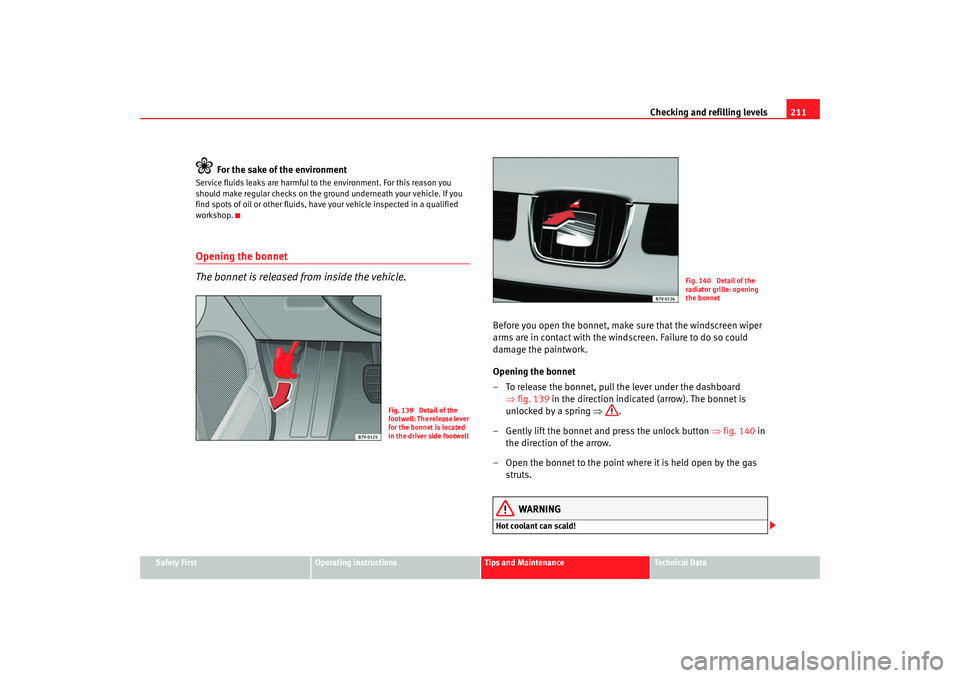
– To release the bonnet, pull the lever under the dashboard ⇒fig. 139 in the direction indicated (arrow). The bonnet is
unlocked by a spring ⇒.
– Gently lift the bonnet and press the unlock button ⇒fig. 140 in
the direction of the arrow.
– Open the bonnet to the point where it is held open by the gas struts.
WARNING
Hot coolant can scald!
Fig. 139 Detail of the
footwell: The release lever
for the bonnet is located
in the driver side footwell
Fig. 140 Detail of the
radiator grille: opening
the bonnet
alhambra ingles.book Seite 211 Donnerstag, 19. April 2007 4:04 16
Page 215 of 291
Checking and refilling levels213
Safety First
Operating instructions
Tips and Maintenance
Te c h n i c a l D a t a
Oil properties
Viscosity
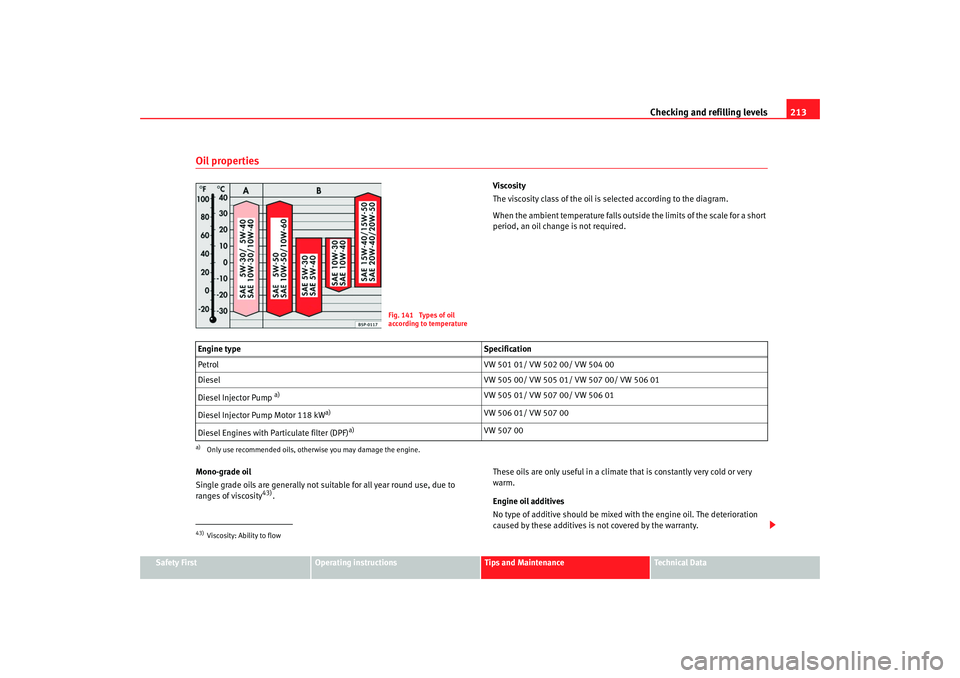
The viscosity class of the oil is selected according to the diagram.
When the ambient temperature falls outside the limits of the scale for a short
period, an oil change is not required.
Mono-grade oil
Single grade oils are generally not suitable for all year round use, due to
ranges of viscosity
43). These oils are only useful in a climate that is constantly very cold or very
warm.
Engine oil additives
No type of additive should be mixed with the engine oil. The deterioration
caused by these additives is not covered by the warranty.
Fig. 141 Types of oil
according to temperature
Engine type
Specification
Petrol VW 501 01/ VW 502 00/ VW 504 00
Diesel VW 505 00/ VW 505 01/ VW 507 00/ VW 506 01
Diesel Injector Pump
a)
a)Only use recommended oils, otherwise you may damage the engine.
VW 505 01/ VW 507 00/ VW 506 01
Diesel Injector Pump Motor 118 kW
a)
VW 506 01/ VW 507 00
Diesel Engines with Particulate filter (DPF)
a)
VW 507 00
43)Viscosity: Ability to flow
alhambra ingles.book Seite 213 Donnerstag, 19. April 2007 4:04 16
Page 217 of 291
Checking and refilling levels215
Safety First
Operating instructions
Tips and Maintenance
Te c h n i c a l D a t a
Topping up engine oil
Top up gradually with small quantities of oil.
Before opening the bonnet, read and observe the warnings ⇒ in
“Safety instructions on working in the engine compartment” on
page 209.
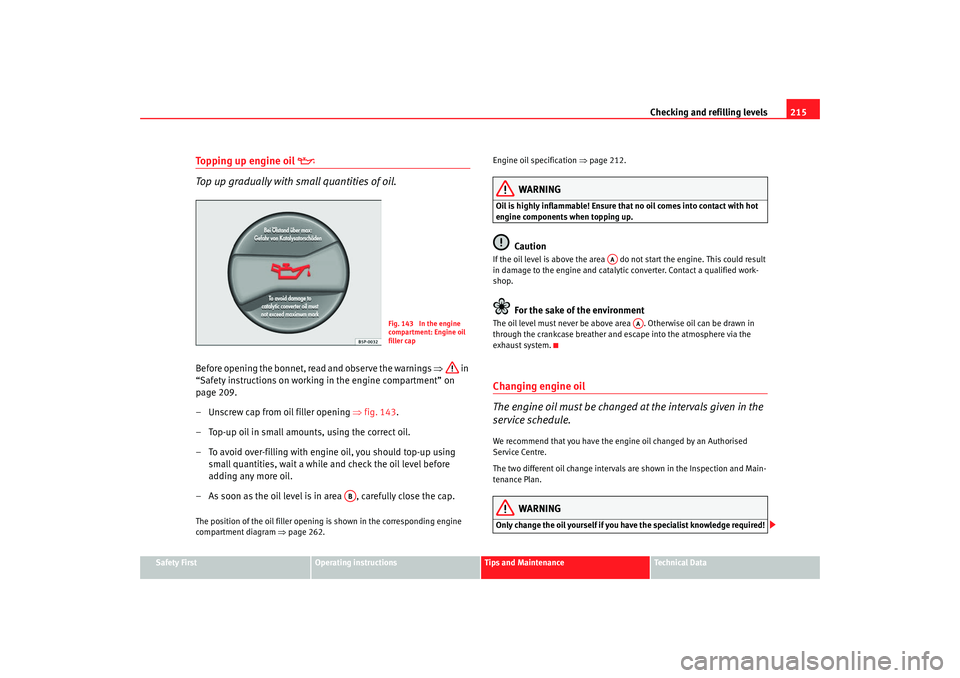
– Unscrew cap from oil filler opening ⇒fig. 143.
– Top-up oil in small amounts, using the correct oil.
– To avoid over-filling with engine oil, you should top-up using small quantities, wait a while and check the oil level before
adding any more oil.
– As soon as the oil level is in area , carefully close the cap.The position of the oil filler opening is shown in the corresponding engine
compartment diagram ⇒page 262. Engine oil specification
⇒page 212.
WARNING
Oil is highly inflammable! Ensure that no oil comes into contact with hot
engine components when topping up.
Caution
If the oil level is above the area do not start the engine. This could result
in damage to the engine and catalytic converter. Contact a qualified work-
shop.
For the sake of the environment
The oil level must never be above area . Otherwise oil can be drawn in
through the crankcase breather and escape into the atmosphere via the
exhaust system.Changing engine oil
The engine oil must be changed at the intervals given in the
service schedule.We recommend that you have the engine oil changed by an Authorised
Service Centre.
The two different oil change intervals are shown in the Inspection and Main-
tenance Plan.
WARNING
Only change the oil yourself if you have the specialist knowledge required!
Fig. 143 In the engine
compartment: Engine oil
filler cap
AB
AA
AA
alhambra ingles.book Seite 215 Donnerstag, 19. April 2007 4:04 16