ESP Seat Alhambra 2007 User Guide
[x] Cancel search | Manufacturer: SEAT, Model Year: 2007, Model line: Alhambra, Model: Seat Alhambra 2007Pages: 291, PDF Size: 9.13 MB
Page 46 of 291
Airbag system
44
– Open centre compartment on instrument panel.
– Using the ignition key, turn the switch to ON ⇒page 43, fig. 28 .
– Check if, when the ignition is switched on, that the warning lamp “PASS AIRBAG OFF” on the instrument panel ⇒page 43, fig. 29
does not light up ⇒.
– Close centre compartment on instrument panel:
WARNING
•
The driver is responsible for the proper position of the key-operated
switch.
•
You should only disable the front and side passenger airbags if, in
exceptional cases, you have to use a rear-facing child seat on the front
passenger seat ⇒ page 45.
•
Never fit a child seat in the passenger seat, where the child faces back-
wards to the direction of travel and th e frontal airbag has not been deacti-
vated. This is highly dangerous for the child. However, if it is necessary in
exceptional circumstances to transport a child in a rear-facing child seat on
the front passenger seat, you must always disable the front passenger
airbag.
•
As soon as the child seat will no longer be used on the front passenger
seat, enable the front and side passenger airbag again.
•
Only deactivate the front and side passenger airbag when the ignition
is off, otherwise a fault may occur in the airbag system, this will create the
risk of the front, curtain or side airbag not deploying properly or not at all
in the event of an accident.
•
If, while the front and side passenger airbag are turned off, the indi-
cator PASS. AIRBAG OFF does not remain lit, this could indicate a fault in
the airbag system: −
Have the airbag system inspected immediately by a qualified work-
shop.
− Do not use a child seat on the front passenger seat! The front and
side passenger airbag may deploy during an accident in spite of the
fault.
− It is impossible to determine whethe r the front or side airbags will be
triggered in case of accident. Inform your passengers of this.
WARNING (continued)
alhambra ingles.book Seite 44 Donnerstag, 19. April 2007 4:04 16
Page 47 of 291
Child safety45
Safety First
Operating instructions
Tips and Maintenance
Te c h n i c a l D a t a
Child safetyBrief introductionIntroduction
Statistics show that children are generally safer on the rear
seat than on the front passenger seat.We recommend that children under 12 years of age be transported on the rear
seats. Children travelling on the rear seat must use a child restraint system or
the seat belts provided, depending on their age, height and weight. For
safety reasons, the child restraint system should be installed in the centre of
the rear seat or behind the front passenger's seat.
The physical principles involved and the forces acting in a collision apply to
children just as much as adults ⇒page 19. But unlike adults, children do not
have fully developed muscle and bone structures. This means that children
are subject to a greater risk of injury.
To reduce this risk, children must always use special child restraint systems
when travelling in the vehicle.
We recommend the use of child safety products from the SEAT Genuine Acces-
sories Program including systems for all ages made by “Peke”
2).
These systems have been especially designed and approved, complying with
the ECE-R44. regulation.
Follow the manufacturer's instructions and observe any statutory require-
ments when installing and using child seats. Always read and observe
⇒ page 45. We recommend that you include the manufacturer's directions for child seat
use in the vehicle wallet and always keep them in the vehicle.
Safety notes on using child seats
Proper use of child seats substantially reduces the risk of
injury in an accident!As the driver, you are responsible for any children you transport in
your vehicle.
– Protect your children by properly using appropriate child seats.
– Always ensure that the belt webbing is properly positioned
according to the instructions provided by the manufacturer of the
child seat.
– When travelling, do not allow children to distract you from traffic.
– Take breaks regularly during long trips. Take a break at least every two hours.We recommend that you include the manufacturer's directions for child seat
use in the vehicle wallet and always keep them in the vehicle.
WARNING
•
Never fit a child seat in the passenger seat, where the child faces back-
wards to the direction of travel and the frontal airbag has not been deacti-
vated. This is highly dangerous for the child. If it is necessary, in excep-
2)Not for all countries
alhambra ingles.book Seite 45 Donnerstag, 19. April 2007 4:04 16
Page 48 of 291
Child safety
46tional circumstances, to transport a child on the front passenger seat,
always disable the front passenger airbag ⇒page 43.•
All passengers, especially children, must assume the proper sitting
position and be properly belted in while travelling.
•
Never hold children or babies on your lap, this can result in potentially
fatal injuries to the child!
•
Never allow a child to be transported in a vehicle without being properly
secured, or to stand up or kneel on a seat while travelling. In an accident,
the child could be flung through the vehicle, causing possibly fatal injuries
to themselves and other occupants.
•
If children assume an improper sitting position when the car is moving,
they expose themselves to greater risk of injury during a sudden braking
manoeuvre or in an accident. This is particularly the case if the child is trav-
elling on the front passenger seat and the airbag system is triggered in an
accident; this could have consequences including serious injury or death.
•
A suitable child seat can protect your child!
•
Make sure that no hard or sharp objects, for example toys, are on the
child seats. Risk of injury.
•
Never leave a child unsupervised in a child seat or alone in the vehicle.
•
Depending on the time of year, the interior of a parked vehicle can reach
extreme temperatures which may enganger the life of people and animals.
•
Children who are less than 1.5 metres tall must not wear a normal seat
belt without a child restraint system, as this could cause injuries to the
abdominal and neck areas during a sudden braking manoeuvre or in an
accident.
•
Do not allow the belt webbing to become twisted or jammed, or to rub
on any sharp edges.
•
Incorrectly worn seat belts can cause injuries even in a minor collision
or sudden braking manoeuvres.
•
The seat belt cannot offer its full prot ection if the belt web is not posi-
tioned correctly.
•
Only one child may occupy a child seat.
WARNING (continued)
WARNING (continued)
alhambra ingles.book Seite 46 Donnerstag, 19. April 2007 4:04 16
Page 63 of 291
Cockpit61
Safety First
Operating instructions
Tips and Maintenance
Te c h n i c a l D a t a
Operating instructionsCockpitOverviewOverview of the instrument panel
This overview will help you to familiarise yourself with the
controls and displays.
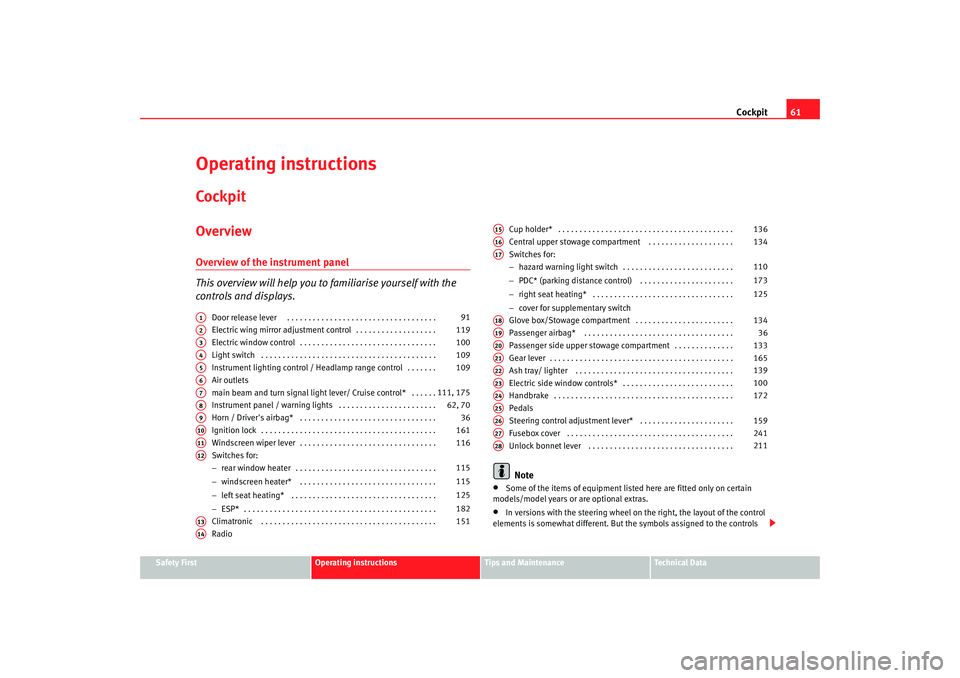
Door release lever . . . . . . . . . . . . . . . . . . . . . . . . . . . . . . . . . . .
Electric wing mirror adjustment control . . . . . . . . . . . . . . . . . . .
Electric window control . . . . . . . . . . . . . . . . . . . . . . . . . . . . . . . .
Light switch . . . . . . . . . . . . . . . . . . . . . . . . . . . . . . . . . . . . . . . . .
Instrument lighting control / Head lamp range control . . . . . . .
Air outlets
main beam and turn signal light lever/ Cruise control* . . . . . .
Instrument panel / warning lights . . . . . . . . . . . . . . . . . . . . . . .
Horn / Driver's airbag* . . . . . . . . . . . . . . . . . . . . . . . . . . . . . . . .
Ignition lock . . . . . . . . . . . . . . . . . . . . . . . . . . . . . . . . . . . . . . . . .
Windscreen wiper lever . . . . . . . . . . . . . . . . . . . . . . . . . . . . . . . .
Switches for:
− rear window heater . . . . . . . . . . . . . . . . . . . . . . . . . . . . . . . . .
− windscreen heater* . . . . . . . . . . . . . . . . . . . . . . . . . . . . . . . .
− left seat heating* . . . . . . . . . . . . . . . . . . . . . . . . . . . . . . . . . .
− ESP* . . . . . . . . . . . . . . . . . . . . . . . . . . . . . . . . . . . . . . . . . . . . .
Climatronic . . . . . . . . . . . . . . . . . . . . . . . . . . . . . . . . . . . . . . . . .
Radio Cup holder* . . . . . . . . . . . . . . . . . . . . . . . . . . . . . . . . . . . . . . . . .
Central upper stowage compartment . . . . . . . . . . . . . . . . . . . .
Switches for:
−
hazard warning light switch . . . . . . . . . . . . . . . . . . . . . . . . . .
− PDC* (parking distance control) . . . . . . . . . . . . . . . . . . . . . .
− right seat heating* . . . . . . . . . . . . . . . . . . . . . . . . . . . . . . . . .
− cover for supplementary switch
Glove box/Stowage compartment . . . . . . . . . . . . . . . . . . . . . . .
Passenger airbag* . . . . . . . . . . . . . . . . . . . . . . . . . . . . . . . . . . .
Passenger side upper stowage compartment . . . . . . . . . . . . . .
Gear lever . . . . . . . . . . . . . . . . . . . . . . . . . . . . . . . . . . . . . . . . . . .
Ash tray/ lighter . . . . . . . . . . . . . . . . . . . . . . . . . . . . . . . . . . . . .
Electric side window controls* . . . . . . . . . . . . . . . . . . . . . . . . . .
Handbrake . . . . . . . . . . . . . . . . . . . . . . . . . . . . . . . . . . . . . . . . . .
Pedals
Steering control adjustment lever* . . . . . . . . . . . . . . . . . . . . . .
Fusebox cover . . . . . . . . . . . . . . . . . . . . . . . . . . . . . . . . . . . . . . .
Unlock bonnet lever . . . . . . . . . . . . . . . . . . . . . . . . . . . . . . . . . .
Note
•
Some of the items of equipment listed here are fitted only on certain
models/model years or are optional extras.
•
In versions with the steering wheel on the right, the layout of the control
elements is somewhat different. But the symbols assigned to the controls
A1
91
A2
119
A3
100
A4
109
A5
109
A6A7
111, 175
A8
62, 70
A9
36
A10
161
A11
116
A12
115
115
125
182
A13
151
A14
A15
136
A16
134
A17
110
173
125
A18
134
A19
36
A20
133
A21
165
A22
139
A23
100
A24
172
A25A26
159
A27
241
A28
211
alhambra ingles.book Seite 61 Donnerstag, 19. April 2007 4:04 16
Page 64 of 291
Cockpit
62correspond to the symbols used in the versions with the steering wheel on
the leftInstrumentsInstrument overview
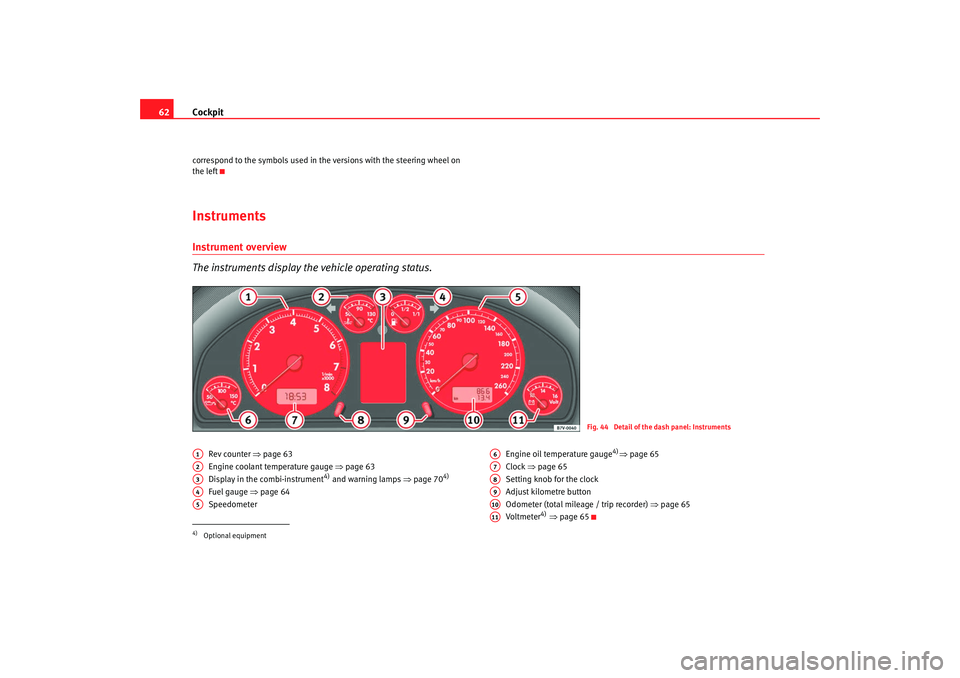
The instruments display the vehicle operating status.
Rev counter ⇒ page 63
Engine coolant temperature gauge ⇒page 63
Display in the combi-instrument
4) and warning lamps ⇒page 70
4)
Fuel gauge ⇒ page 64
Speedometer Engine oil temperature gauge
4)⇒
page 65
Clock ⇒page 65
Setting knob for the clock
Adjust kilometre button
Odometer (total mileage / trip recorder) ⇒page 65
Voltmeter
4) ⇒ page 65
Fig. 44 Detail of the dash panel: Instruments
4)Optional equipmentA1A2A3A4A5
A6A7A8A9A10A11
alhambra ingles.book Seite 62 Donnerstag, 19. April 2007 4:04 16
Page 65 of 291
Cockpit63
Safety First
Operating instructions
Tips and Maintenance
Te c h n i c a l D a t a
Rev counter
The rev. counter displays the engine speed in revolutions per
minute.If, for example, the needle is directly over the 2, this corresponds to an engine
speed of 2000 rpm (revolutions per minute) ⇒page 62, fig. 44 .
The start of the red zone on the dial indicates the maximum engine speed
which may be used briefly when the engi ne is warm and after it has been run
in properly. However, it is advisable to change up a gear or move the selector
lever to D (or lift your foot off the accelerator) before the needle reaches the
red zone.
Caution
The rev counter needle must never enter the red zone on the scale. Risk of
engine damage.
For the sake of the environment
Changing up a gear early will help you to save fuel and minimise engine
noise.
Engine coolant temperature display
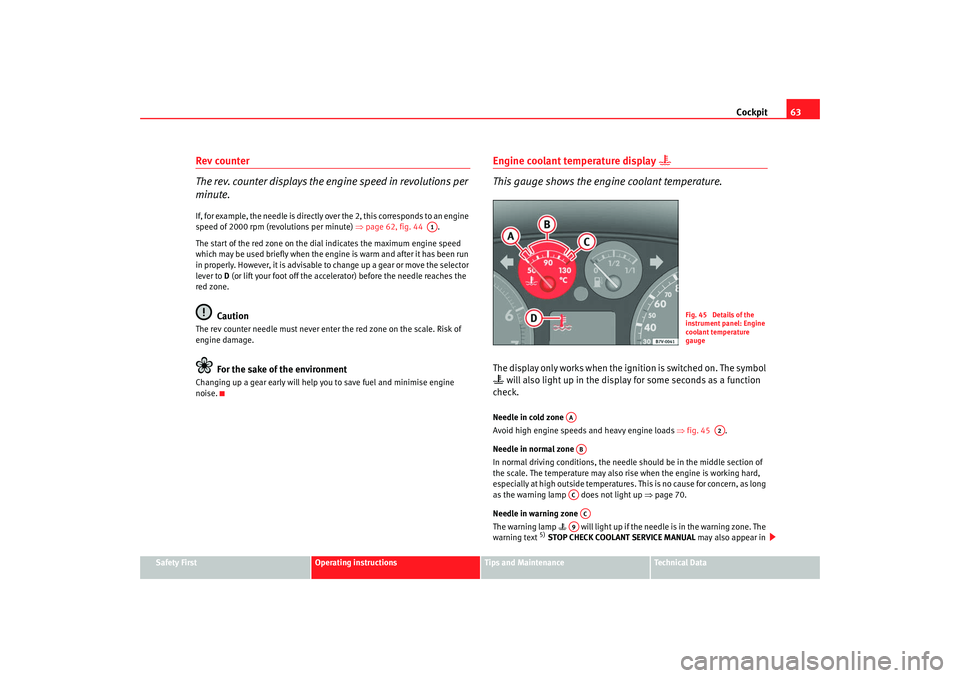
This gauge shows the engine coolant temperature.The display only works when the igni tion is switched on. The symbol will also light up in the display for some seconds as a function
check.Needle in cold zone
Avoid high engine speeds and heavy engine loads ⇒fig. 45 .
Needle in normal zone
In normal driving conditions, the needle should be in the middle section of
the scale. The temperature may also rise when the engine is working hard,
especially at high outside temperatures. This is no cause for concern, as long
as the warning lamp does not light up ⇒page 70.
Needle in warning zone
The warning lamp will light up if the needle is in the warning zone. The
warning text
5) STOP CHECK COOLANT SERVICE MANUAL may also appear in
A1
Fig. 45 Details of the
instrument panel: Engine
coolant temperature
gauge
AA
A2
ABACAC
A9
alhambra ingles.book Seite 63 Donnerstag, 19. April 2007 4:04 16
Page 71 of 291
Cockpit69
Safety First
Operating instructions
Tips and Maintenance
Te c h n i c a l D a t a
Fault message prioritiesPriority 1 fault messages (red)
If one of these faults occurs, the warning lamp will flash or light up and will
be accompanied by three audible warnings ⇒ . This is a danger warning.
Stop the car and switch off the engine. Check the fault and correct it. Obtain
professional assistance if necessary.
If several priority 1 faults are detected at the same time, the symbols will be
displayed one after the other for about 2 seconds at a time. The symbols will
keep flashing until the faults have been rectified.
No menus will be shown in the display for the duration of a priority 1 warning
report.
Priority 2 fault messages (yellow):
If one of these faults occurs, the warning lamp lights up, and is accompanied
by one audible warning . The function should be checked as soon as possible.
If several priority 2 warning reports are detected at the same time, the
symbols are displayed one after the other for about 2 seconds at a time.
Priority 2 warning reports will not be shown until all Priority 1 warning
reports have been dealt with!
WARNING
Failure to observe fault texts and warning lamps can result in serious
personal injury or damage to your vehicle.
alhambra ingles.book Seite 69 Donnerstag, 19. April 2007 4:04 16
Page 73 of 291
Cockpit71
Safety First
Operating instructions
Tips and Maintenance
Te c h n i c a l D a t a
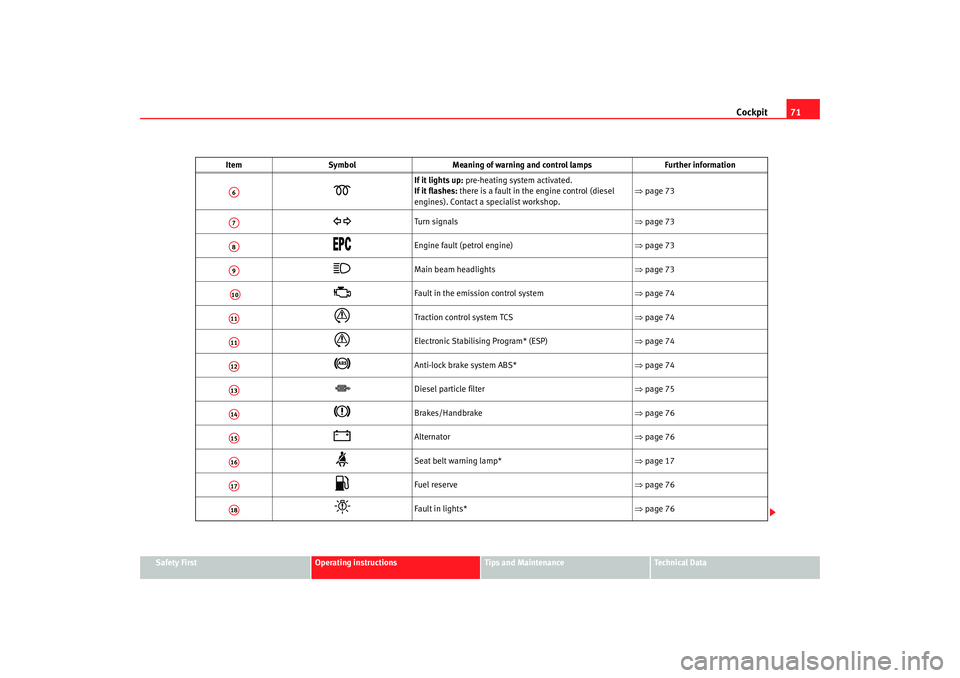
If it lights up: pre-heating system activated.
If it flashes: there is a fault in the engine control (diesel
engines). Contact a specialist workshop. ⇒
page 73
Turn signals ⇒page 73
Engine fault (petrol engine) ⇒page 73
Main beam headlights ⇒page 73
Fault in the emission control system ⇒page 74
Traction control system TCS ⇒page 74
Electronic Stabilising Program* (ESP) ⇒page 74
Anti-lock brake system ABS*
⇒page 74
Diesel particle filter ⇒page 75
Brakes/Handbrake ⇒page 76
Alternator ⇒page 76
Seat belt warning lamp* ⇒page 17
Fuel reserve ⇒page 76
Fault in lights* ⇒page 76
Item
Symbol Meaning of warning and control lamps Further information
A6A7A8A9A10A11A11A12A13A14A15A16A17A18
alhambra ingles.book Seite 71 Donnerstag, 19. April 2007 4:04 16
Page 76 of 291
Cockpit
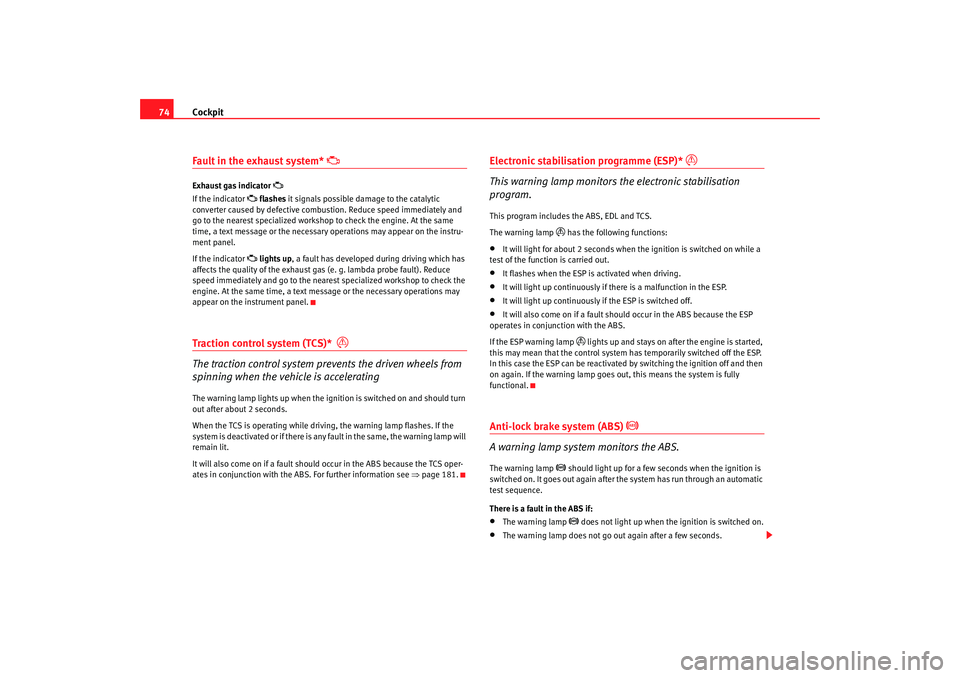
74Fault in the exhaust system*
Exhaust gas indicator
If the indicator
flashes it signals possible damage to the catalytic
converter caused by defective combustion. Reduce speed immediately and
go to the nearest specialized workshop to check the engine. At the same
time, a text message or the necessary operations may appear on the instru-
ment panel.
If the indicator lights up, a fault has developed during driving which has
affects the quality of the exhaust gas (e. g. lambda probe fault). Reduce
speed immediately and go to the nearest specialized workshop to check the
engine. At the same time , a text message or the necessary operations may
appear on the in strument panel.
Traction control system (TCS)*
The traction control system prevents the driven wheels from
spinning when the vehicle is acceleratingThe warning lamp lights up when the ignition is switched on and should turn
out after about 2 seconds.
When the TCS is operating while drivi ng, the warning lamp flashes. If the
system is deactivated or if there is any fault in the same, the warning lamp will
remain lit.
It will also come on if a fault should occur in the ABS because the TCS oper-
ates in conjunction with the ABS. For further information see ⇒page 181.
Electronic stabilisation programme (ESP)*
This warning lamp monitors the electronic stabilisation
program.
This program includes the ABS, EDL and TCS.
The warning lamp
has the following functions:
•
It will light for about 2 seconds when the ignition is switched on while a
test of the function is carried out.
•
It flashes when the ESP is activated when driving.
•
It will light up continuously if there is a malfunction in the ESP.
•
It will light up continuously if the ESP is switched off.
•
It will also come on if a fault should occur in the ABS because the ESP
operates in conjunction with the ABS.
If the ESP warning lamp
lights up and stays on af ter the engine is started,
this may mean that the control system has temporarily switched off the ESP.
In this case the ESP can be reactivated by switching the ignition off and then
on again. If the warning lamp goes out, this means the system is fully
functional.
Anti-lock brake system (ABS)
A warning lamp system monitors the ABS.
The warning lamp
should light up for a few seconds when the ignition is
switched on. It goes out again after the system has run through an automatic
test sequence.
There is a fault in the ABS if:
•
The warning lamp
does not light up when the ignition is switched on.
•
The warning lamp does not go out again after a few seconds.
alhambra ingles.book Seite 74 Donnerstag, 19. April 2007 4:04 16
Page 77 of 291
Cockpit75
Safety First
Operating instructions
Tips and Maintenance
Te c h n i c a l D a t a
•
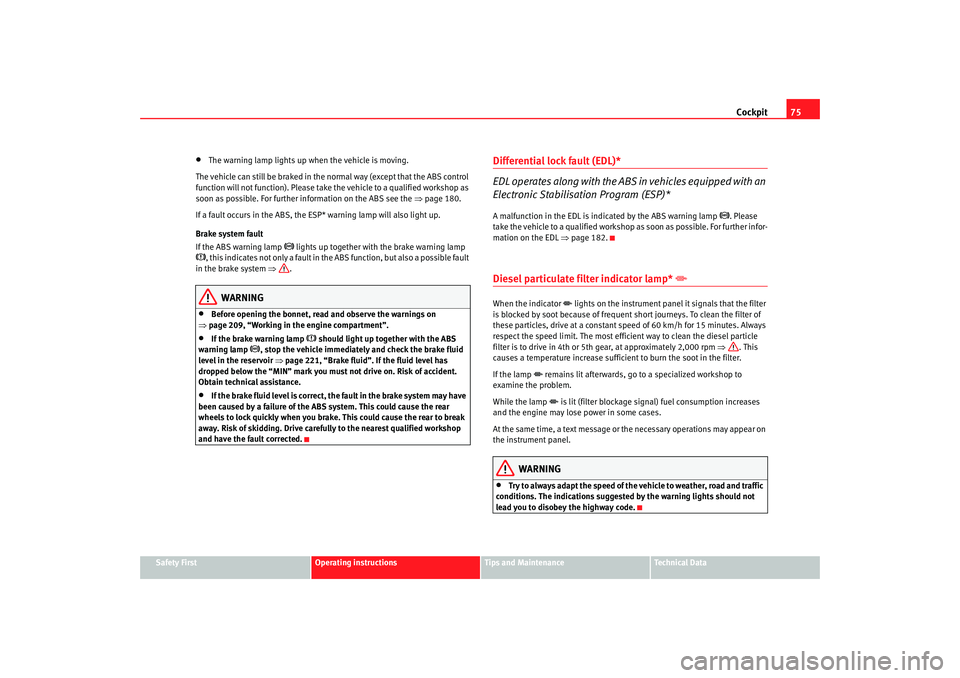
The warning lamp lights up when the vehicle is moving.
The vehicle can still be braked in the normal way (except that the ABS control
function will not function). Please take the vehicle to a qualified workshop as
soon as possible. For further information on the ABS see the ⇒page 180.
If a fault occurs in the ABS, the ESP* warning lamp will also light up.
Brake system fault
If the ABS warning lamp
lights up together with the brake warning lamp
, this indicates not only a fault in the ABS function, but also a possible fault
in the brake system ⇒.
WARNING
•
Before opening the bonnet, read and observe the warnings on
⇒ page 209, “Working in the engine compartment”.
•
If the brake warning lamp
should light up together with the ABS
warning lamp
, stop the vehicle immediately and check the brake fluid
level in the reservoir ⇒page 221, “Brake fluid”. If the fluid level has
dropped below the “MIN” mark you must not drive on. Risk of accident.
Obtain technical assistance.
•
If the brake fluid level is correct, the fault in the brake system may have
been caused by a failure of the ABS system. This could cause the rear
wheels to lock quickly when you brake. This could cause the rear to break
away. Risk of skidding. Drive careful ly to the nearest qualified workshop
and have the fault corrected.
Differential lock fault (EDL)*
EDL operates along with the ABS in vehicles equipped with an
Electronic Stabilisation Program (ESP)*A malfunction in the EDL is indicated by the ABS warning lamp
. Please
take the vehicle to a qualified workshop as soon as possible. For further infor-
mation on the EDL ⇒page 182.
Diesel particulate filter indicator lamp*
When the indicator
lights on the instrument panel it signals that the filter
is blocked by soot because of frequent short journeys. To clean the filter of
these particles, drive at a constant speed of 60 km/h for 15 minutes. Always
respect the speed limit. The most efficient way to clean the diesel particle
filter is to drive in 4th or 5th gear, at approximately 2,000 rpm ⇒. This
causes a temperature increase sufficient to burn the soot in the filter.
If the lamp
remains lit afterwards, go to a specialized workshop to
examine the problem.
While the lamp is lit (filter blockage signal) fuel consumption increases
and the engine may lose power in some cases.
At the same time, a text message or the necessary operations may appear on
the instrument panel.
WARNING
•
Try to always adapt the speed of the vehicle to weather, road and traffic
conditions. The indications suggested by the warning lights should not
lead you to disobey the highway code.
alhambra ingles.book Seite 75 Donnerstag, 19. April 2007 4:04 16