ESP Seat Alhambra 2007 Workshop Manual
[x] Cancel search | Manufacturer: SEAT, Model Year: 2007, Model line: Alhambra, Model: Seat Alhambra 2007Pages: 291, PDF Size: 9.13 MB
Page 197 of 291
Cleaning and caring for your vehicle195
Safety First
Operating instructions
Tips and Maintenance
Te c h n i c a l D a t a
For the sake of the environment
In the interests of environmental protection, the car should be washed only
in specially provided wash bays. This prevents toxic, oil-laden waste water
entering the sewerage system. In some districts, washing vehicles anywhere
else may be prohibited.
Note
Do not wash the vehicle in direct sunlight.Washing the car with a high pressure cleaner
Be particularly careful when using a high pressure cleaner!– Always observe the instructions for the high-pressure cleaner,
particularly those concerning the pressure and the spraying
distance .
– Increase the spraying distance for soft materials and painted bumpers.
– Do not use a high pressure cleaner to remove ice or snow from windows ⇒page 196.
– Never use concentrated jet nozzl es or so-called “dirt blasters”
⇒ .
– If possible, avoid sudden braking directly after washing the vehicle. “Dry” the brakes by braking several times.
WARNING
•
Never wash tyres with a concentrated jet or cylindrical jet (“rotating
nozzle”). Even at large spraying distances and short cleaning times, visible
and invisible damage can occur to the tyres. This may cause an accident.
•
Moisture, ice and salt on the brakes may affect braking efficiency. Risk
of accident.Caution
•
Do not use water hotter than 60
°C. This could damage the car.
•
To avoid damage to the vehicle, maintain a sufficient distance from sensi-
tive materials for example: flexible hoses, plastic, sound proofing, etc. This is
especially important for bumpers painte d in the same colour as the vehicle.
The closer the nozzle is to the surface, the greater the wear on the material.
Waxing the car
Regular waxing protects the paintwork.You need to apply wax to your car if water does not form small drops and run
off the paintwork when it is clean.
Good quality hard wax is available from your Authorised Service Centre.
A good coat of wax helps to protects the paintwork from environmental
contaminants ⇒page 193. It is also effective in protecting against minor
scratches.
Even if a wax solution is used regularly in the car wash, it is advisable to
protect the paint with a coat of hard wax at least twice a year.
alhambra ingles.book Seite 195 Donnerstag, 19. April 2007 4:04 16
Page 202 of 291
Cleaning and caring for your vehicle
200
CautionCleaning products which contain solvents will damage the material.Cleaning wooden trim*– Clean the wooden trim with a clean cloth moistened with water.
– If this does not provide satisfactory results, use a gentle soap
solution.
CautionCleaning products which contain solvents will damage the material.Cleaning cloth seat covers and fabric trimCloth seat covers and fabric trim on the doors, headlining etc. can be cleaned
with a special interior cleanser or with dry foam and a soft brush.Cleaning leather*Normal cleaning
– Moisten a cotton or woollen cloth with water and wipe over the leather surfaces. Cleaning stubborn stains
– More stubborn dirt can be removed using a mild soap solution
(pure liquid soap; two tablespoons diluted in one litre of water)
and a cloth.
– Do not let the water soak through the leather or soak into the seams.
– Then wipe off with a soft, dry cloth.
Leather care
– The leather should be treated regularly (about twice a year) with a special leather-care product, which is available from your
Authorised Service Centre.
– Apply these products very sparingly.
– Then wipe off with a soft, dry cloth.
SEAT does everything possible to preserve the special qualities of leather, as
a natural product. Because of the natural properties of the specially selected
hides employed, the finished leather has a certain sensitivity to grease and
dirt, etc. so a degree of care is required in everyday use and when looking
after the leather.
Dust and grit in the pores and seams can scratch and damage the surface. If
the vehicle is left standing in the sun for long periods, the leather should be
protected against direct sunlight to prevent it from fading. However, slight
colour variations in high-quality natural leather are normal.
Caution
•
Do not use solvents, wax polish, shoe cream, spot removers or similar
products on leather.
alhambra ingles.book Seite 200 Donnerstag, 19. April 2007 4:04 16
Page 204 of 291
Accessories, parts replacement and modifications
202Accessories, parts replacement and modificationsAccessories and partsAlways consult an Authorised Service Centre before
purchasing accessories and parts.Your vehicle is designed to offer a high standard of active and passive safety.
Before purchasing accessories and parts, and before making technical
changes to your car, we recommend that you consult your Authorised Service
Centre.
SEAT dealerships will be happy to provide you with the latest information
about the use, legal requirements and recommendations from the manufac-
turer regarding accessories and parts.
We recommend you use only SEAT Approved Accessories
® and SEAT
Approved Spare Parts
®. This way, SEAT can guarantee that the product in
question is suitable, reliable and safe. Authorised Service Centres have the
necessary experience and facilities to ensure that parts are installed correctly
and professionally.
Despite continuous observation of the market, SEAT is not able to assess the
reliability, safety and suitability of parts not approved by SEAT. For this reason
SEAT cannot assume responsibility for any non-genuine parts used, even if
these parts have been approved by an official testing agency or are covered
by an official approval certificate.
Any equipment subsequently installed which has a direct effect on the
vehicle and/or the way it is driven (e.g. cruise control system or electronically-
controlled suspension) must be approved by SEAT for use in your vehicle and
bear the e mark (the European Union's authorisation symbol).
If any additional electrical components are fitted which do not serve to
control the vehicle itself (for instance a refrigerator box, laptop or ventilator fan, etc.), these must bear the
CE mark (European Union manufacturer
conformity declaration).
WARNING
Accessories, for example telephone holders or drink holders, should never
be fitted on the covers of, or within the working range of, the airbags. If
they are, there is a danger of resulting injury if the airbag is triggered in an
accident.ModificationsModifications must always be carried out according to our
specifications.Unauthorised modifications to the electr onic components or software in the
vehicle may cause malfunctions. Due to the way the electronic components
are linked together in networks, other systems may be affected by the faults.
This can seriously impair safety, lead to excessive wear of components, and
also invalidate your vehic le registration documents.
SEAT Authorised Service Centres cannot be held liable for any damage
caused by modifications and/or work performed incorrectly.
For this reason, we reco mmend that all work should be performed by an
Authorised Service Centre using Genuine SEAT
® approved parts and accesso-
ries.
alhambra ingles.book Seite 202 Donnerstag, 19. April 2007 4:04 16
Page 208 of 291
Checking and refilling levels
206Checking and refilling levelsRefillingThe tank filler neck is located at the rear right-hand side of the vehicle.
The tank flap is locked and unlocked automatically by the central locking
system.
The fuel tank holds about 70 litres.
The tank cap can, once unscrewed, be hung on the tank flap ⇒fig. 138 .
After filling up, screw the tank cap back in firmly and close the tank flap until
it engages.
WARNING
All legal stipulations must be observed when transporting a reserve
supply. For safety reasons, we do not recommend carrying a spare fuel
canister in the vehicle. The canister could be damaged in an accident and
leak.
Caution
•
Never run the fuel tank empty on vehicles equipped with a catalytic
converter. An irregular fuel supply could cause misfiring. In this way the fuel
can arrive without burning the exhaust system, which could cause the cata-
lyser to overheat resulting in damage.
•
Spilt fuel should be removed from the vehicle paint finish as quickly as
possible as the paint could otherwise be damaged. Especially if biodiesel
fuel is being used ⇒page 207.For the sake of the environment
If the automatic filler nozzle is operated correctly, it will switch itself off as
soon as the tank is “full”. Never attempt to fill beyond this point, as this will
fill the expansion chamber. Fuel may leak out if ambient conditions are
warm.
Fig. 138 Tank filler neck
and tank flap
alhambra ingles.book Seite 206 Donnerstag, 19. April 2007 4:04 16
Page 209 of 291
Checking and refilling levels207
Safety First
Operating instructions
Tips and Maintenance
Te c h n i c a l D a t a
PetrolPetrol types
The correct petrol types are listed on a sticker inside the fuel
tank flap.Only unleaded petrol, corresponding to the standard DIN EN 228 , may be
used for vehicles with catalytic converters (EN = “European Norm”).
Petrol types are categorised according to their octane number, e. g. 91, 95,
98 or 99 octanes You may use petrol with a higher octane number than the
one recommended for your engine. Howe ver this has no advantage in terms
of fuel consumption and engine power.
Caution
If you must drive with fuel of a lower octane rating than recommended then
avoid driving at high engine speeds or putting demand on your engine.
Otherwise engine damage may occur. Fill up with petrol with the correct
octane number as soon as possible.
For the sake of the environment
Just one full tank of leaded fuel would seriously impair the efficiency of the
catalytic converter.Petrol additivesThe quality of the petrol influences running behaviour, performance and
service life of the engine. For this reason you should use good quality petrol
containing additives. These additives will help to prevent corrosion, keep the
fuel system clean and prevent deposits from building up in the engine. If good quality petrol with additives is not available, this may cause engine
problems (e.g. engine does not run
smoothly or problems occur when
starting).
DieselDiesel*Diesel fuel must correspond to DIN EN 590 (EN = “European standard”). It
must have a cetane number (CN) of at least 51. The cetane number indicates
the ignition quality of the diesel fuel.
Notes on filling with fuel ⇒page 206.RME fuel*
Only vehicles fitted with special equipment may drive with
biodiesel fuel in accordance with standard DIN EN 14214.The biodiesel fuel must comply wi th the DIN EN 14.214 (FAME) Standard.•
Biodiesel is a methylester obtained from rapeseed oil.
• DIN is a German abbrev iation for “ Deuts c
hes I
nstitut für N ormung e.V.”,
the German standards institute.
•
EN means European Norm.
•
FAME is the English abbreviation “ Fatty Acid Methyl E ster”
If the date sticker of the vehicle in cludes the number PR 2G0 optional equip-
ment) this means that that vehicle has been prepared for biodiesel use.
alhambra ingles.book Seite 207 Donnerstag, 19. April 2007 4:04 16
Page 216 of 291
Checking and refilling levels
214
NoteBefore a long trip, we recommend findin g an engine oil that conforms to the
corresponding VW specifications and keeping it in the vehicle. This way, the
correct engine oil will always be available for a top-up if needed.Checking the engine oil level
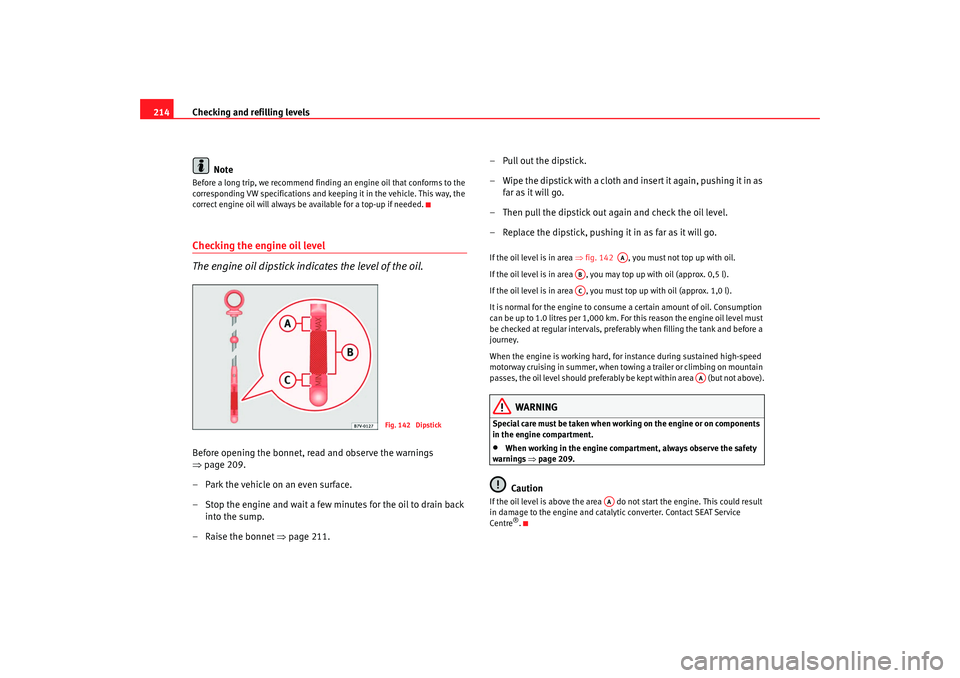
The engine oil dipstick indicates the level of the oil.Before opening the bonnet, read and observe the warnings
⇒ page 209.
– Park the vehicle on an even surface.
– Stop the engine and wait a few minutes for the oil to drain back into the sump.
– Raise the bonnet ⇒page 211. – Pull out the dipstick.
– Wipe the dipstick with a cloth and insert it again, pushing it in as
far as it will go.
– Then pull the dipstick out again and check the oil level.
– Replace the dipstick, pushing it in as far as it will go.
If the oil level is in area ⇒fig. 142 , you must not top up with oil.
If the oil level is in area , you may top up with oil (approx. 0,5 l).
If the oil level is in area , you mu st top up with oil (approx. 1,0 l).
It is normal for the engine to consum e a certain amount of oil. Consumption
can be up to 1.0 litres per 1,000 km. For this reason the engine oil level must
be checked at regular intervals, preferably when filling the tank and before a
journey.
When the engine is working hard, for instance during sustained high-speed
motorway cruising in summer, when towing a trailer or climbing on mountain
passes, the oil level should preferably be kept within area (but not above).
WARNING
Special care must be taken when working on the engine or on components
in the engine compartment.•
When working in the engine compartment, always observe the safety
warnings ⇒page 209.Caution
If the oil level is above the area do not start the engine. This could result
in damage to the engine and catalytic converter. Contact SEAT Service
Centre
®.
Fig. 142 Dipstick
AA
ABAC
AA
AA
alhambra ingles.book Seite 214 Donnerstag, 19. April 2007 4:04 16
Page 217 of 291
Checking and refilling levels215
Safety First
Operating instructions
Tips and Maintenance
Te c h n i c a l D a t a
Topping up engine oil
Top up gradually with small quantities of oil.
Before opening the bonnet, read and observe the warnings ⇒ in
“Safety instructions on working in the engine compartment” on
page 209.
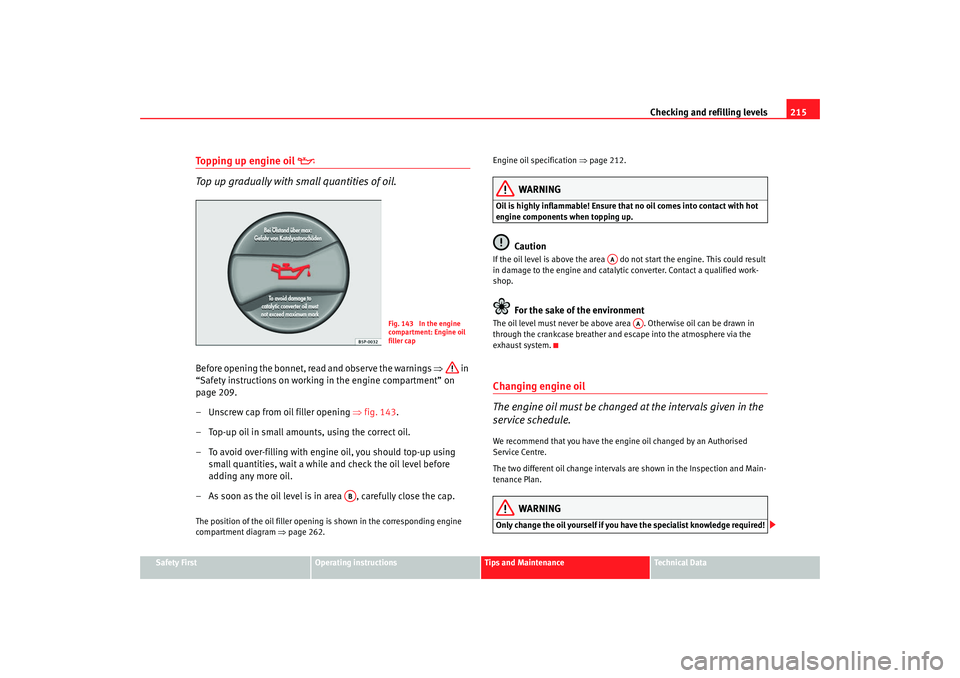
– Unscrew cap from oil filler opening ⇒fig. 143.
– Top-up oil in small amounts, using the correct oil.
– To avoid over-filling with engine oil, you should top-up using small quantities, wait a while and check the oil level before
adding any more oil.
– As soon as the oil level is in area , carefully close the cap.The position of the oil filler opening is shown in the corresponding engine
compartment diagram ⇒page 262. Engine oil specification
⇒page 212.
WARNING
Oil is highly inflammable! Ensure that no oil comes into contact with hot
engine components when topping up.
Caution
If the oil level is above the area do not start the engine. This could result
in damage to the engine and catalytic converter. Contact a qualified work-
shop.
For the sake of the environment
The oil level must never be above area . Otherwise oil can be drawn in
through the crankcase breather and escape into the atmosphere via the
exhaust system.Changing engine oil
The engine oil must be changed at the intervals given in the
service schedule.We recommend that you have the engine oil changed by an Authorised
Service Centre.
The two different oil change intervals are shown in the Inspection and Main-
tenance Plan.
WARNING
Only change the oil yourself if you have the specialist knowledge required!
Fig. 143 In the engine
compartment: Engine oil
filler cap
AB
AA
AA
alhambra ingles.book Seite 215 Donnerstag, 19. April 2007 4:04 16
Page 219 of 291
Checking and refilling levels217
Safety First
Operating instructions
Tips and Maintenance
Te c h n i c a l D a t a
Caution
•
Other additives may give considerably inferior corrosion protection. The
resulting corrosion in the cooling system can lead to a loss of coolant,
causing serious damage to the engine.
•
The coolant additive G 12+ (purple) can be mixed with the additive G 12
(red) or G 11. Never mix G12 (red colour) with G 11.
Checking the coolant level and topping up
The correct coolant level is important for fault-free func-
tioning of the engine cooling system.Before opening the bonnet, read and observe the warnings ⇒ in
“Safety instructions on working in the engine compartment” on
page 209. Opening the coolant expansion tank
– Switch off the engine and allow it to cool.
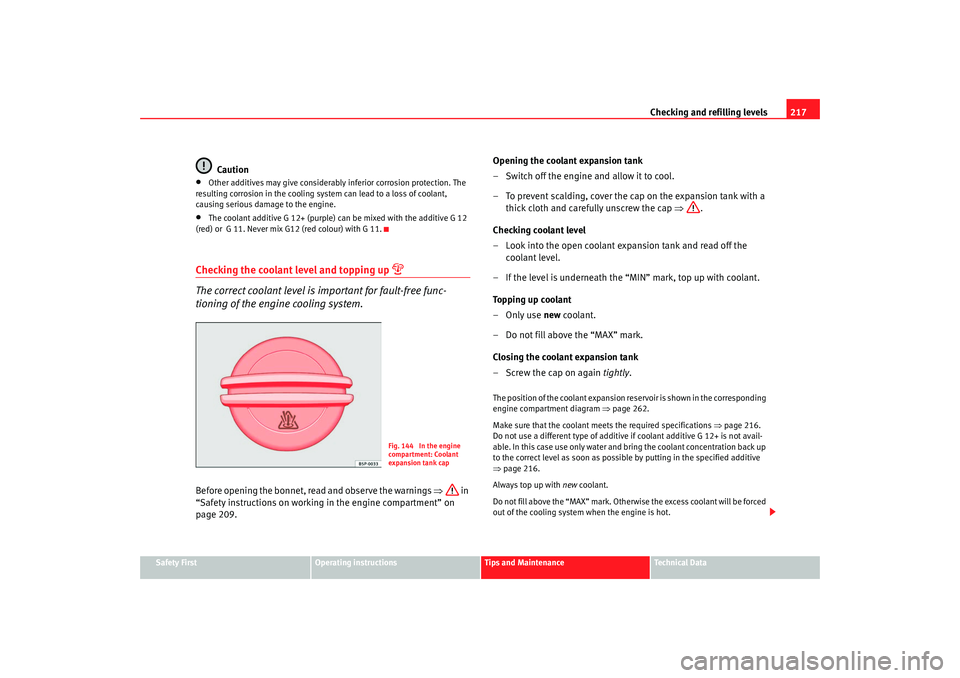
– To prevent scalding, cover the cap on the expansion tank with a
thick cloth and carefully unscrew the cap ⇒.
Checking coolant level
– Look into the open coolant expansion tank and read off the coolant level.
– If the level is underneath the “MIN” mark, top up with coolant.
Topping up coolant
–Only use new coolant.
– Do not fill above the “MAX” mark.
Closing the coolant expansion tank
–Screw the cap on again tightly.
The position of the coolant expansion reservoir is shown in the corresponding
engine compartment diagram ⇒page 262.
Make sure that the coolant meets the required specifications ⇒ page 216.
Do not use a different type of additive if coolant additive G 12+ is not avail-
able. In this case use only water and bring the coolant concentration back up
to the correct level as soon as possible by putting in the specified additive
⇒ page 216.
Always top up with new coolant.
Do not fill above the “MAX” mark. Otherwise the excess coolant will be forced
out of the cooling system when the engine is hot.
Fig. 144 In the engine
compartment: Coolant
expansion tank cap
alhambra ingles.book Seite 217 Donnerstag, 19. April 2007 4:04 16
Page 223 of 291
Checking and refilling levels221
Safety First
Operating instructions
Tips and Maintenance
Te c h n i c a l D a t a
– Insert a new wiper blade of the same length and design in the
direction of arrow and hook the blade back onto the wiper
arm.
– Now pull the wiper blade against the direction of arrow until it engages.
– Push the wiper arm back against the glass.These are available from SEAT Service
®.
If the wiper scrapes , it should be replaced if damaged, or cleaned if soiled.
If this does not produce the desired results, the setting angle of the wind-
screen wiper arms might be incorrect. They should be checked by a qualified
workshop and corrected if necessary.
WARNING
Do not drive unless you have good visibility through all windows!•
Clean the windscreen wiper blades and all windows regularly.
•
The wiper blades should be changed once or twice a year.Caution
•
Damaged or dirty windscreen wipers could scratch the windscreen.
•
Never use fuel, nail varnish remover, paint thinner or similar products to
clean the windows. This could damage the windscreen wiper blades.
•
Never move the windscreen wiper or windscreen wiper arm manually - this
could cause damage!Note
•
The wiper arms can be moved to the service position only when the
bonnet is properly closed.
Brake fluidChecking the brake fluid level
The brake fluid is checked at the intervals given in the service
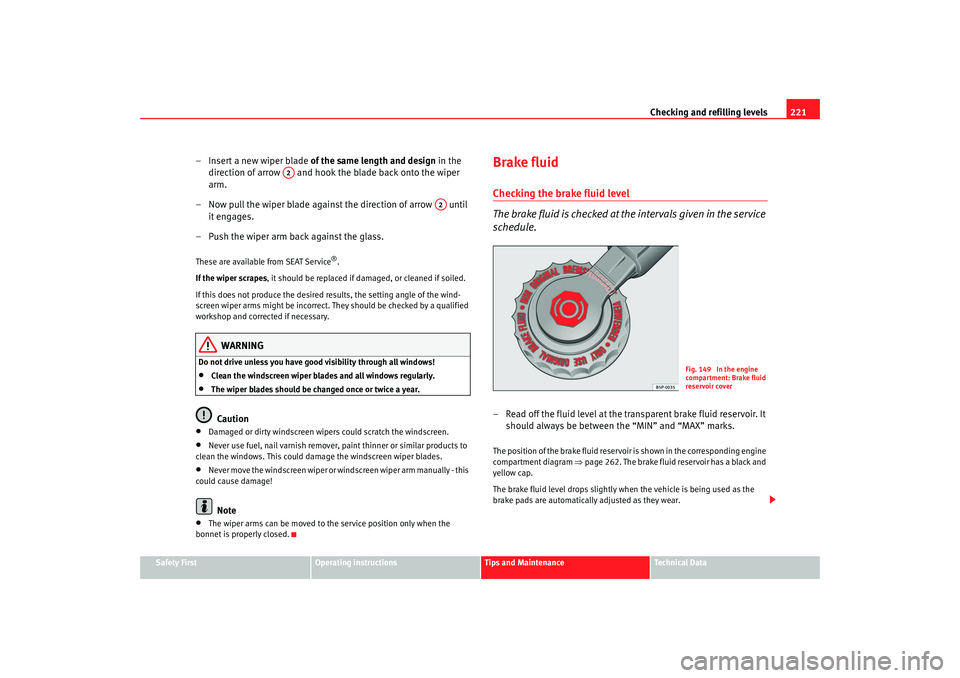
schedule.– Read off the fluid level at the transparent brake fluid reservoir. It should always be between the “MIN” and “MAX” marks.The position of the brake fluid reservoir is shown in the corresponding engine
compartment diagram ⇒page 262. The brake fluid reservoir has a black and
yellow cap.
The brake fluid level drops slightly when the vehicle is being used as the
brake pads are automatically adjusted as they wear.
A2
A2
Fig. 149 In the engine
compartment: Brake fluid
reservoir cover
alhambra ingles.book Seite 221 Donnerstag, 19. April 2007 4:04 16
Page 226 of 291
Checking and refilling levels
224•
If the vehicle is left standing in cold conditions for a long period, protect
the battery from frost. If it “freezes” it will be damaged.
Checking the electrolyte level
The electrolyte level should be checked regularly in high-
mileage vehicles, in hot countries and in older batteries.– Open the bonnet and open the battery cover at the front ⇒ in
“Safety instructions on working in the engine compartment” on
page 209 ⇒ in “Warnings on handling the battery” on
page 223.
– Check the colour display in the "magic eye" on the top of the battery.
– If there are air bubbles in the window, tap the window gently until they disperse.The position of the battery is shown in the corresponding engine compart-
ment diagram ⇒page 262.
The round window (“magic eye”) on the top of the battery changes colour,
depending on the charge level and electrolyte level of the battery.
If the colour in the window is colourless or bright yellow, the electrolyte level
of the battery is too low. Have the battery checked by a qualified workshop.
The colours green and black are used by the workshops for diagnostic
purposes.
Charging and changing the vehicle battery
The battery is maintenance-free and is checked during the
inspection service. All work on the vehicle battery requires
specialist knowledge.If you often drive short distances or if the vehicle is not driven for long
periods, the battery should be checked by a qualified workshop between the
scheduled services.
If the battery has discharged and you have problems starting the vehicle, the
battery might be damaged. If this happens, we recommend you have the
vehicle battery checked by an Authorised Service Centre where it will be re-
charged or replaced.
Charging the battery
The vehicle battery should be charged by a qualified workshop only, as
batteries using special technology have been installed and they must be
charged in a controlled environment.
Replacing a vehicle battery
The battery has been developed to suit the conditions of its location and has
special safety features.
Genuine SEAT batteries fulfil the maintenance, performance and safety spec-
ifications of your vehicle.
WARNING
•
We recommend you use only maintenance-free or cycle free leak-proof
batteries that comply with the standards T 825 06 and VW 7 50 73. This
standard applies as of 2001.
•
Before starting any work on the batteries, you must read and observe
the warnings ⇒ in “Warnings on handling the battery” on page 223.
alhambra ingles.book Seite 224 Donnerstag, 19. April 2007 4:04 16