light Seat Alhambra 2007 User Guide
[x] Cancel search | Manufacturer: SEAT, Model Year: 2007, Model line: Alhambra, Model: Seat Alhambra 2007Pages: 291, PDF Size: 9.13 MB
Page 42 of 291
Airbag system
40Function of side airbags
Inflated airbags reduce the risk of head or chest injury.In some side collisions the side airbag is triggered on the impact side of the
vehicle.
In certain types of accident the front, curtain and side airbags may be trig-
gered together.
When the system is triggered, the airbag is filled with propellant gas.
In order to provide the desired extra protection in an accident, the airbags
have to deploy extremely rapidly (withi n fractions of a second). A fine dust
may develop when the airbag deploys. This is normal and is no indication
that there was a fire in the vehicle.
The fully deployed airbags cushion th e movement of the occupants of the
front seats and help to reduce the risk of injury to the upper body.
The special design of the airbag allows the controlled escape of the propel-
lant gas when an occupant puts pressure on the bag. Thus, the head and
chest are surrounded and protected by the airbag.Safety notes on the operation of the side airbag system
Corerct behaviour considerably reduces the risk of injury.
WARNING
•
If you do not wear a seat belt, if you lean forward, or are not seated
correctly while the vehicle is in motion, you are at greater risk of injury
should the side airbag system be triggered in an accident.
•
In order for the side airbags to provide their maximum protection, the
prescribed sitting position must alwa ys be maintained with seat belts
fastened while travelling.
•
The built-in coat hooks should be us ed only for lightweight clothing. Do
not leave any heavy or sharp-edged objects in the pockets.
•
Great forces, such as hard blows or kicks, must not be exerted upon the
backrest bolster because the system may be damaged. In this case the side
airbags would not be triggered.
•
Under no circumstances should protective covers be fitted over the
driver seat or front passenger seat unless the covers have been expressly
approved for use in your vehicle. Because the airbag deploys from the side
of the backrest, the use of conventional seat covers would obstruct the side
airbag, seriously reducing the airbag's effectiveness.
•
Any damage to the original seat uphol stery or around the seams of the
side airbag units must be repaired immediately by a qualified workshop.
•
The airbags provide protection for one accident only, if they have been
deployed they must be replaced.
•
When children assume an incorrect si tting position, they expose them-
selves to an increased risk of injury in the event of an accident. This is
particularly the case if the child is travelling on the front passenger seat
and the airbag system is triggered in an accident; this could have critical
consequences including serious injury or death ⇒page 45.
•
Any work on the side airbag system or removal and installation of the
airbag components for other repairs (such as removal of the front seat)
should only be performed by a qualified workshop. Otherwise, a fault may
be introduced into the operation of the airbag system.
•
Do not attempt to modify components of the airbag system in any
way.WARNING (continued)
alhambra ingles.book Seite 40 Donnerstag, 19. April 2007 4:04 16
Page 44 of 291
Airbag system
42Function of curtain airbags
Fully inflated airbags reduce the ri sk of head or chest injury in
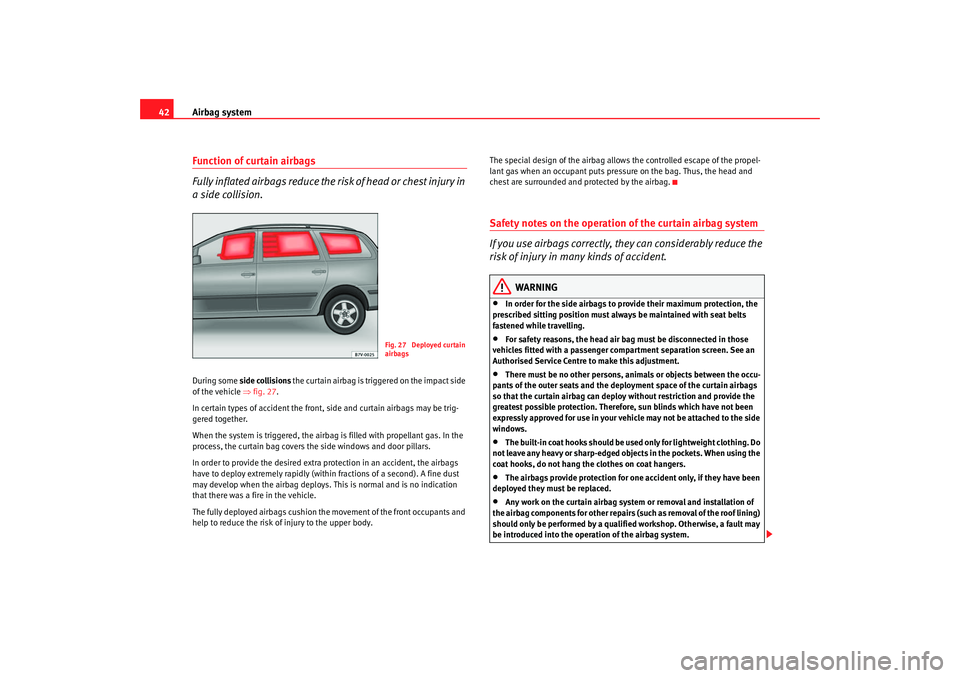
a side collision.During some side collisions the curtain airbag is tri ggered on the impact side
of the vehicle ⇒fig. 27 .
In certain types of accident the front, side and curtain airbags may be trig-
gered together.
When the system is triggered, the airbag is filled with propellant gas. In the
process, the curtain bag covers the side windows and door pillars.
In order to provide the desired extra protection in an accident, the airbags
have to deploy extremely rapidly (withi n fractions of a second). A fine dust
may develop when the airbag deploys. This is normal and is no indication
that there was a fire in the vehicle.
The fully deployed airbags cushion the movement of the front occupants and
help to reduce the risk of injury to the upper body. The special design of the airbag allows the controlled escape of the propel-
lant gas when an occupant puts pressure on the bag. Thus, the head and
chest are surrounded and protected by the airbag.
Safety notes on the operation of the curtain airbag system
If you use airbags correctly, they can considerably reduce the
risk of injury in many kinds of accident.
WARNING
•
In order for the side airbags to provide their maximum protection, the
prescribed sitting position must alwa ys be maintained with seat belts
fastened while travelling.
•
For safety reasons, the head air bag must be disconnected in those
vehicles fitted with a passenger compartment separation screen. See an
Authorised Service Centre to make this adjustment.
•
There must be no other persons, animals or objects between the occu-
pants of the outer seats and the depl oyment space of the curtain airbags
so that the curtain airbag can deploy without restriction and provide the
greatest possible protection. Therefor e, sun blinds which have not been
expressly approved for use in your vehicle may not be attached to the side
windows.
•
The built-in coat hooks should be us ed only for lightweight clothing. Do
not leave any heavy or sharp-edged obje cts in the pockets. When using the
coat hooks, do not hang the clothes on coat hangers.
•
The airbags provide protection for one accident only, if they have been
deployed they must be replaced.
•
Any work on the curtain airbag system or removal and installation of
the airbag components for other repairs (such as removal of the roof lining)
should only be performed by a qualified workshop. Otherwise, a fault may
be introduced into the operation of the airbag system.
Fig. 27 Deployed curtain
airbags
alhambra ingles.book Seite 42 Donnerstag, 19. April 2007 4:04 16
Page 46 of 291
Airbag system
44
– Open centre compartment on instrument panel.
– Using the ignition key, turn the switch to ON ⇒page 43, fig. 28 .
– Check if, when the ignition is switched on, that the warning lamp “PASS AIRBAG OFF” on the instrument panel ⇒page 43, fig. 29
does not light up ⇒.
– Close centre compartment on instrument panel:
WARNING
•
The driver is responsible for the proper position of the key-operated
switch.
•
You should only disable the front and side passenger airbags if, in
exceptional cases, you have to use a rear-facing child seat on the front
passenger seat ⇒ page 45.
•
Never fit a child seat in the passenger seat, where the child faces back-
wards to the direction of travel and th e frontal airbag has not been deacti-
vated. This is highly dangerous for the child. However, if it is necessary in
exceptional circumstances to transport a child in a rear-facing child seat on
the front passenger seat, you must always disable the front passenger
airbag.
•
As soon as the child seat will no longer be used on the front passenger
seat, enable the front and side passenger airbag again.
•
Only deactivate the front and side passenger airbag when the ignition
is off, otherwise a fault may occur in the airbag system, this will create the
risk of the front, curtain or side airbag not deploying properly or not at all
in the event of an accident.
•
If, while the front and side passenger airbag are turned off, the indi-
cator PASS. AIRBAG OFF does not remain lit, this could indicate a fault in
the airbag system: −
Have the airbag system inspected immediately by a qualified work-
shop.
− Do not use a child seat on the front passenger seat! The front and
side passenger airbag may deploy during an accident in spite of the
fault.
− It is impossible to determine whethe r the front or side airbags will be
triggered in case of accident. Inform your passengers of this.
WARNING (continued)
alhambra ingles.book Seite 44 Donnerstag, 19. April 2007 4:04 16
Page 63 of 291
Cockpit61
Safety First
Operating instructions
Tips and Maintenance
Te c h n i c a l D a t a
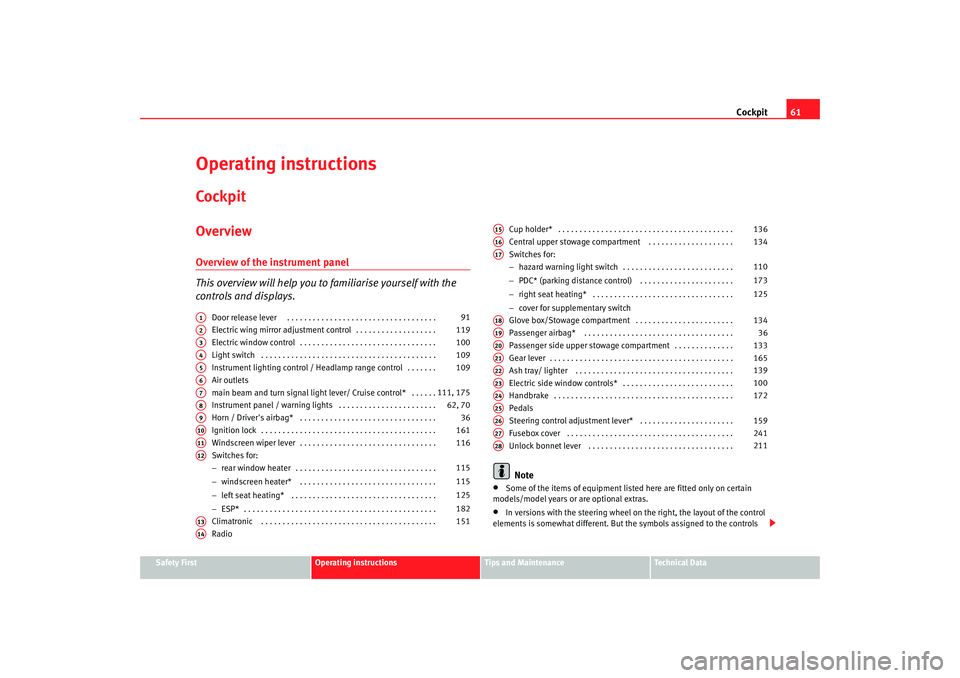
Operating instructionsCockpitOverviewOverview of the instrument panel
This overview will help you to familiarise yourself with the
controls and displays.
Door release lever . . . . . . . . . . . . . . . . . . . . . . . . . . . . . . . . . . .
Electric wing mirror adjustment control . . . . . . . . . . . . . . . . . . .
Electric window control . . . . . . . . . . . . . . . . . . . . . . . . . . . . . . . .
Light switch . . . . . . . . . . . . . . . . . . . . . . . . . . . . . . . . . . . . . . . . .
Instrument lighting control / Head lamp range control . . . . . . .
Air outlets
main beam and turn signal light lever/ Cruise control* . . . . . .
Instrument panel / warning lights . . . . . . . . . . . . . . . . . . . . . . .
Horn / Driver's airbag* . . . . . . . . . . . . . . . . . . . . . . . . . . . . . . . .
Ignition lock . . . . . . . . . . . . . . . . . . . . . . . . . . . . . . . . . . . . . . . . .
Windscreen wiper lever . . . . . . . . . . . . . . . . . . . . . . . . . . . . . . . .
Switches for:
− rear window heater . . . . . . . . . . . . . . . . . . . . . . . . . . . . . . . . .
− windscreen heater* . . . . . . . . . . . . . . . . . . . . . . . . . . . . . . . .
− left seat heating* . . . . . . . . . . . . . . . . . . . . . . . . . . . . . . . . . .
− ESP* . . . . . . . . . . . . . . . . . . . . . . . . . . . . . . . . . . . . . . . . . . . . .
Climatronic . . . . . . . . . . . . . . . . . . . . . . . . . . . . . . . . . . . . . . . . .
Radio Cup holder* . . . . . . . . . . . . . . . . . . . . . . . . . . . . . . . . . . . . . . . . .
Central upper stowage compartment . . . . . . . . . . . . . . . . . . . .
Switches for:
−
hazard warning light switch . . . . . . . . . . . . . . . . . . . . . . . . . .
− PDC* (parking distance control) . . . . . . . . . . . . . . . . . . . . . .
− right seat heating* . . . . . . . . . . . . . . . . . . . . . . . . . . . . . . . . .
− cover for supplementary switch
Glove box/Stowage compartment . . . . . . . . . . . . . . . . . . . . . . .
Passenger airbag* . . . . . . . . . . . . . . . . . . . . . . . . . . . . . . . . . . .
Passenger side upper stowage compartment . . . . . . . . . . . . . .
Gear lever . . . . . . . . . . . . . . . . . . . . . . . . . . . . . . . . . . . . . . . . . . .
Ash tray/ lighter . . . . . . . . . . . . . . . . . . . . . . . . . . . . . . . . . . . . .
Electric side window controls* . . . . . . . . . . . . . . . . . . . . . . . . . .
Handbrake . . . . . . . . . . . . . . . . . . . . . . . . . . . . . . . . . . . . . . . . . .
Pedals
Steering control adjustment lever* . . . . . . . . . . . . . . . . . . . . . .
Fusebox cover . . . . . . . . . . . . . . . . . . . . . . . . . . . . . . . . . . . . . . .
Unlock bonnet lever . . . . . . . . . . . . . . . . . . . . . . . . . . . . . . . . . .
Note
•
Some of the items of equipment listed here are fitted only on certain
models/model years or are optional extras.
•
In versions with the steering wheel on the right, the layout of the control
elements is somewhat different. But the symbols assigned to the controls
A1
91
A2
119
A3
100
A4
109
A5
109
A6A7
111, 175
A8
62, 70
A9
36
A10
161
A11
116
A12
115
115
125
182
A13
151
A14
A15
136
A16
134
A17
110
173
125
A18
134
A19
36
A20
133
A21
165
A22
139
A23
100
A24
172
A25A26
159
A27
241
A28
211
alhambra ingles.book Seite 61 Donnerstag, 19. April 2007 4:04 16
Page 65 of 291
Cockpit63
Safety First
Operating instructions
Tips and Maintenance
Te c h n i c a l D a t a
Rev counter
The rev. counter displays the engine speed in revolutions per
minute.If, for example, the needle is directly over the 2, this corresponds to an engine
speed of 2000 rpm (revolutions per minute) ⇒page 62, fig. 44 .
The start of the red zone on the dial indicates the maximum engine speed
which may be used briefly when the engi ne is warm and after it has been run
in properly. However, it is advisable to change up a gear or move the selector
lever to D (or lift your foot off the accelerator) before the needle reaches the
red zone.
Caution
The rev counter needle must never enter the red zone on the scale. Risk of
engine damage.
For the sake of the environment
Changing up a gear early will help you to save fuel and minimise engine
noise.
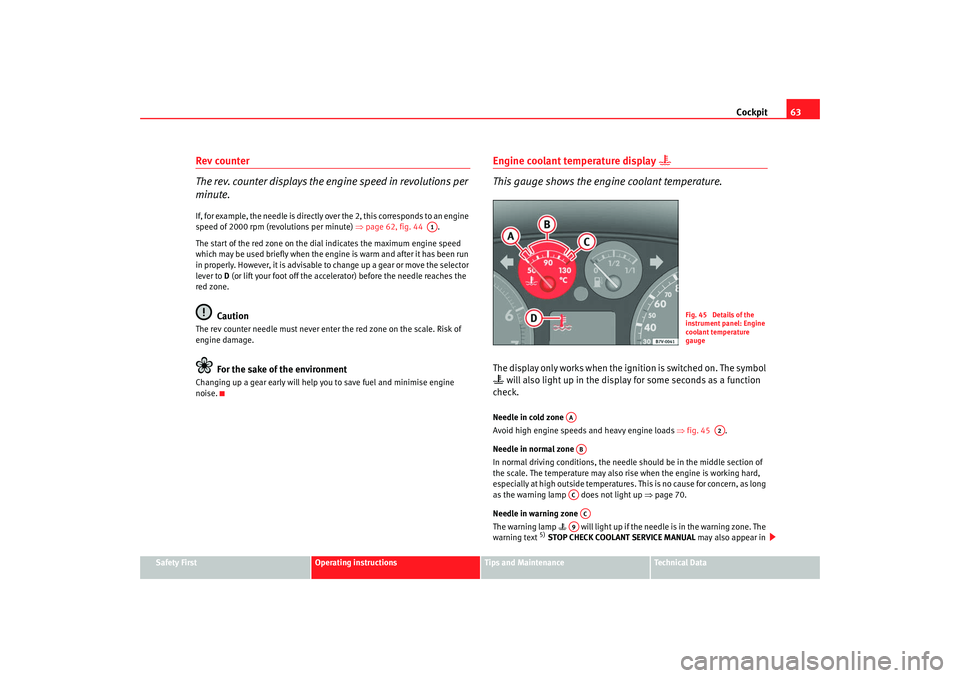
Engine coolant temperature display
This gauge shows the engine coolant temperature.The display only works when the igni tion is switched on. The symbol will also light up in the display for some seconds as a function
check.Needle in cold zone
Avoid high engine speeds and heavy engine loads ⇒fig. 45 .
Needle in normal zone
In normal driving conditions, the needle should be in the middle section of
the scale. The temperature may also rise when the engine is working hard,
especially at high outside temperatures. This is no cause for concern, as long
as the warning lamp does not light up ⇒page 70.
Needle in warning zone
The warning lamp will light up if the needle is in the warning zone. The
warning text
5) STOP CHECK COOLANT SERVICE MANUAL may also appear in
A1
Fig. 45 Details of the
instrument panel: Engine
coolant temperature
gauge
AA
A2
ABACAC
A9
alhambra ingles.book Seite 63 Donnerstag, 19. April 2007 4:04 16
Page 66 of 291
Cockpit
64the combi-instrument display. Stop the car and switch off the engine. Allow
the engine to cool and check the coolant level ⇒.
Even if the coolant level is correct do not continue driving. You should obtain
technical assistance.
WARNING
Read and observe the warnings “Working in the engine compartment”
before opening the bonnet to carry out work in the engine compartment.
Caution
Accessories in front of the air inlet reduce the cooling effect of the coolant. At
high outside temperatures and high engine loads, there is a risk of the
engine overheating.
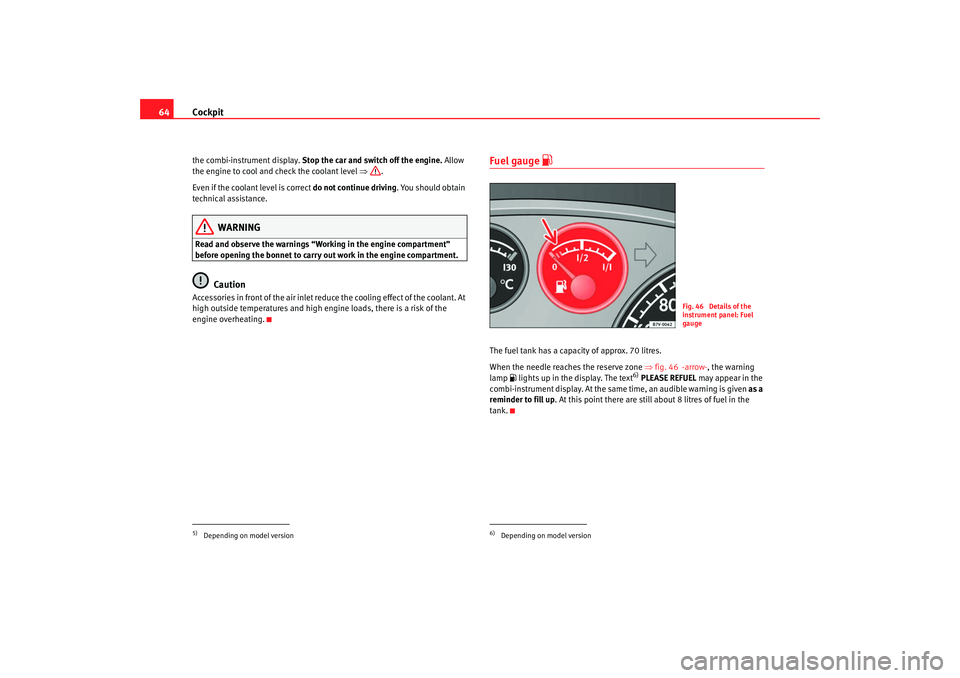
Fuel gauge
The fuel tank has a capacity of approx. 70 litres.
When the needle reaches the reserve zone ⇒fig. 46 -arrow- , the warning
lamp lights up in the display. The text
6) PLEASE REFUEL may appear in the
combi-instrument display. At the same time, an audible warning is given as a
reminder to fill up . At this point there are still about 8 litres of fuel in the
tank.
5)Depending on model version
6)Depending on model version
Fig. 46 Details of the
instrument panel: Fuel
gauge
alhambra ingles.book Seite 64 Donnerstag, 19. April 2007 4:04 16
Page 69 of 291
Cockpit67
Safety First
Operating instructions
Tips and Maintenance
Te c h n i c a l D a t a
Display in the instrument panel Fault messages
Faults are shown by warning lamps and / or as symbols with
warning and information reports on the display.The system runs a check on certain components and functions when the igni-
tion is switched on and while the vehi cle is moving. Functional problems are
shown by warning lamps and / or red or yellow symbols with fault texts on the combi-instrument. Depending on the exact
nature of the functional problem,
audible warnings may also be given.
Note
•
The size of the display depends on the type of combi-instrument you have
fitted. In some models, the combi-inst rument does not have an integrated
display.
•
In addition to warning messages given on a fault, you will receive informa-
tion in the display on procedures or will be asked to carry out certain tasks.
Overview of selected fault messages
Fault messages are displayed on the combi-instrument display.The following overview does not show all fault messages. Not all fault
messages are displayed with a symbol. Warning symbols (priority 1)
If the symbol lights up again after a fa
ult has been corrected, you should stop
the vehicle immediately, switch off th e engine and seek professional advice.
Fault message Symbol Action
STOP BRAKE FAULT SERVICE MANUAL
Stop the car, turn the engine off and check the brake fluid level
⇒ page 221.
HANDBRAKE ON
Release the handbrake.
STOP BRAKE FAULT SERVICE MANUAL
and
Stop the car, turn the engine off and seek professional help ⇒ page 179.
STOP CHECK COOLANT SERVICE MANUAL
Checking coolant level ⇒page 216.
alhambra ingles.book Seite 67 Donnerstag, 19. April 2007 4:04 16
Page 71 of 291
Cockpit69
Safety First
Operating instructions
Tips and Maintenance
Te c h n i c a l D a t a
Fault message prioritiesPriority 1 fault messages (red)
If one of these faults occurs, the warning lamp will flash or light up and will
be accompanied by three audible warnings ⇒ . This is a danger warning.
Stop the car and switch off the engine. Check the fault and correct it. Obtain
professional assistance if necessary.
If several priority 1 faults are detected at the same time, the symbols will be
displayed one after the other for about 2 seconds at a time. The symbols will
keep flashing until the faults have been rectified.
No menus will be shown in the display for the duration of a priority 1 warning
report.
Priority 2 fault messages (yellow):
If one of these faults occurs, the warning lamp lights up, and is accompanied
by one audible warning . The function should be checked as soon as possible.
If several priority 2 warning reports are detected at the same time, the
symbols are displayed one after the other for about 2 seconds at a time.
Priority 2 warning reports will not be shown until all Priority 1 warning
reports have been dealt with!
WARNING
Failure to observe fault texts and warning lamps can result in serious
personal injury or damage to your vehicle.
alhambra ingles.book Seite 69 Donnerstag, 19. April 2007 4:04 16
Page 72 of 291
Cockpit
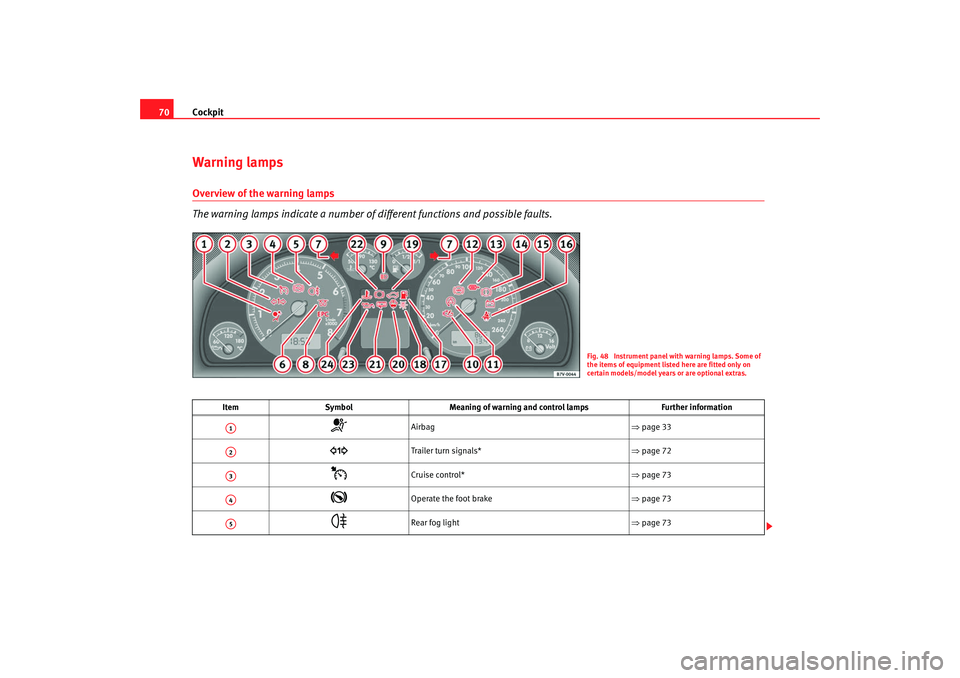
70Warning lampsOverview of the warning lamps
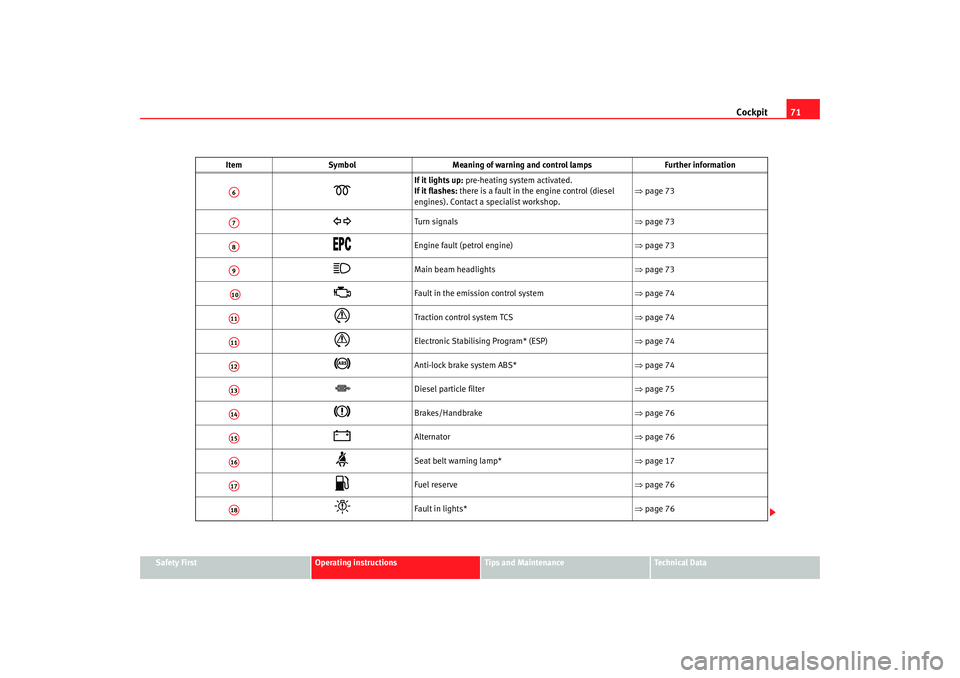
The warning lamps indicate a number of different functions and possible faults.
Item Symbol Meaning of warning and control lamps Further information
Airbag ⇒page 33
Trailer turn signals* ⇒page 72
Cruise control* ⇒page 73
Operate the foot brake ⇒page 73
Rear fog light ⇒page 73
Fig. 48 Instrument panel with warning lamps. Some of
the items of equipment listed here are fitted only on
certain models/model years or are optional extras.
A1A2A3A4A5
alhambra ingles.book Seite 70 Donnerstag, 19. April 2007 4:04 16
Page 73 of 291
Cockpit71
Safety First
Operating instructions
Tips and Maintenance
Te c h n i c a l D a t a
If it lights up: pre-heating system activated.
If it flashes: there is a fault in the engine control (diesel
engines). Contact a specialist workshop. ⇒
page 73
Turn signals ⇒page 73
Engine fault (petrol engine) ⇒page 73
Main beam headlights ⇒page 73
Fault in the emission control system ⇒page 74
Traction control system TCS ⇒page 74
Electronic Stabilising Program* (ESP) ⇒page 74
Anti-lock brake system ABS*
⇒page 74
Diesel particle filter ⇒page 75
Brakes/Handbrake ⇒page 76
Alternator ⇒page 76
Seat belt warning lamp* ⇒page 17
Fuel reserve ⇒page 76
Fault in lights* ⇒page 76
Item
Symbol Meaning of warning and control lamps Further information
A6A7A8A9A10A11A11A12A13A14A15A16A17A18
alhambra ingles.book Seite 71 Donnerstag, 19. April 2007 4:04 16