steering Seat Alhambra 2007 Owner's Guide
[x] Cancel search | Manufacturer: SEAT, Model Year: 2007, Model line: Alhambra, Model: Seat Alhambra 2007Pages: 291, PDF Size: 9.13 MB
Page 185 of 291

Intelligent technology183
Safety First
Operating instructions
Tips and Maintenance
Te c h n i c a l D a t a
You should press the button to switch the ESP back on when you no longer
need wheel spin.
When the ESP is deactivated, the TCS is switched off at the same time. This
means that this technology is not available for as long as the ESP remains
switched off.
How ESP works
ESP reduces the danger of skidding by
braking the wheels individually. The
system uses the steering wheel angle and road speed to calculate the
changes of direction desired by the driver, and constantly compares them
with the actual behaviour of the car. If the desired course is not being main-
tained accurately (for instance if the ca r is beginning to skid) the ESP compen-
sates automatically by applying the brake at the appropriate wheel.
The forces acting on the braked wheel bring the car back to a stable condi-
tion. If the car is tending to oversteer (break away at the rear) the brake appli-
cation is concentrated on the outside front wheel; if the car is understeering
(tending to follow a wider radius in a bend), the brake is mainly applied to the
inside rear wheel.
How the Traction Control System (TCS) works
TCS reduces engine power to help prev ent the driven wheels of front-wheel
drive vehicles losing traction during acceleration. The system works in the
entire speed range in conjunction with ABS. If a malfunction should occur in
the ABS, the TCS will also be out of action. TCS helps the car to start moving,
accelerate and climb a gradient in slippery conditions where this may other-
wise be difficult or even impossible.
When does the warning lamp light up or flash
?
•
The warning lamp
lights up when the ignition is switched on and
should go out again after a few seconds.
•
The warning lamp
will start flashing to indicate that the ESP and TCS
are counteracting an unstable driving condition.
•
It will light up continuously if there is a malfunction in the ESP.
•
It will light up continuously if the ESP is switched off.
•
It will also come on if a fault should occur in the ABS because the ESP
operates in conjunction with the ABS.
If the warning lamp
lights up and stays on after the engine is started, this
may mean that the control system has temporarily switched off the function.
In this case the ESP can be reactivated by switching the ignition off and then
on again. If the warning lamp goes out, this means the system is fully func-
tional
If the battery is disconnected, the warning lamp
lights after turning the
ignition on. This should turn off after a brief trip.
WARNING
Try to always adapt the speed of the vehicle to weather, road and traffic
conditions. Do not let the extra safety afforded by the system tempt you
into taking any risks when driving. Risk of accident.•
The ESP and TCS cannot defy the laws of motion. This should be kept in
mind, particularly on slippery and wet roads and when towing a trailer.
•
Always adapt your driving style to suit the condition of the roads and
the traffic situation.
•
The ESP cannot reduce the risk of accident if, for example, you are
driving with an unsuitable load or too close to the preceding vehicle.
•
Modifications to the vehicle or work carried out incorrectly (e. g. to the
engine, the brake system, running gear or any components affecting the
wheels and tyres) could affect the efficiency of the ABS, EDL, ESP and TCS
and lessen their efficiency.
•
The effectiveness of the ESP is also determined by the tyres fitted
⇒ page 225.Caution
In order to ensure that ESP and TCS func tion correctly, all four wheels must be
fitted with the same tyres. Any differences in the rolling radius of the tyres can
cause the system to reduce engine power when this is not desired.
alhambra ingles.book Seite 183 Donnerstag, 19. April 2007 4:04 16
Page 186 of 291

Intelligent technology
184Power steeringPower steering does not work if the en gine is not running or if the power
steering system has developed a fault. In this case the steering wheel is very
hard to turn.
Caution
Do not keep the steering wheel in the full-lock position for longer than
15 seconds when the engine is runni ng. This could cause damage to the
power steering system.Four-wheel drive*
In vehicles with four-wheel drive, the engine power is distrib-
uted to all four wheelsThe four-wheel drive system is fully automatic and does not require interven-
tion by the driver. The engine power is permanently distributed to all four
wheels. The engine power is distri buted automatically to both axles
according to the road conditions and how you drive.
Winter tyres
Thanks to its four-wheel drive, your car will have plenty of traction in winter
conditions, even with the standard tyres. Nevertheless, we still recommend
that, in keeping with cars with front or rear wheel drive, winter tyres or all-
season tyres should be fitted on all four wheels when winter road conditions
are expected, mainly because this will give a better braking response.
Snow chains
On roads where snow chains are mandatory, they must be fitted to the front
wheels of cars with four-wheel drive. Replacing tyres
In vehicles with four-wheel drive, all
four tyres should have the same amount
of wear. All four wheels must have the same rolling circumference.
WARNING
Never drive too fast on icy, slippery or wet surfaces. You could lose control
of your vehicle if you drive too fast. This may result in serious injury.•
Therefore, it is essential that you adjust your speed to suit the road and
traffic conditions. Do not let the extra safety afforded by four-wheel drive
tempt you into taking any risks when driving.
•
The four-wheel drive gives the vehicle good acceleration even in winter.
When braking, a four-wheel drive vehicle handles in the same way as a
front drive vehicle.
•
On wet roads the front wheels may start to “aquaplane” and lose
contact with the road if the car is driven too fast. If this should happen,
there will be no sudden increase in engine speed to warn the driver, as with
a front-wheel drive car.
alhambra ingles.book Seite 184 Donnerstag, 19. April 2007 4:04 16
Page 229 of 291
Checking and refilling levels227
Safety First
Operating instructions
Tips and Maintenance
Te c h n i c a l D a t a
Wear indicators
The original tyres on your vehicle have 1.6 mm high “tread wear indicators”
⇒
page 226, fig. 150 , running across the tread. Depending on the make,
there will be six to eight of them evenly spaced around the tyre. Markings on
the tyre sidewall (for instance the letters “TWI” or other symbols) indicate the
positions of the tread wear indicators. The minimum tread depth required by
law is 1.6 mm (measured in the tread grooves next to the tread wear indica-
tors). Worn tyres must be replaced. Different figures may apply in export
countries ⇒.
Tyre pressure
Incorrect tyre pressure causes premature wear and could cause tyre blow-out.
For this reason, the tyre pressure should be checked at least once per month
⇒ page 226.
Driving style
Fast cornering, heavy acceleration and hard braking all increase tyre wear.
Changing wheels around
If the front tyres are worn considerably more than the rear ones it is advisable
to change them around as shown ⇒page 226, fig. 151 . All the tyres will then
last for about the same time.
Wheel balance
The wheels on new vehicles are balanced. However, various factors encoun-
tered in normal driving can cause them to become unbalanced, which results
in steering vibration.
Unbalanced wheels should be rebalanced, as they otherwise cause excessive
wear on steering, suspension and tyres. A wheel must also be rebalanced
when a new tyre is fitted.
Incorrect wheel alignment
Incorrect wheel alignment causes excessive tyre wear, impairing the safety of
the vehicle. If tyres show excessive wear, you should have the wheel align-
ment checked by an Authorised Service Centre.
WARNING
There is a serious danger of accidents if a tyre bursts during driving!•
The tyres must be replaced at the latest when the tread is worn down to
the tread wear indicators. Failure to do so could result in an accident. Worn
tyres do not grip well at high speeds on wet roads. There is also a greater
risk of “aquaplaning”.
•
At continuously high speeds, a tyre with insufficient pressure flexes
more. This causes it to overheat. This can cause tread separation and tyre
blow-out. Risk of accident. Always observe the recommended tyre pres-
sures.
•
If tyres show excessive wear, you should have the running gear checked
by an Authorised Service Centre.
•
Keep chemicals such as oil, fuel and brake fluid away from tyres.
•
Damaged wheels and tyres must be replaced immediately!For the sake of the environment
Under-inflated tyres will increase fuel consumption.New tyres and wheels
New tyres and wheels have to be run-in.The tyres and wheel rims are an essential part of the vehicle's design. The
tyres and rims approved by SEAT are specially matched to the characteristics
of the vehicle and make a major contribution to good road holding and safe
handling ⇒.
Tyres should be replaced at least in pair s and not individually (i.e. both front
tyres or both rear tyres together). A knowledge of tyre designations makes it
alhambra ingles.book Seite 227 Donnerstag, 19. April 2007 4:04 16
Page 256 of 291
If and when
254Notes for tow-starting or towingIf a cable is used for towing the vehicle, please observe the
following:
As the driver of the towing vehicle
– Switch on the hazard warning lights. However, observe any regu-
lations to the contrary.
– Drive slowly at first until the to w-rope is taut. Then accelerate
gradually.
– Begin and change gears cautiously. If you are driving an auto- matic vehicle, accelerate gently.
– Remember that the brake servo and power steering are not working in the vehicle you are towing. Brake earlier than you
would normally, but with a more gentle pressure on the brake.
As the driver of the vehicle being towed
– Switch on the hazard warning lights. However, observe any regu- lations to the contrary.
– Place the gearstick in neutral or position N.
– Ensure that the tow-rope remains taut at all times.Tow-rope or tow-bar
It is easier and safer to tow a vehicle with a tow-bar. You should only use a
tow-rope if you do not have a tow-bar.
A tow-rope should be slightly elastic to reduce the loading on both vehicles.
It is advisable to use a tow-rope made of synthetic fibre or similarly elastic
material. Attach the tow-rope or the tow-bar only to the towing eyes provided or a
towing bracket.
Driving tips
Towing requires some experience, espec
ially when using a tow-rope. Both
drivers should be familiar with the te chnique required for towing. Inexperi-
enced drivers should not attempt to tow-start or tow away another vehicle.
Do not pull too hard with the towing vehicle and take care to avoid jerking the
tow-rope. When towing on an unpaved road, there is always a risk of over-
loading and damaging the anchorage points.
The ignition of the vehicle being towed must be switched on to prevent the
steering wheel from locking and also to allow the use of the turn signals,
horn, windscreen wipers and washers.
If the vehicle is towed, with the hazard warning lights on and the ignition
switched on, the turn signal may be used to indicate that you are going to
change direction. Move the turn signal lever accordingly. Meanwhile, the
hazard warning lights will go off. When th e turn signal lever is returned to the
rest position, the hazard warning lights will automatically reconnect.
The brake servo works only when the engine is running. In this case the pedal
has to be pressed harder.
As the power assisted steering does not work if the engine is not running, you
will need more strength to steer than you normally would.
Towing vehicles with an automatic gearbox
•
Move the selector lever to N.
•
Do not drive faster than 50 km/h when towing a vehicle.
•
Do not tow further than 50 km.
•
If a breakdown truck is used, the vehicle must be towed with the front
wheels raised.
alhambra ingles.book Seite 254 Donnerstag, 19. April 2007 4:04 16
Page 257 of 291
If and when255
Safety First
Operating instructions
Tips and Maintenance
Te c h n i c a l D a t a
WARNING
The braking behaviour and capacity of a vehicle changes when being towed
or when you are trying to start the vehicle by pulling. Please observe the
following notes in order to prevent injury and accident:•
Inexperienced drivers should refrain from trying in order to avoid acci-
dent.
•
Notes for the driver of the towed vehicle
− The brake must be depressed must harder as the brake servo does
not operate. Take care not to bump into the towing vehicle.
− More strength is required at the steering wheel as the power
steering does not operate when the engine is switched off.
•
Notes for the driver of the towing vehicle
− Accelerate smoothly and avoid any sudden movement.
− Brake more in advance than usual and brake gently.Caution
When tow-starting, fuel could enter the catalytic converter and damage it
⇒ page 252.
Note
•
Observe legal requirements when towing or tow-starting.
•
For technical reasons, vehicles with an automatic gearbox must not be
tow-started.
•
If, due to a breakdown, the gearbox does not have lubricant, the vehicle
should be towed with the drive wheels suspended.
•
If it is necessary to tow a vehicle with an automatic gearbox for more than
50 km, it should be towed by qualified personnel and with the drive wheels
suspended.
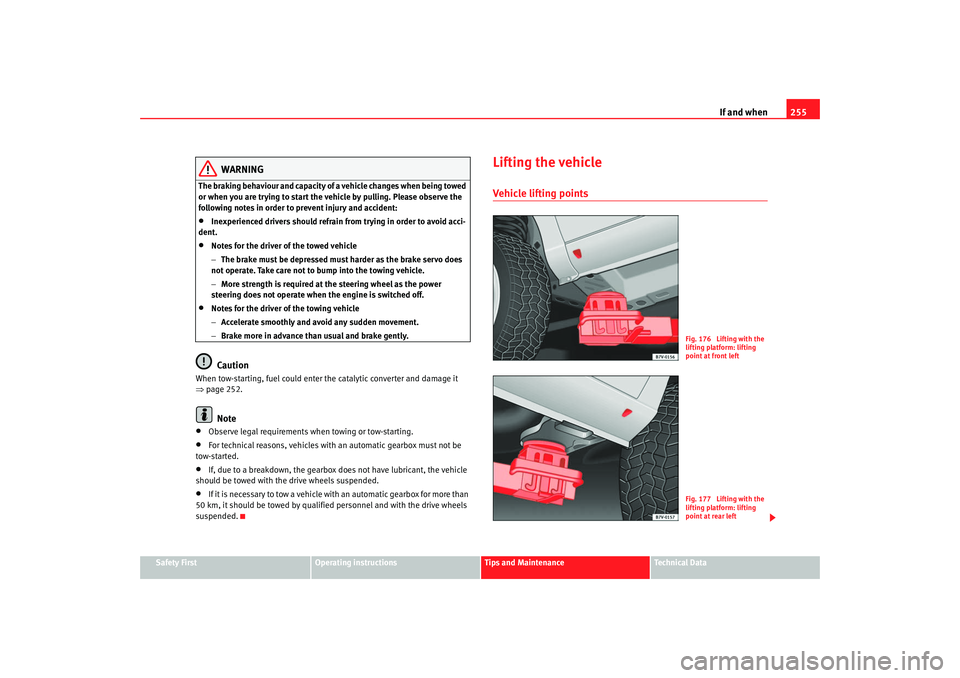
Lifting the vehicleVehicle lifting points
Fig. 176 Lifting with the
lifting platform: lifting
point at front leftFig. 177 Lifting with the
lifting platform: lifting
point at rear left
alhambra ingles.book Seite 255 Donnerstag, 19. April 2007 4:04 16
Page 286 of 291
Index
284Mobile phone . . . . . . . . . . . . . . . . . . . . . . . . . . 203
Modifications . . . . . . . . . . . . . . . . . . . . . . . . . . 202
Multifunction steering wheel . . . . . . . . . . . . . . . 84NNavigation system* . . . . . . . . . . . . . . . . . . . . . . . 83
Net bag . . . . . . . . . . . . . . . . . . . . . . . . . . . . . . . 146
Number of seats . . . . . . . . . . . . . . . . . . . . . . . . . 17OObservations . . . . . . . . . . . . . . . . . . . . . . . . . . . 187
Octane number . . . . . . . . . . . . . . . . . . . . . . . . . 207
Oil . . . . . . . . . . . . . . . . . . . . . . . . . . . . . . . . . . . . 212
Oil change . . . . . . . . . . . . . . . . . . . . . . . . . . . . . 215
Oil properties . . . . . . . . . . . . . . . . . . . . . . . . . . . 213
On board computer with multifunction display*
Check working . . . . . . . . . . . . . . . . . . . . . . . . 79
Message on display . . . . . . . . . . . . . . . . . . . 79
One-touch closing and opening electric windows . . . . . . . . . . . . . . . . . . . . . 101
Overview Control lamps . . . . . . . . . . . . . . . . . . . . . . . . 70
Instrument panel . . . . . . . . . . . . . . . . . . . . . . 61
Instruments . . . . . . . . . . . . . . . . . . . . . . . . . . 62
Multifunction steering wheel . . . . . . . . . . . . 84
Warning lamps . . . . . . . . . . . . . . . . . . . . . . . 70
PPaintworkPolishing . . . . . . . . . . . . . . . . . . . . . . . . . . . 196
Waxing . . . . . . . . . . . . . . . . . . . . . . . . . . . . . 195
Parking . . . . . . . . . . . . . . . . . . . . . . . . . . . . . . . . 172
Parking aid . . . . . . . . . . . . . . . . . . . . . . . . . . . . 173
Parking distance warning system . . . . . . . . . . 173
Parking lights . . . . . . . . . . . . . . . . . . . . . . . . . . 112
Parts . . . . . . . . . . . . . . . . . . . . . . . . . . . . . . . . . . 202
Parts replacement . . . . . . . . . . . . . . . . . . . . . . . 202
Passenger compartment Climatronic . . . . . . . . . . . . . . . . . . . . . . . . . 155
Pedals . . . . . . . . . . . . . . . . . . . . . . . . . . . . . . . . . 14
Petrol . . . . . . . . . . . . . . . . . . . . . . . . . . . . . . . . . 207 Trips to foreign countries . . . . . . . . . . . . . . 187
Petrol additives . . . . . . . . . . . . . . . . . . . . . . . . . 207
Physical principles of a frontal collision . . . . . . 19
Plastic key tab . . . . . . . . . . . . . . . . . . . . . . . . . . . 86
Plastic parts . . . . . . . . . . . . . . . . . . . . . . . . . . . . 196
Pollution filter . . . . . . . . . . . . . . . . . . . . . . . . . . 157
Power steering . . . . . . . . . . . . . . . . . . . . . . . . . . 184
Preheating system indicator . . . . . . . . . . . . . . . . . . . . . . . . . . . . . 73RRaising the vehicle with the vehicle tool kit jack . . . . . . . . . . . . . . . . . . . . . . . . . . . . . . 239
Reading lights . . . . . . . . . . . . . . . . . . . . . . . . . . 113 Rear door
driving with the tailgate open . . . . . . . . . . . 98
Rear fog light . . . . . . . . . . . . . . . . . . . . . . . . . . . 108 Warning lamp . . . . . . . . . . . . . . . . . . . . . . . . 73
warning light . . . . . . . . . . . . . . . . . . . . . . . . 108
Rear seats characteristics of seat equipment . . . . . . . 126
moving . . . . . . . . . . . . . . . . . . . . . . . . . . . . . 127
safety instructions . . . . . . . . . . . . . . . . . . . 131
Rear window heating . . . . . . . . . . . . . . . . . . . . 115 Heating element wires . . . . . . . . . . . . . . . . 197
Rear window wiper . . . . . . . . . . . . . . . . . . . . . . 117
Rear-view mirror . . . . . . . . . . . . . . . . . . . . . . . . 118
Refilling . . . . . . . . . . . . . . . . . . . . . . . . . . . . . . . 206
Remote control key Replacing the battery . . . . . . . . . . . . . . . . . . 94
Synchronising . . . . . . . . . . . . . . . . . . . . . . . . 94
Repairs Airbags . . . . . . . . . . . . . . . . . . . . . . . . . . . . . . 34
Replacement keys . . . . . . . . . . . . . . . . . . . . . . . . 86
Replacing the battery Remote control key . . . . . . . . . . . . . . . . . . . . 94
Replacing tyres Four-wheel drive . . . . . . . . . . . . . . . . . . . . . 184
Retractor See Automatic belt retractor . . . . . . . . . . . . . 22
Retrofitting a towing bracket . . . . . . . . . . . . . . 204
Rev counter . . . . . . . . . . . . . . . . . . . . . . . . . . . . . 63
Reverse gear Automatic gearbox . . . . . . . . . . . . . . . . . . . 169
Manual gearbox . . . . . . . . . . . . . . . . . . . . . 165
alhambra ingles.book Seite 284 Donnerstag, 19. April 2007 4:04 16
Page 287 of 291
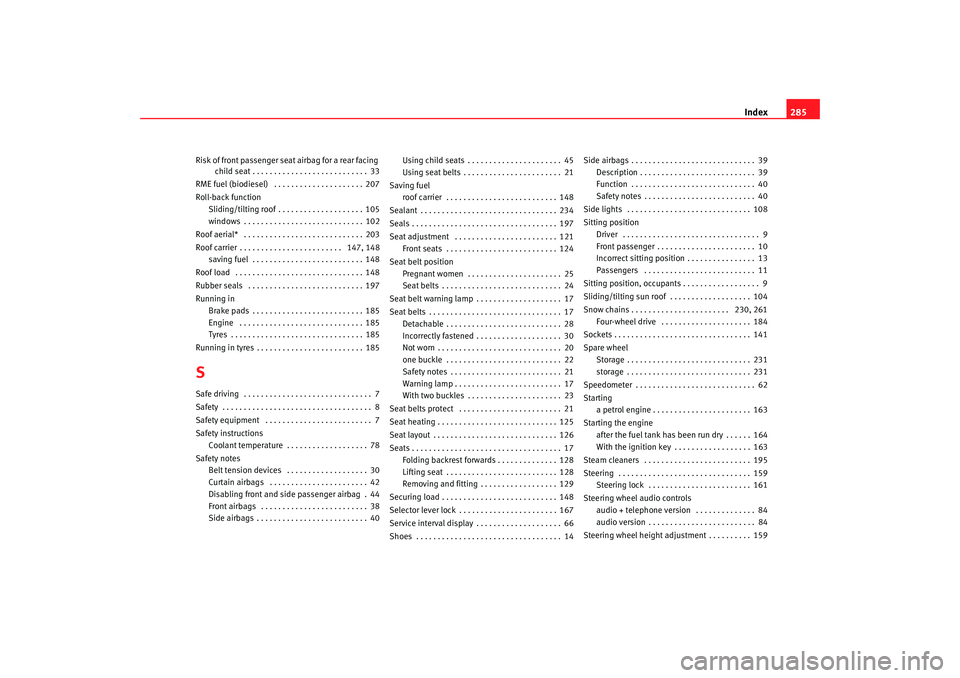
Index285
Risk of front passenger seat airbag for a rear facing
child seat . . . . . . . . . . . . . . . . . . . . . . . . . . . 33
RME fuel (biodiesel) . . . . . . . . . . . . . . . . . . . . . 207
Roll-back function Sliding/tilting roof . . . . . . . . . . . . . . . . . . . . 105
windows . . . . . . . . . . . . . . . . . . . . . . . . . . . . 102
Roof aerial* . . . . . . . . . . . . . . . . . . . . . . . . . . . . 203
Roof carrier . . . . . . . . . . . . . . . . . . . . . . . . 147, 148 saving fuel . . . . . . . . . . . . . . . . . . . . . . . . . . 148
Roof load . . . . . . . . . . . . . . . . . . . . . . . . . . . . . . 148
Rubber seals . . . . . . . . . . . . . . . . . . . . . . . . . . . 197
Running in Brake pads . . . . . . . . . . . . . . . . . . . . . . . . . . 185
Engine . . . . . . . . . . . . . . . . . . . . . . . . . . . . . 185
Tyres . . . . . . . . . . . . . . . . . . . . . . . . . . . . . . . 185
Running in tyres . . . . . . . . . . . . . . . . . . . . . . . . . 185SSafe driving . . . . . . . . . . . . . . . . . . . . . . . . . . . . . . 7
Safety . . . . . . . . . . . . . . . . . . . . . . . . . . . . . . . . . . . 8
Safety equipment . . . . . . . . . . . . . . . . . . . . . . . . . 7
Safety instructions Coolant temperature . . . . . . . . . . . . . . . . . . . 78
Safety notes Belt tension devices . . . . . . . . . . . . . . . . . . . 30
Curtain airbags . . . . . . . . . . . . . . . . . . . . . . . 42
Disabling front and side passenger airbag . 44
Front airbags . . . . . . . . . . . . . . . . . . . . . . . . . 38
Side airbags . . . . . . . . . . . . . . . . . . . . . . . . . . 40 Using child seats . . . . . . . . . . . . . . . . . . . . . . 45
Using seat belts . . . . . . . . . . . . . . . . . . . . . . . 21
Saving fuel roof carrier . . . . . . . . . . . . . . . . . . . . . . . . . . 148
Sealant . . . . . . . . . . . . . . . . . . . . . . . . . . . . . . . . 234
Seals . . . . . . . . . . . . . . . . . . . . . . . . . . . . . . . . . . 197
Seat adjustment . . . . . . . . . . . . . . . . . . . . . . . . 121 Front seats . . . . . . . . . . . . . . . . . . . . . . . . . . 124
Seat belt position Pregnant women . . . . . . . . . . . . . . . . . . . . . . 25
Seat belts . . . . . . . . . . . . . . . . . . . . . . . . . . . . 24
Seat belt warning lamp . . . . . . . . . . . . . . . . . . . . 17
Seat belts . . . . . . . . . . . . . . . . . . . . . . . . . . . . . . . 17 Detachable . . . . . . . . . . . . . . . . . . . . . . . . . . . 28
Incorrectly fastened . . . . . . . . . . . . . . . . . . . . 30
Not worn . . . . . . . . . . . . . . . . . . . . . . . . . . . . . 20
one buckle . . . . . . . . . . . . . . . . . . . . . . . . . . . 22
Safety notes . . . . . . . . . . . . . . . . . . . . . . . . . . 21
Warning lamp . . . . . . . . . . . . . . . . . . . . . . . . . 17
With two buckles . . . . . . . . . . . . . . . . . . . . . . 23
Seat belts protect . . . . . . . . . . . . . . . . . . . . . . . . 21
Seat heating . . . . . . . . . . . . . . . . . . . . . . . . . . . . 125
Seat layout . . . . . . . . . . . . . . . . . . . . . . . . . . . . . 126
Seats . . . . . . . . . . . . . . . . . . . . . . . . . . . . . . . . . . . 17 Folding backrest forwards . . . . . . . . . . . . . . 128
Lifting seat . . . . . . . . . . . . . . . . . . . . . . . . . . 128
Removing and fitting . . . . . . . . . . . . . . . . . . 129
Securing load . . . . . . . . . . . . . . . . . . . . . . . . . . . 148
Selector lever lock . . . . . . . . . . . . . . . . . . . . . . . 167
Service interval display . . . . . . . . . . . . . . . . . . . . 66
Shoes . . . . . . . . . . . . . . . . . . . . . . . . . . . . . . . . . . 14 Side airbags . . . . . . . . . . . . . . . . . . . . . . . . . . . . . 39
Description . . . . . . . . . . . . . . . . . . . . . . . . . . . 39
Function . . . . . . . . . . . . . . . . . . . . . . . . . . . . . 40
Safety notes . . . . . . . . . . . . . . . . . . . . . . . . . . 40
Side lights . . . . . . . . . . . . . . . . . . . . . . . . . . . . . 108
Sitting position Driver . . . . . . . . . . . . . . . . . . . . . . . . . . . . . . . . 9
Front passenger . . . . . . . . . . . . . . . . . . . . . . . 10
Incorrect sitting position . . . . . . . . . . . . . . . . 13
Passengers . . . . . . . . . . . . . . . . . . . . . . . . . . 11
Sitting position, occupants . . . . . . . . . . . . . . . . . . 9
Sliding/tilting sun roof . . . . . . . . . . . . . . . . . . . 104
Snow chains . . . . . . . . . . . . . . . . . . . . . . . 230, 261 Four-wheel drive . . . . . . . . . . . . . . . . . . . . . 184
Sockets . . . . . . . . . . . . . . . . . . . . . . . . . . . . . . . . 141
Spare wheel Storage . . . . . . . . . . . . . . . . . . . . . . . . . . . . . 231
storage . . . . . . . . . . . . . . . . . . . . . . . . . . . . . 231
Speedometer . . . . . . . . . . . . . . . . . . . . . . . . . . . . 62
Starting a petrol engine . . . . . . . . . . . . . . . . . . . . . . . 163
Starting the engine after the fuel tank has b een run dry . . . . . . 164
With the ignition ke y . . . . . . . . . . . . . . . . . . 163
Steam cleaners . . . . . . . . . . . . . . . . . . . . . . . . . 195
Steering . . . . . . . . . . . . . . . . . . . . . . . . . . . . . . . 159 Steering lock . . . . . . . . . . . . . . . . . . . . . . . . 161
Steering wheel audio controls audio + telephone version . . . . . . . . . . . . . . 84
audio version . . . . . . . . . . . . . . . . . . . . . . . . . 84
Steering wheel height adjust ment . . . . . . . . . . 159
alhambra ingles.book Seite 285 Donnerstag, 19. April 2007 4:04 16