ESP Seat Alhambra 2008 Owner's Guide
[x] Cancel search | Manufacturer: SEAT, Model Year: 2008, Model line: Alhambra, Model: Seat Alhambra 2008Pages: 295, PDF Size: 7.83 MB
Page 82 of 295
Cockpit
80Where one or more faults exist, the warning disappears some 15 seconds
after the engine is started, and the corresponding fault symbols with their
respective text messages appear on the display.
For all vehicles
A sound signal is emitted in the event of a fault:•
Priority 1 - three buzzes
•
Priority 2 - one buzz
If priority 1 and 2 faults occur at the same time, three buzzes are emitted.
In the event of a fault, the symbol with the corresponding text message is
displayed.Note
Priority 2 faults are displayed after repairing or eliminating priority 1 faults.Priority 1 (red symbols)
Priority 1 symbols warn of a dangerous situation. Therefore
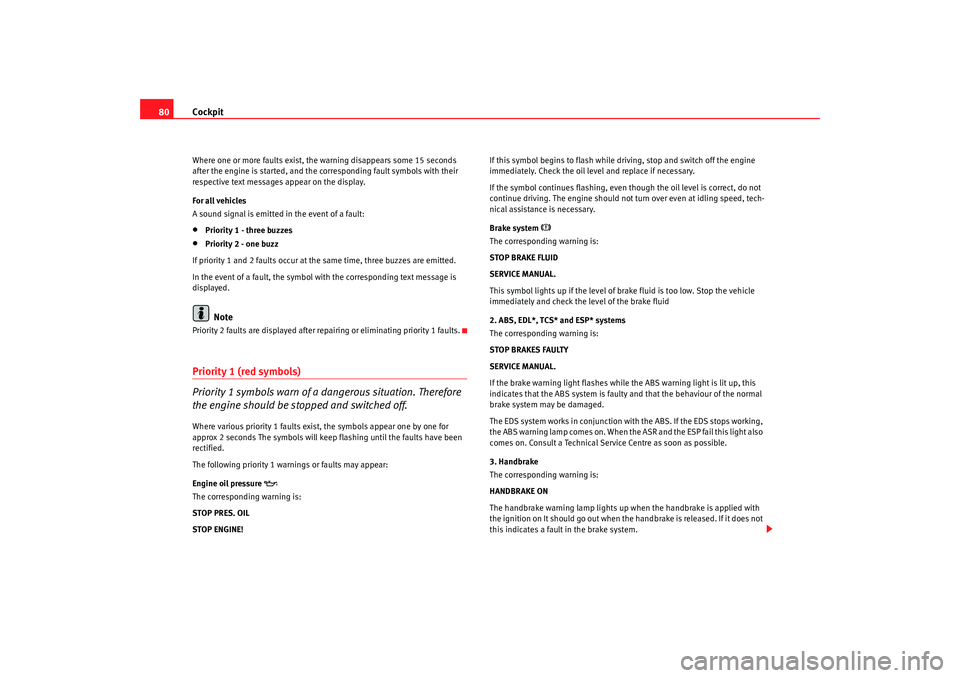
the engine should be stopped and switched off.Where various priority 1 faults exist, the symbols appear one by one for
approx 2 seconds The symbols will keep flashing until the faults have been
rectified.
The following priority 1 warnings or faults may appear:
Engine oil pressure
The corresponding warning is:
STOP PRES. OIL
STOP ENGINE! If this symbol begins to flash while driving, stop and switch off the engine
immediately. Check the oil level and replace if necessary.
If the symbol continues flashing, even though the oil level is correct, do not
continue driving. The engine should not turn over even at idling speed, tech-
nical assistance is necessary.
Brake system
The corresponding warning is:
STOP BRAKE FLUID
SERVICE MANUAL.
This symbol lights up if the level of brake fluid is too low. Stop the vehicle
immediately and check the level of the brake fluid
2. ABS, EDL*, TCS* and ESP* systems
The corresponding warning is:
STOP BRAKES FAULTY
SERVICE MANUAL.
If the brake warning light flashes while the ABS warning light is lit up, this
indicates that the ABS system is faulty and that the behaviour of the normal
brake system may be damaged.
The EDS system works in conjunction with the ABS. If the EDS stops working,
the ABS warning lamp comes on. When the ASR and the ESP fail this light also
comes on. Consult a Technical Service Centre as soon as possible.
3. Handbrake
The corresponding warning is:
HANDBRAKE ON
The handbrake warning lamp lights up when the handbrake is applied with
the ignition on It should go out when the handbrake is released. If it does not
this indicates a fault in the brake system.
alhambra_ingles_0708 Seite 80 Mittwoch, 10. September 2008 10:55 10
Page 83 of 295
Cockpit81
Safety First
Operating instructions
Tips and Maintenance
Te c h n i c a l D a t a
An audible signal is also given if the car is driven faster than 6 km/h (approx.
4 mph) with the handbrake applied.
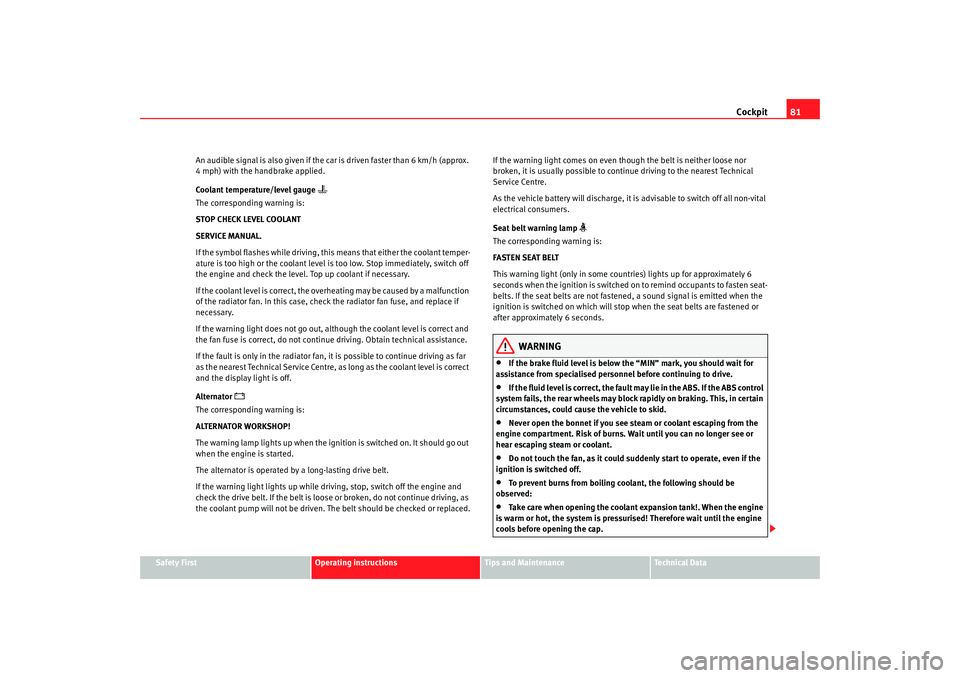
Coolant temperature/level gauge
The corresponding warning is:
STOP CHECK LEVEL COOLANT
SERVICE MANUAL.
If the symbol flashes while driving, this means that either the coolant temper-
ature is too high or the coolant level is too low. Stop immediately, switch off
the engine and check the level. Top up coolant if necessary.
If the coolant level is correct, the overheating may be caused by a malfunction
of the radiator fan. In this case, check the radiator fan fuse, and replace if
necessary.
If the warning light does not go out, although the coolant level is correct and
the fan fuse is correct, do not continue driving. Obtain technical assistance.
If the fault is only in the radiator fan, it is possible to continue driving as far
as the nearest Technical Service Centre, as long as the coolant level is correct
and the display light is off.
Alternator
The corresponding warning is:
ALTERNATOR WORKSHOP!
The warning lamp lights up when the ignition is switched on. It should go out
when the engine is started.
The alternator is operated by a long-lasting drive belt.
If the warning light lights up while driving, stop, switch off the engine and
check the drive belt. If the belt is loose or broken, do not continue driving, as
the coolant pump will not be driven. The belt should be checked or replaced.
If the warning light comes on even though the belt is neither loose nor
broken, it is usually possible to continue driving to the nearest Technical
Service Centre.
As the vehicle battery will discharge, it is advisable to switch off all non-vital
electrical consumers.
Seat belt warning lamp
The corresponding warning is:
FASTEN SEAT BELT
This warning light (only in some countries) lights up for approximately 6
seconds when the ignition is switched on to remind occupants to fasten seat-
belts. If the seat belts are not fastened, a sound signal is emitted when the
ignition is switched on which will stop when the seat belts are fastened or
after approximately 6 seconds.
WARNING
•
If the brake fluid level is below the “MIN” mark, you should wait for
assistance from specialised personnel before continuing to drive.
•
If the fluid level is correct, the fault may lie in the ABS. If the ABS control
system fails, the rear wheels may block rapidly on braking. This, in certain
circumstances, could cause the vehicle to skid.
•
Never open the bonnet if you see steam or coolant escaping from the
engine compartment. Risk of burns. Wait until you can no longer see or
hear escaping steam or coolant.
•
Do not touch the fan, as it could suddenly start to operate, even if the
ignition is switched off.
•
To prevent burns from boiling coolant, the following should be
observed:
•
Take care when opening the coolant expansion tank!. When the engine
is warm or hot, the system is pressurised! Therefore wait until the engine
cools before opening the cap.
alhambra_ingles_0708 Seite 81 Mittwoch, 10. September 2008 10:55 10
Page 84 of 295

Cockpit
82•
To protect your face, hands and arms from hot steam or fluid, cover the
fan cap with a large cloth in order to open it.
•
Take care to avoid coolant spilling on the exhaust pipe or any other hot
component as antifreeze is inflammable.
Priority 2 (yellow symbols)If a yellow symbol appears, a sound signal is emitted. The symbols indicate
a dangerous situation. The function shown should be controlled as fast as
possible. If various faults occur at the same time, the symbols will be
displayed one by one for approx. 2 seconds.
Oil level too low
The corresponding warning is:
CHECK LEVEL OIL
If the symbol lights up: stop, switch off the engine and check the oil level,
topping up where necessary.
Oil level too low
The corresponding warning is:
OIL SENSOR WORKSHOP!
If the symbol flashes this probably means that the oil level sensor is defec-
tive. The vehicle should immediately be taken to a Technical Service Centre.
It is possible to continue driving, but the oil level should be continually moni-
tored, e.g. every time the vehicle is refuelled.
Engine fault
- Petrol engine
- Diesel engine
The corresponding warning is:
ENGINE FAULT WORKSHOP!
If a fault in the running of the engine arises while driving, the corresponding
light will come on (petrol engine) or flash (diesel engine). In this case the
engine should be checked immediately by a Technical Service Centre.
Anti-lock brake system (ABS)
The corresponding warning is:
ABS FAULT
A fault in the ABS system is shown in the following manner:
If the ABS warning light comes on separately, it is possible to brake the
vehicle using the normal brake system (without ABS). Consult a Technical
Service Centre as soon as possible.
Electronic immobiliser
The corresponding warning is:
IMMOBILIS.ACTIVE
When the ignition is switched on, the vehicle key data is automatically
consulted. The warning light will flash to confirm that the data is being
checked
If an unauthorised key is used, the warning light will flash constantly. It will
not be possible to start the vehicle.
Tailgate/bonnet open display *
The corresponding warning is:
TA ILGATE OPEN
This warning light only indicates that the tailgate is open.
WARNING (continued)
alhambra_ingles_0708 Seite 82 Mittwoch, 10. September 2008 10:55 10
Page 85 of 295
Cockpit83
Safety First
Operating instructions
Tips and Maintenance
Te c h n i c a l D a t a
The warning light only goes off when the tailgate is completely closed ( to the
second position)
Windscreen washer*
The corresponding warning is:
TOP UP WASHER FLUID
This symbol lights up to indicate that the windscreen washer level is too low.
Top up windscreen and headlight washer fluid*
Fuel level low
The corresponding warning is:
PLEASE REFUELNavigation system*
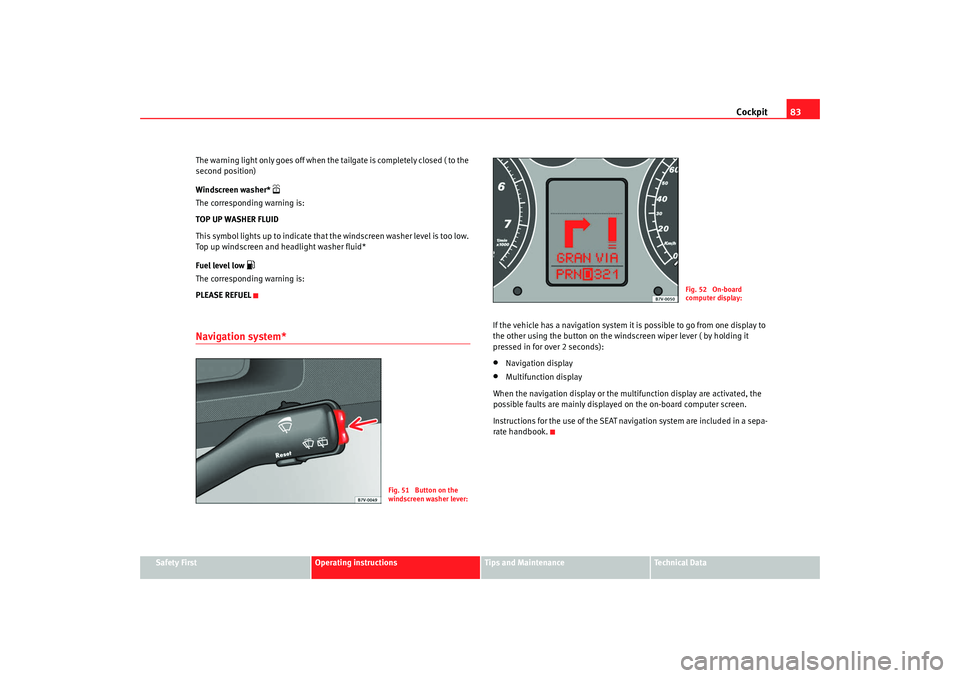
If the vehicle has a navigation system it is possible to go from one display to
the other using the button on the windscreen wiper lever ( by holding it
pressed in for over 2 seconds):•
Navigation display
•
Multifunction display
When the navigation display or the multifunction display are activated, the
possible faults are mainly displayed on the on-board computer screen.
Instructions for the use of the SEAT navigation system are included in a sepa-
rate handbook.
Fig. 51 Button on the
windscreen washer lever:
Fig. 52 On-board
computer display:
alhambra_ingles_0708 Seite 83 Mittwoch, 10. September 2008 10:55 10
Page 87 of 295
Cockpit85
Safety First
Operating instructions
Tips and Maintenance
Te c h n i c a l D a t a
−
Button for: station search, backwards (radio), listening to TIM
messages, starting with latest (radio / navigation), fast rewind
(cassette mode), last track (CD mode).
Pushbutton for switching lighting on and off on the controls on the multi-
function steering wheel (on the side of the steering wheel).
Note
The cruise control system is switched on and off using the button on the turn-
signal / main beam lever.Te l e p h o n e *Handsfree system for mobile telephones*Using the hands-free unit you can telephone without having to hold the
mobile telephone in your hand.
The voice of the person you are talking to will be relayed via the loudspeakers
of the radio system. You do not have to do anything in particular to respond -
simply behave as if you were talking to the front seat passenger.
The microphone is located on the left-hand side of the drink holder.
The required volume for the conversation can be set via the radio controls.
Note
•
P l e as e n o t e t h a t y o u w i l l b e a b l e t o h o l d a p h o n e c o n v e r sa t i o n t h r o u g h t h e
handsfree system only when the key is in the ignition. If the key is removed, the conversation will only be possible through the telephone, since the
handsfree system is disconnected.
•
When leaving the vehicle, either take the mobile telephone with you or
switch the automatic call acceptance off as incoming calls will be passed on
even if the radio is switched off.
Telephone preinstallation*The telephone preinstallation consists of:•
a microphone (on the left of the drinks holder),
•
an interface box,
•
the automatic loudspeaker switch in the radio system to relay telephone
conversations,
•
a support incorporated in the dash panel,
•
and a telephone roof aerial.
In order to use the telephone together with the vehicle system, a mobile tele-
phone holder adapted to the dash panel is also required. Next, the mobile
telephone holder will then have to be connected to the dash panel telephone
console.
For any queries concerning its use, please contact your SEAT Dealer.
A5
alhambra_ingles_0708 Seite 85 Mittwoch, 10. September 2008 10:55 10
Page 88 of 295
Cockpit
86CE0434.
alhambra_ingles_0708 Seite 86 Mittwoch, 10. September 2008 10:55 10
Declaration of conformityNOKIA CORPORATION declares under its sole responsibility that the product
HT-1 conforms to the provisions in 1995/5/EC of the European Union Council.
A copy of the Declaration of Conformity can be requested from the Customer
Service Department for this brand.
Page 112 of 295
Lights and visibility
110Illumination of instruments and switches
When the headlights are switched on, the brightness of the instruments and
switch lighting can be regulated to suit your requirements by turning the
switch ⇒page 109, fig. 71 .
Headlight range control
Using the headlight range control, you can adjust the headlight range to the
load level that is being carried in the vehicle. In this way it is possible to avoid
dazzling oncoming traffic more than necessary. At the same time, the driver
has the best possible lighting for the road ahead using the correct headlight
settings.
The headlights can only be adjusted when the dipped beam is switched on.
To lower the beam, turn the switch down from the basic setting 0.
If the vehicle load does not correspond to those shown in the table, it is
possible to select intermediary positions.
Dynamic headlight range control
Ve h icle s with gas discharge lamps
19) (“xenon lamps”) are equipped with
dynamic headlight range control . When the dipped light is switched on, the
range of the headlights adjusts to the vehicle load condition. In these vehi-
cles, the control is not available.
WARNING
In order not to dazzle other drivers, the dipped light should be adjusted
according to the vehicle load using the headlight range control. If not, an
accident may occur.•
Use the switch to lower the light cone, depending on the vehicle load.
Hazard warning lights
The hazard warning lights are used to draw the attention of
other road users to your vehicle in emergencies.If you have a breakdown:
1. Park your vehicle at a safe distance from moving traffic.
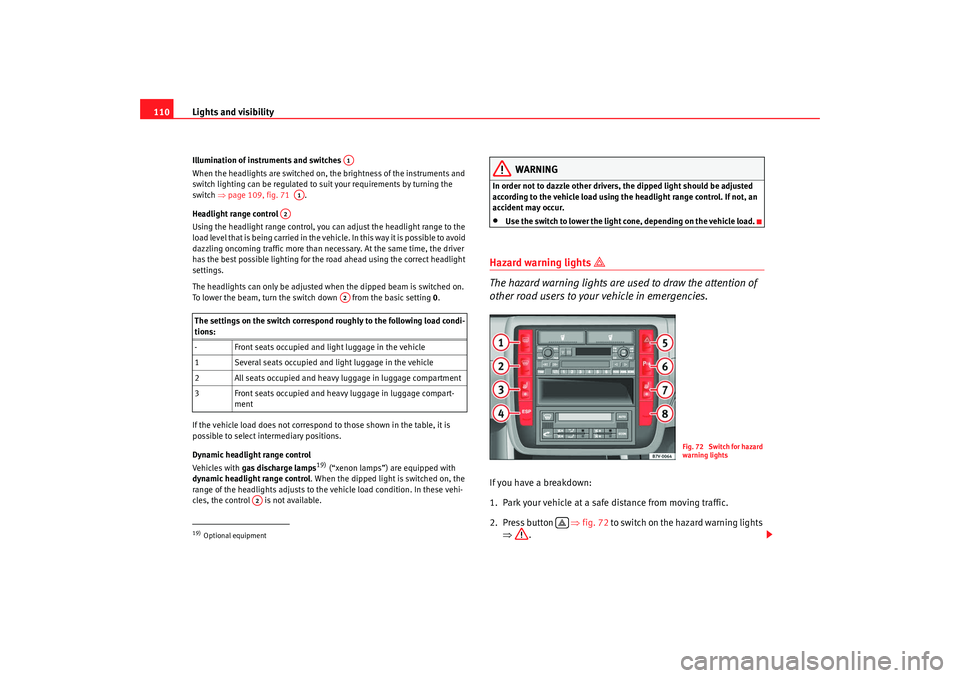
2. Press button ⇒fig. 72 to switch on the hazard warning lights
⇒ .
The settings on the switch correspond roughly to the following load condi-
tions:
- Front seats occupied and light luggage in the vehicle
1 Several seats occupied and light luggage in the vehicle
2 All seats occupied and heavy luggage in luggage compartment
3 Front seats occupied and heavy luggage in luggage compart-
ment19)Optional equipment
A1
A1
A2
A2
A2
Fig. 72 Switch for hazard
warning lights
alhambra_ingles_0708 Seite 110 Mittwoch, 10. September 2008 10:55 10
Page 114 of 295
Lights and visibility
112
Switching on the turn signals
– Move the lever all the way up ⇒page 111, fig. 73 to indicate
right , and all the way down to indicate left .
Signalling a lane change
– Move the lever upwards or downwards to change lanes.
Switching main beam on and off
– Turn the light switch to position
⇒ page 108, fig. 70 .
– Press the lever forward to switch on the main beams.
– Pull the lever back towards you to switch the main beam head- lights off again.
Headlight flasher
– Pull the lever towards the steering wheel to operate the flasher.
Switching on parking lights
– Switch off the ignition and remove the key from the lock.
– Move the lever up or down to turn on the right or left-hand parking lights respectively.
WARNING
The main beam can dazzle other drivers. Risk of accident! Never use the
main beam headlights or the headlight flasher if they could dazzle other
drivers.
Note
•
The turn signals only work when the ignition is switched on. The corre-
sponding warning lamp or flashes in the combi-instrument. The warning
lamp 20) flashes when the turn signals are operated, provided a trailer is
correctly attached and connected to the vehicle. If a turn signal bulb is defec-
tive, the warning lamp flashes at double speed. If the trailer turn signal bulbs
are damaged, warning lamp does not light up. You should have the bulbs
replaced.
•
Both warning lamps will flash at the same time when the hazard warning
lights are switched on.
•
If one turn signal fails, whether that of the vehicle or of the trailer, the
warning lamp will start flashing twice as fast.
•
The main beam headlights can only be switched on if the dipped beam
headlights are already on. The warning lamp
then comes on in the combi-
instrument.
•
The headlight flasher comes on for as long as you pull the lever – even if
no other lights are switched on. The warning lamp
then comes on in the
combi-instrument.
•
When the parking light is switched on, the front side light and the rear
light of the corresponding side of the vehicle stay lit. The parking lights will
only work if the key is removed from the ignition.
•
If the turn signal lever is left on after the key has been taken out of the
ignition lock, a buzzer sounds when the driver door is opened. This is a
reminder to switch off the turn signal, unless of course you wish to leave the
parking light on.
A1
A2
A1
A2
A3
A4
20)Optional equipment
alhambra_ingles_0708 Seite 112 Mittwoch, 10. September 2008 10:55 10
Page 123 of 295
Seats and stowage121
Safety First
Operating instructions
Tips and Maintenance
Te c h n i c a l D a t a
Seats and stowageThe importance of correct seat adjustmentProper seat adjustment optimises the level of protection
offered by seat belts and airbags.The driver seat, front passenger seat, and seats in the passenger compart-
ment, can be adjusted in many ways to suit the physical requirements of the
vehicle occupants. The correct seat position is very important for:•
fast and easy operation of all controls on the instrument panel,
•
relaxed posture that does not cause drowsiness,
•
safe driving,
•
optimum protection from the seat belts and airbag system ⇒page 7.
Vehicle seats
Your vehicle has a total of five or seven
24) seats.
•
First row of seats: two seats
•
Second row of seats: three seats
•
Third row of seats
24): two seats
Each seat is equipped with a three-point seat belt.
WARNING
If the driver and passengers assume improper sitting positions, they may
sustain critical injuries.•
Never transport more people than there are seats available in the
vehicle.
•
Every occupant in the vehicle must properly fasten and wear the seat
belt belonging to his or her seat. Children must be protected with an appro-
priate child restraint system. Section “Child Safety”
•
The seats and all head restraints must always be adjusted to body size
and the seat belt must always be properly adjusted to provide you and your
passengers with optimum protection.
•
Always keep your feet in the footwell when the vehicle is moving; never
rest them on the dash panel, out of the window or on the seat. This also
applies to passengers. An incorrect sitting position exposes you to an
increased risk of injury in the event of a braking manoeuvre or an accident.
If the airbag is triggered, you could sustain fatal injuries due to an improper
sitting position.
•
It is important for the driver and front passenger to maintain a distance
of at least 25 cm from the steering wheel or dash panel. Failure to respect
the minimum distance means that the airbag will not protect you. Risk of
fatal injury. The distance between the driver and the steering wheel or
between the front passenger and the dash panel should always be as great
as possible.
•
Adjust the driver or front passenger seat only when the vehicle is
stationary. Otherwise your seat could move unexpectedly while the vehicle
is moving. This could increase the risk of an accident and therefore injury.
In addition, while adjusting your seat, you will assume an incorrect sitting
position. Risk of fatal accidents.
•
Special guidelines apply to installing a child seat on the front
passenger seat. When installing a child seat, observe the warning note in
“Child safety”.
•
The seats in the third row of seats may, for safety reasons, only be used
if the luggage compartment cover has been removed.
24)Optional equipment
WARNING (continued)
alhambra_ingles_0708 Seite 121 Mittwoch, 10. September 2008 10:55 10
Page 134 of 295
Seats and stowage
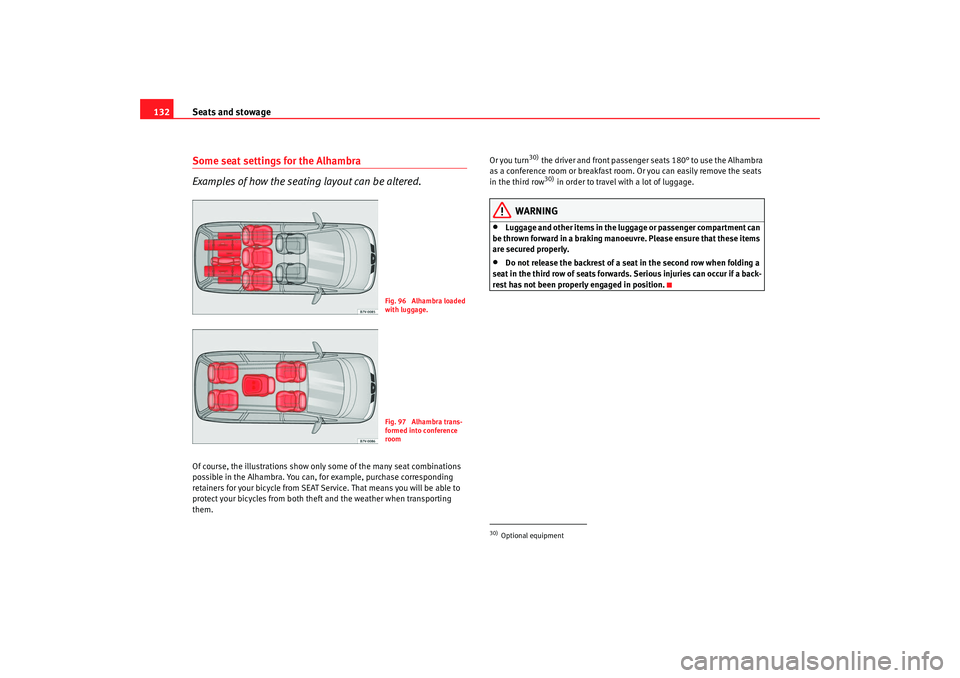
132Some seat settings for the Alhambra
Examples of how the seating layout can be altered.Of course, the illustrations show only some of the many seat combinations
possible in the Alhambra. You can, for example, purchase corresponding
retainers for your bicycle from SEAT Service. That means you will be able to
protect your bicycles from both theft and the weather when transporting
them. Or you turn
30) the driver and front passenger seats 180° to use the Alhambra
as a conference room or breakfast room. Or you can easily remove the seats
in the third row30) in order to travel with a lot of luggage.
WARNING
•
Luggage and other items in the luggage or passenger compartment can
be thrown forward in a braking manoeuvre. Please ensure that these items
are secured properly.
•
Do not release the backrest of a seat in the second row when folding a
seat in the third row of seats forwards. Serious injuries can occur if a back-
rest has not been properly engaged in position.
Fig. 96 Alhambra loaded
with luggage.Fig. 97 Alhambra trans-
formed into conference
room
30)Optional equipment
alhambra_ingles_0708 Seite 132 Mittwoch, 10. September 2008 10:55 10