maintenance Seat Alhambra 2009 Owner's Manual
[x] Cancel search | Manufacturer: SEAT, Model Year: 2009, Model line: Alhambra, Model: Seat Alhambra 2009Pages: 285, PDF Size: 7.62 MB
Page 235 of 285
If and when233
Safety First
Operating instructions
Tips and Maintenance
Te c h n i c a l D a t a
If and whenVehicle tools*, spare wheel*, breakdown set*
and towing bracketLocation
The vehicle tools, the spare wheel and the removable ball
coupling of the towing bracket are stored in the luggage
compartment.Vehicle tool kit and removable ball coupling
The vehicle tool kit and removable towing bracket ball coupling are stored on
the right of the luggage compartment, behind a cover.
Spare wheel
The spare wheel is stored underneath the vehicle ⇒page 234.
Caution
Make sure that the spare wheel / removed wheel and the tools are stored
safely in the luggage compartment.
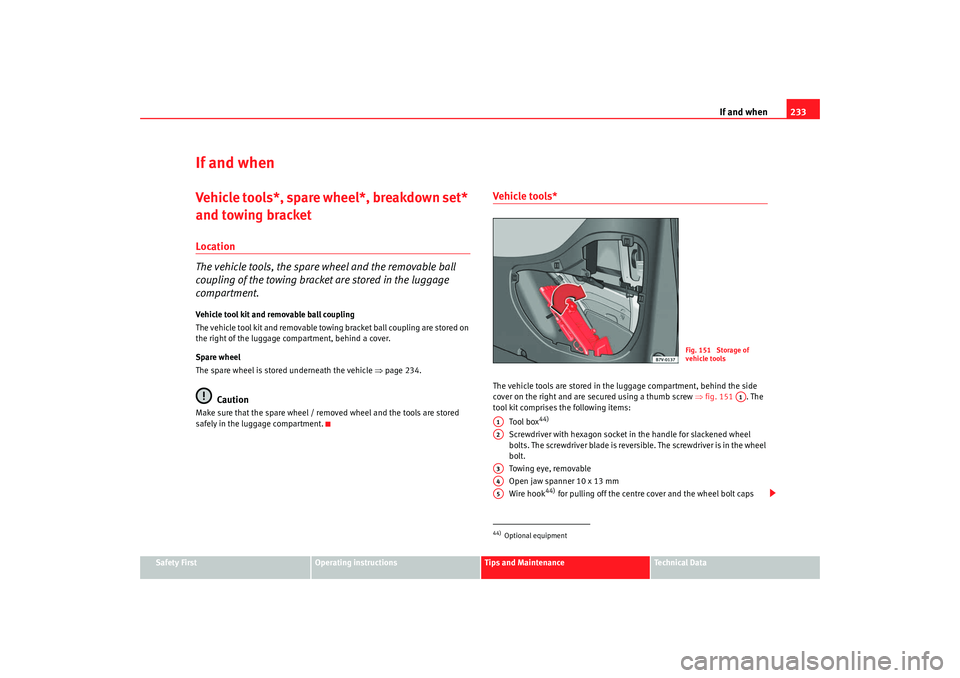
Vehicle tools*The vehicle tools are stored in the luggage compartment, behind the side
cover on the right and are secured using a thumb screw ⇒fig. 151 . The
tool kit comprises the following items:
To ol b ox
44)
Screwdriver with hexagon socket in the handle for slackened wheel
bolts. The screwdriver blade is reversible. The screwdriver is in the wheel
bolt.
Towing eye, removable
Open jaw spanner 10 x 13 mm
Wire hook
44) for pulling off the centre cover and the wheel bolt caps
44)Optional equipment
Fig. 151 Storage of
vehicle tools
A1
A1A2A3A4A5
alhambra_aleman.book Seite 233 Montag, 23. M‰ rz 2009 1:12 13
Page 237 of 285
If and when235
Safety First
Operating instructions
Tips and Maintenance
Te c h n i c a l D a t a
WARNING
•
If you are driving without the spare wheel, the cable should be rolled up
and the bracket fastened to the floor of the luggage compartment.
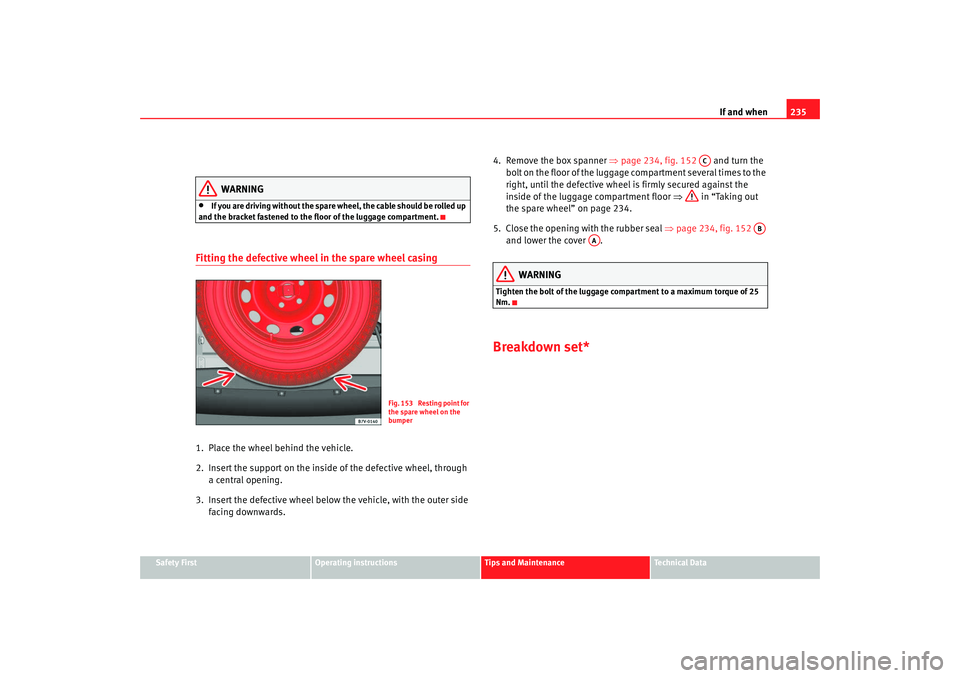
Fitting the defective wheel in the spare wheel casing1. Place the wheel behind the vehicle.
2. Insert the support on the inside of the defective wheel, through a central opening.
3. Insert the defective wheel below the vehicle, with the outer side facing downwards. 4. Remove the box spanner
⇒page 234, fig. 152 and turn the
bolt on the floor of the luggage compartment several times to the
right, until the defective wheel is firmly secured against the
inside of the luggage compartment floor ⇒ in “Taking out
the spare wheel” on page 234.
5. Close the opening with the rubber seal ⇒page 234, fig. 152
and lower the cover .
WARNING
Tighten the bolt of the luggage compartment to a maximum torque of 25
Nm.Breakdown set*
Fig. 153 Resting point for
the spare wheel on the
bumper
AC
AB
AA
alhambra_aleman.book Seite 235 Montag, 23. M‰ rz 2009 1:12 13
Page 239 of 285
If and when237
Safety First
Operating instructions
Tips and Maintenance
Te c h n i c a l D a t a
– Use the enclosed extractor ⇒page 236, fig. 154 to unscrew
the valve insert. Place the valve insert on a clean surface.
– Vigorously shake the sealant bottle ⇒page 236, fig. 154 for
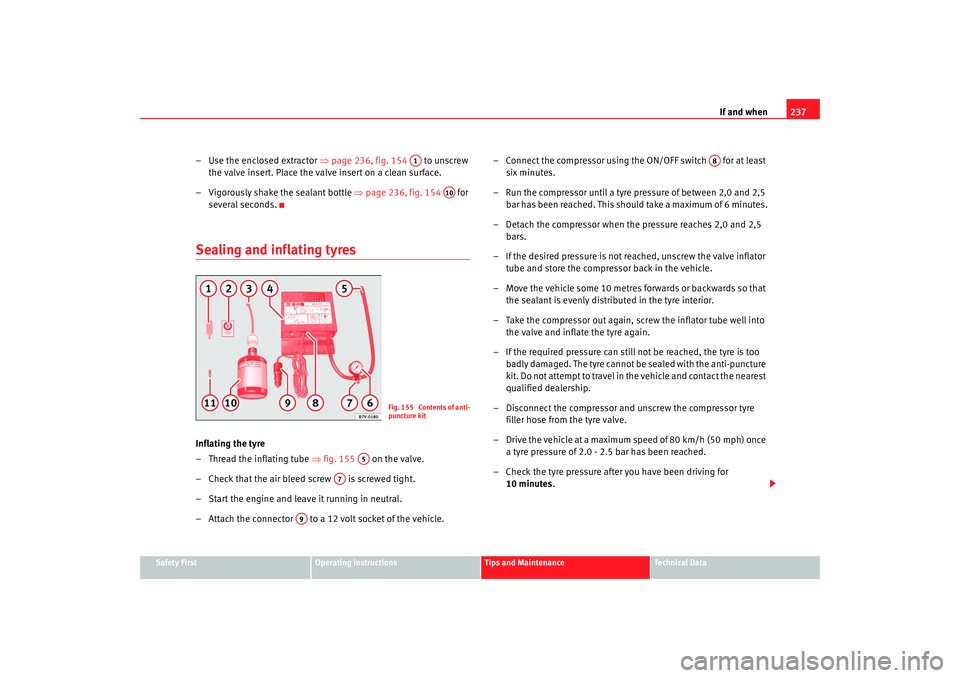
several seconds.Sealing and inflating tyresInflating the tyre
– Thread the inflating tube ⇒fig. 155 on the valve.
– Check that the air bleed screw is screwed tight.
– Start the engine and leave it running in neutral.
– Attach the connector to a 12 volt socket of the vehicle. – Connect the compressor using the ON/OFF switch for at least
six minutes.
– Run the compressor until a tyre pressure of between 2,0 and 2,5 b ar has b ee n rea che d. This sh ould ta ke a ma xi m um of 6 mi n utes.
– Detach the compressor when the pressure reaches 2,0 and 2,5 bars.
– If the desired pressure is not reached, unscrew the valve inflator tube and store the compressor back in the vehicle.
– Move the vehicle some 10 metres forwards or backwards so that the sealant is evenly distributed in the tyre interior.
– Take the compressor out again, screw the inflator tube well into the valve and inflate the tyre again.
– If the required pressure can still not be reached, the tyre is too badly damaged. The tyre cannot be sealed with the anti-puncture
kit. Do not attempt to travel in the vehicle and contact the nearest
qualified dealership.
– Disconnect the compressor and unscrew the compressor tyre filler hose from the tyre valve.
– Drive the vehicle at a maximum speed of 80 km/h (50 mph) once a tyre pressure of 2.0 - 2.5 bar has been reached.
– Check the tyre pressure after you have been driving for 10 minutes .
A1
A10
Fig. 1 55 Conte nts of ant i-
puncture kit
A5
A7
A9
A8
alhambra_aleman.book Seite 237 Montag, 23. M‰ rz 2009 1:12 13
Page 241 of 285
If and when239
Safety First
Operating instructions
Tips and Maintenance
Te c h n i c a l D a t a
Removing the hubcaps
The hubcaps must be removed to gain access to the wheel
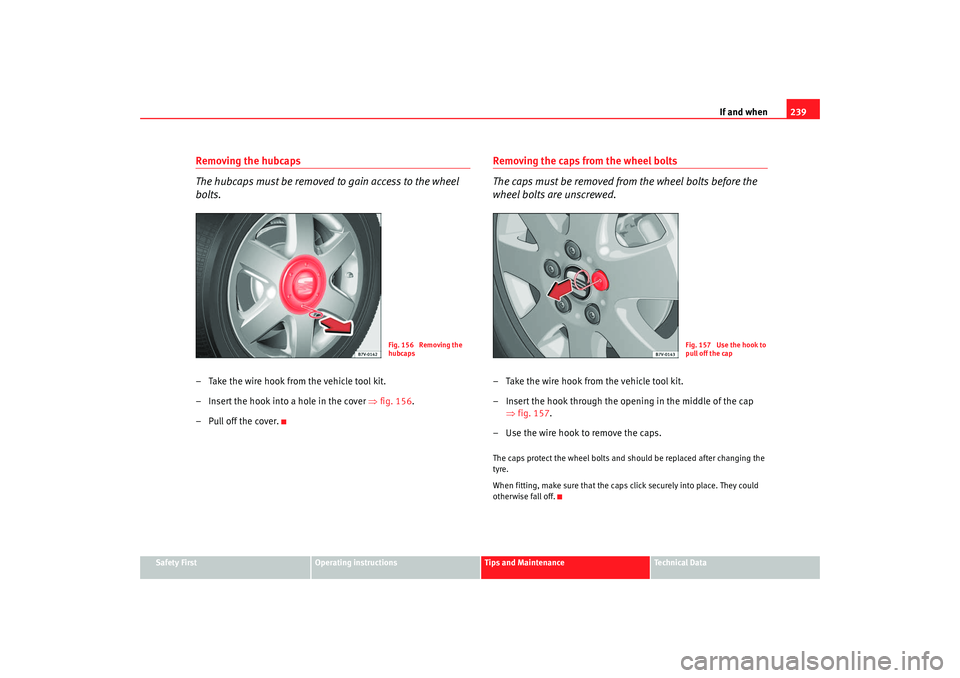
bolts.– Take the wire hook from the vehicle tool kit.
– Insert the hook into a hole in the cover ⇒fig. 156.
– Pull off the cover.
Removing the caps from the wheel bolts
The caps must be removed from the wheel bolts before the
wheel bolts are unscrewed.– Take the wire hook from the vehicle tool kit.
– Insert the hook through the opening in the middle of the cap ⇒fig. 157 .
– Use the wire hook to remove the caps.The caps protect the wheel bolts and should be replaced after changing the
tyre.
When fitting, make sure that the caps click securely into place. They could
otherwise fall off.
Fig. 156 Removing the
hubcaps
Fig. 157 Use the hook to
pull off the cap
alhambra_aleman.book Seite 239 Montag, 23. M‰ rz 2009 1:12 13
Page 243 of 285
If and when241
Safety First
Operating instructions
Tips and Maintenance
Te c h n i c a l D a t a
Raising the vehicle
Raise the vehicle using only the designated jacking points.
Do not raise the vehicle until you have slackened the wheel bolts on
the wheel you wish to remove ⇒page 240.
Jacking up the vehicle
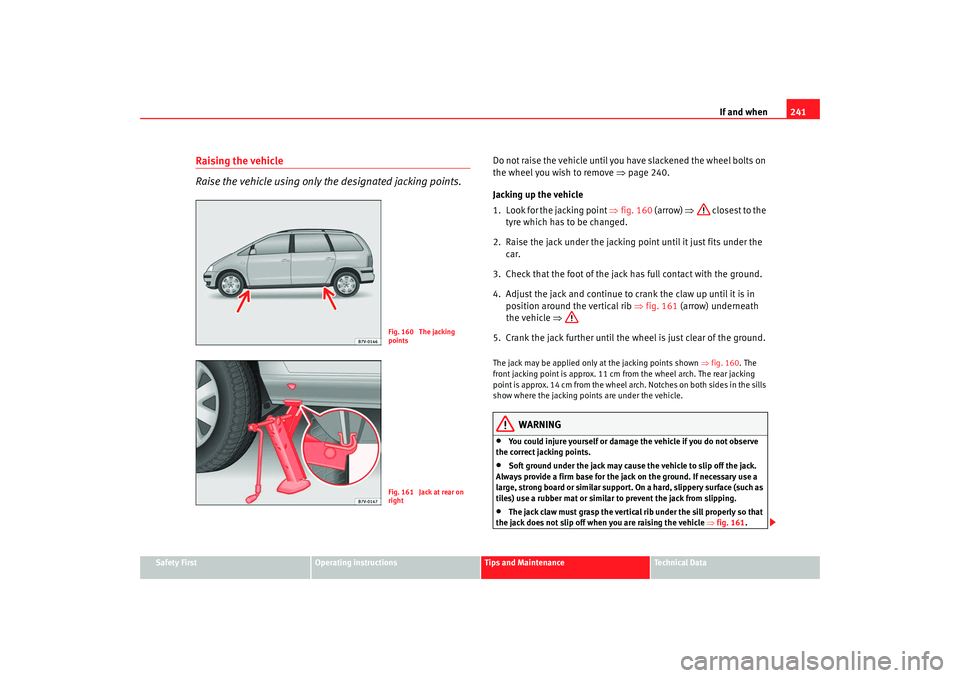
1. Look for the jacking point ⇒fig. 160 (arrow) ⇒ closest to the
tyre which has to be changed.
2. Raise the jack under the jacking point until it just fits under the car.
3. Check that the foot of the jack has full contact with the ground.
4. Adjust the jack and continue to crank the claw up until it is in position around the vertical rib ⇒fig. 161 (arrow) underneath
the vehicle ⇒
5. Crank the jack further until the wheel is just clear of the ground.The jack may be applied only at the jacking points shown ⇒fig. 160 . The
front jacking point is approx. 11 cm from the wheel arch. The rear jacking
point is approx. 14 cm from the wheel arch. Notches on both sides in the sills
show where the jacking points are under the vehicle.
WARNING
•
You could injure yourself or damage the vehicle if you do not observe
the correct jacking points.
•
Soft ground under the jack may cause the vehicle to slip off the jack.
Always provide a firm base for the jack on the ground. If necessary use a
large, strong board or similar support. On a hard, slippery surface (such as
tiles) use a rubber mat or similar to prevent the jack from slipping.
•
The jack claw must grasp the vertical rib under the sill properly so that
the jack does not slip off when you are raising the vehicle ⇒ fig. 161.
Fig. 160 The jacking
pointsFig. 161 Jack at rear on
right
alhambra_aleman.book Seite 241 Montag, 23. M‰ rz 2009 1:12 13
Page 245 of 285
If and when243
Safety First
Operating instructions
Tips and Maintenance
Te c h n i c a l D a t a
WARNING
•
If the prescribed torque of the wheel bolts is too low, they could loosen
whilst the vehicle is in motion. Risk of accident! If the tightening torque is
too high, the wheel bolts and threads could be damaged.Caution
The stipulated torque for the wheel bolts on steel wheels and alloy wheels is
170 Nm with a tolerance of ±10 Nm. You should visit a specialised workshop
as soon as possible to check the torque with a torque wrench.
Note
•
The wheel bolts should be clean and turn easily. Do not grease or oil them.
•
The hexagonal socket in the screwdriver handle should be used only for
turning wheel bolts which have been slackened off. Do not use it to loosen or
tighten the wheel bolts.
•
If you notice that the wheel bolts are corroded and difficult to turn when
changing a wheel, they must be replaced before you have the tightening
torque checked.
•
If the spare tyre is not the same as the tyres that are mounted on the car -
for example with winter tyres - you should only use the spare tyre for a short
period of time and drive with extra care. Refit the normal road wheel as soon
as possible.
•
Have the flat tyre replaced as quickly as possible.
FusesChanging a fuse– Use the fuse tables, to find out where, and in which fuse box, the damaged fuse is located ⇒ page 244.
– Switch off the ignition and the component concerned.
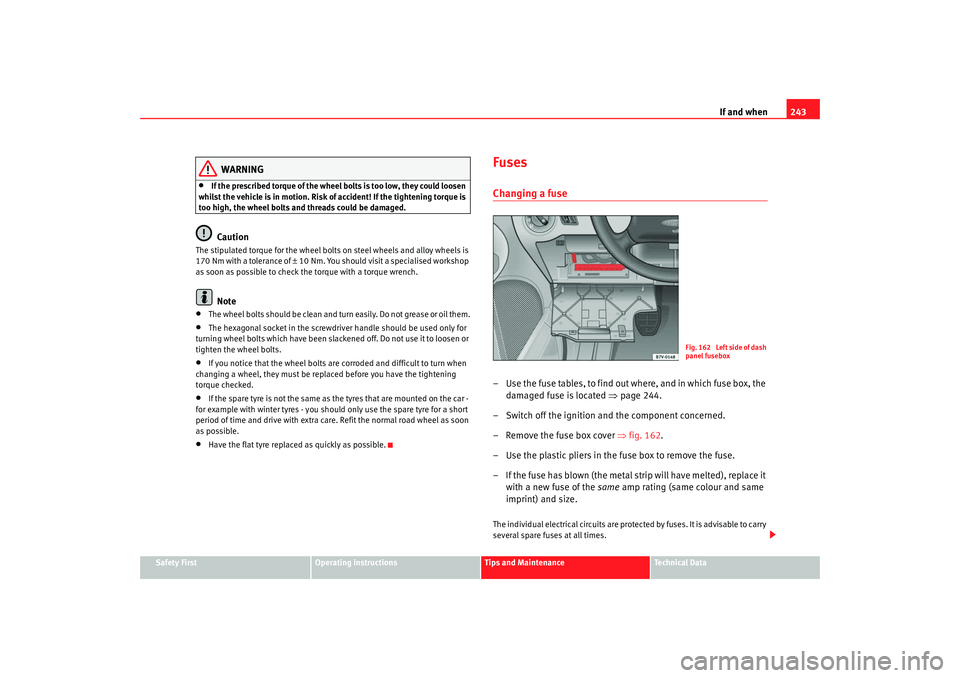
– Remove the fuse box cover ⇒fig. 162 .
– Use the plastic pliers in the fuse box to remove the fuse.
– If the fuse has blown (the metal strip will have melted), replace it with a new fuse of the same amp rating (same colour and same
imprint) and size.The individual electrical circuits are protected by fuses. It is advisable to carry
several spare fuses at all times.
F ig . 1 6 2 Le f t si d e o f d as h
panel fusebox
alhambra_aleman.book Seite 243 Montag, 23. M‰ rz 2009 1:12 13
Page 247 of 285

If and when245
Safety First
Operating instructions
Tips and Maintenance
Te c h n i c a l D a t a
Changing a lightBulbs, changing
Bulbs should be changed by a professional mechanic only.Technical knowledge is required to change bulbs. This is because, in certain
cases, access can be gained only by removing other vehicle components.
This applies in particular to bulbs which can be accessed only from the
engine compartment.
We recommend bulbs are changed by a qualified dealership or, if this is not
possible, by a qualified person.
However, if you wish to change the bulb, please observe the following:
Before changing a bulb, you must switch off the light (light switch in O posi-
tion), and the turn signal lever must be in the neutral position.
Always replace damaged bulbs with identical bulbs with the same designa-
tion. The type is inscribed on the bulb, either on the glass or on the base.
You should store spare light bulbs in the vehicle for safety-relevant lights.
Bulbs can be obtained from SEAT Service Centres.
WARNING
•
The high voltage element of gas discharge lamps must be handled
correctly. Failure to comply could result in fatal injuries.
•
H7* bulbs are pressurised and could explode when they are being
changed. Risk of injury.
•
In vehicles fitted with gas discharge lamps*, there is a mortal danger if
the high voltage section of the lamp is incorrectly handled.
•
When working in the engine compartment, always observe the safety
warnings ⇒page 211.
Hazard warning light switch
Instrument panel lighting
Climate control
Heating
Radio, navigation system
/
Rear light
-
Registration plate light
Windscreen washers
Windscreen washer system
Sliding sunroof
Seat heating
Mirror adjustment
Heating the exterior mirrors
Side lights
Socket (luggage compartment)
Central locking.
-
Electrical consumer
Symbol
alhambra_aleman.book Seite 245 Montag, 23. M‰ rz 2009 1:12 13
Page 249 of 285
If and when247
Safety First
Operating instructions
Tips and Maintenance
Te c h n i c a l D a t a
Lights on vehicle body – Open the cover in the luggage compartment trim.
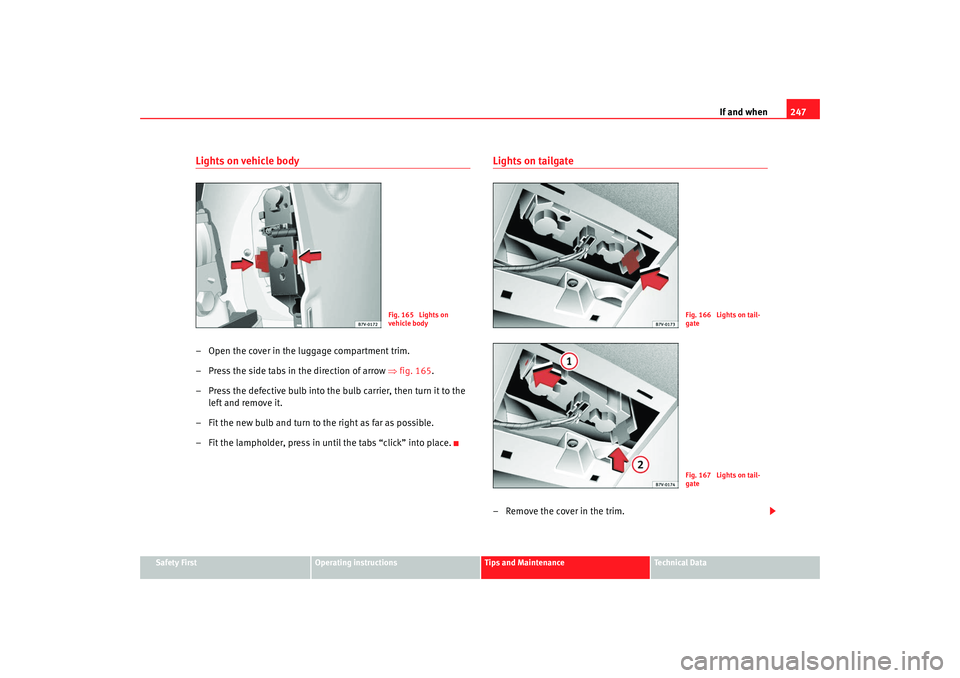
– Press the side tabs in the direction of arrow ⇒fig. 165.
– Press the defective bulb into the bulb carrier, then turn it to the left and remove it.
– Fit the new bulb and turn to the right as far as possible.
– Fit the lampholder, press in until the tabs “click” into place.
Lights on tailgate– Remove the cover in the trim.
Fig. 165 Lights on
vehicle body
Fig. 166 Lights on tail-
gateFig. 167 Lights on tail-
gate
alhambra_aleman.book Seite 247 Montag, 23. M‰ rz 2009 1:12 13
Page 251 of 285
If and when249
Safety First
Operating instructions
Tips and Maintenance
Te c h n i c a l D a t a
– Replace the bulb.
– Replace the glass in the casing.Reading light
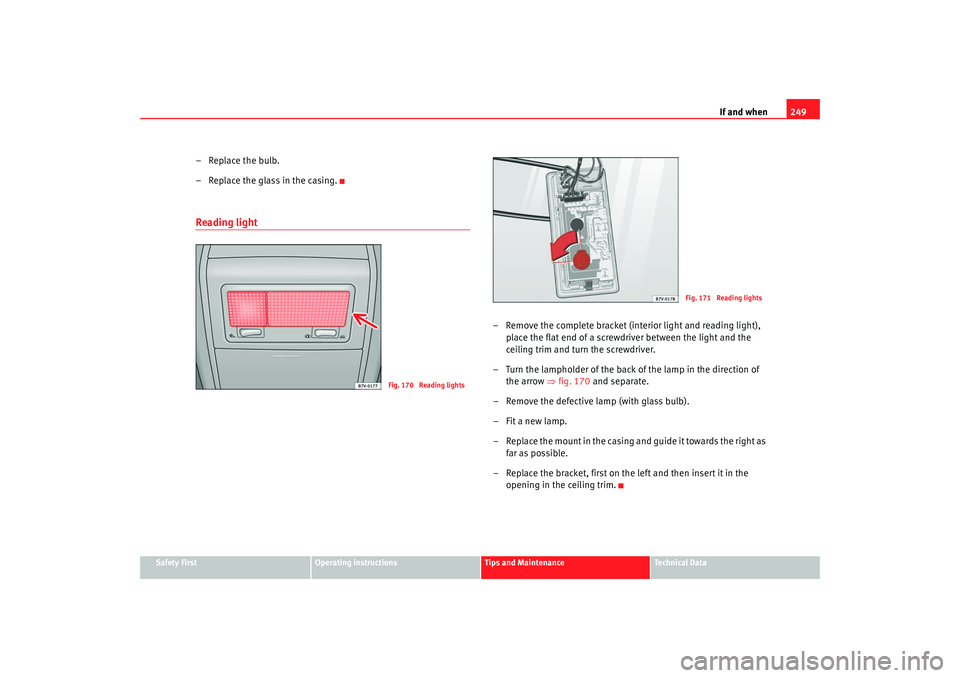
– Remove the complete bracket (interior light and reading light),
place the flat end of a screwdriver between the light and the
ceiling trim and turn the screwdriver.
– Turn the lampholder of the back of the lamp in the direction of the arrow ⇒fig. 170 and separate.
– Remove the defective lamp (with glass bulb).
–Fit a new lamp.
– Replace the mount in the casing and guide it towards the right as far as possible.
– Replace the bracket, first on the left and then insert it in the opening in the ceiling trim.
Fig. 170 Reading lights
Fig. 171 Reading lights
alhambra_aleman.book Seite 249 Montag, 23. M‰ rz 2009 1:12 13
Page 253 of 285
If and when251
Safety First
Operating instructions
Tips and Maintenance
Te c h n i c a l D a t a
4. Connect the other end of the black jump lead to a solid metal
component which is bolted on to the engine block, or onto the
engine block itself of the vehicle with the flat battery. Do not
connect it to a point near the battery ⇒ .
5. Position the leads in such a way that they cannot come into contact with any moving parts in the engine compartment.
Starting
6. Start the engine of the vehicle with the boosting battery and let it run at idling speed.
7. Start the engine of the car with the flat battery and wait one or two minutes until the engine is “running”.
Removing the jump leads
8. Before you remove the jump leads, switch off the headlights (if they are switched on).
9. Turn on the heater blower and rear window heater in the vehicle with the flat battery. This helps minimise voltage peaks which are
generated when the leads are disconnected.
10. When the engine is running, disconnect the leads in reverse order to the details given above.Connect the battery clamps so they have good metal-to-metal contact with
the battery terminals.
If the engine fails to start, switch off the starter after about 10 seconds and
try again after about half a minute.
WARNING
•
Please note the safety warnings referring to working in the engine
compartment ⇒page 211, “Working in the engine compartment”.
•
The battery providing assistance must have the same voltage as the flat
battery (12V) and approximately the same capacity (see imprint on
battery). Failure to comply could result in an explosion.
•
Never use jump leads when one of the batteries is frozen. Danger of
explosion! Even after the battery has thawed, battery acid could leak and
cause chemical burns. If a battery freezes, it should be replaced.
•
Keep sparks, flames and lighted cigarettes away from batteries, danger
of explosion. Failure to comply could result in an explosion.
•
Observe the instructions provided by the manufacturer of the jump
leads.
•
Do not connect the negative cable from the other vehicle directly to the
negative terminal of the flat battery. The gas emitted from the battery could
be ignited by sparks. Danger of explosion.
•
Do not attach the negative cable from the other vehicle to parts of the
fuel system or to the brake line.
•
The non-insulated parts of the battery clamps must not be allowed to
touch. The jump lead attached to the positive battery terminal must not
touch metal parts of the vehicle, this can cause a short circuit.
•
Position the leads in such a way that they cannot come into contact
with any moving parts in the engine compartment.
•
Do not bend over the batteries. This could result in chemical burns.Note
The vehicles must not touch each other, otherwise electricity could flow as
soon as the positive terminals are connected.
AX
alhambra_aleman.book Seite 251 Montag, 23. M‰ rz 2009 1:12 13