maintenance Seat Alhambra 2009 Owner's Manual
[x] Cancel search | Manufacturer: SEAT, Model Year: 2009, Model line: Alhambra, Model: Seat Alhambra 2009Pages: 285, PDF Size: 7.62 MB
Page 255 of 285
If and when253
Safety First
Operating instructions
Tips and Maintenance
Te c h n i c a l D a t a
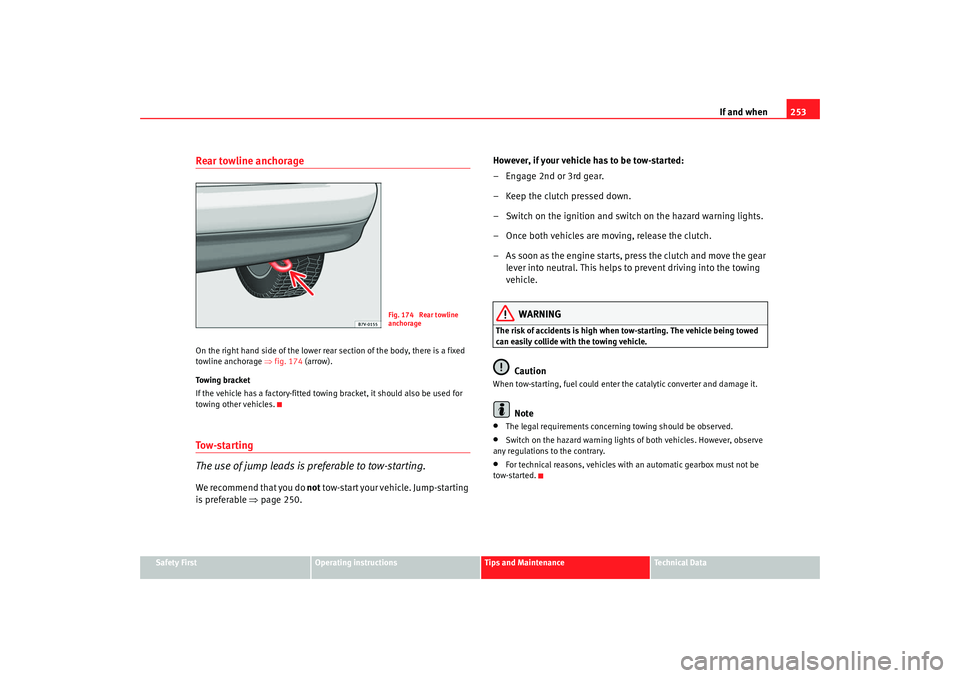
Rear towline anchorageOn the right hand side of the lower rear section of the body, there is a fixed
towline anchorage ⇒ fig. 174 (arrow).
To w i n g b r a c k e t
If the vehicle has a factory-fitted towing bracket, it should also be used for
towing other vehicles.To w - s t a r t i n g
The use of jump leads is preferable to tow-starting.We recommend that you do not tow-start your vehicle. Jump-starting
is preferable ⇒page 250. However, if your vehicle has to be tow-started:
– Engage 2nd or 3rd gear.
– Keep the clutch pressed down.
– Switch on the ignition and switch on the hazard warning lights.
– Once both vehicles are moving, release the clutch.
– As soon as the engine starts, press the clutch and move the gear
lever into neutral. This helps to prevent driving into the towing
vehicle.
WARNING
The risk of accidents is high when tow-starting. The vehicle being towed
can easily collide with the towing vehicle.
Caution
When tow-starting, fuel could enter the catalytic converter and damage it.
Note
•
The legal requirements concerning towing should be observed.
•
Switch on the hazard warning lights of both vehicles. However, observe
any regulations to the contrary.
•
For technical reasons, vehicles with an automatic gearbox must not be
tow-started.
Fig. 174 Rear towline
anchorage
alhambra_aleman.book Seite 253 Montag, 23. M‰ rz 2009 1:12 13
Page 257 of 285
If and when255
Safety First
Operating instructions
Tips and Maintenance
Te c h n i c a l D a t a
WARNING
The braking behaviour and capacity of a vehicle changes when being towed
or when you are trying to start the vehicle by pulling. Please observe the
following notes in order to prevent injury and accident:•
Inexperienced drivers should refrain from trying in order to avoid acci-
dent.
•
Notes for the driver of the towed vehicle
− The brake must be depressed must harder as the brake servo does
not operate. Take care not to bump into the towing vehicle.
− More strength is required at the steering wheel as the power
steering does not operate when the engine is switched off.
•
Notes for the driver of the towing vehicle
− Accelerate smoothly and avoid any sudden movement.
− Brake more in advance than usual and brake gently.Caution
When tow-starting, fuel could enter the catalytic converter and damage it
⇒ page 252.
Note
•
Observe legal requirements when towing or tow-starting.
•
For technical reasons, vehicles with an automatic gearbox must not be
tow-started.
•
If, due to a breakdown, the gearbox does not have lubricant, the vehicle
should be towed with the drive wheels suspended.
•
If it is necessary to tow a vehicle with an automatic gearbox for more than
50 km, it should be towed by qualified personnel and with the drive wheels
suspended.
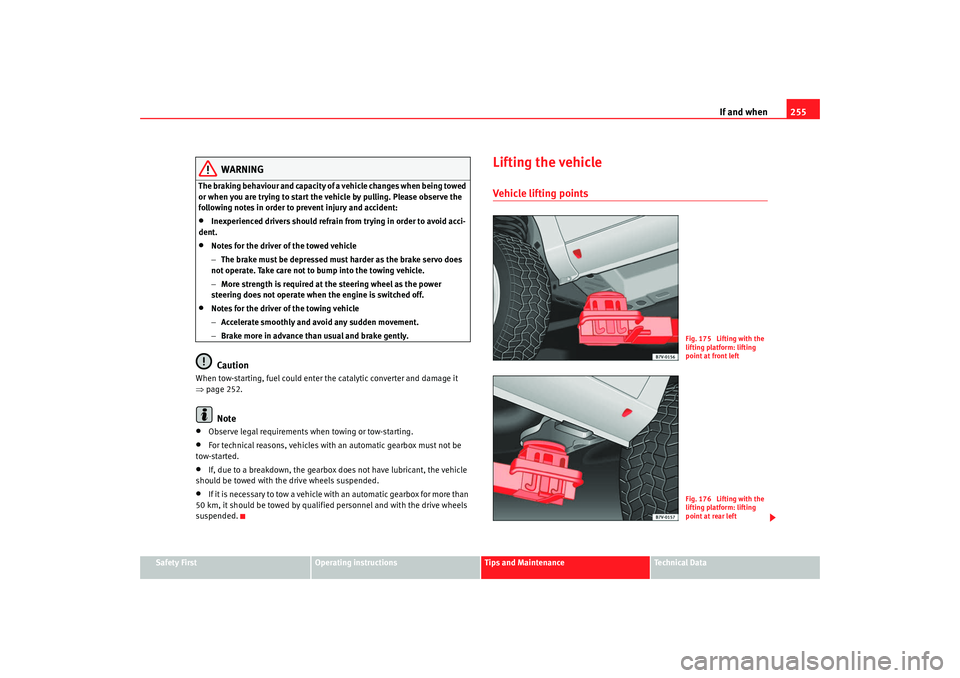
Lifting the vehicleVehicle lifting points
Fig. 175 Lifting with the
lifting platform: lifting
point at front leftFig. 176 Lifting with the
lifting platform: lifting
point at rear left
alhambra_aleman.book Seite 255 Montag, 23. M‰ rz 2009 1:12 13
Page 259 of 285
General notes on the technical data257
Safety First
Operating instructions
Tips and Maintenance
Te c h n i c a l D a t a
Technical DataGeneral notes on the technical dataWhat you should be aware ofGeneral notes
All data in the official vehicle documents take precedence over this data.All data in these documents are valid for the basic model as offered in Spain.
The vehicle data card included in the inspection and maintenance schedule
in the vehicles registration documents show which engine is installed in the
vehicle. The figures may be different if additional equipment is fitted, for different
models, for special vehicles and for other countries.
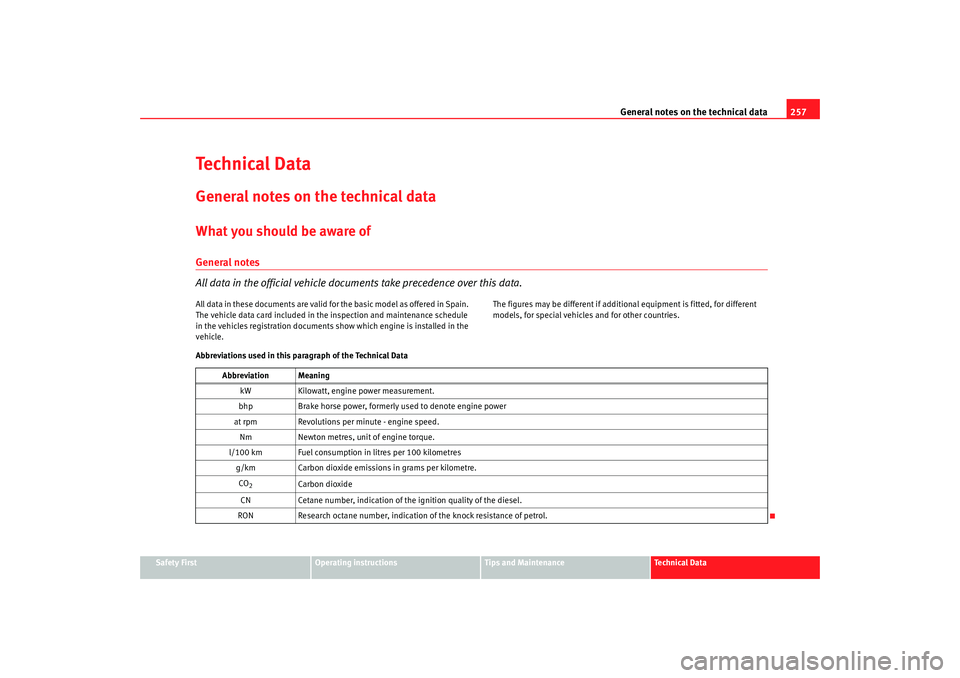
Abbreviations used in this paragraph of the Technical Data Abbreviation MeaningkW Kilowatt, engine power measurement.
bhp Brake horse power, formerly used to denote engine power
at rpm Revolutions per minute - engine speed. Nm Newton metres, unit of engine torque.
l/100 km Fuel consumption in litres per 100 kilometres g/km Carbon dioxide emissions in grams per kilometre.
CO
2
Carbon dioxide
CN Cetane number, indication of the ignition quality of the diesel.
RON Research octane number, indication of the knock resistance of petrol.
alhambra_aleman.book Seite 257 Montag, 23. M‰ rz 2009 1:12 13
Page 260 of 285
General notes on the technical data
258Vehicle identification dataVehicle identification number
The vehicle identification number (chassis number) can be read from outside
the vehicle through a viewer in the windscreen. This is located on the left-
hand side of the vehicle in the lower area of the windscreen. It is also located
on the right hand side of the engine compartment.
Type plate
The type plate is located on the left rib inside the engine compartment.
Ve hicle da ta
The data sticker is placed on the inside of the spare wheel recess in the
luggage compartment.
The following information can be found in the vehicle information:•
Vehicle identification number (chassis number)
•
Vehicle type / engine power / gearbox type
•
Engine and gearbox code / paint number / interior equipment
•
Optional extras / PR numbers
This information also figures in the Maintenance Program.
alhambra_aleman.book Seite 258 Montag, 23. M‰ rz 2009 1:12 13
Page 261 of 285
General notes on the technical data259
Safety First
Operating instructions
Tips and Maintenance
Te c h n i c a l D a t a
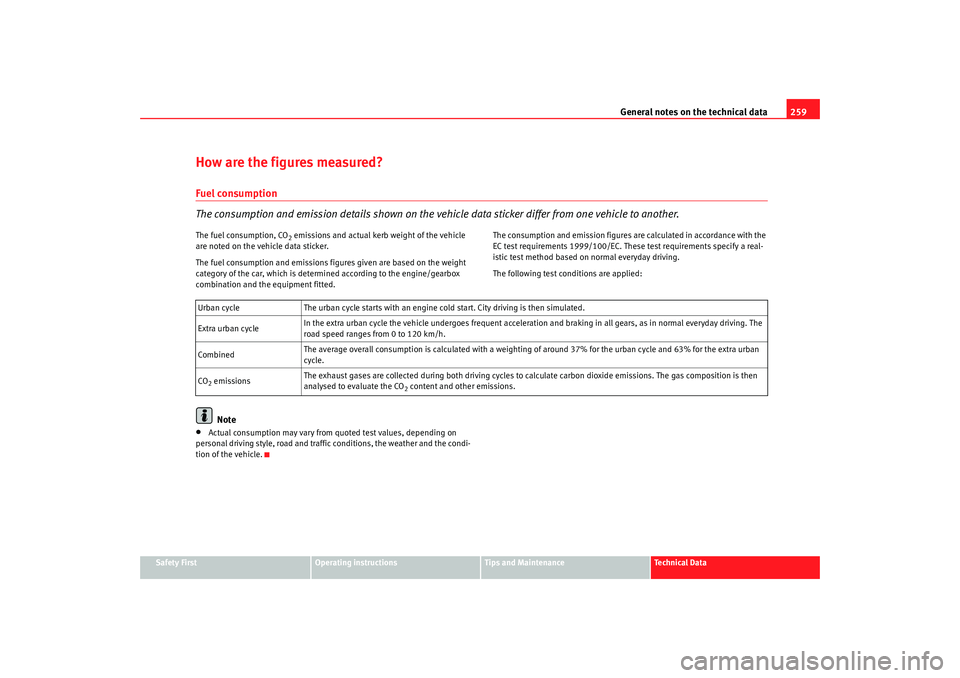
How are the figures measured?Fuel consumption
The consumption and emission details shown on the vehicle data sticker differ from one vehicle to another.The fuel consumption, CO
2 emissions and actual kerb weight of the vehicle
are noted on the vehicle data sticker.
The fuel consumption and emissions figures given are based on the weight
category of the car, which is determined according to the engine/gearbox
combination and the equipment fitted. The consumption and emission figures are calculated in accordance with the
EC test requirements 1999/100/EC. These test requirements specify a real-
istic test method based on normal everyday driving.
The following test conditions are applied:
Note
•
Actual consumption may vary from quoted test values, depending on
personal driving style, road and traffic conditions, the weather and the condi-
tion of the vehicle. Urban cycle
The urban cycle starts with an engine cold start. City driving is then simulated.
Extra urban cycle In the extra urban cycle the vehicle undergoes frequent acceleration and braking in all gears, as in normal everyday driving. T
he
road speed ranges from 0 to 120 km/h.
Combined The average overall consumption is calculated with a weighting of around 37% for the urban cycle and 63% for the extra urban
cycle.
CO2 emissions The exhaust gases are collected during both driving cycles to calculate carbon dioxide emissions. The gas composition is then
analysed to evaluate the CO
2 content and other emissions.
alhambra_aleman.book Seite 259 Montag, 23. M‰
rz 2009 1:12 13
Page 263 of 285
General notes on the technical data261
Safety First
Operating instructions
Tips and Maintenance
Te c h n i c a l D a t a
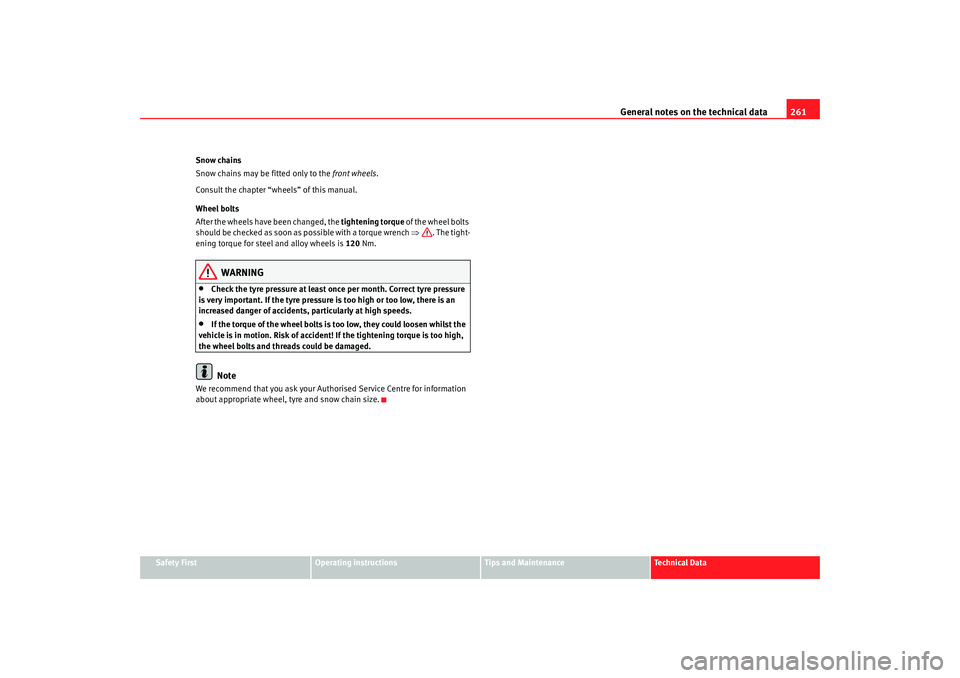
Snow chains
Snow chains may be fitted only to the
front wheels.
Consult the chapter “wheels” of this manual.
Wheel bolts
After the wheels have been changed, the tightening torque of the wheel bolts
s h ou l d b e ch e cke d as s oo n as p o ssi bl e wit h a to rq u e w re n ch ⇒. The tight-
ening torque for steel and alloy wheels is 120 Nm.
WARNING
•
Check the tyre pressure at least once per month. Correct tyre pressure
is very important. If the tyre pressure is too high or too low, there is an
increased danger of accidents, particularly at high speeds.
•
If the torque of the wheel bolts is too low, they could loosen whilst the
vehicle is in motion. Risk of accident! If the tightening torque is too high,
the wheel bolts and threads could be damaged.Note
We recommend that you ask your Authorised Service Centre for information
about appropriate wheel, tyre and snow chain size.
alhambra_aleman.book Seite 261 Montag, 23. M‰ rz 2009 1:12 13
Page 265 of 285
Technical Data263
Safety First
Operating instructions
Tips and Maintenance
Te c h n i c a l D a t a
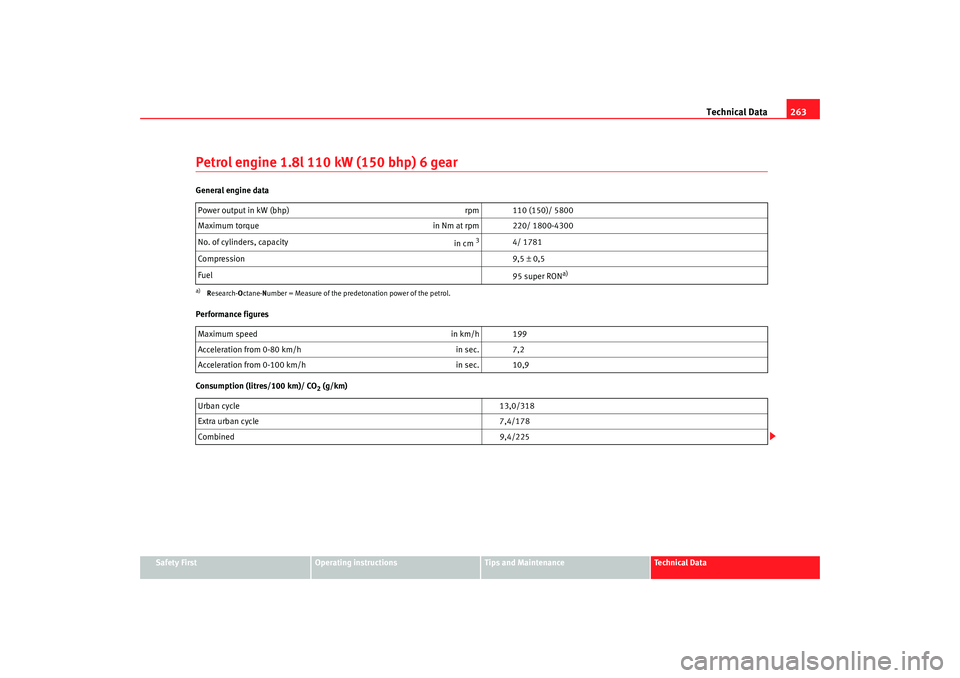
Petrol engine 1.8l 110 kW (150 bhp) 6 gearGeneral engine data
Performance figures
Consumption (litres/100 km)/ CO
2 (g/km)
Power output in kW (bhp)
rpm 110 (150)/ 5800
Maximum torque in Nm at rpm 220/ 1800-4300
No. of cylinders, capacity in cm
3
4/ 1781
Compression 9,5 ± 0,5
Fuel 95 super RON
a)
a)Research- Octane- Number = Measure of the predetonation power of the petrol.Maximum speed in km/h 199
Acceleration from 0-80 km/h in sec. 7,2
Acceleration from 0-100 km/h in sec. 10,9
Urban cycle 13,0/318
Extra urban cycle 7,4/178
Combined 9,4/225
alhambra_aleman.book Seite 263 Montag, 23. M‰rz 2009 1:12 13
Page 267 of 285
Technical Data265
Safety First
Operating instructions
Tips and Maintenance
Te c h n i c a l D a t a
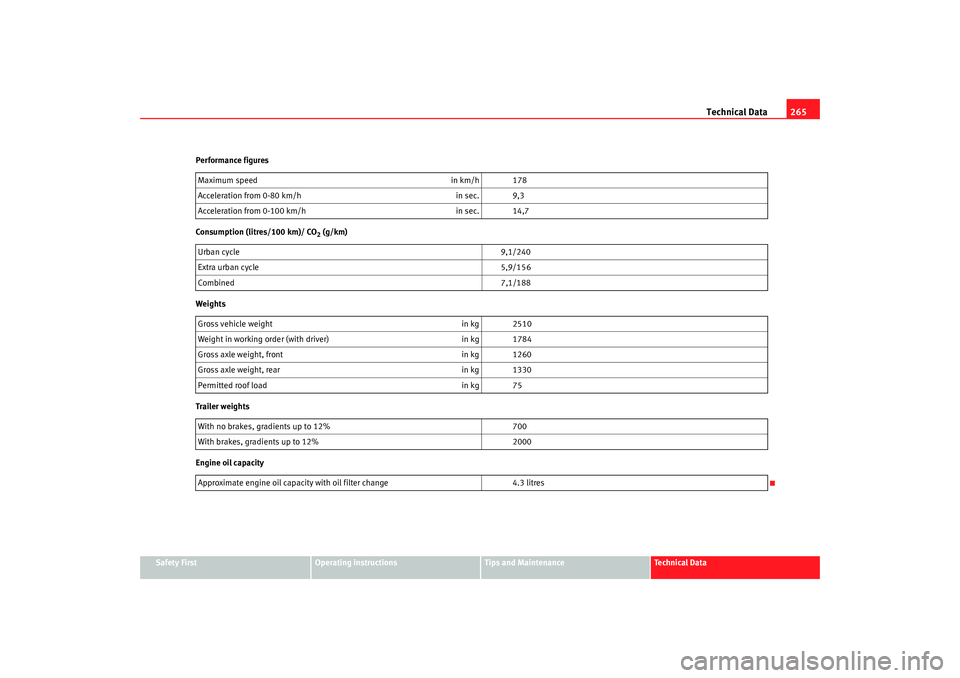
Performance figures
Consumption (litres/100 km)/ CO
2 (g/km)
Weights
Trailer weights
Engine oil capacity Maximum speed
in km/h 178
Acceleration from 0-80 km/h in sec. 9,3
Acceleration from 0-100 km/h in sec. 14,7
Urban cycle 9,1/240
Extra urban cycle 5,9/156
Combined 7,1/188
Gross vehicle weight in kg 2510
Weight in working order (with driver) in kg 1784
Gross axle weight, front in kg 1260
Gross axle weight, rear in kg 1330
Permitted roof load in kg 75
With no brakes, gradients up to 12% 700
With brakes, gradients up to 12% 2000
Approximate engine oil capacity with oil filter change 4.3 litres
alhambra_aleman.book Seite 265 Montag, 23. M‰rz 2009 1:12 13
Page 269 of 285
Technical Data267
Safety First
Operating instructions
Tips and Maintenance
Te c h n i c a l D a t a
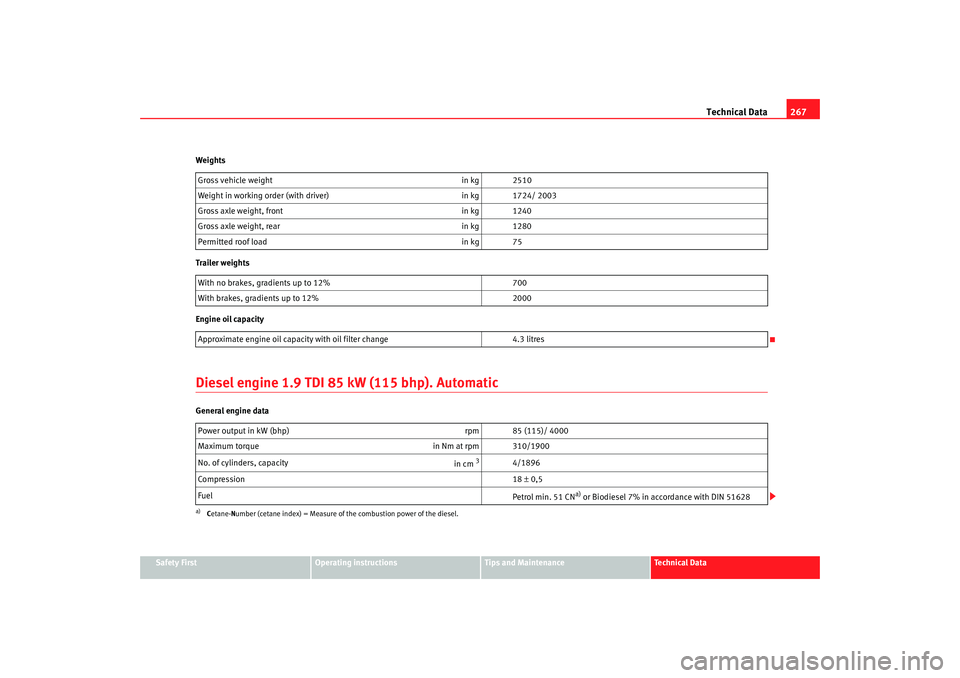
Weights
Trailer weights
Engine oil capacity
Diesel engine 1.9 TDI 85 kW (115 bhp). AutomaticGeneral engine data
Gross vehicle weight
in kg 2510
Weight in working order (with driver) in kg 1724/ 2003
Gross axle weight, front in kg 1240
Gross axle weight, rear in kg 1280
Permitted roof load in kg 75
With no brakes, gradients up to 12% 700
With brakes, gradients up to 12% 2000
Approximate engine oil capacity with oil filter change 4.3 litres
Power output in kW (bhp) rpm 85 (115)/ 4000
Maximum torque in Nm at rpm 310/1900
No. of cylinders, capacity in cm
3
4/1896
Compression 18 ± 0,5
Fuel Petrol min. 51 CN
a) or Biodiesel 7% in accordance with DIN 51628
a)Cetane- Number (cetane index) = Measure of the combustion power of the diesel.
alhambra_aleman.book Seite 267 Montag, 23. M‰ rz 2009 1:12 13
Page 271 of 285
Technical Data269
Safety First
Operating instructions
Tips and Maintenance
Te c h n i c a l D a t a
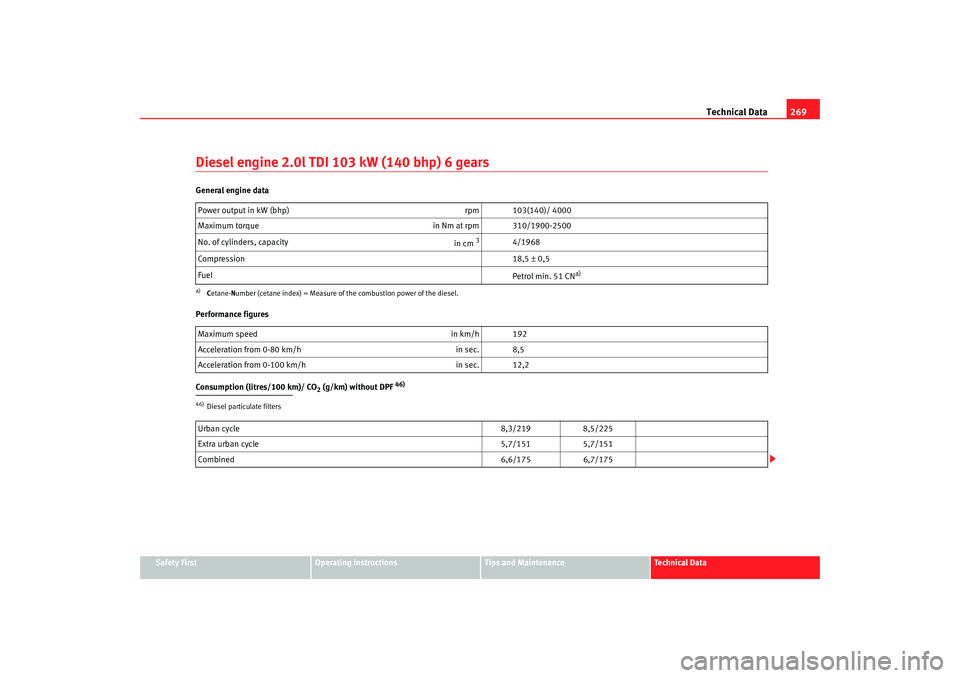
Diesel engine 2.0l TDI 103 kW (140 bhp) 6 gearsGeneral engine data
Performance figures
Consumption (litres/100 km)/ CO
2 (g/km) without DPF
46)
Power output in kW (bhp) rpm 103(140)/ 4000
Maximum torque in Nm at rpm 310/1900-2500
No. of cylinders, capacity in cm
3
4/1968
Compression 18,5 ± 0,5
Fuel Petrol min. 51 CN
a)
a)Cetane- Number (cetane index) = Measure of the combustion power of the diesel.Maximum speed in km/h 192
Acceleration from 0-80 km/h in sec. 8,5
Acceleration from 0-100 km/h in sec. 12,246)Diesel particulate filtersUrban cycle 8,3/2198,5/225
Extra urban cycle 5,7/1515,7/151
Combined 6,6/1756,7/175
alhambra_aleman.book Seite 269 Montag, 23. M‰ rz 2009 1:12 13