child lock Seat Alhambra 2009 User Guide
[x] Cancel search | Manufacturer: SEAT, Model Year: 2009, Model line: Alhambra, Model: Seat Alhambra 2009Pages: 285, PDF Size: 7.62 MB
Page 96 of 285
Unlocking and locking
94Childproof locks
The childproof lock prevents the rear doors being opened
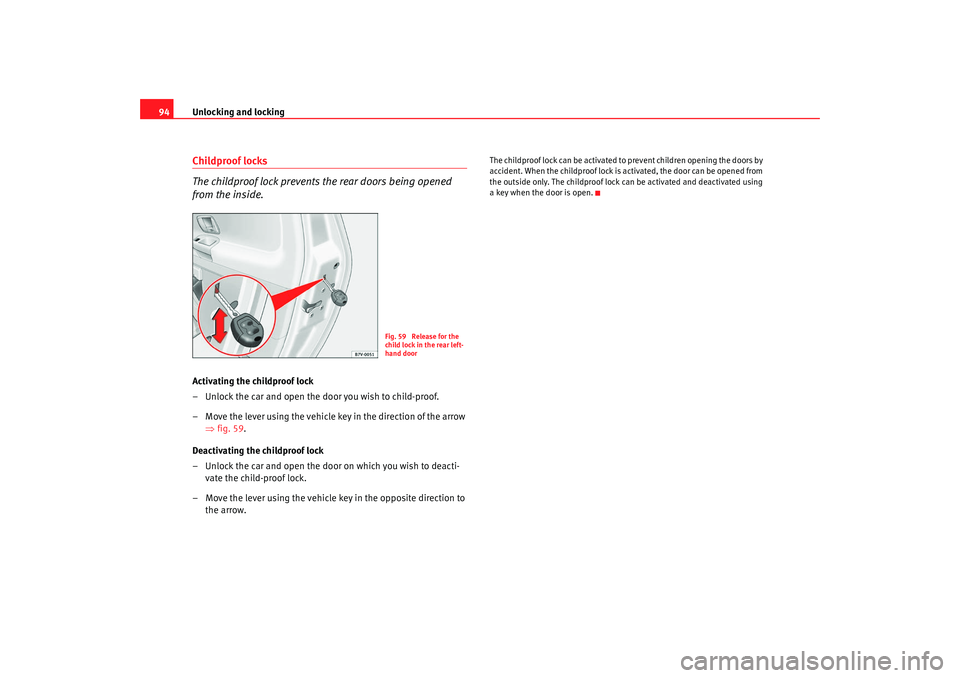
from the inside.Activating the childproof lock
– Unlock the car and open the door you wish to child-proof.
– Move the lever using the vehicle key in the direction of the arrow
⇒fig. 59 .
Deactivating the childproof lock
– Unlock the car and open the door on which you wish to deacti- vate the child-proof lock.
– Move the lever using the vehicle key in the opposite direction to the arrow.
The childproof lock can be activated to prevent children opening the doors by
accident. When the childproof lock is activated, the door can be opened from
the outside only. The childproof lock can be activated and deactivated using
a key when the door is open.
Fig. 59 Release for the
child lock in the rear left-
hand door
alhambra_aleman.book Seite 94 Montag, 23. M‰ rz 2009 1:12 13
Page 98 of 285
Unlocking and locking
96
WARNING
•
Never leave children or disabled persons in the vehicle; in case of emer-
gency they may not be able to leave the vehicle or look after themselves.
•
Always take you car keys with you when you leave the vehicle. Misuse
of the keys, for example, by children, may result in serious damage and
accident.
−The engine may accidentally be started and be out of control.
− If the ignition is switched on, the electric equipment could be acti-
vated with risk of injury, for example, in the electric windows.
− The doors can be locked using the remote control key. This could
result in people being trapped in the vehicle in an emergency.
− Always take the key with you when you leave the vehicle.
•
Never remove the key from the ignition if the vehicle is in motion. Risk
of accident. The steering lock could engage suddenly, and you would not be
able to steer the vehicle.Note
•
An Authorised SEAT Service Centre can programme the individual
opening of doors. In this case, when the unlock button on the remote
control is pressed once, only the driver's door is unlocked ⇒page 90. When
the button is pressed once more, all doors and the tailgate will be unlocked.
Seat Service will be happy to provide more information on the activation of
this function.
•
The remote control transmitter and the batteries are integrated in the
remote control. The receiver is in the interior of the vehicle. Obstacles
between the remote control and the vehicle, bad weather conditions and
discharged batteries can considerably reduce the range of the remote control.
•
The remote control only locks and unlocks the vehicle when it is used
within range.
•
The vehicle will be locked again automatically if you do not open one of
the doors or the tailgate 30 seconds after unlocking the car. This function prevents the vehicle from remaining unlocked if the unlocking button is
pressed by mistake.
•
If it is not possible to open or close the vehicle using the remote control,
this should be re-synchronised ⇒page 96 or change the battery ⇒page 96.
•
The working of the remote control may be momentarily affected if there is
transmitter using the same waveband (e.g. radiotelephone, mobile tele-
phone, etc) in the vicinity of the vehicle.
Synchronising the remote control keySynchronising the remote control key
– Briefly press the open button ⇒page 95, fig. 61 once.
– Then open or close the vehicle using the key bit within one minute ⇒page 90.The vehicle can no longer be opened and closed with the remote control if you
press button ⇒page 95, fig. 61 a long way outside the effective range
of the radio wave remote control. The remote control key will have to be resyn-
chronised.
Spare remote control keys are available from SEAT Service. They must be
matched to the locking system.
Up to four remote control keys can be used.Replacing the batteryIf the battery indicator on the remote control ⇒page 95, fig. 61 does not
flash when the buttons are pushed, the battery must be replaced.
A1
A1
A4
alhambra_aleman.book Seite 96 Montag, 23. M‰ rz 2009 1:12 13
Page 102 of 285
Unlocking and locking
100Driving with the tailgate open
If the tailgate is open or incorrectly closed, the following warning may be
appear on the display
14). Please note that theft of your cargo is more likely if
the tailgate is open.
WARNING
If you have to drive with the tailgate open, please observe the following
warnings:•
Observe the following points to reduce the danger of poisoning from
exhaust fumes entering the vehicle interior:
−Close all windows.
− Close the sliding/tilting roof,
− Switch off air recirculation.
− Open the air outlets in the dash panel,
− Set the fresh air blower to the highest speed.
•
Drive particularly carefully and think ahead. If possible, avoid sudden
braking and driving manoeuvres as this could cause the open tailgate to
move unpredictably. Risk of injury.
•
When carrying objects that protrude from the boot, the correct signals
should be used; otherwise there is a risk of accident. Observe legal require-
ments when doing so.
•
Always secure objects in the boot. Loose items could fall out of the
vehicle and injure other road users.
•
If a baggage rack is fitted on the tailgate, it should be removed before
travelling with the tailgate open.
•
Read and always observe the safety information concerning the use of
the tailgate ⇒page 101.
Closing the tailgateBefore closing the tailgate, make sure that the key has not been left
inside the boot.
Closing the tailgate
– Take hold of the grip in the inside trim of the tailgate ⇒ and
pull the tailgate down.
– Pull hard.A display appears in the combi-instrument if the tailgate is not properly
closed
15).WARNING
Always close the tailgate properly. Risk of accident or injury.•
Do not close the tailgate by pushing it down with your hand on the
window. The glass could shatter. Risk of injury!
•
Ensure the tailgate is locked after closing. If not, it may open unexpect-
edly while driving.
•
Never allow children to play in or around the vehicle. A locked vehicle
can be subjected to extremely high and low temperatures, depending on
the time of year. This could cause serious injuries/illness. It could even
have fatal consequences. Close and lock both the tailgate and all the other
doors when you are not using the vehicle.
•
Never close the tailgate without observing and ensuring it is clear, to do
otherwise could cause serious injury to you and others. Make sure that no
one is in the path of the tailgate.
15)Optional equipment
alhambra_aleman.book Seite 100 Montag, 23. M‰ rz 2009 1:12 13
Page 103 of 285
Unlocking and locking101
Safety First
Operating instructions
Tips and Maintenance
Te c h n i c a l D a t a
Safety instructions for the tailgate
WARNING
For safety reasons, you should always keep the tailgate fully closed when
driving. Always close the tailgate properly. Risk of accident or injury.•
Ensure the tailgate is locked after cl osing. If not, it may open unexpect-
edly while driving.
•
Never close the tailgate without observing and ensuring it is clear, to do
otherwise could cause serious injury to you and others. Make sure that no
one is in the path of the tailgate.
•
Loose objects which could fall out of the vehicle when the tailgate is
opened could cause injury.
•
If you have objects (for example bicycles) on a rack fitted to the tailgate,
you may not be able to open the tailgate fully, or the additional weight
could close the tailgate. For this reason, you should support the tailgate or
remove the objects from the rack. Risk of injury.
•
Never allow children to play in or around the vehicle. A locked vehicle
can be subjected to extremely high and low temperatures, depending on
the time of year. This could cause serious injuries/illness. It could even
have fatal consequences. Close and lock both the tailgate and all the other
doors when you are not using the vehicle. Make sure first that there is no
one in the vehicle.
•
If you have to drive with the tailgate open, observe the all notes
⇒ page 100 to reduce the risk, for example, of poisoning caused by
exhaust fumes entering the passenger compartment.
alhambra_aleman.book Seite 101 Montag, 23. M‰ rz 2009 1:12 13
Page 104 of 285
Unlocking and locking
102WindowsOpening and closing the windows electrically
All electric windows can be operated using the controls in the
driver door. The other doors each have a switch for their own
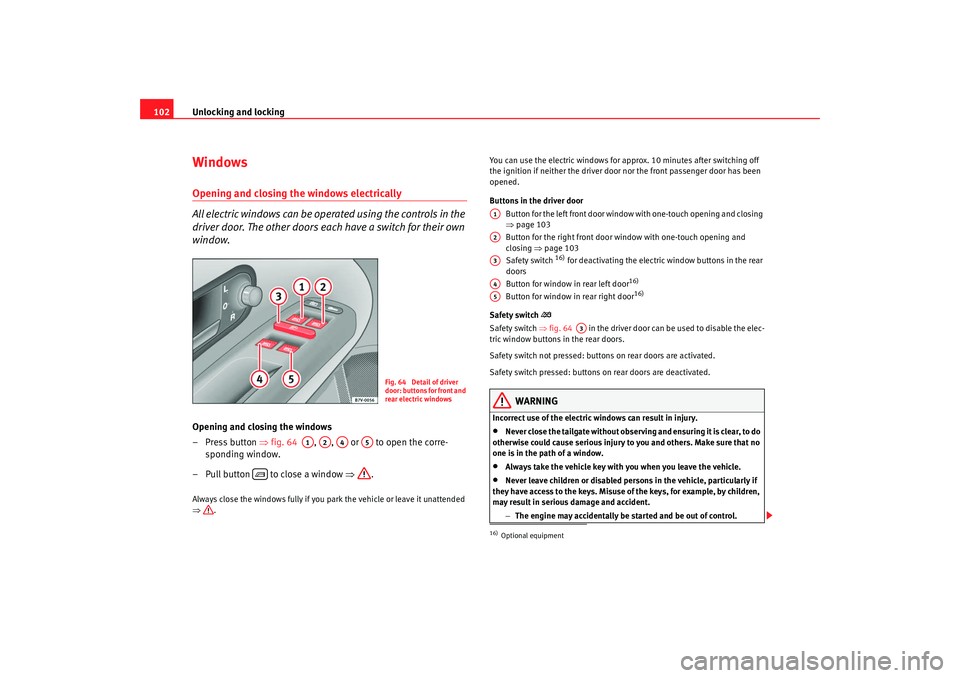
window.Opening and closing the windows
– Press button ⇒ fig. 64 , , or to open the corre-
sponding window.
– Pull button to close a window ⇒.Always close the windows fully if you park the vehicle or leave it unattended
⇒. You can use the electric windows for approx. 10 minutes after switching off
the ignition if neither the driver door nor the front passenger door has been
opened.
Buttons in the driver door
Button for the left front door window with one-touch opening and closing
⇒page 103
Button for the right front door window with one-touch opening and
closing ⇒page 103
Safety switch
16) for deactivating the electric window buttons in the rear
doors
Button for window in rear left door
16)
Button for window in rear right door
16)
Safety switch
Safety switch ⇒ fig. 64 in the driver door can be used to disable the elec-
tric window buttons in the rear doors.
Safety switch not pressed: buttons on rear doors are activated.
Safety switch pressed: buttons on rear doors are deactivated.
WARNING
Incorrect use of the electric windows can result in injury.•
Never close the tailgate without observing and ensuring it is clear, to do
otherwise could cause serious injury to you and others. Make sure that no
one is in the path of a window.
•
Always take the vehicle key with you when you leave the vehicle.
•
Never leave children or disabled persons in the vehicle, particularly if
they have access to the keys. Misuse of the keys, for example, by children,
may result in serious damage and accident.
−The engine may accidentally be started and be out of control.
Fig. 64 Detail of driver
door: buttons for front and
rear electric windows
A1
A2
A4
A5
16)Optional equipmentA1A2A3A4A5
A3
alhambra_aleman.book Seite 102 Montag, 23. M‰ rz 2009 1:12 13
Page 108 of 285
Unlocking and locking
106Always close the sliding/tilting roof fully if you park the vehicle or leave it
unattended ⇒.
If you wish to tilt the roof when the sliding roof is open, press surface until
the function has been carried out. If the sliding roof is to be opened directly
from the tilted position, press surface to carry out the required function.
Once the ignition has been switched off, the sliding/tilting sun roof can no
longer be opened or closed.
Sunroof blind
The sunroof blind is opened together with the sliding/tilting roof. If required,
it can be closed by hand when the sunroof is closed.
WARNING
Incorrect use of the sliding/tilting sunroof can result in injury.•
Never close the sliding/tilting sunroof without observing and ensuring
it is clear, to do otherwise could cause serious injury to you and others.
Make sure that no one is in the path of the sliding/tilting sunroof.
•
Always take the vehicle key with you when you leave the vehicle.
•
Never leave children or disabled persons in the vehicle, particularly if
they have access to the keys. Unsupervised use of a key could mean that
the engine is started or that electrical equipment is used (e.g. electric
windows). Risk of accident. The doors can be locked using the remote
control key. This could result in people being trapped in the vehicle in an
emergency.
•
The sliding/tilting sunroof operates as long as the ignition is switched
on.Note
The roof can be closed by hand if the system is defective.
Convenience closing*– Using the door lock: keep the key in the driver's door lock in the
close position until the sliding/tilting sunroof has closed.
– Release the key to interrupt this function.During convenience closing, first the windows and then the sliding roof will
be closed.
WARNING
Never close the sliding/tilting sunroof without observing and ensuring it is
clear, to do otherwise could cause serious injury to you and others. The
sliding/tilting sunroof closes with the roll-back function activated.
However, always make sure that no one is in the path of the sliding/tilting
sunroof.
Note
The sliding/tilting sunroof rotary button remains in the last position selected
if the roof is closed using convenience closing from outside the vehicle and
will have to be re-positioned the next time you drive.
A2
A1
alhambra_aleman.book Seite 106 Montag, 23. M‰ rz 2009 1:12 13
Page 147 of 285
Seats and stowage145
Safety First
Operating instructions
Tips and Maintenance
Te c h n i c a l D a t a
WARNING
Loose luggage and other objects in the luggage compartment can cause
serious injuries.•
Always stow objects in the luggage compartment and secure them on
the fastening rings.
•
Use suitable specialist straps to secure heavy objects.
•
During sudden manoeuvres or accidents, loose objects can be thrown
forward, injuring vehicle occupants or passers-by. This increased risk of
injury will be further increased if a lo ose object is struck by an inflating
airbag. If this happens, objects can be transformed into “missiles”. Risk of
fatal injury.
•
Remember that transporting heavy objects modifies the driving condi-
tions as the centre of gravity has been altered. There is a risk of accident.
Therefore, it is essential to adjust your speed and driving style accordingly,
to avoid accidents.
•
Never exceed the allowed axle loads or allowed maximum weight. If the
allowed axle load or the allowed total weight is exceeded, the driving char-
acteristics of the vehicle may change, leading to accidents, injuries and
damage to the vehicle.
•
Never leave the vehicle unattended, especially when the tailgate is
open. Children could climb into the luggage compartment closing the door
behind them; they will remain trapped without help and there is a mortal
risk.
•
Never allow children to play in or around the vehicle. Close and lock
both the tailgate and all the doors when you leave the vehicle. Before you
lock the vehicle, make sure that there are no adults or children in the
vehicle.
•
Never transport passengers in the luggage compartment. Every
passenger must be properly belted in.
Caution
•
Avoid overloading small areas by placing heavy objects on the vehicle
floor.
•
The wires of the heating element in the rear window and the window aerial
in the rear side windows could be damaged if objects on the luggage
compartment cover rub against them.
•
If you have removed the seats from the passenger compartment, you
should place a large, robust covering over the floor anchorings to prevent
damage.Note
•
Air circulation in the vehicle helps reduce fogging of the windows. Used
air escapes through ventilation slits in the side trim of the luggage compart-
ment. Ensure that the ventilation slits are never covered.
•
Straps for securing the load to the fastening rings are commercially
available.
Fastening rings
There are fastening rings in the luggage compartment which
can be used to secure luggage and other objects.– Always use suitable undamaged belts for fastening the luggage or any other object tot he anchorage rings ⇒ in “Loading the
luggage compartment” on page 144.The retainers for the detachable seat belts for the third row of seats and the
floor anchorings for the seats can be used as fastening rings for items of
luggage.
alhambra_aleman.book Seite 145 Montag, 23. M‰ rz 2009 1:12 13
Page 149 of 285
Seats and stowage147
Safety First
Operating instructions
Tips and Maintenance
Te c h n i c a l D a t a
•
Always stow objects safely in the vehicle and secure them on the
fastening rings if necessary.
•
Use suitable specialist straps to secure heavy objects.
•
Loose objects in the vehicle can move suddenly. As the centre of gravity
moves, safety is impaired and the vehicle becomes difficult to handle.
•
During sudden manoeuvres or accidents, loose objects can be thrown
forward, injuring vehicle occupants or passers-by. This increased risk of
injury will be further increased if a lo ose object is struck by an inflating
airbag. If this happens, objects can be transformed into “missiles”. Risk of
fatal injury.
•
Remember that transporting heavy objects modifies the driving condi-
tions as the centre of gravity has been altered. There is a risk of accident.
Therefore, it is essential to adjust your speed and driving style accordingly,
to avoid accidents.
•
Never exceed the allowed axle loads or allowed maximum weight. If the
allowed axle load or the allowed total weight is exceeded, the driving char-
acteristics of the vehicle may change, leading to accidents, injuries and
damage to the vehicle.
•
Never leave the vehicle unattended, especially when the tailgate is
open. Children could climb into the interior of the vehicle closing the door
behind them; they will remain trapped without help and there is a mortal
risk.
•
Never allow children to play in or around the vehicle. Close and lock all
windows, the tailgate and all doors when you leave the vehicle.
•
Never transport passengers in the luggage compartment. Every
passenger must be properly belted in.
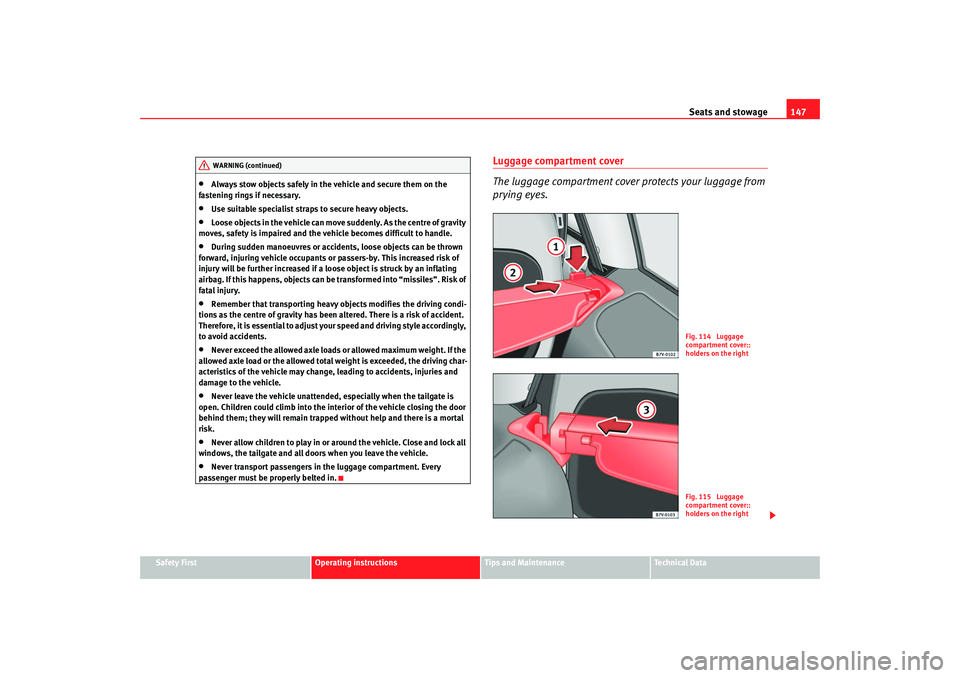
Luggage compartment cover
The luggage compartment cover protects your luggage from
prying eyes.
WARNING (continued)
Fig. 114 Luggage
compartment cover::
holders on the rightFig. 115 Luggage
compartment cover::
holders on the right
alhambra_aleman.book Seite 147 Montag, 23. M‰ rz 2009 1:12 13
Page 166 of 285
Driving
164Starting
The engine is started when the key is in this position. Electrical components
with a high power consumption are switched off temporarily.
Each time that the vehicle must be started, the ignition key must be turned to
the position . The repetitive start prevention lock of the ignition prevents
possible damage to the starter motor if the engine is already running.
WARNING
•
Wait for the vehicle to come to a standstill before removing the ignition
key from the lock. The steering lock could be activated immediately - Risk
of accident!
•
Always remove the key from the ignition lock when leaving the vehicle,
even if you only intend to be gone for a short period. This is especially
important if you must leave children or disabled people in the vehicle, they
could accidentally start the engine or work electrical equipment such as
the windows possibly resulting in an accident.
•
Unsupervised use of the keys could result in the engine being started
or electrical systems, such as the electric windows, being used. This can
result in serious injury.Caution
The starter must not be used unless the vehicle is at a standstill (key position ). If the starter is used as soon as the engine is switched off, the starter or
the engine could be damaged.
Safety interlock for ignition key
The ignition key can only be taken out of the ignition lock if the
selector lever is in position P.After switching off the ignition, you can remove the ignition key only if the
automatic gearbox gear selector lever ⇒page 169 is in position P. The
selector lever is blocked after the ignition key has been removed.Electronic immobiliser
The immobiliser prevents unauthorised persons from driving
the vehicle.Inside the key there is a chip that deactivates the electronic immobiliser auto-
matically when the key is inserted into the ignition.
The electronic immobiliser is automatically activated when you take the key
out of the ignition lock.
The engine can only be started using a genuine SEAT key with the correct
code.
Note
The vehicle cannot be operated properly if you do not have a genuine SEAT
key.
A3A1
A3
alhambra_aleman.book Seite 164 Montag, 23. M‰ rz 2009 1:12 13
Page 177 of 285

Driving175
Safety First
Operating instructions
Tips and Maintenance
Te c h n i c a l D a t a
– Switch off the engine and remove the key from the ignition lock.
Turn the steering wheel slightly to engage the steering lock.
– Always take you car keys with you when you leave the vehicle ⇒ .Additional notes on parking the vehicle on gradients:
Turn the steering wheel so that the vehicle would roll against the kerb if it did
start to roll.•
If the vehicle is facing downhill , turn the front wheels so that they point
towards the kerb .
•
If the vehicle is facing uphill , turn the front wheels so that they point away
from the kerb .
WARNING
Take measures to reduce the risk of injury when you leave your vehicle
unattended.•
Never park where the hot exhaust system could ignite inflammable
materials, such as dry grass, low bushes, spilt fuel etc.
•
Never allow vehicle occupants to remain in the vehicle when it is
locked. They would be unable to open the vehicle from the inside, and
could become trapped in the vehicle in an emergency. In the event of an
emergency, locked doors will delay assistance to occupants.
•
Never leave children unsupervised in the vehicle. They could set the
vehicle in motion, for example, by releasing the handbrake or the gear
lever / selector lever.
•
Depending on weather conditions, it may become extremely hot or cold
inside the vehicle. This can be fatal.
Parking distance warning system*Description
The parking distance warning system is a parking aid which
draws your attention to obstacles in front or behind the
vehicle.The parking distance warning system assists the driver when parking. If the
rear of the vehicle is approaching an obstacle, an intermittent sound signal is
emitted. The shorter the distance, the shorter the intervals between tones. If
the vehicle is too close to the obstacle, the sound signal becomes constant.
The distance to an obstacle at the front is indicated via a high tone and via a
low tone at the rear. The shorter the distance, the shorter the intervals
between tones. If the vehicle is too close to the obstacle, the sound signal
becomes constant.
The obstacle may no longer be detected if the vehicle gets even closer to it!
The warning signal will stop when•
the vehicle moves away from the obstacle
•
the outer sensors measure a constant distance for approximately 3
seconds.
The signal will not be switched off once the vehicle has reached the perma-
nent tone area.
Registering the obstacle
•
Exterior front and rear sensors: from approx 80 cm
•
Front central sensors: from approx 120 cm
•
Rear central sensors: from approx 160 cm
alhambra_aleman.book Seite 175 Montag, 23. M‰ rz 2009 1:12 13