gearbox Seat Alhambra 2009 Owner's Guide
[x] Cancel search | Manufacturer: SEAT, Model Year: 2009, Model line: Alhambra, Model: Seat Alhambra 2009Pages: 285, PDF Size: 7.62 MB
Page 196 of 285
Driving and the environment
194
NoteBy law, the ball coupling must be removed if a trailer is not being towed and
it obscures the number plate.•
When placing the towing bracket in the casing check that it is no longer
tensed and securely fastened.
Driving tips
Driving with a trailer always requires extra care.Weight distribution
The weight distribution of a loaded trailer with an unladen vehicle is very
unfavourable. However, if this cannot be avoided, drive extra slowly to allow
for the unbalanced weight distribution.
Speed
The stability of the car and trailer is reduced with increasing speed. For this
reason it is advisable not to drive at the maximum permissible top speed in
unfavourable road, weather or wind conditions. This applies especially when
driving downhill.
You should always reduce speed immediately if the trailer shows the slightest
sign of snaking . Never try to stop the “snaking” by increasing speed.
Always brake in good time. If the trailer has an overrun brake, apply the
brakes gently at first and then firmly. This will prevent the jerking that can be
caused by the trailer wheels locking. Select a low gear (in both manual and
automatic gearboxes) in good time before going down a steep hill. This
enables you to use the engine braking effect to slow down the vehicle. Overheating
At very high temperatures and during prolonged ascents, driving in a low gear
and high engine speed, always monitor the temperature indicator for the
coolant.
Electronic Stabilisation Program
Do not switch off the ESP when towing a trailer. The ESP makes it easier to
stabilise if the trailer starts to snake.
alhambra_aleman.book Seite 194 Montag, 23. M‰
rz 2009 1:12 13
Page 214 of 285
Checking and refilling levels
212•
Do not unscrew the cap on the expansion tank when the engine is hot.
If the coolant is hot, the cooling system will be pressurised!
•
Protect face, hands and arms by covering the cap with a large, thick
cloth to protect against escaping coolant and steam.
•
Always make sure you have not left any objects, such as cleaning cloths
and tools, in the engine compartment.
•
If you have to work underneath the vehicle, you must use suitable
stands additionally to support the vehicle, there is a risk of accident!. A
hydraulic jack is insufficient for securing the vehicle and there is a risk of
injury.
•
If any work has to be performed when the engine is started or with the
engine running, there is an additional, potentially fatal, safety risk from the
rotating parts, such as the drive belts, alternator, radiator fan, etc., and
from the high-voltage ignition system. You should also observe the
following points:
−Never touch the electrical wiring of the ignition system.
− Ensure that jewellery, loose clothing and long hair do not get
trapped in rotating engine parts. Danger of death. Before starting any
work remove jewellery, tie back and cover hair, and wear tight-fitting
clothes.
− Always think carefully about pressing the accelerator if a gear is
engaged in either an automatic or manual gearbox. The vehicle could
move, even if the handbrake is applied. Danger of death.
•
If work has to be carried out on the fuel system or on electrical compo-
nents, you must observe the following safety notes in addition to the above
warnings:
−Always disconnect the battery. The vehicle must be unlocked when
this is done, otherwise the alarm will be triggered.
− Do not smoke.
− Never work near naked flames. −
Always have a fire extinguisher on hand.
Caution
When changing or topping up service fluids, make absolutely certain that you
fill the fluids into the correct reservoirs. Failure to observe this point will result
in serious malfunctions and engine damage!
For the sake of the environment
Service fluids leaks are harmful to the environment. For this reason you
should make regular checks on the ground underneath your vehicle. If you
find spots of oil or other fluids, have your vehicle inspected in a qualified
workshop.
WARNING (continued)
WARNING (continued)
alhambra_aleman.book Seite 212 Montag, 23. M‰ rz 2009 1:12 13
Page 255 of 285
If and when253
Safety First
Operating instructions
Tips and Maintenance
Te c h n i c a l D a t a
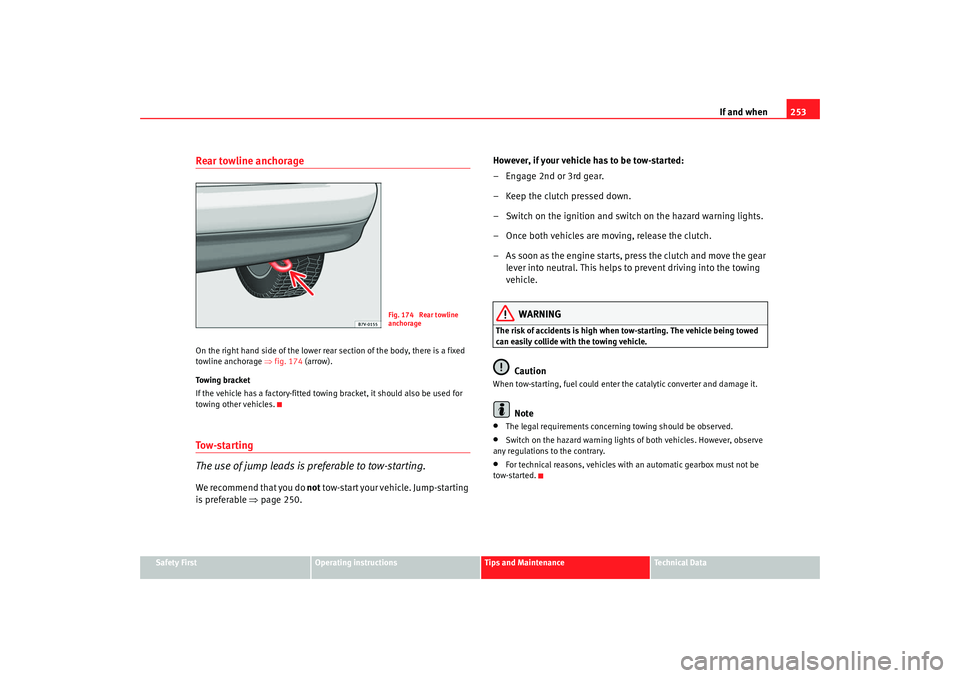
Rear towline anchorageOn the right hand side of the lower rear section of the body, there is a fixed
towline anchorage ⇒ fig. 174 (arrow).
To w i n g b r a c k e t
If the vehicle has a factory-fitted towing bracket, it should also be used for
towing other vehicles.To w - s t a r t i n g
The use of jump leads is preferable to tow-starting.We recommend that you do not tow-start your vehicle. Jump-starting
is preferable ⇒page 250. However, if your vehicle has to be tow-started:
– Engage 2nd or 3rd gear.
– Keep the clutch pressed down.
– Switch on the ignition and switch on the hazard warning lights.
– Once both vehicles are moving, release the clutch.
– As soon as the engine starts, press the clutch and move the gear
lever into neutral. This helps to prevent driving into the towing
vehicle.
WARNING
The risk of accidents is high when tow-starting. The vehicle being towed
can easily collide with the towing vehicle.
Caution
When tow-starting, fuel could enter the catalytic converter and damage it.
Note
•
The legal requirements concerning towing should be observed.
•
Switch on the hazard warning lights of both vehicles. However, observe
any regulations to the contrary.
•
For technical reasons, vehicles with an automatic gearbox must not be
tow-started.
Fig. 174 Rear towline
anchorage
alhambra_aleman.book Seite 253 Montag, 23. M‰ rz 2009 1:12 13
Page 256 of 285
If and when
254Notes for tow-starting or towingIf a cable is used for towing the vehicle, please observe the
following:
As the driver of the towing vehicle
– Switch on the hazard warning lights. However, observe any regu-
lations to the contrary.
– Drive slowly at first until the tow-rope is taut. Then accelerate gradually.
– Begin and change gears cautiously. If you are driving an auto- matic vehicle, accelerate gently.
– Remember that the brake servo and power steering are not working in the vehicle you are towing. Brake earlier than you
would normally, but with a more gentle pressure on the brake.
As the driver of the vehicle being towed
– Switch on the hazard warning lights. However, observe any regu- lations to the contrary.
– Place the gearstick in neutral or position N .
– Ensure that the tow-rope remains taut at all times.Tow-rope or tow-bar
It is easier and safer to tow a vehicle with a tow-bar. You should only use a
tow-rope if you do not have a tow-bar.
A tow-rope should be slightly elastic to reduce the loading on both vehicles.
It is advisable to use a tow-rope made of synthetic fibre or similarly elastic
material. Attach the tow-rope or the tow-bar only to the towing eyes provided or a
towing bracket.
Driving tips
Towing requires some experience, especially when using a tow-rope. Both
drivers should be familiar with the technique required for towing. Inexperi-
enced drivers should not attempt to tow-start or tow away another vehicle.
Do not pull too hard with the towing vehicle and take care to avoid jerking the
tow-rope. When towing on an unpaved road, there is always a risk of over-
loading and damaging the anchorage points.
The ignition of the vehicle being towed must be switched on to prevent the
steering wheel from locking and also to allow the use of the turn signals,
horn, windscreen wipers and washers.
If the vehicle is towed, with the hazard warning lights on and the ignition
switched on, the turn signal may be used to indicate that you are going to
change direction. Move the turn signal lever accordingly. Meanwhile, the
hazard warning lights will go off. When the turn signal lever is returned to the
rest position, the hazard warning lights will automatically reconnect.
The brake servo works only when the engine is running. In this case the pedal
has to be pressed harder.
As the power assisted steering does not work if the engine is not running, you
will need more strength to steer than you normally would.
Towing vehicles with an automatic gearbox
•
Move the selector lever to N.
•
Do not drive faster than 50 km/h when towing a vehicle.
•
Do not tow further than 50 km.
•
If a breakdown truck is used, the vehicle must be towed with the front
wheels raised.
alhambra_aleman.book Seite 254 Montag, 23. M‰ rz 2009 1:12 13
Page 257 of 285
If and when255
Safety First
Operating instructions
Tips and Maintenance
Te c h n i c a l D a t a
WARNING
The braking behaviour and capacity of a vehicle changes when being towed
or when you are trying to start the vehicle by pulling. Please observe the
following notes in order to prevent injury and accident:•
Inexperienced drivers should refrain from trying in order to avoid acci-
dent.
•
Notes for the driver of the towed vehicle
− The brake must be depressed must harder as the brake servo does
not operate. Take care not to bump into the towing vehicle.
− More strength is required at the steering wheel as the power
steering does not operate when the engine is switched off.
•
Notes for the driver of the towing vehicle
− Accelerate smoothly and avoid any sudden movement.
− Brake more in advance than usual and brake gently.Caution
When tow-starting, fuel could enter the catalytic converter and damage it
⇒ page 252.
Note
•
Observe legal requirements when towing or tow-starting.
•
For technical reasons, vehicles with an automatic gearbox must not be
tow-started.
•
If, due to a breakdown, the gearbox does not have lubricant, the vehicle
should be towed with the drive wheels suspended.
•
If it is necessary to tow a vehicle with an automatic gearbox for more than
50 km, it should be towed by qualified personnel and with the drive wheels
suspended.
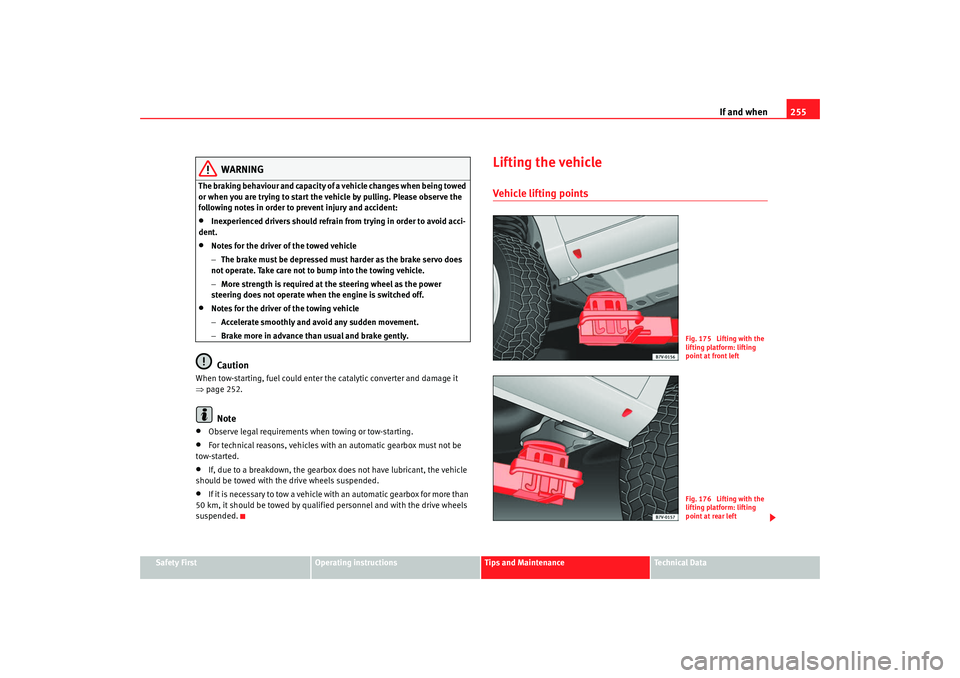
Lifting the vehicleVehicle lifting points
Fig. 175 Lifting with the
lifting platform: lifting
point at front leftFig. 176 Lifting with the
lifting platform: lifting
point at rear left
alhambra_aleman.book Seite 255 Montag, 23. M‰ rz 2009 1:12 13
Page 258 of 285
If and when
256Your vehicle may only be lifted by a lifting platform at the points shown in the
illustrations ⇒page 255, fig. 175 and ⇒page 255, fig. 176 ⇒ .
Using the jack to lift the vehicle ⇒page 241.
To prevent damage to the underside of the vehicle when lifting the vehicle,
rubber pads must be used.
Before driving onto a lifting platform, you must check there is sufficient clear-
ance between low parts of the vehicle and the lifting platform.
WARNING
If the lifting platform is inappropriate or the vehicle is lifted incorrectly,
accidents or injuries may be caused. The vehicle could even fall from the
lifting platform.•
All occupants should leave the vehicle before it is lifted.
•
The vehicle must only be lifted at the points indicated in the diagrams
⇒ page 255, fig. 175 and ⇒page 255, fig. 176 . If the vehicle is not lifted
at the indicated points, it may fall from the platform while the engine or
gearbox is being dismounted, for example.
•
Never start the engine when the vehicle is raised. Risk of accident. The
vehicle may fall from the platform due to the engine vibrations.
•
When work is being carried out underneath the vehicle, it must be
secured using suitable frames. If not, an accident may occur.
•
To lift the vehicle, only two-pillar or two-post lifting platforms with
sufficiently long arms and load-bearing capacity should be used.
•
Lifting platforms with fluid filled cushions may not be used for lifting
the vehicle.Caution
•
The vehicle should never be lifted at the engine oil sump, the gearbox, or
the front or rear axle. This could cause serious damage to the vehicle.
•
Before driving onto a lifting platform, you must check there is sufficient
clearance between low parts of the vehicle and the lifting platform.
alhambra_aleman.book Seite 256 Montag, 23. M‰ rz 2009 1:12 13
Page 260 of 285
General notes on the technical data
258Vehicle identification dataVehicle identification number
The vehicle identification number (chassis number) can be read from outside
the vehicle through a viewer in the windscreen. This is located on the left-
hand side of the vehicle in the lower area of the windscreen. It is also located
on the right hand side of the engine compartment.
Type plate
The type plate is located on the left rib inside the engine compartment.
Ve hicle da ta
The data sticker is placed on the inside of the spare wheel recess in the
luggage compartment.
The following information can be found in the vehicle information:•
Vehicle identification number (chassis number)
•
Vehicle type / engine power / gearbox type
•
Engine and gearbox code / paint number / interior equipment
•
Optional extras / PR numbers
This information also figures in the Maintenance Program.
alhambra_aleman.book Seite 258 Montag, 23. M‰ rz 2009 1:12 13
Page 261 of 285
General notes on the technical data259
Safety First
Operating instructions
Tips and Maintenance
Te c h n i c a l D a t a
How are the figures measured?Fuel consumption
The consumption and emission details shown on the vehicle data sticker differ from one vehicle to another.The fuel consumption, CO
2 emissions and actual kerb weight of the vehicle
are noted on the vehicle data sticker.
The fuel consumption and emissions figures given are based on the weight
category of the car, which is determined according to the engine/gearbox
combination and the equipment fitted. The consumption and emission figures are calculated in accordance with the
EC test requirements 1999/100/EC. These test requirements specify a real-
istic test method based on normal everyday driving.
The following test conditions are applied:
Note
•
Actual consumption may vary from quoted test values, depending on
personal driving style, road and traffic conditions, the weather and the condi-
tion of the vehicle. Urban cycle
The urban cycle starts with an engine cold start. City driving is then simulated.
Extra urban cycle In the extra urban cycle the vehicle undergoes frequent acceleration and braking in all gears, as in normal everyday driving. T
he
road speed ranges from 0 to 120 km/h.
Combined The average overall consumption is calculated with a weighting of around 37% for the urban cycle and 63% for the extra urban
cycle.
CO2 emissions The exhaust gases are collected during both driving cycles to calculate carbon dioxide emissions. The gas composition is then
analysed to evaluate the CO
2 content and other emissions.
alhambra_aleman.book Seite 259 Montag, 23. M‰
rz 2009 1:12 13
Page 275 of 285
Index273
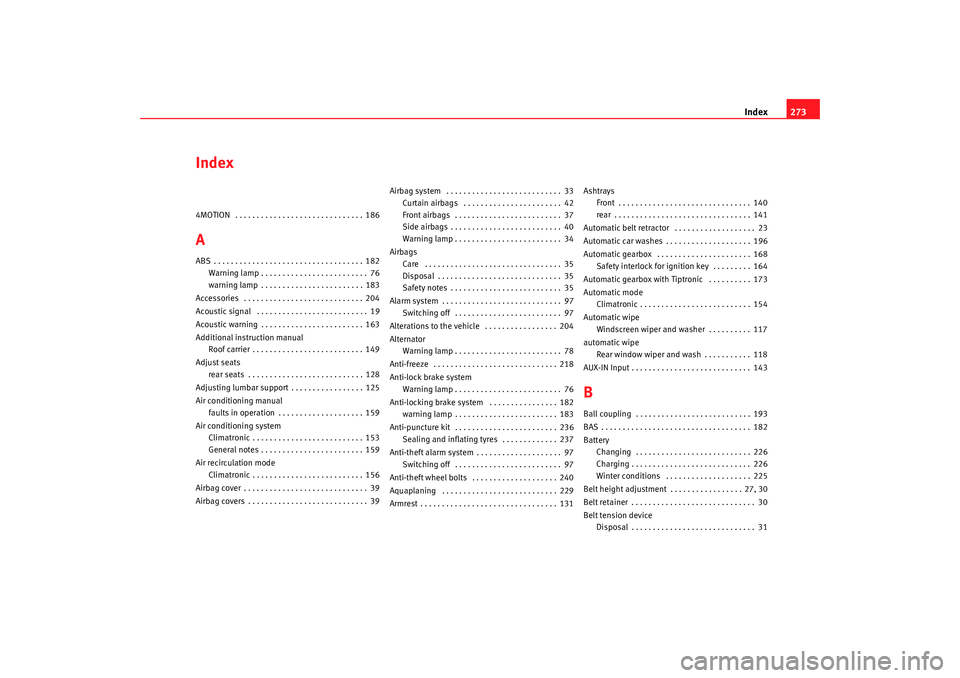
Index4MOTION . . . . . . . . . . . . . . . . . . . . . . . . . . . . . . 186AABS . . . . . . . . . . . . . . . . . . . . . . . . . . . . . . . . . . . 182
Warning lamp . . . . . . . . . . . . . . . . . . . . . . . . . 76
warning lamp . . . . . . . . . . . . . . . . . . . . . . . . 183
Accessories . . . . . . . . . . . . . . . . . . . . . . . . . . . . 204
Acoustic signal . . . . . . . . . . . . . . . . . . . . . . . . . . 19
Acoustic warning . . . . . . . . . . . . . . . . . . . . . . . . 163
Additional instruction manual Roof carrier . . . . . . . . . . . . . . . . . . . . . . . . . . 149
Adjust seats rear seats . . . . . . . . . . . . . . . . . . . . . . . . . . . 128
Adjusting lumbar support . . . . . . . . . . . . . . . . . 125
Air conditioning manual faults in operation . . . . . . . . . . . . . . . . . . . . 159
Air conditioning system Climatronic . . . . . . . . . . . . . . . . . . . . . . . . . . 153
General notes . . . . . . . . . . . . . . . . . . . . . . . . 159
Air recirculation mode Climatronic . . . . . . . . . . . . . . . . . . . . . . . . . . 156
Airbag cover . . . . . . . . . . . . . . . . . . . . . . . . . . . . . 39
Airbag covers . . . . . . . . . . . . . . . . . . . . . . . . . . . . 39 Airbag system . . . . . . . . . . . . . . . . . . . . . . . . . . . 33
Curtain airbags . . . . . . . . . . . . . . . . . . . . . . . 42
Front airbags . . . . . . . . . . . . . . . . . . . . . . . . . 37
Side airbags . . . . . . . . . . . . . . . . . . . . . . . . . . 40
Warning lamp . . . . . . . . . . . . . . . . . . . . . . . . . 34
Airbags Care . . . . . . . . . . . . . . . . . . . . . . . . . . . . . . . . 35
Disposal . . . . . . . . . . . . . . . . . . . . . . . . . . . . . 35
Safety notes . . . . . . . . . . . . . . . . . . . . . . . . . . 35
Alarm system . . . . . . . . . . . . . . . . . . . . . . . . . . . . 97 Switching off . . . . . . . . . . . . . . . . . . . . . . . . . 97
Alterations to the vehicle . . . . . . . . . . . . . . . . . 204
Alternator Warning lamp . . . . . . . . . . . . . . . . . . . . . . . . . 78
Anti-freeze . . . . . . . . . . . . . . . . . . . . . . . . . . . . . 218
Anti-lock brake system Warning lamp . . . . . . . . . . . . . . . . . . . . . . . . . 76
Anti-locking brake system . . . . . . . . . . . . . . . . 182 warning lamp . . . . . . . . . . . . . . . . . . . . . . . . 183
Anti-puncture kit . . . . . . . . . . . . . . . . . . . . . . . . 236 Sealing and inflating tyres . . . . . . . . . . . . . 237
Anti-theft alarm system . . . . . . . . . . . . . . . . . . . . 97 Switching off . . . . . . . . . . . . . . . . . . . . . . . . . 97
Anti-theft wheel bolts . . . . . . . . . . . . . . . . . . . . 240
Aquaplaning . . . . . . . . . . . . . . . . . . . . . . . . . . . 229
Armrest . . . . . . . . . . . . . . . . . . . . . . . . . . . . . . . . 131 Ashtrays
Front . . . . . . . . . . . . . . . . . . . . . . . . . . . . . . . 140
rear . . . . . . . . . . . . . . . . . . . . . . . . . . . . . . . . 141
Automatic belt retractor . . . . . . . . . . . . . . . . . . . 23
Automatic car washes . . . . . . . . . . . . . . . . . . . . 196
Automatic gearbox . . . . . . . . . . . . . . . . . . . . . . 168 Safety interlock for ignition key . . . . . . . . . 164
Automatic gearbox with Tiptronic . . . . . . . . . . 173
Automatic mode Climatronic . . . . . . . . . . . . . . . . . . . . . . . . . . 154
Automatic wipe Windscreen wiper and washer . . . . . . . . . . 117
automatic wipe Rear window wiper and wash . . . . . . . . . . . 118
AUX-IN Input . . . . . . . . . . . . . . . . . . . . . . . . . . . . 143
BBall coupling . . . . . . . . . . . . . . . . . . . . . . . . . . . 193
BAS . . . . . . . . . . . . . . . . . . . . . . . . . . . . . . . . . . . 182
Battery Changing . . . . . . . . . . . . . . . . . . . . . . . . . . . 226
Charging . . . . . . . . . . . . . . . . . . . . . . . . . . . . 226
Winter conditions . . . . . . . . . . . . . . . . . . . . 225
Belt height adjustment . . . . . . . . . . . . . . . . . 27, 30
Belt retainer . . . . . . . . . . . . . . . . . . . . . . . . . . . . . 30
Belt tension device Disposal . . . . . . . . . . . . . . . . . . . . . . . . . . . . . 31
alhambra_aleman.book Seite 273 Montag, 23. M‰ rz 2009 1:12 13
Page 276 of 285
Index
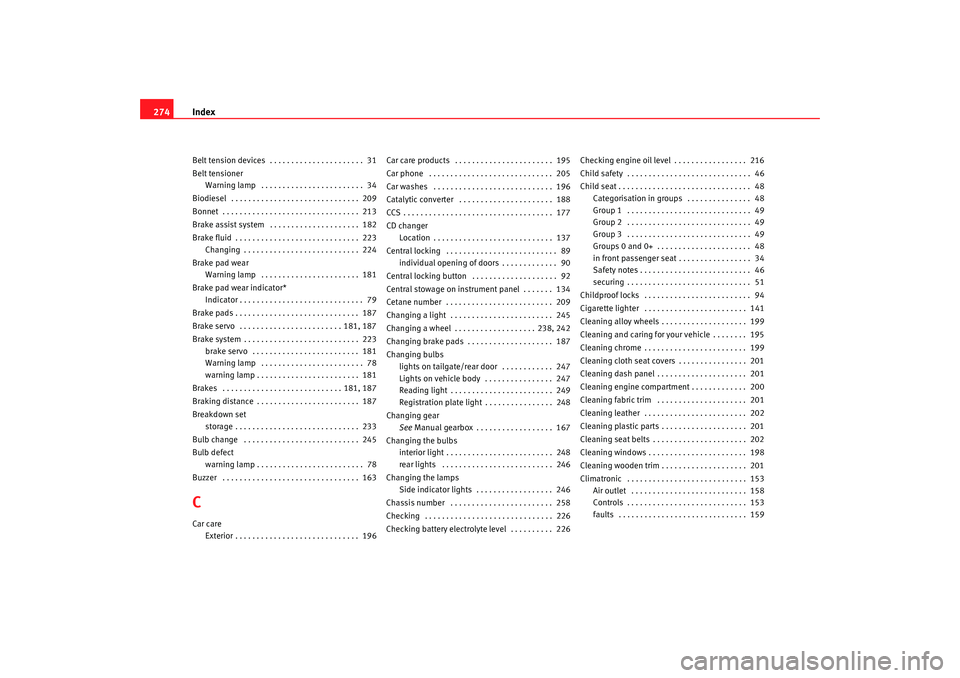
274Belt tension devices . . . . . . . . . . . . . . . . . . . . . . 31
Belt tensioner
Warning lamp . . . . . . . . . . . . . . . . . . . . . . . . 34
Biodiesel . . . . . . . . . . . . . . . . . . . . . . . . . . . . . . 209
Bonnet . . . . . . . . . . . . . . . . . . . . . . . . . . . . . . . . 213
Brake assist system . . . . . . . . . . . . . . . . . . . . . 182
Brake fluid . . . . . . . . . . . . . . . . . . . . . . . . . . . . . 223 Changing . . . . . . . . . . . . . . . . . . . . . . . . . . . 224
Brake pad wear Warning lamp . . . . . . . . . . . . . . . . . . . . . . . 181
Brake pad wear indicator* Indicator . . . . . . . . . . . . . . . . . . . . . . . . . . . . . 79
Brake pads . . . . . . . . . . . . . . . . . . . . . . . . . . . . . 187
Brake servo . . . . . . . . . . . . . . . . . . . . . . . . 181, 187
Brake system . . . . . . . . . . . . . . . . . . . . . . . . . . . 223 brake servo . . . . . . . . . . . . . . . . . . . . . . . . . 181
Warning lamp . . . . . . . . . . . . . . . . . . . . . . . . 78
warning lamp . . . . . . . . . . . . . . . . . . . . . . . . 181
Brakes . . . . . . . . . . . . . . . . . . . . . . . . . . . . 181, 187
Braking distance . . . . . . . . . . . . . . . . . . . . . . . . 187
Breakdown set storage . . . . . . . . . . . . . . . . . . . . . . . . . . . . . 233
Bulb change . . . . . . . . . . . . . . . . . . . . . . . . . . . 245
Bulb defect warning lamp . . . . . . . . . . . . . . . . . . . . . . . . . 78
Buzzer . . . . . . . . . . . . . . . . . . . . . . . . . . . . . . . . 163CCar care Exterior . . . . . . . . . . . . . . . . . . . . . . . . . . . . . 196 Car care products . . . . . . . . . . . . . . . . . . . . . . . 195
Car phone . . . . . . . . . . . . . . . . . . . . . . . . . . . . . 205
Car washes . . . . . . . . . . . . . . . . . . . . . . . . . . . . 196
Catalytic converter . . . . . . . . . . . . . . . . . . . . . . 188
CCS . . . . . . . . . . . . . . . . . . . . . . . . . . . . . . . . . . . 177
CD changer
Location . . . . . . . . . . . . . . . . . . . . . . . . . . . . 137
Central locking . . . . . . . . . . . . . . . . . . . . . . . . . . 89 individual opening of doors . . . . . . . . . . . . . 90
Central locking button . . . . . . . . . . . . . . . . . . . . 92
Central stowage on instrument panel . . . . . . . 134
Cetane number . . . . . . . . . . . . . . . . . . . . . . . . . 209
Changing a light . . . . . . . . . . . . . . . . . . . . . . . . 245
Changing a wheel . . . . . . . . . . . . . . . . . . . 238, 242
Changing brake pads . . . . . . . . . . . . . . . . . . . . 187
Changing bulbs lights on tailgate/rear door . . . . . . . . . . . . 247
Lights on vehicle body . . . . . . . . . . . . . . . . 247
Reading light . . . . . . . . . . . . . . . . . . . . . . . . 249
Registration plate light . . . . . . . . . . . . . . . . 248
Changing gear See Manual gearbox . . . . . . . . . . . . . . . . . . 167
Changing the bulbs interior light . . . . . . . . . . . . . . . . . . . . . . . . . 248
rear lights . . . . . . . . . . . . . . . . . . . . . . . . . . 246
Changing the lamps Side indicator lights . . . . . . . . . . . . . . . . . . 246
Chassis number . . . . . . . . . . . . . . . . . . . . . . . . 258
Checking . . . . . . . . . . . . . . . . . . . . . . . . . . . . . . 226
Checking battery electrolyte level . . . . . . . . . . 226 Checking engine oil level . . . . . . . . . . . . . . . . . 216
Child safety . . . . . . . . . . . . . . . . . . . . . . . . . . . . . 46
Child seat . . . . . . . . . . . . . . . . . . . . . . . . . . . . . . . 48
Categorisation in groups . . . . . . . . . . . . . . . 48
Group 1 . . . . . . . . . . . . . . . . . . . . . . . . . . . . . 49
Group 2 . . . . . . . . . . . . . . . . . . . . . . . . . . . . . 49
Group 3 . . . . . . . . . . . . . . . . . . . . . . . . . . . . . 49
Groups 0 and 0+ . . . . . . . . . . . . . . . . . . . . . . 48
in front passenger seat . . . . . . . . . . . . . . . . . 34
Safety notes . . . . . . . . . . . . . . . . . . . . . . . . . . 46
securing . . . . . . . . . . . . . . . . . . . . . . . . . . . . . 51
Childproof locks . . . . . . . . . . . . . . . . . . . . . . . . . 94
Cigarette lighter . . . . . . . . . . . . . . . . . . . . . . . . 141
Cleaning alloy wheels . . . . . . . . . . . . . . . . . . . . 199
Cleaning and caring for your vehicle . . . . . . . . 195
Cleaning chrome . . . . . . . . . . . . . . . . . . . . . . . . 199
Cleaning cloth seat covers . . . . . . . . . . . . . . . . 201
Cleaning dash panel . . . . . . . . . . . . . . . . . . . . . 201
Cleaning engine compartment . . . . . . . . . . . . . 200
Cleaning fabric trim . . . . . . . . . . . . . . . . . . . . . 201
Cleaning leather . . . . . . . . . . . . . . . . . . . . . . . . 202
Cleaning plastic parts . . . . . . . . . . . . . . . . . . . . 201
Cleaning seat belts . . . . . . . . . . . . . . . . . . . . . . 202
Cleaning windows . . . . . . . . . . . . . . . . . . . . . . . 198
Cleaning wooden trim . . . . . . . . . . . . . . . . . . . . 201
Climatronic . . . . . . . . . . . . . . . . . . . . . . . . . . . . 153 Air outlet . . . . . . . . . . . . . . . . . . . . . . . . . . . 158
Controls . . . . . . . . . . . . . . . . . . . . . . . . . . . . 153
faults . . . . . . . . . . . . . . . . . . . . . . . . . . . . . . 159
alhambra_aleman.book Seite 274 Montag, 23. M‰ rz 2009 1:12 13