maintenance Seat Alhambra 2009 Owner's Guide
[x] Cancel search | Manufacturer: SEAT, Model Year: 2009, Model line: Alhambra, Model: Seat Alhambra 2009Pages: 285, PDF Size: 7.62 MB
Page 43 of 285
Airbag system41
Safety First
Operating instructions
Tips and Maintenance
Te c h n i c a l D a t a
Function of side airbags
Inflated airbags reduce the risk of head or chest injury.In some side collisions the side airbag is triggered on the impact side of the
vehicle.
In certain types of accident the front, curtain and side airbags may be trig-
gered together.
When the system is triggered, the airbag is filled with propellant gas.
In order to provide the desired extra protection in an accident, the airbags
have to deploy extremely rapidly (within fractions of a second). A fine dust
may develop when the airbag deploys. This is normal and is no indication
that there was a fire in the vehicle.
The fully deployed airbags cushion the movement of the occupants of the
front seats and help to reduce the risk of injury to the upper body.
The special design of the airbag allows the controlled escape of the propel-
lant gas when an occupant puts pressure on the bag. Thus, the head and
chest are surrounded and protected by the airbag.Safety notes on the operation of the side airbag system
Correct behaviour considerably reduces the risk of injury.
WARNING
•
If you do not wear a seat belt, if you lean forward, or are not seated
correctly while the vehicle is in motion, you are at greater risk of injury
should the side airbag system be triggered in an accident.
•
In order for the side airbags to provide their maximum protection, the
prescribed sitting position must always be maintained with seat belts
fastened while travelling.
•
The built-in coat hooks should be used only for lightweight clothing. Do
not leave any heavy or sharp-edged objects in the pockets.
•
Great forces, such as hard blows or kicks, must not be exerted upon the
backrest bolster because the system may be damaged. In this case the side
airbags would not be triggered.
•
Under no circumstances should protective covers be fitted over the
driver seat or front passenger seat unless the covers have been expressly
approved for use in your vehicle. Because the airbag deploys from the side
of the backrest, the use of conventional seat covers would obstruct the side
airbag, seriously reducing the airbag's effectiveness.
•
Any damage to the original seat upholstery or around the seams of the
side airbag units must be repaired immediately by a qualified workshop.
•
The airbags provide protection for one accident only, if they have been
deployed they must be replaced.
•
When children assume an incorrect sitting position, they expose them-
selves to an increased risk of injury in the event of an accident. This is
particularly the case if the child is travelling on the front passenger seat
and the airbag system is triggered in an accident; this could have critical
consequences including serious injury or death ⇒page 46.
•
Any work on the side airbag system or removal and installation of the
airbag components for other repairs (such as removal of the front seat)
should only be performed by a qualified workshop. Otherwise, a fault may
be introduced into the operation of the airbag system.
•
Do not attempt to modify components of the airbag system in any
way.WARNING (continued)
alhambra_aleman.book Seite 41 Montag, 23. M‰ rz 2009 1:12 13
Page 45 of 285
Airbag system43
Safety First
Operating instructions
Tips and Maintenance
Te c h n i c a l D a t a
Function of curtain airbags
Fully inflated airbags reduce the ri sk of head or chest injury in
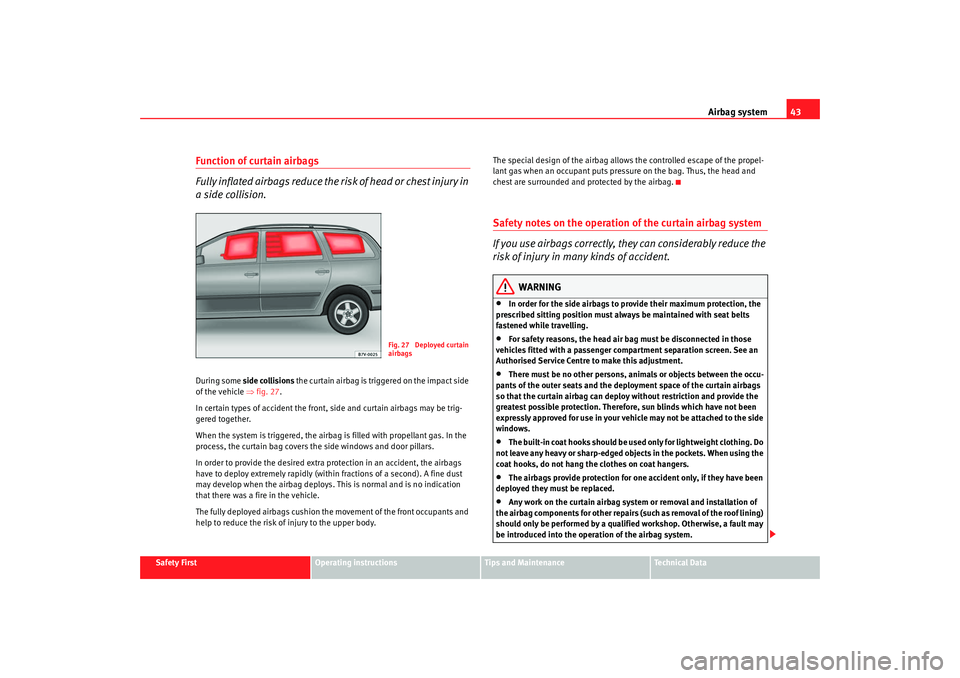
a side collision.During some side collisions the curtain airbag is triggered on the impact side
of the vehicle ⇒fig. 27 .
In certain types of accident the front, side and curtain airbags may be trig-
gered together.
When the system is triggered, the airbag is filled with propellant gas. In the
process, the curtain bag covers the side windows and door pillars.
In order to provide the desired extra protection in an accident, the airbags
have to deploy extremely rapidly (within fractions of a second). A fine dust
may develop when the airbag deploys. This is normal and is no indication
that there was a fire in the vehicle.
The fully deployed airbags cushion the movement of the front occupants and
help to reduce the risk of injury to the upper body. The special design of the airbag allows the controlled escape of the propel-
lant gas when an occupant puts pressure on the bag. Thus, the head and
chest are surrounded and protected by the airbag.
Safety notes on the operation of the curtain airbag system
If you use airbags correctly, they can considerably reduce the
risk of injury in many kinds of accident.
WARNING
•
In order for the side airbags to provide their maximum protection, the
prescribed sitting position must always be maintained with seat belts
fastened while travelling.
•
For safety reasons, the head air bag must be disconnected in those
vehicles fitted with a passenger compartment separation screen. See an
Authorised Service Centre to make this adjustment.
•
There must be no other persons, animals or objects between the occu-
pants of the outer seats and the deployment space of the curtain airbags
so that the curtain airbag can deploy without restriction and provide the
greatest possible protection. Therefore, sun blinds which have not been
expressly approved for use in your vehicle may not be attached to the side
windows.
•
The built-in coat hooks should be used only for lightweight clothing. Do
not leave any heavy or sharp-edged objects in the pockets. When using the
coat hooks, do not hang the clothes on coat hangers.
•
The airbags provide protection for one accident only, if they have been
deployed they must be replaced.
•
Any work on the curtain airbag system or removal and installation of
the airbag components for other repairs (such as removal of the roof lining)
should only be performed by a qualified workshop. Otherwise, a fault may
be introduced into the operation of the airbag system.
Fig. 27 Deployed curtain
airbags
alhambra_aleman.book Seite 43 Montag, 23. M‰ rz 2009 1:12 13
Page 47 of 285
Airbag system45
Safety First
Operating instructions
Tips and Maintenance
Te c h n i c a l D a t a
– Open centre compartment on instrument panel.
– Using the ignition key, turn the switch to ON ⇒ page 44, fig. 28 .
– Check if, when the ignition is switched on, that the warning lamp “PASS AIRBAG OFF” on the instrument panel ⇒page 44, fig. 29
does not light up ⇒.
– Close centre compartment on instrument panel.
WARNING
•
The driver is responsible for the proper position of the key-operated
switch.
•
You should only disable the front and side passenger airbags if, in
exceptional cases, you have to use a rear-facing child seat on the front
passenger seat ⇒ page 46.
•
Never fit a child seat in the passenger seat, where the child faces back-
wards to the direction of travel and the frontal airbag has not been deacti-
vated. This is highly dangerous for the child. However, if it is necessary in
exceptional circumstances to transport a child in a rear-facing child seat on
the front passenger seat, you must always disable the front passenger
airbag.
•
As soon as the child seat will no longer be used on the front passenger
seat, enable the front and side passenger airbag again.
•
Only deactivate the front and side passenger airbag when the ignition
is off, otherwise a fault may occur in the airbag system, this will create the
risk of the front, curtain or side airbag not deploying properly or not at all
in the event of an accident.
•
If, while the front and side passenger airbag are turned off, the indi-
cator PASS. AIRBAG OFF does not remain lit, this could indicate a fault in
the airbag system: −
Have the airbag system inspected immediately by a qualified work-
shop.
− Do not use a child seat on the front passenger seat! The front and
side passenger airbag may deploy during an accident in spite of the
fault.
− It is impossible to determine whether the front or side airbags will be
triggered in case of accident. Inform your passengers of this.
WARNING (continued)
alhambra_aleman.book Seite 45 Montag, 23. M‰ rz 2009 1:12 13
Page 49 of 285
Child safety47
Safety First
Operating instructions
Tips and Maintenance
Te c h n i c a l D a t a
tional circumstances, to transport a child on the front passenger seat,
always disable the front passenger airbag
⇒page 44.
•
All passengers, especially children, must assume the proper sitting
position and be properly belted in while travelling.
•
Never hold children or babies on your lap, this can result in potentially
fatal injuries to the child!
•
Never allow a child to be transported in a vehicle without being properly
secured, or to stand up or kneel on a seat while travelling. In an accident,
the child could be flung through the vehicle, causing possibly fatal injuries
to themselves and other occupants.
•
If children assume an improper sitting position when the car is moving,
they expose themselves to greater risk of injury during a sudden braking
manoeuvre or in an accident. This is particularly the case if the child is trav-
elling on the front passenger seat and the airbag system is triggered in an
accident; this could have consequences including serious injury or death.
•
A suitable child seat can protect your child!
•
Make sure that no hard or sharp objects, for example toys, are on the
child seats. Risk of injury.
•
Never leave a child unsupervised in a child seat or alone in the vehicle.
•
Depending on the time of year, the interior of a parked vehicle can reach
extreme temperatures which may endanger the life of people and animals.
•
Children who are less than 1.5 metres tall must not wear a normal seat
belt without a child restraint system, as this could cause injuries to the
abdominal and neck areas during a sudden braking manoeuvre or in an
accident.
•
Do not allow the belt webbing to become twisted or jammed, or to rub
on any sharp edges.
•
Incorrectly worn seat belts can cause injuries even in a minor collision
or sudden braking manoeuvres.
•
The seat belt cannot offer its full protection if the belt web is not posi-
tioned correctly.
•
Only one child may occupy a child seat.
WARNING (continued)
WARNING (continued)
alhambra_aleman.book Seite 47 Montag, 23. M‰ rz 2009 1:12 13
Page 51 of 285
Child safety49
Safety First
Operating instructions
Tips and Maintenance
Te c h n i c a l D a t a
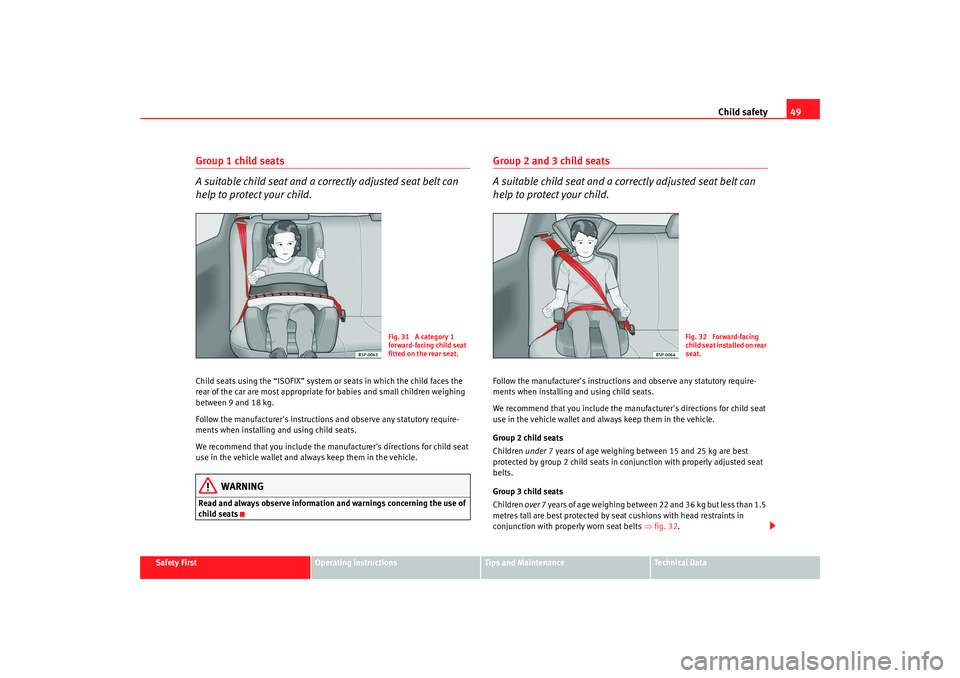
Group 1 child seats
A suitable child seat and a corr ectly adjusted seat belt can
help to protect your child.Child seats using the “ISOFIX” system or seats in which the child faces the
rear of the car are most appropriate for babies and small children weighing
between 9 and 18 kg.
Follow the manufacturer's instructions and observe any statutory require-
ments when installing and using child seats.
We recommend that you include the manufacturer's directions for child seat
use in the vehicle wallet and always keep them in the vehicle.
WARNING
Read and always observe information and warnings concerning the use of
child seats
Group 2 and 3 child seats
A suitable child seat and a correctly adjusted seat belt can
help to protect your child.Follow the manufacturer's instructions and observe any statutory require-
ments when installing and using child seats.
We recommend that you include the manufacturer's directions for child seat
use in the vehicle wallet and always keep them in the vehicle.
Group 2 child seats
Children under 7 years of age weighing between 15 and 25 kg are best
protected by group 2 child seats in conjunction with properly adjusted seat
belts.
Group 3 child seats
Children over 7 years of age weighing between 22 and 36 kg but less than 1.5
metres tall are best protected by seat cushions with head restraints in
conjunction with properly worn seat belts ⇒fig. 32 .
Fig. 31 A category 1
forward-facing child seat
fitted on the rear seat.
Fig. 32 Forward-facing
child seat installed on rear
seat.
alhambra_aleman.book Seite 49 Montag, 23. M‰ rz 2009 1:12 13
Page 53 of 285
Child safety51
Safety First
Operating instructions
Tips and Maintenance
Te c h n i c a l D a t a
Installation of child seats in vehicle seatsGeneral notesThe correct fitting of child seats in the different seats is described below.
Child restraint systems that have been checked according to ECE-R 44 are
suitable for installation on the front passenger seat or on the rear seats.
Note
The passenger seat and the rear seats comply with directive 77/541 EEC for
the installation of child restraint systems.Front passenger seat
Only the use of an officially approved child seat corre-
sponding to the weight and height of the child is permitted.Universal seats for children in groups 0, 0+, 1, 2, or 3 ( ⇒page 54) ⇒ can
be fitted in the passenger seat.
To fit a child seat, position the seat in the upright position and move the
passenger seat as far back as possible. The seat must be in the highest posi-
tion
3) on vehicles with a height-adjustable ⇒ front passenger seat.WARNING
•
Never fit a child seat in the passenger seat, where the child faces back-
wards to the direction of travel and the frontal airbag has not been deacti-
vated. This is highly dangerous for the child. If it is necessary in excep- tional cases to transport a child on the front passenger seat, you must
always disable the front and side passenger airbags
⇒page 44.
•
Children must travel in a child seat appropriate to their weight and
height.
•
The vehicle seat must always be fitted in the direction of travel when
securing child restraint systems in weight class 0 or 0+.
•
Read and always observe information and warnings concerning the use
of child seats ⇒ in “Safety notes on using child seats” on page 46.
•
Please always read and follow the information and warnings provided
by the child seat manufacturer.
Outer seats in the second row of seats and seats in the third row of seats
Only the use of an officially approved child seat corre-
sponding to the weight and height of the child is permitted.In the outer seats of seats in the second and third row universal child seats
for groups 0, 0+, 1, 2, or 3 ( ⇒page 54) ⇒ may be fitted.
Seat with ISOFIX retainers
These seats are suitable for ISOFIX child seats specially designed for this type
of vehicle in accordance with regulation ECE-R 44 ⇒.
Vehicle seat with integrated child seat
Universal child restraint systems for any group can be fitted to this seat if the
integrated child seat ⇒page 54, “Integrated child seat” is not used ⇒.
3)Optional equipment
WARNING (continued)
alhambra_aleman.book Seite 51 Montag, 23. M‰ rz 2009 1:12 13
Page 55 of 285
Child safety53
Safety First
Operating instructions
Tips and Maintenance
Te c h n i c a l D a t a
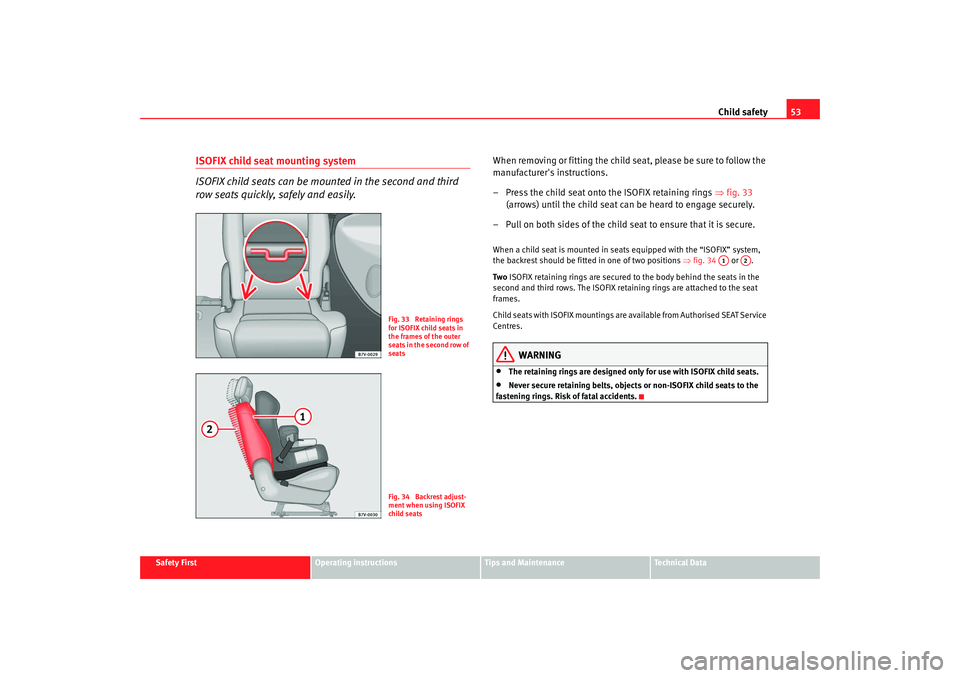
ISOFIX child seat mounting system
ISOFIX child seats can be mounted in the second and third
row seats quickly, safely and easily.
When removing or fitting the child seat, please be sure to follow the
manufacturer's instructions.
– Press the child seat onto the ISOFIX retaining rings ⇒fig. 33
(arrows) until the child seat can be heard to engage securely.
– Pull on both sides of the child seat to ensure that it is secure.When a child seat is mounted in seats equipped with the “ISOFIX” system,
the backrest should be fitted in one of two positions ⇒fig. 34 or .
Two ISOFIX retaining rings are secured to the body behind the seats in the
second and third rows. The ISOFIX retaining rings are attached to the seat
frames.
Child seats with ISOFIX mountings are available from Authorised SEAT Service
Centres.
WARNING
•
The retaining rings are designed only for use with ISOFIX child seats.
•
Never secure retaining belts, objects or non-ISOFIX child seats to the
fastening rings. Risk of fatal accidents.
Fig. 33 Retaining rings
for ISOFIX child seats in
the frames of the outer
seats in the second row of
seatsFig. 34 Backrest adjust-
ment when using ISOFIX
child seats
A1
A2
alhambra_aleman.book Seite 53 Montag, 23. M‰ rz 2009 1:12 13
Page 57 of 285
Child safety55
Safety First
Operating instructions
Tips and Maintenance
Te c h n i c a l D a t a
– Pull the loop in the direction of the arrow and push the seat
cushion down until it engages.
Fitting the slumber roll
– Remove the head restraint.
– Fit the head restraint onto the slumber roll.
– Reinsert the head restraint and push down until it can be heard to engage.
Removing the slumber roll
– Remove the head restraint.
– Pull the slumber roll off the head restraint.
– Reinsert the head restraint and push down until it can be heard to engage.For safety reasons, we recommend that the child seat for children in Group 1
is installed facing against the direction of travel.
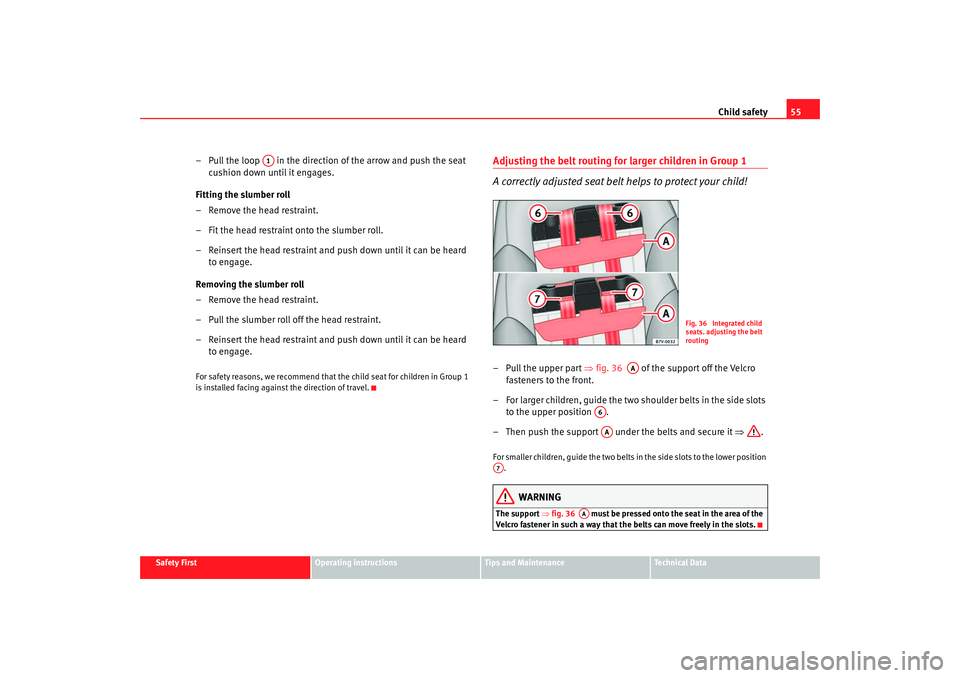
Adjusting the belt routing for larger children in Group 1
A correctly adjusted seat belt helps to protect your child!– Pull the upper part ⇒ fig. 36 of the support off the Velcro
fasteners to the front.
– For larger children, guide the two shoulder belts in the side slots to the upper position .
– Then push the support under the belts and secure it ⇒.For smaller children, guide the two belts in the side slots to the lower position
.
WARNING
The support ⇒fig. 36 must be pressed onto the seat in the area of the
Velcro fastener in such a way that the belts can move freely in the slots.
A1
Fig. 36 Integrated child
seats. adjusting the belt
routing
AA
A6AA
A7
AA
alhambra_aleman.book Seite 55 Montag, 23. M‰ rz 2009 1:12 13
Page 59 of 285
Child safety57
Safety First
Operating instructions
Tips and Maintenance
Te c h n i c a l D a t a
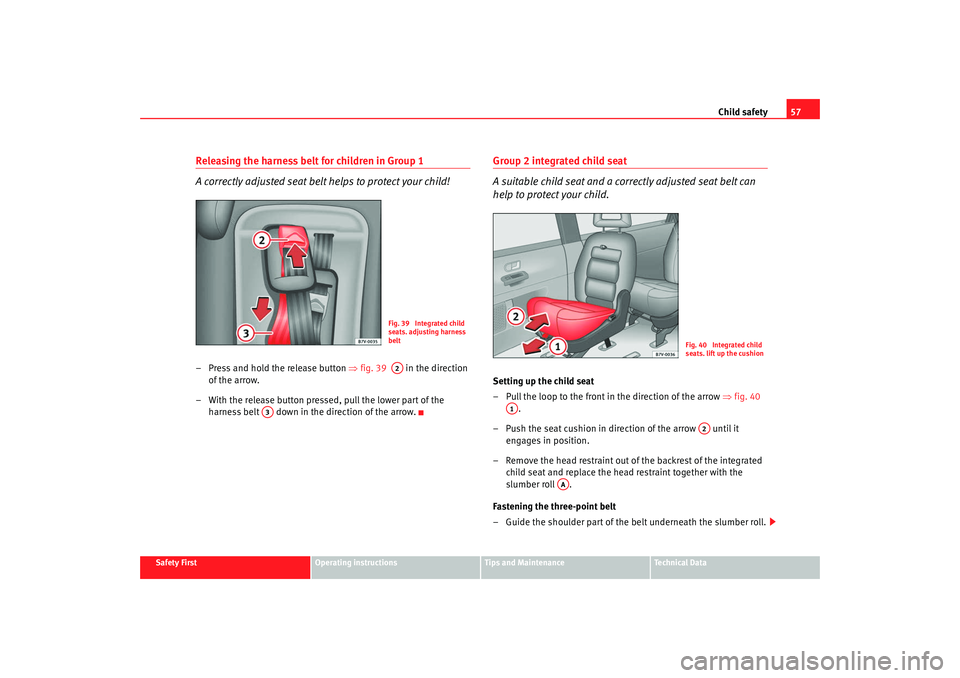
Releasing the harness belt for children in Group 1
A correctly adjusted seat belt helps to protect your child!– Press and hold the release button ⇒ fig. 39 in the direction
of the arrow.
– With the release button pressed, pull the lower part of the harness belt down in the direction of the arrow.
Group 2 integrated child seat
A suitable child seat and a correctly adjusted seat belt can
help to protect your child.Setting up the child seat
– Pull the loop to the front in the direction of the arrow ⇒fig. 40
.
– Push the seat cushion in direction of the arrow until it engages in position.
– Remove the head restraint out of the backrest of the integrated child seat and replace the head restraint together with the
slumber roll .
Fastening the three-point belt
– Guide the shoulder part of the belt underneath the slumber roll.
Fig. 39 Integrated child
seats. adjusting harness
beltA2
A3
Fig. 40 Integrated child
seats. lift up the cushion
A1
A2
AA
alhambra_aleman.book Seite 57 Montag, 23. M‰ rz 2009 1:12 13
Page 61 of 285

Child safety59
Safety First
Operating instructions
Tips and Maintenance
Te c h n i c a l D a t a
– Push the seat cushion in direction of the arrow until it
engages in position.
Fastening the three-point belt
– To fasten the three-point belt, take hold of the tongue and pull it slowly across the chest and lap.
– Push the tongue of the belt into the lock for that seat so that it engages audibly ( pull to check!)
– Adjust the three-point belt to suit body size ⇒.
Restoring the normal seat
– Pull the loop in the direction of the arrow and push the seat cushion down until it engages.Use the following measures to guarantee the proper routing of the shoulder
belt:•
Seatbelt height setting
•
Adjustment of the seat forwards and backwards
•
Backrest angle adjustment
WARNING
•
For safety reasons, the seat for children in Group 3 may only be fitted in
the direction of travel and in one of the outer positions (not on the centre
seat).
•
The risk of injury is increased if the belt is not correctly routed.
•
The shoulder part of the belt should be positioned roughly over the
centre of the shoulder, never across the neck, and fit closely against the
upper part of the body.
•
The lap belt part must lie across the pelvis, not across the stomach, and
always fit closely. check the fitting of the belt.
Cleaning the child seat– Open the zip ⇒fig. 42 fully and undo it at the end.
– Pull the cover from the Velcro fastening in area .
– Guide the belt lock and the harness belts through the cover and remove the child seat cover.The child seat cover can be washed in a washing machine at a maximum
temperature of 30°C.
A2
A1
WARNING (continued)
Fig. 42 Section of inte-
grated child seat
AA
AB
alhambra_aleman.book Seite 59 Montag, 23. M‰ rz 2009 1:12 13