seats Seat Alhambra 2009 Owner's Guide
[x] Cancel search | Manufacturer: SEAT, Model Year: 2009, Model line: Alhambra, Model: Seat Alhambra 2009Pages: 285, PDF Size: 7.62 MB
Page 54 of 285
Child safety
52
WARNING
•
Children must travel in a child seat appropriate to their weight and
height.
•
The vehicle seat must always be fitted in the direction of travel when
securing child restraint systems in weight class 0 or 0+.
•
Read and always observe information and warnings concerning the use
of child seats ⇒ in “Safety notes on using child seats” on page 46.
•
Please always read and follow the information and warnings provided
by the child seat manufacturer.Note
•
Due to space limitation, only the two outer seats can be used if two ISOFIX
system seats are to be fitted in the second row of seats.
Centre seat in the second row of seats (with three-point roof-anchored belt)
Only the use of an officially approved child seat corre-
sponding to the weight and height of the child is permitted.The centre seat with the three-point roof-anchored belt is suitable for weight
classes 0 to 2 ⇒.
Seat with ISOFIX retainers
Child seats fitted with the ISOFIX system can be used on the centre seat if it
is equipped with ISOFIX retainers ⇒.
WARNING
The central seat with three-point roof anchored belt is not suited to
universal child seats in group 3.•
The vehicle seat must always be fitted in the direction of travel when
securing child restraint systems in weight class 0 or 0+.
•
Children must travel in a child seat appropriate to their weight and
height.
•
Read and always observe information and warnings concerning the use
of child seats ⇒ in “Safety notes on using child seats” on page 46.
•
Please always read and follow the information and warnings provided
by the child seat manufacturer.Note
•
Due to space limitations, no further ISOFIX restraint systems can be fitted
in the second row of seats once an ISOFIX system has been fitted to the centre
seat.
alhambra_aleman.book Seite 52 Montag, 23. M‰ rz 2009 1:12 13
Page 55 of 285
Child safety53
Safety First
Operating instructions
Tips and Maintenance
Te c h n i c a l D a t a
ISOFIX child seat mounting system
ISOFIX child seats can be mounted in the second and third
row seats quickly, safely and easily.
When removing or fitting the child seat, please be sure to follow the
manufacturer's instructions.
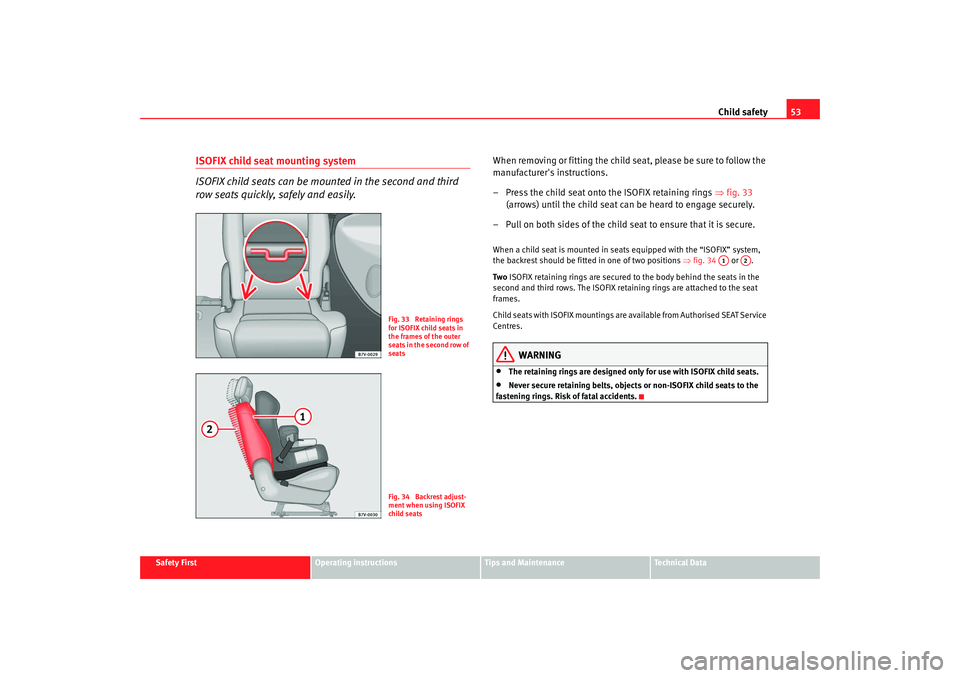
– Press the child seat onto the ISOFIX retaining rings ⇒fig. 33
(arrows) until the child seat can be heard to engage securely.
– Pull on both sides of the child seat to ensure that it is secure.When a child seat is mounted in seats equipped with the “ISOFIX” system,
the backrest should be fitted in one of two positions ⇒fig. 34 or .
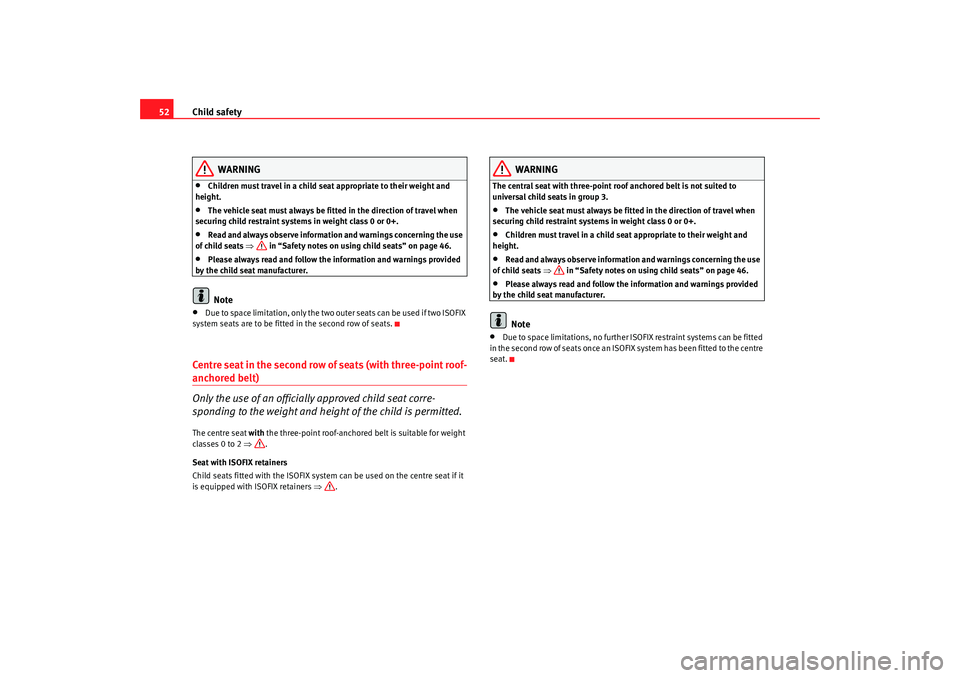
Two ISOFIX retaining rings are secured to the body behind the seats in the
second and third rows. The ISOFIX retaining rings are attached to the seat
frames.
Child seats with ISOFIX mountings are available from Authorised SEAT Service
Centres.
WARNING
•
The retaining rings are designed only for use with ISOFIX child seats.
•
Never secure retaining belts, objects or non-ISOFIX child seats to the
fastening rings. Risk of fatal accidents.
Fig. 33 Retaining rings
for ISOFIX child seats in
the frames of the outer
seats in the second row of
seatsFig. 34 Backrest adjust-
ment when using ISOFIX
child seats
A1
A2
alhambra_aleman.book Seite 53 Montag, 23. M‰ rz 2009 1:12 13
Page 56 of 285
Child safety
54Integrated child seatBasic information on the integrated child seat
Proper use of child seats substantially reduces the risk of
injury in an accident!It can be adjusted to suit the child's size and is suitable for children in the
following groups according to the ECE-R 44 norm: Group 1 (9 - 18 Kg), Group
2 (15 - 25 kg) and Group 3 (22 - 36 kg).
The integrated child seat for children in the Groups 1 and 2 must be used
with the slumber roll delivered with the seat.
For safety reasons, we recommend that the child seat for children in Group 1
is installed facing against the direction of travel. To do this, simply remove
the seat and fit it again facing in the opposite direction. The child must be
fastened in using the harness belt.
The child seat may only be fitted in the direction of travel for children in
Groups 2 and 3 who are fastened in using the three-point belt fitted in the
vehicle.
WARNING
•
With the integrated child seat, the backrest may only be adjusted to the
first or second backrest position for children in Groups 1 to 3.
•
The slumber roll must always be fitted for children in Groups 1 and 2.
•
The integrated child seat must not be modified in any way.
•
Do not allow the belt webbing to become twisted or jammed, or to rub
on any sharp edges.
•
If the child seat or any parts of the seat are damaged, or if the child seat
has to withstand the force of a collision in an accident, the seat, or part of
the seat, must be replaced - preferably by a qualified dealership.
Group 1 integrated child seat
A suitable child seat and a corre ctly adjusted seat belt can
help to protect your child.Setting up the child seat
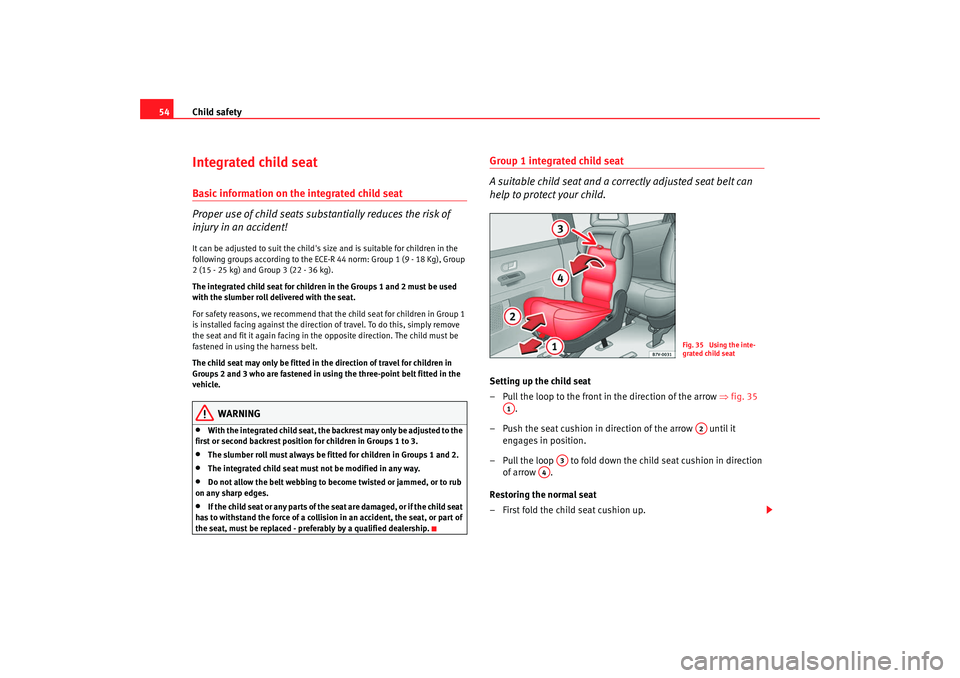
– Pull the loop to the front in the direction of the arrow ⇒fig. 35
.
– Push the seat cushion in direction of the arrow until it engages in position.
– Pull the loop to fold down the child seat cushion in direction of arrow .
Restoring the normal seat
– First fold the child seat cushion up.
Fig. 35 Using the inte-
grated child seat
A1
A2
A3
A4
alhambra_aleman.book Seite 54 Montag, 23. M‰ rz 2009 1:12 13
Page 57 of 285
Child safety55
Safety First
Operating instructions
Tips and Maintenance
Te c h n i c a l D a t a
– Pull the loop in the direction of the arrow and push the seat
cushion down until it engages.
Fitting the slumber roll
– Remove the head restraint.
– Fit the head restraint onto the slumber roll.
– Reinsert the head restraint and push down until it can be heard to engage.
Removing the slumber roll
– Remove the head restraint.
– Pull the slumber roll off the head restraint.
– Reinsert the head restraint and push down until it can be heard to engage.For safety reasons, we recommend that the child seat for children in Group 1
is installed facing against the direction of travel.
Adjusting the belt routing for larger children in Group 1
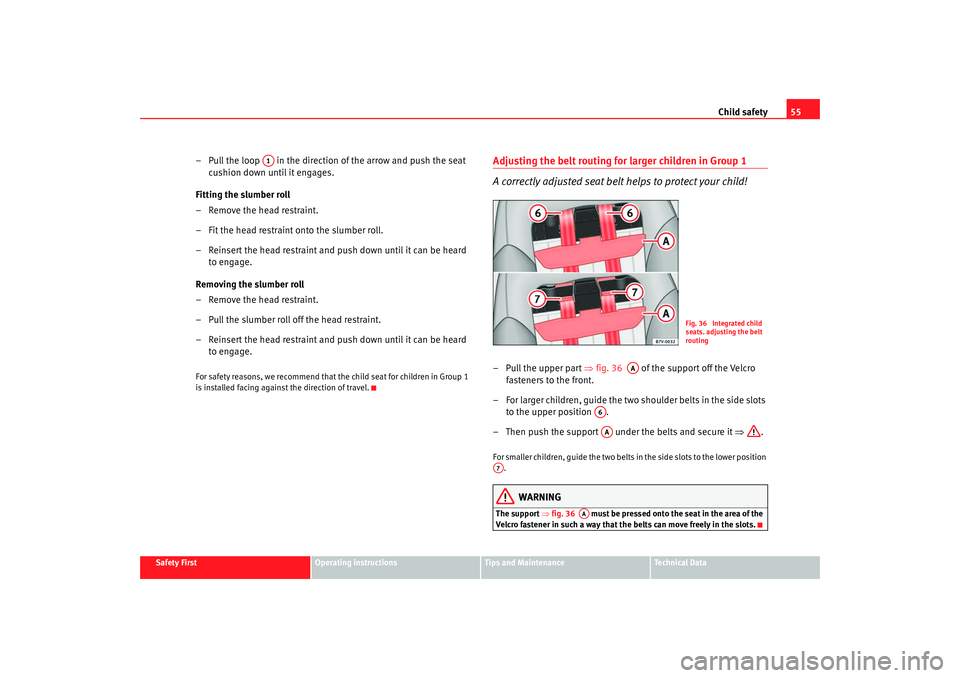
A correctly adjusted seat belt helps to protect your child!– Pull the upper part ⇒ fig. 36 of the support off the Velcro
fasteners to the front.
– For larger children, guide the two shoulder belts in the side slots to the upper position .
– Then push the support under the belts and secure it ⇒.For smaller children, guide the two belts in the side slots to the lower position
.
WARNING
The support ⇒fig. 36 must be pressed onto the seat in the area of the
Velcro fastener in such a way that the belts can move freely in the slots.
A1
Fig. 36 Integrated child
seats. adjusting the belt
routing
AA
A6AA
A7
AA
alhambra_aleman.book Seite 55 Montag, 23. M‰ rz 2009 1:12 13
Page 58 of 285
Child safety
56Fastening the harness belt for children in Group 1
A correctly adjusted seat belt helps to protect your child!
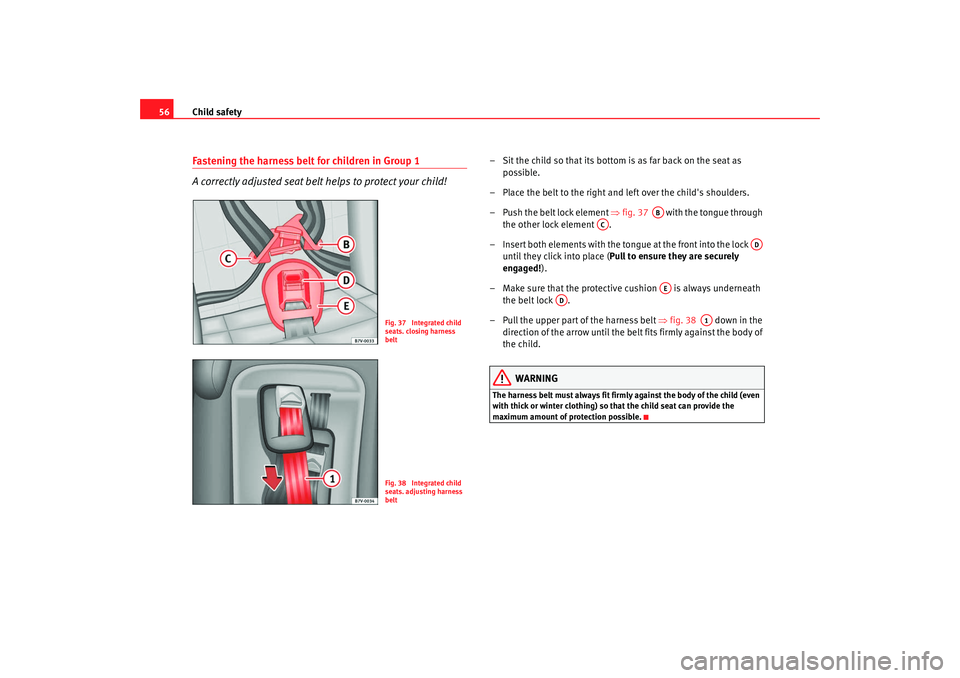
– Sit the child so that its bottom is as far back on the seat as
possible.
– Place the belt to the right and left over the child's shoulders.
– Push the belt lock element ⇒ fig. 37 with the tongue through
the other lock element .
– Insert both elements with the tongue at the front into the lock until they click into place (Pull to ensure they are securely
engaged! ).
– Make sure that the protective cushion is always underneath the belt lock .
– Pull the upper part of the harness belt ⇒ fig. 38 down in the
direction of the arrow until the belt fits firmly against the body of
the child.
WARNING
The harness belt must always fit firmly against the body of the child (even
with thick or winter clothing) so that the child seat can provide the
maximum amount of protection possible.
Fig. 37 Integrated child
seats. closing harness
beltFig. 38 Integrated child
seats. adjusting harness
belt
AB
AC
AD
AE
AD
A1
alhambra_aleman.book Seite 56 Montag, 23. M‰ rz 2009 1:12 13
Page 59 of 285
Child safety57
Safety First
Operating instructions
Tips and Maintenance
Te c h n i c a l D a t a
Releasing the harness belt for children in Group 1
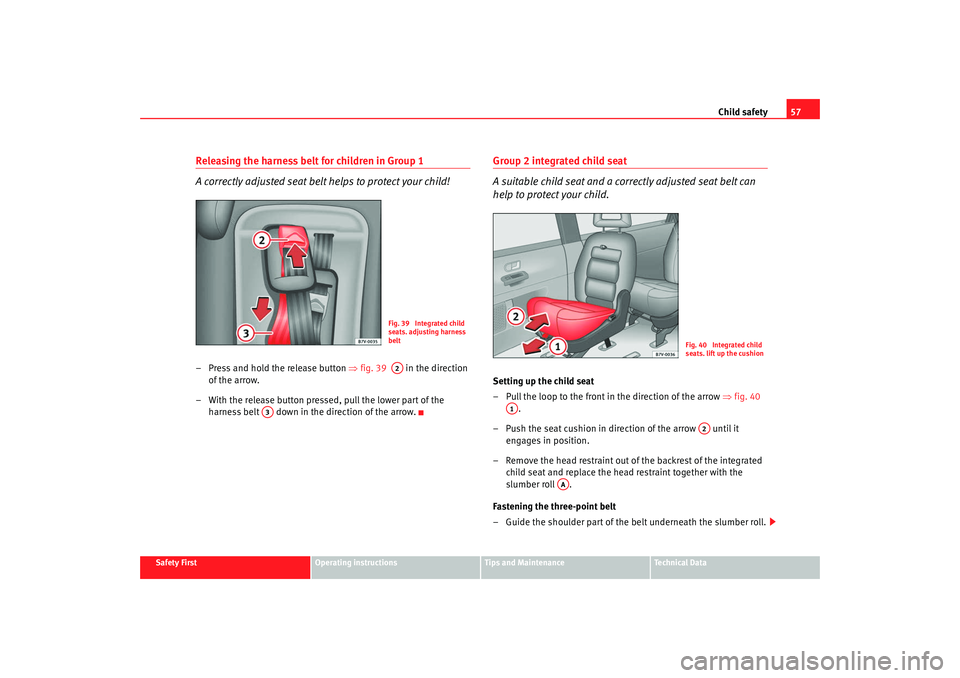
A correctly adjusted seat belt helps to protect your child!– Press and hold the release button ⇒ fig. 39 in the direction
of the arrow.
– With the release button pressed, pull the lower part of the harness belt down in the direction of the arrow.
Group 2 integrated child seat
A suitable child seat and a correctly adjusted seat belt can
help to protect your child.Setting up the child seat
– Pull the loop to the front in the direction of the arrow ⇒fig. 40
.
– Push the seat cushion in direction of the arrow until it engages in position.
– Remove the head restraint out of the backrest of the integrated child seat and replace the head restraint together with the
slumber roll .
Fastening the three-point belt
– Guide the shoulder part of the belt underneath the slumber roll.
Fig. 39 Integrated child
seats. adjusting harness
beltA2
A3
Fig. 40 Integrated child
seats. lift up the cushion
A1
A2
AA
alhambra_aleman.book Seite 57 Montag, 23. M‰ rz 2009 1:12 13
Page 113 of 285
Lights and visibility111
Safety First
Operating instructions
Tips and Maintenance
Te c h n i c a l D a t a
Illumination of instruments and switches
When the headlights are switched on, the brightness of the instruments and
switch lighting can be regulated to suit your requirements by turning the
switch
⇒page 110, fig. 71 .
Headlight range control
Using the headlight range control, you can adjust the headlight range to the
load level that is being carried in the vehicle. In this way it is possible to avoid
dazzling oncoming traffic more than necessary. At the same time, the driver
has the best possible lighting for the road ahead using the correct headlight
settings.
The headlights can only be adjusted when the dipped beam is switched on.
To lower the beam, turn the switch down from the basic setting 0.
If the vehicle load does not correspond to those shown in the table, it is
possible to select intermediary positions.
Dynamic headlight range control
Vehicles with gas discharge lamps
19) (“xenon lamps”) are equipped with
dynamic headlight range control . When the dipped light is switched on, the
range of the headlights adjusts to the vehicle load condition. In these vehi-
cles, the control is not available.
WARNING
In order not to dazzle other drivers, the dipped light should be adjusted
according to the vehicle load using the headlight range control. If not, an
accident may occur.•
Use the switch to lower the light cone, depending on the vehicle load.
Hazard warning lights
The hazard warning lights are used to draw the attention of
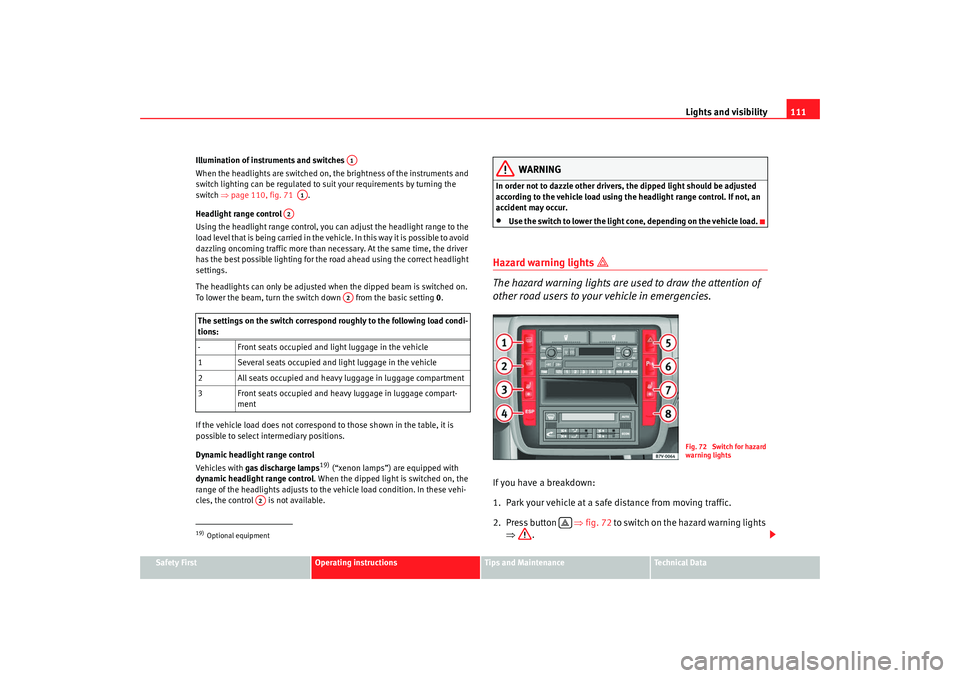
other road users to your vehicle in emergencies.If you have a breakdown:
1. Park your vehicle at a safe distance from moving traffic.
2. Press button ⇒fig. 72 to switch on the hazard warning lights
⇒ .
The settings on the switch correspond roughly to the following load condi-
tions:
- Front seats occupied and light luggage in the vehicle
1 Several seats occupied and light luggage in the vehicle
2 All seats occupied and heavy luggage in luggage compartment
3 Front seats occupied and heavy luggage in luggage compart-
ment19)Optional equipment
A1
A1
A2
A2
A2
Fig. 72 Switch for hazard
warning lights
alhambra_aleman.book Seite 111 Montag, 23. M‰ rz 2009 1:12 13
Page 124 of 285
Seats and stowage
122Seats and stowageThe importance of correct seat adjustmentProper seat adjustment optimises the level of protection
offered by seat belts and airbags.The driver seat, front passenger seat, and seats in the passenger compart-
ment, can be adjusted in many ways to suit the physical requirements of the
vehicle occupants. The correct seat position is very important for:•
fast and easy operation of all controls on the instrument panel,
•
relaxed posture that does not cause drowsiness,
•
safe driving,
•
optimum protection from the seat belts and airbag system ⇒page 7.
Ve hicle s ea ts
Yo u r ve h i cl e ha s a t o ta l o f five or seven
24) seats.
•
First row of seats: two seats
•
Second row of seats: three seats
•
Third row of seats
24): two seats
Each seat is equipped with a three-point seat belt.
WARNING
If the driver and passengers assume improper sitting positions, they may
sustain critical injuries.•
Never transport more people than there are seats available in the
vehicle.
•
Every occupant in the vehicle must properly fasten and wear the seat
belt belonging to his or her seat. Chil dren must be protected with an appro-
priate child restraint system. Section “Child Safety”
•
The seats and all head restraints must always be adjusted to body size
and the seat belt must always be properly adjusted to provide you and your
passengers with optimum protection.
•
Always keep your feet in the footwell when the vehicle is moving; never
rest them on the dash panel, out of the window or on the seat. This also
applies to passengers. An incorrect sitting position exposes you to an
increased risk of injury in the event of a braking manoeuvre or an accident.
If the airbag is triggered, you could sustain fatal injuries due to an improper
sitting position.
•
It is important for the driver and front passenger to maintain a distance
of at least 25 cm from the steering wheel or dash panel. Failure to respect
the minimum distance means that the airbag will not protect you. Risk of
fatal injury. The distance between the driver and the steering wheel or
between the front passenger and the dash panel should always be as great
as possible.
•
Adjust the driver or front passenger seat only when the vehicle is
stationary. Otherwise your seat could move unexpectedly while the vehicle
is moving. This could increase the risk of an accident and therefore injury.
In addition, while adjusting your seat, you will assume an incorrect sitting
position. Risk of fatal accidents.
•
Special guidelines apply to installing a child seat on the front
passenger seat. When installing a child seat, observe the warning note in
“Child safety”.
•
The seats in the third row of seats may, for safety reasons, only be used
if the luggage compartment cover has been removed.
24)Optional equipment
WARNING (continued)
alhambra_aleman.book Seite 122 Montag, 23. M‰ rz 2009 1:12 13
Page 125 of 285
Seats and stowage123
Safety First
Operating instructions
Tips and Maintenance
Te c h n i c a l D a t a
Head restraintsCorrect adjustment of head restraints
Properly adjusted head restraints are an important part of
occupant protection and can reduce the risk of injuries in
most accident situations.
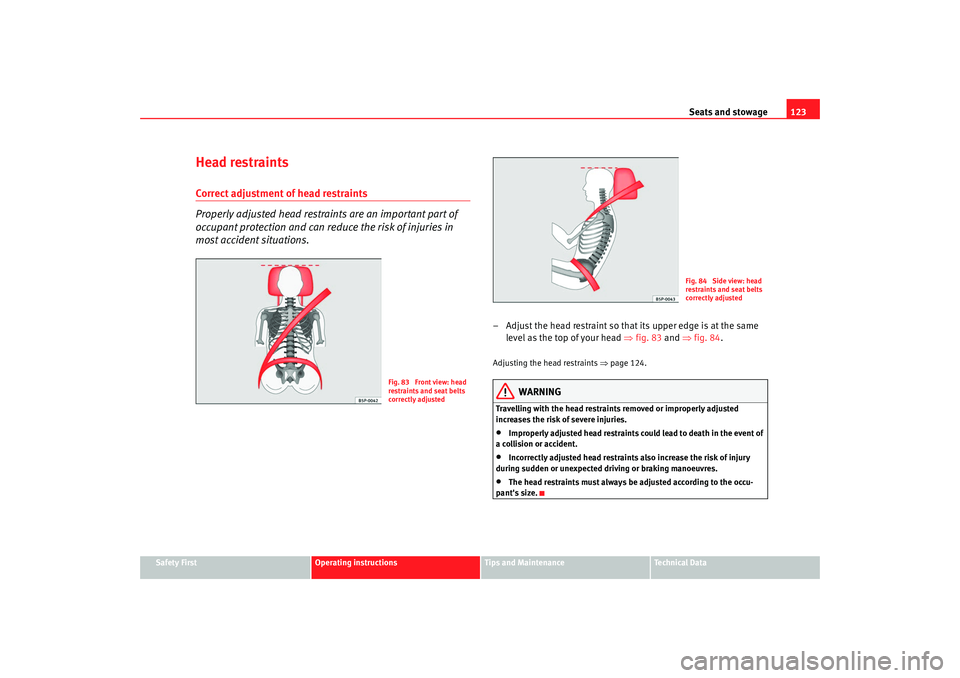
– Adjust the head restraint so that its upper edge is at the same
level as the top of your head ⇒ fig. 83 and ⇒ fig. 84.Adjusting the head restraints ⇒page 124.
WARNING
Travelling with the head restraints removed or improperly adjusted
increases the risk of severe injuries.•
Improperly adjusted head restraints could lead to death in the event of
a collision or accident.
•
Incorrectly adjusted head restraints also increase the risk of injury
during sudden or unexpected driving or braking manoeuvres.
•
The head restraints must always be adjusted according to the occu-
pant's size.
Fig. 83 Front view: head
restraints and seat belts
correctly adjusted
Fig. 84 Side view: head
restraints and seat belts
correctly adjusted
alhambra_aleman.book Seite 123 Montag, 23. M‰ rz 2009 1:12 13
Page 126 of 285
Seats and stowage
124Removing or adjusting head restraints
The head restraints can be adjusted by moving them up and
down.Adjusting height
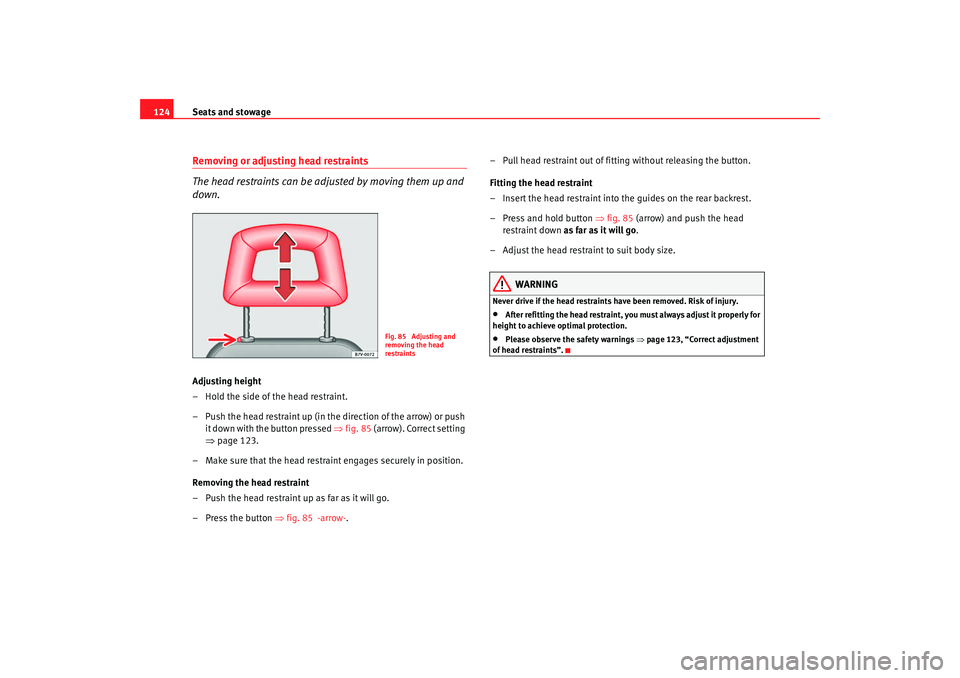
– Hold the side of the head restraint.
– Push the head restraint up (in the direction of the arrow) or push
it down with the button pressed ⇒fig. 85 (arrow). Correct setting
⇒ page 123.
– Make sure that the head restraint engages securely in position.
Removing the head restraint
– Push the head restraint up as far as it will go.
– Press the button ⇒fig. 85 -arrow- . – Pull head restraint out of fitting without releasing the button.
Fitting the head restraint
– Insert the head restraint into the guides on the rear backrest.
– Press and hold button
⇒fig. 85 (arrow) and push the head
restraint down as far as it will go .
– Adjust the head restraint to suit body size.
WARNING
Never drive if the head restraints have been removed. Risk of injury.•
After refitting the head restraint, you must always adjust it properly for
height to achieve optimal protection.
•
Please observe the safety warnings ⇒page 123, “Correct adjustment
of head restraints”.
Fig. 85 Adjusting and
removing the head
restraints
alhambra_aleman.book Seite 124 Montag, 23. M‰ rz 2009 1:12 13