seats Seat Alhambra 2009 Repair Manual
[x] Cancel search | Manufacturer: SEAT, Model Year: 2009, Model line: Alhambra, Model: Seat Alhambra 2009Pages: 285, PDF Size: 7.62 MB
Page 147 of 285
Seats and stowage145
Safety First
Operating instructions
Tips and Maintenance
Te c h n i c a l D a t a
WARNING
Loose luggage and other objects in the luggage compartment can cause
serious injuries.•
Always stow objects in the luggage compartment and secure them on
the fastening rings.
•
Use suitable specialist straps to secure heavy objects.
•
During sudden manoeuvres or accidents, loose objects can be thrown
forward, injuring vehicle occupants or passers-by. This increased risk of
injury will be further increased if a lo ose object is struck by an inflating
airbag. If this happens, objects can be transformed into “missiles”. Risk of
fatal injury.
•
Remember that transporting heavy objects modifies the driving condi-
tions as the centre of gravity has been altered. There is a risk of accident.
Therefore, it is essential to adjust your speed and driving style accordingly,
to avoid accidents.
•
Never exceed the allowed axle loads or allowed maximum weight. If the
allowed axle load or the allowed total weight is exceeded, the driving char-
acteristics of the vehicle may change, leading to accidents, injuries and
damage to the vehicle.
•
Never leave the vehicle unattended, especially when the tailgate is
open. Children could climb into the luggage compartment closing the door
behind them; they will remain trapped without help and there is a mortal
risk.
•
Never allow children to play in or around the vehicle. Close and lock
both the tailgate and all the doors when you leave the vehicle. Before you
lock the vehicle, make sure that there are no adults or children in the
vehicle.
•
Never transport passengers in the luggage compartment. Every
passenger must be properly belted in.
Caution
•
Avoid overloading small areas by placing heavy objects on the vehicle
floor.
•
The wires of the heating element in the rear window and the window aerial
in the rear side windows could be damaged if objects on the luggage
compartment cover rub against them.
•
If you have removed the seats from the passenger compartment, you
should place a large, robust covering over the floor anchorings to prevent
damage.Note
•
Air circulation in the vehicle helps reduce fogging of the windows. Used
air escapes through ventilation slits in the side trim of the luggage compart-
ment. Ensure that the ventilation slits are never covered.
•
Straps for securing the load to the fastening rings are commercially
available.
Fastening rings
There are fastening rings in the luggage compartment which
can be used to secure luggage and other objects.– Always use suitable undamaged belts for fastening the luggage or any other object tot he anchorage rings ⇒ in “Loading the
luggage compartment” on page 144.The retainers for the detachable seat belts for the third row of seats and the
floor anchorings for the seats can be used as fastening rings for items of
luggage.
alhambra_aleman.book Seite 145 Montag, 23. M‰ rz 2009 1:12 13
Page 148 of 285
Seats and stowage
146During a collision or an accident, even small and light objects can build up so
much energy that they can cause very severe injuries. The amount of “kinetic
energy” depends on the speed of the vehicle and the weight of the object.
The most significant factor, however, is the speed of the vehicle.
Example: An object weighing 4.5 kg is lying unsecured in the vehicle. During
a frontal collision at a speed of 50 km/h, this object generates a force corre-
sponding to 20 times its weight. That means that the effective weight of the
object increases to about 90 kg. You can imagine the severity of the injuries
which might be sustained if this “projectile” strikes an occupant as it flies
through the passenger compartment. This increased risk of injury will be
further increased if a loose object is struck by an inflating airbag.
WARNING
If pieces of baggage or other objects are secured to the fastening rings with
inappropriate or damaged retaining cords, injuries could result in the event
of braking manoeuvres or accidents.•
To prevent pieces of luggage or other objects from flying forward,
always use appropriate retaining cords which are secured to the fastening
rings.
•
Never secure a child seat on the fastening rings.
Loading heavy objects
Special care is required when loading heavy objects and
when driving a vehicle which contains heavy objects.Observe the following points to prevent damage and accidents:
– If necessary, remove the seats to increase the load area. –
Before loading the vehicle place a sturdy mat or similar cover
flush on floor of the vehicle.
– Where necessary, do not cover protruding parts of the vehicle floor.
– Protect the seat anchor points from damage.
– Avoid overloading small areas - spread the load.
– Use suitable straps to secure the objects to retaining rings.
– Drive particularly carefully and think ahead.
– If possible, avoid sudden braking and driving manoeuvres.
WARNING
For safety reasons, you should read and observe all information on loading
the vehicle ⇒ page 146.
Caution
•
If you have removed the seats from the passenger compartment, you
should place a large, robust covering over the seat rails to prevent damage.
•
Avoid overloading small areas - spread the load.
Safety notes on loading the vehicle
WARNING
Loose luggage and other objects in the luggage compartment can cause
serious injuries.
alhambra_aleman.book Seite 146 Montag, 23. M‰ rz 2009 1:12 13
Page 149 of 285
Seats and stowage147
Safety First
Operating instructions
Tips and Maintenance
Te c h n i c a l D a t a
•
Always stow objects safely in the vehicle and secure them on the
fastening rings if necessary.
•
Use suitable specialist straps to secure heavy objects.
•
Loose objects in the vehicle can move suddenly. As the centre of gravity
moves, safety is impaired and the vehicle becomes difficult to handle.
•
During sudden manoeuvres or accidents, loose objects can be thrown
forward, injuring vehicle occupants or passers-by. This increased risk of
injury will be further increased if a lo ose object is struck by an inflating
airbag. If this happens, objects can be transformed into “missiles”. Risk of
fatal injury.
•
Remember that transporting heavy objects modifies the driving condi-
tions as the centre of gravity has been altered. There is a risk of accident.
Therefore, it is essential to adjust your speed and driving style accordingly,
to avoid accidents.
•
Never exceed the allowed axle loads or allowed maximum weight. If the
allowed axle load or the allowed total weight is exceeded, the driving char-
acteristics of the vehicle may change, leading to accidents, injuries and
damage to the vehicle.
•
Never leave the vehicle unattended, especially when the tailgate is
open. Children could climb into the interior of the vehicle closing the door
behind them; they will remain trapped without help and there is a mortal
risk.
•
Never allow children to play in or around the vehicle. Close and lock all
windows, the tailgate and all doors when you leave the vehicle.
•
Never transport passengers in the luggage compartment. Every
passenger must be properly belted in.
Luggage compartment cover
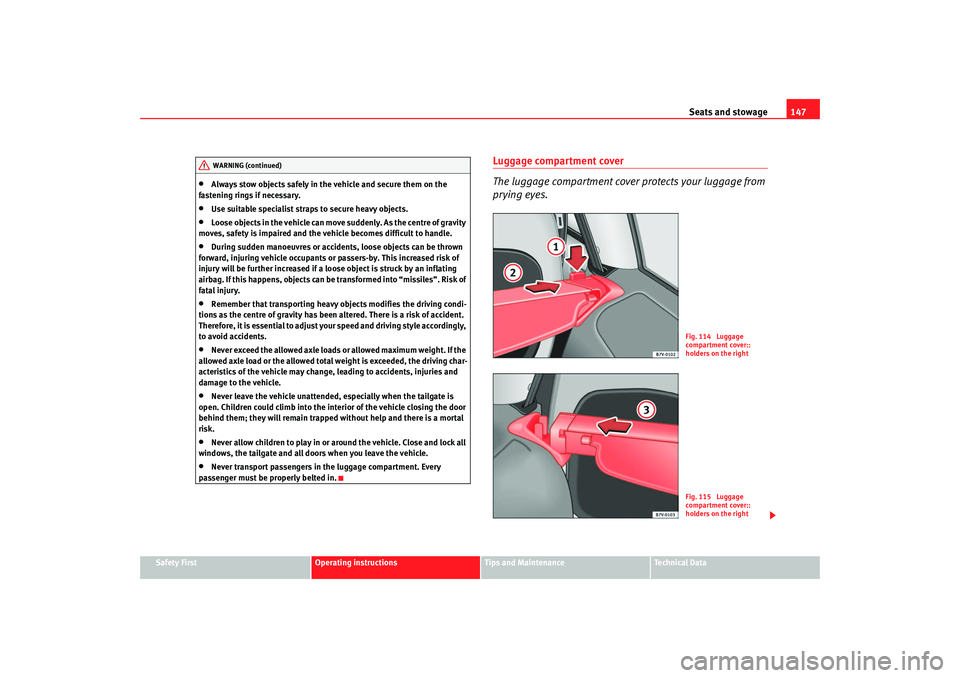
The luggage compartment cover protects your luggage from
prying eyes.
WARNING (continued)
Fig. 114 Luggage
compartment cover::
holders on the rightFig. 115 Luggage
compartment cover::
holders on the right
alhambra_aleman.book Seite 147 Montag, 23. M‰ rz 2009 1:12 13
Page 150 of 285
Seats and stowage
148
Opening the luggage compartment cover
– After fitting the luggage compartment cover, pull the handle on the cover back and hook in the cover on the side.
Removing the luggage compartment cover
– Press the unlock button (with the luggage compartment cover rolled up) ⇒page 147, fig. 114 in the direction of the arrow
and remove the cover from the right holder upwards.
– Remove the cover from the left holder in the direction of the arrow and remove from the vehicle.
Fitting the luggage compartment cover
– Push the luggage compartment cover to the stop in the direction of the arrow ⇒page 147, fig. 115 into the left-hand holder.
– Press the cover down into the right-hand holder until it engages in position.Light items of clothing or other objects on the luggage compartment cover
can restrict visibility through the rear window.
WARNING
•
Never leave hard, heavy or sharp objects on the shelf (unrolled) or in the
pockets of clothing on the luggage compartment cover. Animals must
never be allowed onto the luggage compartment cover. During a sudden
braking or driving manoeuvre or an accident, these objects and animals
endanger all vehicle occupants.Risk of injury.
Caution
The wires of the heating element in the rear window and the window aerial in
the rear side windows could be damaged if objects on the luggage compart-
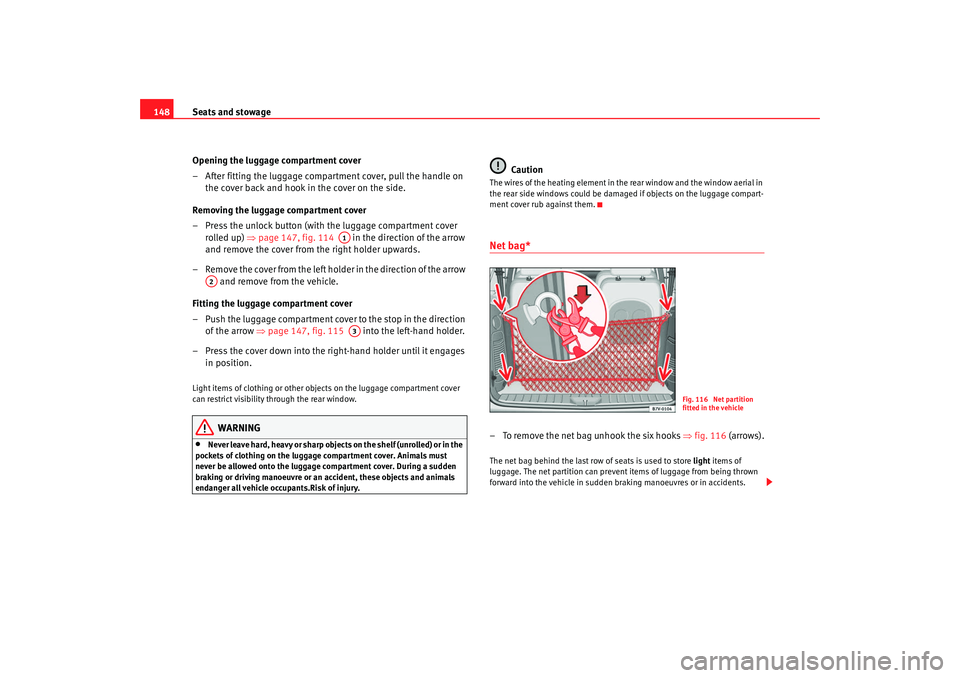
ment cover rub against them.Net bag*– To remove the net bag unhook the six hooks ⇒fig. 116 (arrows).The net bag behind the last row of seats is used to store light items of
luggage. The net partition can prevent items of luggage from being thrown
forward into the vehicle in sudden braking manoeuvres or in accidents.
A1
A2
A3
Fig. 116 Net partition
fitted in the vehicle
alhambra_aleman.book Seite 148 Montag, 23. M‰ rz 2009 1:12 13
Page 151 of 285
Seats and stowage149
Safety First
Operating instructions
Tips and Maintenance
Te c h n i c a l D a t a
WARNING
Always fit the net partition carefully, observing the instructions. Risk of
injury.•
Heavy, pointed or sharp items which are not stowed securely can cause
injury in the event of sudden braking manoeuvres or accidents, even if the
net bag is correctly assembled.
•
For reasons of safety, vehicle occupants must not travel behind a fitted
safety net.
Roof carrierSafety notes on using the roof carrier
The roof carrier system must always be installed exactly
according to the instructions provided.•
Your vehicle has special roof rails on the right and left for fitting the
mounts. Therefore, standard roof carriers cannot be used.
•
The mounts are the basis of a complete roof carrier system. Special
fixtures must then be added in order to safely transport luggage, bicycles,
skis, surf boards or boats on the roof. All these system components are avail-
able from SEAT Service. We recommend you use genuine SEAT roof carrier
systems. If you wish to use a different roof carrier, make sure that it can be
fitted securely to your vehicle and that it cannot damage your vehicle.
•
We recommend that you keep the assembly instructions provided by the
roof carrier manufacturer in your vehicle wallet.
•
Only the fitted retainers may be used to secure the carrier feet on vehicles
without a roof railing . These retainers are located underneath the plastic rain
channel between the markings.
•
In vehicles with roof edging
36), the basic supports can be fitted on the
edge making sure to adapt the distance between the supports to the objects
to be carried. On vehicles with a sliding/tilting roof
36), however, the front
carrier may not be fitted near the rear edge of the sliding/tilting roof when the
roof is open.
When should the roof carrier be removed?
•
When it is not needed (to save fuel, reduce wind noise and avoid theft).
•
Before cleaning in an automatic car wash.
WARNING
•
If you do not use mounts approved by SEAT or fail to fit them according
to instructions, the load or the roof carrier itself may fall off the vehicle roof
and onto the street. Risk of accident or injury.
•
The risk of an accident is increased by transporting heavy or bulky
loads on the roof, which affects the car's handling by shifting the centre of
gravity and increasing susceptibility to cross winds. Both circumstances
increase the risk of accident. Therefore you must adapt your driving style
and speed to the prevailing conditions - avoid sudden braking or driving
manoeuvres when there is a load on the roof carrier.
•
The roof carrier system must always be installed exactly according to
the instructions provided.Caution
•
Check all bolted connections and fastenings for the roof carrier system
before every trip. If necessary, tighten bolted connections and check the
system at regular, appropriate intervals, e.g. at each stop during a long trip.
•
The height of your vehicle is changed by the installation of the roof carrier
and the load secured on it. Bear this in mind when driving through garage
doors or low underpasses – there is danger of damage to the vehicle.
36)Optional equipment
alhambra_aleman.book Seite 149 Montag, 23. M‰ rz 2009 1:12 13
Page 152 of 285
Seats and stowage
150•
Damage to the vehicle caused by incorrect installation of mounts or roof
carrier systems not approved by the factory are excluded from the vehicle
warranty.
Securing the load
Loads transported on the roof carrier must be securely
attached. The car's handling is affected when transporting
loads.The maximum permissible roof load for your vehicle is 75 kg. The load limit
applies to the combined weight of the carrier system and the load itself.
Distribute the load evenly. However, if you are using a roof carrier with a lower
weight rating, you will not be able to carry the maximum roof load. Do not
exceed the maximum weight limit for the roof carrier which is listed in the
fitting instructions.
WARNING
•
If damaged, fine or inadequate securing straps are used to fasten
objects carried on the roof, they could break in the event of sharp braking.
This could cause an accident and serious injury.
•
Always use appropriate securing straps to secure objects on the roof
carrier against sliding or flying off.,This could cause an accident. The load
must be correctly secured.
•
Always respect the maximum authorised weight for the roof, the
maximum authorised weight on the axles and the total maximum author-
ised weight of the vehicle. Otherwise there is danger of causing an acci-
dent.
•
The risk of an accident is increased by transporting heavy or bulky
loads on the roof, which affects the car's handling by shifting the centre of
gravity and increasing susceptibility to cross winds. Both circumstances increase the risk of accident. Therefore you must adapt your driving style
and speed to the prevailing conditions - avoid sudden braking or driving
manoeuvres when there is a load on the roof carrier.
Caution
Please take extra care not to let the tailgate or rear window strike the roof load
when open – there is a risk of damage to the vehicle.
For the sake of the environment
The roof carrier is often left on the roof for convenience even if it is not being
used. However, increased air resistance means that the vehicle uses more
fuel. For this reason you should always take off the roof carrier when it is not
in use.Cooling and heating box*Notes on usage
The cooling and heating box may on
ly be installed in the posi-
tion of rear left seat in the third row.Power can be supplied by any of the 12 Volt sockets in the vehicle. It
consumes approximately 33 watts and has a capacity of approximately 32
litres.
The battery will discharge if the cooling and heating box is used for a long
period while the engine is switched off.
WARNING (continued)
alhambra_aleman.book Seite 150 Montag, 23. M‰ rz 2009 1:12 13
Page 153 of 285
Seats and stowage151
Safety First
Operating instructions
Tips and Maintenance
Te c h n i c a l D a t a
Before using the cooling and heating box for the first time, you should clean
it using a household detergent.
Disconnect the power supply and clean the box if you do not plan to use the
cooling and heating box for a long period. Place a folded towel between the
box and its lid. This prevents mould and damp stains forming in the cooling
and heating box.
Whenever possible, food and drinks should be stored in air-tight containers
in the box.
Do not overfill the box - this would prevent air circulation within the box.
Place crumpled paper (or similar) between bottles and other containers in the
box to prevent clanking noises.
Do not fill the interior of the box with liquid or ice.
Caution
•
Do not place objects, blankets, or clothes on top of the cooling/heating
box, as the air intake and output may be obstructed and the box will discon-
nect itself.
•
Do not place any containers, food items or other objects into the box if
they are warmer than +50°C. This could damage the cooling and heating box.
•
The cold/hot box is not suitable for transporting corrosive material or
material containing solvents.
•
Never leave the cold/hot box in the rain or damp.Note
•
The cooling and heating box is not designed to heat or cool the interior of
the vehicle. The cooling and heating box should be used only for cooling and
warming food and drinks and for transporting heat-sensitive items on short
journeys.
•
A corresponding manual for the installation and use of the cooling and
heating box is included by the manufacturer and should be kept with the
vehicle wallet.
Cooling or heating
The contents of the cooling and heating box can be cooled or
kept warm.Switching on the cooling function
– Insert the cable plug in the cooling and heating box so that the blue marking on the plug is pointing to the notch.
– Insert the connector cable plug into one of the vehicle's 12 volt sockets.
– Keep the lid of the cooling and heating box closed.
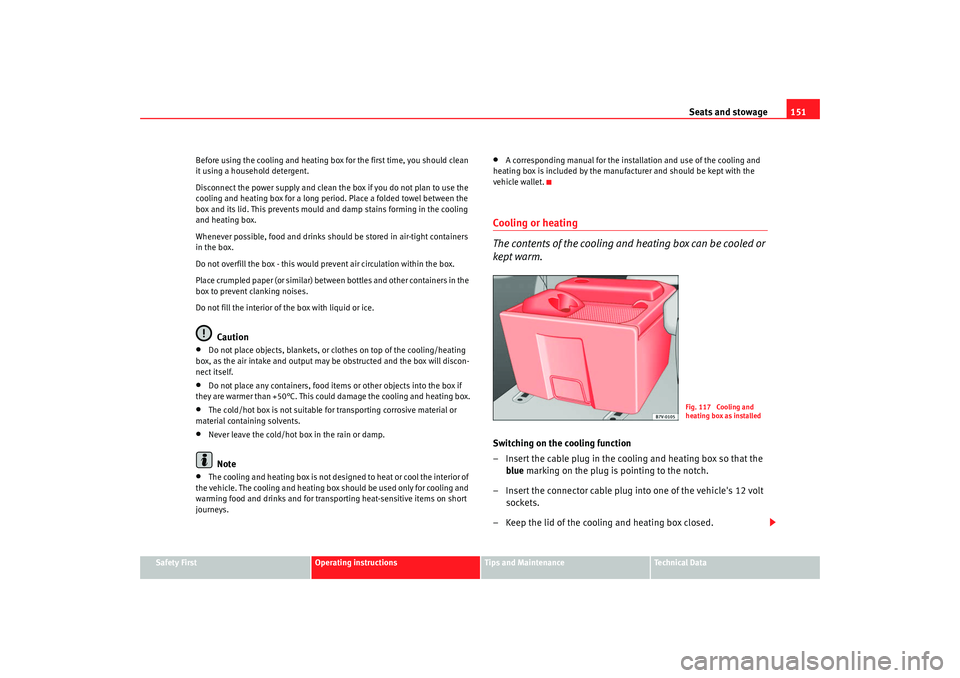
Fig. 117 Cooling and
heating box as installed
alhambra_aleman.book Seite 151 Montag, 23. M‰ rz 2009 1:12 13
Page 154 of 285
Seats and stowage
152
Switching on the heating function
– Insert the cable plug in the cooling and heating box so that the red marking on the plug is pointing to the notch.
– Insert the connector cable plug into one of the vehicle's 12 volt sockets.
– Keep the lid of the cooling and heating box closed.
Switching the cooling and heating box off fully
– Disconnect the power supply to the 12 Volt socket.The internal temperature of the cooling and heating box is dependent on the
temperature in the vehicle. In cooling mode, the internal temperature can be
max. 20 degrees below the temperature in the vehicle. In heating mode it can
be max. 35 degrees above the temperature in the vehicle ⇒ in “Safety
notes on using the cooling and heating box” on page 152.
If you switch directly from cooling to heating (or vice versa) it will take a rela-
tively long time for the interior to reach the desired temperature.
Faults
If the cooling and heating box does not work, proceed as follows:•
Check whether there is power and whether the plug is securely in the
socket.
•
Make sure the power cable is not damaged.
•
Check the fuse for the power supply to the 12 Volt socket.
•
Run the engine to recharge the battery.
If these steps do not help, contact a qualified dealership.
Safety notes on using the cooling and heating box
WARNING
•
For reasons of safety, the cooling and heating box lid must always be
closed and latched when the vehicle is in motion. The cooling and heating
box must always be firmly secured in the correct floor anchorings.
•
If the temperature in the vehicle is too low, the temperature in the box
may fall below +2 degrees and the contents may freeze. Bottles and other
containers could burst. Risk of injury.
•
For reasons of safety, the cooling and heating box lid must not be used
as a table or shelf when the vehicle is in motion.
•
Always close the lid of the cooling and heating box before the vehicle
moves off. If the flap is open, it could drop down when the vehicle moves
off. Risk of injury.
alhambra_aleman.book Seite 152 Montag, 23. M‰ rz 2009 1:12 13
Page 161 of 285
Heating, Ventilation and Air conditioning159
Safety First
Operating instructions
Tips and Maintenance
Te c h n i c a l D a t a
Air vents in the roof
In vehicles with a second cooling system
39) for ventilating the passenger
compartment, an air outlet is fitted in the roof above each rear seat
⇒ fig. 122 .
The air outlets in the roof can be opened and closed individually and
adjusted by moving the grid.
Each air outlet has two thumb wheels. The left thumb wheel can be used to
open and close the air outlet. The right thumb wheel can be used to direct the
air towards the head and chest.
WARNING
Never leave objects, food or medicines in front of the air outlets in the rear
seats. The hot air could damage or destroy heat-sensitive objects, food or
medicines.
Caution
Do not use the area in front of the outlets to store objects. This could cause
the blower to overheat and switch off. The blower could also be damaged.
Note
In the cooling mode, at least one air outlet in the roof must be open. The
cooling system could otherwise ice over.
General notesThe pollution filter
The pollution filter serves as a barrier against impurities in the ambient air (
e.g.dust and pollen).
For the air conditioning system to work with maximum efficiency, the pollen
filter must be replaced at the intervals specified in the Service Schedule.
If the filter loses efficiency prematurely due to use in areas with very high
levels of air pollution, the pollen filter must be changed more frequently than
stated in the Service Schedule.
Instructions for use
If the air conditioning or Climatronic
40) is not switched on for a long period,
deposits on the evaporator can cause unpleasant smells. To prevent these
odours, the cooling system should be run at the highest blower setting at
least once a month when temperatures are over +5°C. Briefly open a window
at the same time.
Faults in the operation of the air conditioning
There is a fault if the all the symbols in the Climatronic flash for approx. 15
seconds when the ignition is switched on. Contact a specialist workshop.
If the air conditioning system cannot be switched on this may be caused by
the following reasons:
•
the engine is not running.
•
The blower is switched off.
•
The outside temperature is lower than +5°C.
•
the cooling system compressor has been temporarily switched off
because the engine coolant temperature is too high.
•
The air conditioning fuse is faulty.
39)Optional equipment
40)Optional equipment
alhambra_aleman.book Seite 159 Montag, 23. M‰ rz 2009 1:12 13
Page 275 of 285
Index273
Index4MOTION . . . . . . . . . . . . . . . . . . . . . . . . . . . . . . 186AABS . . . . . . . . . . . . . . . . . . . . . . . . . . . . . . . . . . . 182
Warning lamp . . . . . . . . . . . . . . . . . . . . . . . . . 76
warning lamp . . . . . . . . . . . . . . . . . . . . . . . . 183
Accessories . . . . . . . . . . . . . . . . . . . . . . . . . . . . 204
Acoustic signal . . . . . . . . . . . . . . . . . . . . . . . . . . 19
Acoustic warning . . . . . . . . . . . . . . . . . . . . . . . . 163
Additional instruction manual Roof carrier . . . . . . . . . . . . . . . . . . . . . . . . . . 149
Adjust seats rear seats . . . . . . . . . . . . . . . . . . . . . . . . . . . 128
Adjusting lumbar support . . . . . . . . . . . . . . . . . 125
Air conditioning manual faults in operation . . . . . . . . . . . . . . . . . . . . 159
Air conditioning system Climatronic . . . . . . . . . . . . . . . . . . . . . . . . . . 153
General notes . . . . . . . . . . . . . . . . . . . . . . . . 159
Air recirculation mode Climatronic . . . . . . . . . . . . . . . . . . . . . . . . . . 156
Airbag cover . . . . . . . . . . . . . . . . . . . . . . . . . . . . . 39
Airbag covers . . . . . . . . . . . . . . . . . . . . . . . . . . . . 39 Airbag system . . . . . . . . . . . . . . . . . . . . . . . . . . . 33
Curtain airbags . . . . . . . . . . . . . . . . . . . . . . . 42
Front airbags . . . . . . . . . . . . . . . . . . . . . . . . . 37
Side airbags . . . . . . . . . . . . . . . . . . . . . . . . . . 40
Warning lamp . . . . . . . . . . . . . . . . . . . . . . . . . 34
Airbags Care . . . . . . . . . . . . . . . . . . . . . . . . . . . . . . . . 35
Disposal . . . . . . . . . . . . . . . . . . . . . . . . . . . . . 35
Safety notes . . . . . . . . . . . . . . . . . . . . . . . . . . 35
Alarm system . . . . . . . . . . . . . . . . . . . . . . . . . . . . 97 Switching off . . . . . . . . . . . . . . . . . . . . . . . . . 97
Alterations to the vehicle . . . . . . . . . . . . . . . . . 204
Alternator Warning lamp . . . . . . . . . . . . . . . . . . . . . . . . . 78
Anti-freeze . . . . . . . . . . . . . . . . . . . . . . . . . . . . . 218
Anti-lock brake system Warning lamp . . . . . . . . . . . . . . . . . . . . . . . . . 76
Anti-locking brake system . . . . . . . . . . . . . . . . 182 warning lamp . . . . . . . . . . . . . . . . . . . . . . . . 183
Anti-puncture kit . . . . . . . . . . . . . . . . . . . . . . . . 236 Sealing and inflating tyres . . . . . . . . . . . . . 237
Anti-theft alarm system . . . . . . . . . . . . . . . . . . . . 97 Switching off . . . . . . . . . . . . . . . . . . . . . . . . . 97
Anti-theft wheel bolts . . . . . . . . . . . . . . . . . . . . 240
Aquaplaning . . . . . . . . . . . . . . . . . . . . . . . . . . . 229
Armrest . . . . . . . . . . . . . . . . . . . . . . . . . . . . . . . . 131 Ashtrays
Front . . . . . . . . . . . . . . . . . . . . . . . . . . . . . . . 140
rear . . . . . . . . . . . . . . . . . . . . . . . . . . . . . . . . 141
Automatic belt retractor . . . . . . . . . . . . . . . . . . . 23
Automatic car washes . . . . . . . . . . . . . . . . . . . . 196
Automatic gearbox . . . . . . . . . . . . . . . . . . . . . . 168 Safety interlock for ignition key . . . . . . . . . 164
Automatic gearbox with Tiptronic . . . . . . . . . . 173
Automatic mode Climatronic . . . . . . . . . . . . . . . . . . . . . . . . . . 154
Automatic wipe Windscreen wiper and washer . . . . . . . . . . 117
automatic wipe Rear window wiper and wash . . . . . . . . . . . 118
AUX-IN Input . . . . . . . . . . . . . . . . . . . . . . . . . . . . 143
BBall coupling . . . . . . . . . . . . . . . . . . . . . . . . . . . 193
BAS . . . . . . . . . . . . . . . . . . . . . . . . . . . . . . . . . . . 182
Battery Changing . . . . . . . . . . . . . . . . . . . . . . . . . . . 226
Charging . . . . . . . . . . . . . . . . . . . . . . . . . . . . 226
Winter conditions . . . . . . . . . . . . . . . . . . . . 225
Belt height adjustment . . . . . . . . . . . . . . . . . 27, 30
Belt retainer . . . . . . . . . . . . . . . . . . . . . . . . . . . . . 30
Belt tension device Disposal . . . . . . . . . . . . . . . . . . . . . . . . . . . . . 31
alhambra_aleman.book Seite 273 Montag, 23. M‰ rz 2009 1:12 13