maintenance Seat Alhambra 2009 Manual PDF
[x] Cancel search | Manufacturer: SEAT, Model Year: 2009, Model line: Alhambra, Model: Seat Alhambra 2009Pages: 285, PDF Size: 7.62 MB
Page 143 of 285
Seats and stowage141
Safety First
Operating instructions
Tips and Maintenance
Te c h n i c a l D a t a
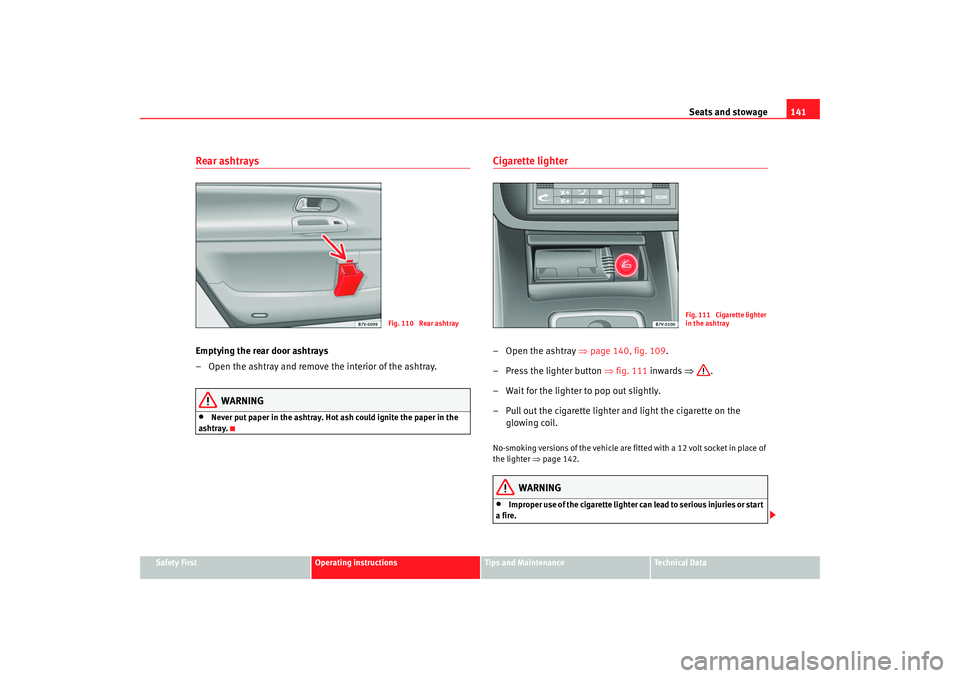
Rear ashtraysEmptying the rear door ashtrays
– Open the ashtray and remove the interior of the ashtray.
WARNING
•
Never put paper in the ashtray. Hot ash could ignite the paper in the
ashtray.
Cigarette lighter–Open the ashtray ⇒page 140, fig. 109 .
– Press the lighter button ⇒fig. 111 inwards ⇒.
– Wait for the lighter to pop out slightly.
– Pull out the cigarette lighter and light the cigarette on the glowing coil.No-smoking versions of the vehicle are fitted with a 12 volt socket in place of
the lighter ⇒page 142.
WARNING
•
Improper use of the cigarette lighter can lead to serious injuries or start
a fire.
Fig. 110 Rear ashtray
Fig. 111 Cigarette lighter
in the ashtray
alhambra_aleman.book Seite 141 Montag, 23. M‰ rz 2009 1:12 13
Page 145 of 285
Seats and stowage143
Safety First
Operating instructions
Tips and Maintenance
Te c h n i c a l D a t a
AUX-IN InputGeneral notes
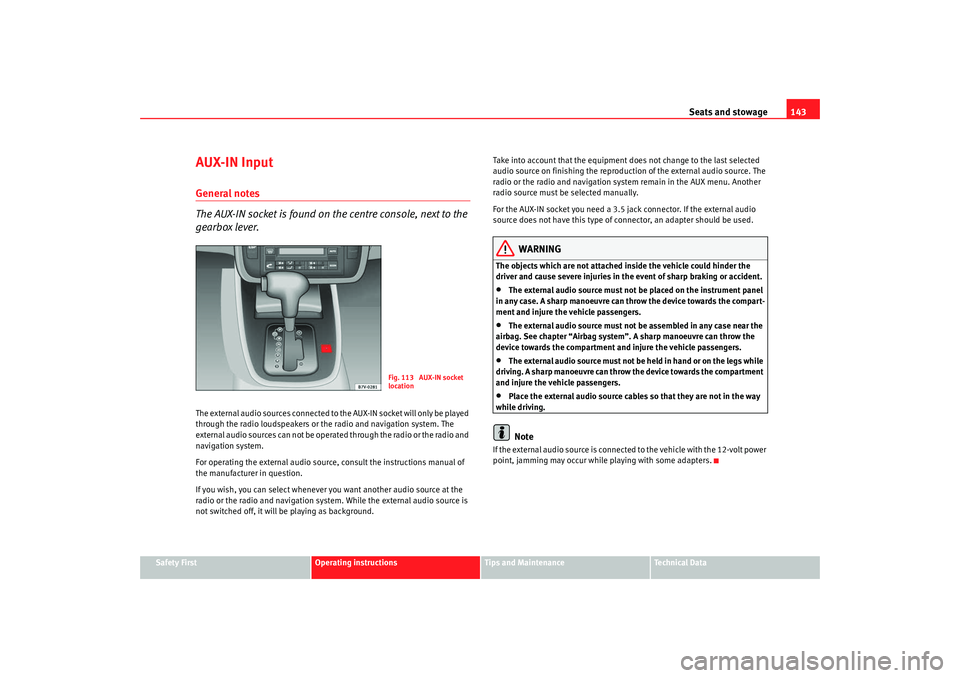
The AUX-IN socket is found on the centre console, next to the
gearbox lever.The external audio sources connected to the AUX-IN socket will only be played
through the radio loudspeakers or the radio and navigation system. The
external audio sources can not be operated through the radio or the radio and
navigation system.
For operating the external audio source, consult the instructions manual of
the manufacturer in question.
If you wish, you can select whenever you want another audio source at the
radio or the radio and navigation system. While the external audio source is
not switched off, it will be playing as background. Take into account that the equipment does not change to the last selected
audio source on finishing the reproduction of the external audio source. The
radio or the radio and navigation system remain in the AUX menu. Another
radio source must be selected manually.
For the AUX-IN socket you need a 3.5 jack connector. If the external audio
source does not have this type of connector, an adapter should be used.
WARNING
The objects which are not attached inside the vehicle could hinder the
driver and cause severe injuries in the event of sharp braking or accident.•
The external audio source must not be placed on the instrument panel
in any case. A sharp manoeuvre can throw the device towards the compart-
ment and injure the vehicle passengers.
•
The external audio source must not be assembled in any case near the
airbag. See chapter “Airbag system”. A sharp manoeuvre can throw the
device towards the compartment and injure the vehicle passengers.
•
The external audio source must not be held in hand or on the legs while
driving. A sharp manoeuvre can throw the device towards the compartment
and injure the vehicle passengers.
•
Place the external audio source cables so that they are not in the way
while driving.Note
If the external audio source is connected to the vehicle with the 12-volt power
point, jamming may occur while playing with some adapters.
Fig. 113 AUX-IN socket
location
alhambra_aleman.book Seite 143 Montag, 23. M‰ rz 2009 1:12 13
Page 147 of 285
Seats and stowage145
Safety First
Operating instructions
Tips and Maintenance
Te c h n i c a l D a t a
WARNING
Loose luggage and other objects in the luggage compartment can cause
serious injuries.•
Always stow objects in the luggage compartment and secure them on
the fastening rings.
•
Use suitable specialist straps to secure heavy objects.
•
During sudden manoeuvres or accidents, loose objects can be thrown
forward, injuring vehicle occupants or passers-by. This increased risk of
injury will be further increased if a lo ose object is struck by an inflating
airbag. If this happens, objects can be transformed into “missiles”. Risk of
fatal injury.
•
Remember that transporting heavy objects modifies the driving condi-
tions as the centre of gravity has been altered. There is a risk of accident.
Therefore, it is essential to adjust your speed and driving style accordingly,
to avoid accidents.
•
Never exceed the allowed axle loads or allowed maximum weight. If the
allowed axle load or the allowed total weight is exceeded, the driving char-
acteristics of the vehicle may change, leading to accidents, injuries and
damage to the vehicle.
•
Never leave the vehicle unattended, especially when the tailgate is
open. Children could climb into the luggage compartment closing the door
behind them; they will remain trapped without help and there is a mortal
risk.
•
Never allow children to play in or around the vehicle. Close and lock
both the tailgate and all the doors when you leave the vehicle. Before you
lock the vehicle, make sure that there are no adults or children in the
vehicle.
•
Never transport passengers in the luggage compartment. Every
passenger must be properly belted in.
Caution
•
Avoid overloading small areas by placing heavy objects on the vehicle
floor.
•
The wires of the heating element in the rear window and the window aerial
in the rear side windows could be damaged if objects on the luggage
compartment cover rub against them.
•
If you have removed the seats from the passenger compartment, you
should place a large, robust covering over the floor anchorings to prevent
damage.Note
•
Air circulation in the vehicle helps reduce fogging of the windows. Used
air escapes through ventilation slits in the side trim of the luggage compart-
ment. Ensure that the ventilation slits are never covered.
•
Straps for securing the load to the fastening rings are commercially
available.
Fastening rings
There are fastening rings in the luggage compartment which
can be used to secure luggage and other objects.– Always use suitable undamaged belts for fastening the luggage or any other object tot he anchorage rings ⇒ in “Loading the
luggage compartment” on page 144.The retainers for the detachable seat belts for the third row of seats and the
floor anchorings for the seats can be used as fastening rings for items of
luggage.
alhambra_aleman.book Seite 145 Montag, 23. M‰ rz 2009 1:12 13
Page 149 of 285
Seats and stowage147
Safety First
Operating instructions
Tips and Maintenance
Te c h n i c a l D a t a
•
Always stow objects safely in the vehicle and secure them on the
fastening rings if necessary.
•
Use suitable specialist straps to secure heavy objects.
•
Loose objects in the vehicle can move suddenly. As the centre of gravity
moves, safety is impaired and the vehicle becomes difficult to handle.
•
During sudden manoeuvres or accidents, loose objects can be thrown
forward, injuring vehicle occupants or passers-by. This increased risk of
injury will be further increased if a lo ose object is struck by an inflating
airbag. If this happens, objects can be transformed into “missiles”. Risk of
fatal injury.
•
Remember that transporting heavy objects modifies the driving condi-
tions as the centre of gravity has been altered. There is a risk of accident.
Therefore, it is essential to adjust your speed and driving style accordingly,
to avoid accidents.
•
Never exceed the allowed axle loads or allowed maximum weight. If the
allowed axle load or the allowed total weight is exceeded, the driving char-
acteristics of the vehicle may change, leading to accidents, injuries and
damage to the vehicle.
•
Never leave the vehicle unattended, especially when the tailgate is
open. Children could climb into the interior of the vehicle closing the door
behind them; they will remain trapped without help and there is a mortal
risk.
•
Never allow children to play in or around the vehicle. Close and lock all
windows, the tailgate and all doors when you leave the vehicle.
•
Never transport passengers in the luggage compartment. Every
passenger must be properly belted in.
Luggage compartment cover
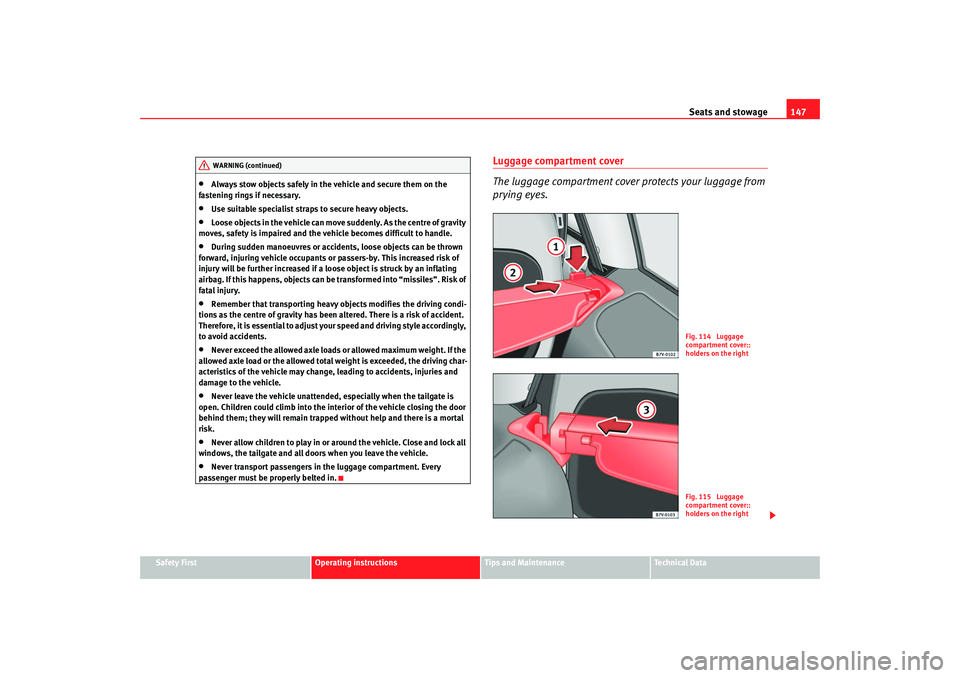
The luggage compartment cover protects your luggage from
prying eyes.
WARNING (continued)
Fig. 114 Luggage
compartment cover::
holders on the rightFig. 115 Luggage
compartment cover::
holders on the right
alhambra_aleman.book Seite 147 Montag, 23. M‰ rz 2009 1:12 13
Page 151 of 285
Seats and stowage149
Safety First
Operating instructions
Tips and Maintenance
Te c h n i c a l D a t a
WARNING
Always fit the net partition carefully, observing the instructions. Risk of
injury.•
Heavy, pointed or sharp items which are not stowed securely can cause
injury in the event of sudden braking manoeuvres or accidents, even if the
net bag is correctly assembled.
•
For reasons of safety, vehicle occupants must not travel behind a fitted
safety net.
Roof carrierSafety notes on using the roof carrier
The roof carrier system must always be installed exactly
according to the instructions provided.•
Your vehicle has special roof rails on the right and left for fitting the
mounts. Therefore, standard roof carriers cannot be used.
•
The mounts are the basis of a complete roof carrier system. Special
fixtures must then be added in order to safely transport luggage, bicycles,
skis, surf boards or boats on the roof. All these system components are avail-
able from SEAT Service. We recommend you use genuine SEAT roof carrier
systems. If you wish to use a different roof carrier, make sure that it can be
fitted securely to your vehicle and that it cannot damage your vehicle.
•
We recommend that you keep the assembly instructions provided by the
roof carrier manufacturer in your vehicle wallet.
•
Only the fitted retainers may be used to secure the carrier feet on vehicles
without a roof railing . These retainers are located underneath the plastic rain
channel between the markings.
•
In vehicles with roof edging
36), the basic supports can be fitted on the
edge making sure to adapt the distance between the supports to the objects
to be carried. On vehicles with a sliding/tilting roof
36), however, the front
carrier may not be fitted near the rear edge of the sliding/tilting roof when the
roof is open.
When should the roof carrier be removed?
•
When it is not needed (to save fuel, reduce wind noise and avoid theft).
•
Before cleaning in an automatic car wash.
WARNING
•
If you do not use mounts approved by SEAT or fail to fit them according
to instructions, the load or the roof carrier itself may fall off the vehicle roof
and onto the street. Risk of accident or injury.
•
The risk of an accident is increased by transporting heavy or bulky
loads on the roof, which affects the car's handling by shifting the centre of
gravity and increasing susceptibility to cross winds. Both circumstances
increase the risk of accident. Therefore you must adapt your driving style
and speed to the prevailing conditions - avoid sudden braking or driving
manoeuvres when there is a load on the roof carrier.
•
The roof carrier system must always be installed exactly according to
the instructions provided.Caution
•
Check all bolted connections and fastenings for the roof carrier system
before every trip. If necessary, tighten bolted connections and check the
system at regular, appropriate intervals, e.g. at each stop during a long trip.
•
The height of your vehicle is changed by the installation of the roof carrier
and the load secured on it. Bear this in mind when driving through garage
doors or low underpasses – there is danger of damage to the vehicle.
36)Optional equipment
alhambra_aleman.book Seite 149 Montag, 23. M‰ rz 2009 1:12 13
Page 153 of 285
Seats and stowage151
Safety First
Operating instructions
Tips and Maintenance
Te c h n i c a l D a t a
Before using the cooling and heating box for the first time, you should clean
it using a household detergent.
Disconnect the power supply and clean the box if you do not plan to use the
cooling and heating box for a long period. Place a folded towel between the
box and its lid. This prevents mould and damp stains forming in the cooling
and heating box.
Whenever possible, food and drinks should be stored in air-tight containers
in the box.
Do not overfill the box - this would prevent air circulation within the box.
Place crumpled paper (or similar) between bottles and other containers in the
box to prevent clanking noises.
Do not fill the interior of the box with liquid or ice.
Caution
•
Do not place objects, blankets, or clothes on top of the cooling/heating
box, as the air intake and output may be obstructed and the box will discon-
nect itself.
•
Do not place any containers, food items or other objects into the box if
they are warmer than +50°C. This could damage the cooling and heating box.
•
The cold/hot box is not suitable for transporting corrosive material or
material containing solvents.
•
Never leave the cold/hot box in the rain or damp.Note
•
The cooling and heating box is not designed to heat or cool the interior of
the vehicle. The cooling and heating box should be used only for cooling and
warming food and drinks and for transporting heat-sensitive items on short
journeys.
•
A corresponding manual for the installation and use of the cooling and
heating box is included by the manufacturer and should be kept with the
vehicle wallet.
Cooling or heating
The contents of the cooling and heating box can be cooled or
kept warm.Switching on the cooling function
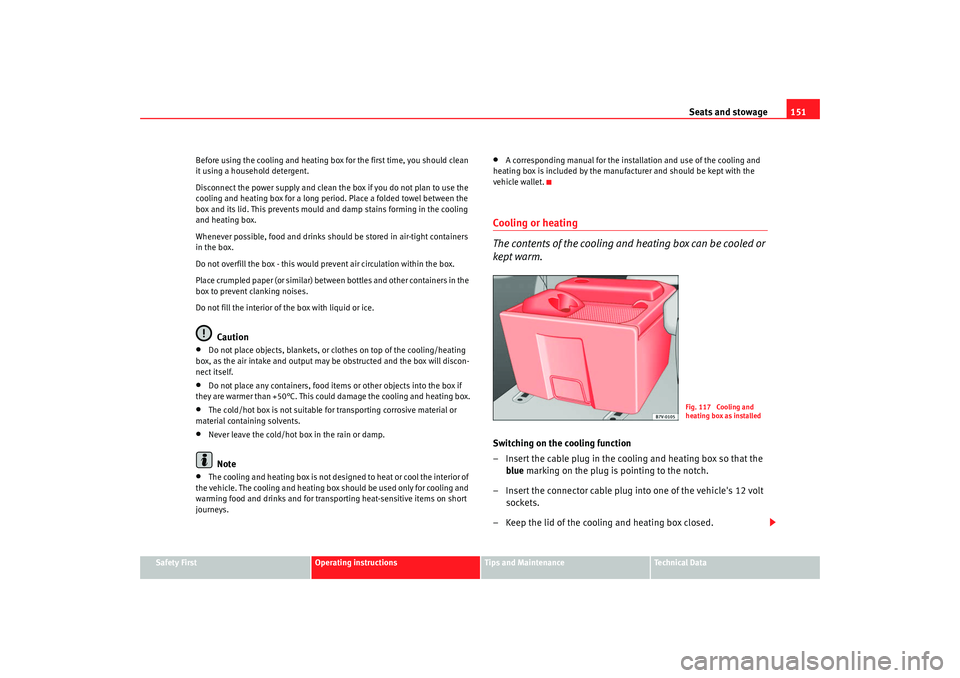
– Insert the cable plug in the cooling and heating box so that the blue marking on the plug is pointing to the notch.
– Insert the connector cable plug into one of the vehicle's 12 volt sockets.
– Keep the lid of the cooling and heating box closed.
Fig. 117 Cooling and
heating box as installed
alhambra_aleman.book Seite 151 Montag, 23. M‰ rz 2009 1:12 13
Page 155 of 285
Heating, Ventilation and Air conditioning153
Safety First
Operating instructions
Tips and Maintenance
Te c h n i c a l D a t a
Heating, Ventilation and Air conditioningClimatronicControls
The Climatronic maintains the selected vehicle temperature automatically.The cooling system only works when the engine is running and the
blower is switched on.
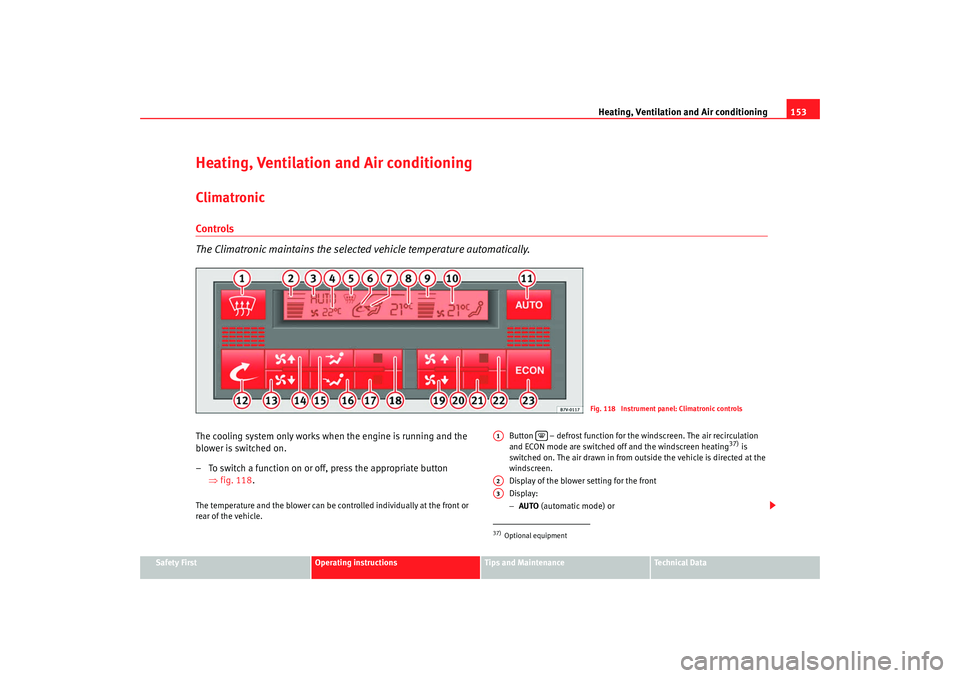
– To switch a function on or off, press the appropriate button
⇒fig. 118 .The temperature and the blower can be controlled individually at the front or
rear of the vehicle. Button – defrost function for the windscreen. The air recirculation
and ECON mode are switched off and the windscreen heating
37) is
switched on. The air drawn in from outside the vehicle is directed at the
windscreen.
Display of the blower setting for the front
Display:
− AUTO (automatic mode) or
Fig. 118 Instrument panel: Climatronic controls
37)Optional equipmentA1
A2A3
alhambra_aleman.book Seite 153 Montag, 23. M‰ rz 2009 1:12 13
Page 157 of 285
Heating, Ventilation and Air conditioning155
Safety First
Operating instructions
Tips and Maintenance
Te c h n i c a l D a t a
If a temperature above +29°C (86°F) is selected, the display switches to
HI In
this setting the system runs at maximum heating output and the temperature
is not controlled.
Climatronic maintains a constant temperature level fully automatically. This is
done by automatically adjusting the temperature of the air supplied to the
interior, the blower setting, and the air distribution. The system also allows
for the effect of strong sunlight, so there is no need for manual adjustment.
Therefore, automatic mode provides the best comfort for the vehicle occu-
pants in virtually all conditions throughout the year. Automatic mode is switched off whenever an adjustment is made using the
buttons for air distribution or blower. The temperature continues to be regu-
lated.
Note
In the automatic mode, at least one outlet in the instrument panel must be
open. The cooling system could otherwise ice over.
Manual mode
In manual mode you can adjust the air temp
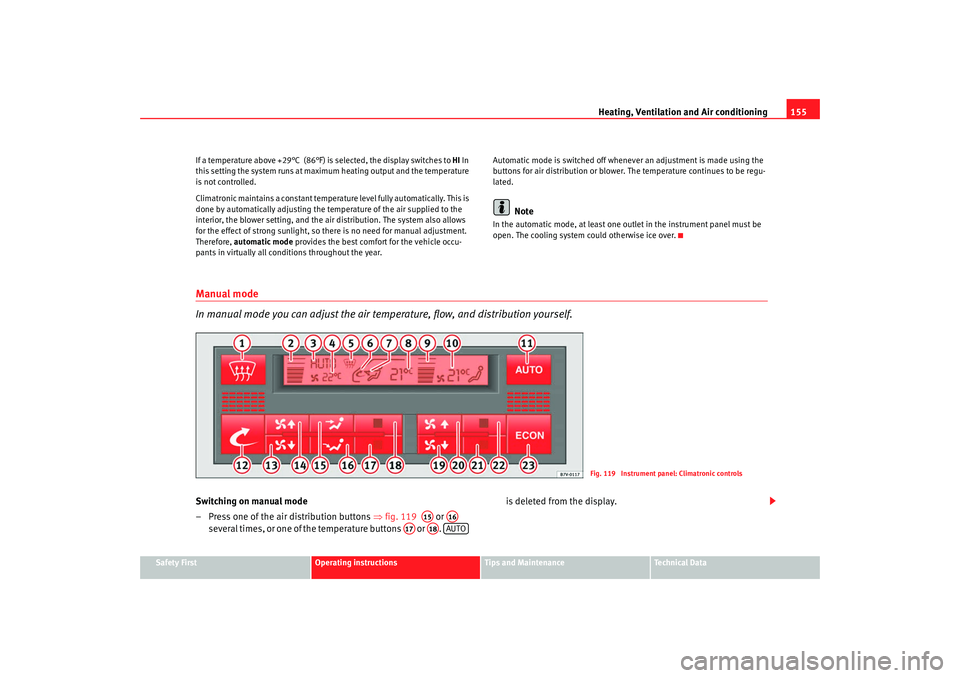
erature, flow, and distribution yourself.Switching on manual mode
– Press one of the air distribution buttons ⇒fig. 119 or
several times, or one of the temperature buttons or . is deleted from the display.
Fig. 119 Instrument panel: Climatronic controls
A15
A16
A17
A18
AUTO
alhambra_aleman.book Seite 155 Montag, 23. M‰
rz 2009 1:12 13
Page 159 of 285
Heating, Ventilation and Air conditioning157
Safety First
Operating instructions
Tips and Maintenance
Te c h n i c a l D a t a
WARNING
Do not leave the air recirculation function on for long periods. In air recircu-
lation mode, no fresh air enters the vehicle interior. Also, if the cooling
system is switched off, the windows can quickly mist over. Stale or contam-
inated air inside the vehicle may cause drowsiness, increasing the risk of
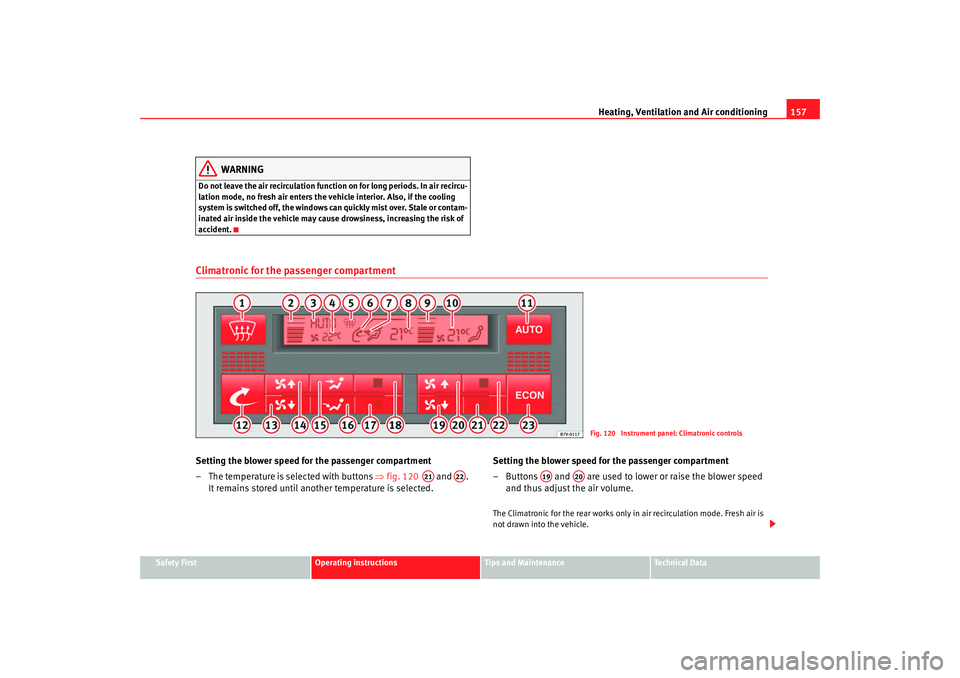
accident.Climatronic for the passenger compartmentSetting the blower speed for the passenger compartment
– The temperature is selected with buttons ⇒fig. 120 and .
It remains stored until another temperature is selected. Setting the blower speed for the passenger compartment
– Buttons and are used to lower or raise the blower speed
and thus adjust the air volume.
The Climatronic for the rear works only in air recirculation mode. Fresh air is
not drawn into the vehicle.
Fig. 120 Instrument panel: Climatronic controls
A21
A22
A19
A20
alhambra_aleman.book Seite 157 Montag, 23. M‰ rz 2009 1:12 13
Page 161 of 285
Heating, Ventilation and Air conditioning159
Safety First
Operating instructions
Tips and Maintenance
Te c h n i c a l D a t a
Air vents in the roof
In vehicles with a second cooling system
39) for ventilating the passenger
compartment, an air outlet is fitted in the roof above each rear seat
⇒ fig. 122 .
The air outlets in the roof can be opened and closed individually and
adjusted by moving the grid.
Each air outlet has two thumb wheels. The left thumb wheel can be used to
open and close the air outlet. The right thumb wheel can be used to direct the
air towards the head and chest.
WARNING
Never leave objects, food or medicines in front of the air outlets in the rear
seats. The hot air could damage or destroy heat-sensitive objects, food or
medicines.
Caution
Do not use the area in front of the outlets to store objects. This could cause
the blower to overheat and switch off. The blower could also be damaged.
Note
In the cooling mode, at least one air outlet in the roof must be open. The
cooling system could otherwise ice over.
General notesThe pollution filter
The pollution filter serves as a barrier against impurities in the ambient air (
e.g.dust and pollen).
For the air conditioning system to work with maximum efficiency, the pollen
filter must be replaced at the intervals specified in the Service Schedule.
If the filter loses efficiency prematurely due to use in areas with very high
levels of air pollution, the pollen filter must be changed more frequently than
stated in the Service Schedule.
Instructions for use
If the air conditioning or Climatronic
40) is not switched on for a long period,
deposits on the evaporator can cause unpleasant smells. To prevent these
odours, the cooling system should be run at the highest blower setting at
least once a month when temperatures are over +5°C. Briefly open a window
at the same time.
Faults in the operation of the air conditioning
There is a fault if the all the symbols in the Climatronic flash for approx. 15
seconds when the ignition is switched on. Contact a specialist workshop.
If the air conditioning system cannot be switched on this may be caused by
the following reasons:
•
the engine is not running.
•
The blower is switched off.
•
The outside temperature is lower than +5°C.
•
the cooling system compressor has been temporarily switched off
because the engine coolant temperature is too high.
•
The air conditioning fuse is faulty.
39)Optional equipment
40)Optional equipment
alhambra_aleman.book Seite 159 Montag, 23. M‰ rz 2009 1:12 13