light Seat Alhambra 2010 Owner's Manual
[x] Cancel search | Manufacturer: SEAT, Model Year: 2010, Model line: Alhambra, Model: Seat Alhambra 2010Pages: 413, PDF Size: 3.86 MB
Page 257 of 413
Driving and the environment 256
Several warning and control lamps should light up for a few seconds when
the ignition is switched. This signals that the lamp is working properly. They
will switch off after a few seconds.
WARNING
Observe traffic regulations when cleaning the diesel particulate filter while
driving.
xOnly carry on driving if visibility, weather, road and traffic conditions so
permit.
xNever endanger your safety or that of other road users.
Caution
Always pay attention to any lit lamps and to the corresponding descriptions
and instructions to avoid damage to the vehicle.
Note
While the indicators ¬, B or %0# remain lit, there may be engine problems,
fuel consumption may be greater and the engine may lose power
Catalytic converter
The catalytic converter permits the subsequent treatment of the exhaust
gases thus reducing contaminating gas emissions. To ensure a longer
working life for the exhaust system and catalytic converter in a petrol engine:
xAlways use unleaded petrol.
xNever run the tank completely dry.
xDo not top up with too much engine oil Ÿpage 309.
xDo not tow-start the vehicle; use the starter cables Ÿpage 371.If you should notice misfiring, uneven running or loss of power when the car
is moving, reduce speed immediately. Have the car inspected by a qualified
workshop. If this happens, unburnt fuel can enter the exhaust system and
escape into the atmosphere. The catalytic converter can also be damaged by
overheating.
For the sake of the environment
Even when the emission control system is working perfectly, there may be a
smell of sulphur from the exhaust gas under some conditions. This depends
on the sulphur content of the fuel being used.
Diesel particulate filter
The diesel particulate filter removes soot particulates from the exhaust gas.
The filter retains these particulates and burns them. To assist the combustion
process, SEAT recommends you avoid frequent short trips.
xAlways use diesel with a low sulphur content Ÿpage 297.
xNever use petrol or fuel oil.
xNever use biodiesel. However, a blend prepared by the diesel manufac-
turer containing biodiesel within the limits established by the EN 590
standard may be used Ÿpage 297.
xNever run the tank completely dry.
xDo not top up with too much engine oil Ÿpage 309.
xDo not tow-start the vehicle; use the starter cables Ÿpage 371.
In order to reduce blocking of the diesel particulate filter, some vehicles with
an automatic gearbox may increase the engine speed slightly to automati-
cally start cleaning the diesel particulate filter. The warning lamp will not light
up in this case
¬.
Page 259 of 413
Trailer towing 258
Trailer towing
Introduction
Always be aware of the legal requirements for each country to drive with a
trailer and to use a trailer bracket.
Your car is intended mainly for transporting passengers however, it can also
be used to tow a trailer provided that it is fitted with the necessary equip-
ment. The additional load has an effect on the useful life, fuel consumption
and the vehicle performance and, in some cases, reduce the service intervals.
Driving with a trailer requires more force from the vehicle and, thus, more
concentration from the driver.
For wintertime temperatures, fit winter tyres to the vehicle and the trailer.
Drawbar load
The maximum permitted Drawbar load exerted by the trailer drawbar on the
ball joint of the tow hitch must not exceed 100 kg (approximately 220 lbs).
Vehicles with the Start-Stop function
With a SEAT factory fitted or retrofitted trailer bracket, the Start-Stop function
is automatically deactivated when a trailer is connected. For trailer brackets
not installed by SEAT, the Start-Stop function must be deactivated manually
using a button located on the dashboard before driving with a trailer and it
must remain off for the entire journey Ÿ.
Additional information and warnings:
xAnti-theft alarm system Ÿpage 83
xLight Ÿpage 113
xEcological driving Ÿpage 252
xStarter assist systems (Start-Stop function) Ÿpage 221
xWheels and tyres Ÿpage 323
xAccessories, parts replacement, repairs and modifications Ÿpage 285
WARNING
Never transport people in a trailer: this will endanger in their life and is
against the law.
WARNING
The incorrect use of the tow hitch can cause accidents and injury.
xOnly use a tow hitch in good condition and correctly installed.
xNever change or repair a tow hitch.
xTo reduce the risk of injury in case of a reversing collision, injury to
pedestrians and cyclists when parking, always keep the ball joint in when
a trailer is not being used.
xNever fit a trailer tow hitch “that distributes the load” or “balances the
load”. Your vehicle has not been designed for this type of tow hitch. The
tow hitch may fail and the trailer will separate from the vehicle.
WARNING
Driving with a trailer and transporting heavy or large objects can affect
vehicle handling and even cause an accident.
xAlways secure loads correctly with suitable and undamaged attach-
ment rope or straps.
xAdjust your speed and driving style to visibility, road, traffic and
weather conditions.
xTrailers with a high centre of gravity can overturn more easily than
trailers with a low centre of gravity.
Page 261 of 413
Trailer towing 260
Driving with a trailer
Technical requirements
If the car is supplied with a factory-fitted tow hitch it will already have the
necessary technical modifications and meet the statutory requirements for
towing a trailer.
Only use an approved trailer hitch for the gross trailer weight rating. The tow
hitch must be suitable for both the vehicle and trailer and must be securely
fitted to the vehicle chassis. Only use a tow hitch with a removable ball joint.
Always check and take into account the tow hitch manufacturer's instruc-
tions. Never fit a trailer tow hitch “that distributes the load” or “balances the
load”.
Bumper mounted tow hitch
Never fit a tow hitch or its attachments to the bumper. A tow hitch should
never interfere with the bumper performance. Do not modify the exhaust
system and brake system. Regularly check the tow hitch to ensure it is firmly
fitted.
Engine cooling system
Driving with a trailer increases the load on the engine and cooling system.
The cooling system should always have sufficient coolant and to be able to
cope with the vehicle and trailer.
Electric trailer brake
If the trailer has its own braking system, please note the relevant legal
requirements. The trailer braking system should never be connected to the
vehicle braking system.
Trailer cable
Always use a cable between the vehicle and the trailer Ÿpage 262.Trailer rear lights
The rear lights of a trailer must fulfil the corresponding standards
Ÿpage 262.
Never connect the trailer's rear lights directly to the vehicle electric system. In
case of any doubt about the electrical connection of the trailer, ask a
specialist workshop. SEAT recommends visiting a qualified workshop.
Wing mirrors
When the field of vision behind the trailer cannot be seen using the standard
wing mirrors of the towing vehicle, additional wing mirrors are required
according to the legal requirements of each country. The wing mirrors must
be fitted before driving and must provide a sufficient field of vision behind.
Trailer electricity consumption
Never exceed the specifications:
WARNING
If the tow hitch is badly fitted or unsuitable, the trailer may separate from
the vehicle causing an accident with serious consequences.
Caution
xIf the rear lights of the trailer are not correctly connected, the vehicle elec-
tronics may be damaged.
Electrical consumerMaximum power
Position lights and rear lights50 Watts
Indicator (each side)54 Watts
Brake lights (total)84 Watts
Reversing lights (total)42 Watts
Rear fog light42 Watts
Page 262 of 413
Trailer towing261
Safety FirstOperating instructionsPractical tipsTe c h n i c a l D a t a
xIf the trailer absorbs excessive electric current, the vehicle electronics
may be damaged.
xNever connect the trailer's electric system to the electrical connections of
the rear lights or any other power sources. Only use suitable connections for
providing electric current to the trailer.
Note
Towing a trailer places additional demands on the vehicle. At SEAT, we recom-
mend additional services between the normal inspection intervals if the
vehicle is used frequently for towing a trailer.
Note
In some countries, an additional fire extinguisher is required if the trailer
weight is more than 2500 kg
Electric tow hitch ball
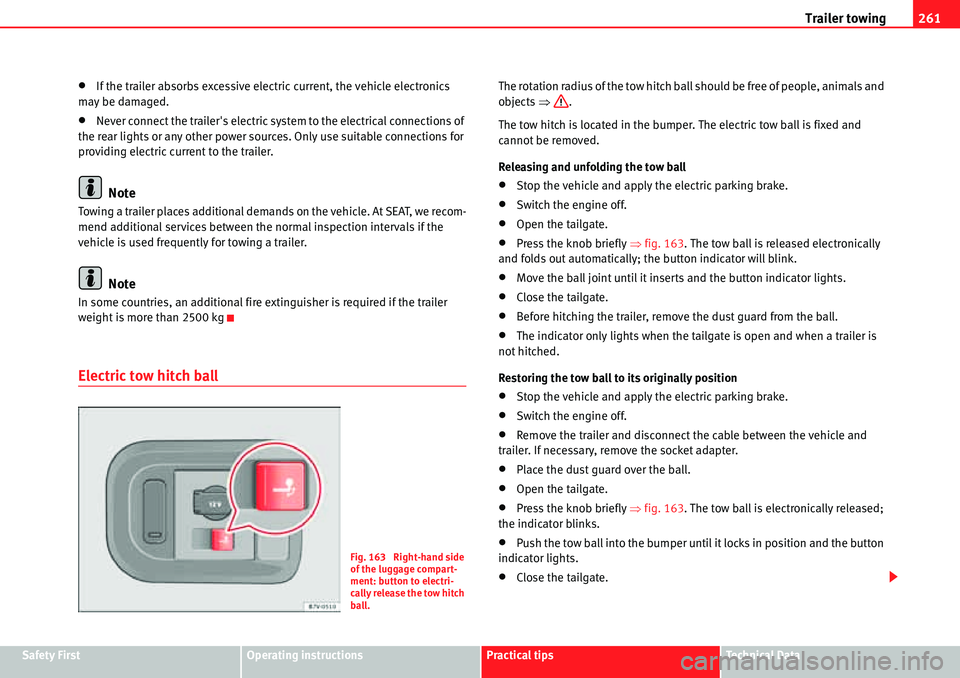
The rotation radius of the tow hitch ball should be free of people, animals and
objects Ÿ.
The tow hitch is located in the bumper. The electric tow ball is fixed and
cannot be removed.
Releasing and unfolding the tow ball
xStop the vehicle and apply the electric parking brake.
xSwitch the engine off.
xOpen the tailgate.
xPress the knob briefly Ÿfig. 163. The tow ball is released electronically
and folds out automatically; the button indicator will blink.
xMove the ball joint until it inserts and the button indicator lights.
xClose the tailgate.
xBefore hitching the trailer, remove the dust guard from the ball.
xThe indicator only lights when the tailgate is open and when a trailer is
not hitched.
Restoring the tow ball to its originally position
xStop the vehicle and apply the electric parking brake.
xSwitch the engine off.
xRemove the trailer and disconnect the cable between the vehicle and
trailer. If necessary, remove the socket adapter.
xPlace the dust guard over the ball.
xOpen the tailgate.
xPress the knob briefly Ÿfig. 163. The tow ball is electronically released;
the indicator blinks.
xPush the tow ball into the bumper until it locks in position and the button
indicator lights.
xClose the tailgate.
Fig. 163 Right-hand side
of the luggage compart-
ment: button to electri-
cally release the tow hitch
ball.
Page 263 of 413
Trailer towing 262
The warning lamp
xWhen the indicator flashes, the tow ball is not in its final position, has not
engaged or is damaged Ÿ.
xWhen the indicator remains lit and the tailgate is open, the tow ball has
inserted correctly into the folded or deployed position.
xWhen the tailgate is closed, the indicator is turned off.
WARNING
The incorrect use of the tow hitch can cause accidents and injury.
xEnsure that no person, animal or object gets in the way of the tow ball.
xNever push the button when there is a trailer hitched or when any kind
of carrier or accessory is fitted to the tow hitch ball.
xWhile the ball is moving, do not interfere with any tool.
xDo not drive with a trailer if the indicator does not light.
xIf there is a fault in the electric system or the trailer tow hitch, visit a
specialist workshop to have it checked.
xIf the diameter of the tow hitch is less than 49 mm, never use this for a
trailer.
Caution
xIf anything is attached to the tow hitch ball, do not, under any circum-
stances press the button.
xNever direct a high-pressure or steam cleaning system directly at the tow
hitch ball or trailer power socket. This could cause damage to seals or remove
lubricating grease.
Note
In extremely low temperatures, it is possible that the tow hitch is not
released. In this case, place the vehicle in a warmer location (for example, a
garage).
Installing a bicycle carrier to the tow hitch
The maximum load permitted for a bicycle carrier on the tow hitch ball is 75
kg, with a maximum distance of 300 mm from the support. The distance
between supports is the distance between the bicycle carrier centre of gravity
(with the bicycles) and the centre of point of the tow hitch ball.
WARNING
The incorrect use of the tow hitch with a bicycle carrier installed can cause
accidents and injury.
xNever exceed the load and distances between supports indicated.
xNever fit the bicycle carrier to the tow hitch ball neck, underneath the
tow hitch given that the bicycle carrier may be incorrectly fitted due to the
shape of the tow hitch and the model of bicycle carrier.
xAlways read and take the manufacturer assembly instructions into
account.
Caution
Exceeding the maximum load and distance between supports indicated can
cause considerable damage to the vehicle.
xNever exceed the specifications.
Hitching and connecting the trailer
Trailer cable
Always secure the trailer cable to the towing vehicle correctly. Leave a little bit
of slack in the cable for turning. However, ensure that the cable does not rub
off the ground while driving.
Page 264 of 413

Trailer towing263
Safety FirstOperating instructionsPractical tipsTe c h n i c a l D a t a Trailer electric socket
The electric connection between vehicle and trailer is a 13-pin socket. If the
trailer plug has seven pins, an adapter cable must be used.
Trailer rear lights
Check the trailer rear lights to ensure they work correctly and remain legal.
Ensure that the trailer does not use more than the maximum power
Ÿpage 260.
Trailer connected to the antitheft alarm:
xWhen a vehicle comes from the factory fitted with an antitheft alarm and
tow hitch.
xWhen the trailer is connected to the vehicle using the socket.
xWhen the vehicle and trailer electrical systems work correctly and are not
damaged.
xWhen the vehicle is locked using the vehicle key and the antitheft alarm
is turned on.
When the vehicle is locked, the alarm is triggered when the electrical connec-
tion between the vehicle and the trailer is removed.
Always turn off the anti-theft alarm system before connecting or discon-
necting a trailer. Otherwise, the tilt sensor may erroneously activate the
alarm.
WARNING
Erroneous or unsuitable connection of electric cables may supply energy to
the trailer causing an anomaly in the vehicle electronics that could result
in an accident with serious consequences.
xAll work on the electrical system must be carried out only by a
specialist workshop.
xNever connect the trailer's electric system to the electrical connections
of the rear lights or any other power sources.
Caution
Do not leave the trailer connected to the vehicle when parked; places on its
support wheel or its supports. For example, when changing the load or a
puncture, the vehicle will be pushed up or down. The force acting on the tow
hitch and the trailer could damage the vehicle or the trailer.
Note
In case of a fault in the vehicle or trailer electrical system or in case of prob-
lems with the antitheft alarm system, have the system checked by a specialist
workshop.
Note
If the trailer accessories use energy from the socket when the engine is
stopped, the battery will be discharged.
Note
For technical reasons, trailers fitted with rear LED lights cannot be connected
to the antitheft alarm system.
Note
If the vehicle battery is running low, the electrical connection with the trailer
is automatically cut.
Note
With the engine running, the electrical equipment on the trailer will consume
power.
Page 265 of 413
Trailer towing 264
Loading the trailer
Trailer weight / drawbar load
The trailer weight is the load that the vehicle can pull Ÿ. The drawbar load
is the vertical weight of the trailer hitch on the tow hitch ball Ÿpage 267.
The figures for trailer weights and draw bar weights given on the data plate of
the towing bracket are for values of this model only. The correct figures for
your specific vehicle, which may be lower than these figures for the tow hitch,
are given in the registration documents. The instructions in the official
vehicle documents take precedence.
For the sake of road safety, SEAT recommends using the maximum allowed
drawbar load. The handling of the combined vehicle and trailer will be poor if
the drawbar load is too low.
The drawbar load increases the weight on the rear axle, reducing the vehicle
carrying capacity.
Gross combination weight
This figure refers to the combined weight of the loaded vehicle and loaded
trailer.
Loading the trailer
The combined vehicle and trailer must be balanced. Use the maximum
drawbar load authorised and do not overload the front or the rear of the
trailer:
xDistribute loads in the trailer so that heavy objects are as near to the axle
as possible or even above it.
xCorrectly secure the trailer load.
Tyre pressure
Inflate the trailer tyres according to the manufacturer's instructions.
Inflate the towing vehicles tyres to the maximum Ÿpage 323.
WARNING
Exceeding the maximum authorised axle load, drawbar load or the gross
combination weight of the towing vehicle and trailer could cause a serious
accident with severe consequences.
xNever exceed the specifications.
xWith the actual load on the front and rear axles, the maximum axle load
should never be exceeded. The weight on the front and rear should never
exceed the gross vehicle weight.
WARNING
If the load moves, the stability and safety of the vehicle and trailer combi-
nation will be seriously affected and this could result in a serious accident.
xAlways correctly load the trailer.
xAlways secure loads correctly with suitable and undamaged attach-
ment rope or straps.
Driving with a trailer
Adjusting the headlights
When towing a trailer, the front of the vehicle may rise and so the dipped
beam headlights may blind other drivers. Use the headlight range control to
lower the cone of light. If you do not have headlight range control, have the
headlights adjusted by a qualified dealership. Vehicles with high-intensity
discharge lamps adapt automatically and do not require adjustment.
Details of driving with a trailer
xIf the trailer has an overrun brake, apply the brakes gently at first and
then, firmly. This will prevent the jerking that can be caused by the trailer
wheels locking.
Page 266 of 413
Trailer towing265
Safety FirstOperating instructionsPractical tipsTe c h n i c a l D a t a
xAs of the combined vehicle and trailer mass, braking distances will be
greater.
xSelect a low gear before driving down a steep hill to use the engine
braking effect to slow down the vehicle. Otherwise, the braking system could
overheat and fail.
xThe vehicle centre of gravity and handling change because of the trailer
load and because of the increased combined mass of the vehicle and trailer.
xIf the towing vehicle is empty and the trailer loaded then the load distri-
bution is incorrect. If you must travel in these conditions, drive carefully and
reduce your speed accordingly.
Hill starts with a trailer
Depending on the hill and the gross combined weight, it is possible that the
combined vehicle and trailer move backwards slightly when starting.
For a hill start with a trailer, proceed as follows:
xPress and hold the brake pedal.
xPress the button once to turn off the electric parking brake
Ÿpage 210.
xPress and hold the button to hold the vehicle and trailer combination
using the parking brake.
xWith a manual gearbox: press the clutch pedal to the floor.
xEngage first gear or the gear range D Ÿpage 201, “Changing gear”.
xRelease the brake pedal.
xMove off slowly. To do this, gently release the clutch pedal (for manual
gearbox).
xRelease the button only when the engine provides sufficient power to
move the vehicle and trailer combination.
WARNING
Jerking the trailer in an unsuitable manner could cause loss of vehicle
control with the subsequent serious consequences.
xDriving with a trailer and transporting heavy or a large objects will
change the vehicle handling and braking distances.
xAnticipate traffic and be extremely cautious. Brake early.
xAdjust your speed and driving style to visibility, road, traffic and
weather conditions. Reduce your speed, especially on steep hills.
xAccelerate gently and carefully. Avoid brusque manoeuvres and sudden
braking.
xAlways take the following precautions seriously. Reduce your speed
immediately if you observe the trailer rocking from side to side.
xNever try to stop the “snaking” by increasing speed.
xAlways take the speed limits for vehicles with and without trailers in
each country into account.
Stabilising the vehicle and trailer combination
Stabilisation of the vehicle and trailer combination is an extension of the
electronic stability programme (ESP) and helps, with the assistance of the
trajectory control, to reduce trailer “snaking”.
Stabilisation of the vehicle and trailer combination is active when the ESP
«
indicator on the dashboard remains lit for about two seconds more than the
ABS indicator.
Requirements for stabilising the vehicle/trailer combination
xAn original tow hitch is fitted by the manufacturer or a compatible model
is retrofitted.
xThe ESP is on. The warning indicator in the control panel « is not lit.
xThe trailer is connected to the vehicle using the socket.
xThe vehicle is driven faster than 60 km/h.
G
G
G
WARNING (continued)
Page 267 of 413
Trailer towing 266
xThe maximum drawbar load is used.
xThe trailer must have a fixed drawbar.
xTrailers with brakes must be equipped with a mechanical inertia brake.
WARNING
Do not let the extra safety afforded by the stabilisation system tempt you
into taking any risks when driving.
xAdjust your speed and driving style to visibility, road, traffic and
weather conditions.
xIf the road surface is slippery, take care when accelerating.
xWhen a system is operating, lift your foot off the accelerator.
WARNING
It is possible that the combination stabilisation system does not correctly
recognised all driving situations.
xIt is possible that the stabilisation system does not detect snaking of a
light trailer and thus does not intervene.
xWhen driving on slippery ground, the trailer could jack-knife despite
the stabilisation system.
xTrailers with a high centre of gravity may even tip over before they start
to rock sideways.
xIf a trailer is not used at the trailer socket is connected (for example,
installation of a bicycle carrier with lights), repeated automatic braking
may occur in extreme driving conditions.
Retrofitting a tow hitch
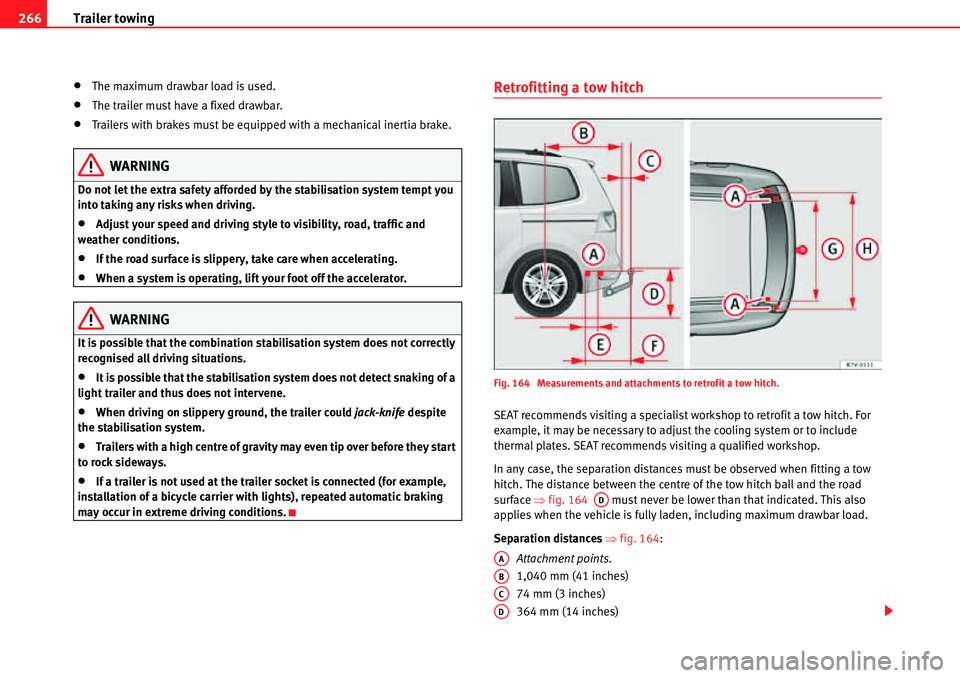
Fig. 164 Measurements and attachments to retrofit a tow hitch.
SEAT recommends visiting a specialist workshop to retrofit a tow hitch. For
example, it may be necessary to adjust the cooling system or to include
thermal plates. SEAT recommends visiting a qualified workshop.
In any case, the separation distances must be observed when fitting a tow
hitch. The distance between the centre of the tow hitch ball and the road
surface Ÿfig. 164 must never be lower than that indicated. This also
applies when the vehicle is fully laden, including maximum drawbar load.
Separation distances Ÿfig. 164:
Attachment points.
1,040 mm (41 inches)
74 mm (3 inches)
364 mm (14 inches)
AD
AA
AB
AC
AD
Page 268 of 413
Trailer towing267
Safety FirstOperating instructionsPractical tipsTe c h n i c a l D a t a 247 mm (10 inches)
596 mm (23 inches)
1,097 mm (43 inches)
1,102 mm (43 inches)
WARNING
Erroneous or unsuitable connection of electric cables may cause anomalies
in the vehicle electronics that could result in an accident with serious
consequences.
xNever connect the trailer's electric system to the electrical connections
of the rear lights or any other unsuitable power sources. Only use suitable
connectors to connect a trailer.
xVisit a specialist workshop if you wish to retrofit a tow hitch to the
vehicle.
WARNING
If the tow hitch is badly fitted or unsuitable, the trailer may separate from
the vehicle while driving. This could result in serious accident.
Note
Use only tow hitches approved by SEAT for the vehicle.
Maximum gross trailer weight
The instructions in the official vehicle documents take precedence. All the
technical data provided in this documentation is applicable to the basic
model. The vehicle data label in the Maintenance Programme or the vehicle
documents show which engine is installed in your vehicle.The figures may be different depending on if additional equipment is fitted,
for different models and for special vehicles.
WARNING
Exceeding the maximum trailer weight indicated could cause a serious
accident.
xNever exceed the indicated trailer weight.
Caution
Exceeding the maximum trailer weight indicated could cause damage to the
vehicle.
xNever exceed the indicated trailer weight.
Gross combined vehicle weight rating
The instructions in the official vehicle documents take precedence. All the
technical data provided in this documentation is applicable to the basic
model. The vehicle data label in the Maintenance Programme or the vehicle
documents show which engine is installed in your vehicle.
The figures may be different depending on if additional equipment is fitted,
for different models and for special vehicles.
The maximum combined weights listed are only applicable for altitudes up to
1,000 m above sea level. The weight of the car and trailer must be reduced by
about 10% for every further 1000 m (or part thereof).
WARNING
Exceeding the maximum weight indicated could cause a serious accident.
xNever exceed the gross combined weight rating.
AE
AF
AG
AH