light Seat Alhambra 2011 Owner's Manual
[x] Cancel search | Manufacturer: SEAT, Model Year: 2011, Model line: Alhambra, Model: Seat Alhambra 2011Pages: 385, PDF Size: 7.92 MB
Page 294 of 385
292
Checking and refilling levels
● the idling s peed i s increased so that the alternator provides more elec-
tricity.
● where necessary, the power of the most powerful consumers is reduced
or even comp
letely disconnected.
● On starting the engine, the power supply from the 12-volt sockets and
the cigar
ette lighter may be interrupted for a short time.
The on-board management program cannot always prevent the battery from
running flat. For example, if the ignition is left on for a long period with the
engine off or if the side lights or parking lights are left on while the vehicle
is stationary.
Why does the battery run flat?
● When stationary for a long time without starting the engine, particularly
if the ignition is
switched on.
● Use of electrical consumers with the engine switched off.
● If the auxiliary heater is running ⇒ page 163.WARNING
Incorrectly securing the battery or using the wrong battery can cause
short -c
ircuits, fire and serious injuries.
● Always use only maintenance free batteries that do not run flat alone
and whose proper
ties, specifications and size correspond to the stand-
ard battery. The specifications are indicated on the battery case. WARNING
A highly explosive mixture of gases is released when the battery is under
ch ar
ge.
● The batteries should be charged in a well-ventilated room only.
● Never charge a frozen or recently thawed battery. A flat battery can
freeze at
temperatures around 0°C (+32°F). WARNING (Continued)
● Always replace a battery which has frozen.
● B
att
ery cables not correctly connected may cause a short circuit. Re-
connect fir
st the positive cable and then the negative cable. CAUTION
● Never disconnect the battery if the ignition is switched on or if the en-
gine i s
running. This could damage the electrical system or electronic com-
ponents.
● Never plug accessories supply current, such as solar panels or a battery
char
ger, to the 12-volt sockets or the cigarette lighter. This could damage
the vehicle's electrical system. For the sake of the environment
● Dispose of the battery in an environment-friendly manner. Batteries con-
t ain t
oxic substances such as sulphuric acid and lead.
● Battery acid can contaminate the environment. Collect any spilt service
fluids and al
low a dispose of them correctly.
Page 307 of 385

305
Wheels and tyres
Press the hubcap against the wheel so that the space for the valve fits over
the tyr e
valve ⇒ fig. 182 1 . Make sure that the hubcap is correctly fitted all
the wa y
around the wheel.
Wheel bolt caps Fig. 180 Removing the
wheel bo
lt
caps
● Take the wire hook from the vehicle tool kit ⇒ page 320.
● In
sert the wire hook in the cap through the opening ⇒ fig. 180 and pul
l
outwards in the direction of the arrow.
The caps protect the wheel bolts and should be remounted after changing
the tyre.
The anti-theft wheel locking bolt has a special cap. This cap only fits on an-
ti-theft locking bolts and is not for use with standard wheel bolts. Changing a wheel*
Introduction The tyres mounted on the vehicle are anti-puncture. The wheels should only
be ch
an
ged when switching from summer to winter tyres or vice-versa. See
⇒ page 299
You should only change the wheels yourself if the vehicle is parked in a safe
place, you are familiar with the procedure and you have all the necessary
tools! Otherwise, you should seek professional assistance.
Additional information and warnings:
● Vehicle key set ⇒ pag
e 71
● Wheels and tyres ⇒ pag
e 293
● Wheel trims ⇒ pag
e 304
● Vehicle tools ⇒ pag
e 320 WARNING
Changing a wheel can be dangerous, especially on the hard shoulder.
Ple a
se observe the following rules to minimise the risk of injury:
● Stop the vehicle safely as soon as possible. Park your vehicle as safe
dist
ance from surrounding traffic to change a wheel.
● When changing a wheel, keep all passengers and particularly chil-
dren a saf
e distance away from the work area.
● Turn on the hazard warning lights to warn other road users.
● Ensure the ground on which you park is flat and solid. If necessary,
suppor
t the jack on a wide solid base.
● If you are changing a wheel yourself, you should be familiar with the
required pr
ocedure. Otherwise, you should seek professional assistance. Safety First Operating instructions Practical tips Technical Data
Page 313 of 385
311
Wheels and tyres
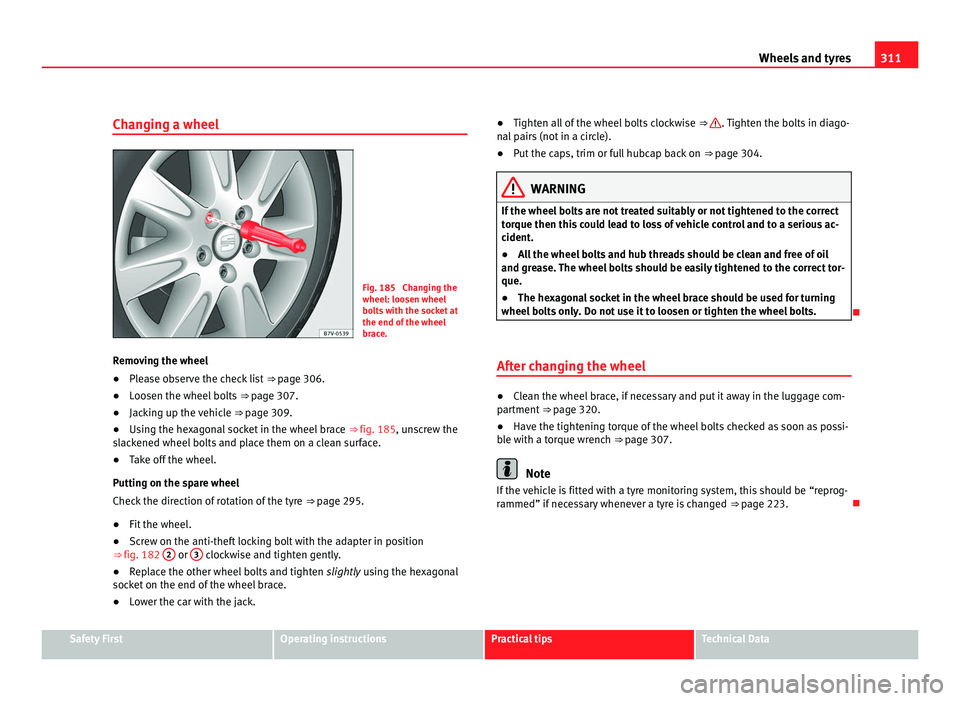
Changing a wheel Fig. 185 Changing the
wheel: loosen wheel
bo
lt
s with the socket at
the end of the wheel
brace.
Removing the wheel
● Please observe the check list ⇒ page 306.
● L
oosen the wheel bolts ⇒ page 307.
● Jac
king up the vehicle ⇒ page 309.
● U
sing the hexagonal socket in the wheel brace ⇒ fig. 185, uns
crew the
slackened wheel bolts and place them on a clean surface.
● Take off the wheel.
Putting on the s
pare wheel
Check the direction of rotation of the tyre ⇒ page 295.
● Fit the wheel.
● Screw on the anti-theft locking bolt with the adapter in position
⇒ fig. 182 2 or
3 clockwise and tighten gently.
● Replace the other wheel bolts and tighten slightl
y using the hexagonal
socket on the end of the wheel brace.
● Lower the car with the jack. ●
Tighten all of the wheel bolts clockwise ⇒ . Tighten the bolts in diago-
nal p
airs (not in a circle).
● Put the caps, trim or full hubcap back on ⇒ page 304. WARNING
If the wheel bolts are not treated suitably or not tightened to the correct
tor que then thi
s could lead to loss of vehicle control and to a serious ac-
cident.
● All the wheel bolts and hub threads should be clean and free of oil
and grea
se. The wheel bolts should be easily tightened to the correct tor-
que.
● The hexagonal socket in the wheel brace should be used for turning
wheel bolt
s only. Do not use it to loosen or tighten the wheel bolts.
After changing the wheel ●
Clean the wheel brace, if necessary and put it away in the luggage com-
par tment
⇒ page 320.
● Have the tightening torque of the wheel bolts checked as soon as possi-
ble w
ith a torque wrench ⇒ page 307. Note
If the vehicle is fitted with a tyre monitoring system, this should be “reprog-
rammed” if nec
essary whenever a tyre is changed ⇒ page 223.Safety First Operating instructions Practical tips Technical Data
Page 314 of 385
312
If and when
If and when
In case of emergency
Introduction Additional information and warnings:
●
Braking, stopping and parking ⇒ pag e 183
● Emer
gency locking and unlocking ⇒ page 314
● V
ehicle tools ⇒ page 320 WARNING
A faulty vehicle in traffic represents a risk of accident for the driver and
for other r o
ad users.
● Stop the vehicle safely as soon as possible. Park the vehicle a safe
dist
ance from surrounding traffic to lock all the doors in case of an emer-
gency. Turn on the hazard warning lights to warn other road users.
● Never leave children or disabled people alone in the vehicle if the
doors ar
e to be locked. In case of an emergency, passengers will be trap-
ped inside the vehicle. Individuals locked in the vehicle can be exposed
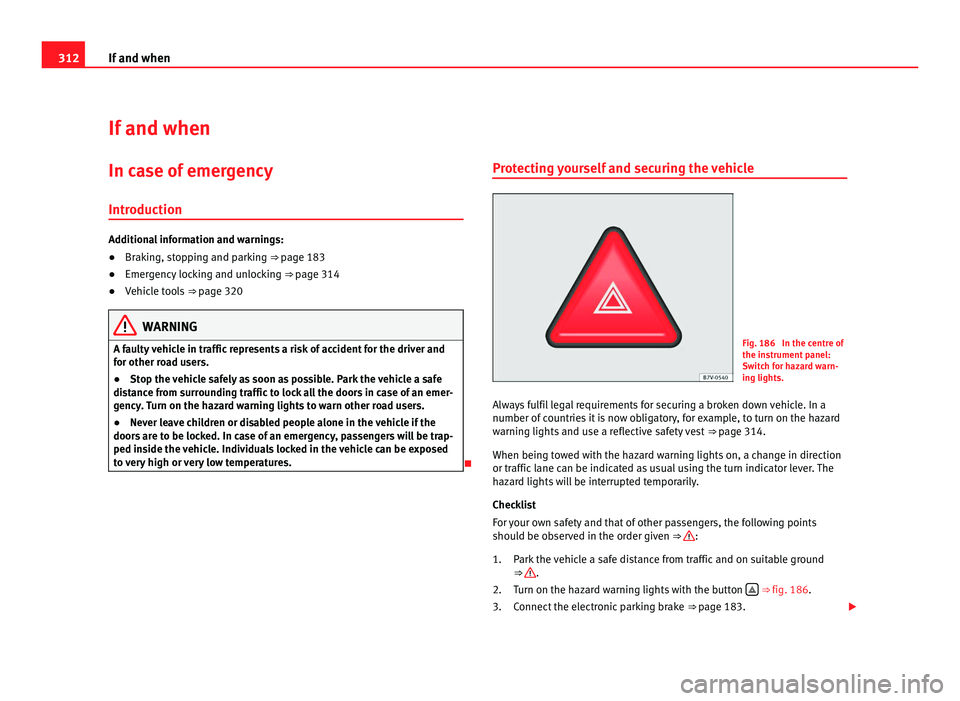
to very high or very low temperatures. Protecting yourself and securing the vehicle Fig. 186 In the centre of
the ins
trument
panel:
Switch for hazard warn-
ing lights.
Always fulfil legal requirements for securing a broken down vehicle. In a
number of cou
ntries it is now obligatory, for example, to turn on the hazard
warning lights and use a reflective safety vest ⇒ page 314.
When being towed with the hazard warning lights on, a change in direction
or traffic lane can be indicated as usual using the turn indicator lever. The
hazard lights will be interrupted temporarily.
Checklist
For your own safety and that of other passengers, the following points
should be observed in the order given ⇒ :
Park the
vehicle a safe distance from traffic and on suitable ground
⇒ .
Turn on the h az
ard warning lights with the button ⇒
fig. 186 .
C
onnect the electronic parking brake ⇒ page 183.
1.
2.
3.
Page 315 of 385
313
If and when
Move the selector lever to its intermediate position or to P ⇒ page 174.
St op the engine and remove the key from the ignition ⇒ page 170.
Have all occupants leave the vehicle and move to safety, for example
behind a guard rail.
When leaving the vehicle, take all keys with you.
Place an emergency warning triangle to indicate the position of your ve-
hicle to other road users.
Allow the engine to cool and check if a specialist is required.
Examples of when to use the hazard warning lights:
● If the vehicles ahead suddenly slow down or reach the end of a traffic
jam, to w
arn the vehicles behind.
● In case of an emergency.
● If the vehicle breaks down.
● When being towed.
Alwa
ys comply with the applicable laws regarding the use of hazard warn-
ing lights.
If the hazard warning lights are not working, you must use an alternative
method of drawing attention to your vehicle. This method must comply with
traffic legislation. WARNING
Failure to follow the checklist prepared for your own safety could lead to
acc ident
s and severe injuries.
● Always complete the operations given in the checklist and observe
the genera
l rules of safety. 4.
5.
6.
7.
8.
9.
WARNING
The components of the exhaust system reach very high temperatures.
This c
ould cause a fire and considerable damage.
● Always park your vehicle so that no part of the exhaust system can
come in cont
act with flammable materials (such as dried grass or fuel). Note
● The vehicle battery will discharge and run down if the hazard warning
lights r
emain on for too much time (even with the ignition turned off).
● For some vehicles, the brake lights will blink when braking suddenly at
speeds
of approximately 80 km/h to warn vehicles behind. If braking con-
tinues, then the hazard warning lights will automatically be turned on at the
speed of less than approximately 10 km an hour. The brake lights remain lit.
Upon accelerating, the hazard warning lights will be automatically turned
off. Safety First Operating instructions Practical tips Technical Data
Page 324 of 385
322
If and when
Fuses
Introduction Due to the constant update of vehicles, fuse assignments depending on
equipment and the u
se of
the same fuse for various electrical components,
at the time of printing this manual it is not possible to provide an up-to-date
summary of the electrical components fuse positions. For detailed informa-
tion about the fuse positions, please consult a Technical Service.
In general, a fuse can be assigned to various electrical components. Like-
wise, an electrical component can be protected by several fuses.
Only replace fuses when the cause of the problem has been solved. If a
newly inserted fuse blows after a short time, you must have the electrical
system checked by a qualified dealership as soon as possible.
Additional information and warnings:
● Working in the engine compartment ⇒ page 275WARNING
The high voltages in the electrical system can give serious electrical
shock s, c
ausing burns and even death!
● Never touch the electrical wiring of the ignition system.
● Take care not to cause short circuits in the electrical system. WARNING
Using unsuitable fuses, repairing fuses or bridging a current circuit with-
out f u
ses can cause a fire and serious injury.
● Never use a fuse with a higher value. Only replace fuses with a fuse of
the same amperag
e (same colour and markings) and size.
● Never repair a fuse.
● Never replace a fuse by a metal strip, staple or similar. CAUTION
● To avoid damage to the vehicles electric system, before replacing a fuse
t urn off
the ignition, the lights and all electrical elements and remove the
keys from the ignition.
● If you replace a fuse with higher-rating fuse, you could cause damage to
another part
of the electrical system.
● Protect the fuse boxes when open to avoid the entry of dust or humidity.
Dirt and humidity
inside fuse boxes can cause damage to the electrical sys-
tem. Note
● One single consumer could have more than one fuse.
● Sev er
al consumers could run over one single fuse.
Page 325 of 385
323
If and when
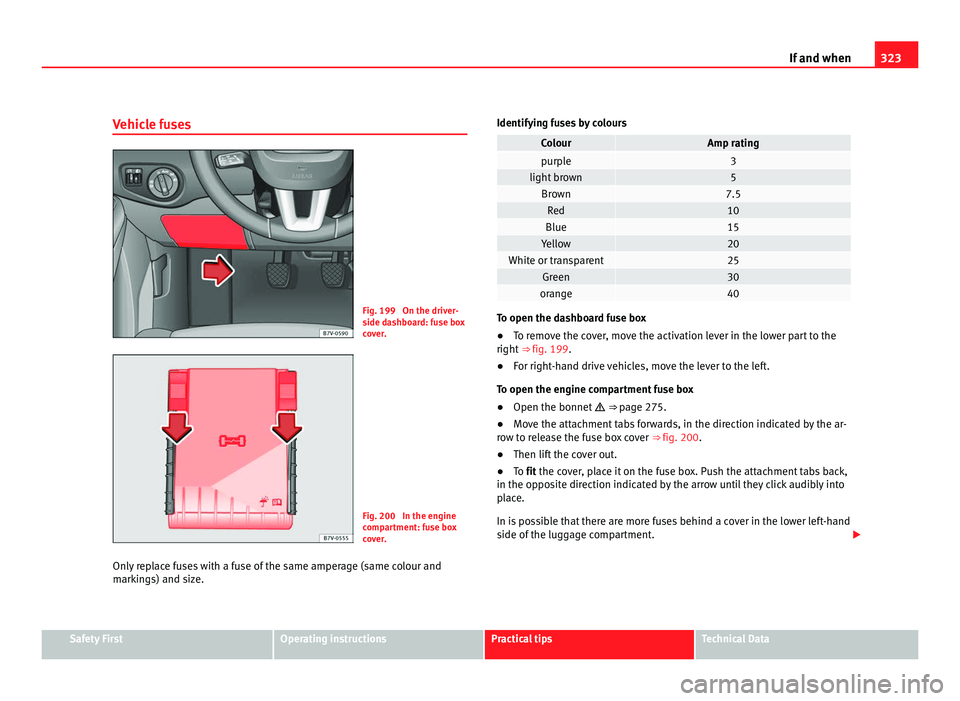
Vehicle fuses Fig. 199 On the driver-
side d
a
shboard: fuse box
cover. Fig. 200 In the engine
comp
ar
tment: fuse box
cover.
Only replace fuses with a fuse of the same amperage (same colour and
markin
gs) and size. Identifying fuses by colours Colour Amp rating
purple 3
light brown 5
Brown 7.5
Red 10
Blue 15
Yellow 20
White or transparent 25
Green 30
orange 40
To open the dashboard fuse box
●
To remove the cover, move the activation lever in the lower part to the
right ⇒ fig. 199 .
● F
or right-hand drive vehicles, move the lever to the left.
To open the engine c
ompartment fuse box
● Open the bonnet ⇒ pag
e 275.
● Move the attachment tabs forwards, in the direction indicated by the ar-
row t
o release the fuse box cover ⇒ fig. 200.
● Then lift the cover out.
● To fit the cover, place it on the fuse box. Push the attachment tabs back,
in the oppo
site direction indicated by the arrow until they click audibly into
place.
In is possible that there are more fuses behind a cover in the lower left-hand
side of the luggage compartment. Safety First Operating instructions Practical tips Technical Data
Page 326 of 385
324
If and when CAUTION
● Always carefully remove the fuse box covers and refit them correctly to
av oid pr
oblems with your vehicle.
● Protect the fuse boxes when open to avoid the entry of dust or humidity.
Dirt and humidity
inside fuse boxes can cause damage to the electrical sys-
tem. Note
In the vehicle, there are more fuses than those indicated in this chapter.
These shoul
d only be changed by a specialist workshop.
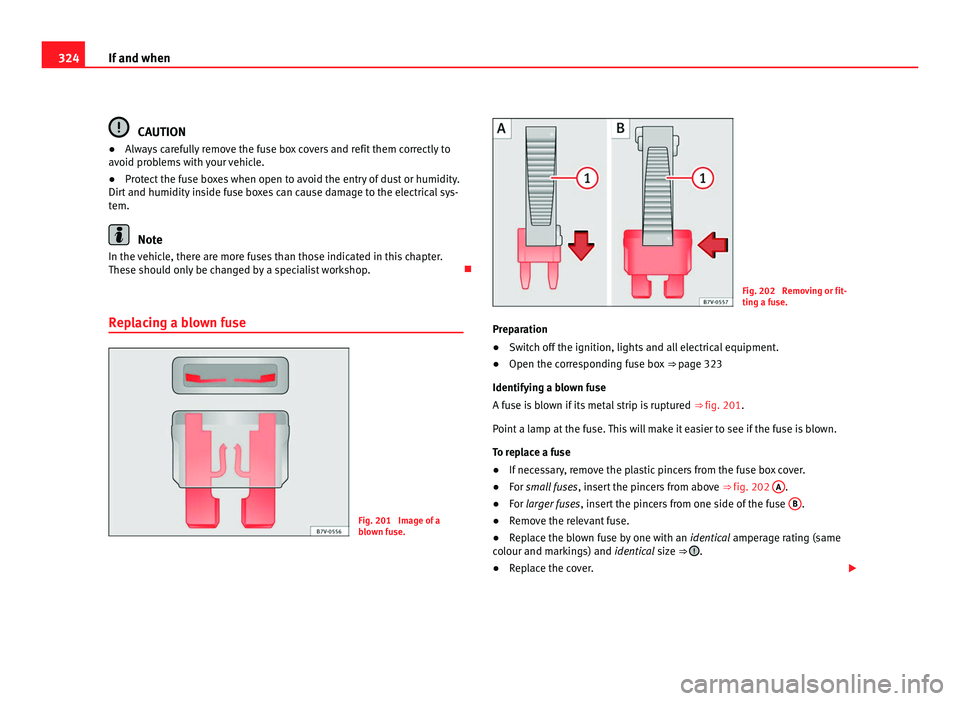
Replacing a blown fuse Fig. 201 Image of a
blo
wn f
use. Fig. 202 Removing or fit-
ting a f
u
se.
Preparation
● Switch off the ignition, lights and all electrical equipment.
● Open the corresponding fuse box ⇒ page 323
Identif
ying a blown fuse
A fuse is blown if its metal strip is ruptured ⇒ fig. 201.
Point a lamp at the fuse. This will make it easier to see if the fuse is blown.
To replace a fuse
● If necessary, remove the plastic pincers from the fuse box cover.
● For small fuses, insert the pincers from above ⇒ fig. 202 A .
● For larger fuses , inser
t the pincers from one side of the fuse B .
● Remove the relevant fuse.
● Replace the blown fuse by one with an identica
l amperage rating (same
colour and markings) and identical size ⇒ .
● Replace the cover.
Page 328 of 385
326
If and when
Changing bulbs
Introduction Changing bulbs requires a certain amount of manual skill. If you are unsure,
SEA
T r
ecommends that you consult an qualified workshop or request assis-
tance from a specialist. In general, a specialist is required if other vehicle
components must be removed or if the discharge lamps must be replaced.
You should store spare light bulbs in the vehicle for safety-relevant lights.
Spare bulbs may be obtained from the Official dealers and workshops. In
some countries, it is a legal requirement to carry spare bulbs in the vehicle.
Driving with faults and blown bulbs on the vehicle exterior lighting is
against the law.
Additional bulb specifications
The specifications of some headlamp bulbs and bulbs for the tail lamps fit-
ted at the factory may be different to those of conventional bulbs. Bulb in-
formation is displayed on the bulb socket or on the bulb itself.
Additional information and warnings:
● Lights and visibility ⇒ page 95
● W
orking in the engine compartment ⇒ page 275
● V
ehicle tools ⇒ page 320
● F
uses ⇒ page 322 WARNING
If the road is not well-lit and the vehicle is not clearly visible to other
driver s, ther
e is a risk of accident. WARNING
Failure to replace bulbs correctly may cause serious accidents.
● Before carrying out any work in the engine compartment please read
and ob ser
ve the warnings ⇒ page 275. In any vehicle, the engine com-
partment is a hazardous area and could cause severe injury.
● Discharge lamps work with high-voltage and can cause serious or fa-
tal
injury if handled incorrectly.
● H7 and discharge lamps are highly pressurised and could explode
when being ch
anged.
● Only replace the bulbs concerned when they have cooled.
● Never replace bulbs alone if you are not familiar with the operations
neces
sary. If you are not sure about procedures then visit a Technical
Service to carry out the necessary work.
● Never touch the bulb glass directly. Fingerprints will be evaporated by
the heat of
the operating bulb thus “fogging” up the reflector.
● The headlamp frameworks in the engine compartment and the tail
lamps
contain sharp elements. Always protect your hands when chang-
ing bulbs. CAUTION
After changing a bulb, if the rubber covers and plastic caps are not replaced
corr ectly
on the headlamp framework, the electrical installation may be
damaged, especially if water is allowed to enter.
Indicator lights up Possible cause Solution
A vehicle exterior lighting
bu
l
b is not working. Replace the faulty bulb.
Page 329 of 385
327
If and when
Several warning and control lamps should light up for a few seconds when
the ignition is sw
itched. This signals that the lamp is working properly. They
will switch off after a few seconds.
Checking the bulbs of a trailer
For vehicles with the factory fitted trailer system, certain trailer lights are al-
so controlled if the socket is correctly connected.
A fault on a trailer turn indicator is indicated on the instrument panel by the
indicator blinking twice as fast ( or ) ⇒ page 95.
● General fault of all indicators on one side.
● Fault in one tail light (on some models, also the registration light).
● Fault in two brake lights. WARNING
If the warning lamps and messages are ignored, the vehicle may stall in
traffic, or m a
y cause accidents and severe injuries.
● Never ignore the warning lamps or text messages.
● Stop the vehicle safely as soon as possible. CAUTION
Failure to heed the warning lamps and text messages when they appear
ma y
result in faults in the vehicle. Note
A fault in the LED on the tail lights will not be indicated. However, if the fault
affects al
l the LEDs then this will be indicated by the indicator . Information for replacing bulbs Checklist
To r
ep
lace a bulb, carry out the following operations always in the order giv-
en ⇒ :
Park the
vehicle a safe distance from traffic and on suitable ground.
Connect the electronic parking brake ⇒ page 183.
Turn the light switch to position 0 ⇒ page 95.
Move the gear lever into the neutral position ⇒ page 95.
Automatic gearbox: Move selector lever to position P ⇒ page 174.
Stop the engine and remove the key from the ignition ⇒ page 170.
Manual gearbox: Select a gear ⇒ page 174.
Wait until all of the passenger compartment lights are turned off
⇒ page 95.
Allow the corresponding bulb to cool. Visually inspect fuses to see if any are blown ⇒ page 322.
Replace the bulb according to the instructions ⇒ . Bulbs should only
be rep l
aced by new identical models. Bulb information is displayed on
the bulb socket or on the bulb itself.
In general, never touch the bulb glass directly. The heat of the bulb
would cause the fingerprint to evaporate and condense on the reflector.
This will impair the brightness of the headlight.
Check if the new bulb is working. If the bulb is not working, it may not
have been correctly fitted, it could be damaged or the connector may
not be correctly connected.
Every time a bulb for the headlights is replaced, visit a specialised
workshop to check the headlights.
1.
2.
3.
4.
5.
6.
7.
8.
9.
10.
11.
12.
13.
14.
Safety First Operating instructions Practical tips Technical Data