AUX Seat Alhambra 2011 User Guide
[x] Cancel search | Manufacturer: SEAT, Model Year: 2011, Model line: Alhambra, Model: Seat Alhambra 2011Pages: 385, PDF Size: 7.92 MB
Page 166 of 385
164
Heating, Ventilation and Air conditioning
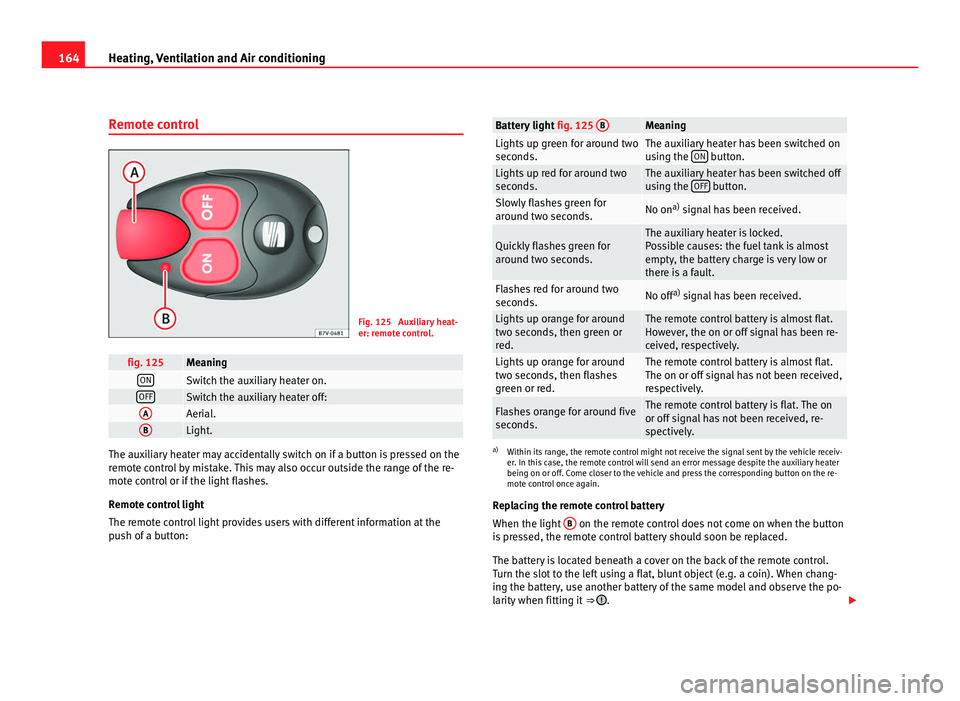
Remote control Fig. 125 Auxiliary heat-
er: remot
e c
ontrol. fig. 125 Meaning
ON
Switch the auxiliary heater on.
OFF
Switch the auxiliary heater off:
A
Aerial.
B
Light.
The auxiliary heater may accidentally switch on if a button is pressed on the
remot
e c
ontrol by mistake. This may also occur outside the range of the re-
mote control or if the light flashes.
Remote control light
The remote control light provides users with different information at the
push of a button: Battery light
fig. 125 B Meaning
Lights up green for around two
second
s. The auxiliary heater has been switched on
us
in
g the ON button.
Lights up red for around two
second
s. The auxiliary heater has been switched off
us
in
g the OFF button.
Slowly flashes green for
arou
nd tw
o seconds. No on
a)
signal has been received. Quickly flashes green for
arou
nd tw
o seconds. The auxiliary heater is locked.
Po
s
sible causes: the fuel tank is almost
empty, the battery charge is very low or
there is a fault. Flashes red for around two
second
s. No off
a)
signal has been received. Lights up orange for around
two sec
ond
s, then green or
red. The remote control battery is almost flat.
How
ev
er, the on or off signal has been re-
ceived, respectively. Lights up orange for around
two sec
ond
s, then flashes
green or red. The remote control battery is almost flat.
The on or off s
ign
al has not been received,
respectively. Flashes orange for around five
second
s. The remote control battery is flat. The on
or off s
ign
al has not been received, re-
spectively. a)
Within its range, the remote control might not receive the signal sent by the vehicle receiv-
er. In thi s
case, the remote control will send an error message despite the auxiliary heater
being on or off. Come closer to the vehicle and press the corresponding button on the re-
mote control once again.
Replacing the remote control battery
When the light B on the remote control does not come on when the button
is pr
essed, the remote control battery should soon be replaced.
The battery is located beneath a cover on the back of the remote control.
Turn the slot to the left using a flat, blunt object (e.g. a coin). When chang-
ing the battery, use another battery of the same model and observe the po-
larity when fitting it ⇒ .
Page 167 of 385
165
Heating, Ventilation and Air conditioning
Range
The rec eiv
er is in the interior of the vehicle. The remote control, when fitted
with new batteries, has a range of several hundred metres. Obstacles be-
tween the remote control and the vehicle, bad weather conditions and dis-
charged batteries can considerably reduce the range of the remote control.
An optimum range is obtained by keeping the remote control vertical, with
the aerial A pointing upwards. When doing so, do not cover the aerial with
your fin g
ers or with the palm of your hand.
There must be a minimum distance of two metres between the remote con-
trol and the vehicle. CAUTION
● The radiofrequency remote control contains electronic components.
Ther ef
ore, avoid getting the remote control wet and from being knocked
and protect it from direct sunlight.
● Use of inappropriate batteries may damage the remote control. For this
rea
son, always replace the dead battery with another of the same voltage,
size and specifications. For the sake of the environment
● Please dispose of old batteries so that they do not harm the environ-
ment .
● The r
emote control battery may contain perchlorate. Observe the legal
requirements
for their disposal.
Programming the auxiliary heater The heater or ventilation inside the vehicle can be programmed for a certain
period. Before programming, check that the day is correctly set in the
Auxi
liary heat-
er - day of the week menu ⇒ .
Enab lin
g the Auxiliary heater menu on the instrument panel
● From the main menu, select the Auxili
ary heater submenu and press the
OK button on the windscreen wiper lever.
● ALTERNATIVELY: pre s
s the or
arrow buttons on the multi-function
st eerin
g wheel until the Auxiliary heater menu is displayed. Menu options Description
Switching on
Swit
c
hing off The auxiliary heater can be set to come on automati-
cal
ly
if required. To do so, select a timer:
– The timer is displayed marked with a .
– Only one timer can be selected. If a timer has been
selected, Prog. ON will be displayed on the screen. If
no timer has been selected, the instrument panel
screen will display Prog. OFF.
– To modify the programmed timer, select another tim-
er or select the Off option. Timer 1
Timer 2
Timer 3 Three different timers (hh.mm) can later be selected
us
in
g the On option. If the auxiliary heater is to be
switched on for just a certain day of the week, select
the day of the week and the time for the auxiliary heat-
er to come on. Duration The operating time may vary between 10 and 60 mi-
nute
s
and can be set to 5-minute intervals. Operating mode Set to heat or ventilate the vehicle interior when the
auxi
li
ary heater is switched on. Day Set the current day of the week.
Manufacturer's
setting
s The predefined factory values for the functions of this
menu are r
e
stored. Back This returns to the main menu
Safety First Operating instructions Practical tips Technical Data
Page 168 of 385
166
Heating, Ventilation and Air conditioning
Checking programming
If the timer h
as been switched on after switching the ignition off, the instant
on button will remain lit for around ten seconds.
WARNING
Never program the independent heating system to be activated and oper-
ated in c lo
sed, unventilated areas. The auxiliary heater fumes contain
carbon dioxide, an odourless and colourless toxic gas. Carbon monoxide
can cause people to lose consciousness. It can also cause death.
Operating instructions The auxiliary heater exhaust system located below the vehicle must be kept
cl
e
ar of snow, mud and other objects. The exhaust fumes must not be ob-
structed in any way. The exhaust fumes generated by the auxiliary heater
are removed via an exhaust pipe fitted underneath the vehicle.
On heating the vehicle interior, depending on the outside temperature the
warm air is first directed at the windscreen and then to the rest of the pas-
senger compartment through the air vents. If the air vents are turned to-
wards the windows, for example, the form of air distribution may be affec-
ted.
Depending on the outside temperature, the temperature at which the auxili-
ary heater warms the vehicle interior may be somewhat higher if the heating
or climate control temperature control is set to maximum before switching
the heating on.
Depending on the engine, vehicles with auxiliary heater may be fitted with a
second battery in the luggage compartment that is responsible for powering
the auxiliary heater. Cases in which the auxiliary heater will not switch on
●
The auxiliary heater requires about as much power as the dipped head-
lights. If the batt
ery charge is low, the auxiliary heater will switch off auto-
matically or will not even switch on. This avoids problems when starting the
engine.
● The heater will switch just once each time. The timer will also have to be
switc
hed back on every time it is required. Note
● Noise will be heard while the auxiliary heater is running.
● When the air humidity i
s high and the outside temperature low, the
heating sy
stem may evaporate condensation from the auxiliary heater. In
this case, steam may be released from underneath the vehicle. This is com-
pletely normal and there is no need to suspect a fault!
● If the auxiliary heater runs several times over a prolonged period, the ve-
hicle b
attery may run flat. To re-charge the battery, drive the vehicle for a
long distance. In general: drive for as much time as the auxiliary heating
was working.
Page 228 of 385
226
Driving and the environment
Economic driving style Changing gear early
General
in
structions: The highest gear is always the most economical gear.
As a guideline, for the majority of vehicles: At a speed of 30 km/h, drive in
third gear, at 40 km/h in fourth gear and at 50 km/h in fifth gear.
In addition, skipping gears when shifting up helps to save fuel, weather and
traffic conditions permitting.
Do not wait until the last moment before changing gear. Only use first gear
when you move off and change to second gear quickly. Avoid the kick-down
function in vehicles with automatic gearbox.
Vehicles with a gear display help to achieve an economical driving style as
the display indicates the best moment to change gear.
Let the vehicle roll
If you take your foot off the accelerator, the fuel supply is stopped and con-
sumption is reduced.
Allow the vehicle to roll without accelerating, for example when approach-
ing a red traffic light. However, if the vehicle is rolling too slowly or the dis-
tance is too long, the clutch pedal should be pressed to declutch. The en-
gine will then operate at idle speed.
If the vehicle is going to be at a standstill for a period of time, switch off the
engine; for example, while waiting at a level crossing. In vehicles which
have the Start-Stop function on, the engine switches off automatically when
the vehicle is not moving.
Think ahead and “flow” with the traffic
Frequent acceleration and braking considerably increase fuel consumption.
If you think ahead as you drive and keep a safe distance from the vehicle in
front, it is possible to slow down by simply lifting your foot off the accelera-
tor. This eliminates the need for constant braking and acceleration. Calm and steady driving
Cons
tancy is more important than speed: The more you drive at a constant
speed, the lower the fuel consumption.
When driving on the motorway, it is more efficient to drive at a constant and
more moderate speed than to be continuously accelerating and braking. As
a general rule, you will reach your destination just as quickly when you drive
at a constant speed.
The cruise control function helps you to achieve a constant style of driving.
Moderate use of additional electrical appliances
It is important to travel in comfort, but convenience systems should be used
in an ecological manner.
Some equipment, when connected, increase fuel consumption considera-
bly, for example:
● Air conditioning cooling system: If the air conditioning system is re-
quired to c
ool to significantly lower temperatures than the true outside tem-
perature, it will require a large quantity of energy from the engine. There-
fore, we recommend that the selected temperature for the vehicle is not too
different to the outside temperature. It is a good idea to open all the win-
dows of the car before starting your journey, and to drive a short distance
with all the windows open to allow the vehicle to cool down slightly. Only
then should you close all the windows and switch on the air conditioning.
Keep windows closed when travelling at high speeds. Driving with the win-
dows open increases fuel consumption.
● Switch off the seat heating when the seats have warmed up.
● Switch off the heated rear window and the windscreen heating when the
window
s have demisted and are free of ice.
● Do not leave the auxiliary heater switched on when the vehicle is mov-
ing ⇒ p
age 163.
Page 266 of 385
264
Checking and refilling levels
Checking and refilling levels
Filling the tank
Introduction The fuel tank flap is on the rear right of the vehicle.
Addition
a
l information and warnings:
● Fuel ⇒ page 267
● Selectiv
e Catalytic Reduction (AdBlue) ⇒ page 271
● W
orking in the engine compartment ⇒ page 275WARNING
Refuelling or handling fuel carelessly can cause an explosion or fire re-
su ltin
g in serious burns and injuries.
● Always make sure that you correctly close the fuel cap to avoid evap-
oration and fuel
spillage.
● Fuels are highly explosive and inflammable substances that can
cause seriou
s burns and injuries.
● Fuel could leak out or be spilt if the engine is not switched off or if the
fill
er fuel nozzle is not fully inserted into the tank filler neck when refuel-
ling. This could lead to a fire, explosion and severe injuries.
● When refuelling, turn off the engine, the auxiliary heating
(⇒ page 163) and t
urn off the ignition for safety reasons.
● Always turn off mobile telephones, radio apparatus and other radio
wave emittin
g equipment before refuelling. Electromagnetic waves could
cause sparks and lead to a fire. WARNING (Continued)
● Nev er enter the vehicle while refuelling. If it is absolutely necessary
t o ent
er the vehicle, close the door and touch a metal surface before
touching the filler nozzle again. This will prevent the generation of static
electricity. Sparks could cause a fire when refuelling.
● Never handle fuel close to open flames, sparks or objects with slow
combu
stion (e.g. cigarettes).
● Avoid static electricity and electro-magnetic radiation when refuel-
ling.
● Ob
serve the safety regulations of the service station.
● Never spill fuel on the vehicle or in the luggage compartment. WARNING
For safety reasons, SEAT does not recommend carrying a spare fuel canis-
ter in the v
ehicle. Fuel could be spilled and catch fire, above all in case of
an accident and this applies to a full container as well as empty contain-
ers. This could lead to explosions, fires and injuries.
● Observe the following if you exceptionally have to carry fuel in a can-
ist
er:
– Never place a fuel container to fill it inside the vehicle or on the ve-
hicle, f
or example, in the luggage compartment or on the tailgate.
Filling in these circumstances could create an electrostatic charge
and spark that could ignite fuel fumes.
– Always place the canister on the ground to fill it.
– Insert the fuel nozzle into the mouth of the canister as far as possi-
ble.
Page 267 of 385
265
Checking and refilling levels WARNING (Continued)
– If you are using a metal fuel canister, the nozzle must always touch
the c ani
s
ter while it is being filled to avoid static electricity.
– Follow the legal requirements for the use, storage and transport of
spar
e fuel canisters.
– Insure that the fuel container complies with manufacturing stand-
ards, f
or example, ANSI or ASTM F852-86. CAUTION
● Always remove any fuel spilled on the vehicle paintwork immediately to
av oid d
amage to the wheel housing, the tyre and vehicle paintwork.
● Refuelling a petrol engine with diesel or a diesel engine with petrol can
cause seriou
s engine and fuel system damage; the resulting malfunctions
are not covered by the SEAT warranty. If you refuel with the wrong type of
fuel, never start the engine. This applies to even the smallest amount of the
wrong fuel. You should obtain professional assistance. With the engine run-
ning, the composition of the wrong fuel could significantly damage the fuel
system and the engine itself.
● In vehicles with a diesel engine, under no cir
cumstances should you re-
fuel or drive with petrol, kerosene, heating oil or any other type of different
fuel. Other types of fuels could cause serious damage to the engine and to
the fuel supply system and the resulting problems are not covered by the
SEAT warranty. For the sake of the environment
Fuels can contaminate the environment. Collect any spilt service fluids and
allo w a pr
ofessional to dispose of them. Note
There is no emergency mechanism for the manual release of the tank flap. If
nece s
sary, request assistance from specialised personnel. Control lamps and fuel gauge
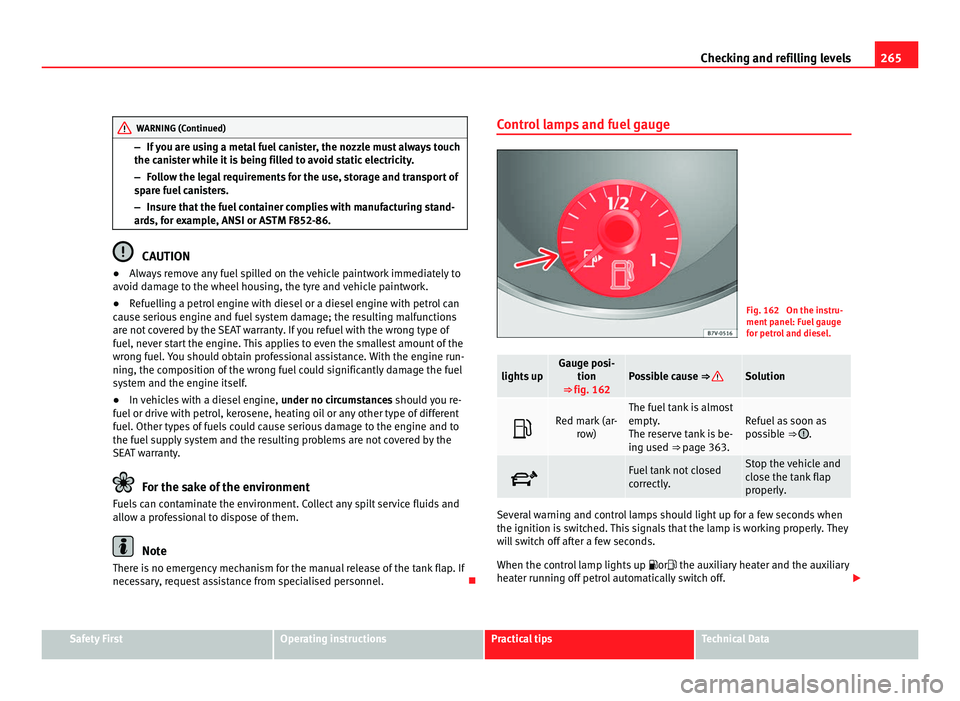
Fig. 162 On the instru-
ment p
anel: F
uel gauge
for petrol and diesel. lights up Gauge posi-
tion
⇒ fig. 162 Possible cause ⇒ Solution
Red mark (ar-
row) The fuel tank is almost
empty.
The r
e
serve tank is be-
ing used ⇒ page 363. Refuel as soon as
pos
s
ible ⇒ .
Fuel tank not closed
corr
ectly
. Stop the vehicle and
clo
se the t
ank flap
properly. Several warning and control lamps should light up for a few seconds when
the ignition is
sw
itched. This signals that the lamp is working properly. They
will switch off after a few seconds.
When the control lamp lights up or the auxiliary heater and the auxiliary
heater running off petrol automatically switch off. Safety First Operating instructions Practical tips Technical Data
Page 268 of 385
266
Checking and refilling levels WARNING
Driving with insufficient fuel reserve could result in the vehicle breaking
down in tr affic
and a serious accident.
● If the fuel level is too low then the fuel supply to the engine can be-
come irre
gular especially on slopes.
● If the engine “is choked” or stalls due to lack of or irregularity of the
fuel s
upply, the power steering as well as all of the driver assistance sys-
tems including braking assistance will stop working.
● Always refuel when there is only one quarter of the fuel tank left to
avoid runnin
g out of fuel. CAUTION
● Always pay attention to any lit lamps and to the corresponding descrip-
tion s
and instructions to avoid damage to the vehicle.
● Never run the tank completely dry. An irregular fuel supply may lead to
ignition faults
and unburnt fuel could enter the exhaust system. This could
damage the catalytic converter filter or the diesel particulate filter! Note
The arrow next to the fuel pump symbol on the instrument panel ⇒ fig. 162
indic
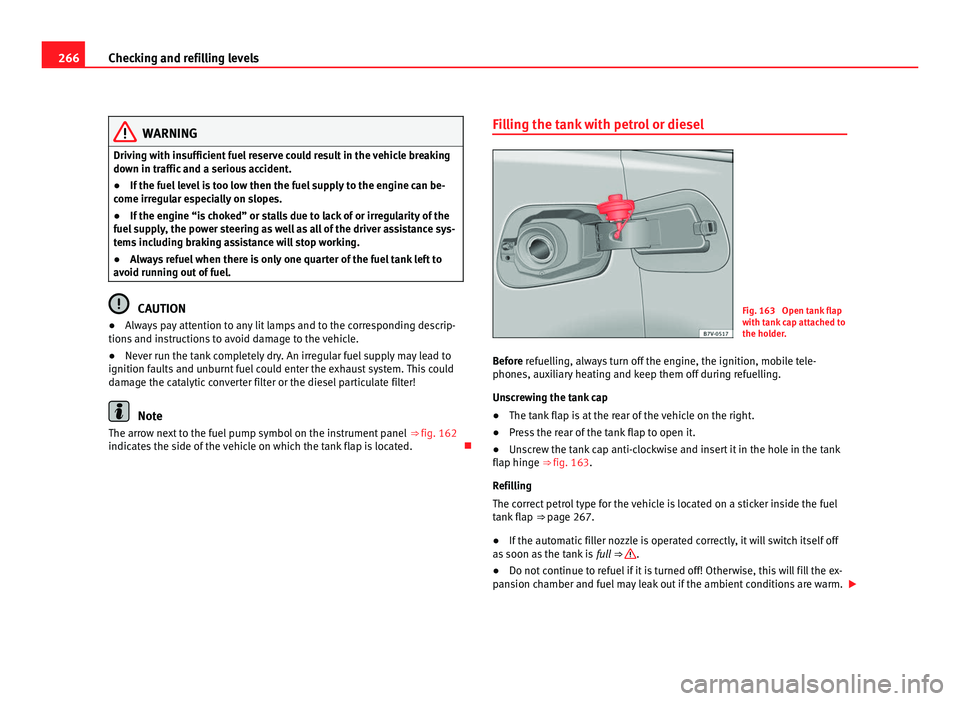
ates the side of the vehicle on which the tank flap is located. Filling the tank with petrol or diesel Fig. 163 Open tank flap
with t
ank
cap attached to
the holder.
Before refuelling, always turn off the engine, the ignition, mobile tele- phones, aux
iliary heating and keep them off during refuelling.
Unscrewing the tank cap
● The tank flap is at the rear of the vehicle on the right.
● Press the rear of the tank flap to open it.
● Unscrew the tank cap anti-clockwise and insert it in the hole in the tank
flap hing
e ⇒ fig. 163.
Refilling
The correct petrol type for the vehicle is located on a sticker inside the fuel
tank flap ⇒ page 267.
● If the automatic filler nozzle is operated correctly, it will switch itself off
as soon a
s the tank is full ⇒ .
● Do not continue to refuel if it is turned off! Otherwise, this will fill the ex-
pan s
ion chamber and fuel may leak out if the ambient conditions are warm.
Page 271 of 385
269
Checking and refilling levels
● If, in exceptional circumstances, petrol with a lower octane rating to that
r ec
ommended is used, only use moderate engine speeds and a light throt-
tle. Avoid using full throttle and overloading the engine. Otherwise you may
damage the engine. Fill up with fuel of a suitable octane rating as soon as
possible.
● Do not refuel if the filler indicates that the fuel contains metal. LRP (lead
repl
acement petrol) fuels also contain high concentrations of metal addi-
tives. This could damage the engine!
● Just one full tank of leaded fuel would seriously impair the efficiency of
the catalytic
converter and could damage it.
Diesel Diesel fuel
Diesel
f
uel must correspond to European standard EN 590 (In Germany,
EN 590 or DIN 51628).
The use of diesel fuel with a high sulphur percentage requires shorter serv-
ice intervals ⇒ Booklet Maintenance Programme ⇒ . Your qualified work-
shop wi l
l be able to tell you which countries have diesel with a high sulphur
content.
Do not mix fuel additives (thinners, or similar additives) with diesel fuel.
Winter-grade diesel
When using “summer-grade diesel fuel”, difficulties may be experienced at
temperatures below 0°C (+32°F) because the fuel thickens due to wax sepa-
ration. For this reason, “winter-grade diesel fuel” is available in Germany,
for example, during the cold months. It can be used at temperatures as low
as -20°C (-4°F).
In countries with different climatic conditions, other types of diesel fuel are
available that are suitable to local temperatures. SEAT qualified workshops
and filling stations in the country concerned will inform you on the type of
diesel fuels available. A cold diesel engine makes more noise during winter temperatures than
summer temper
atures. Furthermore, the exhaust fumes may turn slightly
bluish while the engine is heating. The quantity of exhaust gases will de-
pend on the outside temperature.
Filter pre-heater
Vehicles with a diesel engine are fitted with a fuel filter pre-heater. This en-
sures that the fuel system remains operational to approx. -24°C (-11.2°F),
provided you use winter-grade diesel which is safe to -15°C (+5°F).
However, if the fuel has waxed to such an extent that the engine will not
start at temperatures of under -24°C (-11.2°F), simply place the vehicle in a
warm garage or workshop for a while to heat up.
Auxiliary heater
Vehicles with a diesel engine may be fitted with an auxiliary heater. The
heater runs off the fuel from the fuel tank. On doing so, smells and steam
may be noticed outside the vehicle for a short period. This is normal and it
is not an indication of a fault in the vehicle.
Whenever there is little fuel in the tank (reserve), the auxiliary heater auto-
matically switches off. WARNING
Never use start boosters. An aerosol start booster could explode or cause
a sud den ri
se in engine speed leading to engine damage and serious in-
jury. Safety First Operating instructions Practical tips Technical Data
Page 294 of 385
292
Checking and refilling levels
● the idling s peed i s increased so that the alternator provides more elec-
tricity.
● where necessary, the power of the most powerful consumers is reduced
or even comp
letely disconnected.
● On starting the engine, the power supply from the 12-volt sockets and
the cigar
ette lighter may be interrupted for a short time.
The on-board management program cannot always prevent the battery from
running flat. For example, if the ignition is left on for a long period with the
engine off or if the side lights or parking lights are left on while the vehicle
is stationary.
Why does the battery run flat?
● When stationary for a long time without starting the engine, particularly
if the ignition is
switched on.
● Use of electrical consumers with the engine switched off.
● If the auxiliary heater is running ⇒ page 163.WARNING
Incorrectly securing the battery or using the wrong battery can cause
short -c
ircuits, fire and serious injuries.
● Always use only maintenance free batteries that do not run flat alone
and whose proper
ties, specifications and size correspond to the stand-
ard battery. The specifications are indicated on the battery case. WARNING
A highly explosive mixture of gases is released when the battery is under
ch ar
ge.
● The batteries should be charged in a well-ventilated room only.
● Never charge a frozen or recently thawed battery. A flat battery can
freeze at
temperatures around 0°C (+32°F). WARNING (Continued)
● Always replace a battery which has frozen.
● B
att
ery cables not correctly connected may cause a short circuit. Re-
connect fir
st the positive cable and then the negative cable. CAUTION
● Never disconnect the battery if the ignition is switched on or if the en-
gine i s
running. This could damage the electrical system or electronic com-
ponents.
● Never plug accessories supply current, such as solar panels or a battery
char
ger, to the 12-volt sockets or the cigarette lighter. This could damage
the vehicle's electrical system. For the sake of the environment
● Dispose of the battery in an environment-friendly manner. Batteries con-
t ain t
oxic substances such as sulphuric acid and lead.
● Battery acid can contaminate the environment. Collect any spilt service
fluids and al
low a dispose of them correctly.
Page 367 of 385
Index
A
Abro
a
d
Extended stay abroad with your vehicle . . 255
Sale of vehicle . . . . . . . . . . . . . . . . . . . . . . 255
ABS See "Braking assist systems" . . . . . . . . . . 189
Accessories . . . . . . . . . . . . . . . . . . . . . . . . . . . . 257
Acoustic warnings Headlights . . . . . . . . . . . . . . . . . . . . . . . . . . 97
Adaptive headlights Dynamic . . . . . . . . . . . . . . . . . . . . . . . . . . . . 99
AdBlue Control lamp . . . . . . . . . . . . . . . . . . . . . . . . 271
Information . . . . . . . . . . . . . . . . . . . . . . . . . 272
Minimum quantity for a refill . . . . . . . . . . . 272
Refilling . . . . . . . . . . . . . . . . . . . . . . . . . . . . 273
Specifications . . . . . . . . . . . . . . . . . . . . . . . 274
Tank filling capacity . . . . . . . . . . . . . . . . . . 272
Warning lamp . . . . . . . . . . . . . . . . . . . . . . . 271
Additional equipment . . . . . . . . . . . . . . . . . . . 258
Additional heater See "Auxiliary heater" . . . . . . . . . . . . . . . . 163
Adjusting passenger exterior mirror . . . . . . . . 112
Adjustment Correct sitting position . . . . . . . . . . . . . . . . 12
Electric front seat . . . . . . . . . . . . . . . . . . . . 115
Head restraints . . . . . . . . . . . . . . . . . . . . . . 123
Mechanical front seat . . . . . . . . . . . . . . . . 114
Rear seats . . . . . . . . . . . . . . . . . . . . . . . . . . 116 Seat with position memory . . . . . . . . . . . . 118
Steering wheel
. . . . . . . . . . . . . . . . . . . . . . 169
Adjustments Folding the backrest of the front passeng-er's seat . . . . . . . . . . . . . . . . . . . . . . . . . . 121
Headlight range . . . . . . . . . . . . . . . . . . . . . 102
Aerial . . . . . . . . . . . . . . . . . . . . . . . . . . . . . . . . . 255
Aerial built into the window . . . . . . . . . . . . . . . 255
AFS . . . . . . . . . . . . . . . . . . . . . . . . . . . . . . . . . . . 99
Airbag system . . . . . . . . . . . . . . . . . . . . . . . . 28, 31 Cleaning instrument panel . . . . . . . . . . . . 253
Curtain airbags . . . . . . . . . . . . . . . . . . . . . . . 37
Deactivating the front passenger airbag . . 35
Deactivating using the key switch . . . . . . . . 35
Description . . . . . . . . . . . . . . . . . . . . . . . . . . 31
Differences between front passenger airbagsystems . . . . . . . . . . . . . . . . . . . . . . . . . . . 34
Faults . . . . . . . . . . . . . . . . . . . . . . . . . . . . . 259
Front airbags . . . . . . . . . . . . . . . . . . . . . . . . 33
Function . . . . . . . . . . . . . . . . . . . . . . . . . . . . 31
Knee airbag . . . . . . . . . . . . . . . . . . . . . . . . . 38
Locking the vehicle after airbag deploy- ment . . . . . . . . . . . . . . . . . . . . . . . . . . . . . . 75
Repairs . . . . . . . . . . . . . . . . . . . . . . . . . . . . 259
Side airbags . . . . . . . . . . . . . . . . . . . . . . . . . 36
Use of child seats . . . . . . . . . . . . . . . . . . . . . 35
Vehicle care . . . . . . . . . . . . . . . . . . . . . . . . 253
Warning lamp . . . . . . . . . . . . . . . . . . . . . . . . 30
Air conditioning see "Climate control" . . . . . . . . . . . . . . . . . 155 Air recirculation mode . . . . . . . . . . . . . . . . . . . 161
Air vents
. . . . . . . . . . . . . . . . . . . . . . . . . . . . . . 161
Alarm system . . . . . . . . . . . . . . . . . . . . . . . . . . . 78
Alcantara . . . . . . . . . . . . . . . . . . . . . . . . . . . . . . 251
All-wheel drive Snow chains . . . . . . . . . . . . . . . . . . . . . . . . 301
Winter tyres . . . . . . . . . . . . . . . . . . . . . . . . . 300
Alternator . . . . . . . . . . . . . . . . . . . . . . . . . . . . . 289
Ambient lighting . . . . . . . . . . . . . . . . . . . . . . . 102
Anodized surfaces . . . . . . . . . . . . . . . . . . . . . . 247
Anti-lock brake system (ABS) . . . . . . . . . . . . . 189
Anti-theft locking bolts . . . . . . . . . . . . . . . . . . 305
Anti-theft wheel locking bolts . . . . . . . . . . . . . 307
Anti-tow system . . . . . . . . . . . . . . . . . . . . . . . . . 79
Anti-trap function Electric windows . . . . . . . . . . . . . . . . . . . . . . 91
Panorama sliding sunroof . . . . . . . . . . . . . . 94
Sunshade . . . . . . . . . . . . . . . . . . . . . . . . . . . 94
Antifreeze . . . . . . . . . . . . . . . . . . . . . . . . . . . . . 285
Antitheft alarm . . . . . . . . . . . . . . . . . . . . . . . . . . 78 Trailer . . . . . . . . . . . . . . . . . . . . . . . . . . . . . 236
Antitheft alarm system Anti-tow system . . . . . . . . . . . . . . . . . . . . . . 79
False alarms . . . . . . . . . . . . . . . . . . . . . . . . . 80
Interior monitoring . . . . . . . . . . . . . . . . . . . . 79
Antitheft bolts . . . . . . . . . . . . . . . . . . . . . . . . . . 321
Armrests . . . . . . . . . . . . . . . . . . . . . . . . . . . . . . 125
Ashtray . . . . . . . . . . . . . . . . . . . . . . . . . . . . . . . 150 365
Index