check oil Seat Alhambra 2011 User Guide
[x] Cancel search | Manufacturer: SEAT, Model Year: 2011, Model line: Alhambra, Model: Seat Alhambra 2011Pages: 385, PDF Size: 7.92 MB
Page 267 of 385
265
Checking and refilling levels WARNING (Continued)
– If you are using a metal fuel canister, the nozzle must always touch
the c ani
s
ter while it is being filled to avoid static electricity.
– Follow the legal requirements for the use, storage and transport of
spar
e fuel canisters.
– Insure that the fuel container complies with manufacturing stand-
ards, f
or example, ANSI or ASTM F852-86. CAUTION
● Always remove any fuel spilled on the vehicle paintwork immediately to
av oid d
amage to the wheel housing, the tyre and vehicle paintwork.
● Refuelling a petrol engine with diesel or a diesel engine with petrol can
cause seriou
s engine and fuel system damage; the resulting malfunctions
are not covered by the SEAT warranty. If you refuel with the wrong type of
fuel, never start the engine. This applies to even the smallest amount of the
wrong fuel. You should obtain professional assistance. With the engine run-
ning, the composition of the wrong fuel could significantly damage the fuel
system and the engine itself.
● In vehicles with a diesel engine, under no cir
cumstances should you re-
fuel or drive with petrol, kerosene, heating oil or any other type of different
fuel. Other types of fuels could cause serious damage to the engine and to
the fuel supply system and the resulting problems are not covered by the
SEAT warranty. For the sake of the environment
Fuels can contaminate the environment. Collect any spilt service fluids and
allo w a pr
ofessional to dispose of them. Note
There is no emergency mechanism for the manual release of the tank flap. If
nece s
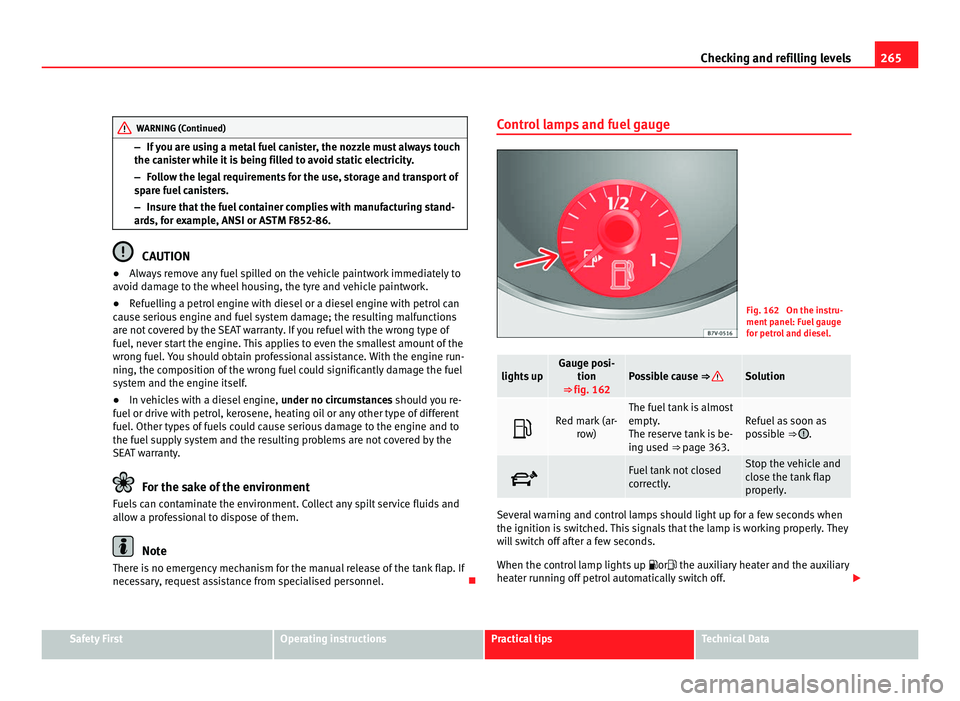
sary, request assistance from specialised personnel. Control lamps and fuel gauge
Fig. 162 On the instru-
ment p
anel: F
uel gauge
for petrol and diesel. lights up Gauge posi-
tion
⇒ fig. 162 Possible cause ⇒ Solution
Red mark (ar-
row) The fuel tank is almost
empty.
The r
e
serve tank is be-
ing used ⇒ page 363. Refuel as soon as
pos
s
ible ⇒ .
Fuel tank not closed
corr
ectly
. Stop the vehicle and
clo
se the t
ank flap
properly. Several warning and control lamps should light up for a few seconds when
the ignition is
sw
itched. This signals that the lamp is working properly. They
will switch off after a few seconds.
When the control lamp lights up or the auxiliary heater and the auxiliary
heater running off petrol automatically switch off. Safety First Operating instructions Practical tips Technical Data
Page 269 of 385
267
Checking and refilling levels
Closing the tank cap
● Screw on the tank cap clockwise until it you hear it click into position.
● Press the tank flap until you hear it click into place. The tank flap must
be flush w ith the body
contour. WARNING
Do not continue refilling once the fuel nozzle has switched itself off. The
fuel t
ank may be filled too much. As a result, fuel may spurt out and spill.
This could lead to a fire, explosion and severe injuries. CAUTION
● Always remove any fuel spilled on the vehicle paintwork immediately to
av oid d
amage to the wheel housing, the tyre and vehicle paintwork. For the sake of the environment
Spilt fuel can contaminate the environment.
Refilling precautions Information on bulb replacement
⇒ pag
e 326.
Checklist
Never work on the engine or in the engine compartment if you are not famil-
iar with the operations to be carried out, the applicable safety standards
and especially if you do not have the instruments, liquids and tools neces-
sary ⇒ page 275, Working in the engine compartment! Have the work car-
ried out by a Technical Service if you are uncertain. Check the following reg-
ularly, preferably when you refuel:
● Windscreen washer fluid level ⇒ pag
e 105
● Engine oil level ⇒ pag
e 279 ●
Engine coolant level ⇒ p
age 283
● Brake fluid level ⇒ pag
e 183
● Tyre pressure ⇒ pag
e 293
● Vehicle lighting required to guarantee road safety:
Indicator
s
Side lights, dipped headlights and full beam headlights
Rear lights
Brake lights
Rear fog light ⇒ page 97 WARNING
Not following the checklist prepared for your own safety could lead to ac-
cident s
and severe injuries.
● Always follow the check list and perform the necessary operations.
Fuel Introduction You will find a factory-fitted sticker containing information on the type of
fuel
f
or your vehicle on the inside of the fuel tank flap.
Additional information and warnings:
● ⇒ Bookl et Maintenance Programme
● R
efuelling ⇒ pag e 264
● En
gine and exhaust system management ⇒ page 228
–
–
–
–
–
Safety First Operating instructions Practical tips Technical Data
Page 272 of 385
270
Checking and refilling levels CAUTION
● The vehicle is not pr epared for the use of biodiesel. Under no circum-
stances should this fuel be used. It could damage the fuel system and sub-
sequently lead to engine faults!
● The addition of biodiesel to diesel by the diesel producer according to
Standar
d EN 590 or other equivalent (DIN 51628 in Germany, for example)
is authorised and causes no type of damage to the engine or the fuel
system.
● The diesel engine has been designed for to use diesel fuel exclusively.
Therefor
e, never use petrol, fuel oil or other unsuitable fuels. The composi-
tion of these fuels may significantly damage the fuel system and the en-
gine.
● The use of diesel fuels with a high sulphur percentage could considera-
bly r
educe the service life of the diesel particulate filter. Your qualified work-
shop will be able to tell you which countries have diesel with a high sulphur
content.
Information on fuel consumption The consumption and emission values indicated do not refer to one specific
vehic
l
e. They are only to be used to compare the values of the different ve-
hicle versions. The fuel consumption and CO 2 emissions of a vehicle not on-
ly depend on the effective use of fuel. They also depend on your driving
style and other non-technical factors.
Calculating fuel consumption
Fuel consumption and emission values are determined according to the cur-
rent version of the 715/2007/EC or 80/1268/EEC regulation and are valid
for the vehicle kerb weight. The specifications do not refer to an individual
vehicle. Two measuring cycles are carried out on a rolling road test bed. The
test criteria are as follows: Urban cycle Measurement of the urban cycle starts with an engine cold
st
ar
t. City driving is then simulated at between 0 and 50 km/
h. Road cycle In the road cycle simulation, the car undergoes frequent ac-
cel
er
ation and braking in all gears, as in normal everyday
driving. The road speed ranges from 0 to 120 km/h. Combined The average combined consumption is calculated with a
weightin
g of
around 37 % for the urban cycle and 63 % for
the road cycle. CO
2 emis-
s ion
s of the
combination The exhaust gases are collected during both driving cycles
to c
alc
ulate carbon dioxide emissions (urban and road). The
gas composition is then analysed to evaluate the CO 2 con-
tent and other emissions. Note
● The kerb weight may vary according to the vehicle equipment. This
c ou
ld raise consumption and the CO 2 emissions slightly.
● In practice, consumption values could be different to the values calcula-
ted ba
sed on the 715/2007/EC or 80/1268/EEC regulations.
Page 277 of 385
275
Checking and refilling levels
Working in the engine compartment Introduction Before working in the engine compartment, make sure that the vehicle is
park
ed on horiz
ontal and firm ground.
The engine compartment of the vehicle is a hazardous area. Never work on
the engine or in the engine compartment if you are not familiar with the op-
erations to be carried out, the applicable safety standards and especially if
you do not have the instruments, liquids and tools necessary ⇒ ! Have
the work c
arried out by a Technical Service if you are uncertain. Negligent
work can cause serious injury.
Additional information and warnings:
● Windscreen wash system ⇒ page 105
● St
art and stop the engine ⇒ page 170
● Br
ake fluid ⇒ page 183
● V
ehicle battery ⇒ page 288
● Chec
ks when filling up ⇒ page 264
● En
gine oil ⇒ page 279
● En
gine coolant ⇒ page 283
● A
ccessories, parts replacement, repairs and modifications ⇒ page 257 WARNING
If the vehicle moves unexpectedly, this could cause serious injury.
● Never work underneath the vehicle if it is not secured against moving.
If y
ou must work underneath the vehicle with the wheels in contact with
the ground then it should be parked on flat ground, the wheels should be
prevented from moving and the key must be removed from the ignition.
● If you have to work underneath the vehicle, you must use suitable
stand
s additionally to support the vehicle, there is a risk of accident!.
The jack is not intended for this kind of work and its failure could lead to
severe injuries. WARNING
The engine compartment is a dangerous area capable of causing serious
injury .
● F
or all type of work, always take the utmost precautions, work care-
ful
ly and note the general safety standards in force. Never take personal
risks.
● Never work on the engine or in the engine compartment if you are not
famili
ar with the necessary operations. If you are not sure about proce-
dures then visit a Technical Service to carry out the necessary work. In-
correct work can cause serious injuries.
● Never open the bonnet if you see steam or coolant escaping from the
engine comp
artment. Hot vapours and coolant can cause serious burns.
Always wait until you cannot see or hear the sound of steam or coolant
coming from the engine compartment.
● Always allow the engine to cool down before opening the bonnet.
● Contact with hot elements of the engine and the exhaust system can
cause b
urns. Safety First Operating instructions Practical tips Technical Data
Page 279 of 385
277
Checking and refilling levels WARNING (Continued)
● Nev er pour service fluids over the engine. These fluid may ignite hot
en gine p
arts and cause injuries.
● If it is necessary to work on the fuel system or the electrical system,
ple
ase follow the instructions below:
– Always disconnect the vehicle battery. When disconnecting the
batter
y, ensure that the vehicle is unlocked otherwise the antitheft
alarm will be triggered.
– Never work close to heaters, heat sources or places exposed to
flames
or sparks.
● Always keep a recently serviced and perfectly working fire extin-
guisher clo
se by. CAUTION
When refilling or changing service liquids, ensure that you put the liquids
into the right t
ank. Making a mistake when refilling could cause serious
malfunctions and damage the engine! For the sake of the environment
Service fluids leaks are harmful to the environment. For this reason you
shoul d m
ake regular checks on the ground underneath your vehicle. Take
the vehicle to a specialist workshop to be checked if you see stains, oil or
other fluids on the ground. Collect any spilt service fluids and allow a pro-
fessional to dispose of them.
Preparing the vehicle for work in the engine compartment Checklist
Carr
y
out the operations below in the order indicated before starting work in
the engine compartment ⇒ : ●
Park the vehicle on an even and solid surface.
● Pre
ss and hold the brake pedal until the vehicle comes to a standstill.
● Connect the electronic parking brake ⇒ page 183.
● Mo
ve the selector lever to its intermediate position or to P ⇒ page 174.
● St
op the engine and remove the key from the ignition ⇒ page 170.
● W
ait for the engine to cool down.
● Always keep children and other people far from the engine compart-
ment.
● Ens
ure that the vehicle can not move off unexpectedly. WARNING
Ignoring this checklist, drawn up for your own safety, could result in seri-
ous injur
y.
● Always complete the operations given in the checklist and observe
the genera
l rules of safety.
Safety First Operating instructions Practical tips Technical Data
Page 281 of 385
279
Checking and refilling levels CAUTION
● To avoid damage to the bonnet and to the windscreen wiper arms, only
open the bonnet when the w
indscreen wipers are in place against the wind-
screen.
● Before driving, always lower the wiper arms.
Engine oil Introduction Additional information and warnings:
●
⇒ Book l
et Maintenance Programme
● W
orking in the engine compartment ⇒ page 275
● A
ccessories, parts replacement, repairs and modifications ⇒ page 257WARNING
Incorrectly handling engine oil can cause injury and serious burns.
● Always protect your eyes when handling engine oil.
● Oil is toxic and must be kept out of the reach of children.
● Engine oil must only be kept closed in its original container. The same
app lie
s to use oil until it has been disposed of.
● Never store engine oil in empty food containers or bottles as other
people m
ay accidentally drink it.
● Regular contact with engine oil can be bad for the skin. If you come
into cont
act with engine oil, wash your skin with soap and water.
● With the engine running, the engine oil gets extremely hot and can
cause sev
ere skin burns. Always wait until the engine has fully cooled. For the sake of the environment
Similar to the other service liquids, spilled engine oil can be bad for the en-
vir onment
. Collect any spilt fluids in suitable containers and dispose of in
accordance with legislation and with the utmost respect for the environ-
ment.
Warning and control lamps lights up Possible cause Solution
Insufficient engine oil. Switch the engine off. Check the
engine oi
l
level ⇒ page 281. flashes Possible cause Solution
Engine oil pressure too low.
Stop the vehicle!
Sw it
ch off the engine. Check the
engine oil level.
- If the warning indicator flashes
although the oil level is correct,
do not continue driving or leave
the engine running. Otherwise,
the engine could be damaged.
You should obtain professional
assistance. Engine oil sensor faulty. Contact a specialist workshop.
Have the en
gine oi
l sensor
checked. Safety First Operating instructions Practical tips Technical Data
Page 282 of 385
280
Checking and refilling levels WARNING
If the warning lamps and messages are ignored, the vehicle may stall in
traffic, or m a
y cause accidents and severe injuries.
● Never ignore the warning lamps or text messages.
● Stop the vehicle safely as soon as possible. CAUTION
Failure to heed the warning lamps and text messages when they appear
ma y
result in faults in the vehicle.
Engine oil specifications Replacement engine oil must strictly comply with the specifications.
The corr
ect
oil must be used to ensure the correct operation and long serv-
ice life of the engine. The engine comes with a high-quality multigrade oil
that can generally be used all year round.
Only use an oil that complies to SEAT standards whenever possible ⇒ . If
you w i
sh to maintain the long-life service duration, only engine oils ap-
proved for this service according to the corresponding VW standard ( ⇒ table
on page 280) may be used. All oils indicated are synthetic multigrade oils.
Engine oils are being continuously further developed. Qualified workshops
are permanently informed of any modifications. SEAT therefore recommends
that you have the engine oil changed by a SEAT Dealership. Engines Engine oil specifications
with LongLife service without LongLife service
Petrol engines VW 504 00, VW 503 00 VW 504 00, VW 502 00
Diesel engines VW 507 00 VW 507 00 CAUTION
● Only use engine oils whose specifications are expressly approved by
S EA
T. The use of any other type of engine oil could cause engine damage!
● No additives should be used with engine oil. Any damage caused by the
use of s
uch additives would not be covered by the factory warranty.
Page 283 of 385
281
Checking and refilling levels
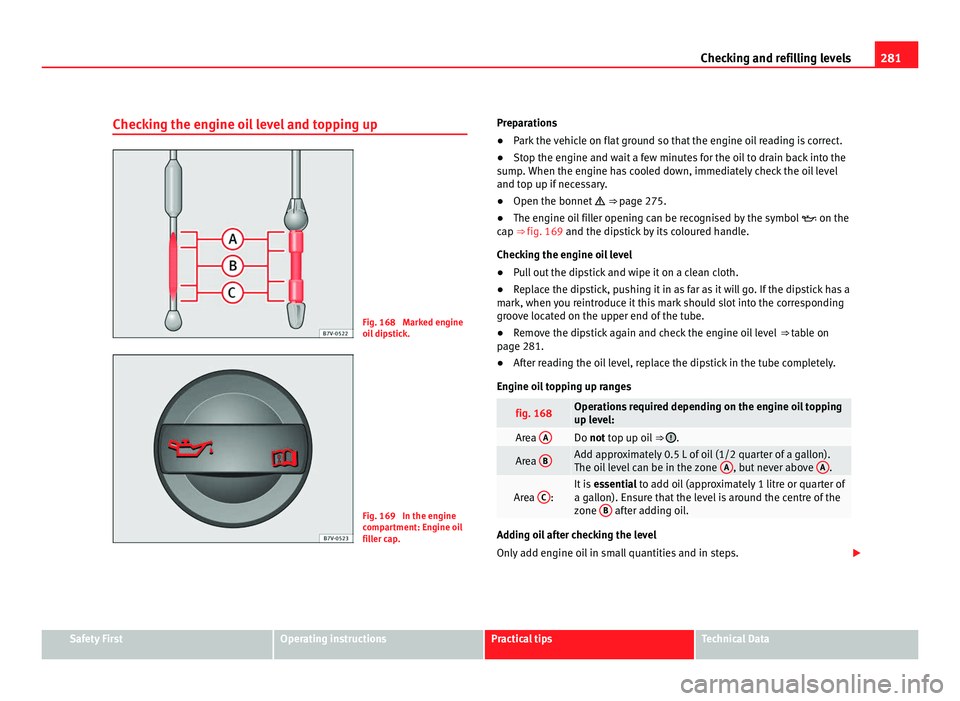
Checking the engine oil level and topping up Fig. 168 Marked engine
oil
dip
stick. Fig. 169 In the engine
comp
ar
tment: Engine oil
filler cap. Preparations
●
Park the vehicle on flat ground so that the engine oil reading is correct.
● Stop the engine and wait a few minutes for the oil to drain back into the
sump.
When the engine has cooled down, immediately check the oil level
and top up if necessary.
● Open the bonnet ⇒ p
age 275.
● The engine oil filler opening can be recognised by the symbol on the
cap ⇒
fig. 169 and the dipstick by its coloured handle.
Checking the engine oil level
● Pull out the dipstick and wipe it on a clean cloth.
● Replace the dipstick, pushing it in as far as it will go. If the dipstick has a
mark, when y
ou reintroduce it this mark should slot into the corresponding
groove located on the upper end of the tube.
● Remove the dipstick again and check the engine oil level ⇒ tabl
e on
page 281.
● After reading the oil level, replace the dipstick in the tube completely.
Engine oil
topping up ranges fig. 168 Operations required depending on the engine oil topping
up lev
el: Area
A Do not top up oil
⇒ .
Area
B Add approximately 0.5 L of oil (1/2 quarter of a gallon).
The oil
l
evel can be in the zone A , but never above
A .
Area
C : It is
essential to add oil (approximately 1 litre or quarter of
a g al
lon). Ensure that the level is around the centre of the
zone B after adding oil.
Adding oil after checking the level
Only
a
dd engine oil in small quantities and in steps. Safety First Operating instructions Practical tips Technical Data
Page 284 of 385
282
Checking and refilling levels
● Unscrew the cap from engine oil filler opening on the cylinder head
⇒ fig. 169
. If you are not sure where the cap is, request help from a special-
ist.
● Only refill using engine oil expressly approved by SEAT and in small
quantities (not
more than 0.5 l or 1/2 a quarter of a gallon at a time)
⇒ page 280.
● To avoid adding too much oil, each time you add a quantity, wait until
the oil h
as flowed into the crankcase so that it can be measured with the
dipstick.
● Check the oil level before adding any more oil. Do not top up with too
much engine oi
l ⇒ .
● When the oil level is in at least the ⇒ fig. 168 B zone, insert the dip-
stic k
into the tube fully to avoid engine oil escaping when the engine is run-
ning.
● After topping up the oil, ensure that the cap is screwed on to the filler
mouth correctly
. WARNING
Oil could catch fire if it comes into contact with hot engine components.
This c
ould lead to a fire, explosion and severe injuries.
● Always ensure that after topping of oil, the engine oil filler cap is cor-
rectly tight
ened. This will avoid engine oil spilling onto hot engine parts
when the engine is running. CAUTION
● If the oil level is above the area A do not start the engine. You should
obt ain pr
ofessional assistance. Otherwise catalytic converter and engine
damage may occur.
● When refilling or changing service liquids, ensure that you put the liq-
uids int
o the right tank. Making a mistake when refilling could cause seri-
ous malfunctions and damage the engine! For the sake of the environment
The oil level must never be above area A . Otherwise oil can be drawn in
through the c r
ankcase breather and escape into the atmosphere via the ex-
haust system.
Engine oil consumption The consumption of engine oil can be different from one engine to another
and can
v
ary during the useful life of the engine.
Depending on driving style and the conditions of use, the consumption of
engine oil can reach 1 litre every 2000 km (one quarter of a gallon every
1200 miles); for new vehicles, this could be higher for the first 5000 km
(3000 miles). For this reason the engine oil level must be checked at regular
intervals, preferably when filling the tank and before a journey.
When the engine is working hard, for instance during sustained high-speed
motorway cruising in summer, when towing a trailer or climbing mountain
passes, the oil level should preferably be kept within area ⇒ fig. 168 A .
Changing the engine oil The engine oil must be changed regularly according to the specifications of
the Maint
en
ance Programme.
Due to the problems linked with disposing of used oil and the need for suit-
able tools and special knowledge, always visit a Technical Service to have
the engine oil and filter changed. SEAT recommends visiting a Technical
Service.
Detailed information on the service intervals are shown in the Maintenance
Programme.
Page 285 of 385
283
Checking and refilling levels
Engine oil additives make new oil darker after the engine has been running
for a shor t
period. This is normal and does not mean more frequent oil
changes are required. WARNING
If, in exceptional circumstances, you must change the engine oil yourself,
pl e
ase note the following:
● Wear eye protection.
● Always wait until the engine has completely cooled to avoid being
burned.
● Alw
ays keep your arms horizontal when unscrewing the oil drainage
bolt so th
at the oil does not run down your arms when it begins to drain.
● Use a suitable and large enough container to collect all of the used oil
in the engine.
● Never c
ollect engine oil in empty food containers, cans, bottles and
other container
s as not all people are able to identify engine oil.
● Oil is toxic and must be kept out of the reach of children. For the sake of the environment
Before changing the engine oil, find a suitable location or service for proper
dis po
sal. For the sake of the environment
Always dispose of engine oil with the utmost respect for the environment.
Never di s
pose of used engine oil in places such as a garden, woods, drains,
roads, paths, rivers and drainage systems. Engine coolant
Introduction Never work on the engine cooling system or if you are not familiar with the
operation
s
to be carried out, the applicable safety standards and especially
if you do not have the instruments, liquids and tools necessary ⇒ ! Have
the work c
arried out by a Technical Service if you are uncertain. SEAT recom-
mends visiting a Technical Service.
Negligent work can cause serious injury.
Additional information and warnings:
● Towing mode ⇒ page 233
● W
orking in the engine compartment ⇒ page 275
● A
ccessories, parts replacement, repairs and modifications ⇒ page 257 WARNING
Engine coolant is toxic!
● Only keep engine coolant in its original container, tightly shut and in
a saf e p
lace.
● Never store engine coolant in empty food containers or bottles as
other people m
ay accidentally drink it.
● Always keep engine coolant out of reach of children.
● Ensure that the proportion of engine coolant additive corresponds to
the lowe
st outside temperature to which the vehicle will be exposed.
● If the outside temperature is extremely low, the engine coolant could
freeze c
ausing the vehicle to stop. As this would also cause the heating
to stop working, passengers without sufficient clothing could freeze. Safety First Operating instructions Practical tips Technical Data