heating Seat Alhambra 2011 User Guide
[x] Cancel search | Manufacturer: SEAT, Model Year: 2011, Model line: Alhambra, Model: Seat Alhambra 2011Pages: 385, PDF Size: 7.92 MB
Page 82 of 385
80
Unlocking and locking
● Push the
OFF button. A yellow warning lamp will light up in the button
unti l
the vehicle is locked.
● Lock all doors and tailgate.
● Use the key to lock the vehicle. The interior monitor and / or anti-towing
alarm are sw
itched off until the next time the vehicle is locked.
To turn off the interior monitoring and anti-tow systems before unlocking
the vehicle, for example in the following situations:
● When leaving animals inside the vehicle ⇒ page 74.
● When the
vehicle must be loaded.
● When the vehicle is being transported, for example, by ferry.
● When the vehicle must be towed with the axle raised.
Risk of
false alarms
The interior monitoring system only operates correctly if the vehicle is com-
pletely closed. Observe legal requirements. The alarm may be accidentally
triggered in the following cases:
● When a window is completely or partially open.
● If the sunglasses storage compartment in the roof console is open.
● When the panorama sliding sunroof is completely or partially open.
● When suspended objects are hung from the interior mirror (air freshen-
er) or there are loo
se papers in the vehicle.
● If the separation net is fitted and moves (due to heating).
● Due to a vibrating mobile telephone inside the vehicle. Note
Upon activating the alarm, if any door or the tailgate is open, only the alarm
wi l
l be activated. The interior monitoring and anti-tow systems will only be
activated when the doors and tailgate are fully closed. Doors
Introduction Additional information and warnings:
●
Vehicle key set ⇒ page 71
● C
entral locking and locking system ⇒ page 74
● Emer
gency locking and unlocking ⇒ page 314 WARNING
If a door is not correctly closed, it could open unexpectedly when driving
and cau se seriou
s injuries.
● Always stop immediately and close the door.
● When closing, ensure that the door has closed correctly. A closed
door should be flu
sh with the corresponding parts of the bodywork.
● Open and close doors only when nobody is in the way of the door. WARNING
A door held open by its retainer could be blown closed by the wind or
clo se if
the vehicle is on a hill causing injury.
● When opening and closing doors, always use the door handle.
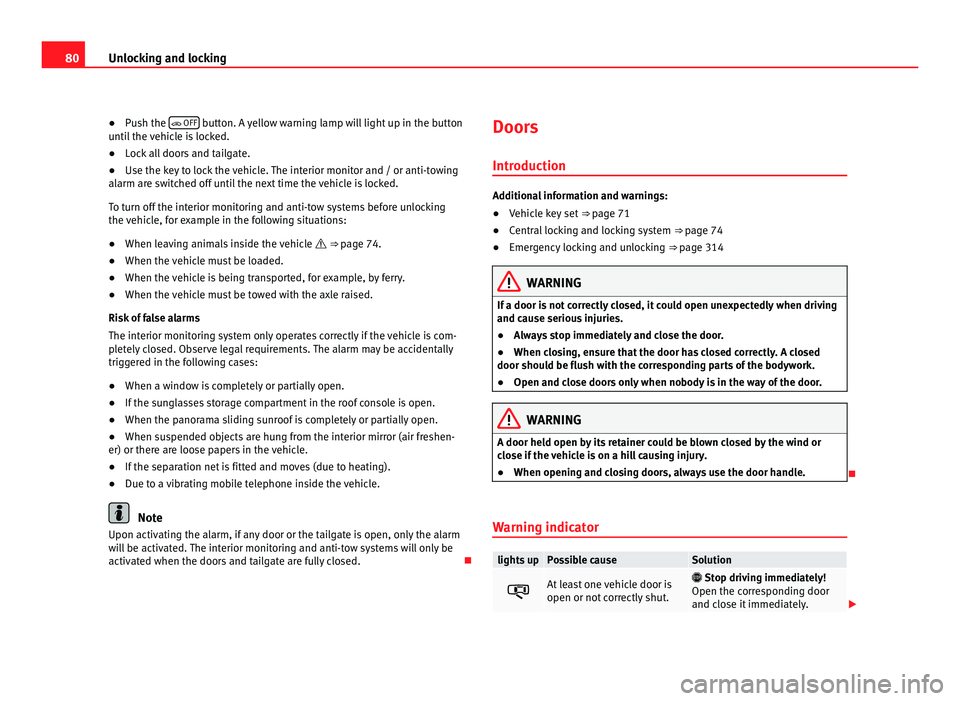
Warning indicator lights up Possible cause Solution
At least one vehicle door is
open or not c
orr
ectly shut.
Stop driving immediately!
Open the c orr
esponding door
and close it immediately.
Page 114 of 385
112
Lights and visibility
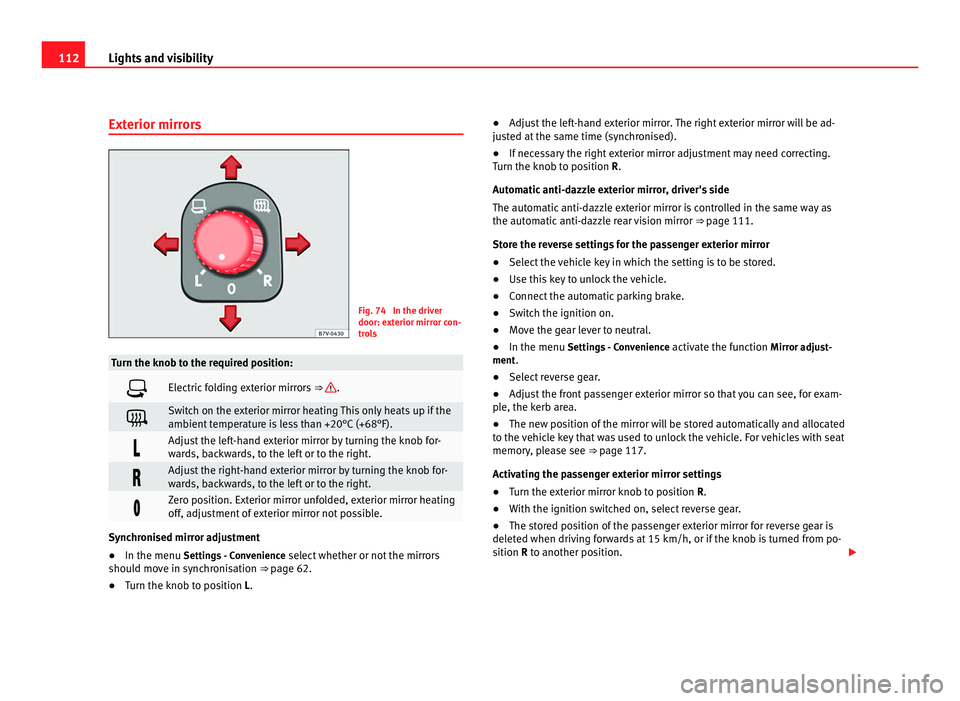
Exterior mirrors Fig. 74 In the driver
door: ext
erior mirr
or con-
trols Turn the knob to the required position:
Electric folding exterior mirrors
⇒ .
Switch on the exterior mirror heating This only heats up if the
ambient
t
emperature is less than +20°C (+68°F). Adjust the left-hand exterior mirror by turning the knob for-
war
d
s, backwards, to the left or to the right. Adjust the right-hand exterior mirror by turning the knob for-
war
d
s, backwards, to the left or to the right. Zero position. Exterior mirror unfolded, exterior mirror heating
off, a
dju
stment of exterior mirror not possible. Synchronised mirror adjustment
●
In the menu Setting s
- Convenience select whether or not the mirrors
should move in synchronisation ⇒ page 62.
● Turn the knob to position L. ●
Adjust the left-hand exterior mirror. The right exterior mirror will be ad-
jus
ted at the same time (synchronised).
● If necessary the right exterior mirror adjustment may need correcting.
Turn the knob t
o position R.
Automatic anti-dazzle exterior mirror, driver's side
The automatic anti-dazzle exterior mirror is controlled in the same way as
the automatic anti-dazzle rear vision mirror ⇒ page 111.
Store the reverse settings for the passenger exterior mirror
● Select the vehicle key in which the setting is to be stored.
● Use this key to unlock the vehicle.
● Connect the automatic parking brake.
● Switch the ignition on.
● Move the gear lever to neutral.
● In the menu Settings
- Convenience activate the function Mirror adjust-
ment.
● Select reverse gear.
● Adjust the front passenger exterior mirror so that you can see, for exam-
ple, the k
erb area.
● The new position of the mirror will be stored automatically and allocated
to the v
ehicle key that was used to unlock the vehicle. For vehicles with seat
memory, please see ⇒ page 117.
Activating the passenger exterior mirror settings
● Turn the exterior mirror knob to position R.
● With the ignition switched on, select reverse gear.
● The stored position of the passenger exterior mirror for reverse gear is
deleted when driv
ing forwards at 15 km/h, or if the knob is turned from po-
sition R to another position.
Page 115 of 385
113
Lights and visibility WARNING
Fold and unfold the exterior mirror, taking care to avoid injuries.
● Only fold or unfold the exterior mirror when there is no-one in the way
of the mirr or
.
● When moving the mirror, take care not to trap fingers between the
mirror and the mirror br
acket. WARNING
Failure to correctly estimate the distance of the vehicle behind could lead
to serious
accident.
● Rear-view convex or aspheric mirrors increase the field of vision, how-
ever ob
jects appear smaller and further away in the mirrors.
● The use of these mirrors to estimate the distance to the next vehicle
when chan
ging lane is imprecise and could result in serious accident.
● If possible, use the rear vision mirror to estimate distances to vehi-
cle
s behind you or in other circumstances.
● Make sure that the rear visibility is adequate. CAUTION
● Before entering a car wash, always ensure that the exterior mirrors are
c orr
ectly folded in.
● Electrically-folding exterior mirrors should not be folded and unfolded
mechanic
ally as this may damage the electrical operation. For the sake of the environment
The exterior mirror heating should be switched off when it is no longer nee-
ded. Otherw i
se, it is an unnecessary fuel waste. Note
● The exterior mirror heating initially heats up with a high power, after two
minut e
s the heat will depend upon the ambient temperature.
● In the event of faults, the electric exterior mirrors can be adjusted man-
ually b
y pressing the edge of the mirror surface. Safety First Operating instructions Practical tips Technical Data
Page 119 of 385
117
Seats and storage compartments
Seat functions Introduction Additional information and warnings
●
Adjust the seat position ⇒ page 10
● Se
at belts ⇒ page 21
● Airb
ag system ⇒ page 31
● Chi
ld seats (accessories) ⇒ page 39
● Int
egrated child seats ⇒ page 46
● Ext
erior mirrors ⇒ page 110
● L
uggage compartment ⇒ page 125 WARNING
Inappropriate use of the seat functions can cause severe injuries.
● Assume the proper sitting position before your trip and remain in it
throughout .
This also applies to the other occupants.
● Only adjust the seat position memory when the vehicle is stationary.
● Only switch the lumbar massage function on and off when the vehicle
is s
tationary.
● Keep hands, fingers, feet and other limbs away from the seat operat-
ing and adju
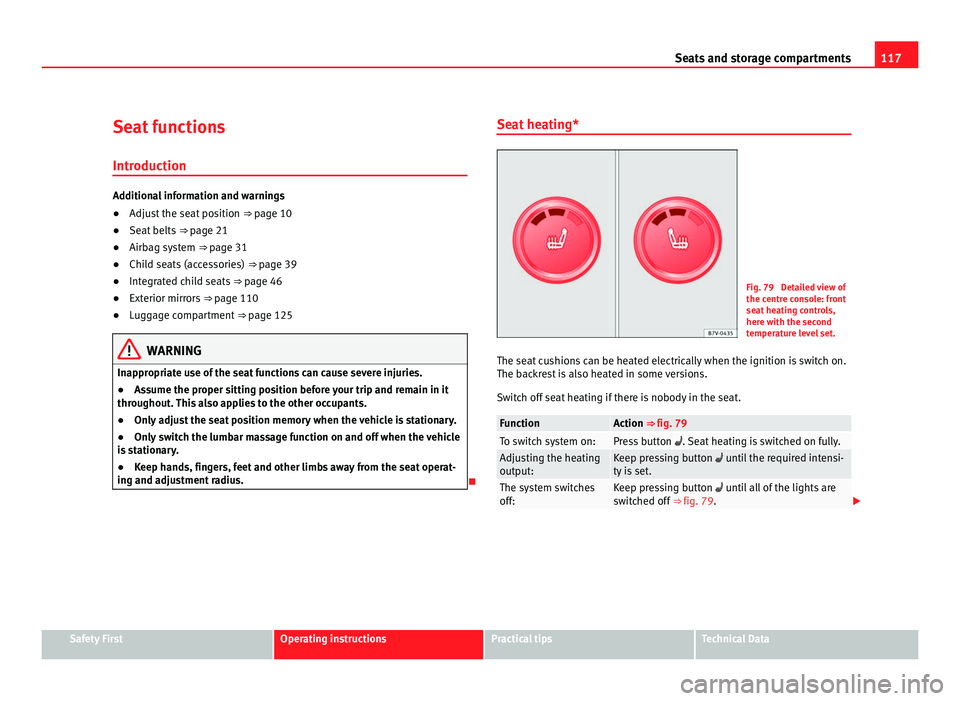
stment radius. Seat heating* Fig. 79 Detailed view of
the centr
e c
onsole: front
seat heating controls,
here with the second
temperature level set.
The seat cushions can be heated electrically when the ignition is switch on.
The back
rest is also heated in some versions.
Switch off seat heating if there is nobody in the seat. Function Action ⇒ fig. 79
To switch system on: Press button
. Seat
heating is switched on fully. Adjusting the heating
output: Keep pressing button unti
l
the required intensi-
ty is set. The system switches
off: Keep pressing button unti
l
all of the lights are
switched off ⇒ fig. 79. Safety First Operating instructions Practical tips Technical Data
Page 120 of 385
118
Seats and storage compartments WARNING
People whose pain and temperature threshold has been affected by some
kind of medic
ine, paraplegia or chronic illness (e.g. diabetes) may sus-
tain burns to the back, buttocks and legs from use of the seat heating
that may lead to a long healing process or that may never completely
heal. Seek medical advice if you have doubts regarding your health.
● People with a limit pain and temperature threshold must never use
seat he
ating. CAUTION
● To avoid damaging the heating elements of the seat heating, please do
not kneel
on the seat or apply sharp pressure at a single point to the seat
cushion and backrest.
● Liquids, sharp objects and insulating materials on the seat could dam-
age the seat
heating.
● In the event of smells, switch off the seat heating immediately and have
the unit in
spected by a Technical Service. For the sake of the environment
The seat heating should remain on only when needed. Otherwise, it is an
unnec e
ssary fuel waste. Seat with position memory* Fig. 80 Memory buttons
on the outs
ide of
the
driver seat
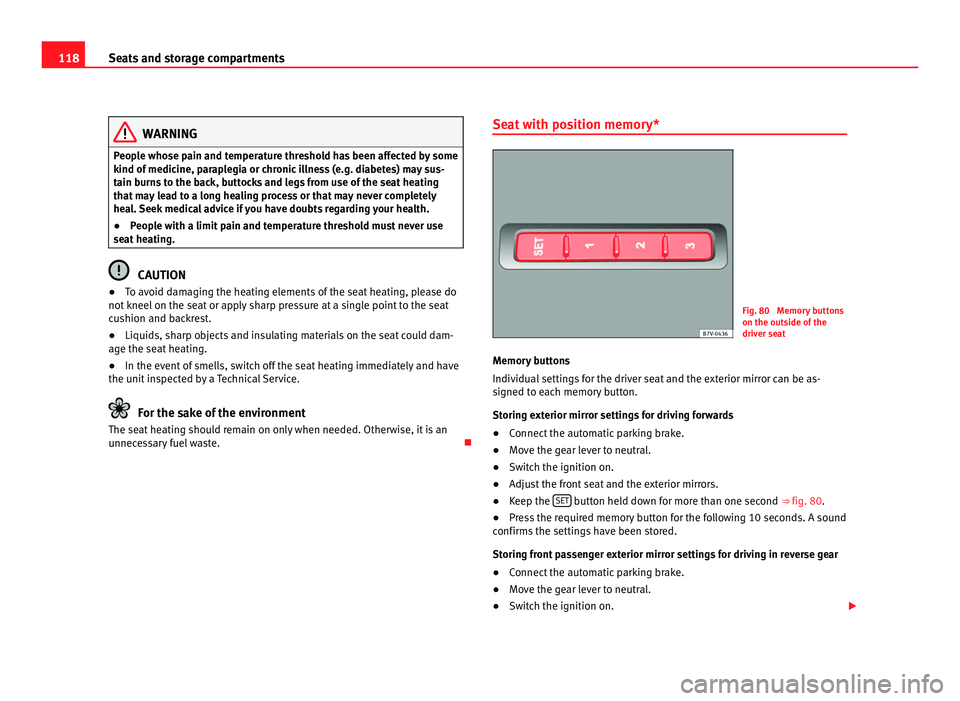
Memory buttons
Individual settin
gs for the driver seat and the exterior mirror can be as-
signed to each memory button.
Storing exterior mirror settings for driving forwards
● Connect the automatic parking brake.
● Move the gear lever to neutral.
● Switch the ignition on.
● Adjust the front seat and the exterior mirrors.
● Keep the SET button held down for more than one second ⇒ fig. 80.
● Press the required memory button for the following 10 seconds. A sound
confirms the settin
gs have been stored.
Storing front passenger exterior mirror settings for driving in reverse gear
● Connect the automatic parking brake.
● Move the gear lever to neutral.
● Switch the ignition on.
Page 128 of 385
126
Seats and storage compartments WARNING
When the vehicle is not in use or being watched, always lock the doors
and the tai l
gate to reduce the risk of serious injury or death.
● Do not leave children unwatched, especially when the tailgate is
open. Childr
en could climb into the luggage compartment, close the tail-
gate from inside and be unable to escape themselves. This could lead to
serious injury or death.
● Never allow children to play in or around the vehicle.
● Never transport people in the luggage compartment. WARNING
Unsecured or incorrectly secured objects can cause serious injury in case
of a s ud
den manoeuvring or breaking or in case of an accident. This is es-
pecially true when objects are struck by a detonating airbag and fired
through the vehicle interior. To reduce the risks, please note the follow-
ing:
● Secure all objects in the vehicle. Always keep equipment and heavy
obj
ects in the luggage compartment.
● Always secure objects with suitable rope or straps so that they can-
not enter the ar
eas around the frontal or side airbags in case of sudden
braking or an accident.
● While driving, always keep object compartments closed. WARNING (Continued)
● Do not place hard, heavy or sharp objects inside the passenger com-
p ar
tment, in open storage compartments, the rear shelf or on the dash-
board.
● Remove hard, heavy and sharp objects from clothes and pockets in-
side the v
ehicle and store securely. WARNING
The transport of heavy object changes vehicle handling and increases
brak in
g distance. Heavy loads that have not been stored or secured cor-
rectly could cause loss of control and result in serious injury.
● The vehicle handling changes when transporting heavy objects due
to a ch
ange in the centre of gravity.
● Distribute the load as uniformly and as low down on the vehicle as
poss
ible.
● Store heavy objects in the luggage compartment as far from the rear
axle a
s possible. CAUTION
● Hard objects on the shelf could chafe the wires of the heating element
and ant enn
a of the rear window and cause damage.
● The side window antenna could be damaged due to chafing from ob-
jects. Note
The ventilating slits between the heated rear window and the shelf must not
be co v
ered so that used air can escape from the vehicle.
Page 143 of 385
141
Seats and storage compartments
Storage compartments
Introduction Storage compartments must only be used to store light or small objects.
The front
c
entral armrest compartment houses the factory-fitted AUX-IN or
multimedia (MEDIA-IN) connection sockets.
The factory-fitted CD changer is located in the left-hand storage compart-
ment of the luggage compartment.
Additional information and warnings:
● Child seats (accessories) ⇒ page 39
● L
uggage compartment ⇒ page 125
● C
are and cleaning of the vehicle interior ⇒ page 249
● ⇒
Bookl et Radio or ⇒ Booklet navigation system WARNING
In the event of sudden braking movements or turns, loose objects may be
thro wn ar
ound the vehicle interior. This could cause serious injuries to
passengers and cause the driver to lose control of the vehicle.
● Do not transport animals or place hard, heavy or sharp objects inside
the vehic
le in: open storage compartments, instrument panel, storage
tray, items of clothing or bags.
● While driving, always keep object compartments closed. WARNING
Objects falling into the driver's footwell could prevent use of the pedals.
This c
ould lead the driver to lose control of the vehicle, increasing the
risk of a serious accident.
● Make sure the pedals can be used at all times, with no objects rolling
underneath them.
● The floor m
at should always be secured to the floor.
● Never place other mats or rugs on top of the original mat supplied by
the factor
y.
● Make sure that no objects can fall into the driver's footwell while the
vehicl
e is in motion. CAUTION
● Objects on the shelf could chafe against the wires of the heating ele-
ment in the r
ear window and cause damage.
● Do not keep heat-sensitive objects, food or medicines inside the vehi-
cle. He
at and cold could damage them or render them useless.
● Light-transparent objects placed inside the vehicle, such as lenses,
magnify
ing glasses or transparent suction caps on the windows, could con-
centrate the sun's rays and cause damage to the vehicle. Note
The ventilating slits between the heated rear window and the shelf must not
be co v
ered so that used air can escape from the vehicle. Safety First Operating instructions Practical tips Technical Data
Page 156 of 385
154
Seats and storage compartments LED on the socket
⇒ fig. 120Steady green light: The child safety device is unlocked. The
sock
et
can now be used. Flashing red light: There is some kind of fault (e.g. discon-
nection due to e
x
cess current or tempera-
ture). Heat protection
The 230 V
o
lt Euro power connector converter switches off automatically
when a certain temperature is exceeded. This disconnect prevents overheat-
ing in the event of an increase in power consumption of the connected ap-
pliance and where the atmospheric temperature is too high. The converter
will switch on again automatically after it has cooled down. Appliances that
are switched on and connected to the socket will start up again. Therefore,
switch off all electrical appliances connected to the socket when the current
converter switches off due to overheating. WARNING
High voltage in the electrical installation!
● Liquids must not be spilt over the socket.
● Do not plug adapters or extension cords into the 230 Volt Euro power
connect or
. Otherwise, the built-in child safety device will switch off and
the connector will become live.
● Do not plug current conductors such as a knitting needle into the 230
Volt
Euro power connector. CAUTION
● Always follow the operating instructions for the appliances to be con-
nect ed!
● Nev
er exceed the maximum power rating as this could damage the vehi-
cle's
general electrical system. ●
12 volt socket:
– Only
use accessories with approved electromagnetic compatibility ac-
cordin
g to current regulations.
– Never power the socket.
● 230 Volt Euro socket:
– Do not hang appliances or plugs that are too heavy (e.g. a transform-
er) from the sock
et.
– Do not connect lamps which contain a neon tube.
– Only plug appliances with a voltage that matches the socket voltage
into the sock
et.
– In the event of consumers with a high start-up current, surge protec-
tion prevents
them from switching on. In this case, unplug the consumer
and try plugging it back in after around 10 seconds. Note
● Some app li
ances may not work properly in the 230 Volt Euro power con-
nector due to a lack of power (Watts).
● The 230 Watt Euro power connector can be modified for 115 Watt appli-
ances
and vice versa. Consult a specialist shop for advice on accessories to
adapt the connector. SEAT recommends visiting a Technical Service.
Page 157 of 385
155
Heating, Ventilation and Air conditioning
Heating, Ventilation and Air conditioning Climate Control
Introduction Viewing Climatronic information
The fact
or
y-fitted radio or navigation system screen briefly displays informa-
tion relating to Climatronic.
The units of temperature measurement is displayed on the factory-installed
radio or navigation system and, depending on the vehicle equipment, can
be set using the Configuration menu on the instrument panel.
Additional information and warnings:
● SEAT information system ⇒ page 62
● W
indscreen wash system ⇒ page 105
● Aux
iliary heating ⇒ page 163
● C
aring for and cleaning the vehicle exterior ⇒ page 242WARNING
Reduced visibility through the windows increases the risk of serious acci-
dents.
● Ens
ure that all windows are free of ice and snow and that they are not
fogg
ed up preventing a clear view of everything outside.
● The maximum heat output required to defrost windows quickly is only
avail
able when the engine has reached its normal running temperature.
Only drive when you have good visibility. WARNING (Continued)
● Always ensure that you use the climate control and heated rear win-
do w t
o maintain good visibility.
● Never leave the air recirculation on for a long period of time. If the
coolin
g mode is switched off and air recirculation mode switched on, the
windows can mist over very quickly, considerably limiting visibility.
● Switch air recirculation mode off when it is not required. WARNING
Stuffy or used air will increase fatigue and reduce driver concentration
pos s
ibly resulting in a serious accident.
● Never leave the fresh air fan turned off or use the air recirculation for
long periods
of time; the air inside the passenger compartment will not
be refreshed. CAUTION
● Switch the climate control system off if you think it may be broken. This
w i
ll avoid additional damage. Have the climate control system checked by a
Technical Service.
● Repairs to the climate control system require specialist knowledge and
speci
al tools. SEAT recommends visiting a Technical Service.
● Do not smoke when air recirculation is switched on in vehicles with a cli-
mate c
ontrol system. The smoke taken in could lie on the cooling system va-
poriser and on the activated charcoal cartridge of the dust and pollen filter,
leading to a permanently unpleasant smell. Safety First Operating instructions Practical tips Technical Data
Page 158 of 385
156
Heating, Ventilation and Air conditioning Note
● When the coo lin g system is turned off, air coming from the outside will
not be dried. To avoid fogging up the windows, SEAT recommends leaving
the cooler (compressor) on. To do this, press the AC button. The button in-
dicat or shou
ld light up.
● If the humidity and temperature outside the vehicle are high, condens
a-
tion can drip off the evaporator in the cooling system and form a pool un-
derneath the vehicle, this is completely normal and there is no need to sus-
pect a leak.
● Keep the air vents in front of the windscreen free of snow, ice and leaves
to ens
ure heating and cooling are not impaired and to prevent the windows
from misting over.