oil Seat Alhambra 2011 User Guide
[x] Cancel search | Manufacturer: SEAT, Model Year: 2011, Model line: Alhambra, Model: Seat Alhambra 2011Pages: 385, PDF Size: 7.92 MB
Page 190 of 385
188
Driving
If the brake servo does not operate or the vehicle must be towed, then the
brak e ped
al will have to be pressed with more force given that the braking
distance will be increased when the brake servo does not operate ⇒ .
WARNING
New brake pads do not brake to full efficiency.
● For the first 320 km (200 miles), new brake pads have not yet reached
their max imum br
aking capacity, and need to be run in first. For this, to
compensate for reduced braking efficiency the brake pedal will have to
be pressed with more force.
● To avoid losing control of the vehicle and causing serious accidents,
alwa
ys take great care when driving with new brake pads.
● When running in new brake pads, always respect the safety distances
between y
ou and other vehicles and do not cause situations requiring ex-
treme braking performance. WARNING
When brakes overheat, braking is less efficient and braking distances in-
cr e
ase.
● When driving on slopes, brakes can be overloaded and overheat
quickly
.
● Reduce speed, move down a gear or select a shorter range of gears
before lon
g steep slopes. This allows you to use the engine braking ef-
fect and to reduce the strain on the brake system.
● Non-standard or damaged front spoilers could restrict the airflow to
the brake
s and cause them to overheat. WARNING
Wet, frozen or salt-covered brakes take time to brake and this increases
brak in
g distances.
● Test the brakes carefully.
● Dry the brakes, free them of ice and salt by braking gently several
times, when we
ather, road and traffic conditions permit. WARNING
Driving without the brake servo may significantly increase the braking
dist
ance and result in a severe accident.
● Never allow the vehicle to move forwards when the engine is switched
off.
● If the br
ake servo does not operate or the vehicle must be towed,
then the brake ped
al will have to be pressed with more force given that
the braking distance will be increased when the brake servo does not op-
erate. CAUTION
● Never make the brakes slip by pressing the pedal gently, if it is not really
nec e
ssary to brake. Continuously pressing on the brake pedal will heat the
brakes. This could significantly reduce braking power, increase braking dis-
tance or even result in the total failure of the brake system.
● Reduce speed, move down a gear or select a shorter range of gears be-
fore lon
g steep slopes. This allows you to use the engine braking effect and
to reduce the strain on the brake system. Otherwise, the brakes may over-
heat and fail. Only use the brakes to reduce speed or to stop.
Page 193 of 385
191
Driving WARNING (Continued)
● Changes to the vehicle suspension or using unapproved wheel/tyre
c omb
inations can affect operation of the ABS, BAS, ASL EDL and ESC
(ESP) and their effectiveness.
● Likewise, the effectiveness of ESC (ESP) depends on the use of suita-
ble ty
res ⇒ page 293. Note
● To ensure that the ESC (ESP) and ASR (TCS) work properly, all four
wheel s
must be fitted with identical tyres. Any differences in the rolling radi-
us of the tyres can cause the system to reduce engine power when this is
not desired.
● If a malfunction should occur in the ABS, the ESC (ESP), ASR (TCS) and
EDS w
ill also be affected.
● Noises may be heard while any of the above systems are operating.
Turning on and off the ASR (TCS) Fig. 136 Detailed view of
the centr
e c
onsole: but-
ton used to switch ASR
(TCS) on and off (vehicles
with ESC (ESP)). The electronic stabilisation control ESC (ESP) consists of ABS, EDL and ASR
(TCS) and on
ly works when the engine is running.
The ASR (TCS) can be switched off while the engine is running by pressing
the OFF ⇒ fig. 136 butt
on.
The ASR (TCS) (and similar) is only switched off
when the required traction is not obtained:
● When driving through deep snow or on loose ground (gravel...).
● When freeing a trapped vehicle.
Turn the ASR (TC
S) back on by pressing the button OFF ⇒ fig. 136.
Brake fluid Fig. 137 In the engine
comp
ar
tment: brake fluid
reservoir, lid
In the course of time, the brake fluid absorbs water from the ambient air. If
there is
too much water contained in the brake fluid, the brake system could
be damaged. In addition, the boiling point of the brake fluid is significantly
lowered. When the brake fluid contains too much water and the brakes are
subject to considerable forces, bubbles of water vapour can form in the sys-
tem. These bubbles of water vapour can significantly reduce braking power, Safety First Operating instructions Practical tips Technical Data
Page 229 of 385
227
Driving and the environment
Other factors which increase fuel consumption (examples):
● Fault in engine management.
● Driving on hills.
● Trailer towing.
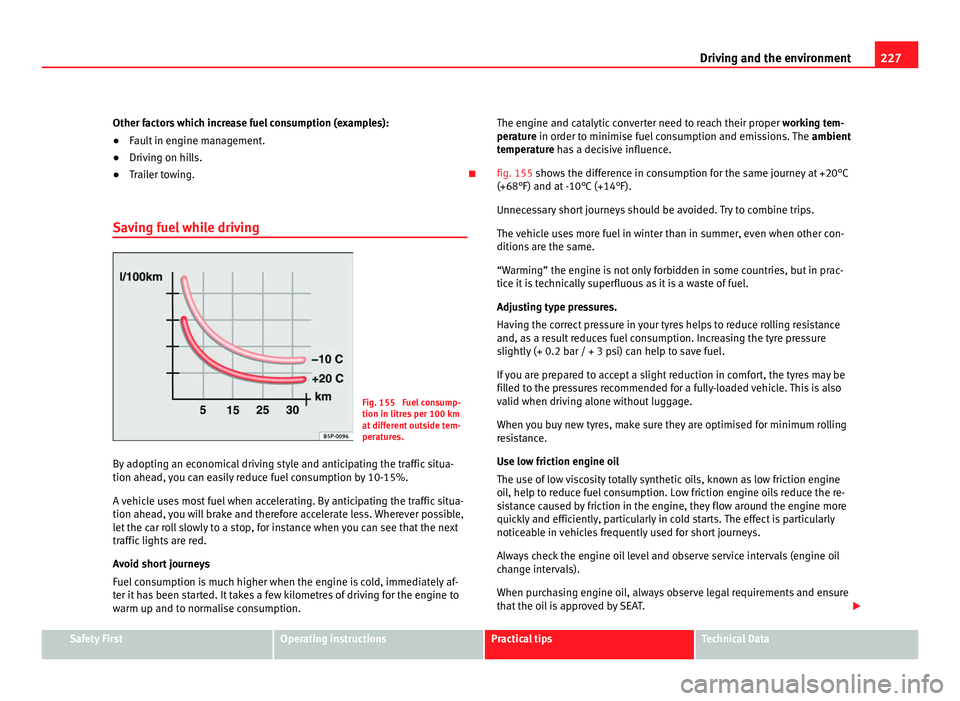
Saving fuel while driving Fig. 155 Fuel consump-
tion in litre
s
per 100 km
at different outside tem-
peratures.
By adopting an economical driving style and anticipating the traffic situa-
tion ahead,
you can easily reduce fuel consumption by 10-15%.
A vehicle uses most fuel when accelerating. By anticipating the traffic situa-
tion ahead, you will brake and therefore accelerate less. Wherever possible,
let the car roll slowly to a stop, for instance when you can see that the next
traffic lights are red.
Avoid short journeys
Fuel consumption is much higher when the engine is cold, immediately af-
ter it has been started. It takes a few kilometres of driving for the engine to
warm up and to normalise consumption. The engine and catalytic converter need to reach their proper
workin
g tem-
perature in order to minimise fuel consumption and emissions. The ambient
temperature has a decisive influence.
fig. 155 shows the difference in consumption for the same journey at +20°C
(+68°F) and at -10°C (+14°F).
Unnecessary short journeys should be avoided. Try to combine trips.
The vehicle uses more fuel in winter than in summer, even when other con-
ditions are the same.
“Warming” the engine is not only forbidden in some countries, but in prac-
tice it is technically superfluous as it is a waste of fuel.
Adjusting type pressures.
Having the correct pressure in your tyres helps to reduce rolling resistance
and, as a result reduces fuel consumption. Increasing the tyre pressure
slightly (+ 0.2 bar / + 3 psi) can help to save fuel.
If you are prepared to accept a slight reduction in comfort, the tyres may be
filled to the pressures recommended for a fully-loaded vehicle. This is also
valid when driving alone without luggage.
When you buy new tyres, make sure they are optimised for minimum rolling
resistance.
Use low friction engine oil
The use of low viscosity totally synthetic oils, known as low friction engine
oil, help to reduce fuel consumption. Low friction engine oils reduce the re-
sistance caused by friction in the engine, they flow around the engine more
quickly and efficiently, particularly in cold starts. The effect is particularly
noticeable in vehicles frequently used for short journeys.
Always check the engine oil level and observe service intervals (engine oil
change intervals).
When purchasing engine oil, always observe legal requirements and ensure
that the oil is approved by SEAT. Safety First Operating instructions Practical tips Technical Data
Page 230 of 385
228
Driving and the environment
Avoid carrying unnecessary loads
The lighter the v
ehicle, the more economical and ecological the driving
style. For example, an additional weight of 100 kg will increase fuel con-
sumption up to 0.3 l/100 km.
Remove any unnecessary objects or loads from the vehicle.
Remove optional equipment and unnecessary accessories
The more aerodynamic the vehicle, the lower the fuel consumption. Option-
al equipment and accessories (such as roof racks or bike carriers) reduce
the aerodynamic benefits of the vehicle.
Therefore, we recommend you remove all optional and unnecessary equip-
ment and racks, especially if you intend to drive at high speeds.
Engine management and exhaust gas
purification sy
stem
Introduction Additional information and warnings:
●
Changing gear ⇒ p ag
e 174
● Refuelling ⇒ pag
e 264
● Fuel ⇒ page 267
● En
gine oil ⇒ pag
e 279
● Vehicle battery ⇒ pag
e 288
● Information stored in the control units ⇒ pag
e 257
● Tow-starting and towing away ⇒ pag
e 340 WARNING
The components of the exhaust system reach very high temperatures.
This c
ould cause a fire.
● Always park your vehicle so that no part of the exhaust system can
come in cont
act with flammable materials (such as dried grass).
● Do not apply additional underseal or anti-corrosion coatings to the
exhau
st pipes, catalytic converter, heat shields or the diesel particulate
filter.
Warning lamps lights up Possible cause Solution
Fault in engine management
(Electr
onic
Power Control). Take the vehicle to a Technical
Serv
ic
e as soon as possible and
have the engine checked. Pre-heating a diesel engine
befor
e s
tarting the engine. ⇒ page 170
Fault in catalytic converter. You should reduce speed ac-
cor
din
gly. Drive carefully until
you reach the next qualified
workshop. Have the engine
checked there. Diesel particulate filter
bloc
k
ed Drive for 15 minutes in 4th gear
(manual
g
earbox), or in D (auto-
matic gearbox) at a minimum
speed of 70 km/h (45 mph).
Observe speed limits ⇒ .
If the w arnin
g lamp remains lit
up, take the vehicle to a Techni-
cal Service ⇒ page 229.
Page 231 of 385
229
Driving and the environment flashes Possible cause Solution
Fault in the engine manage-
ment (die
sel
engines). Take the vehicle to a Technical
Serv
ic
e as soon as possible and
have the engine checked. Combustion fault which could
dam
ag
e the catalytic convert-
er. You should reduce speed ac-
cor
din
gly. Drive carefully until
you reach the next qualified
workshop. Have the engine
checked there. Several warning and control lamps should light up for a few seconds when
the ignition is
sw
itched. This signals that the lamp is working properly. They
will switch off after a few seconds. WARNING
Observe traffic regulations when cleaning the diesel particulate filter
whil e driv
ing.
● Only carry on driving if visibility, weather, road and traffic conditions
so permit.
● Never end
anger your safety or that of other road users. CAUTION
Always pay attention to any lit lamps and to the corresponding descriptions
and ins truction
s to avoid damage to the vehicle. Note
While the control lamps , or r
emain lit, there may be engine prob-
lems, fuel consumption may be greater and the engine may lose power. Catalytic converter The catalytic converter permits the subsequent treatment of the exhaust
ga
se
s thus reducing contaminating gas emissions. To ensure a longer work-
ing life for the exhaust system and catalytic converter in a petrol engine:
● Always use unleaded petrol.
● Never run the tank completely dry.
● Do not top up with too much engine oil ⇒ page 279.
● Do not
tow-start the vehicle; use the starter cables ⇒ page 337.
If
you should notice misfiring, uneven running or loss of power when the car
is moving, reduce speed immediately. Have the car inspected by a Technical
Service. If this happens, unburnt fuel can enter the exhaust system and es-
cape into the atmosphere. The catalytic converter can also be damaged by
overheating. For the sake of the environment
Even when the emission control system is working perfectly, there may be a
smell of
sulphur from the exhaust gas under some conditions. This depends
on the sulphur content of the fuel being used.
Diesel particulate filter The diesel particulate filter removes soot particulates from the exhaust gas.
The filt
er r
etains these particulates and burns them. To assist the combus-
tion process, SEAT recommends you avoid frequent short trips.
● Always use diesel with a low sulphur content ⇒ page 267.
● Nev
er use petrol or fuel oil.
● Never use biodiesel. However, a blend prepared by the diesel manufac-
turer c
ontaining biodiesel within the limits established by the EN 590
standard may be used ⇒ page 267. Safety First Operating instructions Practical tips Technical Data
Page 232 of 385
230
Driving and the environment
●Never run the tank completely dry.
● Do not t
op up with too much engine oil ⇒ page 279.
● Do not
tow-start the vehicle; use the starter cables ⇒ page 337.
In or
der to reduce blocking of the diesel particulate filter, some vehicles
with an automatic gearbox may increase the engine speed slightly to auto-
matically start cleaning the diesel particulate filter. The warning lamp will
not light up in this case .For the sake of the environment
Even when the emission control system is working perfectly, there may be a
smell of
sulphur from the exhaust gas under some conditions. This depends
on the sulphur content of the fuel being used.
Page 244 of 385
242
Vehicle maintenance and cleaning
Vehicle maintenance and cleaning
Care and cleaning the vehicle exterior
Introduction Regular maintenance and washing help to maint
ain the value of the vehicle.
This may also be one of the requirements for acknowledging warranty
claims in the event of bodywork corrosion or paint defects.
Products suitable for the care of your vehicle are available at any Technical
Service.
Additional information and warnings:
● Care and cleaning of the vehicle interior ⇒ page 249
● W
orking in the engine compartment ⇒ page 275
● A
ccessories, parts replacement, repairs and modifications ⇒ page 257WARNING
Car care products may be toxic and hazardous. If car care products are
not s uit
able or are used inappropriately, this could result in accident, se-
rious injury, burns or intoxication.
● Car care products must always be stored in the original container
which shoul
d be kept closed.
● Observe information provided by the manufacturer.
● To prevent confusion, never store car care products in empty food
cans, bottl
es or other containers.
● Keep all care products out of reach of children. WARNING (Continued)
● Harmf ul vapours may be produced when using car care products.
Ther ef
ore, care products should only be used in well-ventilated spaces or
in the open air.
● Never use fuel, turpentine, engine oil, acetone or any other volatile
liquid to w
ash, clean or care for the vehicle. These are toxic and highly
flammable. WARNING
Inappropriate care and cleaning of vehicle components may effect the ve-
hicl e s
afety equipment, increasing the risk of severe injury.
● Vehicle components should only be cleaned and maintained in ac-
cord
ance with the manufacturer's instructions.
● Only use approved or recommended care products. CAUTION
Cleaning products which contain solvents will damage the material. For the sake of the environment
● Only wash the vehicle in areas allocated for this purpose, to prevent
dir ty
water which may be contaminated by oil, grease or fuel, from entering
the drains. In some districts, washing vehicles outside wash bays is prohibi-
ted.
● Where possible, always use products which respect the environment.
● The remains of car care products should not be disposed of with ordina-
ry hou
sehold waste. Observe information provided by the manufacturer.
Page 245 of 385
243
Vehicle maintenance and cleaning
Washing the vehicle The longer substances such as insects, bird droppings, resinous tree sap,
ro
a
d dirt, industrial deposits, tar, soot or road salt and other aggressive ma-
terials remain on the vehicle, the more damage they do to the paintwork.
High temperatures (for instance due to strong sunlight) further intensify the
corrosive effect. The vehicle undercarriage should also be thoroughly wash-
ed at regular intervals.
Automatic car washes
Always observe the instructions provided at the automatic car wash. The
standard precautionary measures prior to entering the car wash should be
taken to avoid damage to the vehicle (close all windows, fold in exterior mir-
rors). If the vehicle is fitted with additional components (spoiler, roof-rack,
aerial...), check with the car wash supervisor whether these can enter the
car wash ⇒ .
The v ehic
le paintwork is so durable that the car can normally be washed
without problems in an automatic car washing tunnel. However, wear and
damage to the paintwork will depend on the type of car wash used. SEAT
recommends the use of car washed without brushes.
To remove traces of wax on windows and to prevent wiper blades from
scratching, please observe the following ⇒ page 245, Cleaning windows
and exterior mirrors.
Washing the car by hand
When washing the car by hand, use plenty of water to soften the dirt first,
and rinse off as well as possible.
Then clean the vehicle with a soft sponge, glove or brush using only slight
pressure. Start at the roof and work downwards. Special car shampoo
should only be used for very persistent dirt.
Rinse the sponge or glove thoroughly and often.
Wheels, sills and similar should be cleaned last. Use a second sponge for
this. WARNING
Sharp components on the vehicle may cause injury.
● Protect arms and hands from sharp edges when cleaning the vehicle
under c
arriage or the interior of the wheel hubs. WARNING
After the vehicle has been washed, the braking effect will be reduced
(and the brakin
g distance increased) due to moisture (and ice in winter)
on the brakes.
● Dry the brakes and remove ice by braking carefully. Ensure that you
are not end
angering other road-users or breaking traffic regulations in
the process. CAUTION
● The temperature of the water must not exceed +60°C (+140°F).
● To av
oid damage to the paintwork, do not wash the vehicle in full sun.
● Do not use rough sponges or similar which could damage the surface to
cle
an away the traces of insects.
● Never wipe the headlights with a dry cloth or sponge, always moisten
first
. It is best to use soapy water.
● Washing the vehicle in low temperatures: When washing the vehicle
with a hose, do not
direct water into the lock cylinders or the gaps around
the doors, tailgate, or sunroof. Locks and seals could freeze! CAUTION
To prevent damage to the vehicle, please observe the following before en-
terin g
an automatic car wash :
● Compare the distance between the vehicle wheels and the distance be-
tween the guide-rai
ls of the car wash to prevent damage to the wheels and
tyres! Safety First Operating instructions Practical tips Technical Data
Page 247 of 385
245
Vehicle maintenance and cleaning
Cleaning windows and exterior mirrors Cleaning windows and exterior mirrors
Spr
a
y windows and exterior windows with a standard window cleaner con-
taining alcohol.
Dry the windows with a clean chamois leather or a lint-free cloth. The cha-
mois leathers used on painted surfaces are not suitable for cleaning win-
dows because they are soiled with wax deposits which could smear the win-
dows.
Use window cleaner or a silicone remover to clean rubber, oil, grease and
silicone deposits off ⇒ .
Remo v
ing wax deposits
Automatic car washes and certain car care products may leave wax deposits
on the windows. These deposits can only be removed with a special product
or cleaning cloths. Wax deposits on the windscreen could cause the wiper
blades to judder. SEAT recommends you wipe the wax deposits off the wind-
screen with a soft cloth each time after you have washed the vehicle.
A window cleaning detergent which helps to dissolve the wax may be added
to the windscreen washer fluid to prevent the wiper blades from scratching
the windscreen. Please ensure the you add the cleaning product in the cor-
rect proportions. Products for removing grease do not eliminate the wax de-
posits ⇒ .
Spec i
al cleaning products or window cloths are available at any Technical
Service. To remove wax deposits, SEAT recommends the following products:
● For the hottest time of the year: the window cleaner for summer
use G 052 184 A1. Propor
tion 1:100 (1 part detergent, 100 parts water) in
the windscreen washer bottle.
● All year round: the window cleaner G 052 164 A2; proportion 1:2 in
winds
creen washer bottle (1 part concentrate, 2 parts water) in winter, up to
-18°C (-0.4°F), or 1:4, during the rest of the year.
● Window cloths G 052 522 A1 for all windows and exterior mirrors. Removing snow
Use a smal
l brush to remove snow from the windows and exterior mirrors.
Removing ice
If possible, use a de-icing spray to remove ice. If you use an ice scraper,
push it in one direction only without swinging it. If you pull the scraper
backwards, the dirt may scratch the window. WARNING
Dirty or misted windows reduce visibility in all directions and increase
the risk of
accident and serious injury.
● Do not drive unless you have good visibility through all windows!
● Remove ice and snow from the windows and demist inside and out. CAUTION
● Never mix our cleaning products with other products not recommended
b y
SEAT in the windscreen washer bottle. This could lead to flocculation and
may block the windscreen washer jets.
● Do not use hot or warm water to remove ice or snow from the windows
and exterior mirr
ors. The glass could crack!
● The heating element for the rear window is located on the inner side of
the window
. Do not stick adhesive labels over the heating elements and
never clean the inside of the rear window with corrosive or acid products or
other similar chemical cleaning products.
● Aerials on the inside of windows may be damaged if knocked or if
cle
aned with corrosive or acid cleaning products. Do not stick adhesive la-
bels over the heating elements and never clean the inside of the rear win-
dow with corrosive or acid products or other similar chemical cleaning prod-
ucts. Safety First Operating instructions Practical tips Technical Data
Page 251 of 385
249
Vehicle maintenance and cleaning WARNING
Additional underseal or anti-corrosion products could catch fire due to
the high temper at
ures reached by the exhaust gas system and other en-
gine components.
● Do not apply additional underseal or anti-corrosion products to the
exhau
st pipes, catalytic converters, heat shields or other parts of the ve-
hicle which reach high temperatures.
Cleaning the engine compartment The engine compartment of any motor vehicle is a potentially hazardous
are
a
⇒ page 275.
The engine compartment should only be cleaned by qualified personnel. If
it is not correctly cleaned, the anti-corrosion coating and consequently elec-
trical components may be damaged. Moreover, water may filter directly into
the vehicle interior through the water chamber ⇒ .
If the en gine c
ompartment is very dirty, always take the vehicle to a Techni-
cal Service for professional cleaning. SEAT recommends visiting a Technical
Service.
Water box
The water box is in the engine compartment, between the windscreen and
the engine, and beneath a perforated cover. Air is taken in through the wa-
ter box from outside to the vehicle interior via the heating and air condition-
ing system.
Leaves and other loose objects should be regularly cleaned away from the
water box either by hand or with a vacuum. WARNING
When working on the engine or in the engine compartment, there is a
risk of
injury, burns, accident or fire.
● Before starting work, please ensure you are familiar with the required
procedur
e and the safety precautions ⇒ page 275.
● SEAT recommends you have this work performed by a qualified deal-
ership. CAUTION
If water is manually poured into the water box (for example, using a high
pre s
sure cleaning appliance), this could cause significant damage to the ve-
hicle. For the sake of the environment
Only wash the engine compartment in areas allocated for this purpose, to
prev ent
dirty water which may be contaminated by oil, grease or fuel, from
entering the drains. In some districts, the engine compartment may not be
washed outside the wash bays provided for this purpose.
Caring for and cleaning the vehicle interior Introduction The dye from many items of modern clothing (e.g. dark jeans) is not always
solid enough.
Se
at upholstery (material and leather), especially when light-
coloured, may visibly discolour if the dye comes out of clothing (even when
used correctly). This is not an upholstery defect but indicates that the dye in
the item of clothing is not solid enough. Safety First Operating instructions Practical tips Technical Data