oil Seat Alhambra 2011 Owner's Guide
[x] Cancel search | Manufacturer: SEAT, Model Year: 2011, Model line: Alhambra, Model: Seat Alhambra 2011Pages: 385, PDF Size: 7.92 MB
Page 252 of 385
250
Vehicle maintenance and cleaning
Additional information and warnings:
● Caring for and cleaning the vehicle exterior ⇒ page 242
● A
ccessories, parts replacement, repairs and modifications ⇒ page 257WARNING
Car care products may be toxic and hazardous. If car care products are
not s uit
able or are used inappropriately, this could result in accident, se-
rious injury, burns or intoxication.
● Car care products must always be stored in the original container
which shoul
d be kept closed.
● Observe information provided by the manufacturer.
● To prevent confusion, never store car care products in empty food
cans, bottl
es or other containers.
● Keep all care products out of reach of children.
● Harmful vapours may be produced when using car care products.
Therefor
e, care products should only be used in well-ventilated spaces or
in the open air.
● Never use fuel, turpentine, engine oil, acetone or any other volatile
liquid to w
ash, clean or care for the vehicle. These are toxic and highly
flammable. WARNING
Inappropriate care and cleaning of vehicle components may effect the ve-
hicl e s
afety equipment, increasing the risk of severe injury.
● Vehicle components should only be cleaned and maintained in ac-
cord
ance with the manufacturer's instructions.
● Only use approved or recommended care products. CAUTION
● Cleaning products which contain solvents will damage the material.
● To av
oid damage, stubborn stains should be removed by a specialist
cle
aning company. Note
Suitable car care products are available from your Technical Service.
Treating your upholstery Check list
For inf
orm
ation on how to treat and care for the vehicle upholstery, please
bear the following in mind ⇒ :
● Before entering the vehicle, fasten all Velcro fastenings which could
come int o c
ontact with upholstery and coverings. If the Velcro fastenings on
upholstery and material covers are not securely fastened, this could dam-
age them.
● To prevent damage, do not allow the upholstery or covers to come into
contact
with sharp or decorative objects. Decorative objects such as zips,
rivets and rhinestones on clothing and belts.
● Dust and grit in the pores and seams should be removed regularly to
prevent
them scratching and damaging the surface.
● Always check that the dyes used in clothing are fast to prevent them
from st
aining the upholstery. This is particularly true for clear-coloured up-
holstery.
Page 253 of 385
251
Vehicle maintenance and cleaning CAUTION
Failure to observe the instructions in the check list for caring for your up-
hol s
tery could result in damage or discolouration of the upholstery and cov-
ers.
● Always follow the check list and perform the necessary operations. Note
SEAT recommends you take the vehicle to a Technical Service to treat any
stain
s on the upholstery caused by the discolouration of clothing.
Cleaning upholstery, textile covers and Alcantara ®
mat eri
alNormal cleaning
●
Before applying cleaning products, please read the instructions for han-
dling and the w arnin
gs shown on the container.
● The upholstery, textile covers, Alcantara ®
materi
al and mats should be
regularly vacuumed (with vacuum brush).
● We recommend that you use a soft sponge or lint-free, micro-fibre cloth
for normal
cleaning ⇒ .
● Clean Alcantara ®
sur f
aces with a damp lint-free cotton, wool or micro-
fibre cloth used for normal cleaning ⇒ .
General s
uperficial dirt on upholstery and textile covers can be cleaned with
a normal foam cleaning product.
If the upholstery and the material trims are very dirty, we recommend you
have them cleaned by a specialist cleaning form.
Cleaning stains
It may be necessary to clean the whole surface and not only the stain itself.
Especially if the surface has been dirtied through normal use. Otherwise, the stained area may become lighter than the rest of the surface after treat-
ment. Type of stain Cleaning the vehicle
Water-based stains
,
e.g. c off
ee or fruit
juice.
Use a sponge and wipe with a solution of water
and w oo
l wash.
Dry the area gently with a soft dry cloth. Persistent stains
,
e.g. c hoc
olate or
make-up.
Apply cleaning paste a)
dir ectly to the stain and
treat.
Next, rinse with clean water using a sponge or
damp cloth to remove the cleaning product deposits.
Carefully dry the area with an absorbent dry cloth. Grease-based
st
ain
s, e.g. oil or lip-
stick.
Apply a neutral soap or cleaning paste a)
and tr e at
the stain.
Apply absorbent material to loose colorants or par-
ticles of grease.
Then rinse the area with clean water. Take care not
to soak the upholstery. a)
Bile soap can be used as a cleaning paste. CAUTION
● Brushes should only be used to clean the mats and floor mat! Other sur-
f ac
es may be damaged if a brush is used.
● Do not use steam cleaning equipment, as the dirt becomes more incrus-
ted in the mat
erial when steam is applied.
● Alcantara ®
uphols
teries should never be soaked.
● Do not use leather cleaning products, solvents, wax polish, shoe cream,
spot r
emovers or similar products on Alcantara ®
.
● Never use brushes for cleaning damp material as they could damage the
surf
ace.
● Do not use steam cleaning equipment, as the dirt becomes more incrus-
ted in the mat
erial when steam is applied. Safety First Operating instructions Practical tips Technical Data
Page 254 of 385
252
Vehicle maintenance and cleaning
Cleaning and care of real leather upholstery In the event of query regarding the care or cleaning of the leather in your
vehic
l
e, please ask a Technical Service or specialised workshop.
Cleaning and care
Untreated Nappa is delicate as it is not covered with a layer of colour.
● Use a suitable impregnating cream with ultra-violet protection at regular
interv
als and after cleaning. This cream will nourish and moisturise the
leather, keep it supple and able to breathe. It will also form a protective
film.
● Clean the leather every two to three months and remove fresh dirt as
neces
sary.
● Leather should be treated every six months with a suitable leather care
product ⇒
.
● When using care and cleaning products, only apply the minimum re-
quired quantitie s.
● R
emove stains from fresh ball-pen and other inks, lipstick, shoe cream
and simil
ar stains as soon as possible.
● Caring for coloured leather. A special coloured cream will renew the col-
our of the le
ather when required and will eliminate differences in colour.
● Then wipe off with a soft, dry cloth.
Cle
aning the vehicle
SEAT recommends the use of a damp cotton or wool cloth for general clean-
ing.
Do not let the water soak through the leather or soak into the seams. Type of stain Cleaning the vehicle
More stubborn dirt
Apply a mild soap and water solution a)
u s
ing a
cloth. (Squeeze out the cloth well before applica-
tion).
Carefully dry the area with an absorbent dry cloth. Water-based stains
,
e.g. c off
ee, tea, fruit
juice, blood, etc.
Remove fresh stains with an absorbent cloth.
U se a s
uitable cleaning product to treat dried-in
stains ⇒ .
Grease-based
st
ain
s, e.g. oil or lip-
stick, etc.
Remove fresh stains with an absorbent cloth.
U se a s
uitable cleaning product if the stain has not
yet penetrated the surface ⇒ .
Tr e
at dry stains with a grease-removal spray ⇒ .
Dry
difficult stains ,
e. g. ink, f
elt-tip pen,
nail varnish, pig-
ment dispersions or
shoe polish.
Carefully dry the area with an absorbent dry cloth.
C l
ean using a special stain remover suitable for
use on leather. a)
Mild soap and water solution: two table spoons of neutral soap per litre of water. CAUTION
● On no acc ou
nt use solvents, wax polish, shoe cream, spot removers or
similar materials.
● In the event of spilt liquids, dry immediately with an absorbent cloth to
prevent
the liquid penetrating through the leather. CAUTION
If the car is left standing in the sun for long periods, the leather should be
prot ect
ed against direct sunlight to prevent it from fading. Note
However, slight colour variations will arise in normal use.
Page 260 of 385
258
Accessories, parts replacement and modifications
Fluids and consumables All vehicle fluids and consumables
, such a s notched belts, tyres, coolant
fluids, engine oils, spark plugs and batteries are continually being devel-
oped. Therefore all fluids and consumables should be changed at a Techni-
cal Service. Qualified workshops are permanently informed of any modifica-
tions. WARNING
The incorrect use or handling of fluids or consumables may result in acci-
dent, serious injur
y, burns or intoxication.
● Therefore, fluids must always be stored closed in their original con-
tainer.
● Nev
er store fluids in empty food containers or bottles as other people
may
accidentally drink the fluid.
● Keep all fluids and consumables out of reach of children.
● Read and observe the information and warnings given on the fluid
container
s.
● Only work in the open air or in well-ventilated zones, when using
products
which give off harmful vapours.
● Never use fuel, turpentine, engine oil, acetone or any other volatile
liquid in the maint
enance of the vehicle. These are toxic and highly flam-
mable. They could lead to fire or explosions! CAUTION
● Only use appropriate fluids. Never mix the fluids. Failure to observe this
point w
ill result in serious malfunctions and engine damage!
● Accessories and other components mounted in front of the air inlet re-
duce the coo
ling effect of the coolant. If the engine is running under great
strain in high outside temperatures, it could overheat. For the sake of the environment
Leaking fluids could pollute the environment. Collect any spilt fluids in suit-
abl e c
ontainers and dispose of in accordance with legislation and with re-
spect for the environment.
Repairs and technical changes When performing repairs and technical modifications, SEAT's directives
mus
t
be observed! ⇒ Unauthorised modifications to the electronic components or software in the
vehic
l
e may cause malfunctions. Due to the way the electronic components
are linked together in networks, other indirect systems may be affected by
the faults. This may significantly affect the vehicle's performance, increase
component wear and could mean that the vehicle registration documents
are no longer valid.
Your Technical Service cannot be held liable for any damage caused by tech-
nical modifications or repairs performed incorrectly.
The Technical Service does not accept liability for damage resulting from
technical modifications or repairs performed incorrectly; neither is the SEAT
warranty valid in these cases.
SEAT recommends you have any technical modifications or repairs per-
formed at a SEAT authorised service and that you use genuine SEAT spare
parts ®
.
Vehicles with special accessories and equipment
The manufacturers of additional equipment guarantee that the equipment
complies with applicable laws and regulations with respect to the environ-
ment, in particular Directives 2000/53/CE and 2003/11/CE. The first direc-
tive governs the disposal of end-of-life vehicles while the second refers to
the restrictions on the marketing and use of certain dangerous substances
and preparations.
Page 265 of 385
263
Accessories, parts replacement and modifications
The vehicle should not be lifted using lifting platforms with lift pads con-
tainin g fluid.
When r
aising a vehicle using a platform or jack, a series of precautionary
measures are required. Never raise the vehicle with a lifting platform or jack
unless you have received training in how to do so and know how to lift the
vehicle safely.
Notes on raising the vehicle with a jack ⇒ page 309. WARNING
The improper use of the lifting platform or the jack when raising the vehi-
cl e m
ay result in accidents or serious injury.
● Before raising the vehicle, please observe the manufacturer's instruc-
tions f
or the platform or jack, and the legal requirements, where applica-
ble.
● There should not be anyone inside the vehicle when it is being raised
or once it i
s in the air.
● Only use the jacking points indicated in the figures ⇒ fig. 160
and
⇒ fig. 161 when raising the vehicle. If the vehicle is not lifted at the indi-
cated points, it may fall from the platform while the engine or gearbox is
being dismounted, for example.
● The jacking points should be centrally aligned and firmly positioned
on the platf
orm support plates.
● Never start the engine when the vehicle is raised! The vehicle may fall
from the pl
atform due to the engine vibrations.
● If it is necessary to work underneath the vehicle while it is raised, you
should c
heck that the supporting stands have an adequate load capacity.
● Never climb onto the lifting platform.
● Always make sure that the weight of the vehicle does not exceed the
lifting p
latform load capacity. CAUTION
● Never raise the vehicle at the engine oil sump, the gearbox or the rear or
fr ont
axles.
● Always use an intermediat
e rubber support to prevent damage to the
vehicle underbody. Check that the arms of the lifting platform are able to
move with obstruction.
● The arms should not come into contact with the side running boards or
other parts
of the vehicle. Safety First Operating instructions Practical tips Technical Data
Page 267 of 385
265
Checking and refilling levels WARNING (Continued)
– If you are using a metal fuel canister, the nozzle must always touch
the c ani
s
ter while it is being filled to avoid static electricity.
– Follow the legal requirements for the use, storage and transport of
spar
e fuel canisters.
– Insure that the fuel container complies with manufacturing stand-
ards, f
or example, ANSI or ASTM F852-86. CAUTION
● Always remove any fuel spilled on the vehicle paintwork immediately to
av oid d
amage to the wheel housing, the tyre and vehicle paintwork.
● Refuelling a petrol engine with diesel or a diesel engine with petrol can
cause seriou
s engine and fuel system damage; the resulting malfunctions
are not covered by the SEAT warranty. If you refuel with the wrong type of
fuel, never start the engine. This applies to even the smallest amount of the
wrong fuel. You should obtain professional assistance. With the engine run-
ning, the composition of the wrong fuel could significantly damage the fuel
system and the engine itself.
● In vehicles with a diesel engine, under no cir
cumstances should you re-
fuel or drive with petrol, kerosene, heating oil or any other type of different
fuel. Other types of fuels could cause serious damage to the engine and to
the fuel supply system and the resulting problems are not covered by the
SEAT warranty. For the sake of the environment
Fuels can contaminate the environment. Collect any spilt service fluids and
allo w a pr
ofessional to dispose of them. Note
There is no emergency mechanism for the manual release of the tank flap. If
nece s
sary, request assistance from specialised personnel. Control lamps and fuel gauge
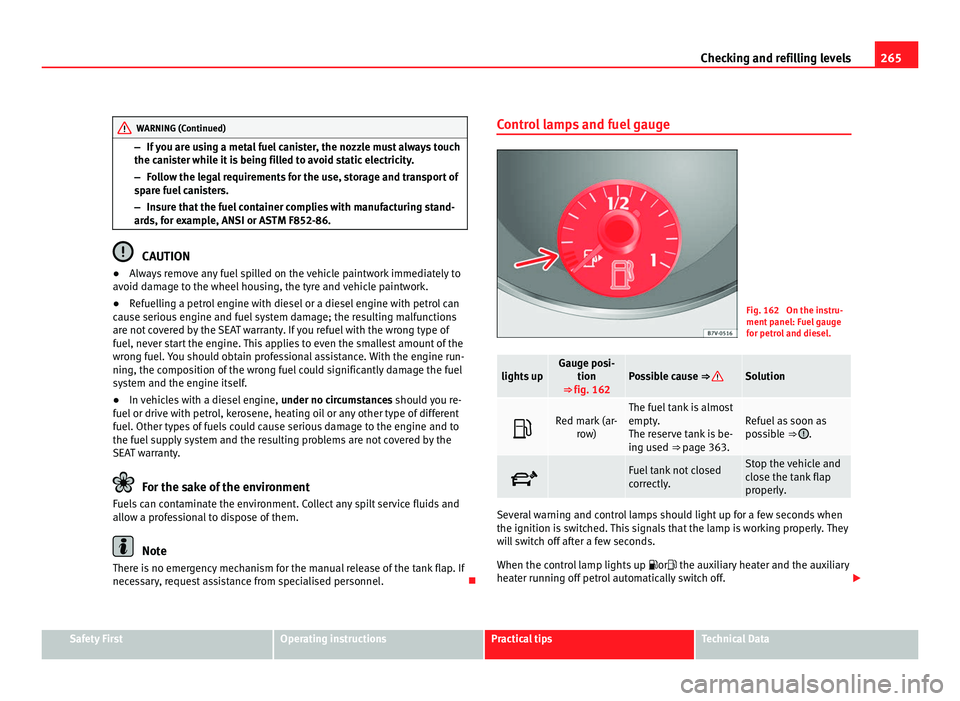
Fig. 162 On the instru-
ment p
anel: F
uel gauge
for petrol and diesel. lights up Gauge posi-
tion
⇒ fig. 162 Possible cause ⇒ Solution
Red mark (ar-
row) The fuel tank is almost
empty.
The r
e
serve tank is be-
ing used ⇒ page 363. Refuel as soon as
pos
s
ible ⇒ .
Fuel tank not closed
corr
ectly
. Stop the vehicle and
clo
se the t
ank flap
properly. Several warning and control lamps should light up for a few seconds when
the ignition is
sw
itched. This signals that the lamp is working properly. They
will switch off after a few seconds.
When the control lamp lights up or the auxiliary heater and the auxiliary
heater running off petrol automatically switch off. Safety First Operating instructions Practical tips Technical Data
Page 269 of 385
267
Checking and refilling levels
Closing the tank cap
● Screw on the tank cap clockwise until it you hear it click into position.
● Press the tank flap until you hear it click into place. The tank flap must
be flush w ith the body
contour. WARNING
Do not continue refilling once the fuel nozzle has switched itself off. The
fuel t
ank may be filled too much. As a result, fuel may spurt out and spill.
This could lead to a fire, explosion and severe injuries. CAUTION
● Always remove any fuel spilled on the vehicle paintwork immediately to
av oid d
amage to the wheel housing, the tyre and vehicle paintwork. For the sake of the environment
Spilt fuel can contaminate the environment.
Refilling precautions Information on bulb replacement
⇒ pag
e 326.
Checklist
Never work on the engine or in the engine compartment if you are not famil-
iar with the operations to be carried out, the applicable safety standards
and especially if you do not have the instruments, liquids and tools neces-
sary ⇒ page 275, Working in the engine compartment! Have the work car-
ried out by a Technical Service if you are uncertain. Check the following reg-
ularly, preferably when you refuel:
● Windscreen washer fluid level ⇒ pag
e 105
● Engine oil level ⇒ pag
e 279 ●
Engine coolant level ⇒ p
age 283
● Brake fluid level ⇒ pag
e 183
● Tyre pressure ⇒ pag
e 293
● Vehicle lighting required to guarantee road safety:
Indicator
s
Side lights, dipped headlights and full beam headlights
Rear lights
Brake lights
Rear fog light ⇒ page 97 WARNING
Not following the checklist prepared for your own safety could lead to ac-
cident s
and severe injuries.
● Always follow the check list and perform the necessary operations.
Fuel Introduction You will find a factory-fitted sticker containing information on the type of
fuel
f
or your vehicle on the inside of the fuel tank flap.
Additional information and warnings:
● ⇒ Bookl et Maintenance Programme
● R
efuelling ⇒ pag e 264
● En
gine and exhaust system management ⇒ page 228
–
–
–
–
–
Safety First Operating instructions Practical tips Technical Data
Page 272 of 385
270
Checking and refilling levels CAUTION
● The vehicle is not pr epared for the use of biodiesel. Under no circum-
stances should this fuel be used. It could damage the fuel system and sub-
sequently lead to engine faults!
● The addition of biodiesel to diesel by the diesel producer according to
Standar
d EN 590 or other equivalent (DIN 51628 in Germany, for example)
is authorised and causes no type of damage to the engine or the fuel
system.
● The diesel engine has been designed for to use diesel fuel exclusively.
Therefor
e, never use petrol, fuel oil or other unsuitable fuels. The composi-
tion of these fuels may significantly damage the fuel system and the en-
gine.
● The use of diesel fuels with a high sulphur percentage could considera-
bly r
educe the service life of the diesel particulate filter. Your qualified work-
shop will be able to tell you which countries have diesel with a high sulphur
content.
Information on fuel consumption The consumption and emission values indicated do not refer to one specific
vehic
l
e. They are only to be used to compare the values of the different ve-
hicle versions. The fuel consumption and CO 2 emissions of a vehicle not on-
ly depend on the effective use of fuel. They also depend on your driving
style and other non-technical factors.
Calculating fuel consumption
Fuel consumption and emission values are determined according to the cur-
rent version of the 715/2007/EC or 80/1268/EEC regulation and are valid
for the vehicle kerb weight. The specifications do not refer to an individual
vehicle. Two measuring cycles are carried out on a rolling road test bed. The
test criteria are as follows: Urban cycle Measurement of the urban cycle starts with an engine cold
st
ar
t. City driving is then simulated at between 0 and 50 km/
h. Road cycle In the road cycle simulation, the car undergoes frequent ac-
cel
er
ation and braking in all gears, as in normal everyday
driving. The road speed ranges from 0 to 120 km/h. Combined The average combined consumption is calculated with a
weightin
g of
around 37 % for the urban cycle and 63 % for
the road cycle. CO
2 emis-
s ion
s of the
combination The exhaust gases are collected during both driving cycles
to c
alc
ulate carbon dioxide emissions (urban and road). The
gas composition is then analysed to evaluate the CO 2 con-
tent and other emissions. Note
● The kerb weight may vary according to the vehicle equipment. This
c ou
ld raise consumption and the CO 2 emissions slightly.
● In practice, consumption values could be different to the values calcula-
ted ba
sed on the 715/2007/EC or 80/1268/EEC regulations.
Page 277 of 385
275
Checking and refilling levels
Working in the engine compartment Introduction Before working in the engine compartment, make sure that the vehicle is
park
ed on horiz
ontal and firm ground.
The engine compartment of the vehicle is a hazardous area. Never work on
the engine or in the engine compartment if you are not familiar with the op-
erations to be carried out, the applicable safety standards and especially if
you do not have the instruments, liquids and tools necessary ⇒ ! Have
the work c
arried out by a Technical Service if you are uncertain. Negligent
work can cause serious injury.
Additional information and warnings:
● Windscreen wash system ⇒ page 105
● St
art and stop the engine ⇒ page 170
● Br
ake fluid ⇒ page 183
● V
ehicle battery ⇒ page 288
● Chec
ks when filling up ⇒ page 264
● En
gine oil ⇒ page 279
● En
gine coolant ⇒ page 283
● A
ccessories, parts replacement, repairs and modifications ⇒ page 257 WARNING
If the vehicle moves unexpectedly, this could cause serious injury.
● Never work underneath the vehicle if it is not secured against moving.
If y
ou must work underneath the vehicle with the wheels in contact with
the ground then it should be parked on flat ground, the wheels should be
prevented from moving and the key must be removed from the ignition.
● If you have to work underneath the vehicle, you must use suitable
stand
s additionally to support the vehicle, there is a risk of accident!.
The jack is not intended for this kind of work and its failure could lead to
severe injuries. WARNING
The engine compartment is a dangerous area capable of causing serious
injury .
● F
or all type of work, always take the utmost precautions, work care-
ful
ly and note the general safety standards in force. Never take personal
risks.
● Never work on the engine or in the engine compartment if you are not
famili
ar with the necessary operations. If you are not sure about proce-
dures then visit a Technical Service to carry out the necessary work. In-
correct work can cause serious injuries.
● Never open the bonnet if you see steam or coolant escaping from the
engine comp
artment. Hot vapours and coolant can cause serious burns.
Always wait until you cannot see or hear the sound of steam or coolant
coming from the engine compartment.
● Always allow the engine to cool down before opening the bonnet.
● Contact with hot elements of the engine and the exhaust system can
cause b
urns. Safety First Operating instructions Practical tips Technical Data
Page 279 of 385
277
Checking and refilling levels WARNING (Continued)
● Nev er pour service fluids over the engine. These fluid may ignite hot
en gine p
arts and cause injuries.
● If it is necessary to work on the fuel system or the electrical system,
ple
ase follow the instructions below:
– Always disconnect the vehicle battery. When disconnecting the
batter
y, ensure that the vehicle is unlocked otherwise the antitheft
alarm will be triggered.
– Never work close to heaters, heat sources or places exposed to
flames
or sparks.
● Always keep a recently serviced and perfectly working fire extin-
guisher clo
se by. CAUTION
When refilling or changing service liquids, ensure that you put the liquids
into the right t
ank. Making a mistake when refilling could cause serious
malfunctions and damage the engine! For the sake of the environment
Service fluids leaks are harmful to the environment. For this reason you
shoul d m
ake regular checks on the ground underneath your vehicle. Take
the vehicle to a specialist workshop to be checked if you see stains, oil or
other fluids on the ground. Collect any spilt service fluids and allow a pro-
fessional to dispose of them.
Preparing the vehicle for work in the engine compartment Checklist
Carr
y
out the operations below in the order indicated before starting work in
the engine compartment ⇒ : ●
Park the vehicle on an even and solid surface.
● Pre
ss and hold the brake pedal until the vehicle comes to a standstill.
● Connect the electronic parking brake ⇒ page 183.
● Mo
ve the selector lever to its intermediate position or to P ⇒ page 174.
● St
op the engine and remove the key from the ignition ⇒ page 170.
● W
ait for the engine to cool down.
● Always keep children and other people far from the engine compart-
ment.
● Ens
ure that the vehicle can not move off unexpectedly. WARNING
Ignoring this checklist, drawn up for your own safety, could result in seri-
ous injur
y.
● Always complete the operations given in the checklist and observe
the genera
l rules of safety.
Safety First Operating instructions Practical tips Technical Data