technical data Seat Alhambra 2011 User Guide
[x] Cancel search | Manufacturer: SEAT, Model Year: 2011, Model line: Alhambra, Model: Seat Alhambra 2011Pages: 385, PDF Size: 7.92 MB
Page 25 of 385
23
Seat belts
Fastening the seat belt
Fa s
ten your seat belt before each trip.
● Adjust the front seat and head restraint correctly ⇒ page 10.
● En
gage the backrest of the rear seat in an upright position ⇒ .
● Pull the latch plate and place the belt webbing evenly across your chest
and lap . Do
not twist the seat belt when doing so ⇒ .
● Engage the latch plate in the buckle of the corresponding seat ⇒ fig. 10.
● Pull the belt to ensure that the latch plate is securely engaged in the
buc k
le.
Unfastening the seat belt
The seat belt must not be unfastened until the vehicle has come to a stand-
still ⇒ .
● Press the red button on the buckle ⇒ fig. 11. The lat
ch plate is released
from the buckle.
● Guide the belt back by hand so that it rolls up easily and the trim will not
be damag
ed. WARNING
An incorrectly worn seat belt web can cause severe or fatal injuries in the
event of
an accident.
● The seat belt cannot offer its full protection unless the backrests are
in an upright pos
ition and the seat belt is worn correctly, according to
your size.
● Unbuckling your seat belt while the vehicle is in motion can cause se-
vere or f
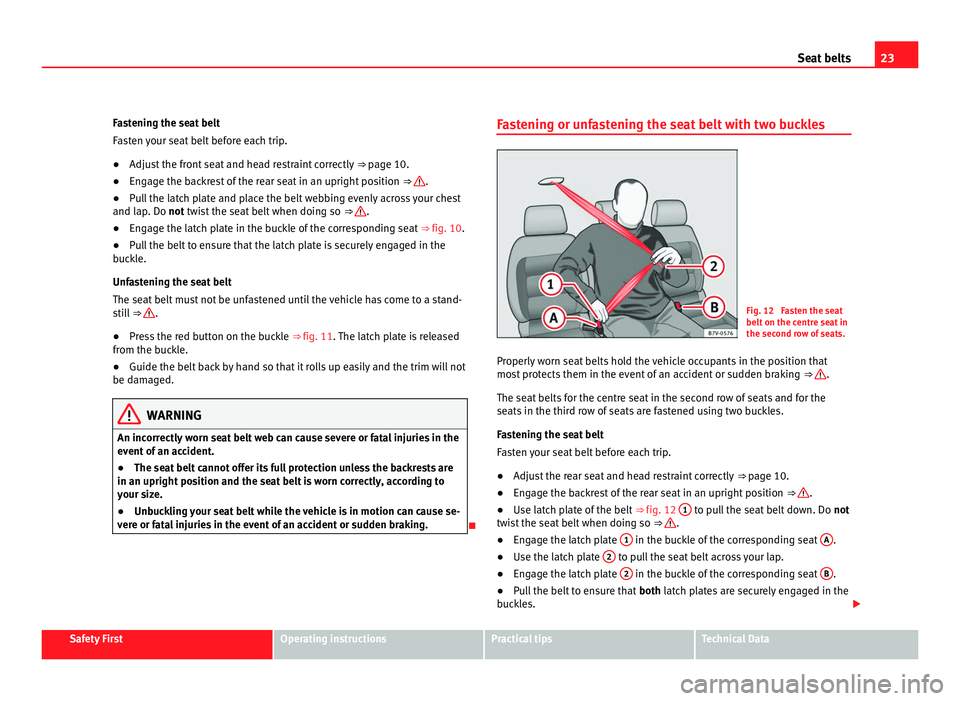
atal injuries in the event of an accident or sudden braking. Fastening or unfastening the seat belt with two buckles
Fig. 12 Fasten the seat
belt on the c
entr
e seat in
the second row of seats.
Properly worn seat belts hold the vehicle occupants in the position that
most
protects them in the event of an accident or sudden braking ⇒ .
The seat belts
for the centre seat in the second row of seats and for the
seats in the third row of seats are fastened using two buckles.
Fastening the seat belt
Fasten your seat belt before each trip.
● Adjust the rear seat and head restraint correctly ⇒ page 10.
● En
gage the backrest of the rear seat in an upright position ⇒ .
● Use latch plate of the belt ⇒ fig. 12 1 to pull the seat belt down. Do
not
twi s
t the seat belt when doing so ⇒ .
● Engage the latch plate 1 in the buckle of the corresponding seat
A .
● Use the latch plate 2 to pull the seat belt across your lap.
● Engage the latch plate 2 in the buckle of the corresponding seat
B .
● Pull the belt to ensure that both latc
h plates are securely engaged in the
buckles. Safety First Operating instructions Practical tips Technical Data
Page 27 of 385
25
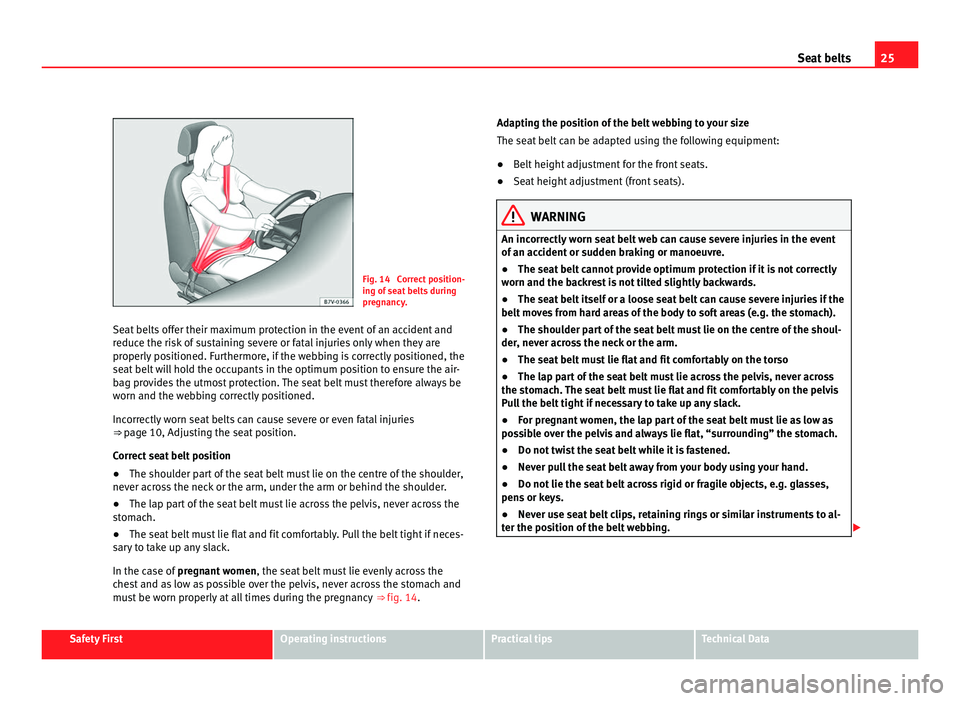
Seat belts Fig. 14 Correct position-
ing of
se
at belts during
pregnancy.
Seat belts offer their maximum protection in the event of an accident and
reduce the ri
sk of sustaining severe or fatal injuries only when they are
properly positioned. Furthermore, if the webbing is correctly positioned, the
seat belt will hold the occupants in the optimum position to ensure the air-
bag provides the utmost protection. The seat belt must therefore always be
worn and the webbing correctly positioned.
Incorrectly worn seat belts can cause severe or even fatal injuries
⇒ page 10, Adjusting the seat position.
Correct seat belt position
● The shoulder part of the seat belt must lie on the centre of the shoulder,
never acr
oss the neck or the arm, under the arm or behind the shoulder.
● The lap part of the seat belt must lie across the pelvis, never across the
stom
ach.
● The seat belt must lie flat and fit comfortably. Pull the belt tight if neces-
sary
to take up any slack.
In the case of pregnant women , the seat belt must lie evenly across the
chest and as low as possible over the pelvis, never across the stomach and
must be worn properly at all times during the pregnancy ⇒ fig. 14.Adapting the position of the belt webbing to your size
The seat belt
can be adapted using the following equipment:
● Belt height adjustment for the front seats.
● Seat height adjustment (front seats). WARNING
An incorrectly worn seat belt web can cause severe injuries in the event
of an ac c
ident or sudden braking or manoeuvre.
● The seat belt cannot provide optimum protection if it is not correctly
worn and the bac
krest is not tilted slightly backwards.
● The seat belt itself or a loose seat belt can cause severe injuries if the
belt mov
es from hard areas of the body to soft areas (e.g. the stomach).
● The shoulder part of the seat belt must lie on the centre of the shoul-
der, never ac
ross the neck or the arm.
● The seat belt must lie flat and fit comfortably on the torso
● The lap part of the seat belt must lie across the pelvis, never across
the stom
ach. The seat belt must lie flat and fit comfortably on the pelvis
Pull the belt tight if necessary to take up any slack.
● For pregnant women, the lap part of the seat belt must lie as low as
poss
ible over the pelvis and always lie flat, “surrounding” the stomach.
● Do not twist the seat belt while it is fastened.
● Never pull the seat belt away from your body using your hand.
● Do not lie the seat belt across rigid or fragile objects, e.g. glasses,
pens or k
eys.
● Never use seat belt clips, retaining rings or similar instruments to al-
ter the pos
ition of the belt webbing. Safety First Operating instructions Practical tips Technical Data
Page 29 of 385
27
Seat belts
Belt tension limiter
The belt t en
sion limiter reduces the force of the seat belt on the body in the
event of an accident. Note
The relevant safety requirements must be observed when the vehicle or
components of
the system are scrapped. These requirements are known to
specialised workshops ⇒ page 27.
Service and disposal of belt tension devices If you work on the belt tension devices or remove and install other parts of
the v
ehic
le when performing other repair work, the seat belt may be dam-
aged. The consequence may be that, in the event of an accident, the belt
tension devices function incorrectly or not at all.
So that the effectiveness of the belt tension device is not reduced and that
removed parts do not cause any injuries or environmental pollution, regula-
tions must be observed. These requirements are known to qualified dealer-
ships. WARNING
Improper handling and homemade repairs of seat belts, automatic belt
ret ainer
s and tension devices increase the risk of sustaining severe or fa-
tal injuries. The belt tension device may fail to trigger or may trigger in
the wrong circumstances.
● Never attempt to repair, adjust or remove or install parts of the belt
tens
ion devices or seat belts. Any work must be performed by a Technical
Service only ⇒ page 257.
● Belt tension devices and automatic belt retainers cannot be repaired
and must
be replaced. For the sake of the environment
Airbag modules and belt tension devices may contain perchlorate. Observe
the le g
al requirements for their disposal. Safety First Operating instructions Practical tips Technical Data
Page 31 of 385
29
Airbag system WARNING
The airbag system provides protection for one accident only. If they have
been deplo y
ed, they must be replaced.
● Ensure deployed airbags and the system components involved are im-
mediately
replaced with new, SEAT-approved components for the vehicle.
● Have any repairs or modifications carried out at a Technical Service.
Qualified work
shops have the necessary tools, diagnostics equipment,
repair information and qualified personnel.
● Never fit recycled or reused airbag components in your vehicle.
● Never modify the airbag system components. WARNING
If the airbags are triggered, a fine dust is produced. This is normal and it
is not
an indication of fire in the vehicle.
● This fine dust may irritate the skin and eyes and cause breathing dif-
ficultie
s, particularly in people suffering from or who have suffered from
asthma or other illnesses of the respiratory tract. To reduce breathing dif-
ficulties, get out of the vehicle and open and doors and windows to
breath in fresh air.
● Should you touch the dust, wash your hands and face using a mild
soap and wat
er before you eat.
● Prevent the dust from affecting the eyes or open wounds.
● Rinse your eyes with water if you have dust in them. WARNING
Solvents cause the surfaces of the airbag modules to become porous. If
an airbag i s
accidentally triggered, the detachment of plastic parts could
cause serious injury.
● Never clean the instrument panel and the surfaces of the airbag mod-
ule
s with cleaners containing solvents.
Safety First Operating instructions Practical tips Technical Data
Page 33 of 385
31
Airbag system CAUTION
Always pay attention to any lit lamps and to the corresponding descriptions
and ins truction
s to avoid damage to the vehicle.
Airbag system Des
cription and function of the airbag The airbag can protect vehicle occupants in the event of an accidents, cush-
ioning the mo
v
ement of the occupants in the direction of the collision in
frontal and side accidents.
Deployed airbags fill with a propellant gas. This causes the airbag covers to
break and the airbags to deploy extremely quickly in their entire deploy-
ment space within fractions of a second. When an occupant with the seat
belt properly fastened puts pressure on the inflated airbag, the propellant
gas escapes to absorb the force of the impact and slow the movement. This
reduces the risk of severe or fatal injuries. Airbag deployment does not
mean that other types of injury such as swelling, bruising, burns and skin
injuries can be ruled out.
Airbags do not protect the arms or the lower part of the body.
The most important factors for triggering the airbag are the type of accident,
the angle of impact, the vehicle speed and the characteristics of the object
the vehicle hits. Therefore, airbags are not triggered every time the vehicle
is visibly damaged.
The airbag system is designed to be triggered in collisions with a severe im-
pact. The front, curtain, side and knee airbags may be triggered under spe-
cial circumstances. The scope of any visible damage to the vehicle is not an
indication of airbag deployment. Airbags act in conjunction with three-point seat belts in the event of certain
accidents, when the
vehicle deceleration rate is severe enough to trigger
the airbags. Airbags only deploy once and only under certain circumstan-
ces. Seat belts remain present to offer protection in situations where air-
bags are not triggered or where they have already deployed. For example,
when a vehicle hits another after an initial collision or is hit by another vehi-
cle.
The airbag system is an integral part of the car's passive safety system. The
airbag system can only work effectively when the occupants are wearing
their seat belts correctly and have adjusted the head restraints properly
⇒ page 10.
Vehicle safety components
The following safety equipment makes up the vehicle safety design to re-
duce the risk of severe and fatal injuries. Depending on the vehicle equip-
ment, some equipment may not be fitted in the vehicle or may not be avail-
able in some markets.
● Optimised seat belts for all seats.
● Belt tension devices for the driver and front passenger and, where appli-
cabl
e, on the outer seats of the second row of seats in combination with the
side airbags.
● Furthermore, belt tension limiters for the driver's and front passenger's
seat belt
.
● Belt height adjustment for the front seats and, where applicable, the
outer seats
of the second row of seats.
● Seat belt warning lamp
● Frontal airbags for driver and passenger.
● Side airbags for the driver, front passenger and, where applicable, the
outer seats
of the second row of seats.
● Left and right curtain airbags.
● One airbag for the driver's knees.
● Airbag control lamp .
● PASSENGER AIR BAG contro
l lamp. Safety First Operating instructions Practical tips Technical Data
Page 35 of 385
33
Airbag system
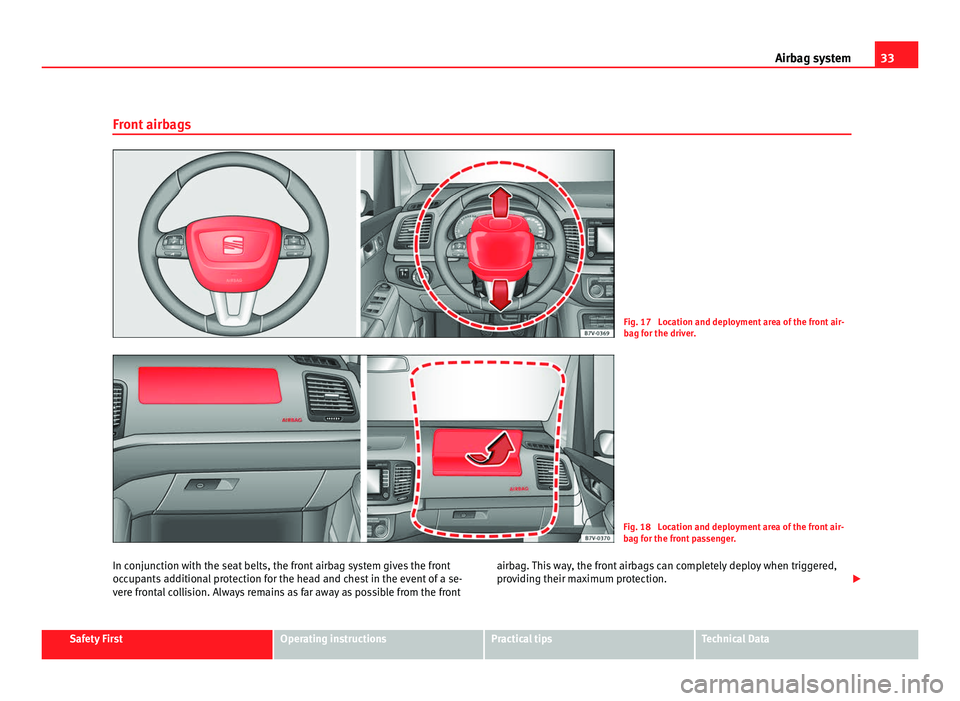
Front airbags Fig. 17 Location and deployment area of the front air-
bag f
or the driv
er. Fig. 18 Location and deployment area of the front air-
bag f
or the fr
ont passenger.
In conjunction with the seat belts, the front airbag system gives the front
occup
ants additional protection for the head and chest in the event of a se-
vere frontal collision. Always remains as far away as possible from the front airbag. This way, the front airbags can completely deploy when triggered,
prov
iding their maximum protection. Safety First Operating instructions Practical tips Technical Data
Page 37 of 385
35
Airbag system
Deactivating and activating the front passenger airbag
us in
g the key switch Fig. 19 In the glove com-
par
tment
on the front
passenger side: key
switch for disabling and
enabling the front pas-
senger airbag.
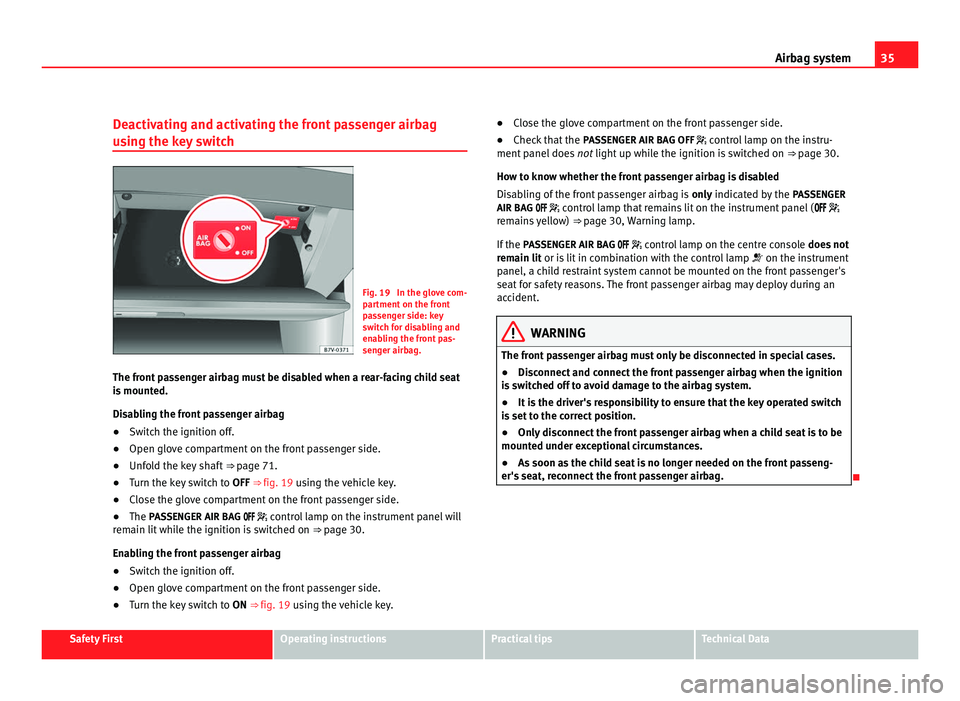
The front passenger airbag must be disabled when a rear-facing child seat
is mou
nted.
Disabling the front passenger airbag
● Switch the ignition off.
● Open glove compartment on the front passenger side.
● Unfold the key shaft ⇒ page 71.
● T
urn the key switch to OFF ⇒ fig. 19 usin
g the vehicle key.
● Close the glove compartment on the front passenger side.
● The PASSENGER AIR BAG
control lamp on the instrument panel will
remain lit while the ignition is switched on ⇒ page 30.
Enabling the front passenger airbag
● Switch the ignition off.
● Open glove compartment on the front passenger side.
● Turn the key switch to ON ⇒ fig. 19 u
sing the vehicle key. ●
Close the glove compartment on the front passenger side.
● Check
that the PASS
ENGER AIR BAG OFF control lamp on the instru-
ment panel does not light up while the ignition is switched on ⇒ page 30.
How to know whether the front passenger airbag is disabled
Disabling of the front passenger airbag is only indicated by the PASSENGER
AIR BAG control lamp that remains lit on the instrument panel (
remains yellow) ⇒ page 30, Warning lamp.
If the PASSENGER AIR BAG control lamp on the centre console does not
remain lit or is lit in combination with the control lamp on the instrument
panel, a child restraint system cannot be mounted on the front passenger's
seat for safety reasons. The front passenger airbag may deploy during an
accident. WARNING
The front passenger airbag must only be disconnected in special cases.
● Disconnect and connect the front passenger airbag when the ignition
is sw
itched off to avoid damage to the airbag system.
● It is the driver's responsibility to ensure that the key operated switch
is set
to the correct position.
● Only disconnect the front passenger airbag when a child seat is to be
mounted u
nder exceptional circumstances.
● As soon as the child seat is no longer needed on the front passeng-
er's seat, r
econnect the front passenger airbag.
Safety First Operating instructions Practical tips Technical Data
Page 39 of 385
37
Airbag system
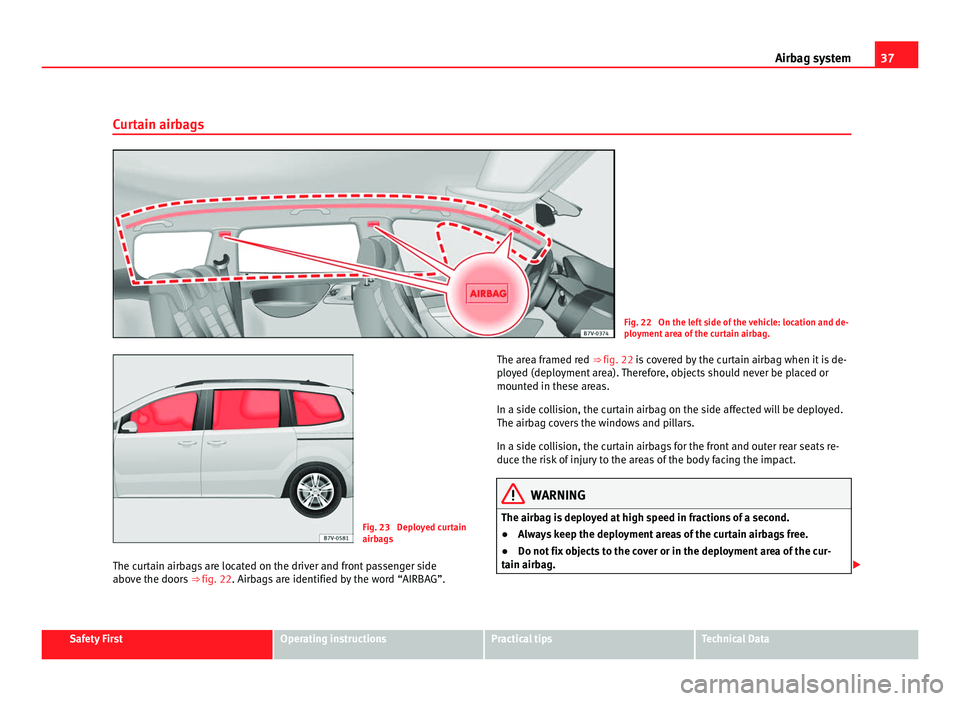
Curtain airbags Fig. 22 On the left side of the vehicle: location and de-
plo
yment
area of the curtain airbag. Fig. 23 Deployed curtain
airbag
s
The c
urtain airbags are located on the driver and front passenger side
above the door
s ⇒ fig. 22. Airbags are identified by the word “AIRBAG”. The area framed red ⇒ fig. 22 is c
overed by the curtain airbag when it is de-
ployed (deployment area). Therefore, objects should never be placed or
mounted in these areas.
In a side collision, the curtain airbag on the side affected will be deployed.
The airbag covers the windows and pillars.
In a side collision, the curtain airbags for the front and outer rear seats re-
duce the risk of injury to the areas of the body facing the impact. WARNING
The airbag is deployed at high speed in fractions of a second.
● Always keep the deployment areas of the curtain airbags free.
● Do not fix objects to the cover or in the deployment area of the cur-
tain airb ag. Safety First Operating instructions Practical tips Technical Data
Page 41 of 385
39
Child safety
Child safety
Child seats (accessories) Introduction Please read the information regarding the airbag system fully before trans-
portin
g b
abies and children in a child seat or other child restraint system
installed on the front passenger seat.
This information is extremely important for driver and passenger safety, par-
ticularly that of babies and children.
SEAT recommends the use of child seats from the SEAT accessory pro-
gramme. These child seats have been designed and tested for use in SEAT
vehicles. You can purchase child seats with different mountings from a
Technical Service.
Using child restraint systems with a base or foot
Some child retention systems are secured to the seat using a base or foot.
For certain equipment the use of an additional accessory will be necessary
(for example, the accessory for the floor compartment) to fit the child reten-
tion system correctly and securely.
Additional information and warnings:
● Airbag system ⇒ page 31
● Int
egrated child seats ⇒ page 46 WARNING
Make sure children are properly belted in and correctly secured to avoid
sever e or f
atal injuries while the vehicle is in motion.
● Never use a rear-facing child seat in the front passenger seat if the
front p
assenger airbag is enabled.
● You should always transport all children up to 12 years of age on the
rear se
at.
● Children must always be protected with an approved child restraint
syst
em suited to their height and weight.
● Children must assume the proper sitting position and be properly bel-
ted in whil
e travelling.
● Ensure the backrest of a seat is upright when a child seat is being
used on it.
● Do not
allow the child's head or other part of his or her body to fall
into the deplo
yment area of the side airbags.
● Make sure the belt webbing is correctly positioned.
● Never hold children or babies on your lap or in your arms.
● Only one child may occupy a child seat.
● If you are using a child seat with a base or foot, always install this
base or f
oot correctly and safely.
● If the vehicle has a storage compartment in the foot well in front of
the las
t row of seats, this compartment cannot be used as designed; on
the contrary: It must be filled using the specially designed accessory so
that the base or foot is correctly supported by the closed compartment
and the child seat is secured properly. If this compartment is not suitably Safety First Operating instructions Practical tips Technical Data
Page 43 of 385
41
Child safety
Specific child seat regulations for each country (selection) Regulation Further information
ECE-R 44
a) Technical Service or qualified work-
shop
a)
ECE-R: Economic Commi ssion for Europe Regulation.
Categorisation of child seats according to ECE-R 44 Weight cate-
gory Weight of the
chil
d Installation of the child seat
Group 0 children up to 10
kg Rear-facing. On rear seats, optionally
usin
g the ISOFIX system. Group 0+ children up to 13
kg Group 1 9 to 18 kg Forward-facing. On rear seats, optional-
ly us
ing the ISOFIX system. Group 2 15 to 25 kg Forward-facing. On the outer rear seats
or in the centr e se
at of the second row
of seats and on all seats in the third row. Optionally with ISOFIX system. Group 3 22 to 36 kg Forward-facing.
Not all children fit in the seat of their weight group. Nor do all seats adapt to
the v
ehic
le. Therefore, always check whether the child fits properly in the
child seat and whether the seat can be installed safely in the vehicle.
The rear seats are suitable for child seats with the ISOFIX system specially
designed for this type of vehicle in accordance with regulation ECE-R 44.
Child seats approved under the ECE-R 44 regulation are fitted with the corre-
sponding approval symbol. The sign is an upper-case E in a circle with the
identification number below it. WARNING
Not following the checklist prepared for your own safety could lead to ac-
cident s
and severe injuries.
● Always follow the check list and perform the necessary operations. WARNING
In general, the rear seat is always the safest place for correctly belted in
chil
dren in the event of an accident.
● A suitable child seat that is correctly installed and used on one of the
rear se
ats offer the most protection possible for babies and small chil-
dren in most accidents. Note
Other accessories may be required to fit the child retention system with a
ba se or f
oot security and safely. Contact a specialist or qualified workshop. Safety First Operating instructions Practical tips Technical Data