warning Seat Alhambra 2011 User Guide
[x] Cancel search | Manufacturer: SEAT, Model Year: 2011, Model line: Alhambra, Model: Seat Alhambra 2011Pages: 385, PDF Size: 7.92 MB
Page 19 of 385
17
Seat belts WARNING (Continued)
● If the fabric or other parts of the seat belt are damaged, the seat belts
c ou
ld break in the event of an accident or sudden braking.
● Always have damaged seatbelts replaced immediately by seat belts
appro
ved for the vehicle in question by SEAT. Seat belts which have been
worn in an accident and stretched must be replaced by a Technical Serv-
ice. Renewal may be necessary even if there is no apparent damage. The
belt anchorage should also be checked.
● Never attempt to repair, modify or remove a seat belt yourself. All re-
pairs
to seat belts, retractors and buckles must be carried out by a spe-
cialist workshop.
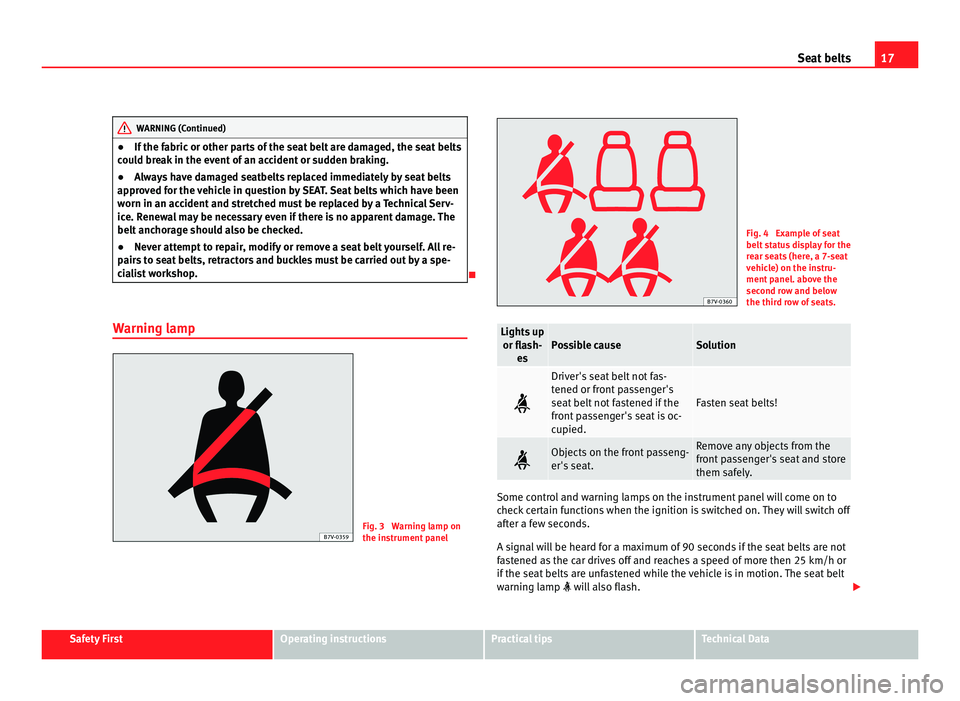
Warning lamp Fig. 3 Warning lamp on
the ins
trument
panel Fig. 4 Example of seat
belt s
t
atus display for the
rear seats (here, a 7-seat
vehicle) on the instru-
ment panel. above the
second row and below
the third row of seats. Lights up
or fla sh-
e
s Possible cause Solution
Driver's seat belt not fas-
tened or fr
ont
passenger's
seat belt not fastened if the
front passenger's seat is oc-
cupied. Fasten seat belts!
Objects on the front passeng-
er's se
at
. Remove any objects from the
front
p
assenger's seat and store
them safely. Some control and warning lamps on the instrument panel will come on to
chec
k
certain functions when the ignition is switched on. They will switch off
after a few seconds.
A signal will be heard for a maximum of 90 seconds if the seat belts are not
fastened as the car drives off and reaches a speed of more then 25 km/h or
if the seat belts are unfastened while the vehicle is in motion. The seat belt
warning lamp will also flash. Safety First Operating instructions Practical tips Technical Data
Page 20 of 385
18
Seat belts
The warning lamp does not switch off until the driver and front passenger
fasten their seat belts while the ignition is switched on.
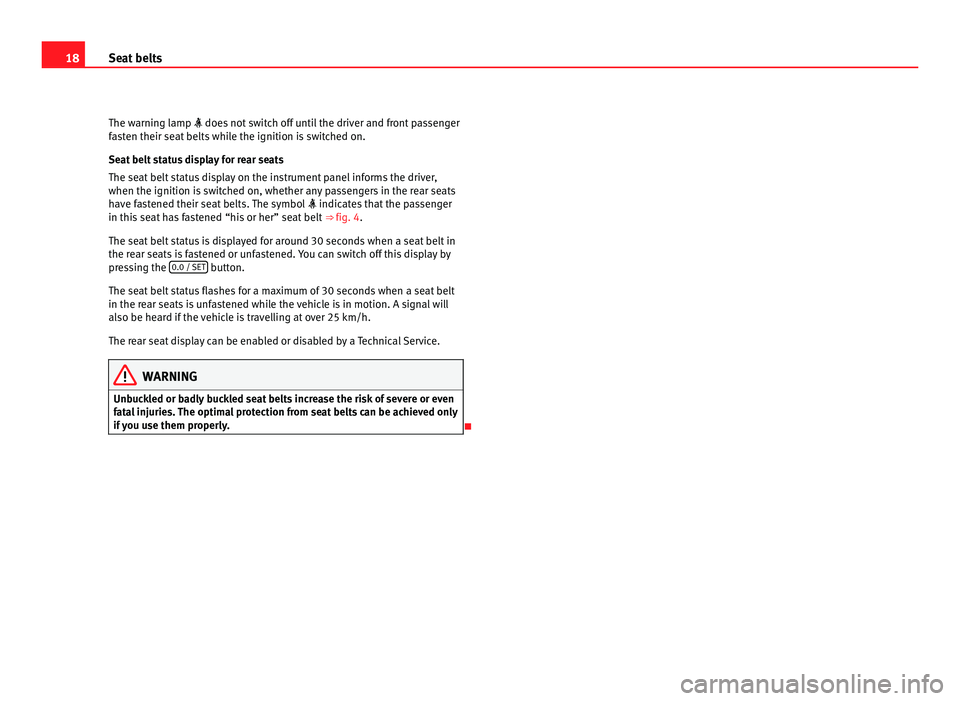
Seat belt status display for rear seats
The seat belt status display on the instrument panel informs the driver,
when the ignition is switched on, whether any passengers in the rear seats
have fastened their seat belts. The symbol indicates that the passenger
in this seat has fastened “his or her” seat belt ⇒ fig. 4.
The seat belt status is displayed for around 30 seconds when a seat belt in
the rear seats is fastened or unfastened. You can switch off this display by
pressing the 0.0 / SET button.
The seat belt
status flashes for a maximum of 30 seconds when a seat belt
in the rear seats is unfastened while the vehicle is in motion. A signal will
also be heard if the vehicle is travelling at over 25 km/h.
The rear seat display can be enabled or disabled by a Technical Service. WARNING
Unbuckled or badly buckled seat belts increase the risk of severe or even
fat a
l injuries. The optimal protection from seat belts can be achieved only
if you use them properly.
Page 24 of 385
22
Seat belts
Twisted seat belt
If it i
s difficult to remove the seat belt from the guide, the seat belt may
have become twisted inside the side trim after being wound too quickly on
unfastening:
● Pull out the seat belt completely, carefully pulling on the latch plate.
● Untwist the belt and guide it back, assisting it by hand.
The seat belt
must be fastened even if it is impossible to untwist it. In this
case, the twisted area must not be in an area in direct contact with your
body. Have the seat belt untwisted urgently by a Technical Service. WARNING
An improperly handled seat belt increases the risk of sustaining severe
or fat a
l injuries.
● Regularly check that the seat belts and their components are in per-
fect c
ondition.
● Always keep your seat belt clean.
● Do not jam or damage the seat belt or rub it with sharp edges.
● Make sure there are no liquids or foreign bodies on the latch plate
and in the buck
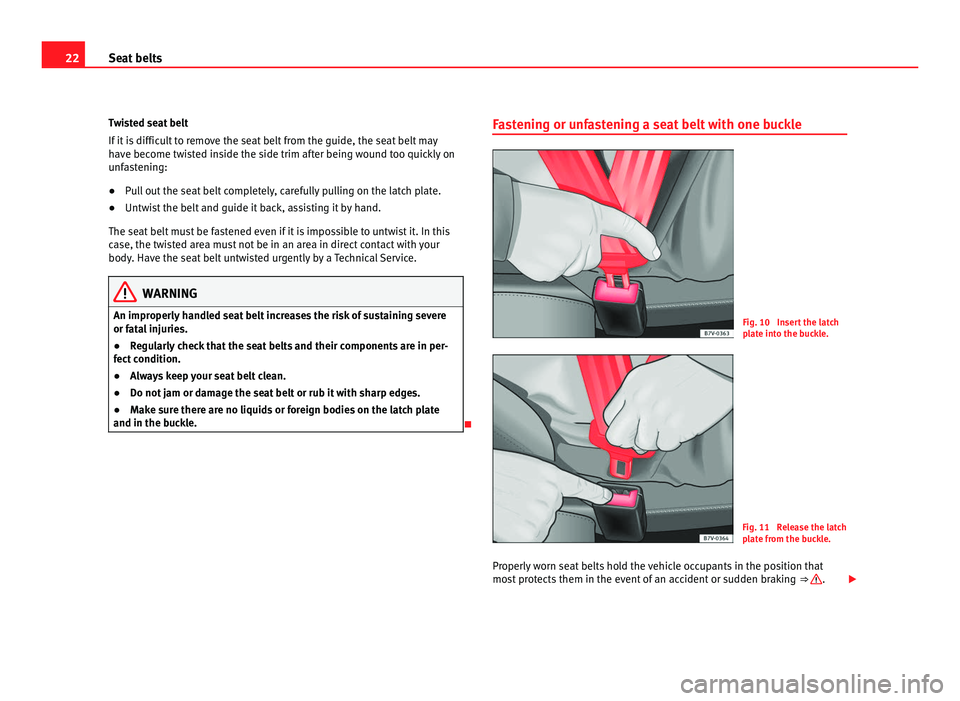
le. Fastening or unfastening a seat belt with one buckle Fig. 10 Insert the latch
pl
at
e into the buckle. Fig. 11 Release the latch
pl
at
e from the buckle.
Properly worn seat belts hold the vehicle occupants in the position that
most
protects them in the event of an accident or sudden braking ⇒ .
Page 25 of 385
23
Seat belts
Fastening the seat belt
Fa s
ten your seat belt before each trip.
● Adjust the front seat and head restraint correctly ⇒ page 10.
● En
gage the backrest of the rear seat in an upright position ⇒ .
● Pull the latch plate and place the belt webbing evenly across your chest
and lap . Do
not twist the seat belt when doing so ⇒ .
● Engage the latch plate in the buckle of the corresponding seat ⇒ fig. 10.
● Pull the belt to ensure that the latch plate is securely engaged in the
buc k
le.
Unfastening the seat belt
The seat belt must not be unfastened until the vehicle has come to a stand-
still ⇒ .
● Press the red button on the buckle ⇒ fig. 11. The lat
ch plate is released
from the buckle.
● Guide the belt back by hand so that it rolls up easily and the trim will not
be damag
ed. WARNING
An incorrectly worn seat belt web can cause severe or fatal injuries in the
event of
an accident.
● The seat belt cannot offer its full protection unless the backrests are
in an upright pos
ition and the seat belt is worn correctly, according to
your size.
● Unbuckling your seat belt while the vehicle is in motion can cause se-
vere or f
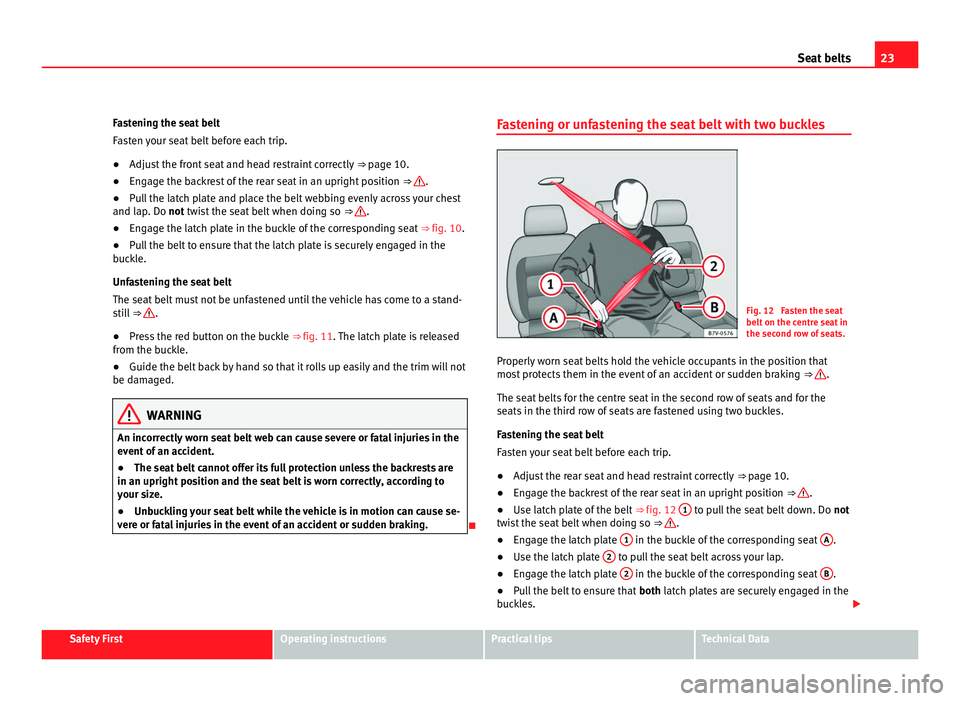
atal injuries in the event of an accident or sudden braking. Fastening or unfastening the seat belt with two buckles
Fig. 12 Fasten the seat
belt on the c
entr
e seat in
the second row of seats.
Properly worn seat belts hold the vehicle occupants in the position that
most
protects them in the event of an accident or sudden braking ⇒ .
The seat belts
for the centre seat in the second row of seats and for the
seats in the third row of seats are fastened using two buckles.
Fastening the seat belt
Fasten your seat belt before each trip.
● Adjust the rear seat and head restraint correctly ⇒ page 10.
● En
gage the backrest of the rear seat in an upright position ⇒ .
● Use latch plate of the belt ⇒ fig. 12 1 to pull the seat belt down. Do
not
twi s
t the seat belt when doing so ⇒ .
● Engage the latch plate 1 in the buckle of the corresponding seat
A .
● Use the latch plate 2 to pull the seat belt across your lap.
● Engage the latch plate 2 in the buckle of the corresponding seat
B .
● Pull the belt to ensure that both latc
h plates are securely engaged in the
buckles. Safety First Operating instructions Practical tips Technical Data
Page 26 of 385
24
Seat belts
Unfastening the seat belt
The seat belt
must not be unfastened until the vehicle has come to a stand-
still ⇒ .
● Press the red button on the buckle A . The latch plate is released from
the buc k
le.
● Press the red button on the buckle B . The latch plate is released from
the buc k
le.
● Guide the belt back by hand so that it rolls up easily and the trim will not
be damag
ed. WARNING
An incorrectly worn seat belt web can cause severe or fatal injuries in the
event of
an accident.
● The seat belt cannot offer its full protection unless the backrests are
in an upright pos
ition and the seat belt is worn correctly, according to
your size.
● Unbuckling your seat belt while the vehicle is in motion can cause se-
vere or f
atal injuries in the event of an accident or sudden braking. Note
Seat belts with two buckles include a diagram to show how to fasten the
seat belt
.
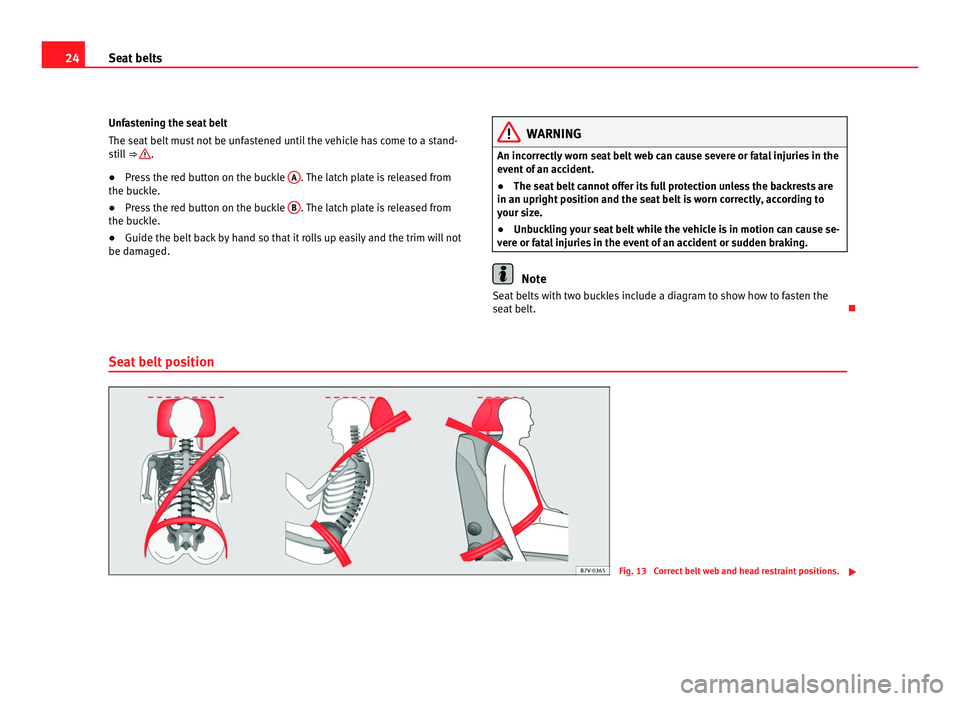
Seat belt position Fig. 13 Correct belt web and head restraint positions.
Page 27 of 385
25
Seat belts Fig. 14 Correct position-
ing of
se
at belts during
pregnancy.
Seat belts offer their maximum protection in the event of an accident and
reduce the ri
sk of sustaining severe or fatal injuries only when they are
properly positioned. Furthermore, if the webbing is correctly positioned, the
seat belt will hold the occupants in the optimum position to ensure the air-
bag provides the utmost protection. The seat belt must therefore always be
worn and the webbing correctly positioned.
Incorrectly worn seat belts can cause severe or even fatal injuries
⇒ page 10, Adjusting the seat position.
Correct seat belt position
● The shoulder part of the seat belt must lie on the centre of the shoulder,
never acr
oss the neck or the arm, under the arm or behind the shoulder.
● The lap part of the seat belt must lie across the pelvis, never across the
stom
ach.
● The seat belt must lie flat and fit comfortably. Pull the belt tight if neces-
sary
to take up any slack.
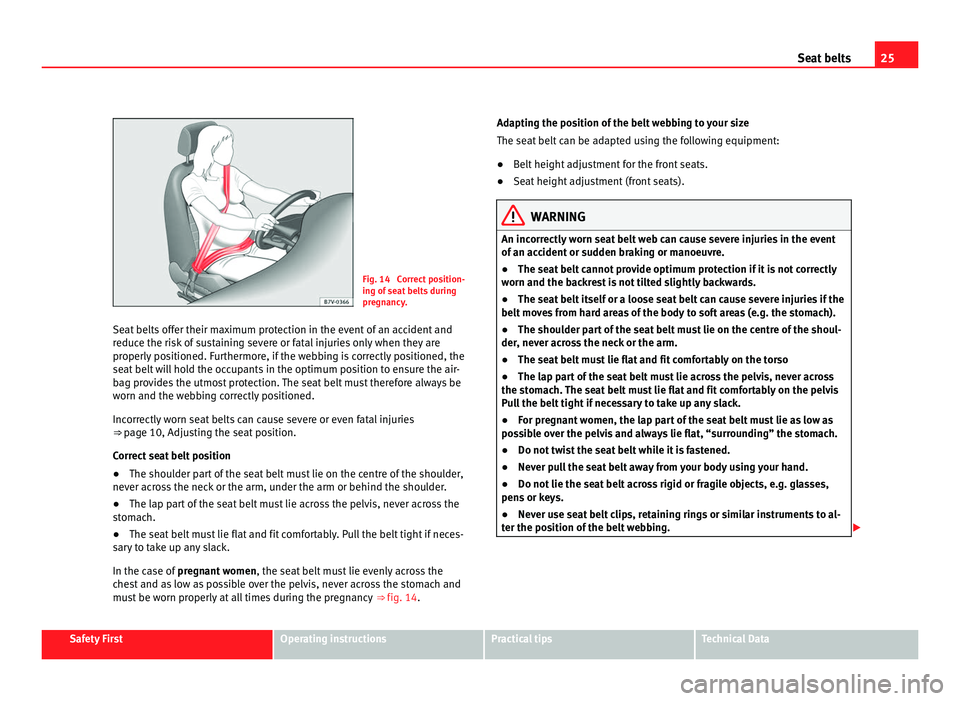
In the case of pregnant women , the seat belt must lie evenly across the
chest and as low as possible over the pelvis, never across the stomach and
must be worn properly at all times during the pregnancy ⇒ fig. 14.Adapting the position of the belt webbing to your size
The seat belt
can be adapted using the following equipment:
● Belt height adjustment for the front seats.
● Seat height adjustment (front seats). WARNING
An incorrectly worn seat belt web can cause severe injuries in the event
of an ac c
ident or sudden braking or manoeuvre.
● The seat belt cannot provide optimum protection if it is not correctly
worn and the bac
krest is not tilted slightly backwards.
● The seat belt itself or a loose seat belt can cause severe injuries if the
belt mov
es from hard areas of the body to soft areas (e.g. the stomach).
● The shoulder part of the seat belt must lie on the centre of the shoul-
der, never ac
ross the neck or the arm.
● The seat belt must lie flat and fit comfortably on the torso
● The lap part of the seat belt must lie across the pelvis, never across
the stom
ach. The seat belt must lie flat and fit comfortably on the pelvis
Pull the belt tight if necessary to take up any slack.
● For pregnant women, the lap part of the seat belt must lie as low as
poss
ible over the pelvis and always lie flat, “surrounding” the stomach.
● Do not twist the seat belt while it is fastened.
● Never pull the seat belt away from your body using your hand.
● Do not lie the seat belt across rigid or fragile objects, e.g. glasses,
pens or k
eys.
● Never use seat belt clips, retaining rings or similar instruments to al-
ter the pos
ition of the belt webbing. Safety First Operating instructions Practical tips Technical Data
Page 28 of 385
26
Seat belts Note
If you physical constitution prevents you from maintaining the correct posi-
tion of the belt w
ebbing, contact a Technical Service for help with any spe-
cial devices to ensure the optimum protection of the seat belt and airbag.
SEAT recommends visiting a Technical Service.
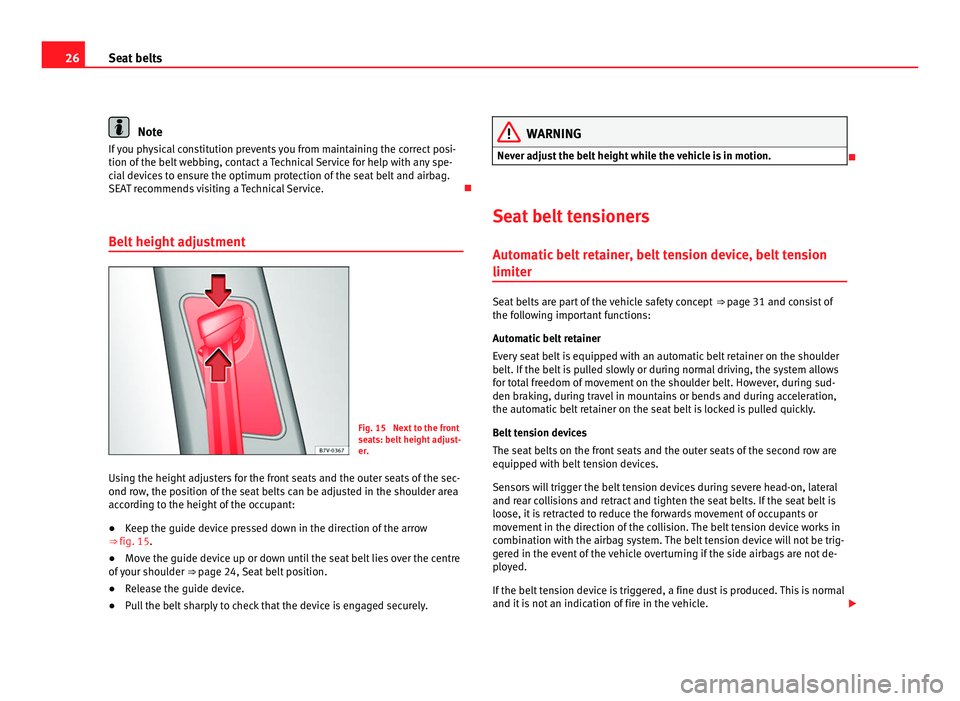
Belt height adjustment Fig. 15 Next to the front
seat
s: belt
height adjust-
er.
Using the height adjusters for the front seats and the outer seats of the sec-
ond row
, the position of the seat belts can be adjusted in the shoulder area
according to the height of the occupant:
● Keep the guide device pressed down in the direction of the arrow
⇒ fig. 15.
● Move the guide device up or down until the seat belt lies over the centre
of y
our shoulder ⇒ page 24, Seat belt position.
● Release the guide device.
● Pull the belt sharply to check that the device is engaged securely. WARNING
Never adjust the belt height while the vehicle is in motion.
Seat belt tensioners
Autom atic
belt retainer, belt tension device, belt tension
limiter Seat belts are part of the vehicle safety concept
⇒ page 31 and c
onsist of
the following important functions:
Automatic belt retainer
Every seat belt is equipped with an automatic belt retainer on the shoulder
belt. If the belt is pulled slowly or during normal driving, the system allows
for total freedom of movement on the shoulder belt. However, during sud-
den braking, during travel in mountains or bends and during acceleration,
the automatic belt retainer on the seat belt is locked is pulled quickly.
Belt tension devices
The seat belts on the front seats and the outer seats of the second row are
equipped with belt tension devices.
Sensors will trigger the belt tension devices during severe head-on, lateral
and rear collisions and retract and tighten the seat belts. If the seat belt is
loose, it is retracted to reduce the forwards movement of occupants or
movement in the direction of the collision. The belt tension device works in
combination with the airbag system. The belt tension device will not be trig-
gered in the event of the vehicle overturning if the side airbags are not de-
ployed.
If the belt tension device is triggered, a fine dust is produced. This is normal
and it is not an indication of fire in the vehicle.
Page 29 of 385
27
Seat belts
Belt tension limiter
The belt t en
sion limiter reduces the force of the seat belt on the body in the
event of an accident. Note
The relevant safety requirements must be observed when the vehicle or
components of
the system are scrapped. These requirements are known to
specialised workshops ⇒ page 27.
Service and disposal of belt tension devices If you work on the belt tension devices or remove and install other parts of
the v
ehic
le when performing other repair work, the seat belt may be dam-
aged. The consequence may be that, in the event of an accident, the belt
tension devices function incorrectly or not at all.
So that the effectiveness of the belt tension device is not reduced and that
removed parts do not cause any injuries or environmental pollution, regula-
tions must be observed. These requirements are known to qualified dealer-
ships. WARNING
Improper handling and homemade repairs of seat belts, automatic belt
ret ainer
s and tension devices increase the risk of sustaining severe or fa-
tal injuries. The belt tension device may fail to trigger or may trigger in
the wrong circumstances.
● Never attempt to repair, adjust or remove or install parts of the belt
tens
ion devices or seat belts. Any work must be performed by a Technical
Service only ⇒ page 257.
● Belt tension devices and automatic belt retainers cannot be repaired
and must
be replaced. For the sake of the environment
Airbag modules and belt tension devices may contain perchlorate. Observe
the le g
al requirements for their disposal. Safety First Operating instructions Practical tips Technical Data
Page 30 of 385
28
Airbag system
Airbag system
Brief introduction Introduction Front airbags have been installed for both driver and passenger. The front
airbag
s
can also protect the chest and head of driver and passenger if the
seats, seat belts head restraints and, for the driver, the steering wheel are
correctly adjusted and used. Airbags are considered as additional safety
equipment. An airbag cannot replace the safety belt, which must be worn at
all times, even in front seats where front airbags have been installed.
Additional information and warnings:
● Driving tips ⇒ pag
e 7
● Correct sitting positions ⇒ pag
e 10
● Seat belts ⇒ pag
e 21
● Child seats (accessories) ⇒ pag
e 39
● Care and cleaning of the vehicle interior ⇒ pag
e 249
● Accessories, parts replacement, repairs and modifications ⇒ pag
e 257
● Notes for the user ⇒ pag
e 255WARNING
Never exclusively trust the airbag system as a means of protection.
● Even when triggered, airbag protection is only auxiliary. WARNING (Continued)
● The airb ags provide the best protection when the seat belts are prop-
erly f
astened, thus reducing the risk of sustaining injuries ⇒ page 21,
Seat belts.
● Before each trip, every occupant must sit properly, correctly fasten
the seat belt
belonging to his or her seat and keeping it fastened
throughout the trip. This rule is valid for all occupants. WARNING
Occupants sitting in the front of the vehicle must never carry any objects
in the deplo yment
space between them and the airbags, as this increa-
ses the risk of sustaining injuries if the airbag is triggered. This modifies
the airbag deployment space or the objects may fly uncontrollably and
hit your body.
● Never carry objects in your hand or on your lap while the vehicle is in
motion.
● Never transport objects on the front passenger seat. In the event of
sudden br
aking and manoeuvres, the objects may end up in the airbag
deployment space and fly uncontrollably around the vehicle interior if the
airbag is activated.
● Occupants of the front and outer rear seats must never carry any oth-
er people, pet
s or objects in the deployment space between them and
the airbags. Make sure children and other passengers also respect this
recommendation.
Page 31 of 385
29
Airbag system WARNING
The airbag system provides protection for one accident only. If they have
been deplo y
ed, they must be replaced.
● Ensure deployed airbags and the system components involved are im-
mediately
replaced with new, SEAT-approved components for the vehicle.
● Have any repairs or modifications carried out at a Technical Service.
Qualified work
shops have the necessary tools, diagnostics equipment,
repair information and qualified personnel.
● Never fit recycled or reused airbag components in your vehicle.
● Never modify the airbag system components. WARNING
If the airbags are triggered, a fine dust is produced. This is normal and it
is not
an indication of fire in the vehicle.
● This fine dust may irritate the skin and eyes and cause breathing dif-
ficultie
s, particularly in people suffering from or who have suffered from
asthma or other illnesses of the respiratory tract. To reduce breathing dif-
ficulties, get out of the vehicle and open and doors and windows to
breath in fresh air.
● Should you touch the dust, wash your hands and face using a mild
soap and wat
er before you eat.
● Prevent the dust from affecting the eyes or open wounds.
● Rinse your eyes with water if you have dust in them. WARNING
Solvents cause the surfaces of the airbag modules to become porous. If
an airbag i s
accidentally triggered, the detachment of plastic parts could
cause serious injury.
● Never clean the instrument panel and the surfaces of the airbag mod-
ule
s with cleaners containing solvents.
Safety First Operating instructions Practical tips Technical Data