change time Seat Alhambra 2011 Owner's Guide
[x] Cancel search | Manufacturer: SEAT, Model Year: 2011, Model line: Alhambra, Model: Seat Alhambra 2011Pages: 385, PDF Size: 7.92 MB
Page 223 of 385
221
Driving
Tyre monitoring systems Introduction The tyre monitor indicator monitors the tyre pressure of each wheel during
drivin
g u
sing the ABS sensors. The ABS sensors monitor the tyre tread pe-
rimeter and vibrations of each tire. The tyre monitor indicator warns the driv-
er if it detects a considerable drop in tyre pressure of one or several tyres
while driving. Loss of tyre pressure will be indicated by the indicator as
well as a sound and sometimes a text message on the screen of the instru-
ment panel. When you open the driver's door, you will find a label indicat-
ing the tyre pressure recommended by the manufacturer for the maximum
vehicle load for each tyre approved for the vehicle in question. By pressing
the adjustment button on the tyre monitoring indicator, you may change the
reference pressure for the tyres so that the tyre pressure to be monitored co-
incides with actual tyre pressure ⇒ page 223.
Suitable use of the adjustment button ⇒ page 223.
Additional information and warnings:
● Transporting ⇒ pag
e 13
● Braking, stopping and parking ⇒ pag
e 183
● Caring for and cleaning the vehicle exterior ⇒ pag
e 242
● Wheels and tyres ⇒ pag
e 293
● Accessories, parts replacement, repairs and modifications ⇒ pag
e 257 WARNING
Unsuitable handling of the wheels and tyres may lead to sudden tyre
pre s
sure losses, to tread separation or even to a blow-out.
● Check tyre pressures regularly and ensure they are maintained at the
pres
sures indicated. If the tyre pressure is too low, the tyres could over-
heat, resulting in tread detachment or even burst tyres.
● Tyre pressure should be that indicated on the label when the tyres are
col
d at all times ⇒ page 297.
● Regularly check the cold inflation pressure of the tyres. If necessary,
chan
ge the tyre pressure of the vehicle tyres while they are cold.
● Regularly check your tyres for damage and wear.
● Never exceed the maximum permitted speed or loads specified for the
type of ty
re fitted on your vehicle. WARNING
Incorrect use of the tyre monitoring indicator button could result in the
indicat or giv
ing erroneous messages or prevented from indicating the
danger caused by a defective tyre ⇒ page 223. CAUTION
● The tyre valves may be damaged if the cap is not in place. Check that the
c ap
s are identical to the standard caps and have been correctly tightened.
Do not use metal caps ⇒ page 223.
● Do not damage the valves when changing the tyres ⇒ page 223. For the sake of the environment
Under-inflated tyres lead to increased fuel consumption and tyre wear. Safety First Operating instructions Practical tips Technical Data
Page 228 of 385
226
Driving and the environment
Economic driving style Changing gear early
General
in
structions: The highest gear is always the most economical gear.
As a guideline, for the majority of vehicles: At a speed of 30 km/h, drive in
third gear, at 40 km/h in fourth gear and at 50 km/h in fifth gear.
In addition, skipping gears when shifting up helps to save fuel, weather and
traffic conditions permitting.
Do not wait until the last moment before changing gear. Only use first gear
when you move off and change to second gear quickly. Avoid the kick-down
function in vehicles with automatic gearbox.
Vehicles with a gear display help to achieve an economical driving style as
the display indicates the best moment to change gear.
Let the vehicle roll
If you take your foot off the accelerator, the fuel supply is stopped and con-
sumption is reduced.
Allow the vehicle to roll without accelerating, for example when approach-
ing a red traffic light. However, if the vehicle is rolling too slowly or the dis-
tance is too long, the clutch pedal should be pressed to declutch. The en-
gine will then operate at idle speed.
If the vehicle is going to be at a standstill for a period of time, switch off the
engine; for example, while waiting at a level crossing. In vehicles which
have the Start-Stop function on, the engine switches off automatically when
the vehicle is not moving.
Think ahead and “flow” with the traffic
Frequent acceleration and braking considerably increase fuel consumption.
If you think ahead as you drive and keep a safe distance from the vehicle in
front, it is possible to slow down by simply lifting your foot off the accelera-
tor. This eliminates the need for constant braking and acceleration. Calm and steady driving
Cons
tancy is more important than speed: The more you drive at a constant
speed, the lower the fuel consumption.
When driving on the motorway, it is more efficient to drive at a constant and
more moderate speed than to be continuously accelerating and braking. As
a general rule, you will reach your destination just as quickly when you drive
at a constant speed.
The cruise control function helps you to achieve a constant style of driving.
Moderate use of additional electrical appliances
It is important to travel in comfort, but convenience systems should be used
in an ecological manner.
Some equipment, when connected, increase fuel consumption considera-
bly, for example:
● Air conditioning cooling system: If the air conditioning system is re-
quired to c
ool to significantly lower temperatures than the true outside tem-
perature, it will require a large quantity of energy from the engine. There-
fore, we recommend that the selected temperature for the vehicle is not too
different to the outside temperature. It is a good idea to open all the win-
dows of the car before starting your journey, and to drive a short distance
with all the windows open to allow the vehicle to cool down slightly. Only
then should you close all the windows and switch on the air conditioning.
Keep windows closed when travelling at high speeds. Driving with the win-
dows open increases fuel consumption.
● Switch off the seat heating when the seats have warmed up.
● Switch off the heated rear window and the windscreen heating when the
window
s have demisted and are free of ice.
● Do not leave the auxiliary heater switched on when the vehicle is mov-
ing ⇒ p
age 163.
Page 233 of 385
231
Trailer towing
Trailer towing Introduction Always be aware of the legal requirements for each country to drive with a
trai
l
er and to use a trailer bracket.
Your car is intended mainly for transporting passengers however, it can also
be used to tow a trailer provided that it is fitted with the necessary equip-
ment. The additional load has an effect on the useful life, fuel consumption
and the vehicle performance and, in some cases, reduce the service inter-
vals.
Driving with a trailer requires more force from the vehicle and, thus, more
concentration from the driver.
For wintertime temperatures, fit winter tyres to the vehicle and the trailer.
Drawbar load
The maximum permitted Drawbar load exerted by the trailer drawbar on the
ball joint of the tow hitch must not exceed 100 kg (approximately 220 lbs).
Vehicles with the Start-Stop function
With a SEAT factory fitted or retrofitted trailer bracket, the Start-Stop func-
tion is automatically deactivated when a trailer is connected. For trailer
brackets not installed by SEAT, the Start-Stop function must be deactivated
manually using a button located on the dashboard before driving with a
trailer and it must remain off for the entire journey ⇒ .
Addition a
l information and warnings:
● Anti-theft alarm system ⇒ page 74
● Light
⇒ page 95
● Ec
ological driving ⇒ page 225
● St
arter assist systems (Start-Stop function) ⇒ page 194●
Wheel
s and tyres
⇒ p
age 293
● Accessories, parts replacement, repairs and modifications ⇒ page 257 WARNING
Never transport people in a trailer: this will endanger in their life and is
again s
t the law. WARNING
The incorrect use of the tow hitch can cause accidents and injury.
● Only use a tow hitch in good condition and correctly installed.
● Never change or repair a tow hitch.
● To reduce the risk of injury in case of a reversing collision, injury to
pedestri
ans and cyclists when parking, always keep the ball joint in
when a trailer is not being used.
● Never fit a trailer tow hitch “that distributes the load” or “balances
the load”.
Your vehicle has not been designed for this type of tow hitch.
The tow hitch may fail and the trailer will separate from the vehicle. WARNING
Driving with a trailer and transporting heavy or large objects can affect
vehic l
e handling and even cause an accident.
● Always secure loads correctly with suitable and undamaged attach-
ment rope or s
traps.
● Adjust your speed and driving style to visibility, road, traffic and
weather c
onditions. Safety First Operating instructions Practical tips Technical Data
Page 284 of 385
282
Checking and refilling levels
● Unscrew the cap from engine oil filler opening on the cylinder head
⇒ fig. 169
. If you are not sure where the cap is, request help from a special-
ist.
● Only refill using engine oil expressly approved by SEAT and in small
quantities (not
more than 0.5 l or 1/2 a quarter of a gallon at a time)
⇒ page 280.
● To avoid adding too much oil, each time you add a quantity, wait until
the oil h
as flowed into the crankcase so that it can be measured with the
dipstick.
● Check the oil level before adding any more oil. Do not top up with too
much engine oi
l ⇒ .
● When the oil level is in at least the ⇒ fig. 168 B zone, insert the dip-
stic k
into the tube fully to avoid engine oil escaping when the engine is run-
ning.
● After topping up the oil, ensure that the cap is screwed on to the filler
mouth correctly
. WARNING
Oil could catch fire if it comes into contact with hot engine components.
This c
ould lead to a fire, explosion and severe injuries.
● Always ensure that after topping of oil, the engine oil filler cap is cor-
rectly tight
ened. This will avoid engine oil spilling onto hot engine parts
when the engine is running. CAUTION
● If the oil level is above the area A do not start the engine. You should
obt ain pr
ofessional assistance. Otherwise catalytic converter and engine
damage may occur.
● When refilling or changing service liquids, ensure that you put the liq-
uids int
o the right tank. Making a mistake when refilling could cause seri-
ous malfunctions and damage the engine! For the sake of the environment
The oil level must never be above area A . Otherwise oil can be drawn in
through the c r
ankcase breather and escape into the atmosphere via the ex-
haust system.
Engine oil consumption The consumption of engine oil can be different from one engine to another
and can
v
ary during the useful life of the engine.
Depending on driving style and the conditions of use, the consumption of
engine oil can reach 1 litre every 2000 km (one quarter of a gallon every
1200 miles); for new vehicles, this could be higher for the first 5000 km
(3000 miles). For this reason the engine oil level must be checked at regular
intervals, preferably when filling the tank and before a journey.
When the engine is working hard, for instance during sustained high-speed
motorway cruising in summer, when towing a trailer or climbing mountain
passes, the oil level should preferably be kept within area ⇒ fig. 168 A .
Changing the engine oil The engine oil must be changed regularly according to the specifications of
the Maint
en
ance Programme.
Due to the problems linked with disposing of used oil and the need for suit-
able tools and special knowledge, always visit a Technical Service to have
the engine oil and filter changed. SEAT recommends visiting a Technical
Service.
Detailed information on the service intervals are shown in the Maintenance
Programme.
Page 297 of 385
295
Wheels and tyres
● Replace damaged or worn tyres as soon as possible ⇒ p age 299.
● Regularly check tyres for non-visible damage ⇒ page 299.
● Nev
er exceed the maximum permitted speed or loads specified for the
type of tyr
e fitted on your vehicle ⇒ page 302.
● Do not allow tyres to come into contact with aggressive substances,
grea
se, oil, fuel or brake fluid ⇒ .
● Lost valve caps should be replaced immediately.
Ty r
es with directional tread pattern
Tyres with directional tread pattern have been designed to operate best
when rotating in only one direction. An arrow on the tyre sidewall indicates
the direction of rotation on tyres with directional tread ⇒ page 302. Always
observe the direction of rotation indicated when mounting the wheel. This
guarantees optimum grip and helps to avoid aquaplaning, excessive noise
and wear.
If the tyre is mounted in the opposite direction of rotation, drive with ex-
treme caution, as the tyre is no longer being used correctly. This is of partic-
ular importance when the road surface is wet. Change the tyre as soon as
possible or remount it with the correct direction of rotation.
Interchanging tyres
To ensure that the wear is equal on all tyres the wheels should be changed
round from time to time according to the system ⇒ fig. 175. All the tyres will
then last for about the same time.
SEAT recommends you take the vehicle to a Technical Service to have the
tyres changed.
Tyres that are over 6 years old
Tyres are subject to an ageing process as a result of physical and chemical
processes. This may affect their performance. Tyres which are stored for
long periods of time without being used, harden and become more fragile
than tyres which are in constant use.
SEAT recommends that tyres over six years old are replaced with new tyres.
This also applies to tyres which appear to be in perfect condition on the out- side and which have a tread depth within the values stipulated by the Law
⇒ .
The dat e of
manufacture, part of the tyre identification number (TIN), indi-
cates the age of the tyre ⇒ page 302.
Storing tyres
Mark tyres when you remove them to indicate the direction of rotation (left,
right, forwards, backwards). This ensures you will be able to mount them
correctly when you replace them. When removed, the wheels and/or tyres
should be stored in a cool, dry and preferably dark location. Do not place
tyres mounted on the wheel in a vertical position.
Protect tyres not mounted on wheels from dirt by storing them in suitable
bags and standing them on the ground on their tread. WARNING
Aggressive fluids or substances could result in visible or invisible dam-
age w ith the c
onsequent risks.
● Always ensure that tyres do not come into contact with chemical
products, oi
l, grease, fuel, brake fluid or other aggressive substances. WARNING
Old tyres, even if they have never been used, may lose air or burst unex-
pectedly whi
le driving, resulting in serious accident or damage.
● If tyres are over six years old, they should only be used in an emer-
gency and w
ith extreme caution. For the sake of the environment
Old tyres must be disposed of by qualified personnel according to the laws
in the cou ntr
y concerned. Safety First Operating instructions Practical tips Technical Data
Page 323 of 385
321
If and when
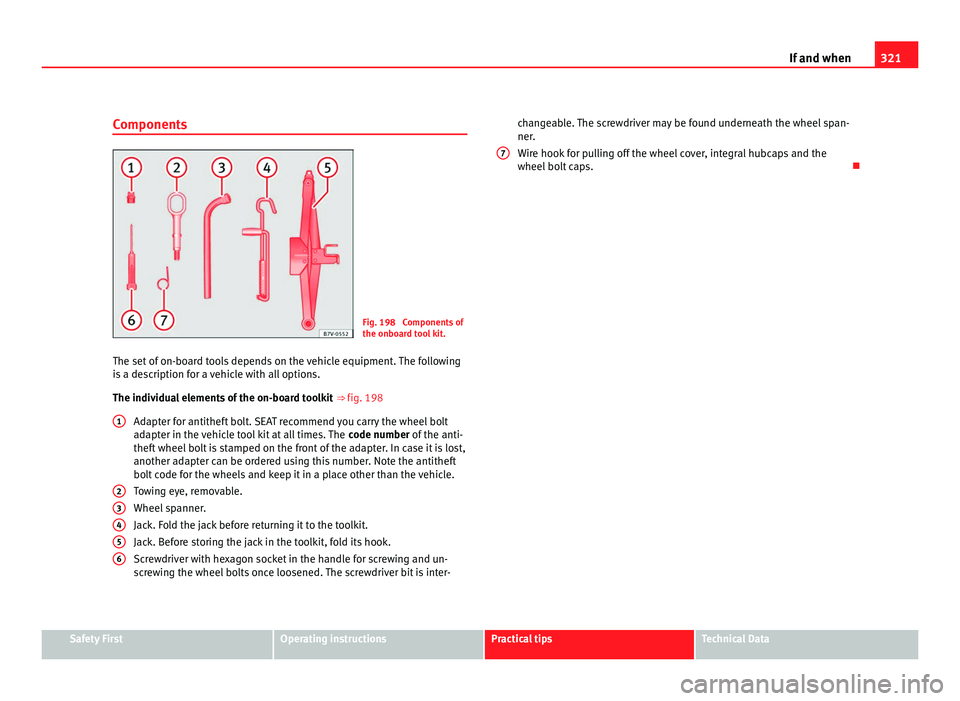
Components Fig. 198 Components of
the onboar
d t
ool kit.
The set of on-board tools depends on the vehicle equipment. The following
is a de
scription for a vehicle with all options.
The individual elements of the on-board toolkit ⇒ fig. 198
Adapter for antitheft bolt. SEAT recommend you carry the wheel bolt
adapter in the vehicle tool kit at all times. The code number of the anti-
theft wheel bolt is stamped on the front of the adapter. In case it is lost,
another adapter can be ordered using this number. Note the antitheft
bolt code for the wheels and keep it in a place other than the vehicle.
Towing eye, removable.
Wheel spanner.
Jack. Fold the jack before returning it to the toolkit.
Jack. Before storing the jack in the toolkit, fold its hook.
Screwdriver with hexagon socket in the handle for screwing and un-
screwing the wheel bolts once loosened. The screwdriver bit is inter-
1 2
3
4
5
6 changeable. The screwdriver may be found underneath the wheel span-
ner.
W
ir
e hook for pulling off the wheel cover, integral hubcaps and the
wheel bolt caps. 7
Safety First Operating instructions Practical tips Technical Data