child lock Seat Alhambra 2011 Owner's Guide
[x] Cancel search | Manufacturer: SEAT, Model Year: 2011, Model line: Alhambra, Model: Seat Alhambra 2011Pages: 385, PDF Size: 7.92 MB
Page 128 of 385
126
Seats and storage compartments WARNING
When the vehicle is not in use or being watched, always lock the doors
and the tai l
gate to reduce the risk of serious injury or death.
● Do not leave children unwatched, especially when the tailgate is
open. Childr
en could climb into the luggage compartment, close the tail-
gate from inside and be unable to escape themselves. This could lead to
serious injury or death.
● Never allow children to play in or around the vehicle.
● Never transport people in the luggage compartment. WARNING
Unsecured or incorrectly secured objects can cause serious injury in case
of a s ud
den manoeuvring or breaking or in case of an accident. This is es-
pecially true when objects are struck by a detonating airbag and fired
through the vehicle interior. To reduce the risks, please note the follow-
ing:
● Secure all objects in the vehicle. Always keep equipment and heavy
obj
ects in the luggage compartment.
● Always secure objects with suitable rope or straps so that they can-
not enter the ar
eas around the frontal or side airbags in case of sudden
braking or an accident.
● While driving, always keep object compartments closed. WARNING (Continued)
● Do not place hard, heavy or sharp objects inside the passenger com-
p ar
tment, in open storage compartments, the rear shelf or on the dash-
board.
● Remove hard, heavy and sharp objects from clothes and pockets in-
side the v
ehicle and store securely. WARNING
The transport of heavy object changes vehicle handling and increases
brak in
g distance. Heavy loads that have not been stored or secured cor-
rectly could cause loss of control and result in serious injury.
● The vehicle handling changes when transporting heavy objects due
to a ch
ange in the centre of gravity.
● Distribute the load as uniformly and as low down on the vehicle as
poss
ible.
● Store heavy objects in the luggage compartment as far from the rear
axle a
s possible. CAUTION
● Hard objects on the shelf could chafe the wires of the heating element
and ant enn
a of the rear window and cause damage.
● The side window antenna could be damaged due to chafing from ob-
jects. Note
The ventilating slits between the heated rear window and the shelf must not
be co v
ered so that used air can escape from the vehicle.
Page 130 of 385
128
Seats and storage compartments
Folding the seats in the second row of seats for loading
●If necessary, open the belt loop and wind up the seat belt by hand.
● If it is necessary, remove the head rests on the integrated child seats
then rein s
talled the integrated child seats ⇒ page 46.
● If necessary, raise the armrests.
● Remove objects from the footrest area in front of and behind the rear
seat ⇒ .
● Move the rear seat all the way back.
● Push the head restraint down as far as it will go ⇒ page 10.
● In the mid
dle seat, close the drinks carrier in the rear of the centre con-
sole, if
necessary.
● Pull lever ⇒ fig. 89 1 back and fold the backrest forwards. The com-
pl et
e rear seat folds forward ⇒ .
● Fold the backrest forwards until it locks into the load surface position
B .
● If necessary, pull on the lever ⇒ fig. 90 2 to move the seat to the re-
quired po s
ition.
● When the seat is folded down, no adults or children should travel in it
⇒ .
Fo l
ding the seats in the third row of seats for loading
● If necessary, open the belt loop and wind up the seat belt by hand.
● Open the tailgate.
● Push the head restraint down as far as it will go ⇒ page 10.
● R
emove objects from the footrest area in front of and behind the rear
seat ⇒ .
● Remove objects from the space below the rear seat.
● Remove the attachment elements and supports for the net from the rail
sys t
em.
● Pull lever 1 back and fold the backrest forwards. The rear seat folds for-
war d
⇒ and the cushion also moves forward. ●
Fold the seat tray forward on top of the folded seat.
● When the se at
is folded down, no adults or children should travel in it
⇒ .
Puttin g the se
ats in the second row back in place
● Pull lever ⇒ fig. 89 1 upwards and place the seatback in vertical posi-
tion. The entir e se
at folds backwards.
● Pull on the rear seats and the backrest to ensure that they are correctly
locked in p
lace and that the safety belt protection is guaranteed for rear
seat passengers.
Putting the seats in the third row back in place
● Open the tailgate.
● Pull on the handle ⇒ fig. 90 2 to put the seat tray back in position.
● Pull on the handle 3 . The entire seat folds backwards.
● Press on the seat tray in the backrest until it is held in position by its
magnets.
● Open the s lidin
g door.
● Put the backrest into position and press firmly until it clicks into place.
● Pull on the rear seats and the backrest to ensure that they are correctly
locked in p
lace and that the safety belt protection is guaranteed for rear
seat passengers. WARNING
Folding and lifting the rear seats carelessly without paying attention
cou l
d cause serious injury.
● Never fold or lift the seats while driving.
● Do no trap or damage seat belts when raising the backrest.
● Keep your hands, fingers, feet and other body parts out of the hinges
and the seat loc
king mechanism when folding and unfolding.
Page 155 of 385
153
Seats and storage compartments
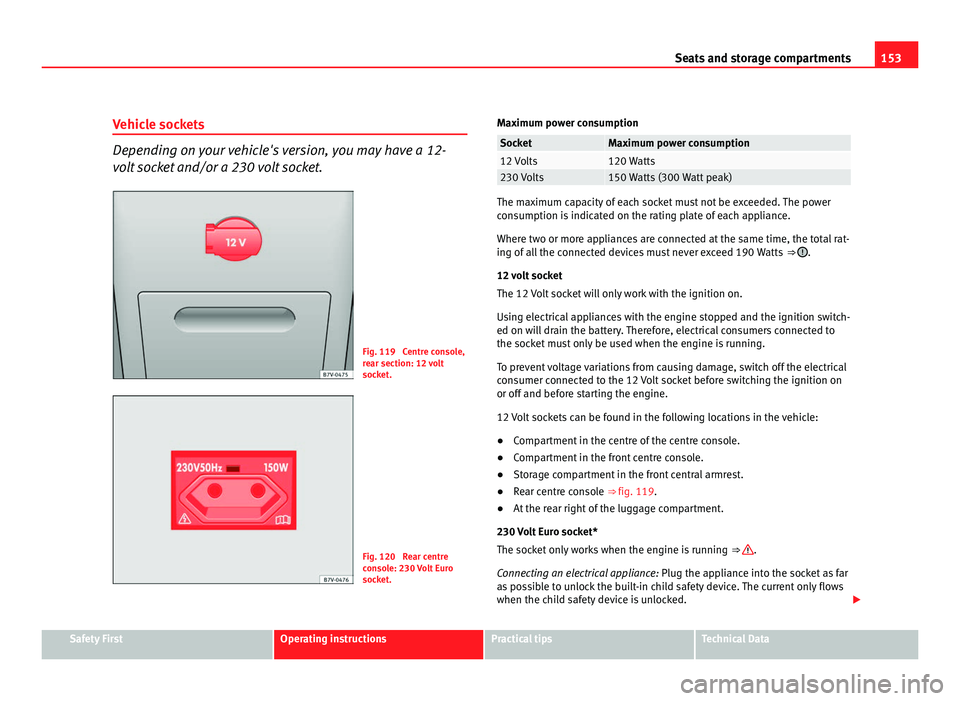
Vehicle sockets Depending on your vehicle's version, you may have a 12-
volt
socket and/or a 230 volt socket. Fig. 119 Centre console,
re
ar section: 12
volt
socket. Fig. 120 Rear centre
con
so
le: 230 Volt Euro
socket. Maximum power consumption Socket Maximum power consumption
12 Volts 120 Watts
230 Volts 150 Watts (300 Watt peak)
The maximum capacity of each socket must not be exceeded. The power
con
s
umption is indicated on the rating plate of each appliance.
Where two or more appliances are connected at the same time, the total rat-
ing of all the connected devices must never exceed 190 Watts ⇒ .
12 v o
lt socket
The 12 Volt socket will only work with the ignition on.
Using electrical appliances with the engine stopped and the ignition switch-
ed on will drain the battery. Therefore, electrical consumers connected to
the socket must only be used when the engine is running.
To prevent voltage variations from causing damage, switch off the electrical
consumer connected to the 12 Volt socket before switching the ignition on
or off and before starting the engine.
12 Volt sockets can be found in the following locations in the vehicle:
● Compartment in the centre of the centre console.
● Compartment in the front centre console.
● Storage compartment in the front central armrest.
● Rear centre console ⇒ fig. 119.
● At the rear right of the luggage compartment.
230 Vo
lt Euro socket*
The socket only works when the engine is running ⇒ .
Conn e
cting an electrical appliance: Plug the appliance into the socket as far
as possible to unlock the built-in child safety device. The current only flows
when the child safety device is unlocked. Safety First Operating instructions Practical tips Technical Data
Page 156 of 385
154
Seats and storage compartments LED on the socket
⇒ fig. 120Steady green light: The child safety device is unlocked. The
sock
et
can now be used. Flashing red light: There is some kind of fault (e.g. discon-
nection due to e
x
cess current or tempera-
ture). Heat protection
The 230 V
o
lt Euro power connector converter switches off automatically
when a certain temperature is exceeded. This disconnect prevents overheat-
ing in the event of an increase in power consumption of the connected ap-
pliance and where the atmospheric temperature is too high. The converter
will switch on again automatically after it has cooled down. Appliances that
are switched on and connected to the socket will start up again. Therefore,
switch off all electrical appliances connected to the socket when the current
converter switches off due to overheating. WARNING
High voltage in the electrical installation!
● Liquids must not be spilt over the socket.
● Do not plug adapters or extension cords into the 230 Volt Euro power
connect or
. Otherwise, the built-in child safety device will switch off and
the connector will become live.
● Do not plug current conductors such as a knitting needle into the 230
Volt
Euro power connector. CAUTION
● Always follow the operating instructions for the appliances to be con-
nect ed!
● Nev
er exceed the maximum power rating as this could damage the vehi-
cle's
general electrical system. ●
12 volt socket:
– Only
use accessories with approved electromagnetic compatibility ac-
cordin
g to current regulations.
– Never power the socket.
● 230 Volt Euro socket:
– Do not hang appliances or plugs that are too heavy (e.g. a transform-
er) from the sock
et.
– Do not connect lamps which contain a neon tube.
– Only plug appliances with a voltage that matches the socket voltage
into the sock
et.
– In the event of consumers with a high start-up current, surge protec-
tion prevents
them from switching on. In this case, unplug the consumer
and try plugging it back in after around 10 seconds. Note
● Some app li
ances may not work properly in the 230 Volt Euro power con-
nector due to a lack of power (Watts).
● The 230 Watt Euro power connector can be modified for 115 Watt appli-
ances
and vice versa. Consult a specialist shop for advice on accessories to
adapt the connector. SEAT recommends visiting a Technical Service.
Page 174 of 385
172
Driving
Key not authorised for the vehicle
If a k ey
which is not authorised for this vehicle is inserted in the ignition
lock, it can be removed as follows:
● Automatic gearbox: the key cannot be removed from the ignition lock.
Pres
s and release the selector lever locking button. Key can be removed
from the vehicle.
● Manual gearbox: Remove the key from the ignition. WARNING
Unsuitable or careless use of the vehicle key could result in serious in-
jury .
● A
lways take all the keys with you whenever you leave the vehicle. The
engine cou
ld accidentally be started and electrical equipment such as
the windows could accidentally be operated resulting in serious injury.
● Never leave children or disabled people alone in the car. They could
be trapped in the c
ar in an emergency and will not be able to get them-
selves to safety. For example, depending on the time of the year, temper-
atures inside a locked and closed vehicle can be extremely high or ex-
tremely low resulting in serious injuries and illness or even death, partic-
ularly for young children.
● Never remove the key from the ignition if the vehicle is in motion. The
steerin
g may lock and it will not be possible to turn the steering wheel. Note
● If the key is left in the ignition lock with the engine off for long periods,
the v
ehicle battery will run flat.
● For automatic gearbox vehicles the key
can only be removed from the ig-
nition lock if the gear selector lever is in position P. In this case, press and
release the selector lever locking button. Starting the engine Complete operations only in the sequence given:
Step
1. Press the brake pedal and keep pressed until step 5 has been
comp
l
eted. 1 a. In vehicles with a manual gearbox:
Pres
s the clutch pedal all
the way and keep pressed until the engine starts. 2. Put the gearstick in neutral or the selector lever in position
P
or N. 3. Only in vehicles with diesel engine:
To prehe
at, turn the key
in the ignition lock to position ⇒ fig. 127 1 . A warning lamp
lights up in the c ontr
ol panel . 4. Turn the key in the ignition lock to position
⇒ fig. 127 2 ; do
not pr e
ss the accelerator. 5. When the engine has started, release the key in the ignition
lock.
6. If the engine does not start, stop the process and try again af-
ter one minut
e. 7. Disconnect the electronic parking brake when you wish to
st
ar
t driving ⇒ page 183. WARNING
Never leave the vehicle unattended if the engine is running. The vehicle
cou l
d move off suddenly, especially if it is in gear, resulting in an acci-
dent and serious injury.
Page 185 of 385
183
Driving
Braking, stopping and parking
Introduction The assisted braking systems include the anti-lock braking system (ABS),
the br
ak
e assist system (BAS), the electronic differential system (EDS), the
ASR traction control system (TCS) and the ESC electronic stabilisation pro-
gram (ESP).
Additional information and warnings:
● Towing mode ⇒ page 233
● St
art assist systems ⇒ page 194
● Wheel
s and tyres ⇒ page 293
● A
ccessories, parts replacement, repairs and modifications ⇒ page 257WARNING
Driving with worn brake pads or a faulty brake system may lead to seri-
ous ac
cident.
● If lights, alone or accompanied by a warning message on the in-
strument
panel, please go immediately to a specialist workshop to check
the brake pads and to replace them if they are worn. WARNING
Careless parking can cause serious injury.
● Never remove the key from the ignition if the vehicle is in motion. The
st eerin
g lock may engage and locked the steering wheel making the vehi-
cle impossible to control. WARNING (Continued)
● Always park your vehicle so that no part of the exhaust system can
c ome in c
ontact with flammable materials (such as wood, leaves, spilled
fuel, dried grass, etc).
● Always apply the electronic parking brake when you leave your vehi-
cle and when
you park.
● Never leave children or disabled people alone in the vehicle. They
coul
d release the electronic parking brake, activate the selector lever or
gear stick and start the vehicle moving. This could result in serious acci-
dent.
● Always take all the keys with you whenever you leave the vehicle. The
engine cou
ld accidentally be started and electrical equipment such as
the windows could accidentally be operated resulting in serious injury.
● Never leave children or disabled people alone in the car. They could
be trapped in the c
ar in an emergency and will not be able to get them-
selves to safety. For example, depending on the time of the year, temper-
atures inside a locked and closed vehicle can be extremely high or ex-
tremely low resulting in serious injuries and illness or even death, partic-
ularly for young children. CAUTION
● Special care should be taken when parking in areas with high kerbs or
fi x
ed barriers. Objects protruding from the ground may damage the bumper
or other parts of the vehicle during manoeuvres. To avoid damage, stop be-
fore the wheels touched the barrier or kerb.
● Special attention is required when driving through entrances, over
ramps, k
erbs or other objects. The vehicle underbody, bumpers, mudguards
and running gear, and the engine and exhaust system could be damaged as
you drive over these objects. Safety First Operating instructions Practical tips Technical Data
Page 188 of 385
186
Driving
Automatic release of the electronic parking brake on starting the engine
The electr onic
parking brake is automatically released when the vehicle
starts moving, if the driver's door is closed and the driver is wearing his/her
seat belt. In vehicles with a manual gearbox the clutch pedal should also be
pressed to the floor before starting the engine so that the system recogni-
ses that the parking brake should be released.
Emergency braking function
Only use the emergency braking function if the vehicle cannot be stopped
with the brake pedal ⇒ !
● Pull button hard to stop the vehicle. The warning display will be ac-
c omp
anied by the corresponding warning chime.
● To stop the braking process, release the button or press the accelerator. WARNING
The incorrect use of the electronic parking brake may result in serious ac-
cident .
● Nev
er use the electronic parking brake to brake the vehicle except in
an emergency
. The braking distance is considerably longer, because
braking is only applied to the rear wheels. Always use the foot brake.
● Never accelerate from the engine compartment with the engine run-
ning and a ge
ar or a gear range engaged. The vehicle could move, even if
the parking brake is applied. Note
● In vehicles with a manual gearbox: When the clutch pedal is released
and the ac c
elerator pressed at the same time, the electronic parking brake
is automatically released.
● If the vehicle battery is flat, it will not be possible to disconnect the elec-
tronic p
arking brake. Use the jump-start ⇒ page 337. ●
When the electronic
parking brake is applied or released, noises may be
heard.
● If the electronic parking brake has not been used for a long while, the
syst
em sometimes performs automatic and audible checks while the vehi-
cle is at a standstill.
Parking When parking your vehicle, all legal requirements should be observed.
To p
ark
the vehicle
Complete operations only in the sequence given.
● Park the vehicle on a suitable surface ⇒ .
● Press and hold the brake pedal until the vehicle comes to a standstill.
● Connect the electronic parking brake ⇒ page 185.
● F
or an automatic gearbox, move the selector lever to position P.
● Switch off the engine and release the brake pedal.
● Remove the key from the ignition.
● If necessary, turn the steering wheel slightly to lock the steering.
● With a manual gearbox, engage the 1st gear on flat ground and slopes,
or even the rev
erse gear on hills, and release the clutch pedal.
● Ensure that all passengers leave the vehicle, especially children.
● When leaving the vehicle, take all keys with you.
● Lock the vehicle.
Additiona
l information for steep slopes and hills
Before switching off the engine, rotate the steering wheel so that if the vehi-
cle should move then it will be held by the kerb.
Page 276 of 385
274
Checking and refilling levels
Opening the tank filling neck
● Open the tailgate.
● Rotate the shut off on the cover clockwise ⇒ fig. 164 and open the cov er
forwards.
● Unscrew the tank filler neck cap ⇒ fig. 165 1 anticlockwise.
Refi l
ling AdBlue
Only use AdBlue that is approved by SEAT and that complies with the
ISO 22241-1 Standard. Only use genuine bottles.
● Observe the instructions and information provided by the refill bottle
manufact
urer.
● Observe the expiry date.
● Unscrew the cap on the refill bottle.
● Place the refill bottle 2 upside down inside the tank filler neck.
● Press the refill bottle against the filler neck and keep in this position.
● Add at least 10 litres of AdBlue (6 bottles). A lower quantity
would be
insufficient.
● Wait until the contents of the refill bottle have been poured into the
AdBlue tank. Do not c
rush or damage the bottle!
● Unscrew the liquid bottle anticlockwise and remove it carefully ⇒ .
● You can tell when the AdBlue tank is full because the bottle will be emp-
ty.
C lo
sing the tank filling neck
● Screw on the tank filler neck cap 1 clockwise until it is fully inserted.
● Place the cover and turn the shut off anticlockwise to close it.
Operation s
before driving
● Only switch the ignition on after refilling.
● Keep the ignition sw
itch on for at least 30 seconds so that the system
detects t
ank refilling.
● Wait 30 seconds before starting the engine! WARNING
Only keep AdBlue in its original container, tightly shut and in a safe
pl ac
e.
● Never keep AdBlue in empty food cans, bottles or other containers to
avoid other peopl
e mistaking it for something else.
● Keep the AdBlue out of the reach of small children. CAUTION
● Only refill using AdBlue expressly approved by SEAT. The use of any oth-
er type of AdBlue c
ould cause engine damage!
● AdBlue should never be mixed with water or any other additives. Any
type of dam
age caused by a mixture will not be covered by the warranty.
● Do not add AdBlue to the diesel fuel tank! Otherwise you may damage
the engine.
● Never l
eave the refill bottle in the vehicle. It could become permeable
due to temper
ature changes and bottle damage and the AdBlue could dam-
age the vehicle interior. For the sake of the environment
Dispose of the refill bottle in an environment-friendly manner. Note
Suitable AdBlue refill bottles can be purchased from a Technical Service.
Page 278 of 385
276
Checking and refilling levels WARNING (Continued)
● Onc e the engine has cooled, follow the instructions below before
openin g the bonnet:
– T
urn on the electronic parking brake and place the gear selector
lever in P or the g
ear stick in neutral.
– Remove the key from the ignition.
– Keep children away from the engine compartment and never leave
them uns
upervised.
● When the engine is warm or hot, the cooling system is pressurised!
Do not un
screw the cap on the expansion tank when the engine is hot.
Otherwise, coolant may spray out under pressure causing burns and seri-
ous injury.
–Carefully and slowly unscrew the cap anticlockwise, gently press-
ing down on it
.
– Always protect your face, hands and arms from hot coolant and
ste
am using a large, thick cloth.
● When refilling liquids, avoid spilling them on parts of the engine and
the exhau
st system. Spilled liquids could cause a fire. WARNING
The high voltages of the electrical system can give electric shocks as well
as c
ausing burns and serious injury and possibly even death!
● Never cause short circuits in the electrical system. The battery could
explode.
● T
o minimise the risk of electric shock and serious consequences
while the en
gine is running or starting the engine, note the following:
– Never touch the electrical wiring of the ignition system.
– Never touch electric cables or the gas discharge lamps. WARNING
In the engine compartment, there are rotating parts that could cause se-
rious injur
y.
● Never place your hands on or near the radiator fan. Touching the rotor
bla
des could seriously harm you. The ventilator works according to the
engine temperature and could start suddenly even when the ignition is
turned off and the key is removed.
● If any work has to be performed when the engine is started or with
the engine runnin
g, there is an additional, potentially fatal, safety risk
from the rotating parts, such as the drive belts, alternator, radiator fan
etc as well as from the high-voltage ignition system. Always work with
the utmost caution.
–Always make sure that no parts of your body, jewellery, ties, loose
clothing and lon
g hair can be trapped by the rotating parts of the en-
gine. Before any work, remove ties and jewellery ( necklaces, etc), tie
longhair back and tie all items of loose clothing to your body to make
sure that they cannot be trapped by engine components.
– Take extreme caution when operating the accelerator and remain
attentive.
The vehicle could move, even with the electronic parking
brake activated.
● Always make sure you have not left any objects, such as cloths or
tool
s, in the engine compartment. If any object is left in the engine com-
partment, this could cause malfunctions, engine faults and even a fire. WARNING
Refill liquids and certain materials can catch fire easily in the engine
comp ar
tment, causing a fire and serious injury!
● Never smoke.
● Never work close to places exposed to flames or sparks.
Page 279 of 385
277
Checking and refilling levels WARNING (Continued)
● Nev er pour service fluids over the engine. These fluid may ignite hot
en gine p
arts and cause injuries.
● If it is necessary to work on the fuel system or the electrical system,
ple
ase follow the instructions below:
– Always disconnect the vehicle battery. When disconnecting the
batter
y, ensure that the vehicle is unlocked otherwise the antitheft
alarm will be triggered.
– Never work close to heaters, heat sources or places exposed to
flames
or sparks.
● Always keep a recently serviced and perfectly working fire extin-
guisher clo
se by. CAUTION
When refilling or changing service liquids, ensure that you put the liquids
into the right t
ank. Making a mistake when refilling could cause serious
malfunctions and damage the engine! For the sake of the environment
Service fluids leaks are harmful to the environment. For this reason you
shoul d m
ake regular checks on the ground underneath your vehicle. Take
the vehicle to a specialist workshop to be checked if you see stains, oil or
other fluids on the ground. Collect any spilt service fluids and allow a pro-
fessional to dispose of them.
Preparing the vehicle for work in the engine compartment Checklist
Carr
y
out the operations below in the order indicated before starting work in
the engine compartment ⇒ : ●
Park the vehicle on an even and solid surface.
● Pre
ss and hold the brake pedal until the vehicle comes to a standstill.
● Connect the electronic parking brake ⇒ page 183.
● Mo
ve the selector lever to its intermediate position or to P ⇒ page 174.
● St
op the engine and remove the key from the ignition ⇒ page 170.
● W
ait for the engine to cool down.
● Always keep children and other people far from the engine compart-
ment.
● Ens
ure that the vehicle can not move off unexpectedly. WARNING
Ignoring this checklist, drawn up for your own safety, could result in seri-
ous injur
y.
● Always complete the operations given in the checklist and observe
the genera
l rules of safety.
Safety First Operating instructions Practical tips Technical Data