lock Seat Alhambra 2011 Owner's Manual
[x] Cancel search | Manufacturer: SEAT, Model Year: 2011, Model line: Alhambra, Model: Seat Alhambra 2011Pages: 385, PDF Size: 7.92 MB
Page 5 of 385
Table of Contents
Manual structure
. . . . . . . . . . . . . . . . . . . . 5
Content . . . . . . . . . . . . . . . . . . . . . . . . . . . . . . . . 6
Safety First . . . . . . . . . . . . . . . . . . . . . . . . . . . . 7
Safe driving . . . . . . . . . . . . . . . . . . . . . . . . . . . . . . . 7
Dear SEAT Driver . . . . . . . . . . . . . . . . . . . . . . . . . . 7
Tips for driving . . . . . . . . . . . . . . . . . . . . . . . . . . . 7
Adjusting the seat position . . . . . . . . . . . . . . . . . 10
Transporting objects . . . . . . . . . . . . . . . . . . . . . . . 13
Seat belts . . . . . . . . . . . . . . . . . . . . . . . . . . . . . . . . . 16
Brief introduction . . . . . . . . . . . . . . . . . . . . . . . . . 16
Why wear seat belts? . . . . . . . . . . . . . . . . . . . . . . 19
Seat belts . . . . . . . . . . . . . . . . . . . . . . . . . . . . . . . 21
Seat belt tensioners . . . . . . . . . . . . . . . . . . . . . . . 26
Airbag system . . . . . . . . . . . . . . . . . . . . . . . . . . . . . 28
Brief introduction . . . . . . . . . . . . . . . . . . . . . . . . . 28
Airbag system . . . . . . . . . . . . . . . . . . . . . . . . . . . . 31
Child safety . . . . . . . . . . . . . . . . . . . . . . . . . . . . . . . 39
Child seats (accessories) . . . . . . . . . . . . . . . . . . . 39
Integrated child seat . . . . . . . . . . . . . . . . . . . . . . . 46
Operating instructions . . . . . . . . . . . . . 53
Cockpit . . . . . . . . . . . . . . . . . . . . . . . . . . . . . . . . . . . 53
Overview . . . . . . . . . . . . . . . . . . . . . . . . . . . . . . . . 53
Instrument panel . . . . . . . . . . . . . . . . . . . . . . . . . . 54
Instruments . . . . . . . . . . . . . . . . . . . . . . . . . . . . . . 57
SEAT information system . . . . . . . . . . . . . . . . . . . 62 Unlocking and locking
. . . . . . . . . . . . . . . . . . . . . 71
Vehicle key set . . . . . . . . . . . . . . . . . . . . . . . . . . . 71
Central locking and locking system . . . . . . . . . . . 74
Doors . . . . . . . . . . . . . . . . . . . . . . . . . . . . . . . . . . . 80
Sliding doors . . . . . . . . . . . . . . . . . . . . . . . . . . . . . 81
Tailgate . . . . . . . . . . . . . . . . . . . . . . . . . . . . . . . . . 84
Electric windows . . . . . . . . . . . . . . . . . . . . . . . . . . 89
Panorama sliding sunroof* . . . . . . . . . . . . . . . . . 92
Lights and visibility . . . . . . . . . . . . . . . . . . . . . . . . 95
Lights . . . . . . . . . . . . . . . . . . . . . . . . . . . . . . . . . . . 95
Sun blind . . . . . . . . . . . . . . . . . . . . . . . . . . . . . . . . 103
Windscreen wiper and washer . . . . . . . . . . . . . . . 105
Rear vision mirror . . . . . . . . . . . . . . . . . . . . . . . . . 110
Seats and storage compartments . . . . . . . . . . 114
Seat adjustment . . . . . . . . . . . . . . . . . . . . . . . . . . 114
Seat functions . . . . . . . . . . . . . . . . . . . . . . . . . . . . 117
Head restraints . . . . . . . . . . . . . . . . . . . . . . . . . . . 123
Centre armrest . . . . . . . . . . . . . . . . . . . . . . . . . . . . 125
Loading luggage compartment . . . . . . . . . . . . . . 125
Roof carrier system* . . . . . . . . . . . . . . . . . . . . . . . 138
Storage compartments . . . . . . . . . . . . . . . . . . . . . 141
Cup holders . . . . . . . . . . . . . . . . . . . . . . . . . . . . . . 148
Ashtray and cigarette lighter* . . . . . . . . . . . . . . . 150
Sockets . . . . . . . . . . . . . . . . . . . . . . . . . . . . . . . . . 151
Heating, Ventilation and Air conditioning . . . 155
Climate Control . . . . . . . . . . . . . . . . . . . . . . . . . . . 155
Auxiliary heater* (additional heater) . . . . . . . . . . 163
Driving . . . . . . . . . . . . . . . . . . . . . . . . . . . . . . . . . . . . 167
Steering . . . . . . . . . . . . . . . . . . . . . . . . . . . . . . . . . 167
Stopping and starting the engine . . . . . . . . . . . . 170
Changing gear . . . . . . . . . . . . . . . . . . . . . . . . . . . . 174
Braking, stopping and parking . . . . . . . . . . . . . . 183
Start assist systems . . . . . . . . . . . . . . . . . . . . . . . 194
Parking sensor system* . . . . . . . . . . . . . . . . . . . . 198 Park Assist system* . . . . . . . . . . . . . . . . . . . . . . . 202
Rear Assist system* . . . . . . . . . . . . . . . . . . . . . . . 207
Cruise control system* . . . . . . . . . . . . . . . . . . . . . 212
Lane Assist system* . . . . . . . . . . . . . . . . . . . . . . . 215
Sign Assist* . . . . . . . . . . . . . . . . . . . . . . . . . . . . . . 218
Tyre monitoring systems . . . . . . . . . . . . . . . . . . . . 221
Practical tips . . . . . . . . . . . . . . . . . . . . . . . . . . 225
Driving and the environment . . . . . . . . . . . . . . . 225
Running-in . . . . . . . . . . . . . . . . . . . . . . . . . . . . . . . 225
Ecological driving . . . . . . . . . . . . . . . . . . . . . . . . . 225
Engine management and exhaust gas
purific ation sy
stem . . . . . . . . . . . . . . . . . . . . . . . . 228
Trailer towing . . . . . . . . . . . . . . . . . . . . . . . . . . . . . . 231
Introduction . . . . . . . . . . . . . . . . . . . . . . . . . . . . . . 231
Driving with a trailer . . . . . . . . . . . . . . . . . . . . . . . 233
Vehicle maintenance and cleaning . . . . . . . . . 242
Care and cleaning the vehicle exterior . . . . . . . . 242
Caring for and cleaning the vehicle interior . . . . 249
Notes for the user . . . . . . . . . . . . . . . . . . . . . . . . . 255
Accessories, parts replacement and
modifications . . . . . . . . . . . . . . . . . . . . . . . . . . . . .
257
Accessories, replacement of parts and
modifications
. . . . . . . . . . . . . . . . . . . . . . . . . . . . 257
Checking and refilling levels . . . . . . . . . . . . . . . 264
Filling the tank . . . . . . . . . . . . . . . . . . . . . . . . . . . . 264
Fuel . . . . . . . . . . . . . . . . . . . . . . . . . . . . . . . . . . . . 267
Selective Catalytic Reduction* (AdBlue) . . . . . . . 271
Working in the engine compartment . . . . . . . . . . 275
Engine oil . . . . . . . . . . . . . . . . . . . . . . . . . . . . . . . . 279
Engine coolant . . . . . . . . . . . . . . . . . . . . . . . . . . . 283
Vehicle battery . . . . . . . . . . . . . . . . . . . . . . . . . . . 288 3
Table of Contents
Page 6 of 385
Wheels and tyres
. . . . . . . . . . . . . . . . . . . . . . . . . . 293
Wheels . . . . . . . . . . . . . . . . . . . . . . . . . . . . . . . . . . 293
Wheel trims* . . . . . . . . . . . . . . . . . . . . . . . . . . . . . 304
Changing a wheel* . . . . . . . . . . . . . . . . . . . . . . . . 305
If and when . . . . . . . . . . . . . . . . . . . . . . . . . . . . . . . 312
In case of emergency . . . . . . . . . . . . . . . . . . . . . . 312
Emergency locking and unlocking . . . . . . . . . . . . 314
Tools* . . . . . . . . . . . . . . . . . . . . . . . . . . . . . . . . . . . 320
Fuses . . . . . . . . . . . . . . . . . . . . . . . . . . . . . . . . . . . 322
Changing bulbs . . . . . . . . . . . . . . . . . . . . . . . . . . . 326
Starting assistance . . . . . . . . . . . . . . . . . . . . . . . . 337
Towing and tow starting . . . . . . . . . . . . . . . . . . . . 340
Technical Data . . . . . . . . . . . . . . . . . . . . . . . . 344
General notes on the technical data . . . . . . . . 344
Outstanding information . . . . . . . . . . . . . . . . . . . 344
Data on fuel consumption . . . . . . . . . . . . . . . . . . 346
Towing a trailer . . . . . . . . . . . . . . . . . . . . . . . . . . . 347
Wheels . . . . . . . . . . . . . . . . . . . . . . . . . . . . . . . . . . 347
Technical Data . . . . . . . . . . . . . . . . . . . . . . . . . . . . 348
Checking fluid levels . . . . . . . . . . . . . . . . . . . . . . . 348
Petrol engine 1.4 110 kW (150 PS) . . . . . . . . . . . 349
Petrol engine 1.4 110 kW (150 HP). Automatic . 350
Petrol engine 2.0 147 kW (200 HP). Automatic . 351
Diesel engine 2.0 TDI CR 85 kW (115 PS) . . . . . . 352
Diesel engine 2.0 TDI CR 100 kW (136 PS) . . . . . 354
Diesel engine 2.0 TDI CR 100 kW (136 PS)
Autom atic
. . . . . . . . . . . . . . . . . . . . . . . . . . . . . . . 355
Diesel engine 2.0 TDI CR 103 kW (140 PS) . . . . . 356
Diesel engine 2.0 TDI CR 103 kW (140 PS)
Automatic
. . . . . . . . . . . . . . . . . . . . . . . . . . . . . . . 357
Diesel engine 2.0 TDI CR 103 kW (140 PS) four-
wheel drive
. . . . . . . . . . . . . . . . . . . . . . . . . . . . . . 359
Diesel engine 2.0 TDI CR 125 kW (170 PS) . . . . . 360 Diesel engine 2.0 TDI CR 125 kW (170 PS)
Automatic
. . . . . . . . . . . . . . . . . . . . . . . . . . . . . . . 361
Dimensions and capacities . . . . . . . . . . . . . . . . . 363
Index . . . . . . . . . . . . . . . . . . . . . . . . . . . . . . . . . . . 3654
Table of Contents
Page 13 of 385
11
Safe driving WARNING (Continued)
● Keep your back straight and resting completely against the backrest
and the fr ont
seats correctly adjusted. Never place any part of your body
in the area of the airbag or very close to it.
● If passengers on the rear seats are not sitting in an upright position,
the risk of
severe injury due to incorrect positioning of the belt web in-
creases. WARNING
Incorrect seat adjustment may lead to accidents and severe injuries.
● Only adjust the seats when the vehicle is stationary, as the seats
cou l
d move unexpectedly while the vehicle is in motion and you could
lose control of the vehicle. Furthermore, an incorrect position is adopted
when adjusting the seat.
● Only adjust the height, backrest and forwards or backwards position
of the seat
when there is nobody in the seat adjustment area.
● There must be no objects blocking the seat adjustment area.
● Only adjust the height, angle and longitudinal position of the rear
seats
when nobody is in the way.
● The seat adjustment and lock areas must be kept clean.
Danger of injuries due to an incorrect sitting position If the seat belts are worn incorrectly or not at all, the risk of severe injuries
incr
e
ases. Seat belts can provide optimal protection only if the belt web is
properly worn. The seat belt cannot offer its full protection if the belt web is
not positioned correctly. This could result in severe and even fatal injuries.
The risk of severe or fatal injuries is especially increased when a deploying
airbag strikes an occupant who has assumed an incorrect sitting position.
The driver is responsible for all passengers in the vehicle, particularly chil-
dren. The following list shows just some examples of incorrect sitting positions
which can be d
angerous to all occupants.
Whenever the vehicle is in motion:
● Never stand in the vehicle.
● Never stand on the seats.
● Never kneel on the seats.
● Never tilt your backrest too far to the rear.
● Never lean against the dash panel.
● Never lie on the rear bench.
● Never sit on the front edge of a seat.
● Never sit sideways.
● Never lean out of a window.
● Never put your feet out of a window.
● Never put your feet on the dash panel.
● Never put your feet on the surface of a seat or backrest.
● Never travel in a footwell.
● Never sit on the armrests.
● Never travel on a seat without wearing the seat belt.
● Never carry any person in the luggage compartment. WARNING
Every incorrect sitting position increases the risk of severe or fatal inju-
ries in the ev
ent of accidents or sudden braking or manoeuvres.
● All passengers must assume the proper sitting position and be prop-
erly belted in whi
le travelling.
● Occupants in incorrect sitting positions, not wearing their seat belt or
too clo
se to the airbag run the risk of suffering severe or fatal injuries,
particularly if the airbag deploys and hits an occupant sitting in an incor-
rect position.
Safety First Operating instructions Practical tips Technical Data
Page 14 of 385
12
Safe driving
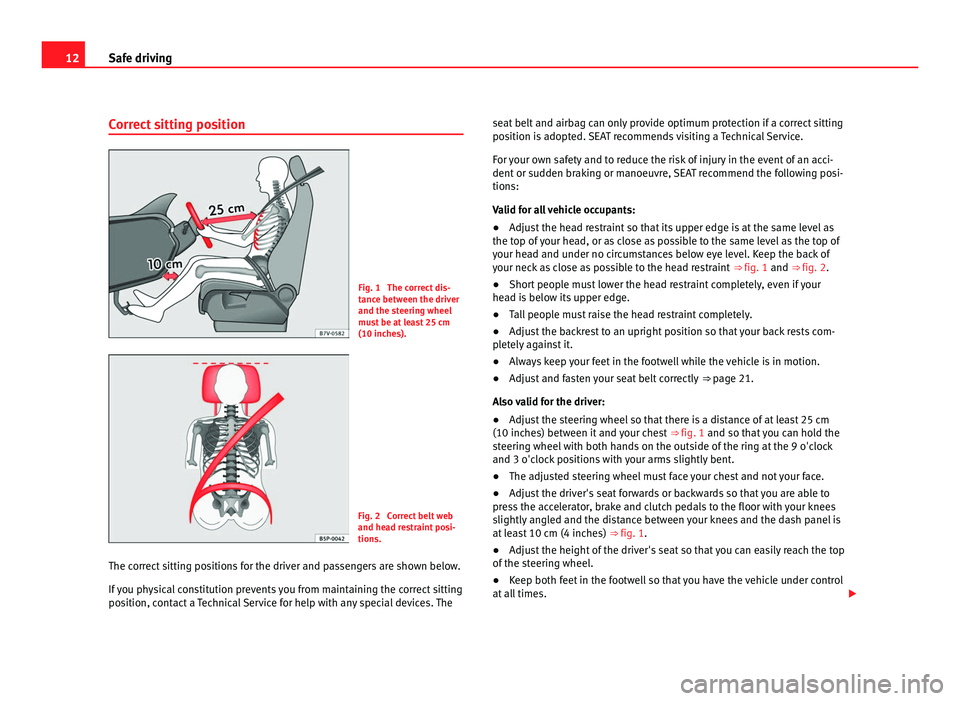
Correct sitting position Fig. 1 The correct dis-
tanc
e betw
een the driver
and the steering wheel
must be at least 25 cm
(10 inches). Fig. 2 Correct belt web
and hea
d r
estraint posi-
tions.
The correct sitting positions for the driver and passengers are shown below.
If y
ou physical constitution prevents you from maintaining the correct sitting
position, contact a Technical Service for help with any special devices. The seat belt and airbag can only provide optimum protection if a correct sitting
position i
s adopted. SEAT recommends visiting a Technical Service.
For your own safety and to reduce the risk of injury in the event of an acci-
dent or sudden braking or manoeuvre, SEAT recommend the following posi-
tions:
Valid for all vehicle occupants:
● Adjust the head restraint so that its upper edge is at the same level as
the top of
your head, or as close as possible to the same level as the top of
your head and under no circumstances below eye level. Keep the back of
your neck as close as possible to the head restraint ⇒ fig. 1 and ⇒ fig. 2.
● Short people must lower the head restraint completely, even if your
head i
s below its upper edge.
● Tall people must raise the head restraint completely.
● Adjust the backrest to an upright position so that your back rests com-
plet
ely against it.
● Always keep your feet in the footwell while the vehicle is in motion.
● Adjust and fasten your seat belt correctly ⇒ page 21.
A
lso valid for the driver:
● Adjust the steering wheel so that there is a distance of at least 25 cm
(10 inches) betw
een it and your chest ⇒ fig. 1 and so that you can hold the
steering wheel with both hands on the outside of the ring at the 9 o'clock
and 3 o'clock positions with your arms slightly bent.
● The adjusted steering wheel must face your chest and not your face.
● Adjust the driver's seat forwards or backwards so that you are able to
pres
s the accelerator, brake and clutch pedals to the floor with your knees
slightly angled and the distance between your knees and the dash panel is
at least 10 cm (4 inches) ⇒ fig. 1.
● Adjust the height of the driver's seat so that you can easily reach the top
of the st
eering wheel.
● Keep both feet in the footwell so that you have the vehicle under control
at all
times.
Page 16 of 385
14
Safe driving WARNING
The driving behaviour and braking ability change when transporting
heavy and l
arge objects.
● Adjust your speed and driving style to visibility, road, traffic and
weather c
onditions.
● Accelerate gently and carefully.
● Avoid sudden braking and manoeuvres.
● Brake early.
Transporting a load Secure all objects in the vehicle
●
Distribute the load throughout the vehicle, on the roof and in a trailer as
unif orm
ly as possible.
● Transport heavy objects as far forward as possible in the luggage com-
partment
and lock the seat backs in the vertical position.
● Secure luggage in the luggage compartment with suitable straps on the
fas
tening rings ⇒ page 125.
● Check the headlight adjustment ⇒ page 95.
● U
se the suitable tyre pressure according to the load being transported.
Rea
d the tire inflation information label ⇒ page 293.
● For vehicles with a tire pressure indicator, change the vehicle load status
⇒ page 221. CAUTION
Objects on the shelf could chafe against the wires of the heating element in
the re ar w
indow and cause damage. Note
Please note the information about loading a trailer ⇒ pag
e 233 and the
roof carrier system ⇒ page 138.
Driving with the tailgate open Driving with the tailgate open creates an additional risk. Secure all objects
and secur
e the t
ailgate correctly and take all measures possible to reduce
toxic gases from entering the vehicle. WARNING
Driving with the tailgate unlocked or open could cause serious injuries.
● Always drive with the tailgate closed.
● Secure all objects in the vehicle. Loose items could fall out of the ve-
hicl e and injur
e other road users or damage other vehicles.
● Drive particularly carefully and think ahead.
● Avoid sudden manoeuvres and braking given that this could cause an
uncontr
olled movement of the open tailgate.
● When transporting objects that protrude out of the luggage compart-
ment, indicate them s
uitably. Observe legal requirements.
● If objects must project out of the luggage compartment, the tailgate
must
never be used to “secure” or “attach” objects.
● If a baggage rack is fitted on the tailgate, it should be removed before
travel
ling with the tailgate open.
Page 17 of 385
15
Safe driving WARNING
Toxic gases may enter the vehicle interior when the tailgate is open. This
cou l
d cause loss of consciousness, carbon monoxide poisoning, serious
injury and accidents.
● To avoid toxic gases entering the vehicle always drive with the tail-
gate c
losed.
● In exceptional circumstances, if you must drive with the tailgate
open, obser
ve the following to reduce the entry of toxic gases inside the
vehicle:
–Close all windows and the sliding roof.
– Turn off the air recirculation for the heating and air conditioning.
– Open all of the air outlets in the dashboard.
– Turn the heating fan and heater to the highest level. CAUTION
An open tailgate changes the length and height of the vehicle.
Driving a loaded vehicle For the best handling when driving a loaded vehicle, note the following:
●
Secure all objects
⇒ pag
e 14.
● A
ccelerate gently and carefully.
● Avoid sudden braking and manoeuvres.
● Brake early.
● If necessary, read the instructions for driving with a trailer
⇒ page 233.
● If
necessary, read the instructions for driving with a roof carrier system
⇒ page 138. WARNING
A sliding load could considerably affect the stability and safety of the ve-
hicl e r
esulting in an accident with serious consequences.
● Secure loads correctly so they do not move.
● When transporting heavy objects, use suitable ropes or straps.
● Lock the seat backs in vertical position.
Specific vehicle weight information The instructions in the official vehicle documents take precedence. All the
tec
hnic
al data provided in this documentation is applicable to the basic
model. The vehicle data label in the Maintenance Programme or the vehicle
documents show which engine is installed in your vehicle.
The figures may be different depending on if additional equipment is fitted,
for different models and for special vehicles. WARNING
Exceeding the maximum authorised weight and the load on the axles
cou l
d cause damage to the vehicle, accidents and serious injuries.
● The real load on the axles should never exceed the maximum permit-
ted.
● The loa
d and its distribution in the vehicle have effects on the vehicle
handling and the br
aking ability. Always drive at a suitable speed. CAUTION
Distribute the load as uniformly and as low down on the vehicle as possible.
When tran s
porting heavy objects in the trunk/boot, these should be placed
as far forward as possible or over the rear axle to have as little influence on
handling as possible. Safety First Operating instructions Practical tips Technical Data
Page 28 of 385
26
Seat belts Note
If you physical constitution prevents you from maintaining the correct posi-
tion of the belt w
ebbing, contact a Technical Service for help with any spe-
cial devices to ensure the optimum protection of the seat belt and airbag.
SEAT recommends visiting a Technical Service.
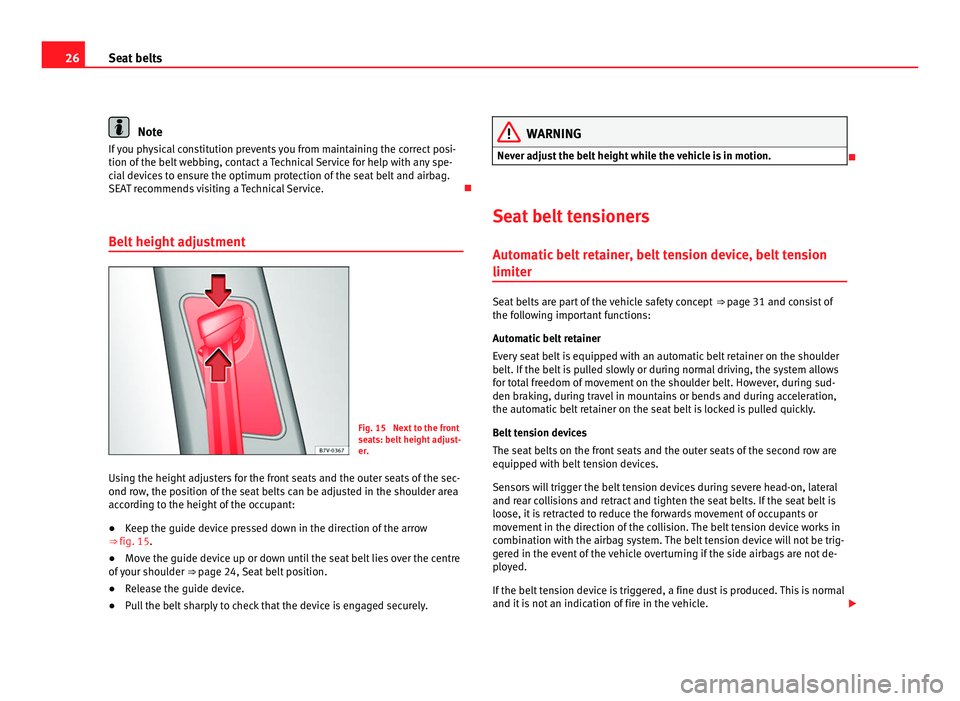
Belt height adjustment Fig. 15 Next to the front
seat
s: belt
height adjust-
er.
Using the height adjusters for the front seats and the outer seats of the sec-
ond row
, the position of the seat belts can be adjusted in the shoulder area
according to the height of the occupant:
● Keep the guide device pressed down in the direction of the arrow
⇒ fig. 15.
● Move the guide device up or down until the seat belt lies over the centre
of y
our shoulder ⇒ page 24, Seat belt position.
● Release the guide device.
● Pull the belt sharply to check that the device is engaged securely. WARNING
Never adjust the belt height while the vehicle is in motion.
Seat belt tensioners
Autom atic
belt retainer, belt tension device, belt tension
limiter Seat belts are part of the vehicle safety concept
⇒ page 31 and c
onsist of
the following important functions:
Automatic belt retainer
Every seat belt is equipped with an automatic belt retainer on the shoulder
belt. If the belt is pulled slowly or during normal driving, the system allows
for total freedom of movement on the shoulder belt. However, during sud-
den braking, during travel in mountains or bends and during acceleration,
the automatic belt retainer on the seat belt is locked is pulled quickly.
Belt tension devices
The seat belts on the front seats and the outer seats of the second row are
equipped with belt tension devices.
Sensors will trigger the belt tension devices during severe head-on, lateral
and rear collisions and retract and tighten the seat belts. If the seat belt is
loose, it is retracted to reduce the forwards movement of occupants or
movement in the direction of the collision. The belt tension device works in
combination with the airbag system. The belt tension device will not be trig-
gered in the event of the vehicle overturning if the side airbags are not de-
ployed.
If the belt tension device is triggered, a fine dust is produced. This is normal
and it is not an indication of fire in the vehicle.
Page 36 of 385
34
Airbag system
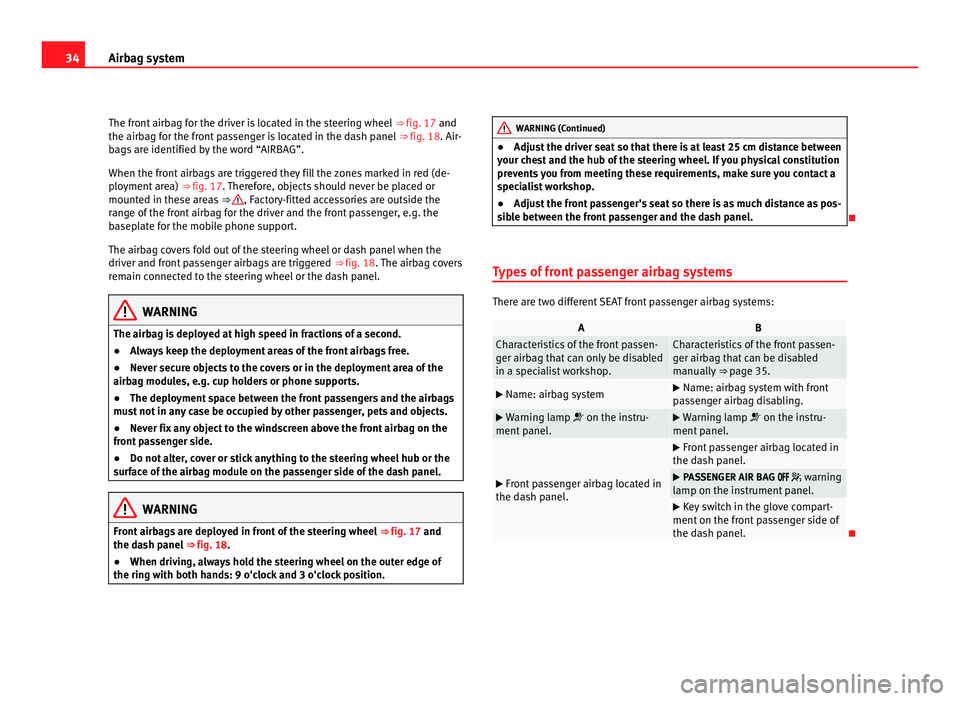
The front airbag for the driver is located in the steering wheel ⇒ fig. 17 and
the airb ag for the front passenger is located in the dash panel ⇒ fig. 18. Air-
bags are identified by the word “AIRBAG”.
When the front airbags are triggered they fill the zones marked in red (de-
ployment area) ⇒ fig. 17. Therefore, objects should never be placed or
mounted in these areas ⇒ , Factory-fitted accessories are outside the
ran g
e of the front airbag for the driver and the front passenger, e.g. the
baseplate for the mobile phone support.
The airbag covers fold out of the steering wheel or dash panel when the
driver and front passenger airbags are triggered ⇒ fig. 18. The airbag covers
remain connected to the steering wheel or the dash panel. WARNING
The airbag is deployed at high speed in fractions of a second.
● Always keep the deployment areas of the front airbags free.
● Never secure objects to the covers or in the deployment area of the
airbag modu l
es, e.g. cup holders or phone supports.
● The deployment space between the front passengers and the airbags
must
not in any case be occupied by other passenger, pets and objects.
● Never fix any object to the windscreen above the front airbag on the
front p
assenger side.
● Do not alter, cover or stick anything to the steering wheel hub or the
surf
ace of the airbag module on the passenger side of the dash panel. WARNING
Front airbags are deployed in front of the steering wheel ⇒ fig. 17 and
the da sh p
anel ⇒ fig. 18.
● When driving, always hold the steering wheel on the outer edge of
the ring with both h
ands: 9 o'clock and 3 o'clock position. WARNING (Continued)
● Adju st the driver seat so that there is at least 25 cm distance between
y our c
hest and the hub of the steering wheel. If you physical constitution
prevents you from meeting these requirements, make sure you contact a
specialist workshop.
● Adjust the front passenger's seat so there is as much distance as pos-
sibl
e between the front passenger and the dash panel.
Types of front passenger airbag systems There are two different SEAT front passenger airbag systems:
A B
Characteristics of the front passen-
ger airb
ag th
at can only be disabled
in a specialist workshop. Characteristics of the front passen-
ger airb
ag th
at can be disabled
manually ⇒ page 35.
Name: airbag sy s
tem
Name: airbag sy s tem with front
passenger airbag disabling.
Warning lamp on the in s
tru-
ment panel.
Warning lamp on the in s tru-
ment panel.
Front passenger airbag located in
the d a
sh panel.
Front passenger airbag located in
the d a
sh panel.
PASSENGER AIR BAG warning
l amp on the in
strument panel.
Key switch in the glove compart-
ment on the fr
ont passenger side of
the dash panel.
Page 45 of 385
43
Child safety
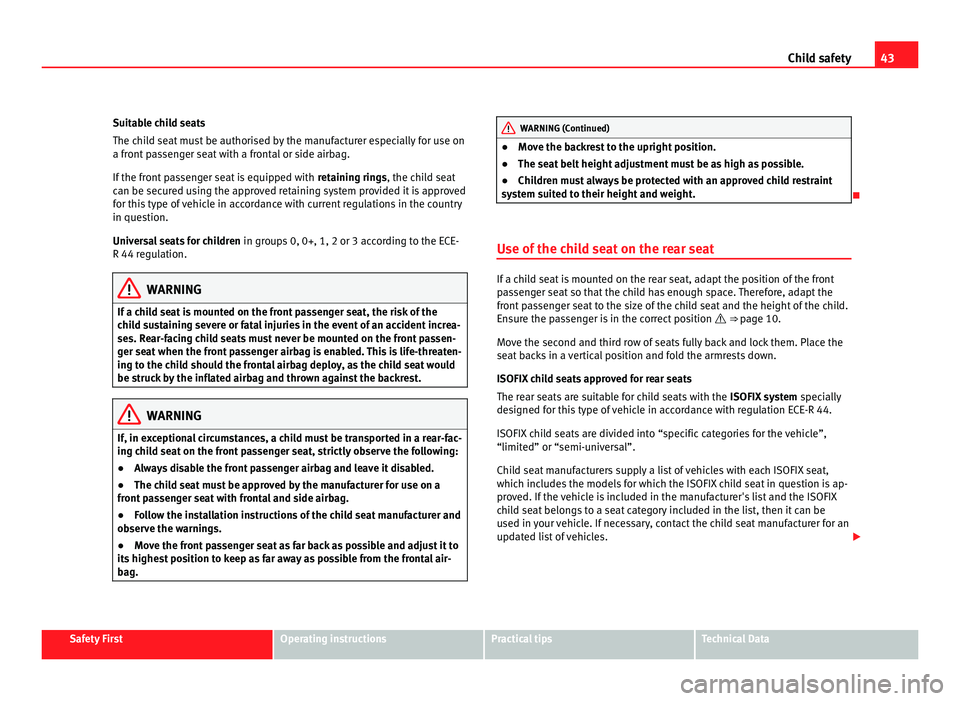
Suitable child seats
The chi l
d seat must be authorised by the manufacturer especially for use on
a front passenger seat with a frontal or side airbag.
If the front passenger seat is equipped with retaining rings, the child seat
can be secured using the approved retaining system provided it is approved
for this type of vehicle in accordance with current regulations in the country
in question.
Universal seats for children in groups 0, 0+, 1, 2 or 3 according to the ECE-
R 44 regulation. WARNING
If a child seat is mounted on the front passenger seat, the risk of the
chi l
d sustaining severe or fatal injuries in the event of an accident increa-
ses. Rear-facing child seats must never be mounted on the front passen-
ger seat when the front passenger airbag is enabled. This is life-threaten-
ing to the child should the frontal airbag deploy, as the child seat would
be struck by the inflated airbag and thrown against the backrest. WARNING
If, in exceptional circumstances, a child must be transported in a rear-fac-
ing c hi
ld seat on the front passenger seat, strictly observe the following:
● Always disable the front passenger airbag and leave it disabled.
● The child seat must be approved by the manufacturer for use on a
front p
assenger seat with frontal and side airbag.
● Follow the installation instructions of the child seat manufacturer and
obser
ve the warnings.
● Move the front passenger seat as far back as possible and adjust it to
its highe
st position to keep as far away as possible from the frontal air-
bag. WARNING (Continued)
● Move the backrest to the upright position.
● The se
at
belt height adjustment must be as high as possible.
● Children must always be protected with an approved child restraint
syst
em suited to their height and weight.
Use of the child seat on the rear seat If a child seat is mounted on the rear seat, adapt the position of the front
pa
s
senger seat so that the child has enough space. Therefore, adapt the
front passenger seat to the size of the child seat and the height of the child.
Ensure the passenger is in the correct position ⇒ page 10.
Move the second and third row of seats fully back and lock them. Place the
seat backs in a vertical position and fold the armrests down.
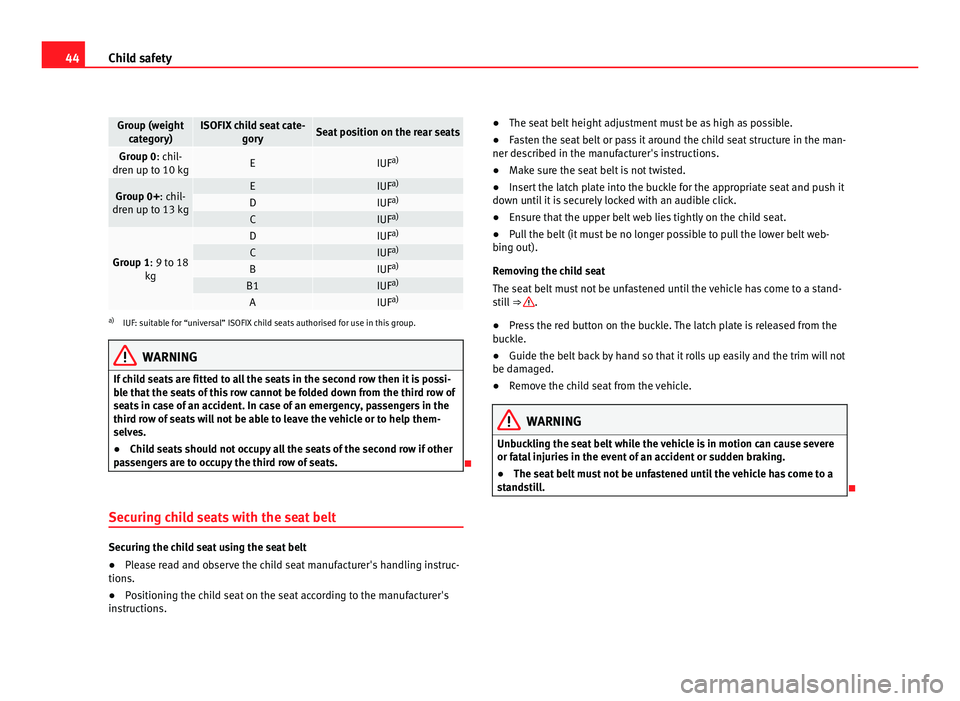
ISOFIX child seats approved for rear seats
The rear seats are suitable for child seats with the ISOFIX system specially
designed for this type of vehicle in accordance with regulation ECE-R 44.
ISOFIX child seats are divided into “specific categories for the vehicle”,
“limited” or “semi-universal”.
Child seat manufacturers supply a list of vehicles with each ISOFIX seat,
which includes the models for which the ISOFIX child seat in question is ap-
proved. If the vehicle is included in the manufacturer's list and the ISOFIX
child seat belongs to a seat category included in the list, then it can be
used in your vehicle. If necessary, contact the child seat manufacturer for an
updated list of vehicles. Safety First Operating instructions Practical tips Technical Data
Page 46 of 385
44
Child safety Group (weight
cat e
gory) ISOFIX child seat cate-
gory Seat position on the rear seats
Group 0: chil-
dr en up t
o 10 kg E IUF
a) Group 0+: chil-
dr en up t
o 13 kg E IUF
a) D IUF
a) C IUF
a) Group 1: 9 to 18
kg D IUF
a) C IUF
a) B IUF
a) B1 IUF
a) A IUF
a) a)
IUF: suitable for “universal” ISOFIX child seats authorised for use in this group. WARNING
If child seats are fitted to all the seats in the second row then it is possi-
bl e th
at the seats of this row cannot be folded down from the third row of
seats in case of an accident. In case of an emergency, passengers in the
third row of seats will not be able to leave the vehicle or to help them-
selves.
● Child seats should not occupy all the seats of the second row if other
pas
sengers are to occupy the third row of seats.
Securing child seats with the seat belt Securing the child seat using the seat belt
●
Please read and observe the child seat manufacturer's handling instruc-
tions.
● Po
sitioning the child seat on the seat according to the manufacturer's
instruction
s. ●
The seat belt height adjustment must be as high as possible.
● Fa
sten the seat belt or pass it around the child seat structure in the man-
ner desc
ribed in the manufacturer's instructions.
● Make sure the seat belt is not twisted.
● Insert the latch plate into the buckle for the appropriate seat and push it
down unti
l it is securely locked with an audible click.
● Ensure that the upper belt web lies tightly on the child seat.
● Pull the belt (it must be no longer possible to pull the lower belt web-
bing out).
R
emoving the child seat
The seat belt must not be unfastened until the vehicle has come to a stand-
still ⇒ .
● Press the red button on the buckle. The latch plate is released from the
buc k
le.
● Guide the belt back by hand so that it rolls up easily and the trim will not
be damag
ed.
● Remove the child seat from the vehicle. WARNING
Unbuckling the seat belt while the vehicle is in motion can cause severe
or fat a
l injuries in the event of an accident or sudden braking.
● The seat belt must not be unfastened until the vehicle has come to a
stand
still.