gearbox Seat Alhambra 2011 Owner's Guide
[x] Cancel search | Manufacturer: SEAT, Model Year: 2011, Model line: Alhambra, Model: Seat Alhambra 2011Pages: 385, PDF Size: 7.92 MB
Page 240 of 385
238
Trailer towing
●The vehicle centre of gravity and handling change because of the trailer
lo a
d and because of the increased combined mass of the vehicle and trail-
er.
● If the towing vehicle is empty and the trailer loaded then the load distri-
bution is
incorrect. If you must travel in these conditions, drive carefully and
reduce your speed accordingly.
Hill starts with a trailer
Depending on the hill and the gross combined weight, it is possible that the
combined vehicle and trailer move backwards slightly when starting.
For a hill start with a trailer, proceed as follows:
● Press and hold the brake pedal.
● Press the button once to turn off the electric parking brake
⇒ p ag
e 183.
● Press and hold the button to hold the vehicle and trailer combination
us in
g the parking brake.
● With a manual gearbox: press the clutch pedal to the floor.
● Engage first gear or the gear range D ⇒ page 174, Ch
anging gear.
● Release the brake pedal.
● Move off slowly. To do this, gently release the clutch pedal (for manual
gearbo
x).
● Release the button only when the engine provides sufficient power
to mo v
e the vehicle and trailer combination. WARNING
Jerking the trailer in an unsuitable manner could cause loss of vehicle
contr o
l with the subsequent serious consequences.
● Driving with a trailer and transporting heavy or a large objects will
chan
ge the vehicle handling and braking distances. WARNING (Continued)
● Antic ipate traffic and be extremely cautious. Brake early.
● Adju
s
t your speed and driving style to visibility, road, traffic and
weather c
onditions. Reduce your speed, especially on steep hills.
● Accelerate gently and carefully. Avoid brusque manoeuvres and sud-
den brakin
g.
● Always take the following precautions seriously. Reduce your speed
immediately
if you observe the trailer rocking from side to side.
● Never try to stop the “snaking” by increasing speed.
● Always take the speed limits for vehicles with and without trailers in
each c
ountry into account.
Stabilising the vehicle and trailer combination Stabilisation of the vehicle and trailer combination is an extension of the
electr
onic
stability control ESC (ESP) and helps, with the assistance of the
trajectory control, to reduce trailer “snaking”.
Stabilisation of the vehicle and trailer combination is active when the ESC
(ESP) indicator on the dashboard remains lit for about two seconds more
than the ABS indicator.
Requirements for stabilising the vehicle/trailer combination
● An original tow hitch is fitted by the manufacturer or a compatible model
is r
etrofitted.
● The ESC (ESP) is on. The warning indicator in the control panel is not
lit
.
● The trailer is connected to the vehicle using the socket.
● The vehicle is driven faster than 60 km/h.
● The maximum drawbar load is used.
Page 262 of 385
260
Accessories, parts replacement and modifications
Retro-fitting of two-way radios An exterior aerial is required for the use of two-way radios in the vehicle.
The retr
o-fittin
g of electrical or electronic appliances in the vehicle is sub-
ject to their approval for use in your vehicle. Under certain circumstances,
this could mean that your vehicle registration documents are no longer val-
id.
SEAT has approved your vehicle for use with two-way radios providing the
following conditions are observed:
● The exterior aerial must be mounted professionally.
● The maximum transmitting power is 10 watts.
An only e
xternal aerial is needed to give the equipment its optimal reach.
Check first with a qualified dealer if you wish to use a two-way radio with a
transmitting power of over 10 watts. The qualified workshops are familiar
with the technical options for installation. SEAT recommends visiting a Tech-
nical Service.
All legal requirements, together with the instructions for the use of two-way
radios must be observed. WARNING
If the two-way radio is not securely fastened in position, it could be sent
flyin g ar
ound the vehicle in the event of sharp braking, sudden manoeu-
vres or accident, causing injury.
● While driving, two-way radios must be securely fastened in position,
outside the r
adius of action of the airbags, or safely stowed away. WARNING
When using a two-way radio without a connection to an exterior aerial,
the max imum permitt
ed levels of electromagnetic radiation may be ex-
ceeded. This is also the case if the aerial has not been correctly installed.
● You should only use a two-way radio inside the vehicle if it has first
been correctly
connected to an exterior aerial.
Information stored by the control units Your vehicle is fitted at the factory with a series of electronic control units
re
s
ponsible for the engine and gearbox management. In addition, the con-
trol units supervise the performance of the exhaust gas system and the air-
bag systems.
Therefore, while the vehicle is being driven, these electronic control units
are continuously analysing the vehicle data. In the event of faults or devia-
tions from the theoretical values, only this data is stored. Normally, the
warning lamps on the instrument panel light up in the event of faults.
This data can only be read and analysed using special equipment.
The storing of the data allows specialised workshops to detect and repair
faults. Stored data may include:
● Data relating to the engine or the gearbox
● Speed
● Direction of travel
● Braking force
● Detection of seat belt
The vehic
le control units never record conversations held by passengers in
the vehicle.
Page 265 of 385
263
Accessories, parts replacement and modifications
The vehicle should not be lifted using lifting platforms with lift pads con-
tainin g fluid.
When r
aising a vehicle using a platform or jack, a series of precautionary
measures are required. Never raise the vehicle with a lifting platform or jack
unless you have received training in how to do so and know how to lift the
vehicle safely.
Notes on raising the vehicle with a jack ⇒ page 309. WARNING
The improper use of the lifting platform or the jack when raising the vehi-
cl e m
ay result in accidents or serious injury.
● Before raising the vehicle, please observe the manufacturer's instruc-
tions f
or the platform or jack, and the legal requirements, where applica-
ble.
● There should not be anyone inside the vehicle when it is being raised
or once it i
s in the air.
● Only use the jacking points indicated in the figures ⇒ fig. 160
and
⇒ fig. 161 when raising the vehicle. If the vehicle is not lifted at the indi-
cated points, it may fall from the platform while the engine or gearbox is
being dismounted, for example.
● The jacking points should be centrally aligned and firmly positioned
on the platf
orm support plates.
● Never start the engine when the vehicle is raised! The vehicle may fall
from the pl
atform due to the engine vibrations.
● If it is necessary to work underneath the vehicle while it is raised, you
should c
heck that the supporting stands have an adequate load capacity.
● Never climb onto the lifting platform.
● Always make sure that the weight of the vehicle does not exceed the
lifting p
latform load capacity. CAUTION
● Never raise the vehicle at the engine oil sump, the gearbox or the rear or
fr ont
axles.
● Always use an intermediat
e rubber support to prevent damage to the
vehicle underbody. Check that the arms of the lifting platform are able to
move with obstruction.
● The arms should not come into contact with the side running boards or
other parts
of the vehicle. Safety First Operating instructions Practical tips Technical Data
Page 308 of 385
306
Wheels and tyres WARNING (Continued)
● Only use suitable tools that are not damaged when changing a wheel.
● A
lw
ays stop the engine, turn on the electronic parking brake and
plac
e the gear selector lever in position P, for an automatic gearbox, or
engage a gear for a manual gearbox to reduce the risk of the vehicle mov-
ing accidentally.
● Have the tightening torque of the wheel bolts checked as soon as
poss
ible with a reliable torque wrench.
Preparations for changing a wheel Check list
Bef
or
e changing a wheel, complete the following operations in the order
given ⇒ :
Park the
vehicle on an even and solid surface.
Connect the electronic parking brake ⇒ page 183.
Automatic gearbox: Move selector lever to position P ⇒ page 174.
Stop the engine and remove the key from the ignition ⇒ page 170.
Manual gearbox: Select a gear ⇒ page 174.
Have all vehicle occupants get out of the vehicle and wait in a safe
place (for example, behind the safety barrier).
Block the opposite wheel with wedges or a similar object.
When towing a trailer: unhook the trailer from the towing vehicle and
park it correctly.
If the luggage compartment is full: take the baggage out of the vehicle. Take the vehicle tool kit out of the luggage compartment.
Remove the wheel trims ⇒ page 304.
1.
2.
3.
4.
5.
6.
7.
8.
9.
10.
11. WARNING
Failure to follow the checklist prepared for your own safety could lead to
acc ident
s and severe injuries.
● Always complete the operations given in the checklist and observe
the genera
l rules of safety.
Page 312 of 385
310
Wheels and tyres
Check list
For y
our own safety and that of other passengers, the following points
should be observed in the order given ⇒ :
Select a s
uitable flat and firm surface for raising the vehicle.
Switch off the engine, engage a gear (manual gearbox) or place the se-
lector lever in position P ⇒ page 174 and turn on the electronic parking
brake ⇒ page 183.
When towing a trailer: unhook the trailer from the towing vehicle and
park it correctly.
Loosen the wheel bolts on the wheel to be changed ⇒ page 307.
Look below the vehicle for the jacking point ⇒ fig. 183 closest to the
tyre which has to be changed.
Raise the jack with the handle until it can be inserted below the jacking
point.
Ensure that the foot of the jack is firmly on the ground and that it is
placed immediately below the lifting point on the vehicle ⇒ fig. 184.
Straighten the jack and continue raising it using the handle until the
claw holds the vertical reinforcement beneath the vehicle ⇒ fig. 184.
Raise the vehicle until the wheel is clear of the ground. WARNING
If the vehicle is not correctly raised, it could fall off the jack causing seri-
ous injur
y. Please observe the following rules to minimise the risk of in-
jury:
● You should only use a jack approved by SEAT for your vehicle. Other
jack
s, even those approved for other SEAT models, might slip out of
place.
● The ground should be firm and flat. If the ground is sloped or soft
then the vehic
le could slip and fall off the jack. If necessary, support the
jack on a wide solid base. 1.
2.
3.
4.
5.
6.
7.
8.
9. WARNING (Continued)
● If the ground is slippery (for example, on tiles), place a non-slip sur-
f ac
e (for example a floor mat) beneath the jack to avoid slipping.
● Only fit the jack at the prescribed jacking points. The claw of the jack
should grip the r
einforcement nerve on the underbody ⇒ fig. 184.
● You should never have any limbs beneath a raised vehicle which is
only s
upported by a jack.
● If you have to work underneath the vehicle, you must use suitable
stand
s additionally to support the vehicle, there is a risk of accident!.
● Never raise the vehicle if it is tilting to one side or the engine is run-
ning.
● Never s
tart the engine when the vehicle is raised. The vehicle may
come loose fr
om the jack due to the engine vibrations. WARNING
Failure to follow the checklist prepared for your own safety could lead to
acc ident
s and severe injuries.
● Always complete the operations given in the checklist and observe
the genera
l rules of safety.
Page 321 of 385
319
If and when
Manually unlocking the gear selection lever Fig. 195 Remove the lin-
ing fr
om the ar
ea of the
gear indication. Fig. 196 Manual release
of g
e
ar selector lever.
If the vehicle power supply should ever fail (discharged battery, etc.) and
the vehic
le has to be pushed or towed, the selector lever must first be
moved to position N using the manual release mechanism. The emergency release mechanism is located underneath the gearbox cover
panel t
o the right-hand side. To release the gear selector lever mechanism,
a suitable tool is required, for example a screwdriver.
Preparations
● Apply the parking brake. If the parking brake cannot be activated in the
vehicl
e must be secured otherwise so that it cannot move.
● Switch the ignition off.
To remo
ve the gearbox cover panel
● Pull the cover up around the dust guard on the gear selector lever
⇒ fig. 195.
● Take the cover off by passing it over the gear selector lever ⇒ .
Manua l
release of selector lever
● Press the release lever ⇒ fig. 196 in the direction of the arr
ow and hold
it in this position.
● Press the lock button ⇒ fig. 195 1 on the gear selector lever knob and
pl ac
e the gear selector lever in the N position. WARNING
Never move the gear selector lever from the position P while the electron-
ic p ark
ing brake is deactivated. Otherwise, the vehicle may accidentally
move off on hills or steep slopes causing serious accidents. CAUTION
If the vehicle is moved on its wheels with the engine stopped and the selec-
tor l ev
er in position N for a prolonged period of time and at high speed, for
example for towing, then the automatic gearbox will be damaged. Safety First Operating instructions Practical tips Technical Data
Page 329 of 385
327
If and when
Several warning and control lamps should light up for a few seconds when
the ignition is sw
itched. This signals that the lamp is working properly. They
will switch off after a few seconds.
Checking the bulbs of a trailer
For vehicles with the factory fitted trailer system, certain trailer lights are al-
so controlled if the socket is correctly connected.
A fault on a trailer turn indicator is indicated on the instrument panel by the
indicator blinking twice as fast ( or ) ⇒ page 95.
● General fault of all indicators on one side.
● Fault in one tail light (on some models, also the registration light).
● Fault in two brake lights. WARNING
If the warning lamps and messages are ignored, the vehicle may stall in
traffic, or m a
y cause accidents and severe injuries.
● Never ignore the warning lamps or text messages.
● Stop the vehicle safely as soon as possible. CAUTION
Failure to heed the warning lamps and text messages when they appear
ma y
result in faults in the vehicle. Note
A fault in the LED on the tail lights will not be indicated. However, if the fault
affects al
l the LEDs then this will be indicated by the indicator . Information for replacing bulbs Checklist
To r
ep
lace a bulb, carry out the following operations always in the order giv-
en ⇒ :
Park the
vehicle a safe distance from traffic and on suitable ground.
Connect the electronic parking brake ⇒ page 183.
Turn the light switch to position 0 ⇒ page 95.
Move the gear lever into the neutral position ⇒ page 95.
Automatic gearbox: Move selector lever to position P ⇒ page 174.
Stop the engine and remove the key from the ignition ⇒ page 170.
Manual gearbox: Select a gear ⇒ page 174.
Wait until all of the passenger compartment lights are turned off
⇒ page 95.
Allow the corresponding bulb to cool. Visually inspect fuses to see if any are blown ⇒ page 322.
Replace the bulb according to the instructions ⇒ . Bulbs should only
be rep l
aced by new identical models. Bulb information is displayed on
the bulb socket or on the bulb itself.
In general, never touch the bulb glass directly. The heat of the bulb
would cause the fingerprint to evaporate and condense on the reflector.
This will impair the brightness of the headlight.
Check if the new bulb is working. If the bulb is not working, it may not
have been correctly fitted, it could be damaged or the connector may
not be correctly connected.
Every time a bulb for the headlights is replaced, visit a specialised
workshop to check the headlights.
1.
2.
3.
4.
5.
6.
7.
8.
9.
10.
11.
12.
13.
14.
Safety First Operating instructions Practical tips Technical Data
Page 343 of 385
341
If and when
Instructions for tow starting In general, the vehicle should not be started by towing. Jump-starting is
much mor
e pr
eferable ⇒ page 337.
For technical reasons, the following vehicles can not be tow started:
● Vehicles with an automatic gearbox.
● Vehicles with an electronic parking brake, given that it is possible that
the brake w
ill not be disengaged.
● If the vehicle battery is flat, it is possible that the engine control units do
not operat
e correctly.
However, if your vehicle must absolutely be tow-started (manual gearbox):
● Engage the 2nd or 3rd gear.
● Keep the clutch pressed down.
● Switch on the ignition and the hazard warning lights.
● Release the clutch when both vehicles are moving.
● As soon as the engine starts, press the clutch and move the gear lever
into neutral
. This helps to prevent a collision with the towing vehicle. CAUTION
When tow-starting, fuel could enter the catalytic converter and damage it.
Towing instructions Tow-rope or tow-bar
When to
w
ing, the tow bar is the safest and vehicle friendly way. You should
only use a tow-rope if you do not have a tow-bar. A tow-rope should be slightly elastic to avoid damage to both vehicles. It is
advi
sable to use a tow-rope made of synthetic fibre or similarly elastic mate-
rial.
Only secure the tow rope or tow bar to the tow ring or specially designed
fitting.
Vehicles with a factory fitted towing device , can only be used for towing
with a tow-bar, specially designed to fit on a tow hitch ball ⇒ page 233.
Towing vehicles with an automatic gearbox
Note the following for a towed vehicle:
● Make sure the gear selector lever is in the N position.
● Do not
drive faster than 50 km/h (30 mph) when towing a vehicle.
● Do not tow further than 50 km (30 miles).
● If a breakdown truck is used, the vehicle must be towed with the front
wheels r
aised. Note the following instructions for towing four wheel drive
vehicles.
Instructions for towing four-wheel-drive vehicles
Four wheel drive vehicles can be towed using a toolbar or tow rope. If the
vehicle is towed with the front or rear axle raised, the engine must be turned
off to avoid transmission damage.
For vehicles with a double clutched DSG ®
(direct shift gearbox) the instruc-
tions for towing vehicles with an automatic gearbox apply ⇒ page 341.
Situations in which the vehicle should not be towed
In the following cases, the vehicle should not be towed but transported on a
trailer or special vehicle:
● If the vehicle gearbox does not contain lubricant due to a fault.
● If the vehicle battery is flat and, as a result, the electronic steering lock
and electronic
parking brake cannot be disengaged if applied.
● If the vehicle to be towed has an automatic gearbox and the distance to
be cov
ered is greater than 50 km (30 miles). Safety First Operating instructions Practical tips Technical Data
Page 347 of 385
345
General notes on the technical data
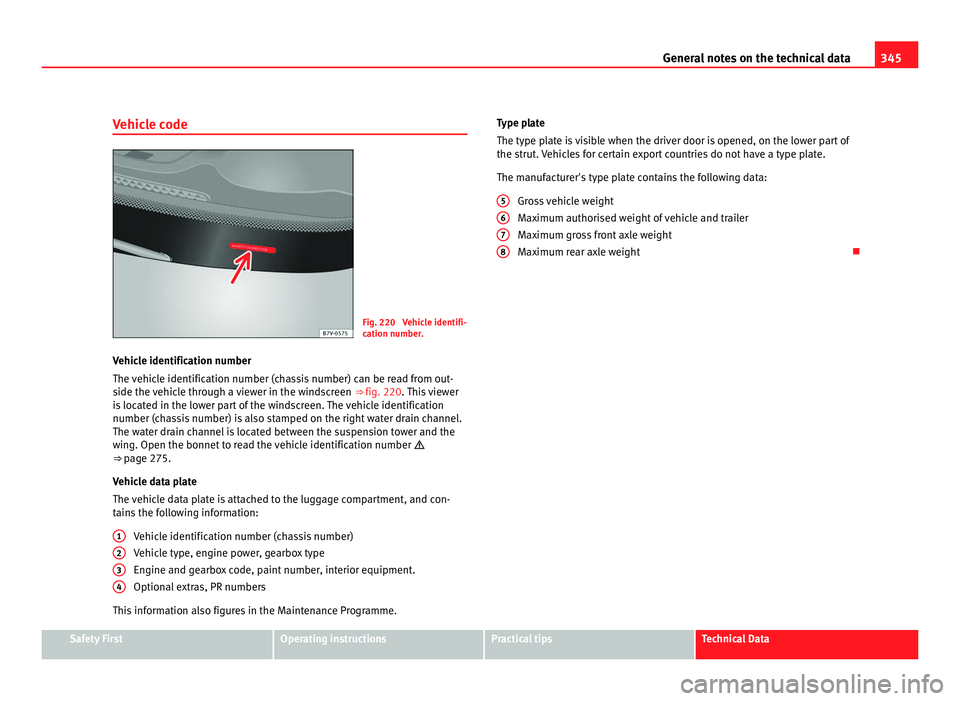
Vehicle code Fig. 220 Vehicle identifi-
cation number
.
V
ehicle identification number
The vehic
le identification number (chassis number) can be read from out-
side the vehicle through a viewer in the windscreen ⇒ fig. 220. This viewer
is located in the lower part of the windscreen. The vehicle identification
number (chassis number) is also stamped on the right water drain channel.
The water drain channel is located between the suspension tower and the
wing. Open the bonnet to read the vehicle identification number
⇒ page 275.
Vehicle data plate
The vehicle data plate is attached to the luggage compartment, and con-
tains the following information:
Vehicle identification number (chassis number)
Vehicle type, engine power, gearbox type
Engine and gearbox code, paint number, interior equipment.
Optional extras, PR numbers
This information also figures in the Maintenance Programme. 1 2
3
4 Type plate
The type pl
at
e is visible when the driver door is opened, on the lower part of
the strut. Vehicles for certain export countries do not have a type plate.
The manufacturer's type plate contains the following data:
Gross vehicle weight
Maximum authorised weight of vehicle and trailer
Maximum gross front axle weight
Maximum rear axle weight 5
6
7
8
Safety First Operating instructions Practical tips Technical Data
Page 348 of 385
346
General notes on the technical data
Data on fuel consumption
Fuel c
onsumption The consumption and emission details shown on the vehicle
data
s
ticker differ from one vehicle to another.
The fuel consumption, CO 2 emissions and actual kerb weight of the vehicle
are noted on the vehicle data sticker.
The fuel consumption and emissions figures given are based on the vehicle
weight category, which is determined according to the engine/gearbox
combination and the equipment fitted.
The consumption and emission figures are calculated in accordance with
the EC test requirements 1999/100/EC. These test requirements specify a
realistic test method based on normal everyday driving.
The following test conditions are applied: Urban cycle The urban cycle starts with an engine cold start. City driving
is
then s
imulated. Extra urban
cyc
l
e In the extra urban cycle simulation the vehicle frequently ac-
cel
er
ates and brakes in all gears, as in normal everyday driv-
ing. The road speed ranges from 0 to 120 km/h. Total con-
sumption The average total consumption is calculated with a weight-
ing of
ar
ound 37% for the urban cycle and 63% for the extra
urban cycle. CO
2 emis-
s ion
s The exhaust gases are collected during both driving cycles
to c
alc
ulate carbon dioxide emissions. The gas composition
is then analysed to evaluate the CO 2 content and other
emissions. Note
● Actual consumption may vary from quoted test values, depending on
per son
al driving style, road and traffic conditions, the weather and the vehi-
cle condition.
Weights Kerb weight refers to the basic model with a fuel tank filled to 90% capacity
and without
option
al extras. The figure quoted includes 75 kg to allow for
the weight of the driver.
For special versions and optional equipment fittings or for the addition of
accessories, the weight of the vehicle will increase ⇒ .
WARNING
● Please note that the centre of gravity may shift when transporting
he avy
objects; this may affect the vehicle's handling and lead to an acci-
dent. Always adjust your speed and driving style to suit road conditions
and requirements.
● Never exceed the gross axle weight rating or the gross vehicle weight
rating. If
the allowed axle load or the allowed total weight is exceeded,
the driving characteristics of the vehicle may change, leading to acci-
dents, injuries and damage to the vehicle.