remove seats Seat Alhambra 2011 Owner's Guide
[x] Cancel search | Manufacturer: SEAT, Model Year: 2011, Model line: Alhambra, Model: Seat Alhambra 2011Pages: 385, PDF Size: 7.92 MB
Page 139 of 385
137
Seats and storage compartments WARNING
Baggage net supports that are not secured correctly can be released from
the guide in ca se of
the sudden braking or accident. As a result, objects
may be fired through the passenger compartment causing serious injury
or death.
● Always ensure that the baggage net supports are correctly inserted
into the rai
ls; the red mark should not be visible.
● Never secure a child seat to the baggage net supports. CAUTION
● The baggage net supports placed on the rail system can be damaged
when f o
lding down seats from the third row or putting them back into posi-
tion and these can also damage the seats themselves. Before folding down
or repositioning the seats, remove the baggage net supports from the rail
system. Retaining hooks Fig. 99 In the luggage
comp
ar
tment: retaining
hooks.
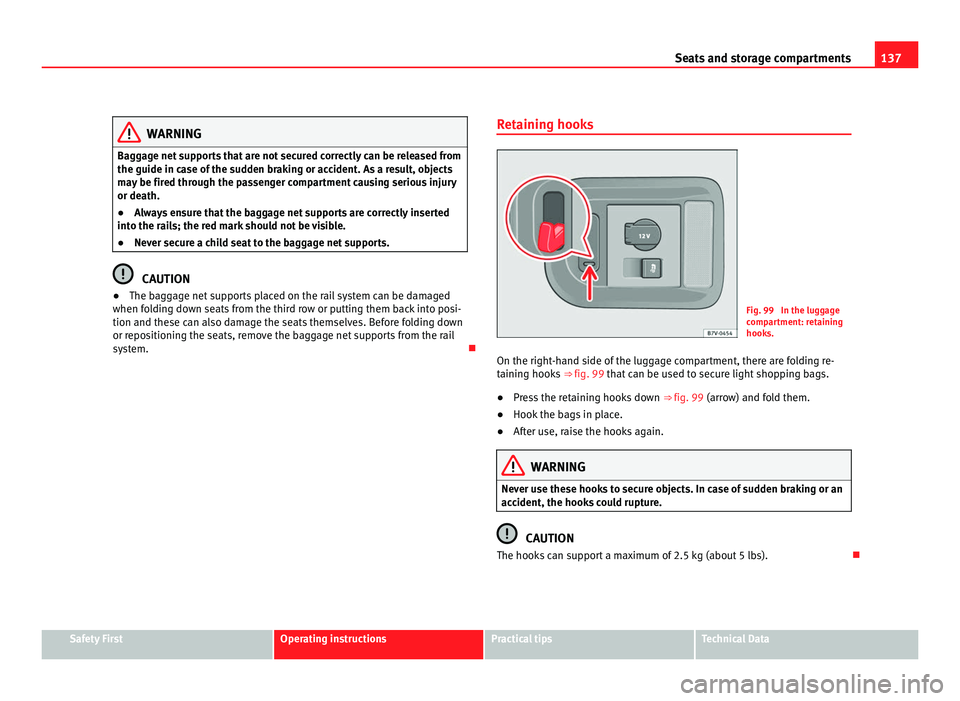
On the right-hand side of the luggage compartment, there are folding re-
taining hook
s ⇒ fig. 99 that can be used to secure light shopping bags.
● Press the retaining hooks down ⇒ fig. 99 (arrow) and f
old them.
● Hook the bags in place.
● After use, raise the hooks again. WARNING
Never use these hooks to secure objects. In case of sudden braking or an
acc ident, the hook
s could rupture. CAUTION
The hooks can support a maximum of 2.5 kg (about 5 lbs). Safety First Operating instructions Practical tips Technical Data
Page 140 of 385
138
Seats and storage compartments
Luggage net* Fig. 100 In the luggage
comp
ar
tment: net used
on secured baggage.
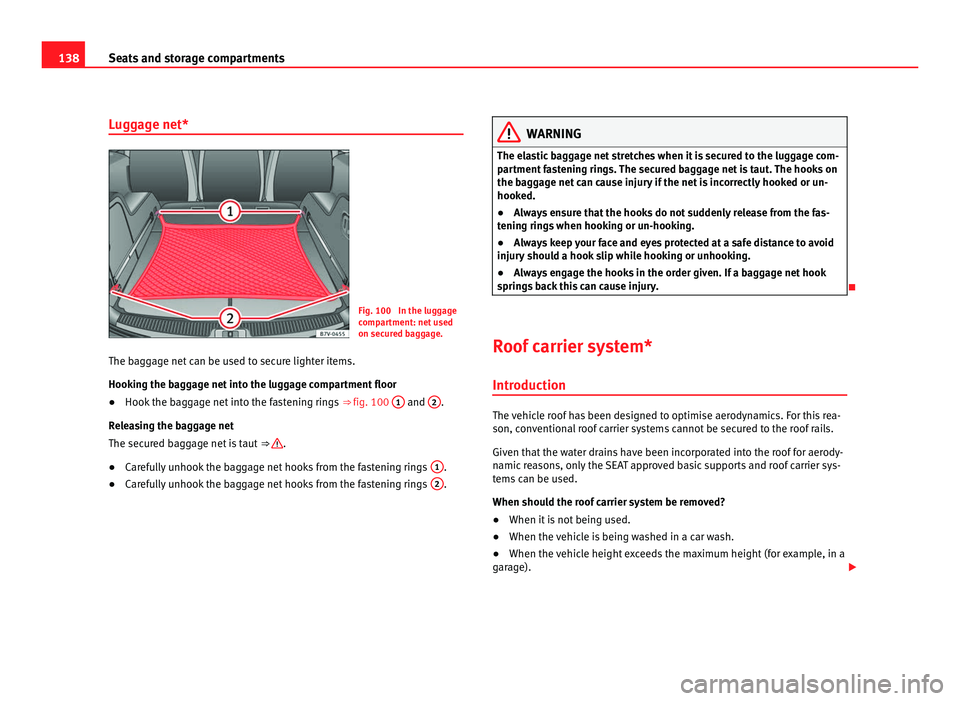
The baggage net can be used to secure lighter items.
Hooking the b
aggage net into the luggage compartment floor
● Hook the baggage net into the fastening rings ⇒ fig. 100 1 and
2 .
Rel e
asing the baggage net
The secured baggage net is taut ⇒ .
● Carefully unhook the baggage net hooks from the fastening rings 1 .
● Carefully unhook the baggage net hooks from the fastening rings 2 . WARNING
The elastic baggage net stretches when it is secured to the luggage com-
par tment
fastening rings. The secured baggage net is taut. The hooks on
the baggage net can cause injury if the net is incorrectly hooked or un-
hooked.
● Always ensure that the hooks do not suddenly release from the fas-
tening rin
gs when hooking or un-hooking.
● Always keep your face and eyes protected at a safe distance to avoid
injury shou
ld a hook slip while hooking or unhooking.
● Always engage the hooks in the order given. If a baggage net hook
spring
s back this can cause injury.
Roof carrier system* Introduction The vehicle roof has been designed to optimise aerodynamics. For this rea-
son, con
v
entional roof carrier systems cannot be secured to the roof rails.
Given that the water drains have been incorporated into the roof for aerody-
namic reasons, only the SEAT approved basic supports and roof carrier sys-
tems can be used.
When should the roof carrier system be removed?
● When it is not being used.
● When the vehicle is being washed in a car wash.
● When the vehicle height exceeds the maximum height (for example, in a
garag
e).
Page 141 of 385
139
Seats and storage compartments
Additional information and warnings:
● Light ⇒ page 95
● Tr
ansporting ⇒ page 13
● E
cological driving ⇒ page 225
● Wheel
s and tyres ⇒ page 293
● A
ccessories, parts replacement, repairs and modifications ⇒ page 257WARNING
The risk of an accident is increased by transporting heavy or bulky loads
on the roof , whic
h affects the car's handling by shifting the centre of
gravity and increasing susceptibility to cross winds.
● Always secure loads correctly with suitable and undamaged attach-
ment rope or s
traps.
● Large, heavy, wide and flat loads negatively affect the vehicle aerody-
namics, c
entre of gravity and handling.
● Avoid brusque manoeuvres and sudden braking.
● Adjust your speed and driving style to visibility, road, traffic and
weather c
onditions. CAUTION
● Always remove the roof carrier system from the roof before entering a car
w a
sh.
● The height of your vehicle is changed by the installation of the roof carri-
er and the load sec
ured on it. Compare the vehicle height with the passage
height, for example in underground car parks or entering garage doors.
● The roof antenna, the range of the panoramic sliding roof and the tail-
gate shou
ld not be affected by the roof carrier system and the load being
transported.
● Take extra care not to let the tailgate strike the roof load when opening. For the sake of the environment
The vehicle uses more fuel when the roof carrier system is fitted.
Securing the base supports and roof carrier system Fig. 101 Attachment
points
f
or the basic sup-
port and the roof carrier
system.
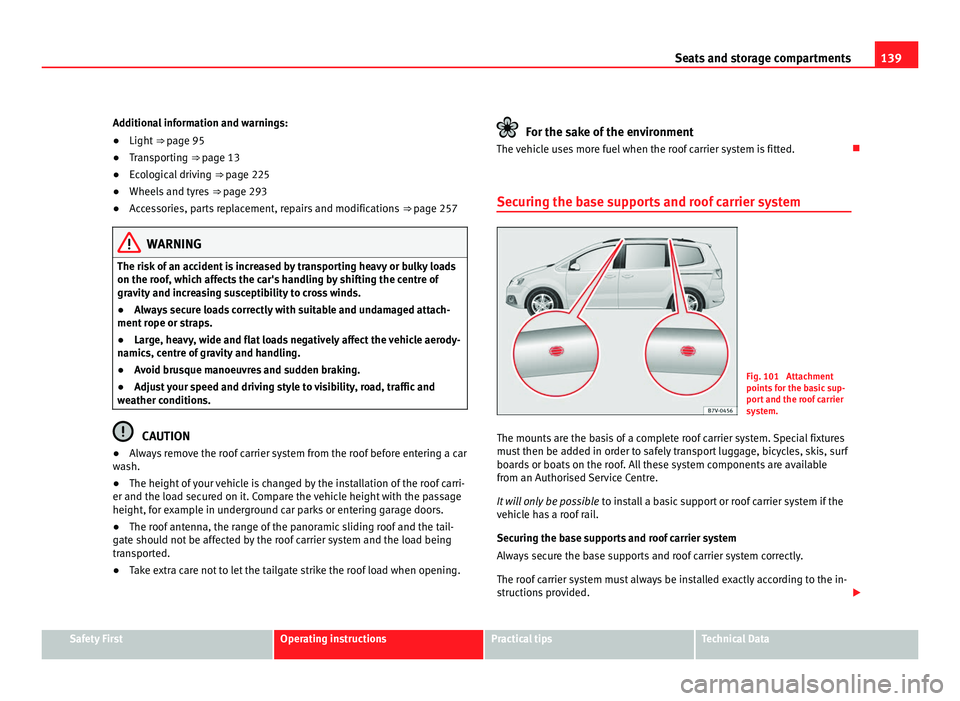
The mounts are the basis of a complete roof carrier system. Special fixtures
mus t
then be added in order to safely transport luggage, bicycles, skis, surf
boards or boats on the roof. All these system components are available
from an Authorised Service Centre.
It will only be possible to install a basic support or roof carrier system if the
vehicle has a roof rail.
Securing the base supports and roof carrier system
Always secure the base supports and roof carrier system correctly.
The roof carrier system must always be installed exactly according to the in-
structions provided. Safety First Operating instructions Practical tips Technical Data
Page 151 of 385
149
Seats and storage compartments WARNING
Improper use of the cup holders can cause injury.
● Never place hot drinks in the drink holders. During sudden braking or
drivin g m
anoeuvres, the hot drink could be spilled and lead to scalding.
● Ensure that bottles and other object is dropped in the driver footwell,
as it
could get under the pedals and obstruct their working.
● Never place heavy containers, food or other heavy objects in the cup
holder
. In the event of an accident, these heavy objects could be thrown
around the passenger compartment and cause serious injuries. WARNING
Closed bottles inside the vehicle could explode or crack due to the heat
or the co l
d.
● Never leave a closed bottle in the vehicle if the inside temperature is
too high or too lo
w. CAUTION
Do not leave open cans in the cup holders when the vehicle is in motion.
They c ou
ld spill during braking, for example, and cause damage to the vehi-
cle and the electrical system. Note
The cup holders can be removed for cleaning. Cup holders in front centre console
Fig. 115 Front centre
con
so
le: cup holder.
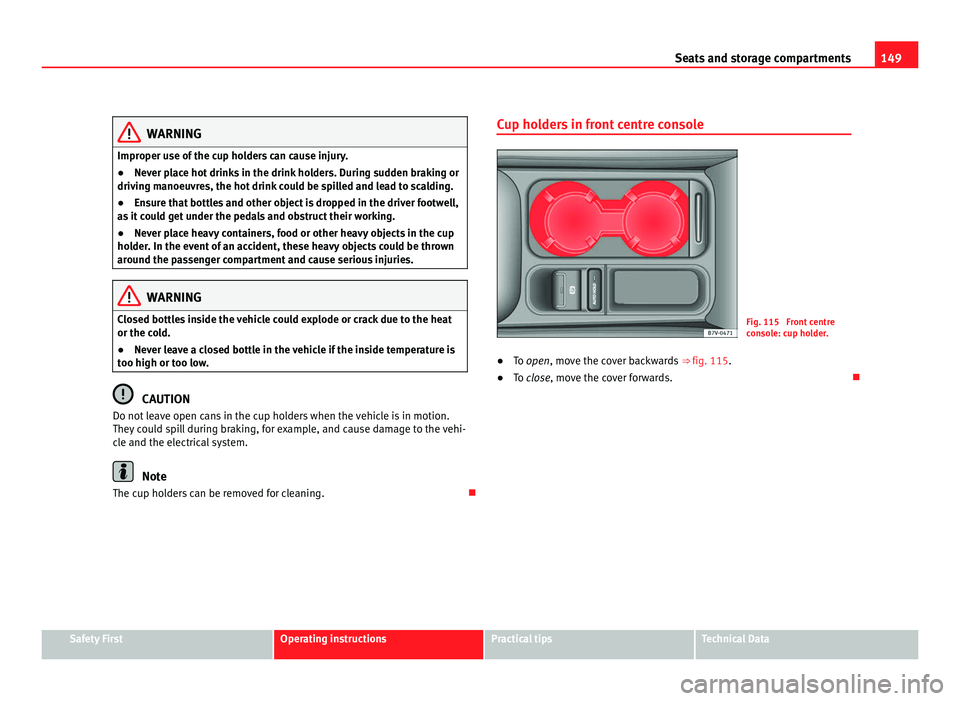
● To open, move the c
over backwards ⇒ fig. 115.
● To close, move the cover forwards. Safety First Operating instructions Practical tips Technical Data
Page 153 of 385
151
Seats and storage compartments
Emptying the ashtray
● Remove the ashtray from the cup holder or lining of the door by pulling
it up w
ards.
● After emptying the ashtray, insert it from above into the cup holder or
door lining.
Cig
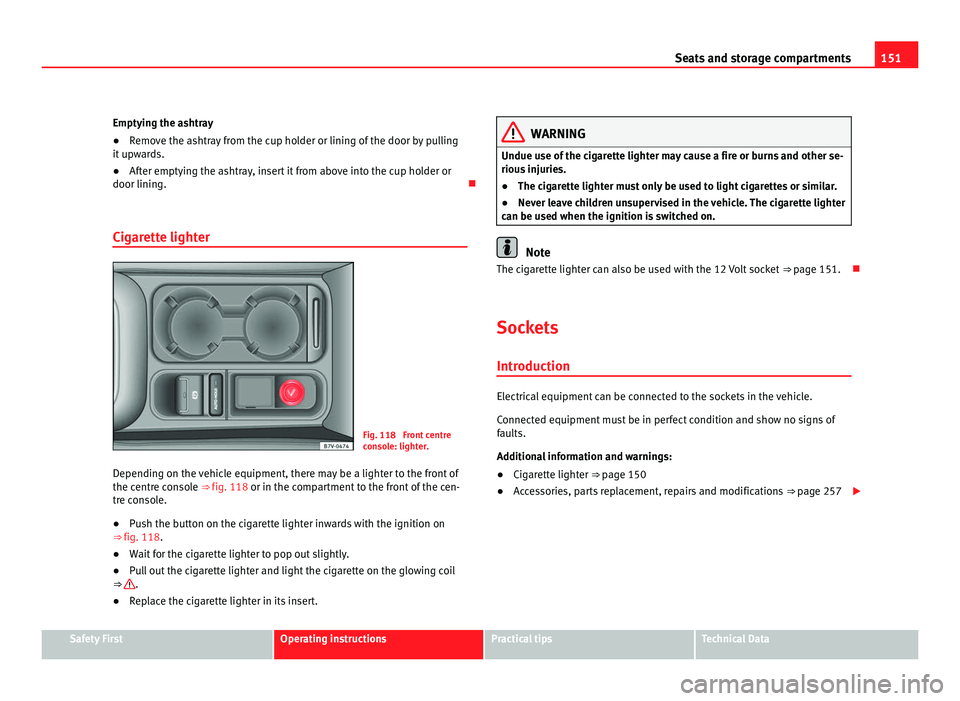
arette lighter Fig. 118 Front centre
con
so
le: lighter.
Depending on the vehicle equipment, there may be a lighter to the front of
the centre c
onsole ⇒ fig. 118 or in the compartment to the front of the cen-
tre console.
● Push the button on the cigarette lighter inwards with the ignition on
⇒ fig. 118.
● Wait for the cigarette lighter to pop out slightly.
● Pull out the cigarette lighter and light the cigarette on the glowing coil
⇒ .
● Replace the cigarette lighter in its insert. WARNING
Undue use of the cigarette lighter may cause a fire or burns and other se-
rious injurie
s.
● The cigarette lighter must only be used to light cigarettes or similar.
● Never leave children unsupervised in the vehicle. The cigarette lighter
can be used when the ignition i
s switched on. Note
The cigarette lighter can also be used with the 12 Volt socket ⇒ pag
e 151.
Sockets Intr oduction Electrical equipment can be connected to the sockets in the vehicle.
Connect
ed equipment
must be in perfect condition and show no signs of
faults.
Additional information and warnings:
● Cigarette lighter
⇒ page 150
● A
ccessories, parts replacement, repairs and modifications ⇒ page 257
Safety First Operating instructions Practical tips Technical Data
Page 261 of 385
259
Accessories, parts replacement and modifications
The vehicle owner should keep the documentation for the additional equip-
ment s af
ely and hand it over to the scrap yard at the end of the vehicle's
service life. This ensures that any additional equipment mounted in end-of-
life vehicles is correctly disposed of with respect for the environment. WARNING
Repairs or modifications which are not performed correctly may result in
dam ag
e or errors in the vehicle operation, affecting the efficiency of the
driver assist systems. This could result in serious accident.
● All repairs and modifications to the vehicle should only be performed
by a
Technical Service.
Repair and faults in the airbag system When performing repairs and technical modifications, SEAT's directives
mus
t
be observed! ⇒ Modifications and repairs to the front bumper, doors, front seats, and re-
pair
s
to the roof or chassis should only be carried out in a Technical Service.
These components may contain parts or sensors belonging to the airbag
system.
If work is carried out on the airbag system or remove and fit parts of the sys-
tem when performing other repair work, parts of the airbag system may be
damaged. The consequence may be that, in the event of an accident, the
airbag inflates incorrectly or does not inflate at all.
So that the effectiveness of the airbag is not reduced and that removed
parts do not cause any injuries or environmental pollution, regulations must
be observed. These requirements are known to qualified dealerships.
Modifications to the vehicle suspension may affect the operation of the air-
bag system in the event of collision. For example, if wheel and tyre combi-
nations not approved by SEAT are used, or if the vehicle height is lowered, the suspension is stiffened or the suspension springs, telescopic arms,
dampers, et
c., are modified, the results received by the airbag sensors and
sent to the control unit may not be accurate. For example, some modifica-
tions to the suspension could increase the force measured by the sensors
and result in the triggering of the airbag systems in collisions. Under normal
conditions, the measured values would be lower and the airbag would not
have been triggered. Other modifications may reduce the forces measured
by the sensors and therefore the airbags are not triggered in situations
when they should have triggered. WARNING
Repairs or modifications which are not performed correctly may result in
dam ag
e or errors in the vehicle operation, affecting the efficiency of the
airbag systems. This could result in serious or fatal accident.
● All repairs and modifications to the vehicle should only be performed
by a
Technical Service.
● Airbag modules must never be repaired: if damaged, they must be re-
plac
ed.
● Never fit recycled or reused airbag components in your vehicle. WARNING
Modifications to the vehicle suspension, including the use of unauthor-
ised wheel and ty
re combinations, may affect the performance of the air-
bags and increase the risk of serious or fatal injury in the event of acci-
dent.
● Never fit suspension components which are not identical to the origi-
nal
parts mounted in the vehicle.
● Never use wheel and tyre combinations not approved by SEAT.
Safety First Operating instructions Practical tips Technical Data