roof Seat Alhambra 2011 Owner's Guide
[x] Cancel search | Manufacturer: SEAT, Model Year: 2011, Model line: Alhambra, Model: Seat Alhambra 2011Pages: 385, PDF Size: 7.92 MB
Page 142 of 385
140
Seats and storage compartments
The position holes are located on the inner side of the rail ⇒ fig. 101.WARNING
If the base supports and the roof carrier system are incorrectly fitted or
used in an u n
suitable manner, the entire system could break free causing
accident and injury.
● Always take the manufacturer assembly instructions into account.
● Only use base supports and roof carrier systems that are not dam-
aged and are c
orrectly fitted.
● The base support should only be fitted to the points indicated in the
diagram
⇒ fig. 101.
● Secure the base supports and roof carrier system correctly.
● Check the screw fittings and attachments before driving and after a
short di
stance. During each long journey, check the attachments during
every break.
● Always fit the roof carrier system correctly for wheels, skis and surf-
board
s.
● Never change or repair the basic supports or roof carrier system. Note
Read and take into account the instructions included with the roof carrier
sys t
em fitted and keep them in the vehicle.
Loading the roof carrier system Loads can only be correctly secured when the roof carrier system is correctly
fitted
⇒ .
Max imum authori
sed roof load
The maximum authorised roof load is 100 kg (about 220 lbs). The roof load
includes the roof carrier system and the load being transported ⇒ .Always check the roof carrier system weight and the weight of the load to be
tran
s
ported and, if necessary, weigh them. Never exceed the maximum au-
thorised roof load.
If you are using a roof carrier with a lower weight rating, you cannot trans-
port the maximum roof load. Do not exceed the maximum weight limit for
the roof carrier given in the fitting instructions.
Distributing a load
Uniformly distribute loads and secure them correctly ⇒ .
Check att
achments
After fitting the base supports and the roof carrier system, always check the
attachments after a short trip or at regular intervals. WARNING
Exceeding the maximum authorised roof load can result in accidents
and/or v ehic
le damage.
● Always respect the maximum authorised weight for the roof, the max-
imum authorised weight
on the axles and the total maximum authorised
weight of the vehicle.
● Never exceed the capacity of the roof carrier system even if this is
les
s than the maximum authorised roof load.
● Secure heavy objects towards the front and distribute the load even-
ly. WARNING
Loose and incorrectly secured loads can fall from the roof carrier system
cau s
ing accidents and injury.
● Always use suitable ropes and straps in good condition.
● Always secure loads correctly.
Page 144 of 385
142
Seats and storage compartments
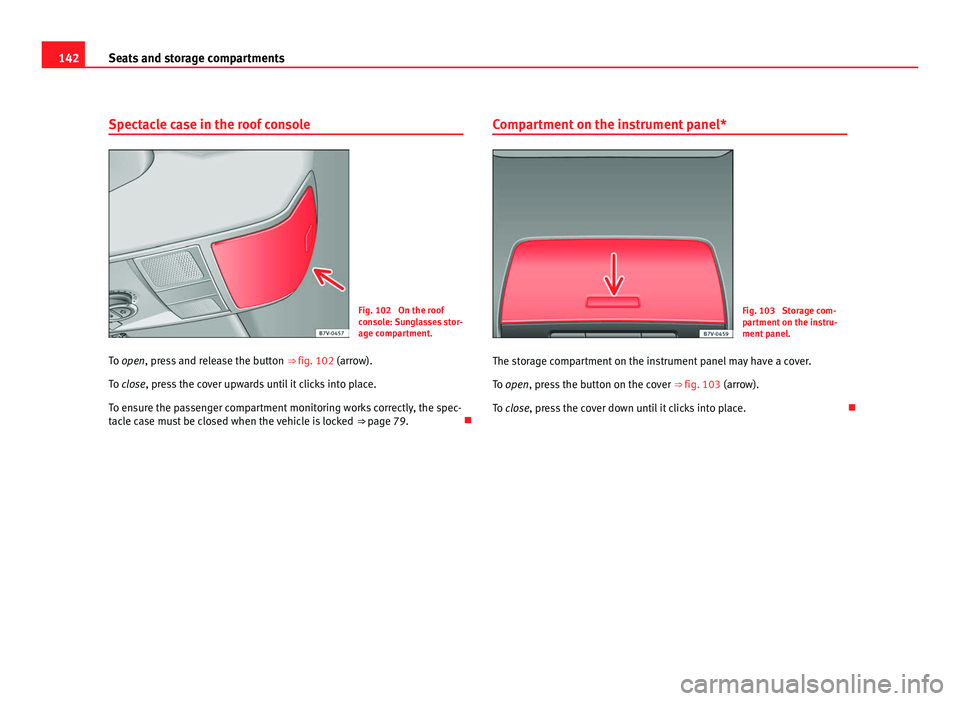
Spectacle case in the roof console Fig. 102 On the roof
con
so
le: Sunglasses stor-
age compartment.
To open, press and release the button ⇒ fig. 102 (arr
ow).
To close, press the cover upwards until it clicks into place.
To ensure the passenger compartment monitoring works correctly, the spec-
tacle case must be closed when the vehicle is locked ⇒ page 79.Compartment on the instrument panel* Fig. 103 Storage com-
par
tment
on the instru-
ment panel.
The storage compartment on the instrument panel may have a cover.
To open
, press the button on the cover ⇒ fig. 103 (arrow).
To close, press the cover down until it clicks into place.
Page 150 of 385
148
Seats and storage compartments
can be located in the storage compartment 1 .. The cover of the compart-
ment 1 can be used to safely store the covers of the rear shelf supports.
Comp ar
tments in the luggage compartment floor
More storage compartments can be found in the luggage compartment
floor. Function Necessary operations
Open the front compartment
⇒ fig. 114
3 :
Pull the front of the luggage compart-
ment floor b
ack using the handle. Open the rear compartment
⇒ fig. 114
4 :
Lift the rear of the luggage compart-
ment floor u
sing the handle. Keeping the rear compartment
open:
Move the hook at the rear right of the
lug g
age compartment and hook the lug-
gage compartment floor onto it
⇒ page 125. Closing the compartment:
Push back the hook and push the rear
of the lug
gage compartment floor 4 down.
Fo l
d the front part of the luggage com-
partment floor forwards 3 .
Other storage compartments:
●
in the centre console, front and rear.
● in the door trims, front and rear.
● Coat hooks on the centr al
door pillars and on the rear roof handles.
● Bag hook in the luggag
e compartment ⇒ page 125. WARNING
Clothing hung on the coat hooks could restrict the driver's view and lead
to seriou s
accidents.
● Hang the clothes from the hooks so that driver's view is not restric-
ted.
● The co
at hook is suitable for light items of clothing. Never place
heavy, h
ard or sharp objects in the bags. CAUTION
Keep the CD changer compartment closed while the vehicle is in motion to
reduc e
vibrations that could damage the changer. Note
The first aid kit is located in the rear left compartment of the luggage com-
par tment
.
Cup holders Introduction Bottle holders
There i
s
a bottle holder in the open compartments in the driver and front
passenger doors and in that of the sliding door.
Additional information and warnings:
● Care and cleaning of the vehicle interior ⇒ pag
e 249
Page 161 of 385
159
Heating, Ventilation and Air conditioning Control
butt on Additional information. Climatic
⇒ fig. 121; Climatr onic
⇒ fig. 122. Climatronic: tran
sf
erring the driver's seat temperature set-
tings to the other seats. If the button is not lit up, the set
temper at
ure in the driver's seat will also apply to the other
seats.
Press the button or the temperature control for the front pas-
senger's seat or the rear seats to set them to a different tem-
perature. The button lights with an indicator.
Vehicles with auxiliary heating: observe the description of the AUTO button.
AUTO Automatic temperature, fan, and air distribution control.
WARNING
Never turn off the air fan for a long time or the air in the passenger com-
par tment
will not be refreshed.
● Stuffy or used air will increase fatigue and reduce driver and passen-
ger conc
entration possibly resulting in a serious accident. Note
● Not all Climatronic buttons are operational in REAR mode.
● The REAR button is locked in defrost mode.
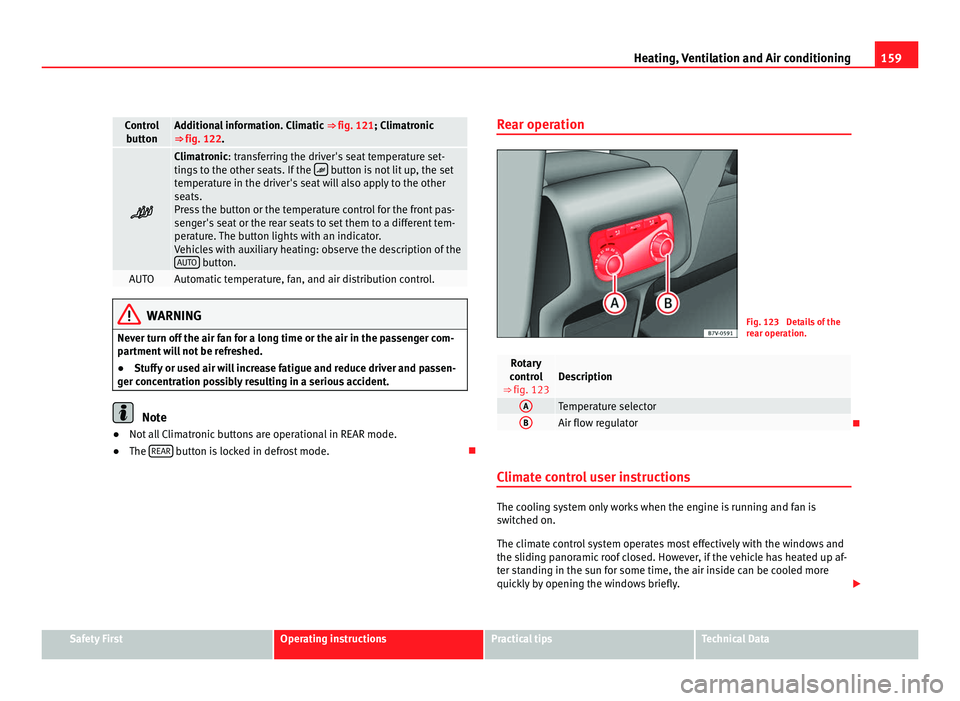
Rear operation Fig. 123 Details of the
re
ar oper
ation. Rotary
contr o
l
⇒ fig. 123 Description
A
Temperature selector
B
Air flow regulator
Climate control user instructions The cooling system only works when the engine is running and fan is
swit
c
hed on.
The climate control system operates most effectively with the windows and
the sliding panoramic roof closed. However, if the vehicle has heated up af-
ter standing in the sun for some time, the air inside can be cooled more
quickly by opening the windows briefly. Safety First Operating instructions Practical tips Technical Data
Page 230 of 385
228
Driving and the environment
Avoid carrying unnecessary loads
The lighter the v
ehicle, the more economical and ecological the driving
style. For example, an additional weight of 100 kg will increase fuel con-
sumption up to 0.3 l/100 km.
Remove any unnecessary objects or loads from the vehicle.
Remove optional equipment and unnecessary accessories
The more aerodynamic the vehicle, the lower the fuel consumption. Option-
al equipment and accessories (such as roof racks or bike carriers) reduce
the aerodynamic benefits of the vehicle.
Therefore, we recommend you remove all optional and unnecessary equip-
ment and racks, especially if you intend to drive at high speeds.
Engine management and exhaust gas
purification sy
stem
Introduction Additional information and warnings:
●
Changing gear ⇒ p ag
e 174
● Refuelling ⇒ pag
e 264
● Fuel ⇒ page 267
● En
gine oil ⇒ pag
e 279
● Vehicle battery ⇒ pag
e 288
● Information stored in the control units ⇒ pag
e 257
● Tow-starting and towing away ⇒ pag
e 340 WARNING
The components of the exhaust system reach very high temperatures.
This c
ould cause a fire.
● Always park your vehicle so that no part of the exhaust system can
come in cont
act with flammable materials (such as dried grass).
● Do not apply additional underseal or anti-corrosion coatings to the
exhau
st pipes, catalytic converter, heat shields or the diesel particulate
filter.
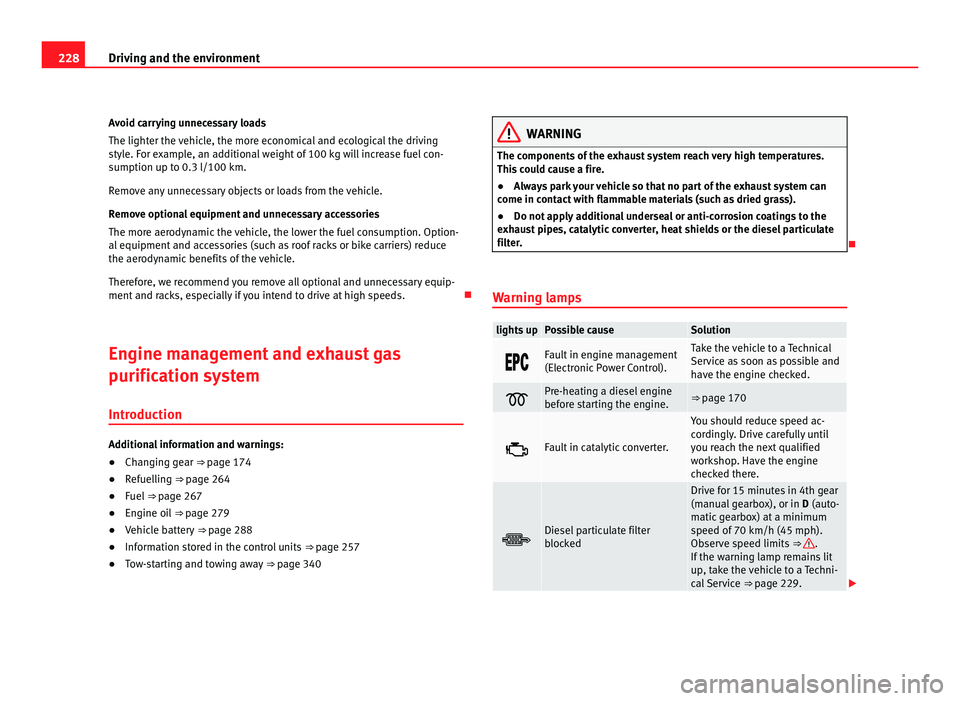
Warning lamps lights up Possible cause Solution
Fault in engine management
(Electr
onic
Power Control). Take the vehicle to a Technical
Serv
ic
e as soon as possible and
have the engine checked. Pre-heating a diesel engine
befor
e s
tarting the engine. ⇒ page 170
Fault in catalytic converter. You should reduce speed ac-
cor
din
gly. Drive carefully until
you reach the next qualified
workshop. Have the engine
checked there. Diesel particulate filter
bloc
k
ed Drive for 15 minutes in 4th gear
(manual
g
earbox), or in D (auto-
matic gearbox) at a minimum
speed of 70 km/h (45 mph).
Observe speed limits ⇒ .
If the w arnin
g lamp remains lit
up, take the vehicle to a Techni-
cal Service ⇒ page 229.
Page 245 of 385
243
Vehicle maintenance and cleaning
Washing the vehicle The longer substances such as insects, bird droppings, resinous tree sap,
ro
a
d dirt, industrial deposits, tar, soot or road salt and other aggressive ma-
terials remain on the vehicle, the more damage they do to the paintwork.
High temperatures (for instance due to strong sunlight) further intensify the
corrosive effect. The vehicle undercarriage should also be thoroughly wash-
ed at regular intervals.
Automatic car washes
Always observe the instructions provided at the automatic car wash. The
standard precautionary measures prior to entering the car wash should be
taken to avoid damage to the vehicle (close all windows, fold in exterior mir-
rors). If the vehicle is fitted with additional components (spoiler, roof-rack,
aerial...), check with the car wash supervisor whether these can enter the
car wash ⇒ .
The v ehic
le paintwork is so durable that the car can normally be washed
without problems in an automatic car washing tunnel. However, wear and
damage to the paintwork will depend on the type of car wash used. SEAT
recommends the use of car washed without brushes.
To remove traces of wax on windows and to prevent wiper blades from
scratching, please observe the following ⇒ page 245, Cleaning windows
and exterior mirrors.
Washing the car by hand
When washing the car by hand, use plenty of water to soften the dirt first,
and rinse off as well as possible.
Then clean the vehicle with a soft sponge, glove or brush using only slight
pressure. Start at the roof and work downwards. Special car shampoo
should only be used for very persistent dirt.
Rinse the sponge or glove thoroughly and often.
Wheels, sills and similar should be cleaned last. Use a second sponge for
this. WARNING
Sharp components on the vehicle may cause injury.
● Protect arms and hands from sharp edges when cleaning the vehicle
under c
arriage or the interior of the wheel hubs. WARNING
After the vehicle has been washed, the braking effect will be reduced
(and the brakin
g distance increased) due to moisture (and ice in winter)
on the brakes.
● Dry the brakes and remove ice by braking carefully. Ensure that you
are not end
angering other road-users or breaking traffic regulations in
the process. CAUTION
● The temperature of the water must not exceed +60°C (+140°F).
● To av
oid damage to the paintwork, do not wash the vehicle in full sun.
● Do not use rough sponges or similar which could damage the surface to
cle
an away the traces of insects.
● Never wipe the headlights with a dry cloth or sponge, always moisten
first
. It is best to use soapy water.
● Washing the vehicle in low temperatures: When washing the vehicle
with a hose, do not
direct water into the lock cylinders or the gaps around
the doors, tailgate, or sunroof. Locks and seals could freeze! CAUTION
To prevent damage to the vehicle, please observe the following before en-
terin g
an automatic car wash :
● Compare the distance between the vehicle wheels and the distance be-
tween the guide-rai
ls of the car wash to prevent damage to the wheels and
tyres! Safety First Operating instructions Practical tips Technical Data
Page 246 of 385
244
Vehicle maintenance and cleaning
● Switch off the rain sensor and the Auto Hold function before entering a
c ar w
ash.
● Compare the height and width of your vehicle with the available height
and width when enterin
g and driving through the car wash.
● Fold in exterior mirrors Electrically retractable exterior mirrors must NOT
be fol
ded in or out by hand. Always use the electrical power control.
● To avoid damaging the bonnet paintwork, rest the wipers on the wind-
scr
een after drying them. Do not let them fall!
● Lock the tailgate to prevent it from opening unexpectedly while inside
the car wa
sh.
Washing the vehicle with high pressure cleaning
equipment When cleaning the vehicle with a high-pressure cleaner, always follow the
operatin
g in
structions for the equipment. Pay special attention to the re-
quired pressure of the jet and the distance between the jet and the vehicle
⇒ .
Keep a s uit
able distance from soft materials, such as rubber hoses or insu-
lating material, and from the parking distance warning system sensors. The
parking distance sensors are fitted in the rear bumpers and, where applica-
ble, in the front bumpers ⇒ .
Do not u se a no
zzle that sprays the water out in a direct stream or one that
has a rotating jet for forcing off dirt ⇒ . WARNING
The incorrect use of high pressure cleaning equipment could result in
permanent d
amage, visible or invisible, to the tyres or other materials.
This could result in serious accident.
● Ensure there is a suitable distance between the nozzle and the tyres.
● Never wash tyres with a concentrated jet or so-called “dirt blasters”.
Even at
large spraying distances and short cleaning times, you may dam-
age the tyres. WARNING
After the vehicle has been washed, the braking effect will be reduced
(and the brakin
g distance increased) due to moisture (and ice in winter)
on the brakes.
● Dry the brakes and remove ice by braking carefully. Ensure that you
are not end
angering other road-users or breaking traffic regulations in
the process. CAUTION
● The temperature of the water must not be above +60°C (+140°F).
● To av
oid damage to the paintwork, do not wash the vehicle in full sun.
● The sensors on the bumpers should be kept clean and free of ice at all
times t
o ensure the parking distance warning system and the parking aid
system operate correctly. When cleaning with pressure hoses and steam
cleaners, the sensors should be sprayed only briefly. A distance of 10 cm
between the sensors and the steam / hose nozzle must be observed.
● Do not use a high pressure cleaner to remove ice or snow from windows
● Washing the vehicle in low temperatures: When washing the vehicle
with a hose, do not
direct water into the lock cylinders or the gaps around
the doors, tailgate, or sunroof. Locks and seals could freeze!
Page 257 of 385
255
Vehicle maintenance and cleaning
Notes for the user Labels and p
latesSome parts in the engine compartment come from the factory with certifi-
cat
e
s of safety, labels or plates containing important information regarding
the operation of the vehicle, for example, on the petrol cap, on the passeng-
er's sun visor, on the driver's door strut, or on the floor of the luggage com-
partment.
● Never remove these certificates of safety, labels or plates, and ensure
they are k
ept in good condition and are legible.
● If a vehicle part, bearing a certificate of safety, label or plate, is re-
plac
ed, the qualified workshop should attach the information back in the
same place.
Certificate of safety
A certificate of safety on the door strut states that all the safety standards
and regulations established by the national traffic authorities responsible
for road safety were met at the time of manufacture. It may also give the
month and year of manufacture, together with the chassis number.
Warning of high voltage label*
There is a label close to the bonnet lock which warns of high voltage in the
vehicle electrical installation. The vehicle ignition system complies with sev-
eral standards, including the Canadian standard, ICES-002.
Using your vehicle in other countries and continents The vehicle is manufactured at the factory for use in a particular country in
acc
or
dance with the national legislation in force at the time of manufacture. If the vehicle is sold in another country or used in another country for an ex-
tended period of time, the ap
plicable legislation of that country should be
observed.
It may be necessary to fit or remove certain pieces of equipment or to deac-
tivate certain functions. Service work may also be affected. This is particu-
larly true if the vehicle is used in a different climate for an extended period
of time.
As there are different types of frequency bands around the world, you may
find that the radio or navigation system supplied at the factory does not
work in another country. CAUTION
● SEAT does not accept liability for any damage to the vehicle due to the
u se of
a lower quality fuel, an inadequate service or the non-availability of
genuine spare parts.
● SEAT does not accept liability if the vehicle does not comply in part or in
ful
l with the legal requirements of other countries or continents.
Radio reception and the aerial The aerial of radio and navigation systems fitted at the factory may be
mount
ed in diff
erent parts of the vehicle:
● On the inside of the rear window, next to the rear window heating,
● on the inside of the rear side windows,
● on the inside of the windscreen,
● on the roof of the car.
Aerials
mounted on the inside of a window can be recognised by the fine
wires. Safety First Operating instructions Practical tips Technical Data
Page 261 of 385
259
Accessories, parts replacement and modifications
The vehicle owner should keep the documentation for the additional equip-
ment s af
ely and hand it over to the scrap yard at the end of the vehicle's
service life. This ensures that any additional equipment mounted in end-of-
life vehicles is correctly disposed of with respect for the environment. WARNING
Repairs or modifications which are not performed correctly may result in
dam ag
e or errors in the vehicle operation, affecting the efficiency of the
driver assist systems. This could result in serious accident.
● All repairs and modifications to the vehicle should only be performed
by a
Technical Service.
Repair and faults in the airbag system When performing repairs and technical modifications, SEAT's directives
mus
t
be observed! ⇒ Modifications and repairs to the front bumper, doors, front seats, and re-
pair
s
to the roof or chassis should only be carried out in a Technical Service.
These components may contain parts or sensors belonging to the airbag
system.
If work is carried out on the airbag system or remove and fit parts of the sys-
tem when performing other repair work, parts of the airbag system may be
damaged. The consequence may be that, in the event of an accident, the
airbag inflates incorrectly or does not inflate at all.
So that the effectiveness of the airbag is not reduced and that removed
parts do not cause any injuries or environmental pollution, regulations must
be observed. These requirements are known to qualified dealerships.
Modifications to the vehicle suspension may affect the operation of the air-
bag system in the event of collision. For example, if wheel and tyre combi-
nations not approved by SEAT are used, or if the vehicle height is lowered, the suspension is stiffened or the suspension springs, telescopic arms,
dampers, et
c., are modified, the results received by the airbag sensors and
sent to the control unit may not be accurate. For example, some modifica-
tions to the suspension could increase the force measured by the sensors
and result in the triggering of the airbag systems in collisions. Under normal
conditions, the measured values would be lower and the airbag would not
have been triggered. Other modifications may reduce the forces measured
by the sensors and therefore the airbags are not triggered in situations
when they should have triggered. WARNING
Repairs or modifications which are not performed correctly may result in
dam ag
e or errors in the vehicle operation, affecting the efficiency of the
airbag systems. This could result in serious or fatal accident.
● All repairs and modifications to the vehicle should only be performed
by a
Technical Service.
● Airbag modules must never be repaired: if damaged, they must be re-
plac
ed.
● Never fit recycled or reused airbag components in your vehicle. WARNING
Modifications to the vehicle suspension, including the use of unauthor-
ised wheel and ty
re combinations, may affect the performance of the air-
bags and increase the risk of serious or fatal injury in the event of acci-
dent.
● Never fit suspension components which are not identical to the origi-
nal
parts mounted in the vehicle.
● Never use wheel and tyre combinations not approved by SEAT.
Safety First Operating instructions Practical tips Technical Data
Page 316 of 385
314
If and when
First aid kit, warning triangle, reflective vests and fire
extingui
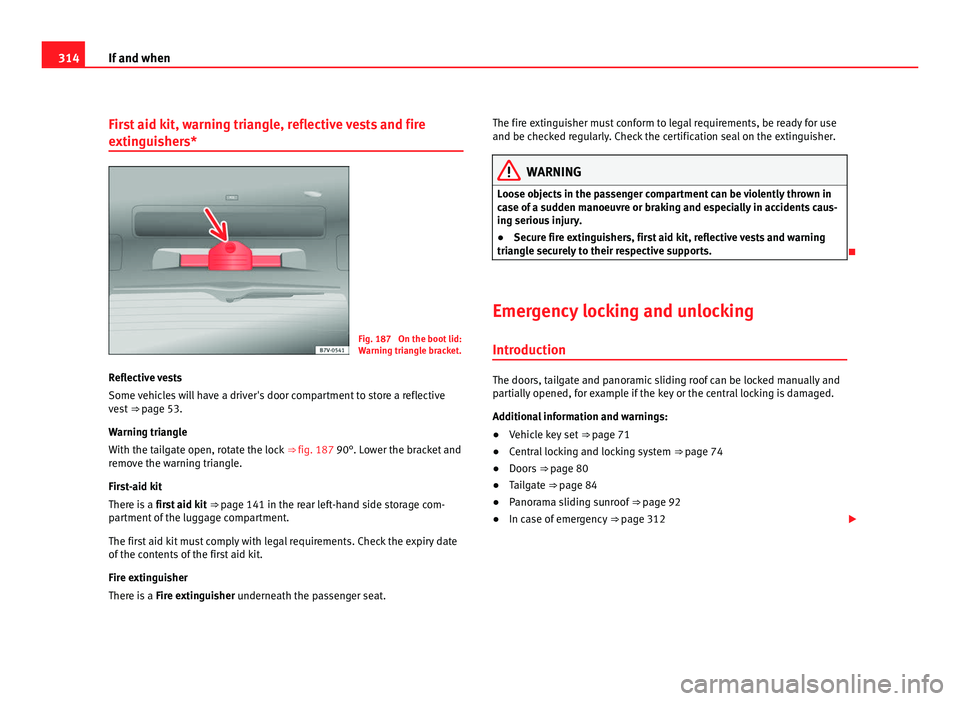
shers* Fig. 187 On the boot lid:
Warnin
g tri
angle bracket.
Reflective vests
Some vehic
les will have a driver's door compartment to store a reflective
vest ⇒ page 53.
Warning triangle
With the tailgate open, rotate the lock ⇒ fig. 187 90°. Lower the bracket and
remove the warning triangle.
First-aid kit
There is a first aid kit ⇒ page 141 in the rear left-hand side storage com-
partment of the luggage compartment.
The first aid kit must comply with legal requirements. Check the expiry date
of the contents of the first aid kit.
Fire extinguisher
There is a Fire extinguisher underneath the passenger seat. The fire extinguisher must conform to legal requirements, be ready for use
and be check
ed regularly. Check the certification seal on the extinguisher. WARNING
Loose objects in the passenger compartment can be violently thrown in
ca se of
a sudden manoeuvre or braking and especially in accidents caus-
ing serious injury.
● Secure fire extinguishers, first aid kit, reflective vests and warning
triangl
e securely to their respective supports.
Emergency locking and unlocking Introduction The doors, tailgate and panoramic sliding roof can be locked manually and
par
ti
ally opened, for example if the key or the central locking is damaged.
Additional information and warnings:
● Vehicle key set ⇒ pag
e 71
● Central locking and locking system ⇒ pag
e 74
● Doors ⇒ page 80
● T
ailgate ⇒ pag
e 84
● Panorama sliding sunroof ⇒ pag
e 92
● In case of emergency ⇒ pag
e 312