tailgate Seat Alhambra 2011 Owner's Guide
[x] Cancel search | Manufacturer: SEAT, Model Year: 2011, Model line: Alhambra, Model: Seat Alhambra 2011Pages: 385, PDF Size: 7.92 MB
Page 130 of 385
128
Seats and storage compartments
Folding the seats in the second row of seats for loading
●If necessary, open the belt loop and wind up the seat belt by hand.
● If it is necessary, remove the head rests on the integrated child seats
then rein s
talled the integrated child seats ⇒ page 46.
● If necessary, raise the armrests.
● Remove objects from the footrest area in front of and behind the rear
seat ⇒ .
● Move the rear seat all the way back.
● Push the head restraint down as far as it will go ⇒ page 10.
● In the mid
dle seat, close the drinks carrier in the rear of the centre con-
sole, if
necessary.
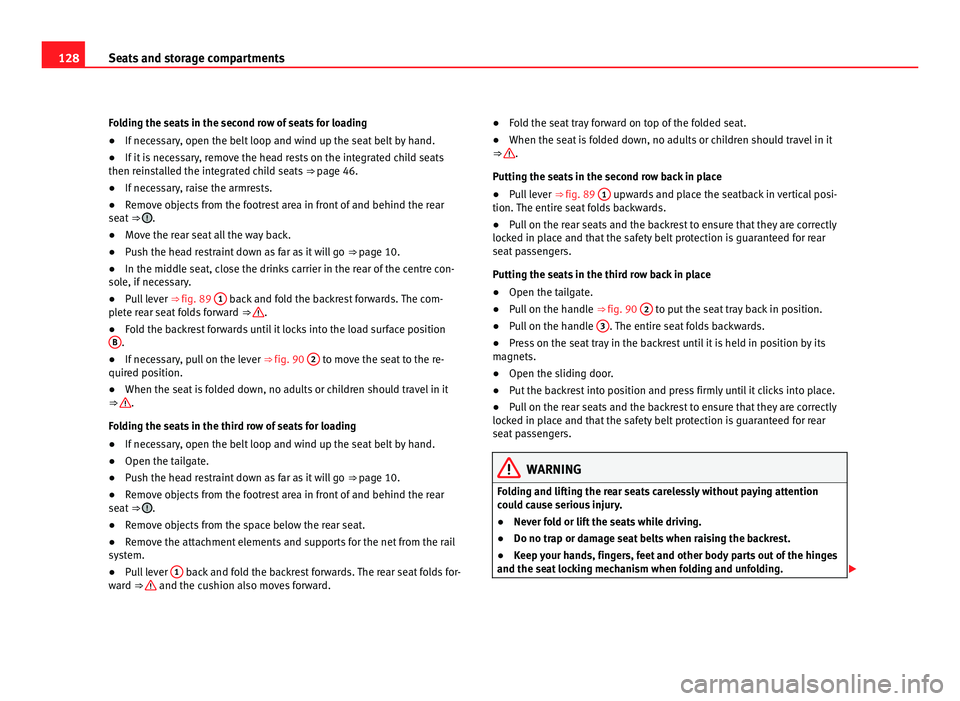
● Pull lever ⇒ fig. 89 1 back and fold the backrest forwards. The com-
pl et
e rear seat folds forward ⇒ .
● Fold the backrest forwards until it locks into the load surface position
B .
● If necessary, pull on the lever ⇒ fig. 90 2 to move the seat to the re-
quired po s
ition.
● When the seat is folded down, no adults or children should travel in it
⇒ .
Fo l
ding the seats in the third row of seats for loading
● If necessary, open the belt loop and wind up the seat belt by hand.
● Open the tailgate.
● Push the head restraint down as far as it will go ⇒ page 10.
● R
emove objects from the footrest area in front of and behind the rear
seat ⇒ .
● Remove objects from the space below the rear seat.
● Remove the attachment elements and supports for the net from the rail
sys t
em.
● Pull lever 1 back and fold the backrest forwards. The rear seat folds for-
war d
⇒ and the cushion also moves forward. ●
Fold the seat tray forward on top of the folded seat.
● When the se at
is folded down, no adults or children should travel in it
⇒ .
Puttin g the se
ats in the second row back in place
● Pull lever ⇒ fig. 89 1 upwards and place the seatback in vertical posi-
tion. The entir e se
at folds backwards.
● Pull on the rear seats and the backrest to ensure that they are correctly
locked in p
lace and that the safety belt protection is guaranteed for rear
seat passengers.
Putting the seats in the third row back in place
● Open the tailgate.
● Pull on the handle ⇒ fig. 90 2 to put the seat tray back in position.
● Pull on the handle 3 . The entire seat folds backwards.
● Press on the seat tray in the backrest until it is held in position by its
magnets.
● Open the s lidin
g door.
● Put the backrest into position and press firmly until it clicks into place.
● Pull on the rear seats and the backrest to ensure that they are correctly
locked in p
lace and that the safety belt protection is guaranteed for rear
seat passengers. WARNING
Folding and lifting the rear seats carelessly without paying attention
cou l
d cause serious injury.
● Never fold or lift the seats while driving.
● Do no trap or damage seat belts when raising the backrest.
● Keep your hands, fingers, feet and other body parts out of the hinges
and the seat loc
king mechanism when folding and unfolding.
Page 141 of 385
139
Seats and storage compartments
Additional information and warnings:
● Light ⇒ page 95
● Tr
ansporting ⇒ page 13
● E
cological driving ⇒ page 225
● Wheel
s and tyres ⇒ page 293
● A
ccessories, parts replacement, repairs and modifications ⇒ page 257WARNING
The risk of an accident is increased by transporting heavy or bulky loads
on the roof , whic
h affects the car's handling by shifting the centre of
gravity and increasing susceptibility to cross winds.
● Always secure loads correctly with suitable and undamaged attach-
ment rope or s
traps.
● Large, heavy, wide and flat loads negatively affect the vehicle aerody-
namics, c
entre of gravity and handling.
● Avoid brusque manoeuvres and sudden braking.
● Adjust your speed and driving style to visibility, road, traffic and
weather c
onditions. CAUTION
● Always remove the roof carrier system from the roof before entering a car
w a
sh.
● The height of your vehicle is changed by the installation of the roof carri-
er and the load sec
ured on it. Compare the vehicle height with the passage
height, for example in underground car parks or entering garage doors.
● The roof antenna, the range of the panoramic sliding roof and the tail-
gate shou
ld not be affected by the roof carrier system and the load being
transported.
● Take extra care not to let the tailgate strike the roof load when opening. For the sake of the environment
The vehicle uses more fuel when the roof carrier system is fitted.
Securing the base supports and roof carrier system Fig. 101 Attachment
points
f
or the basic sup-
port and the roof carrier
system.
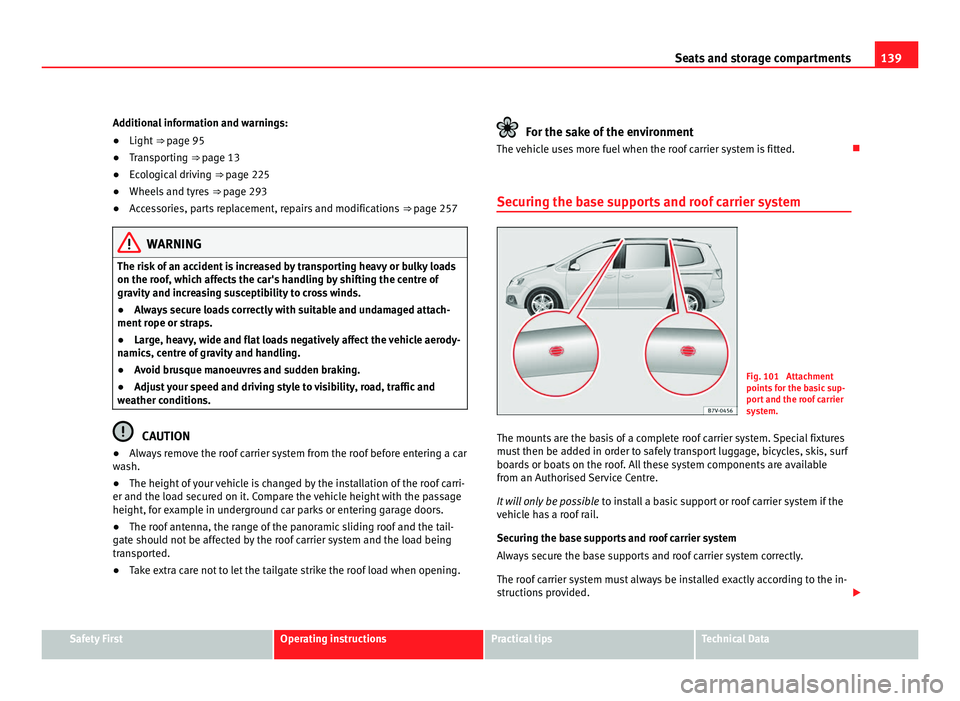
The mounts are the basis of a complete roof carrier system. Special fixtures
mus t
then be added in order to safely transport luggage, bicycles, skis, surf
boards or boats on the roof. All these system components are available
from an Authorised Service Centre.
It will only be possible to install a basic support or roof carrier system if the
vehicle has a roof rail.
Securing the base supports and roof carrier system
Always secure the base supports and roof carrier system correctly.
The roof carrier system must always be installed exactly according to the in-
structions provided. Safety First Operating instructions Practical tips Technical Data
Page 209 of 385
207
Driving
Rear Assist system*
Introduction The camera fitted to the tailgate helps drivers during parking or reversing
manoeu
vr
es. The camera image and certain orientation points generated by
the system are indicated on the factory-fitted radio or navigation system
screen.
Two types of location point (modes) can be selected:
● Mode 1: reverse parking perpendicular to the road (e.g. in a car park).
● Mode 2: r
everse parking parallel to the curb.
The mode can be c
hanged by pressing the button on the radio or navigation
system screen. Only the mode to which the points can be changed will be
displayed.
Additional information and warnings:
● Accessories, parts replacement, repairs and modifications ⇒ page 257WARNING
Use of the camera to calculate the distance from obstacles (people, vehi-
cl e
s, etc.) is inaccurate and may cause accidents and severe injuries.
● The camera lens expands and distorts the field of vision and displays
the obj
ects on the screen in a different, vague manner.
● Some objects may not be displayed or may not be very clear (e.g. very
thin post
s or fences), due to the resolution of the monitor or if the light is
dim.
● The camera has blind spots in which obstacles and people are not
regi
stered.
● Keep the camera lens clean and clear of snow and ice. Do not cover it. WARNING
The intelligent technology in the rear assist system cannot change the
limits impo
sed by the laws of physics and by the system itself. Careless
or uncontrolled use of the rear assist system may result in severe injuries
and accidents. The system is not a replacement for driver awareness.
● Adjust your speed and driving style to visibility, road, traffic and
weather c
onditions.
● Always keep a close eye on the area around the vehicle and always
look to
wards where you are parking. The display shows the path of the
rear end of the vehicle using the current steering angle. The front of the
vehicle turns more in comparison with the rear.
● Do not be distracted from the traffic when looking at the screen.
● Always observe the area around the vehicle, as the cameras do not al-
way
s detect children, animals or objects.
● The system might not show all areas clearly.
● Only use the rear assist system when the tailgate is completely
closed. CAUTION
● The camera only displays 2D images on the screen. Due to the lack of
depth, it might
be difficult or impossible to recognise protruding objects or
cracks in the road.
● The cameras may not always be able to detect objects such as thin rails,
fence
s, posts and trees, etc. This could result in damage to your car. Safety First Operating instructions Practical tips Technical Data
Page 211 of 385
209
Driving
Things to note 1) Do not use the rear assist system in the following cases:
– If there is a fault in the dynamic chassis control (DCC).
– If the image displayed is not very clear or reliable (low visibility or dirty
len
s). – If the space behind the vehicle cannot be clearly or completely recog-
nised.
– If the vehicle has been overloaded at the rear.
– If the driver is not familiar with the system.
– If the tailgate is open.
– If the position and installation angle of the camera have been changed,
e.g. in a r
e
ar-end collision. Have a specialised workshop check the system. 2) Optical illusions of the camera (examples)
The rear assist camera produces two-dimensional images. Any cracks in or
ob
j
ects protruding from the ground or from other vehicles are more diffi-
cult to spot or cannot be seen due to a lack of depth in the image dis-
played. Objects or other vehicles may seem to be closer or further away than what
they r
e
ally are: – On changing from a flat surface to a slope or gradient.
– On changing from a slope or gradient to a flat surface.
– If the vehicle has been overloaded at the rear.
– On approaching protruding objects. These objects may be outside the
angl
e of
vision of the camera when reversing. Cleaning the camera lens
Keep the c
amer
a lens clean and clear of snow and ice:
● Moisten the lens using a commercially available, alcohol-based glass
cle
aning agent and clean the lens with a dry cloth ⇒ .
● Remove snow using a small brush.
● Use de-icing spray to remove any ice ⇒ . CAUTION
● Never use abrasive cleaners to clean the camera lens.
● Nev er r
emove snow or ice from the camera lens using warm or hot water.
This c
ould damage the lens. Note
● SEAT recommends that you practise parking with the rear assist system
in a quiet loc
ation or in a car park to become familiar with the system, in-
cluding the orientation lines and their function.
● The orientation lines will not be displayed on the screen if the tailgate is
open or the factor
y-fitted towing bracket is electrically connected to a trailer.
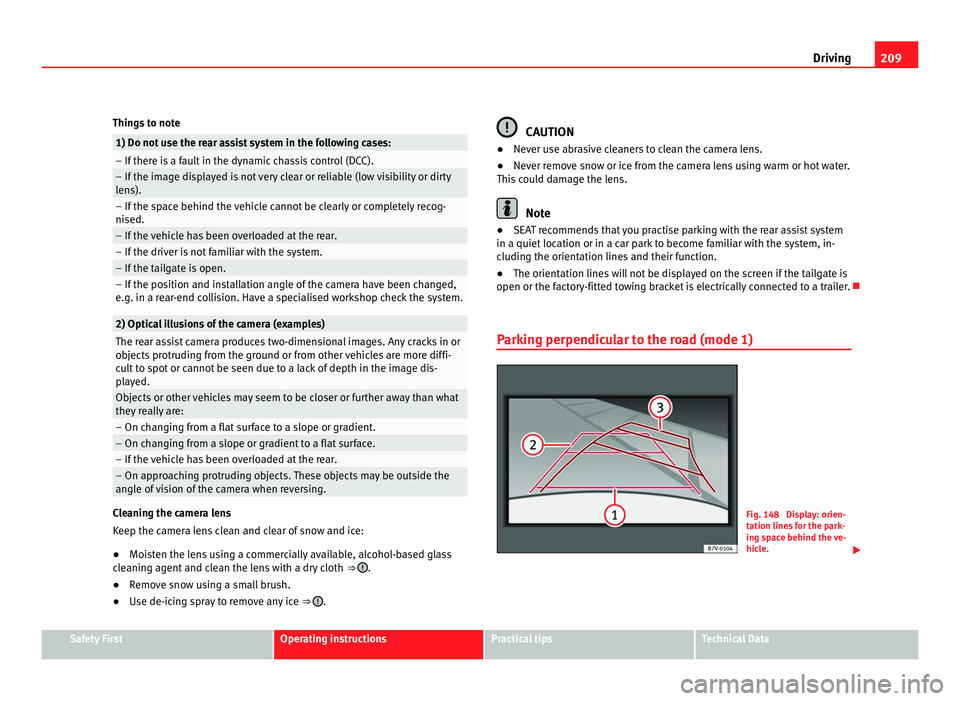
Parking perpendicular to the road (mode 1) Fig. 148 Display: orien-
tation line
s
for the park-
ing space behind the ve-
hicle. Safety First Operating instructions Practical tips Technical Data
Page 236 of 385
234
Trailer towing CAUTION
● If the rear lights of the trailer are not correctly connected, the vehicle
el ectr
onics may be damaged.
● If the trailer absorbs excessive electric current, the vehicle electronics
may
be damaged.
● Never connect the trailer's electric system to the electrical connections
of the re
ar lights or any other power sources. Only use suitable connections
for providing electric current to the trailer. Note
● Towing a trailer places additional demands on the vehicle. At SEAT, we
r ec
ommend additional services between the normal inspection intervals if
the vehicle is used frequently for towing a trailer.
● In some countries, an additional fire extinguisher is required if the trailer
weight i
s more than 2500 kg
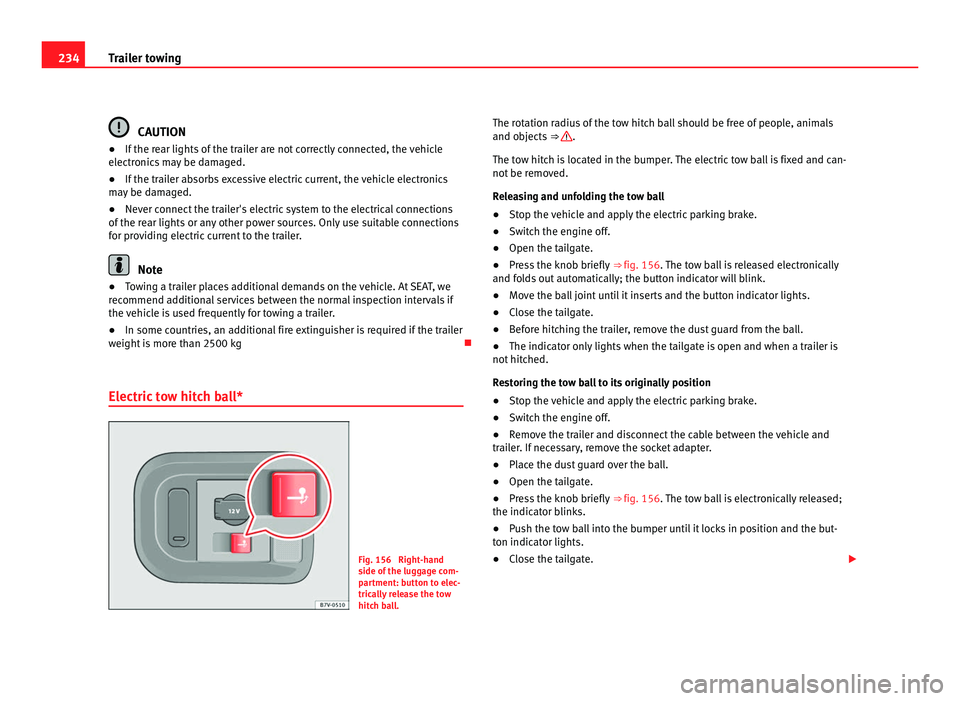
Electric tow hitch ball* Fig. 156 Right-hand
side of
the lug
gage com-
partment: button to elec-
trically release the tow
hitch ball. The rotation radius of the tow hitch ball should be free of people, animals
and obj
ects ⇒ .
The to w hit
ch is located in the bumper. The electric tow ball is fixed and can-
not be removed.
Releasing and unfolding the tow ball
● Stop the vehicle and apply the electric parking brake.
● Switch the engine off.
● Open the tailgate.
● Press the knob briefly ⇒ fig. 156. The to
w ball is released electronically
and folds out automatically; the button indicator will blink.
● Move the ball joint until it inserts and the button indicator lights.
● Close the tailgate.
● Before hitching the trailer, remove the dust guard from the ball.
● The indicator only lights when the tailgate is open and when a trailer is
not hitc
hed.
Restoring the tow ball to its originally position
● Stop the vehicle and apply the electric parking brake.
● Switch the engine off.
● Remove the trailer and disconnect the cable between the vehicle and
trail
er. If necessary, remove the socket adapter.
● Place the dust guard over the ball.
● Open the tailgate.
● Press the knob briefly ⇒ fig. 156. The to
w ball is electronically released;
the indicator blinks.
● Push the tow ball into the bumper until it locks in position and the but-
ton indicat
or lights.
● Close the tailgate.
Page 237 of 385
235
Trailer towing
The warning lamp
● When the indicator flashes , the t ow ball is not in its final position, has
not engaged or is damaged ⇒ .
● When the indicator remain s
lit and the tailgate is open, the tow ball has
inserted correctly into the folded or deployed position.
● When the tailgate is closed, the indicator is turned off. WARNING
The incorrect use of the tow hitch can cause accidents and injury.
● Ensure that no person, animal or object gets in the way of the tow
ba l
l.
● Never push the button when there is a trailer hitched or when any
kind of c
arrier or accessory is fitted to the tow hitch ball.
● While the ball is moving, do not interfere with any tool.
● Do not drive with a trailer if the indicator does not light.
● If there is a fault in the electric system or the trailer tow hitch, visit a
speci
alist workshop to have it checked.
● If the diameter of the tow hitch is less than 49 mm, never use this for
a trail
er. CAUTION
● If anything is attached to the tow hitch ball, do not, under any circum-
s t
ances press the button.
● Never direct a high-pressure or steam cleaning system directly at the
tow hit
ch ball or trailer power socket. This could cause damage to seals or
remove lubricating grease. Note
In extremely low temperatures, it is possible that the tow hitch is not re-
le a
sed. In this case, place the vehicle in a warmer location (for example, a
garage). Installing a bicycle carrier to the tow hitch The maximum load permitted for a bicycle carrier on the tow hitch ball is
75 kg
, w
ith a maximum distance of 300 mm from the support. The distance
between supports is the distance between the bicycle carrier centre of gravi-
ty (with the bicycles) and the centre of point of the tow hitch ball. WARNING
The incorrect use of the tow hitch with a bicycle carrier installed can
cau se ac
cidents and injury.
● Never exceed the load and distances between supports indicated.
● Never fit the bicycle carrier to the tow hitch ball neck, underneath the
tow hit
ch given that the bicycle carrier may be incorrectly fitted due to
the shape of the tow hitch and the model of bicycle carrier.
● Always read and take the manufacturer assembly instructions into ac-
count
. CAUTION
Exceeding the maximum load and distance between supports indicated can
cau se c
onsiderable damage to the vehicle.
● Never exceed the specifications.
Hitching and connecting the trailer Trailer cable
Alw
a
ys secure the trailer cable to the towing vehicle correctly. Leave a little
bit of slack in the cable for turning. However, ensure that the cable does not
rub off the ground while driving. Safety First Operating instructions Practical tips Technical Data
Page 245 of 385
243
Vehicle maintenance and cleaning
Washing the vehicle The longer substances such as insects, bird droppings, resinous tree sap,
ro
a
d dirt, industrial deposits, tar, soot or road salt and other aggressive ma-
terials remain on the vehicle, the more damage they do to the paintwork.
High temperatures (for instance due to strong sunlight) further intensify the
corrosive effect. The vehicle undercarriage should also be thoroughly wash-
ed at regular intervals.
Automatic car washes
Always observe the instructions provided at the automatic car wash. The
standard precautionary measures prior to entering the car wash should be
taken to avoid damage to the vehicle (close all windows, fold in exterior mir-
rors). If the vehicle is fitted with additional components (spoiler, roof-rack,
aerial...), check with the car wash supervisor whether these can enter the
car wash ⇒ .
The v ehic
le paintwork is so durable that the car can normally be washed
without problems in an automatic car washing tunnel. However, wear and
damage to the paintwork will depend on the type of car wash used. SEAT
recommends the use of car washed without brushes.
To remove traces of wax on windows and to prevent wiper blades from
scratching, please observe the following ⇒ page 245, Cleaning windows
and exterior mirrors.
Washing the car by hand
When washing the car by hand, use plenty of water to soften the dirt first,
and rinse off as well as possible.
Then clean the vehicle with a soft sponge, glove or brush using only slight
pressure. Start at the roof and work downwards. Special car shampoo
should only be used for very persistent dirt.
Rinse the sponge or glove thoroughly and often.
Wheels, sills and similar should be cleaned last. Use a second sponge for
this. WARNING
Sharp components on the vehicle may cause injury.
● Protect arms and hands from sharp edges when cleaning the vehicle
under c
arriage or the interior of the wheel hubs. WARNING
After the vehicle has been washed, the braking effect will be reduced
(and the brakin
g distance increased) due to moisture (and ice in winter)
on the brakes.
● Dry the brakes and remove ice by braking carefully. Ensure that you
are not end
angering other road-users or breaking traffic regulations in
the process. CAUTION
● The temperature of the water must not exceed +60°C (+140°F).
● To av
oid damage to the paintwork, do not wash the vehicle in full sun.
● Do not use rough sponges or similar which could damage the surface to
cle
an away the traces of insects.
● Never wipe the headlights with a dry cloth or sponge, always moisten
first
. It is best to use soapy water.
● Washing the vehicle in low temperatures: When washing the vehicle
with a hose, do not
direct water into the lock cylinders or the gaps around
the doors, tailgate, or sunroof. Locks and seals could freeze! CAUTION
To prevent damage to the vehicle, please observe the following before en-
terin g
an automatic car wash :
● Compare the distance between the vehicle wheels and the distance be-
tween the guide-rai
ls of the car wash to prevent damage to the wheels and
tyres! Safety First Operating instructions Practical tips Technical Data
Page 246 of 385
244
Vehicle maintenance and cleaning
● Switch off the rain sensor and the Auto Hold function before entering a
c ar w
ash.
● Compare the height and width of your vehicle with the available height
and width when enterin
g and driving through the car wash.
● Fold in exterior mirrors Electrically retractable exterior mirrors must NOT
be fol
ded in or out by hand. Always use the electrical power control.
● To avoid damaging the bonnet paintwork, rest the wipers on the wind-
scr
een after drying them. Do not let them fall!
● Lock the tailgate to prevent it from opening unexpectedly while inside
the car wa
sh.
Washing the vehicle with high pressure cleaning
equipment When cleaning the vehicle with a high-pressure cleaner, always follow the
operatin
g in
structions for the equipment. Pay special attention to the re-
quired pressure of the jet and the distance between the jet and the vehicle
⇒ .
Keep a s uit
able distance from soft materials, such as rubber hoses or insu-
lating material, and from the parking distance warning system sensors. The
parking distance sensors are fitted in the rear bumpers and, where applica-
ble, in the front bumpers ⇒ .
Do not u se a no
zzle that sprays the water out in a direct stream or one that
has a rotating jet for forcing off dirt ⇒ . WARNING
The incorrect use of high pressure cleaning equipment could result in
permanent d
amage, visible or invisible, to the tyres or other materials.
This could result in serious accident.
● Ensure there is a suitable distance between the nozzle and the tyres.
● Never wash tyres with a concentrated jet or so-called “dirt blasters”.
Even at
large spraying distances and short cleaning times, you may dam-
age the tyres. WARNING
After the vehicle has been washed, the braking effect will be reduced
(and the brakin
g distance increased) due to moisture (and ice in winter)
on the brakes.
● Dry the brakes and remove ice by braking carefully. Ensure that you
are not end
angering other road-users or breaking traffic regulations in
the process. CAUTION
● The temperature of the water must not be above +60°C (+140°F).
● To av
oid damage to the paintwork, do not wash the vehicle in full sun.
● The sensors on the bumpers should be kept clean and free of ice at all
times t
o ensure the parking distance warning system and the parking aid
system operate correctly. When cleaning with pressure hoses and steam
cleaners, the sensors should be sprayed only briefly. A distance of 10 cm
between the sensors and the steam / hose nozzle must be observed.
● Do not use a high pressure cleaner to remove ice or snow from windows
● Washing the vehicle in low temperatures: When washing the vehicle
with a hose, do not
direct water into the lock cylinders or the gaps around
the doors, tailgate, or sunroof. Locks and seals could freeze!
Page 266 of 385
264
Checking and refilling levels
Checking and refilling levels
Filling the tank
Introduction The fuel tank flap is on the rear right of the vehicle.
Addition
a
l information and warnings:
● Fuel ⇒ page 267
● Selectiv
e Catalytic Reduction (AdBlue) ⇒ page 271
● W
orking in the engine compartment ⇒ page 275WARNING
Refuelling or handling fuel carelessly can cause an explosion or fire re-
su ltin
g in serious burns and injuries.
● Always make sure that you correctly close the fuel cap to avoid evap-
oration and fuel
spillage.
● Fuels are highly explosive and inflammable substances that can
cause seriou
s burns and injuries.
● Fuel could leak out or be spilt if the engine is not switched off or if the
fill
er fuel nozzle is not fully inserted into the tank filler neck when refuel-
ling. This could lead to a fire, explosion and severe injuries.
● When refuelling, turn off the engine, the auxiliary heating
(⇒ page 163) and t
urn off the ignition for safety reasons.
● Always turn off mobile telephones, radio apparatus and other radio
wave emittin
g equipment before refuelling. Electromagnetic waves could
cause sparks and lead to a fire. WARNING (Continued)
● Nev er enter the vehicle while refuelling. If it is absolutely necessary
t o ent
er the vehicle, close the door and touch a metal surface before
touching the filler nozzle again. This will prevent the generation of static
electricity. Sparks could cause a fire when refuelling.
● Never handle fuel close to open flames, sparks or objects with slow
combu
stion (e.g. cigarettes).
● Avoid static electricity and electro-magnetic radiation when refuel-
ling.
● Ob
serve the safety regulations of the service station.
● Never spill fuel on the vehicle or in the luggage compartment. WARNING
For safety reasons, SEAT does not recommend carrying a spare fuel canis-
ter in the v
ehicle. Fuel could be spilled and catch fire, above all in case of
an accident and this applies to a full container as well as empty contain-
ers. This could lead to explosions, fires and injuries.
● Observe the following if you exceptionally have to carry fuel in a can-
ist
er:
– Never place a fuel container to fill it inside the vehicle or on the ve-
hicle, f
or example, in the luggage compartment or on the tailgate.
Filling in these circumstances could create an electrostatic charge
and spark that could ignite fuel fumes.
– Always place the canister on the ground to fill it.
– Insert the fuel nozzle into the mouth of the canister as far as possi-
ble.
Page 276 of 385
274
Checking and refilling levels
Opening the tank filling neck
● Open the tailgate.
● Rotate the shut off on the cover clockwise ⇒ fig. 164 and open the cov er
forwards.
● Unscrew the tank filler neck cap ⇒ fig. 165 1 anticlockwise.
Refi l
ling AdBlue
Only use AdBlue that is approved by SEAT and that complies with the
ISO 22241-1 Standard. Only use genuine bottles.
● Observe the instructions and information provided by the refill bottle
manufact
urer.
● Observe the expiry date.
● Unscrew the cap on the refill bottle.
● Place the refill bottle 2 upside down inside the tank filler neck.
● Press the refill bottle against the filler neck and keep in this position.
● Add at least 10 litres of AdBlue (6 bottles). A lower quantity
would be
insufficient.
● Wait until the contents of the refill bottle have been poured into the
AdBlue tank. Do not c
rush or damage the bottle!
● Unscrew the liquid bottle anticlockwise and remove it carefully ⇒ .
● You can tell when the AdBlue tank is full because the bottle will be emp-
ty.
C lo
sing the tank filling neck
● Screw on the tank filler neck cap 1 clockwise until it is fully inserted.
● Place the cover and turn the shut off anticlockwise to close it.
Operation s
before driving
● Only switch the ignition on after refilling.
● Keep the ignition sw
itch on for at least 30 seconds so that the system
detects t
ank refilling.
● Wait 30 seconds before starting the engine! WARNING
Only keep AdBlue in its original container, tightly shut and in a safe
pl ac
e.
● Never keep AdBlue in empty food cans, bottles or other containers to
avoid other peopl
e mistaking it for something else.
● Keep the AdBlue out of the reach of small children. CAUTION
● Only refill using AdBlue expressly approved by SEAT. The use of any oth-
er type of AdBlue c
ould cause engine damage!
● AdBlue should never be mixed with water or any other additives. Any
type of dam
age caused by a mixture will not be covered by the warranty.
● Do not add AdBlue to the diesel fuel tank! Otherwise you may damage
the engine.
● Never l
eave the refill bottle in the vehicle. It could become permeable
due to temper
ature changes and bottle damage and the AdBlue could dam-
age the vehicle interior. For the sake of the environment
Dispose of the refill bottle in an environment-friendly manner. Note
Suitable AdBlue refill bottles can be purchased from a Technical Service.