brake Seat Alhambra 2011 Workshop Manual
[x] Cancel search | Manufacturer: SEAT, Model Year: 2011, Model line: Alhambra, Model: Seat Alhambra 2011Pages: 385, PDF Size: 7.92 MB
Page 246 of 385
244
Vehicle maintenance and cleaning
● Switch off the rain sensor and the Auto Hold function before entering a
c ar w
ash.
● Compare the height and width of your vehicle with the available height
and width when enterin
g and driving through the car wash.
● Fold in exterior mirrors Electrically retractable exterior mirrors must NOT
be fol
ded in or out by hand. Always use the electrical power control.
● To avoid damaging the bonnet paintwork, rest the wipers on the wind-
scr
een after drying them. Do not let them fall!
● Lock the tailgate to prevent it from opening unexpectedly while inside
the car wa
sh.
Washing the vehicle with high pressure cleaning
equipment When cleaning the vehicle with a high-pressure cleaner, always follow the
operatin
g in
structions for the equipment. Pay special attention to the re-
quired pressure of the jet and the distance between the jet and the vehicle
⇒ .
Keep a s uit
able distance from soft materials, such as rubber hoses or insu-
lating material, and from the parking distance warning system sensors. The
parking distance sensors are fitted in the rear bumpers and, where applica-
ble, in the front bumpers ⇒ .
Do not u se a no
zzle that sprays the water out in a direct stream or one that
has a rotating jet for forcing off dirt ⇒ . WARNING
The incorrect use of high pressure cleaning equipment could result in
permanent d
amage, visible or invisible, to the tyres or other materials.
This could result in serious accident.
● Ensure there is a suitable distance between the nozzle and the tyres.
● Never wash tyres with a concentrated jet or so-called “dirt blasters”.
Even at
large spraying distances and short cleaning times, you may dam-
age the tyres. WARNING
After the vehicle has been washed, the braking effect will be reduced
(and the brakin
g distance increased) due to moisture (and ice in winter)
on the brakes.
● Dry the brakes and remove ice by braking carefully. Ensure that you
are not end
angering other road-users or breaking traffic regulations in
the process. CAUTION
● The temperature of the water must not be above +60°C (+140°F).
● To av
oid damage to the paintwork, do not wash the vehicle in full sun.
● The sensors on the bumpers should be kept clean and free of ice at all
times t
o ensure the parking distance warning system and the parking aid
system operate correctly. When cleaning with pressure hoses and steam
cleaners, the sensors should be sprayed only briefly. A distance of 10 cm
between the sensors and the steam / hose nozzle must be observed.
● Do not use a high pressure cleaner to remove ice or snow from windows
● Washing the vehicle in low temperatures: When washing the vehicle
with a hose, do not
direct water into the lock cylinders or the gaps around
the doors, tailgate, or sunroof. Locks and seals could freeze!
Page 250 of 385
248
Vehicle maintenance and cleaning
● Use a clean, damp, lint-free cloth to clean anodized surfaces.
● If ther
e is a lot of dirt, use a special cleaning product which does not
contain
solvents. CAUTION
To prevent damage to the anodized surfaces:
● Do not use products containing solvents.
● Do not use polish or hard wax.
● Do not use abrasive products.
● Do not polish anodized surfaces in sandy or dusty environments.
● Do not polish dirty surfaces.
Cleaning wheels Cleaning steel wheels
Use an indu
s
trial cleaner to remove brake dust. Therefore, clean wheels reg-
ularly with a separate sponge.
Any damage to the paint on steel wheels should be touched up before the
metal starts to rust.
Caring for and cleaning alloy wheels
Remove road salt and brake dust by washing the wheels approximately
once a fortnight. Use an acid free detergent to clean the wheel rims. SEAT
recommends treating the wheels thoroughly with a wax compound about
once every three months.
It is important to remove road salt and brake dust by washing the wheels at
regular intervals, otherwise the finish will be impaired.
Always use an acid-free detergent for alloy wheel rims. Car polish or other
abrasive agents should not be used. If the protective coating on the paint has been damaged (for example, hit by
a stone), it
should be repaired immediately.
Caring for rubber seals The rubber seals on doors, windows, etc., remain flexible, provide a better
seal
and l
ast longer if they are regularly treated with a product specifically
designed for use on rubber.
Before applying the product, use a soft cloth to remove dust and dirt from
the rubber seals.
De-icing the door lock cylinder To de-ice the lock cylinders, SEAT recommend the use of genuine SEAT spray
with lubric
atin
g and anti-corrosive properties. CAUTION
The use of products containing degreasing agents to de-ice the locks may
rus t
the lock cylinder.
Protection of vehicle undercarriage The vehicle underbody is coated to protect it from chemical and mechanical
dam
ag
e. The protective coat on the undercarriage may wear through use
while driving. Therefore, SEAT recommends that the protective coating on
the undercarriage and on the running gear should be regularly checked, and
repaired if necessary.
Page 269 of 385
267
Checking and refilling levels
Closing the tank cap
● Screw on the tank cap clockwise until it you hear it click into position.
● Press the tank flap until you hear it click into place. The tank flap must
be flush w ith the body
contour. WARNING
Do not continue refilling once the fuel nozzle has switched itself off. The
fuel t
ank may be filled too much. As a result, fuel may spurt out and spill.
This could lead to a fire, explosion and severe injuries. CAUTION
● Always remove any fuel spilled on the vehicle paintwork immediately to
av oid d
amage to the wheel housing, the tyre and vehicle paintwork. For the sake of the environment
Spilt fuel can contaminate the environment.
Refilling precautions Information on bulb replacement
⇒ pag
e 326.
Checklist
Never work on the engine or in the engine compartment if you are not famil-
iar with the operations to be carried out, the applicable safety standards
and especially if you do not have the instruments, liquids and tools neces-
sary ⇒ page 275, Working in the engine compartment! Have the work car-
ried out by a Technical Service if you are uncertain. Check the following reg-
ularly, preferably when you refuel:
● Windscreen washer fluid level ⇒ pag
e 105
● Engine oil level ⇒ pag
e 279 ●
Engine coolant level ⇒ p
age 283
● Brake fluid level ⇒ pag
e 183
● Tyre pressure ⇒ pag
e 293
● Vehicle lighting required to guarantee road safety:
Indicator
s
Side lights, dipped headlights and full beam headlights
Rear lights
Brake lights
Rear fog light ⇒ page 97 WARNING
Not following the checklist prepared for your own safety could lead to ac-
cident s
and severe injuries.
● Always follow the check list and perform the necessary operations.
Fuel Introduction You will find a factory-fitted sticker containing information on the type of
fuel
f
or your vehicle on the inside of the fuel tank flap.
Additional information and warnings:
● ⇒ Bookl et Maintenance Programme
● R
efuelling ⇒ pag e 264
● En
gine and exhaust system management ⇒ page 228
–
–
–
–
–
Safety First Operating instructions Practical tips Technical Data
Page 278 of 385
276
Checking and refilling levels WARNING (Continued)
● Onc e the engine has cooled, follow the instructions below before
openin g the bonnet:
– T
urn on the electronic parking brake and place the gear selector
lever in P or the g
ear stick in neutral.
– Remove the key from the ignition.
– Keep children away from the engine compartment and never leave
them uns
upervised.
● When the engine is warm or hot, the cooling system is pressurised!
Do not un
screw the cap on the expansion tank when the engine is hot.
Otherwise, coolant may spray out under pressure causing burns and seri-
ous injury.
–Carefully and slowly unscrew the cap anticlockwise, gently press-
ing down on it
.
– Always protect your face, hands and arms from hot coolant and
ste
am using a large, thick cloth.
● When refilling liquids, avoid spilling them on parts of the engine and
the exhau
st system. Spilled liquids could cause a fire. WARNING
The high voltages of the electrical system can give electric shocks as well
as c
ausing burns and serious injury and possibly even death!
● Never cause short circuits in the electrical system. The battery could
explode.
● T
o minimise the risk of electric shock and serious consequences
while the en
gine is running or starting the engine, note the following:
– Never touch the electrical wiring of the ignition system.
– Never touch electric cables or the gas discharge lamps. WARNING
In the engine compartment, there are rotating parts that could cause se-
rious injur
y.
● Never place your hands on or near the radiator fan. Touching the rotor
bla
des could seriously harm you. The ventilator works according to the
engine temperature and could start suddenly even when the ignition is
turned off and the key is removed.
● If any work has to be performed when the engine is started or with
the engine runnin
g, there is an additional, potentially fatal, safety risk
from the rotating parts, such as the drive belts, alternator, radiator fan
etc as well as from the high-voltage ignition system. Always work with
the utmost caution.
–Always make sure that no parts of your body, jewellery, ties, loose
clothing and lon
g hair can be trapped by the rotating parts of the en-
gine. Before any work, remove ties and jewellery ( necklaces, etc), tie
longhair back and tie all items of loose clothing to your body to make
sure that they cannot be trapped by engine components.
– Take extreme caution when operating the accelerator and remain
attentive.
The vehicle could move, even with the electronic parking
brake activated.
● Always make sure you have not left any objects, such as cloths or
tool
s, in the engine compartment. If any object is left in the engine com-
partment, this could cause malfunctions, engine faults and even a fire. WARNING
Refill liquids and certain materials can catch fire easily in the engine
comp ar
tment, causing a fire and serious injury!
● Never smoke.
● Never work close to places exposed to flames or sparks.
Page 279 of 385
277
Checking and refilling levels WARNING (Continued)
● Nev er pour service fluids over the engine. These fluid may ignite hot
en gine p
arts and cause injuries.
● If it is necessary to work on the fuel system or the electrical system,
ple
ase follow the instructions below:
– Always disconnect the vehicle battery. When disconnecting the
batter
y, ensure that the vehicle is unlocked otherwise the antitheft
alarm will be triggered.
– Never work close to heaters, heat sources or places exposed to
flames
or sparks.
● Always keep a recently serviced and perfectly working fire extin-
guisher clo
se by. CAUTION
When refilling or changing service liquids, ensure that you put the liquids
into the right t
ank. Making a mistake when refilling could cause serious
malfunctions and damage the engine! For the sake of the environment
Service fluids leaks are harmful to the environment. For this reason you
shoul d m
ake regular checks on the ground underneath your vehicle. Take
the vehicle to a specialist workshop to be checked if you see stains, oil or
other fluids on the ground. Collect any spilt service fluids and allow a pro-
fessional to dispose of them.
Preparing the vehicle for work in the engine compartment Checklist
Carr
y
out the operations below in the order indicated before starting work in
the engine compartment ⇒ : ●
Park the vehicle on an even and solid surface.
● Pre
ss and hold the brake pedal until the vehicle comes to a standstill.
● Connect the electronic parking brake ⇒ page 183.
● Mo
ve the selector lever to its intermediate position or to P ⇒ page 174.
● St
op the engine and remove the key from the ignition ⇒ page 170.
● W
ait for the engine to cool down.
● Always keep children and other people far from the engine compart-
ment.
● Ens
ure that the vehicle can not move off unexpectedly. WARNING
Ignoring this checklist, drawn up for your own safety, could result in seri-
ous injur
y.
● Always complete the operations given in the checklist and observe
the genera
l rules of safety.
Safety First Operating instructions Practical tips Technical Data
Page 289 of 385
287
Checking and refilling levels WARNING
Hot vapours and coolant can cause serious burns.
● Never open the coolant expansion tank if steam or coolant is coming
from the en gine c
ompartment. Wait until you cannot see or hear any
steam or coolant escaping.
● Always wait until the engine has completely cooled before very care-
ful
ly opening the expansion tank cap. Contact with hot elements of the
engine can cause skin burns.
● Once the engine has cooled, follow the instructions below before
opening the bonnet:
–Turn on the el
ectronic parking brake and place the gear selector
lever in P or the g
ear stick in neutral.
– Remove the key from the ignition.
– Keep children away from the engine compartment and never leave
them uns
upervised.
● When the engine is warm or hot, the cooling system is pressurised!
Do not un
screw the cap on the expansion tank when the engine is hot.
Otherwise, coolant may spray out under pressure causing burns and seri-
ous injury.
–Carefully and slowly unscrew the cap anticlockwise, gently press-
ing down on it
.
– Always protect your face, hands and arms from hot coolant and
ste
am using a large, thick cloth.
● When refilling liquids, avoid spilling them on parts of the engine and
the exhau
st system. Spilled liquids could cause a fire. Under specific cir-
cumstances, the ethylene glycol can catch fire. CAUTION
● Top up with distilled water only. Any other type of water may lead to con-
s ider
able rusting in the engine due to its chemical components. This could
consequently damage the engine. If you have not used distilled water but
another type of water to top up the coolant, a specialist workshop must im-
mediately replace all of the fluid in the engine cooling system.
● Only top up coolant to the top level of the marked area ⇒ fig. 171. Other-
wi
se the excess coolant will be forced out of the cooling system when the
engine is hot, causing damage.
● If a lot of liquid coolant has been lost, wait for the engine to cool do
wn
completely before adding coolant. Extensive coolant loss is an indication of
leaks in the engine cooling system. Have the engine cooling system inspec-
ted immediately by a Technical Service. Otherwise you may damage the en-
gine.
● When refilling or changing service liquids, ensure that you put the liq-
uids int
o the right tank. Making a mistake when refilling could cause seri-
ous malfunctions and damage the engine! Safety First Operating instructions Practical tips Technical Data
Page 295 of 385
293
Wheels and tyres
Wheels and tyres
Wheels
Introduction The SEAT Alhambra is equipped as standard with anti-puncture technology
tyr
e
s (Conti-Seal). In the event of a puncture or air leak of up to 5 mm, the
tyre seals the hole with a protective layer inside the tread.
SEAT recommend that all work on tyres and wheels is carried out by a Tech-
nical Service. They have the necessary special tools and replacement parts,
trained personnel and facilities for disposing of the old tyres. SEAT recom-
mends visiting a Technical Service.
Additional information and warnings:
● Transporting ⇒ page 13
● T
owing mode ⇒ page 233
● Br
aking, stopping and parking ⇒ page 183
● P
ark assist system ⇒ page 202
● T
yre control systems ⇒ page 221
● C
aring for and cleaning the vehicle exterior ⇒ page 242
● Wheel
trims ⇒ page 304
● Ch
ange wheel ⇒ page 305
● Not
es for the user ⇒ page 255 WARNING
The vehicle cannot be totally controlled or braked if the tyres (new or
used) ar e w
orn or damaged.
● Incorrect use of wheels and tyres could make driving more dangerous
and res
ult in serious accidents and damage.
● All four wheels must be fitted with radial tyres of the same type, size
(rol
ling circumference) and the same tread pattern.
● New tyres do not give maximum grip and will not have reached their
maximum br
aking capacity to start with, and therefore need running in.
To prevent accidents and major damage, extreme caution should be tak-
en for the first 600 km (370 miles).
● Check tyre pressures regularly and ensure they are maintained at the
pres
sures indicated. If the tyre pressure is too low, the tyres could over-
heat, resulting in tread detachment or even burst tyres.
● Never drive on damaged (punctured, cut, cracked or dented) or worn
tyre
s. Driving on damaged or worn tyres could result in burst tyres, seri-
ous accidents or damage. Worn or damaged tyres must be replaced im-
mediately.
● Never exceed the maximum permitted speed or loads specified for the
type of ty
re fitted on your vehicle.
● The efficiency of driver and brake assist systems also depends on the
grip of the tyr
es.
● If you notice unusual vibration or if the vehicle pulls to one side when
driving, s
top the car immediately and check the tyres and wheels for
damage.
● To minimise the risk of losing control of the vehicle or causing a seri-
ous ac
cident, never undo the bolted joints of beadlock wheels. Safety First Operating instructions Practical tips Technical Data
Page 297 of 385
295
Wheels and tyres
● Replace damaged or worn tyres as soon as possible ⇒ p age 299.
● Regularly check tyres for non-visible damage ⇒ page 299.
● Nev
er exceed the maximum permitted speed or loads specified for the
type of tyr
e fitted on your vehicle ⇒ page 302.
● Do not allow tyres to come into contact with aggressive substances,
grea
se, oil, fuel or brake fluid ⇒ .
● Lost valve caps should be replaced immediately.
Ty r
es with directional tread pattern
Tyres with directional tread pattern have been designed to operate best
when rotating in only one direction. An arrow on the tyre sidewall indicates
the direction of rotation on tyres with directional tread ⇒ page 302. Always
observe the direction of rotation indicated when mounting the wheel. This
guarantees optimum grip and helps to avoid aquaplaning, excessive noise
and wear.
If the tyre is mounted in the opposite direction of rotation, drive with ex-
treme caution, as the tyre is no longer being used correctly. This is of partic-
ular importance when the road surface is wet. Change the tyre as soon as
possible or remount it with the correct direction of rotation.
Interchanging tyres
To ensure that the wear is equal on all tyres the wheels should be changed
round from time to time according to the system ⇒ fig. 175. All the tyres will
then last for about the same time.
SEAT recommends you take the vehicle to a Technical Service to have the
tyres changed.
Tyres that are over 6 years old
Tyres are subject to an ageing process as a result of physical and chemical
processes. This may affect their performance. Tyres which are stored for
long periods of time without being used, harden and become more fragile
than tyres which are in constant use.
SEAT recommends that tyres over six years old are replaced with new tyres.
This also applies to tyres which appear to be in perfect condition on the out- side and which have a tread depth within the values stipulated by the Law
⇒ .
The dat e of
manufacture, part of the tyre identification number (TIN), indi-
cates the age of the tyre ⇒ page 302.
Storing tyres
Mark tyres when you remove them to indicate the direction of rotation (left,
right, forwards, backwards). This ensures you will be able to mount them
correctly when you replace them. When removed, the wheels and/or tyres
should be stored in a cool, dry and preferably dark location. Do not place
tyres mounted on the wheel in a vertical position.
Protect tyres not mounted on wheels from dirt by storing them in suitable
bags and standing them on the ground on their tread. WARNING
Aggressive fluids or substances could result in visible or invisible dam-
age w ith the c
onsequent risks.
● Always ensure that tyres do not come into contact with chemical
products, oi
l, grease, fuel, brake fluid or other aggressive substances. WARNING
Old tyres, even if they have never been used, may lose air or burst unex-
pectedly whi
le driving, resulting in serious accident or damage.
● If tyres are over six years old, they should only be used in an emer-
gency and w
ith extreme caution. For the sake of the environment
Old tyres must be disposed of by qualified personnel according to the laws
in the cou ntr
y concerned. Safety First Operating instructions Practical tips Technical Data
Page 298 of 385
296
Wheels and tyres
Wheel rims The design of wheel bolts is matched to the rims. If different rims are fitted,
the corr
ect
wheel bolts with the right length and correctly shaped bolt
heads must be used. This ensures that wheels are fitted securely and that
the brake system functions correctly ⇒ page 305.
For technical reasons, it is not generally possible to use the wheels from
other vehicles. In some cases, this may also be true for the same model of
wheel.
The tyres and rims approved by SEAT are specially matched to the character-
istics of the vehicle and are critical to good road holding and safe handling.
Wheel bolts
Wheel bolts must be tightened to the correct torque ⇒ page 305.
Beadlock wheel rims
Beadlock wheel rims have various components. These are joined together
by special bolts using a special procedure. This ensures good performance,
a better seal, improved safety and wheel run out. Therefore, worn rims
should always be replaced and must only be repaired in a Technical Service.
SEAT recommends visiting a Technical Service ⇒ .
Wheel rims w
ith bolted trims
Wheel rims may be fitted with interchangeable trim parts which are attach-
ed to the rim using self-locking bolts. Worn trims should only be replaced at
a Technical Service. SEAT recommends visiting a Technical Service ⇒ .
WARNING
The use of worn or damaged wheel rims could make driving more danger-
ous and r
esult in serious accidents and damage.
● Only wheel rims which have been approved for use with your vehicle
should be u
sed.
● Inspect wheel rims regularly for damage and replace as required. WARNING
If the bolted joints of wheel rims with bolted ring trims are not correctly
tightened or loo sened, thi
s could result in serious accident.
● Never loosen the bolted joints of wheel rims with bolted ring trims.
● Any work relating to wheel rims with bolted rims should be carried
out at qua
lified workshop. SEAT recommends visiting a Technical Service.
Replacement of new tyres and wheel rims New tyres
●
When tyres are new, drive with extreme caution for the first 500 km
(310 mil e
s), as all tyres need to be run-in. Tyres which have not been run-in
do not have such good grip ⇒ or braking capacity
⇒ .
● All four wheels must be fitted with radial tyres of the same type, size
(ro l
ling circumference) and the same tread pattern.
● The tread depth of new tyres may vary, according to the type and make
of tyr
e and the tread pattern.
Replacing tyres
● Where possible, always replace both wheels on an axle (both wheels on
the front ax
le or both wheels on the rear axle) ⇒ .
● Old tyres should only be replaced by SEAT approved tyres for the vehicle
in ques tion, and in ac
cordance with the maximum permitted size, diameter,
load and speed capacity.
● Never use tyres which are larger than SEAT approved tyres. If the tyres
are too b
ig, they may knock or rub against the chassis or other components,
resulting in damage.
Page 299 of 385
297
Wheels and tyres WARNING
New tyres do not give maximum grip and will not have reached their max-
imum brak in
g capacity to start with, and therefore need running in.
● To prevent accidents and major damage, extreme caution should be
taken f
or the first 600 km (370 miles). WARNING
There should be adequate space between the tyres and the vehicle in ac-
cord
ance with the vehicle design. If this is not the case, the tyres may
rub against parts of the running gear, chassis or brake lines, leading to
faults in the brake system or to tread detachment, and the risk of burst
tyres.
● The true tyre dimension should not be greater than the dimensions of
tyre
s manufactured and approved by SEAT and should not rub against
parts of the vehicle. Note
● Although tyres may be shown as being the same size, the true dimen-
s ion
s of different types of tyre may vary with respect to the nominal size, or
tread patterns may be different.
● If you use tyres that are approved by SEAT, you can be sure that the true
tyre dimen
sions will be correct for your vehicle. For other tyre models, the
tyre vendor should provide the manufacturer's certificate with the tyre, indi-
cating that this type of tyre is suitable for your vehicle. This certificate
should always be carried with the vehicle. Tyre pressures
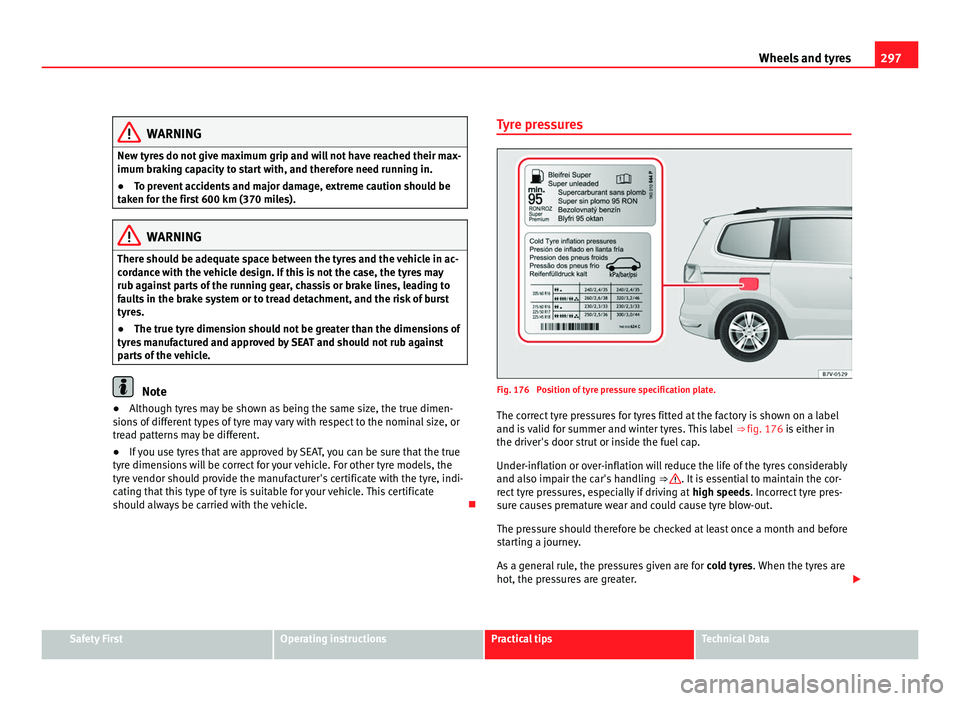
Fig. 176 Position of tyre pressure specification plate.
The corr ect
tyre pressures for tyres fitted at the factory is shown on a label
and is valid for summer and winter tyres. This label ⇒ fig. 176 is either in
the driver's door strut or inside the fuel cap.
Under-inflation or over-inflation will reduce the life of the tyres considerably
and also impair the car's handling ⇒ . It is essential to maintain the cor-
rect ty
re pressures, especially if driving at high speeds. Incorrect tyre pres-
sure causes premature wear and could cause tyre blow-out.
The pressure should therefore be checked at least once a month and before
starting a journey.
As a general rule, the pressures given are for cold tyres. When the tyres are
hot, the pressures are greater. Safety First Operating instructions Practical tips Technical Data